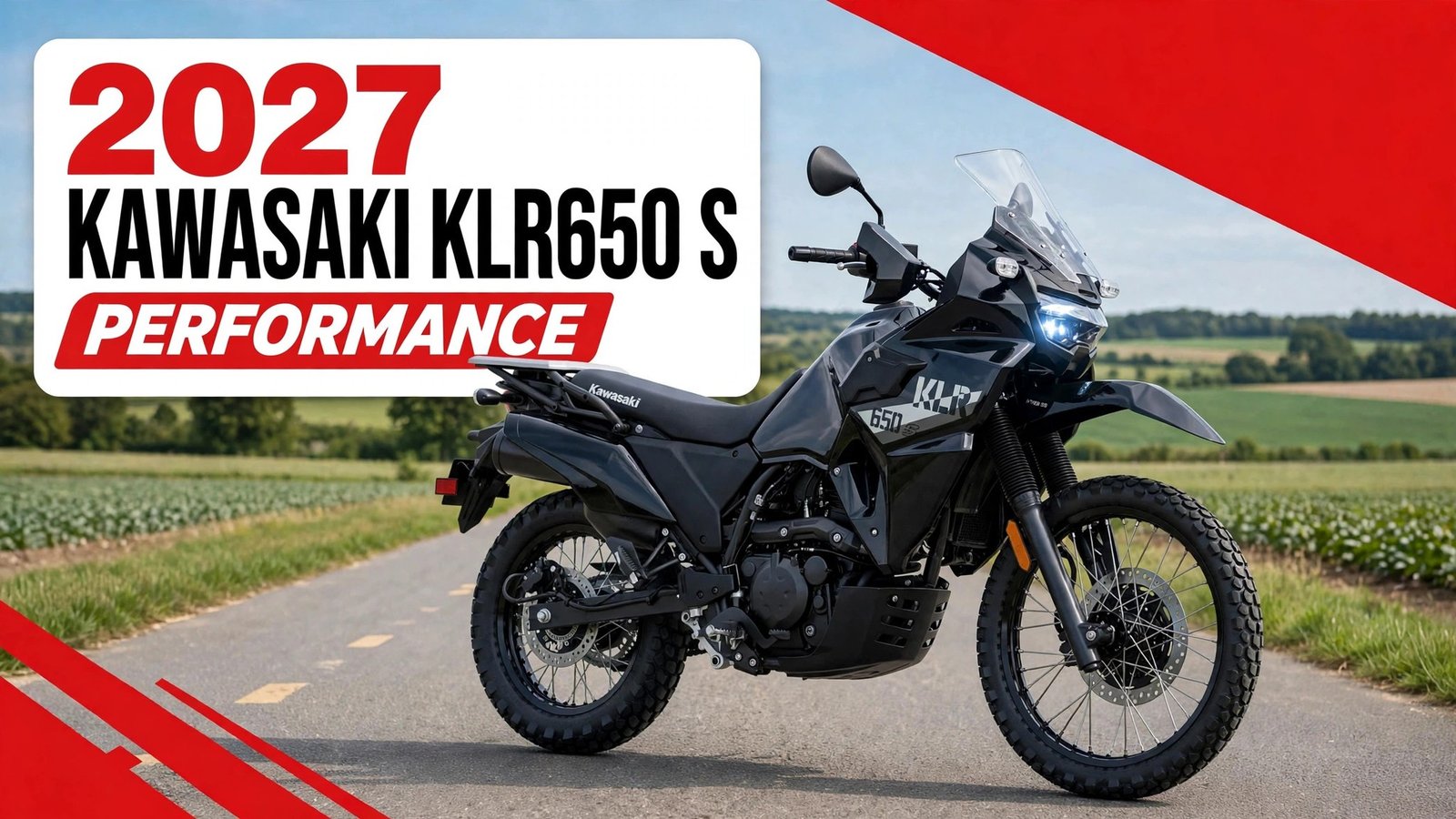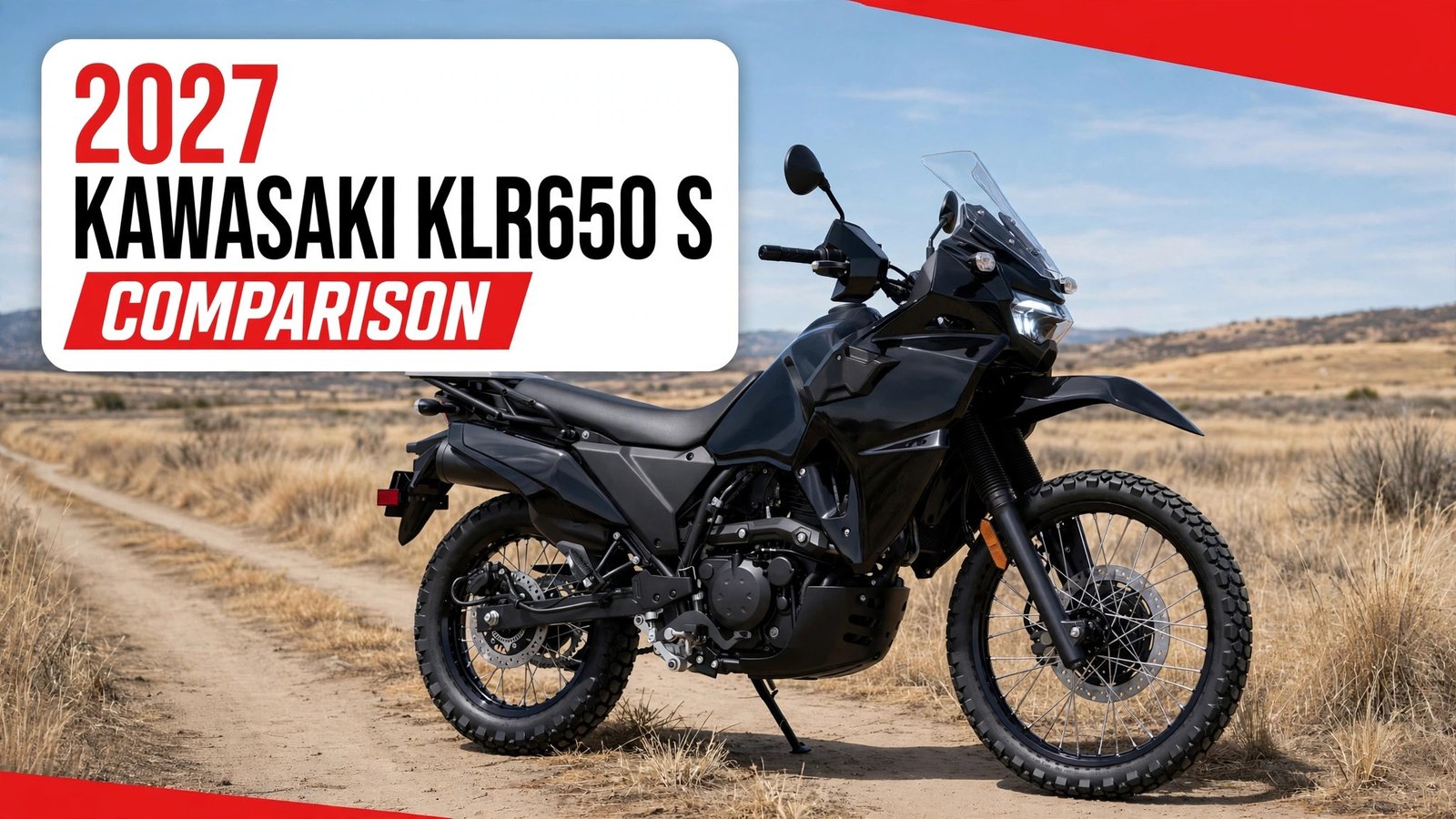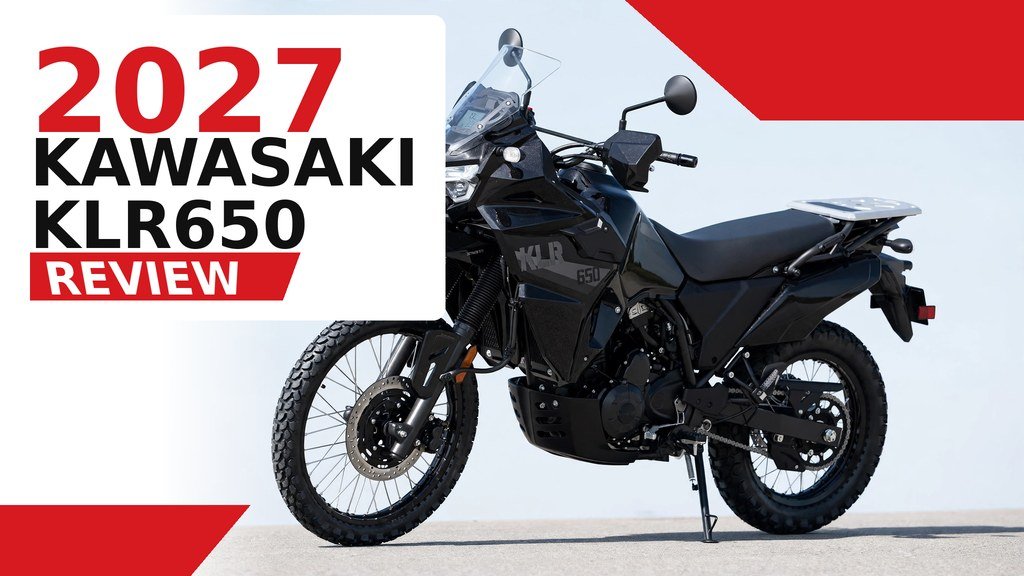
The Kawasaki KLR650 is back where it has always belonged: at the cheap end of the adventure bike market. This Kawasaki KLR650 review looks at the third-generation bike. The short answer is yes, it still makes sense in 2027: the 652cc single makes a published 40 hp, the 6.1-gallon tank delivers close to 300 miles, and the base price undercuts every Japanese rival except the Honda XR650L.
This Kawasaki KLR650 review covers the full 2027 lineup. Kawasaki publishes 40 hp at 6,000 rpm with an ISO 4106 footnote, and dyno runs put 34.6 to 36.9 hp at the rear wheel. There is no tachometer, no traction control, no ride modes, and no cruise control. ABS is the only rider aid, and it costs $300 extra on the base bike.
Kawasaki KLR650 Overview and Model-Year Updates
The third-generation KLR650 is a 2022 motorcycle, updated in small steps since. This Kawasaki KLR650 review starts with the overview because the model-year story explains most of the buying decision: the bike you can buy new today is a fuel-injected, LED-lit version of a motorcycle that first appeared in 1987.
Rider Magazine tested the 2022 Adventure trim at launch, and its video review is the best single introduction to the motorcycle. The film below is Rider Magazine’s full review of the exact US 2022 KLR650 Adventure, with the 21-litre side cases, auxiliary lights, and frame sliders fitted.
Killed in 2018, Reborn With Fuel Injection
Kawasaki ended the second-generation KLR650 after 2018, and the nameplate did not exist for three years. The old bike had a carburettor that could not carry it into the 2020s. When the KLR650 returned for 2022, this Kawasaki KLR650 review notes the changes were real: fuel injection, a stiffer frame, bigger brakes, LED lighting.
The 2022 bike kept the 6.1-gallon tank, the 34.3-inch seat, the five-speed gearbox, and the basic, repairable layout that made the old bike popular. Since then the updates have been trims: the S trim arrived for 2023, the Traveler came and went. For 2027, the new DF ABS trim adds frame sliders, hand guards, and a taller screen at $7,699.
Still Five Gears, Still No Tachometer
The five-speed gearbox is the most old-fashioned thing about the new bike. First gear is tall enough that slow technical work needs clutch slip, while fifth gear lets the bike cruise at 70 to 75 mph. Testers split on highway vibration, with Cycle News noting buzz at speed and Rider Magazine reporting very little. This Kawasaki KLR650 review treats the comfortable cruising speed as 70 to 75 mph.
The missing tachometer is the other deliberate omission. The all-digital dash shows speed, fuel level, trip meters, and a clock, but no rev counter. Riders shift by ear and by feel, which is how KLR650 owners have always done it. The dash at least adds the fuel gauge the old bike lacked.
Kawasaki KLR650 Engine and Specifications
The engine is a 652cc liquid-cooled single with double overhead cams and four valves. This Kawasaki KLR650 review treats the engine as a known quantity: a big, understressed single that makes modest power. Kawasaki publishes 40 hp at 6,000 rpm and 39.1 lb-ft at 4,500 rpm, and the power figure carries an ISO 4106 footnote.
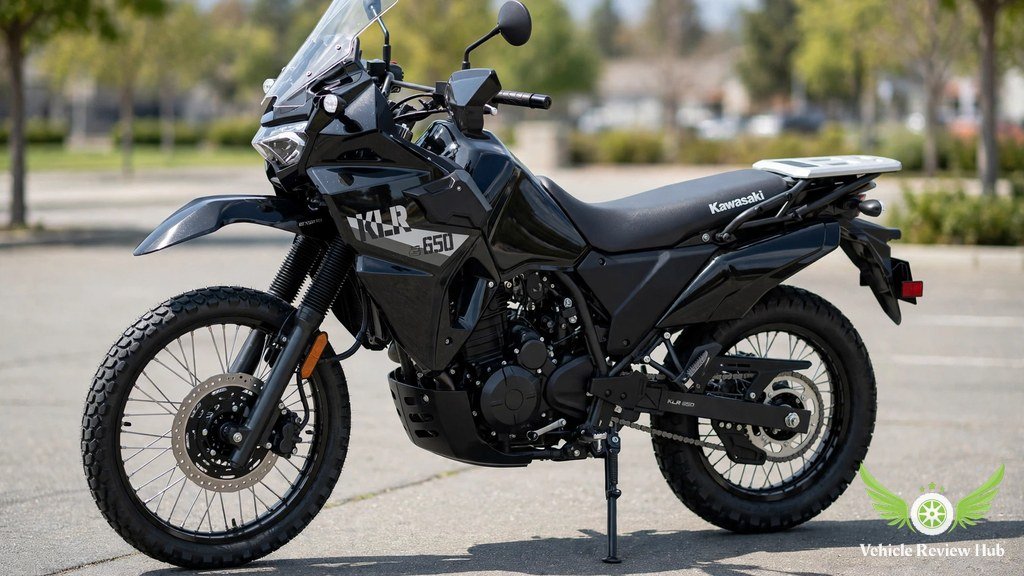
652cc Single, 100 by 83 Millimetres
The 100.0 by 83.0 mm bore and stroke make the KLR650 an oversquare single. The tuning is relaxed: peak power arrives at 6,000 rpm and peak torque at 4,500 rpm. This Kawasaki KLR650 review notes the liquid cooling keeps temperatures stable in slow traffic and on long climbs.
The single-cylinder layout leaves the spark plug, the oil filter, and the valve cover easy to reach. The owner’s manual calls for a valve clearance inspection every 15,000 miles and oil changes every 7,500 miles, although the 2009 service manual lists 6,000 miles.
Kawasaki Publishes 40 Horsepower Now
Kawasaki publishes 40 hp, a crank claim measured to the ISO 4106 standard. At the rear wheel, Cycle World measured 34.61 hp at 5,910 rpm on a 2022 Adventure, Rider Magazine measured 36.5 hp at 6,100 rpm on the same bike, and Cycle World measured 36.9 hp on a 2023 S. This Kawasaki KLR650 review presents all three runs with their sources.
What matters more than the peak figure is where the power lives. The torque peak of 39.1 lb-ft at 4,500 rpm means the bike pulls cleanly from low revs. Cycle World recorded 33.52 lb-ft at the wheel. The “42 hp” number on aggregator sites is not a Kawasaki figure.
| Specification | 2027 Kawasaki KLR650 |
|---|---|
| Engine | 652cc liquid-cooled single, DOHC, 4-valve |
| Bore x stroke | 100.0 x 83.0 mm |
| Compression ratio | 9.8:1 |
| Claimed power | 40 hp @ 6,000 rpm (ISO 4106 footnote) |
| Claimed torque | 39.1 lb-ft @ 4,500 rpm (53 Nm) |
| Fueling | Digital fuel injection, 40 mm throttle body |
| Gearbox | 5-speed return shift, wet multi-disc clutch |
| Curb weight | 456.2 lb (non-ABS) / 460.6 lb (ABS) |
| Seat height | 34.3 in (standard) / 32.1 in (S) |
| Fuel capacity | 6.1 gal |
| Wheelbase | 60.6 in |
| Ground clearance | 8.3 in |
| Front suspension | 41 mm telescopic fork, 7.9 in travel |
| Rear suspension | Uni-Trak single shock, 8.0 in travel (Kawasaki sheet) |
| Brakes | 300 mm front disc, 240 mm rear disc, ABS |
| Wheels | 21 in front / 18 in rear |
| Warranty | 12 months limited |
Notes for this Kawasaki KLR650 review specification table: power is Kawasaki’s claimed crank figure with the ISO 4106 footnote, and rear-wheel dyno figures are lower (34.61 hp Cycle World 2022 Adventure, 36.5 hp Rider Magazine 2022 Adventure, 36.9 hp Cycle World 2023 S). Kawasaki names no caliper brand.
Kawasaki KLR650 Price and Market Availability
Price is the KLR650’s strongest argument. The 2027 base model lists at $6,999 before destination, and with the $685 destination charge the delivered price is $7,684. This Kawasaki KLR650 review lists the ABS model at $7,299, or $7,984 delivered. The new DF ABS trim is $7,699 before destination, or $8,384 delivered, and the Adventure ABS tops the range at $8,199, or $8,884 delivered. Kawasaki USA’s KLR650 page lists the full range.
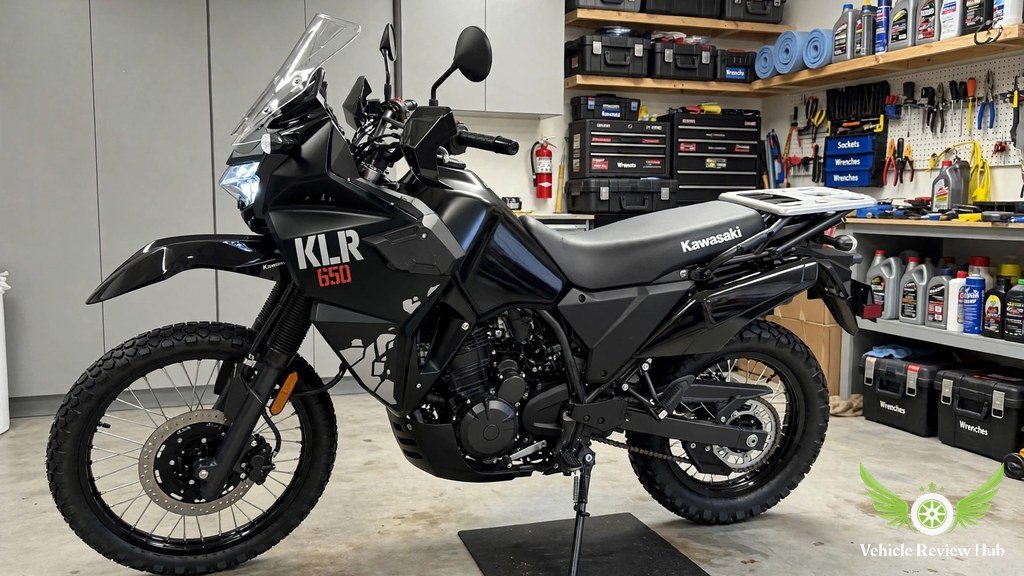
Kawasaki KLR650 Price in the USA: $6,999
The $6,999 figure is the 2027 and 2026 base-model MSRP. The base bike cost $6,699 in 2022 and $6,899 in 2023 and 2024. The Adventure trim rose from $7,999 in 2022 to $8,199 in 2027. The delivered figures in this Kawasaki KLR650 review are MSRP plus destination only, before tax, title, and dealer fees.
The base bike has no ABS and no side cases. The S trim lowers the seat from 34.3 inches to 32.1 inches. This Kawasaki KLR650 review notes the DF ABS is new for 2027 with frame sliders, hand guards, and a taller screen, while the Adventure ABS adds 21-litre side cases, auxiliary lights, frame sliders, a tank pad, and a DC socket.
The 2025 prices need a note because Kawasaki priced that year by colour. Cycle World’s 2025 model page lists the base and S models at $6,899 to $6,949 without ABS and $7,199 to $7,249 with ABS, green at the lower figure and white at the higher. The Adventure ABS was $8,099 in blue and $8,199 in camo.
Destination Is $685, Not $450
Destination charges are where KLR650 prices move. The destination charge was $435 in 2022 and 2023, $450 in 2024, and $685 in 2026 and 2027. The 2025 figure is $665, based on two Motorcycle.com compare pages and six dealer listings that state a $665.00 destination fee for 2025 models. One newer-crawled Motorcycle.com page now shows $685 for the same 2025 models, so this Kawasaki KLR650 review uses $665 for 2025 and notes the split.
The Suzuki DR650S carries a $600 destination charge on a $7,299 MSRP, for $7,899 delivered, so the base KLR650 undercuts it by $215 delivered while the ABS KLR650 costs $85 more. The Honda XR650L is $85 cheaper than the base KLR650 at $7,599 delivered. Our DR650S review covers the closest rival in full.
| Model year | Trim | MSRP | Destination | Delivered |
|---|---|---|---|---|
| 2022 | Base / ABS / Traveler ABS / Adventure ABS | $6,699 / $6,999 / $7,399 / $7,999 | $435 | $7,134 / $7,434 / $7,834 / $8,434 |
| 2023 | Base / ABS / Traveler ABS / Adventure ABS | $6,899 / $7,199 / $7,599 / $8,199 | $435 | $7,334 / $7,634 / $8,034 / $8,634 |
| 2024 | Base / S / ABS / Adventure ABS | $6,899 / $7,199 / $8,199 | $450 | $7,349 / $7,649 / $8,649 |
| 2025 | Base / S / ABS / Adventure ABS | $6,899-$6,949 / $7,199-$7,249 / $8,099-$8,199 | $665 | $7,564-$7,614 / $7,864-$7,914 / $8,764-$8,864 |
| 2026 | Base / S / ABS / Adventure ABS | $6,999 / $7,299 / $8,199 | $685 | $7,684 / $7,984 / $8,884 |
| 2027 | Base / S / ABS / DF ABS / Adventure ABS | $6,999 / $7,299 / $7,699 / $8,199 ($8,299 camo) | $685 | $7,684 / $7,984 / $8,384 / $8,884 ($8,984 camo) |
Notes for this Kawasaki KLR650 review price table: delivered prices are MSRP plus destination for the year shown, before tax, title, and dealer fees. The 2025 MSRP ranges are by colour, per Cycle World: green $6,899 and white $6,949 for the base and S without ABS, green $7,199 and white $7,249 with ABS, blue $8,099 and camo $8,199 for the Adventure.
Kawasaki KLR650 Design, Features and Technology
This Kawasaki KLR650 review treats the design as practical choices: a tall two-position adjustable windscreen, an LED headlight, a large aluminium rear carrier on every trim, and a digital dash that finally includes a fuel gauge. The 21-inch front wheel and 18-inch rear wheel wear Dunlop K750-style dual-sport tyres.

ABS Is the Only Rider Aid Listed
ABS is the only electronic rider aid Kawasaki lists for the KLR650, a $300 option on the base and S models and standard on the Adventure and DF trims. This Kawasaki KLR650 review notes the ABS cannot be switched off from the dash: the only ways to disable it are pulling the fuse or fitting an aftermarket kill switch.
Everything else on the bike is mechanical. The throttle is cable-operated, the clutch is a wet multi-disc unit, and the suspension is a 41 mm telescopic fork with 7.9 inches of travel up front and a Uni-Trak single shock with adjustable rebound and preload at the rear. The rear shock carries 8.0 inches of travel on the current Kawasaki sheet, although some third-party listings still print the 7.3-inch second-generation figure.
Traveler Trim Ended After 2023
The Traveler trim lasted two model years, 2022 and 2023, and then disappeared. It was an ABS model with a top case and a tank bag added, for riders who wanted luggage without the Adventure trim. Cycle World’s 2024 model coverage lists no Traveler, and Kawasaki’s current pages offer the base, S, ABS, DF ABS, and Adventure ABS trims only.
Kawasaki KLR650 Riding Experience and Comfort
Riding the KLR650 is an exercise in modest expectations met well. This Kawasaki KLR650 review finds the bike at its best on back roads, gravel, and long highway stretches at legal speeds, and at its weakest when asked to hurry. The 652cc single pulls cleanly from low revs, and the upright riding position keeps wind off the chest.

300-Mile Range Is the Party Trick
The 6.1-gallon tank is the KLR650’s party trick. Cycle News measured 49 mpg on a mostly paved ride home to California and came close to 300 miles on a tank, while Rider Magazine recorded 47 mpg and estimated 287 miles of range. This Kawasaki KLR650 review notes Fuelly owner data averages 48.56 mpg, roughly 300 miles on the full tank, labelled as owner-reported data.
Range changes how the bike gets used. A 300-mile tank means crossing a state on back roads without planning fuel stops. The digital dash finally includes a fuel gauge. Compared with the smaller tank on our Versys 650 review, which carries 5.5 gallons, the KLR650 trades speed for distance.
Built in Thailand, Sold Everywhere
The KLR650 is built by Kawasaki Motors Enterprise in Thailand, per Kawasaki’s own NHTSA defect correspondence, and sold in the United States, Canada, Europe, Australia, and much of Asia. The Thai build is not a quality compromise: fit and finish are consistently praised in road tests, and the global production run keeps parts cheap and widely available.
Kawasaki KLR650 Review: Pros, Cons and Verdict
The verdict on the KLR650 has not changed in 38 years: it is the best cheap way to ride a long way on any road. This Kawasaki KLR650 review prices the 2027 bike at $7,684 delivered in base form, and it returns close to 300 miles per tank. It is also slow, basic, and short on modern equipment, and buyers who want power or electronics should look elsewhere.
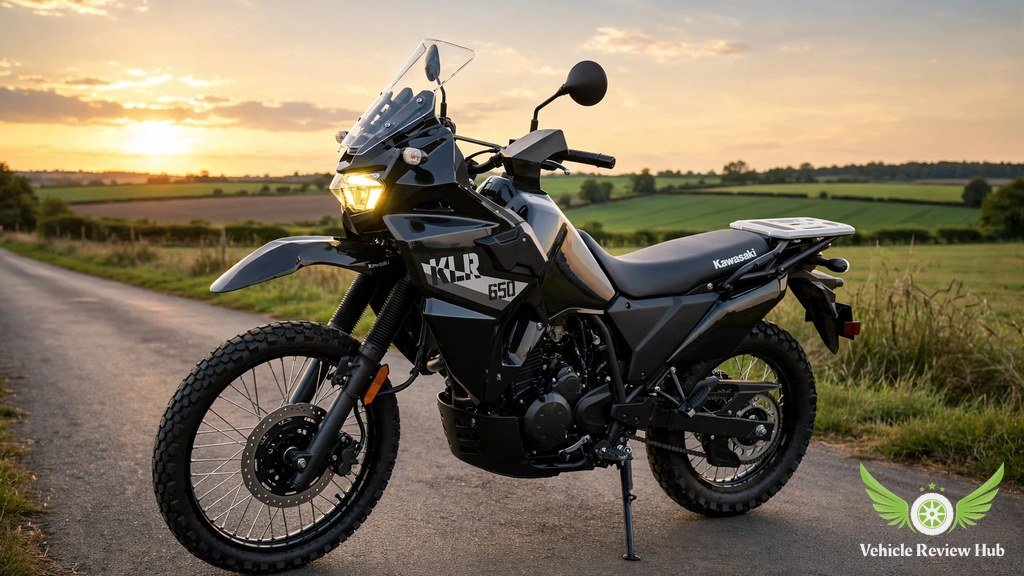
Main Advantages and Limitations of the Kawasaki KLR650
This Kawasaki KLR650 review starts the advantages with price and range and ends with simplicity. The base bike undercuts the Suzuki DR650S by $215 delivered, the 6.1-gallon tank delivers nearly 300 miles, and the single-cylinder engine is cheap to service with a valve check only every 15,000 miles.
The limitations are equally clear. Forty horsepower is modest for a 456-pound motorcycle, and the bike feels slow next to any modern twin. There is no tachometer, no traction control, no riding modes, and no cruise control. The seat height of 34.3 inches is tall for shorter riders.
| Advantages | Limitations |
|---|---|
| $6,999 base MSRP, $7,684 delivered for 2027 | 40 hp is modest for a 456 lb motorcycle |
| 6.1-gal tank, close to 300 miles of range | No tachometer, no traction control, no riding modes |
| Simple, repairable single-cylinder engine | ABS cannot be switched off from the dash |
| Valve check only every 15,000 miles | Five speeds, no sixth gear for highway cruising |
| Huge aftermarket and global parts support | 34.3 in seat is tall; S trim drops it to 32.1 in |
| Adventure trim arrives ready for touring | 12-month warranty is short next to bigger Kawasakis |
Notes for this Kawasaki KLR650 review pros and cons table: delivered prices are MSRP plus destination for the year shown, before tax, title, and dealer fees. The 456 lb curb weight is the non-ABS figure; the ABS model is 460.6 lb. The 12-month warranty is the US limited warranty.
12 Month Limited Warranty
The KLR650 carries a 12-month limited warranty in the United States, the shortest cover in Kawasaki’s adventure range. The Versys 650 carries the same 12 months on the base bike, but the LT trim gets 24 months, and the Versys 1100 SE LT ABS review shows the bigger tourer with a full 24-month limited warranty. Kawasaki Protection Plus extended cover is available in 12, 24, 36, and 48-month terms.
Buy the base bike if the budget is tight and the riding is mixed road and dirt. Buy the ABS model if the bike will see regular road use in traffic, because $300 is cheap insurance. Buy the Adventure ABS for touring, because the side cases, auxiliary lights, and DC socket cost far more as accessories than as factory equipment. For everyone else, this Kawasaki KLR650 review ends where it started: the bike is slow, basic, and honest, and at $6,999 it remains the cheapest honest adventure motorcycle on sale in America.
Kawasaki KLR650 Review: Frequently Asked Questions
Direct answers to the Kawasaki KLR650 review questions buyers ask.
How much does a 2027 Kawasaki KLR650 cost?
The 2027 base model lists at $6,999 before destination, or $7,684 delivered with the $685 destination charge. This Kawasaki KLR650 review lists the ABS model at $7,299, or $7,984 delivered, the new DF ABS at $7,699, or $8,384 delivered, and the Adventure ABS at $8,199, or $8,884 delivered. Prices exclude tax, title, and dealer fees.
Is the KLR650 good for beginners?
It can be, with a warning about height. This Kawasaki KLR650 review notes the 34.3-inch seat is tall for shorter riders, but the S trim drops it to 32.1 inches. The power delivery is gentle, the controls are simple, and the bike is forgiving. The 456-pound weight is the real challenge at parking speeds, so shorter or lighter beginners should sit on the S trim first.
How fast is the Kawasaki KLR650?
The only instrumented top speed is 88 to 90 mph, measured by Cycle News in 2022 on level ground in a full tuck with no wind. This Kawasaki KLR650 review does not print the 98 mph figure found on aggregator sites, because it is invented. The comfortable cruising speed is 70 to 75 mph.
What is the KLR650 fuel range?
Close to 300 miles on the 6.1-gallon tank. Cycle News measured 49 mpg and came close to 300 miles, while Rider Magazine recorded 47 mpg and estimated 287 miles of range. This Kawasaki KLR650 review treats 300 miles as realistic for mixed road riding, and less in deep sand or at sustained high speed.
Does the KLR650 have ABS?
ABS is available but not standard on every trim. This Kawasaki KLR650 review lists ABS as a $300 option on the base and S models and standard on the Adventure and DF trims. The ABS cannot be switched off from the dash, so dirt riders must pull the fuse or fit an aftermarket kill switch.
Is the KLR650 reliable?
Yes, by reputation and by the record. The third-generation bike has no NHTSA recalls, and the only complaints on file are one for 2022 and sixteen for the 2023 plain model. This Kawasaki KLR650 review covers the full reliability picture in the companion reliability guide, including the valve check every 15,000 miles and the doohickey debate.
What is the doohickey on a KLR650?
The doohickey is the balancer chain tensioner lever, and its failure is the most famous KLR650 problem. This Kawasaki KLR650 review notes the evidence splits on the third generation: ProCycle says it was redesigned for 2022; other sources say the second-generation tensioner was kept. The fix is an aftermarket Eagle Mike kit.
How often does the KLR650 need servicing?
The owner’s-manual chart calls for a valve clearance inspection every 15,000 miles and an oil change every 7,500 miles. This Kawasaki KLR650 review notes the 2009 service manual lists 6,000 miles for oil, so owners should follow the owner’s-manual figure. The chain needs lubrication every 400 miles and a slack check every 600 miles, with the first service at 600 miles.
What is the KLR650 seat height?
The standard seat height is 34.3 inches, and the S trim lowers it to 32.1 inches. This Kawasaki KLR650 review recommends the S trim for riders under about 5 feet 8 inches. The seat itself is wide and rubber-dampened, and it is comfortable for long days in the saddle.
Is the KLR650 good off-road?
It is good on dirt roads and gravel, and limited on technical trails. The 21-inch front wheel, 8.3 inches of ground clearance, and long-travel suspension handle fire roads well, but the 456-pound weight and tall first gear make slow, rocky work hard. This Kawasaki KLR650 review treats the bike as a dual-sport for roads and easy trails rather than a dirt bike.
Should I buy the Adventure or the base KLR650?
Buy the Adventure if the plan is touring. This Kawasaki KLR650 review prices the Adventure at $8,199 before destination, or $8,884 delivered, against $6,999 for the base bike, and the side cases, auxiliary lights, frame sliders, tank pad, and DC socket would cost far more as accessories.
What is the KLR650 warranty?
The KLR650 carries a 12-month limited warranty in the United States. This Kawasaki KLR650 review notes that is the shortest cover in Kawasaki’s adventure range, and Kawasaki Protection Plus extended cover is available in 12, 24, 36, and 48-month terms.