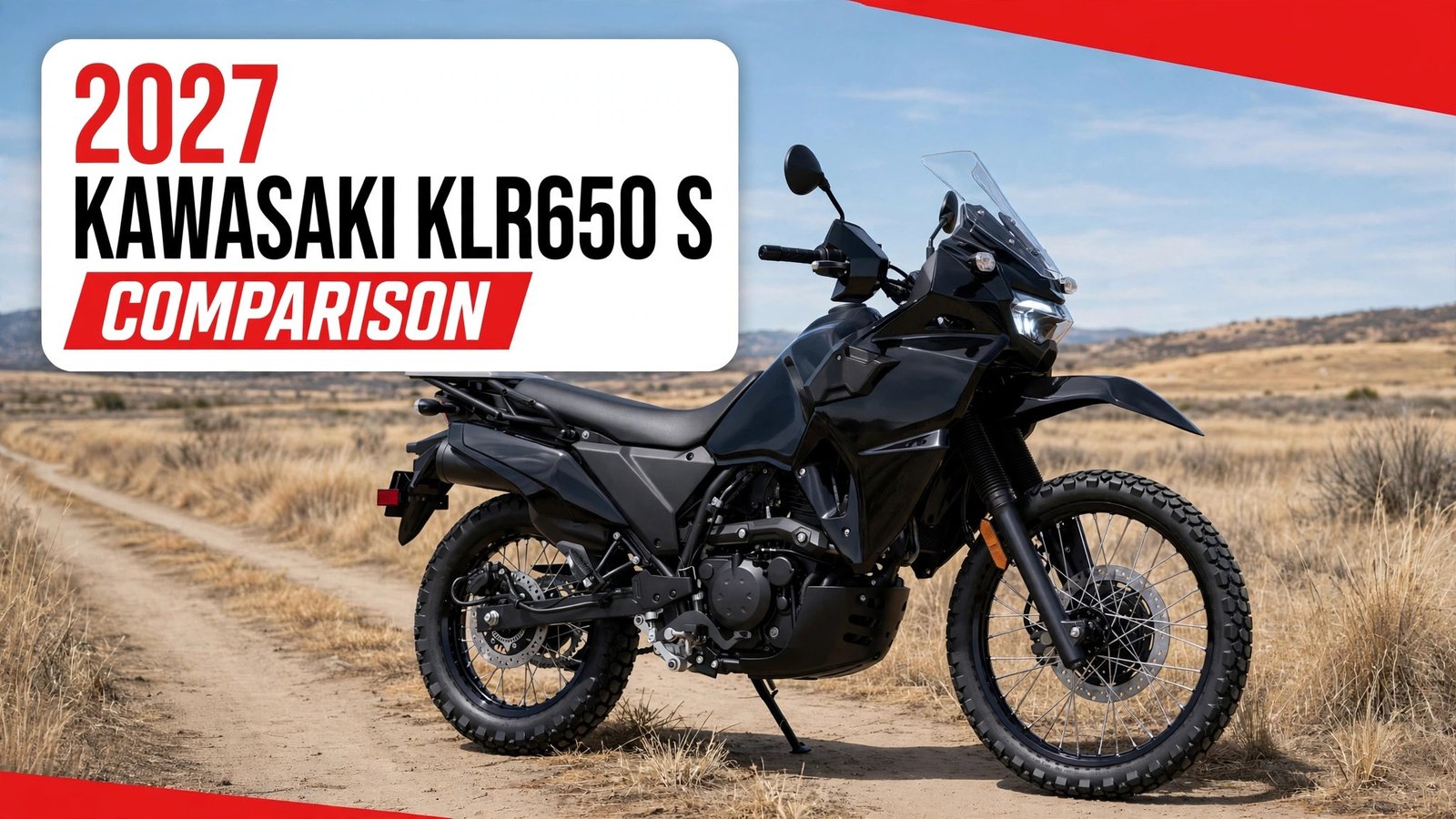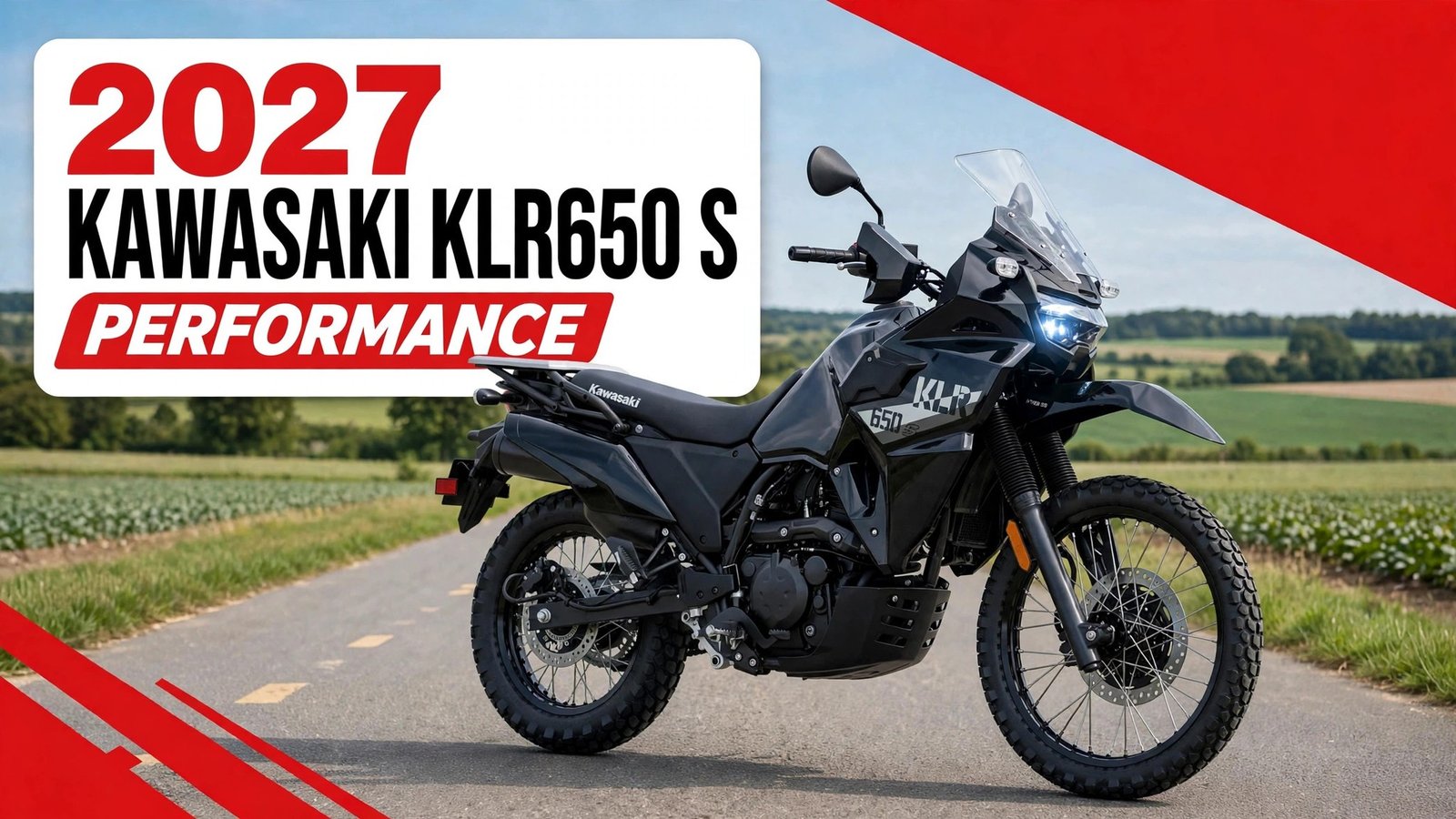
The 2023 Kawasaki KLR650 S makes 36.86 horsepower on Cycle World’s dyno, and that settles the biggest question in this Kawasaki KLR650 S performance guide: the lowered bike is not a slower bike. The S runs the same 652cc single as every gen-3 KLR650, and its dyno run is the highest of the three published runs on the platform. Lowering changed the seat and the suspension, not the engine.
This Kawasaki KLR650 S performance guide covers the S’s own dyno figures, the top speed no one has measured, the 43.94 mpg Cycle World recorded, and the flat-foot tests at two inseams. The S is a trim of the gen-3 KLR650, so every figure here is the KLR650’s figure, measured on the lowered bike where a test exists.
Kawasaki KLR650 S Engine Performance and Power Delivery
The S’s engine is the gen-3 KLR650’s engine, unchanged: a 652cc liquid-cooled single, 40 hp claimed at 6,000 rpm and 39.1 lb-ft at 4,500 rpm, with an ISO 4106 footnote on the power figure. Nothing about the lowering touches the engine, so this Kawasaki KLR650 S performance guide starts with the dyno numbers.

Its Own Dyno: 36.86 Horsepower
Cycle World put a 2023 S on its Dynojet 250i and recorded 36.86 hp at 6,080 rpm and 35.42 lb-ft at 4,590 rpm. Those precise figures come from the Cycle World first-ride article: the S’s own run, not a borrowed number from the standard bike. The rounded figures from the Cycle World S dyno test are 36.9 hp at 6,100 rpm and 35.4 lb-ft at 4,600 rpm, the figures in the table below. The S’s run is the centrepiece of this Kawasaki KLR650 S performance guide.
The claimed figure is 40 hp at 6,000 rpm, so the S gives up about 3 hp between the crank and the rear wheel, normal drivetrain loss for a chain-drive single. The torque curve matters more than the peak: 35.42 lb-ft at 4,590 rpm puts the pull in the middle of the rev range, where a dual-sport spends its time. Cycle World also weighed the S at 464 pounds, against Kawasaki’s claimed 460.6 for the ABS bike. That mid-range pull is the real story of this Kawasaki KLR650 S performance guide.
Higher Figure Is a Different Dyno Day
The S’s 36.86 hp looks higher than the 34.61 hp Cycle World recorded on the 2022 Adventure, and the gap invites the wrong conclusion. It is not a trim advantage: the engine is identical, and the same 2022 Adventure made 36.5 hp on Rider Magazine’s dyno, a different machine on a different day. This Kawasaki KLR650 S performance guide treats all three published runs as the same bike measured three times, not three different bikes.
Cycle World’s own text makes the point: the S’s numbers put it ahead of the 2022 Adventure’s 34.6 hp and 33.5 lb-ft, but that is two dyno days, not two engines. A buyer should expect the same rear-wheel output from either bike. Our KLR650 performance guide covers the shared engine in depth.
| Dyno run | Peak horsepower | Peak torque | Source |
|---|---|---|---|
| 2023 KLR650 S | 36.86 hp @ 6,080 rpm | 35.42 lb-ft @ 4,590 rpm | Cycle World, Dynojet 250i |
| 2022 KLR650 Adventure | 34.61 hp @ 5,910 rpm | 33.52 lb-ft @ 4,700 rpm | Cycle World, Dynojet 250i |
| 2022 KLR650 Adventure | 36.5 hp @ 6,100 rpm | 35.2 lb-ft @ 4,600 rpm | Rider Magazine |
| Claimed (crank) | 40 hp @ 6,000 rpm (ISO 4106) | 39.1 lb-ft @ 4,500 rpm | Kawasaki spec sheet |
Notes for this Kawasaki KLR650 S performance dyno table: the three wheel figures are rear-wheel dyno runs, while the claimed 40 hp is a crank figure with Kawasaki’s ISO 4106 footnote. The 34.61 hp and 36.5 hp runs are the same 2022 Adventure on two different dynos, so the gap is dyno-to-dyno variance. No US dyno exists for any other S model year.
Kawasaki KLR650 S Top Speed and Acceleration
Top speed is the thinnest section of this Kawasaki KLR650 S performance guide: no one has measured the S’s top speed, and Kawasaki publishes no official figure. The only instrumented figure in the family was recorded on the Adventure, and the S shares its engine, gearing and weight.
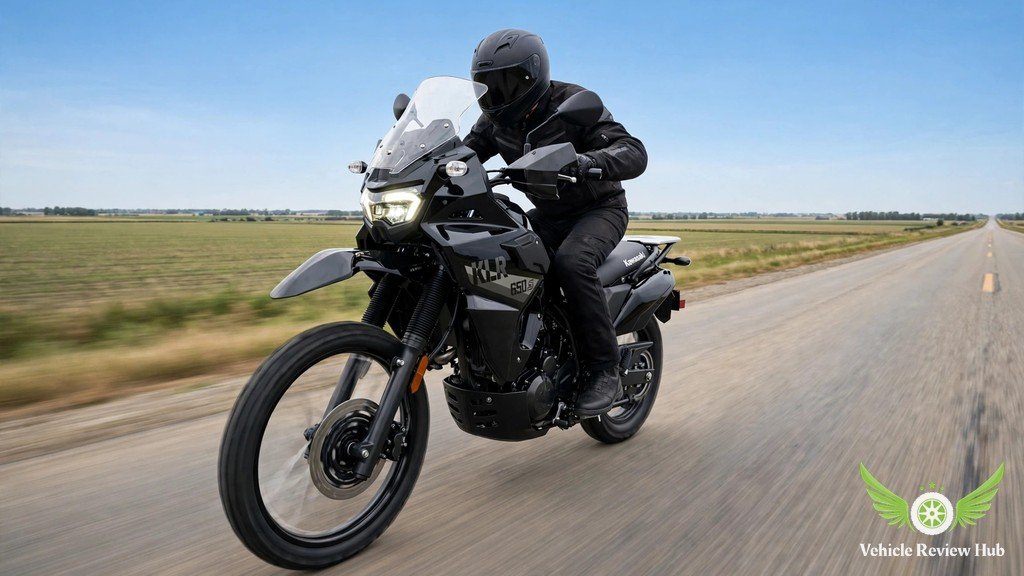
No Top Speed Measure on an S
There is no instrumented top-speed test of the KLR650 S anywhere, and no official top-speed figure from Kawasaki for any KLR650. The only instrumented figure in the family is Cycle News in 2022, when Kit Palmer recorded 88 to 90 mph on the Adventure, with a comfortable cruise speed of 74 mph. The S shares that Adventure’s engine, gearbox and weight, so a rider can expect the same 88 to 90 mph, but it is an inference from the sibling bike, not a test of the S, and this Kawasaki KLR650 S performance guide labels it as one.
Acceleration is equally unmeasured on the gen-3 bike: no instrumented quarter-mile run exists for any gen-3 KLR650. The only quarter-mile figure in the family is Motorcyclist’s 2008 gen-2 test, 14.81 seconds at 85.97 mph with 0 to 60 mph in 6.27 seconds, and that is a carburetted gen-2 bike, never the S’s figure. The testers agree the S feels unhurried rather than slow: the single pulls cleanly from low revs, first gear winds out near 30 mph, and highway passing needs a downshift and patience.
TopSpeed’s 89 MPH Is Unsourced
TopSpeed prints 89 mph as the KLR650 S top speed, with no source attached: no test, no GPS run, no named rider. It sits inside the 88 to 90 mph band Cycle News measured on the Adventure, so it is plausible, but plausible is not tested, and this Kawasaki KLR650 S performance guide does not print it as a measured figure.
Aggregator figures in the high nineties are invented and do not appear in this guide.
Kawasaki KLR650 S Mileage and Fuel Economy
Fuel economy is where the S has its own tested figure: Cycle World recorded 43.94 mpg on the 2023 S, a 268-mile range from the 6.1-gallon tank. This Kawasaki KLR650 S performance guide puts the S’s own number first, the platform numbers after it, each labelled with the bike it was measured on.

Cycle World Recorded 43.94 MPG
Cycle World’s 43.94 mpg came from its 2023 S first ride, a real test on the lowered bike itself, not a figure borrowed from the standard KLR650. The same test recorded the 268-mile range: 43.94 mpg times the 6.1-gallon tank is 268.0 miles. Kawasaki publishes no MPG figure, so tested numbers from named outlets are the only economy figures worth quoting, and this Kawasaki KLR650 S performance guide quotes them with their sources attached.
The platform spread is wide. Rider Magazine recorded 47 mpg on the 2022 Adventure, an estimated 287 miles. Cycle News measured 49 mpg on the Adventure with the side bags packed, riding home to California. At the other end, Motorcycle.com recorded 35.2 mpg on an 800-mile freeway blast at nearly full throttle. The same engine returns 35 mpg held wide open and 49 mpg ridden steadily. Fuelly’s owner data averages 48.56 mpg, which should be read as owner-reported, not instrumented.
Range Works Out to 268 Miles
The 268-mile range is the S’s own tested range, and it is the number a buyer should plan around. The bookends are arithmetic: 35.2 mpg times 6.1 gallons is 214.7 miles, and 49 mpg times 6.1 gallons is 298.9 miles, so the honest range window is roughly 215 to 300 miles. The 6.1-gallon tank is the same on every gen-3 KLR650.
| Test | Bike tested | MPG | Range on 6.1 gal |
|---|---|---|---|
| Cycle World first ride | 2023 KLR650 S | 43.94 mpg | 268 miles |
| Rider Magazine | 2022 KLR650 Adventure | 47 mpg | 287 miles (estimated) |
| Cycle News | 2022 KLR650 Adventure | 49 mpg | Nearly 300 miles |
| Motorcycle.com freeway test | KLR650 | 35.2 mpg | Just over 200 miles |
| Fuelly owner average | KLR650 owners | 48.56 mpg | About 296 miles |
Notes for this Kawasaki KLR650 S performance economy table: only the Cycle World 43.94 mpg row was measured on the S itself; the other rows are platform tests on the Adventure or the standard bike, labelled as such. Range figures are the testers’ own numbers, or arithmetic on the 6.1-gallon tank where marked estimated. Kawasaki publishes no MPG figure. Fuelly’s 48.56 mpg is owner-reported data, not an instrumented test.
Kawasaki KLR650 S Real-World Riding Experience
The S’s performance story is not really about horsepower. It is about reach: a rider who can put both feet down at a stop rides more confidently in traffic and on loose ground. This Kawasaki KLR650 S performance guide treats the two published inseam tests as the headline evidence.

Balls of Feet at 31.5-Inch Inseam
RevZilla’s Jen Dunstan is 5 feet 4 inches tall with a 31.5-inch inseam, and on the S she could balance on the balls of both feet. The same rider on the Adventure, at 34.3 inches, called it a perilous teeter-totter she could not put both feet down on. The drop is 2.2 inches by the spec-sheet arithmetic, and Kawasaki’s press material rounds it to 2.3, but the practical difference is the whole buying decision: feet down versus feet dangling.
The second test is the stronger one. Cycle World’s Jeff Allen is 5 feet 7 inches with a 28-inch inseam, and on the S he could firmly plant both feet on the ground. Ultimate Motorcycling’s tester, with a 30-inch inseam, put both boots flat on the ground. Three testers, three inseams, and the S flat-foots all three.
Pegs Drag Sooner on the Lowered Bike
The lowering costs an inch of ground clearance, and the pegs feel it first. The S sits 7.3 inches off the ground against the standard bike’s 8.3, and the foot pegs are closer to the dirt, so they touch down sooner when the bike leans hard. RevZilla joked about the S’s foot-peg feelers, calling them insanely long and adding, those are some whiskers. The feelers warn the rider before the hard parts touch.
The trade is real but narrow. On paved roads and light dirt the S rarely leans far enough for the pegs to matter, and RevZilla found the cornering performance exceeded all expectations, calling the bike deceptively good in the corners. The pegs only become a limit on rutted two-track and steep off-camber ground, where the standard bike’s extra inch buys room the S does not have. The thinner seat is the other trade: RevZilla called the low-profile seat undeniably less plush compared to the Adventure’s seat, and Cycle World noticed the standard seat’s extra padding when the testers swapped bikes.
Kawasaki KLR650 S Handling, Braking and Stability
The S handles differently from the standard bike, and the difference is a pleasant surprise: the shorter suspension is stiffer and sportier, the lower seat drops the centre of gravity, and the bike feels planted where the standard bike feels tall. This Kawasaki KLR650 S performance guide covers the handling the testers actually found.

Handling, Braking and Stability Off-Road
Cycle World found the S’s suspension stiffer and sportier than the standard bike’s, resisting dive under braking and staying up in its stroke over rough ground, and the S handled a full backyard lap without bottoming out, which is why this Kawasaki KLR650 S performance guide calls the suspension the S’s biggest surprise. The shortened travel with S-specific valving gives what Cycle World called an unexpectedly sporty ride. The lower seat helps too: the rider sits closer to the ground.
The gearing is the off-road compromise. RevZilla found the gearbox consistently tall and better tailored for street riding, spending the vast majority of an off-road ride in first gear, which winds out near 30 mph while second bogs below it. Braking is the same as the standard bike: a single 300 mm front disc and a single 240 mm rear disc, with non-switchable ABS, which matters on loose ground. There is no tachometer, no traction control and no rider modes. Vibration splits the testers: Cycle News notes buzz at highway speed, while Rider Magazine says there is very little, and this Kawasaki KLR650 S performance guide presents both camps.
Clearance Only Matters on Logs and Whoops
The S’s 7.3 inches of ground clearance against the standard bike’s 8.3 sounds like a big loss, and on paper it is a full inch. In practice it only matters where the ground rises to meet the bike: logs, deep whoops, rock steps and rutted climbs. On graded dirt roads and paved mountain passes, the S clears everything the standard bike clears.
The wheelbase tells the same story: 59.6 inches between the axles, one inch shorter than the standard bike’s 60.6, so the S turns a touch quicker. The 21-inch front and 17-inch rear wire-spoked wheels and the Dunlop K750-style dual-sport tyres are the same as the standard bike’s, so grip does not change with the trim. The S gives up its inch exactly where a trail rider needs it and nowhere else. Our Adventure performance guide covers the taller, heavier trim for riders who want the full-travel bike with factory luggage.
Kawasaki KLR650 S Performance Compared With Other Dual-Sports
The S’s performance only makes sense against its rivals: 36.86 hp and 43.94 mpg mean little without context. This Kawasaki KLR650 S performance guide compares the S with its sibling first, then with the lighter dual-sports a shorter rider might cross-shop: the S wins on reach and range and loses on weight.

Kawasaki KLR650 S vs KLR650
The S and the standard KLR650 are the same bike with different legs, and the performance comparison in this Kawasaki KLR650 S performance guide is a list of things that do not change: the same 652cc single, the same 40 hp claimed, the same 36.86 hp on the dyno, the same 43.94 mpg, the same 268-mile range, the same 6.1-gallon tank and the same 456.2-pound curb weight. The differences are the seat at 32.1 against 34.3, the clearance at 7.3 against 8.3, the travel at 6.7/7.0 against 7.9/8.0, and the wheelbase at 59.6 against 60.6. The price is the same too: $6,999 without ABS and $7,299 with it in 2027, plus $685 destination, or $7,684 and $7,984 delivered.
The wider comparison is less flattering. The Suzuki DR650S, our DR650S performance guide covers it in full, is 366 pounds, about 90 pounds lighter than the S, with a 644cc single and a seat a dealer can drop to 33.2 inches, but it has no fuel injection, no fuel gauge and no ABS at any price. The Honda CRF300L Rally is lighter and cheaper, but it is a 286cc bike with far less power. The S’s defence, in this Kawasaki KLR650 S performance guide, is the combination no rival matches at the price: fuel injection, a 268-mile range, a factory lowering job, and a $7,684 delivered price. The Versys 650 performance guide shows the road-biased twin alternative.
| Figure | KLR650 S | Standard KLR650 | DR650S |
|---|---|---|---|
| Engine | 652cc single | 652cc single | 644cc single |
| Dyno horsepower | 36.86 hp @ 6,080 rpm | 34.61–36.5 hp (two runs) | Not tested here |
| Tested MPG | 43.94 mpg | 47–49 mpg (platform) | Not tested here |
| Range | 268 miles | 287–300 miles | Not tested here |
| Seat height | 32.1 in | 34.3 in | 34.8 in (33.2 in lowered) |
| Curb weight | 456.2 lb | 456.2 lb | 366 lb |
| 2027 delivered price | $7,684 | $7,684 | $7,899 |
Notes for this Kawasaki KLR650 S performance comparison table: the S’s dyno and MPG figures are its own tested numbers; the standard bike’s dyno spread is two runs on the same 2022 Adventure, and its MPG figures are platform tests in the economy table above. DR650S figures are from our own verified DR650S blogs. The DR650S has no fuel injection, no fuel gauge and no ABS, and its seat lowers to 33.2 inches only with a dealer adjustment.
Is the Kawasaki KLR650 S Suitable for Beginner Riders?
The S is one of the better beginner dual-sports for a shorter rider, and the reasons are all in this Kawasaki KLR650 S performance guide. The low seat lets a new rider put both feet down, which is the single biggest confidence factor in the first year of riding. The engine is forgiving: a 652cc single with a flat torque curve, tall gearing and no sudden surge anywhere in the rev range. The 6.1-gallon tank and the huge dealer network help too.
The caveats are honest ones. The 456-pound weight is heavy for a new rider, and a dropped bike is harder to pick up than a 300-pound one. There is no traction control, no ride modes and no tachometer, so a beginner learns on feel rather than on electronics. The non-switchable ABS is the only rider aid. RevZilla found no fatal flaw in the lowered bike, and neither does this Kawasaki KLR650 S performance guide: buy the S if the standard bike is too tall, buy the standard bike if you can flat-foot 34.3 inches, and buy the lighter DR650S if 90 pounds matters more than fuel injection.
Kawasaki KLR650 S Performance: Frequently Asked Questions
Short answers to the questions this Kawasaki KLR650 S performance guide raises most: dyno figures, top speed, mileage, range, flat-foot tests and handling.
What is the top speed of the KLR650 S?
There is no instrumented top-speed figure for the S, and Kawasaki publishes no official top speed, in this Kawasaki KLR650 S performance guide. The only instrumented figure in the family is Cycle News at 88 to 90 mph on the Adventure.
How much horsepower does the KLR650 S make?
The S made 36.86 hp at 6,080 rpm and 35.42 lb-ft at 4,590 rpm on Cycle World’s Dynojet 250i, in this Kawasaki KLR650 S performance guide. The claimed figure is 40 hp at 6,000 rpm at the crank.
What mileage does the KLR650 S get?
Cycle World recorded 43.94 mpg on the 2023 S, in this Kawasaki KLR650 S performance guide. Other platform tests run from 35.2 mpg to 49 mpg.
How far can the KLR650 S go on a tank?
The S’s tested range is 268 miles from the 6.1-gallon tank, in this Kawasaki KLR650 S performance guide. The platform window is roughly 215 to 300 miles by arithmetic.
Is the KLR650 S slower than the standard KLR650?
No. The S has the same 652cc single, and its own dyno run made 36.86 hp, the highest of the three published gen-3 runs, in this Kawasaki KLR650 S performance guide. The gap is dyno-to-dyno variance, since the engine is identical.
Can a rider with a 28-inch inseam flat-foot the KLR650 S?
Yes. Cycle World’s tester, at 5 feet 7 inches with a 28-inch inseam, firmly planted both feet on the ground on the S, in this Kawasaki KLR650 S performance guide.
Can a rider with a 31.5-inch inseam flat-foot the KLR650 S?
Yes, on the balls of both feet. RevZilla’s tester, at 5 feet 4 inches with a 31.5-inch inseam, balanced on the balls of both feet on the S, in this Kawasaki KLR650 S performance guide, while the Adventure at 34.3 inches was a perilous teeter-totter.
Does the KLR650 S handle worse off-road?
Not on most ground. The shorter suspension is stiffer and sportier, and Cycle World found the S handled a full backyard lap without bottoming out, in this Kawasaki KLR650 S performance guide. The S only loses out on logs, deep whoops and rock steps, where its 7.3 inches of clearance falls an inch short.
Do the pegs drag sooner on the KLR650 S?
Yes. The S sits an inch lower, so the foot pegs touch down sooner when the bike leans hard, in this Kawasaki KLR650 S performance guide. RevZilla joked about the insanely long peg feelers.
Is the KLR650 S good for beginners?
The S is one of the better beginner dual-sports for a shorter rider, in this Kawasaki KLR650 S performance guide. The low seat, the forgiving single and the 268-mile range all help, and the 456-pound weight is the weak spot.
What is the quarter-mile time of the KLR650 S?
There is no instrumented quarter-mile run for any gen-3 KLR650, in this Kawasaki KLR650 S performance guide. The only family figure is Motorcyclist’s 2008 gen-2 test at 14.81 seconds.
How much does the 2027 KLR650 S cost?
The 2027 KLR650 S is $6,999 without ABS and $7,299 with ABS, plus $685 destination, or $7,684 and $7,984 delivered, in this Kawasaki KLR650 S performance guide. It costs the same as the standard KLR650 in every model year.