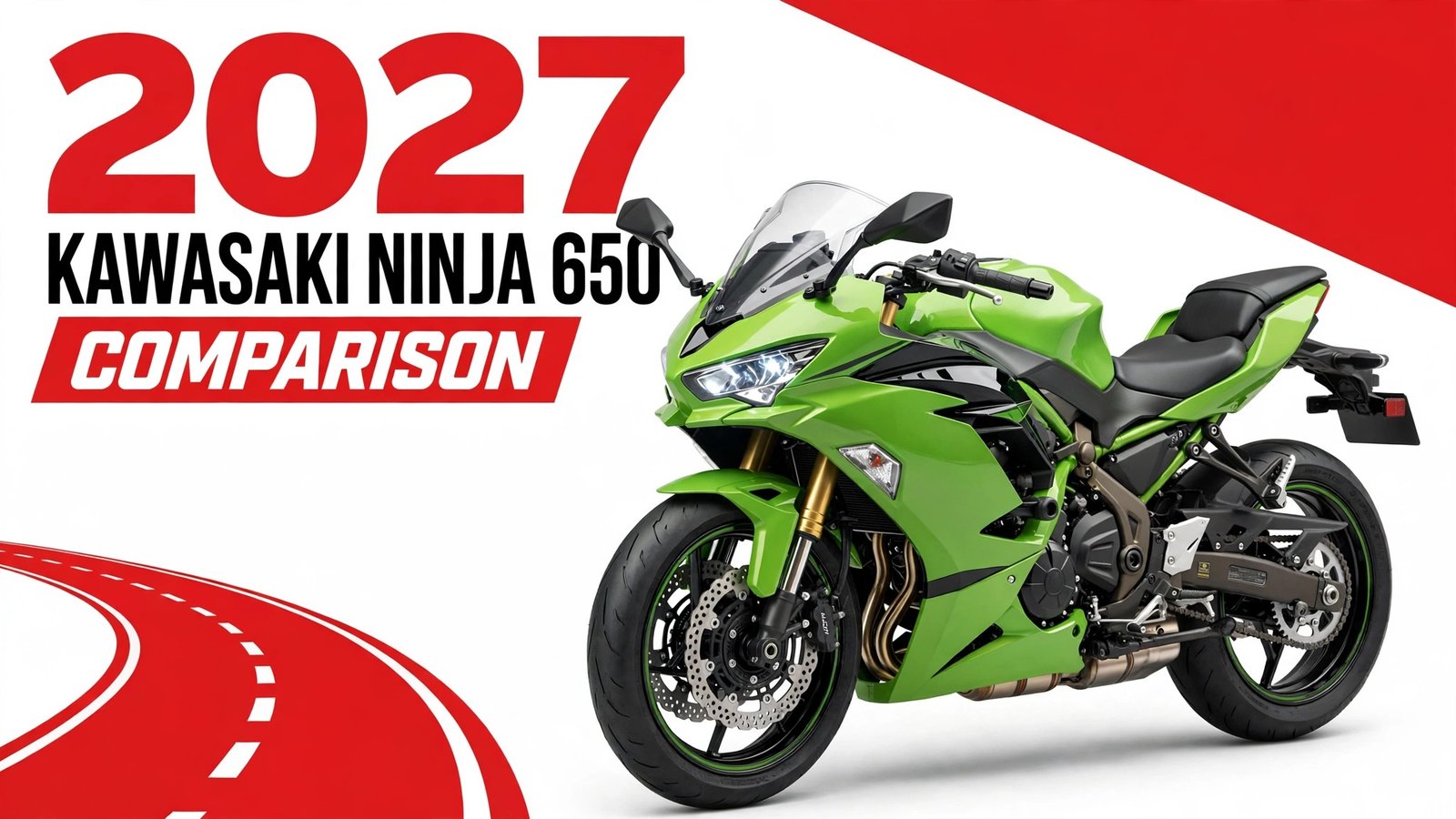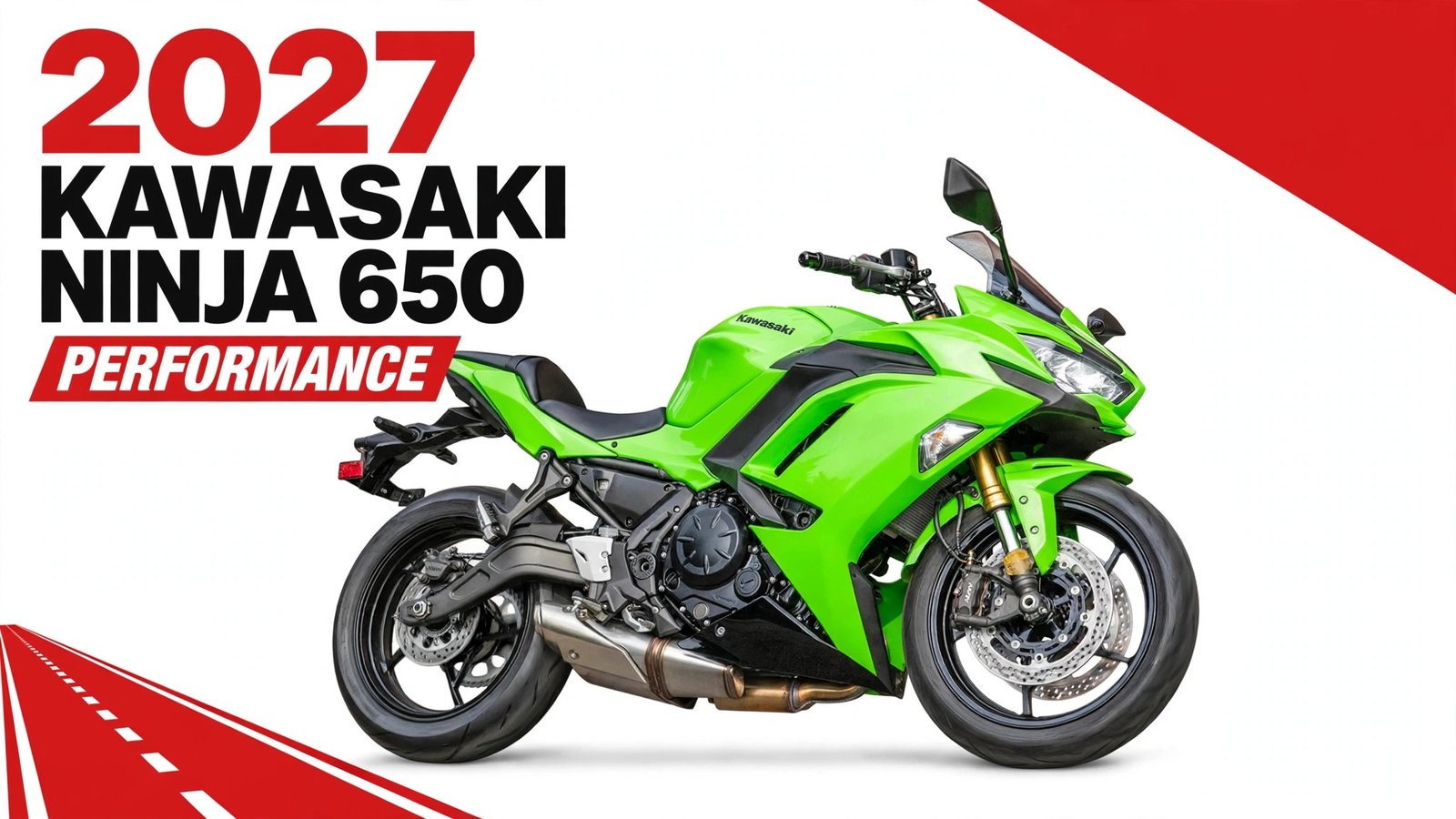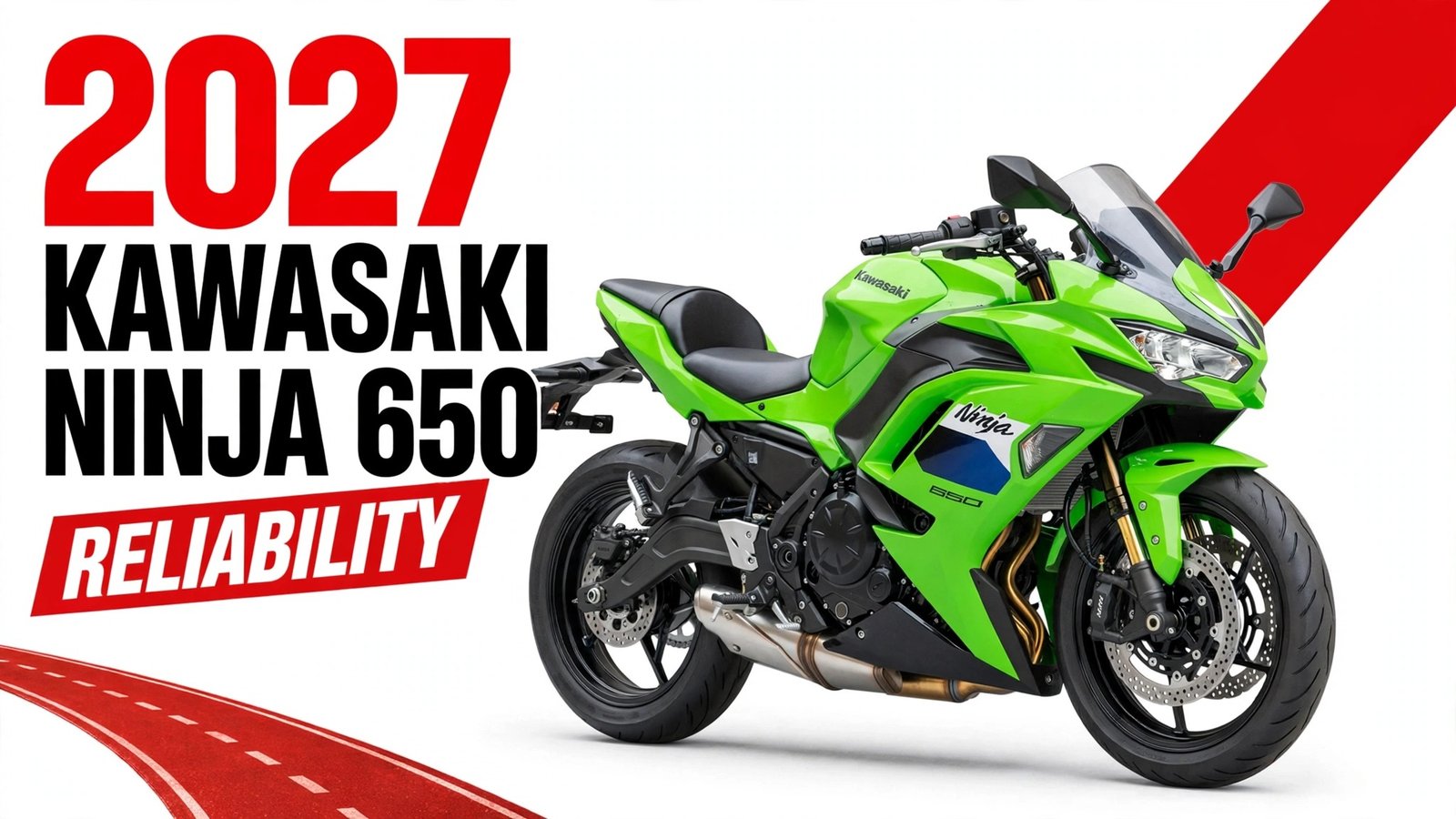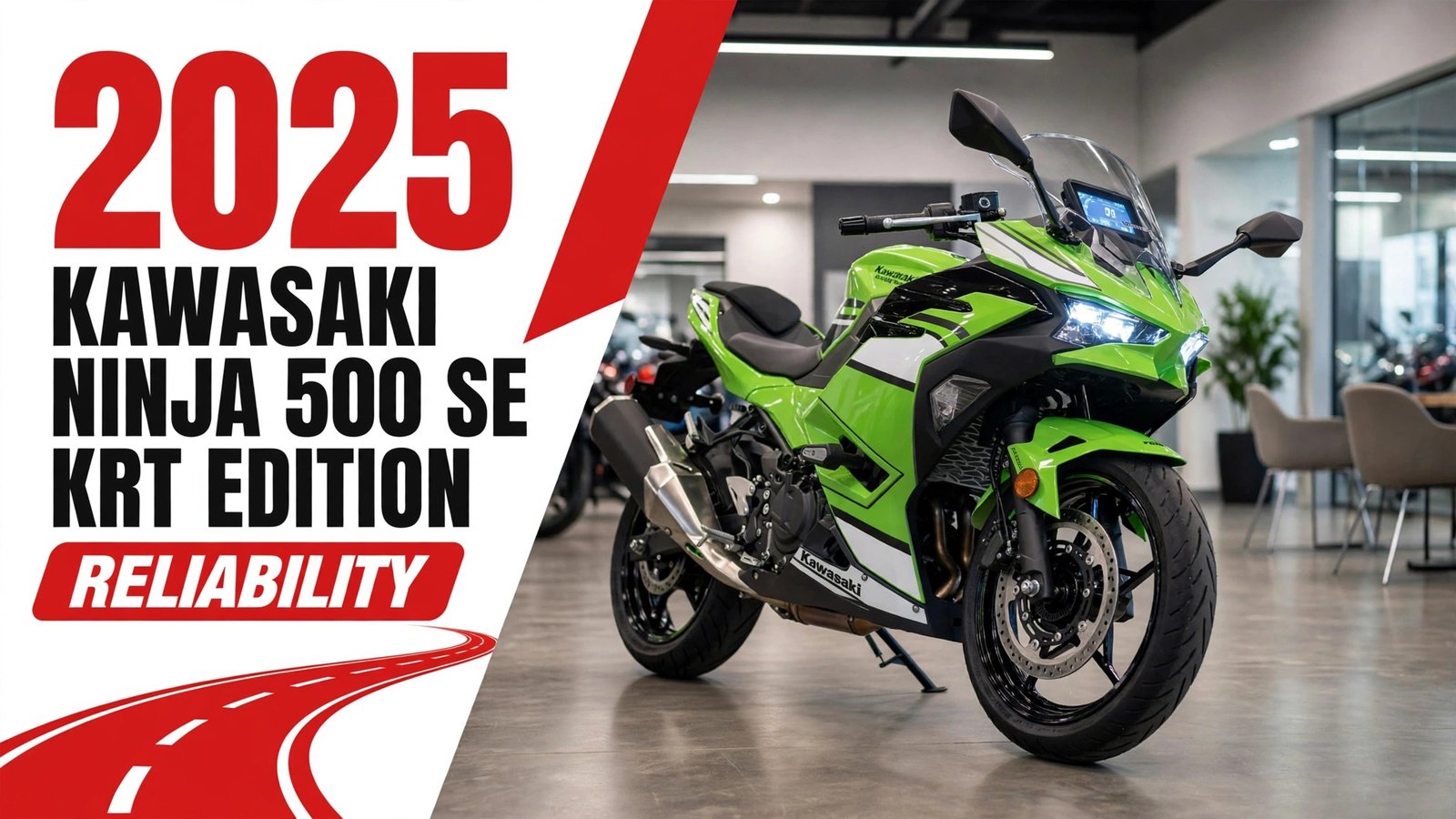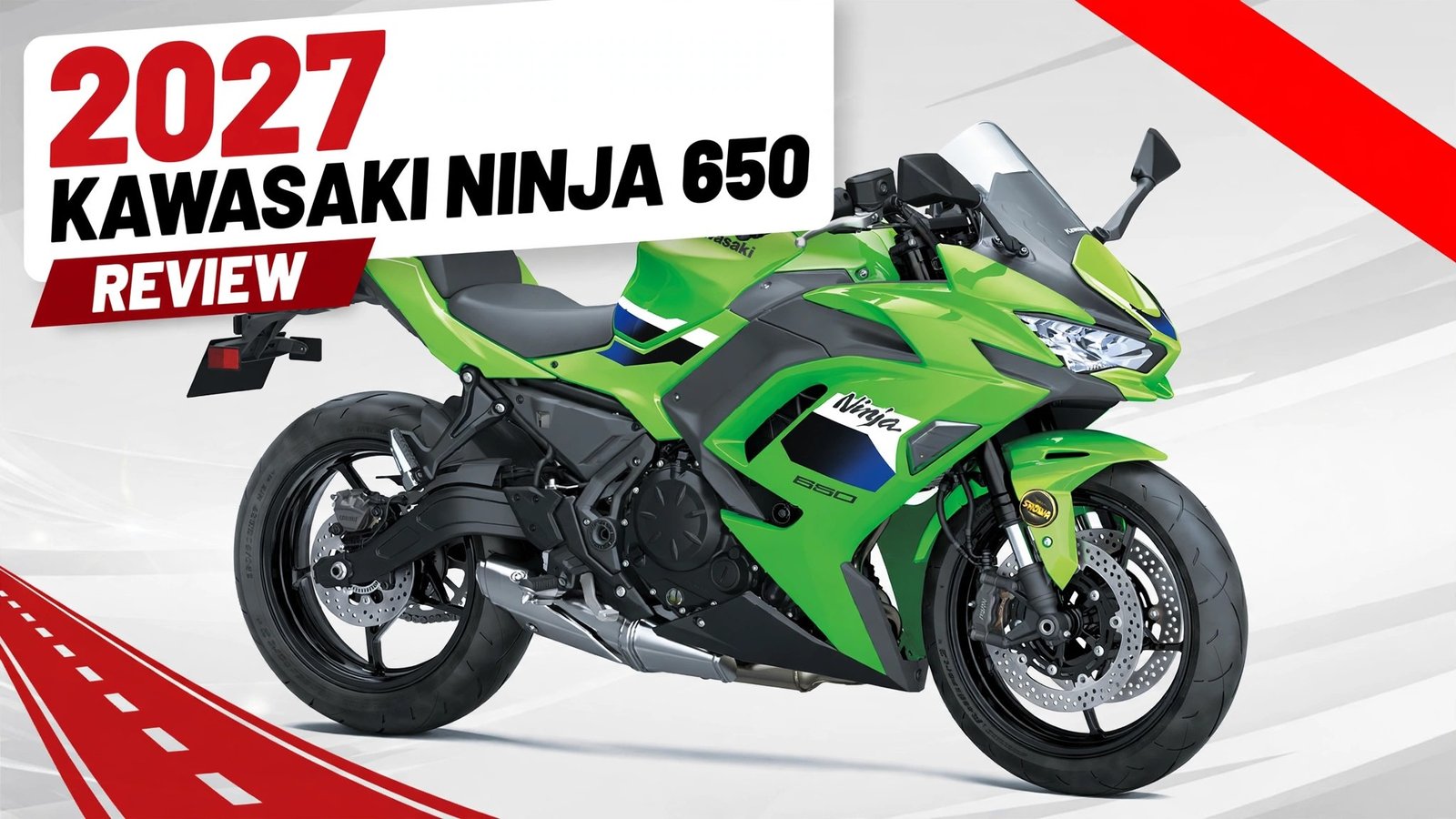
The 2027 Kawasaki Ninja 650 is the first Ninja 650 in a decade with a genuinely new front end. Kawasaki has fitted a 37 mm inverted Showa SFF-BP fork and radial-mount four-piston calipers, dropped the non-ABS trim and the KRT Edition, and kept the same 67 hp parallel twin that has powered the bike since 2017. This Kawasaki Ninja 650 review looks at what changed, what stayed the same, and whether the $8,099 base price still makes the 650 the comfort pick of the middleweight class. The short answer in this Kawasaki Ninja 650 review is yes, with one honest caveat: the engine, the dash and the electronics are unchanged.
Kawasaki Ninja 650 Overview and Model-Year Updates
The Ninja 650 has been on sale in the United States continuously since the 2006 Ninja 650R, and the 2027 model is the most meaningful update since the trellis-framed bike arrived in 2017, as this Kawasaki Ninja 650 review sets out below. The changes are all at the front of the bike. A Kawasaki Ninja 650 review of any earlier year had to describe a 41 mm conventional fork and two-piston calipers, and that description no longer fits the 2027 bike.
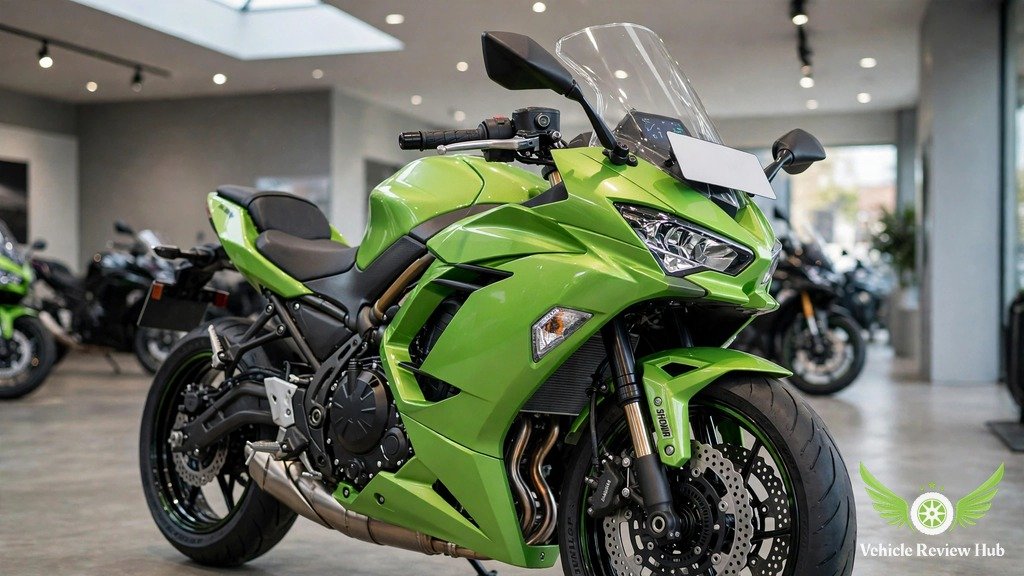
2027 Update Is a Real One
The 2027 update is a real one because it changes how the bike stops and steers, not just how it looks, and that is the headline of this Kawasaki Ninja 650 review. The front fork is now a 37 mm inverted Showa Separate Function Big Piston Fork, or SFF-BP, with 4.9 inches of travel. The front brakes are now dual semi-floating 300 mm discs with radial-mount four-piston calipers and ABS, replacing the 41 mm hydraulic telescopic fork and dual 300 mm petal-type discs with two-piston calipers of the 2026 bike. The rear suspension is unchanged: a horizontal back-link single shock with adjustable preload and 5.1 inches of travel. Kawasaki also shortened the wheelbase by 0.6 inches to 54.9 inches, lowered the seat by 0.2 inches to 30.9 inches, and trimmed the length to 80.5 inches and the height to 44.9 inches. Ground clearance is 4.9 inches, down from 5.1 inches in 2026. The 2027 bike is 2.2 lb heavier than the 2026 ABS at 427.8 lb for the 50-state model and 425.6 lb for the 49-state model. The 49-state and 50-state split is the California emissions equipment, so the headline figure in this Kawasaki Ninja 650 review is the 50-state 427.8 lb. The fuel tank still holds 4.0 gallons.
The SFF-BP fork shares its design family with the Suzuki GSX-8R’s fork, but it is not the same fork. The 8R uses a 41 mm Showa SFF-BP unit, while the Ninja 650 uses a 37 mm unit. Kawasaki publishes no stopping-distance figure for the 650, so this Kawasaki Ninja 650 review does not invent one.
ABS Only, KRT Is Gone
For 2027 the Ninja 650 is ABS only. There is no non-ABS 2027 Ninja 650 and no 2027 KRT Edition. That is the whole trim list: one ABS model in four colours, with a $200 paint premium on two of them. The KRT Edition was already gone in 2026, so it is wrong to say Kawasaki dropped it only for 2027. The KRT was last sold as a 2025 model, in Lime Green, Ebony and Pearl Blizzard White, at the same $7,999 as the plain 2025 ABS. The KRT was paint and graphics only, and the 2025 KRT paint was free. There is no KRT colour for 2027, so the 2027 Lime Green bike should not be described as a KRT Edition. The 2027 colours in this Kawasaki Ninja 650 review are Lime Green and Metallic Matte Twilight Blue with Candy Persimmon Red at $8,099, and Metallic Flat Spark Black with Metallic Carbon Gray and Galaxy Silver at $8,299.
Kawasaki Ninja 650 Engine and Specifications
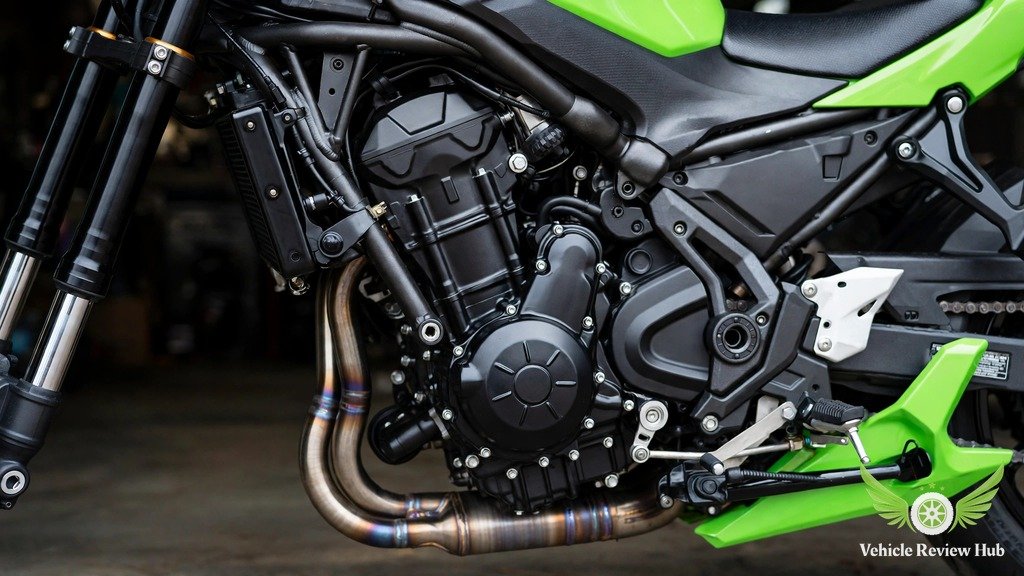
The engine is the part of the 2027 Ninja 650 that did not change, and that is the point of this section of the Kawasaki Ninja 650 review. Kawasaki kept the same 649cc parallel twin that has powered the bike since the 2017 retune, with the same claimed output, the same fuel injection and the same six-speed gearbox. A buyer who rides a 2026 bike and then rides a 2027 bike will feel the same engine and a different front end.
Engine Unchanged at 67 HP
The engine is a 649cc liquid-cooled DOHC parallel twin with an 83.0 mm bore and a 60.0 mm stroke, a 10.8:1 compression ratio, eight valves and digital fuel injection with dual 36 mm Keihin throttle bodies. Kawasaki claims 67.0 hp at 8,000 rpm and 48.5 lb-ft at 6,700 rpm, measured to the ISO 4106 standard. Those figures are identical on the 2027, 2026, 2025 and 2024 spec sheets, and this Kawasaki Ninja 650 review prints them exactly as Kawasaki claims them. The gearbox is a six-speed return shift, the chain is sealed, and the clutch is an assist and slipper unit. Kawasaki publishes no redline for the 650, so no redline figure appears in this Kawasaki Ninja 650 review.
The 67 hp figure is a crank claim, not a rear-wheel figure, and the two should never be confused. The measured rear-wheel figures for this engine, as this Kawasaki Ninja 650 review records, are about 60 to 61 hp, from MCN’s long-term test at 60.38 bhp and Rider Magazine’s dyno of the same engine in the Z650 at 60.6 hp. The pre-2017 bikes claimed about 71 hp, and the 2017 retune traded about five peak horsepower for stronger midrange torque.
| Specification | 2027 Ninja 650 ABS | 2026 Ninja 650 ABS |
|---|---|---|
| Engine | 649cc liquid-cooled parallel twin, DOHC | Same as 2027 |
| Claimed power | 67.0 hp at 8,000 rpm (ISO 4106) | 67.0 hp at 8,000 rpm (ISO 4106) |
| Claimed torque | 48.5 lb-ft at 6,700 rpm | 48.5 lb-ft at 6,700 rpm |
| Front fork | 37 mm inverted Showa SFF-BP, 4.9 in travel | 41 mm hydraulic telescopic, 4.9 in travel |
| Front brakes | Dual 300 mm discs, radial 4-piston calipers, ABS | Dual 300 mm petal discs, 2-piston calipers, ABS |
| Seat height | 30.9 in | 31.1 in |
| Wheelbase | 54.9 in | 55.5 in |
| Curb weight | 427.8 lb (50-state) / 425.6 lb (49-state) | 423.4 lb |
| Fuel capacity | 4.0 gal | 4.0 gal |
| Dash | 4.3-in full-colour TFT with Rideology | 4.3-in full-colour TFT with Rideology |
Note: all figures in this Kawasaki Ninja 650 review spec table come from Kawasaki’s own 2027 and 2026 spec sheets. Curb weights are the 50-state figures first, with the 49-state figures beside them, because the two differ by the California emissions equipment. The 2026 sheet lists a single curb figure per trim.
Quickshifter Is Accessory Only
The Kawasaki Quick Shifter, or KQS, is available as an accessory only. It is not standard on any 2027 trim, and it was not standard on the 2026 bike either. That matters because the 2026 Yamaha YZF-R7 and the Suzuki GSX-8R both fit a bi-directional quickshifter as standard. A buyer who wants clutchless shifts on the Ninja 650 has to buy the accessory and pay to have it fitted. Kawasaki’s spec sheet lists KQS as an available accessory with no price, and no KQS price was verified from a live Kawasaki source, so no price appears in this Kawasaki Ninja 650 review. KTRC arrived for the 2023 model year, and it is wheel-speed based with two modes plus off, with no IMU, so it is not lean-sensitive traction control.
Kawasaki Ninja 650 Price and Market Availability
Price is where the 2027 Ninja 650 makes its strongest case, and it is also where the recent history needs care. The 2027 base price is $8,099, which is $100 less than the 2026 ABS at $8,199, while the premium colours are $8,299, which is $100 more than the 2026 ABS. Both statements are true at the same time, and a Kawasaki Ninja 650 review that prints only one of them misleads the buyer. The price table below in this Kawasaki Ninja 650 review carries every recent model year with its destination charge and its delivered price.

Kawasaki Ninja 650 Price in the USA: $8,099
The 2027 Ninja 650 ABS costs $8,099 in Lime Green or Metallic Matte Twilight Blue with Candy Persimmon Red, and $8,299 in Metallic Flat Spark Black with Metallic Carbon Gray or Galaxy Silver. The $200 difference is a paint premium only, and the hardware is identical. The destination charge is $685, so the delivered prices in this Kawasaki Ninja 650 review are $8,784 for the base colours and $8,984 for the premium colours. That $685 destination charge is correct for the 2026 and 2027 Ninja 650, and this Kawasaki Ninja 650 review does not confuse it with the Ninja 500, whose destination charge is different. Kawasaki’s 2027 model page carries the bike and its colours, and Motorcycle.com’s 2027 ABS detail page lists the spec sheet figures.
The recent price history in this Kawasaki Ninja 650 review is a story of a sharp drop, a climb and a small cut. The 2025 bike cost $7,399 without ABS and $7,999 with ABS, with a $665 destination charge, so the delivered prices were $8,064 and $8,664. The 2024 ABS cost $8,899, or $9,349 delivered, so the 2025 bike was $1,500 cheaper on MSRP. No 2023 destination charge was verified, so none is printed in this Kawasaki Ninja 650 review. Kawasaki’s live 2025 spec PDF says the 2025 base price was $8,899, but that is the 2024 price carried into a stale file. Motorcycle.com’s database, SlashGear and every dealer MSRP label checked put the 2025 bike at $7,399 and $7,999, and Motorcycle.com’s 2025 ABS spec page lists the $7,999 figure, so $8,899 is the 2024 ABS price only.
| Model year | Trim | MSRP | Destination | Delivered |
|---|---|---|---|---|
| 2023 | Standard | $7,999 | Not verified | Not stated |
| 2023 | KRT Edition ABS | $8,599 | Not verified | Not stated |
| 2024 | ABS | $8,899 | $450 | $9,349 |
| 2025 | Non-ABS | $7,399 | $665 | $8,064 |
| 2025 | ABS / KRT Edition ABS | $7,999 | $665 | $8,664 |
| 2026 | Non-ABS | $7,599 | $685 | $8,284 |
| 2026 | ABS | $8,199 | $685 | $8,884 |
| 2027 | ABS, base colours | $8,099 | $685 | $8,784 |
| 2027 | ABS, premium colours | $8,299 | $685 | $8,984 |
Note: this Kawasaki Ninja 650 review price table uses MSRP plus the destination charge for each year, with the trim and the year named on every row. The 2025 figures in this Kawasaki Ninja 650 review are $7,399 and $7,999 from the Motorcycle.com database, SlashGear and dealer MSRP labels, not the $8,899 in Kawasaki’s stale 2025 spec PDF. The 2024 KRT and non-ABS MSRP figures and the 2023 destination charge were not verified, so they do not appear here.
2026 Promo Runs to Year-End
Kawasaki’s Good Times Sales Event gives $300 in factory savings on the 2026 Ninja 650 and the 2026 Ninja 650 ABS, $500 on the 2025 bike and $600 on the 2024 bike. The current Good Times promotion runs through 31 December 2026, so a buyer shopping before the end of the year can take the $300 off a new 2026 bike. One dealer flyer shows a 2026 Ninja 650 ABS at $8,199 minus the $300 saving at $7,899 plus tax, title and license. Shawnee Cycle Plaza listed a new 2026 ABS, stock KAJ8858, at $8,000 total, and Power Lodge in Florida listed one at $7,699. A three-year-old leftover at Howell Cycle Powersports in Michigan, a new 2023 Ninja 650, stock 23M6619, at $7,499 against a $7,999 retail price, is the cheapest new 650 found in this Kawasaki Ninja 650 review. A rider stepping up from a smaller bike should read our Ninja 500 review before deciding whether the 650’s extra capacity is worth the step, and a rider coming from the 400 should read our Ninja 400 review for the same reason.
Kawasaki Ninja 650 Design, Features and Technology
The 2027 Ninja 650 looks like the bike it has been since the 2020 restyle, and the design changes are the same as the chassis changes: the inverted fork and the radial calipers are visible at the front wheel, and everything else carries over. This section of the Kawasaki Ninja 650 review takes the design apart piece by piece so the buyer can see which parts are new and which parts are carried over.
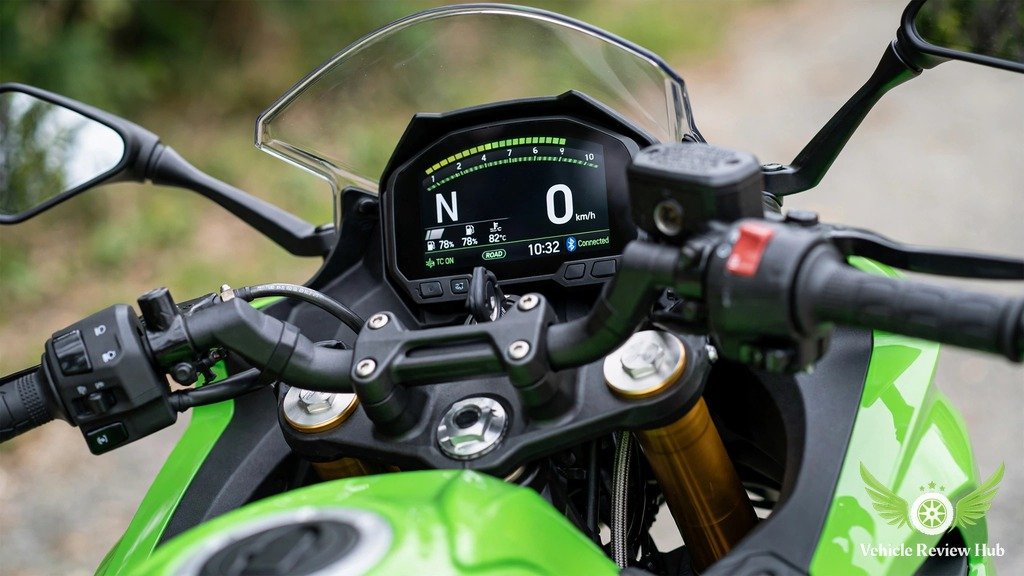
Inverted Showa Fork, Radial Calipers
The inverted Showa SFF-BP fork is the single most important design change on the 2027 bike. An inverted fork puts the larger-diameter outer tube at the top, clamped in the triple trees, and the slimmer inner tube at the bottom, near the axle. That layout is stiffer under braking than a conventional fork, and it is the layout the middleweight class had already moved to. The 37 mm size is smaller than the 41 mm fork on the Suzuki GSX-8R, which uses the same SFF-BP design family. The radial-mount four-piston calipers sit on dual semi-floating 300 mm discs, replacing the two-piston calipers on petal-type discs of the 2026 bike. The tyres are unchanged at 120/70-17 front and 160/60-17 rear. No tyre brand was verified for the 2027 bike, because the spec sheet lists sizes only. There is no cruise control, no riding mode beyond the two KTRC modes, and no IMU anywhere on the bike.
Seat Drops to 30.9 Inches
The seat drops to 30.9 inches for 2027, down from 31.1 inches in 2026, and that 0.2-inch drop is the smallest change on the bike that matters most to the shortest riders. A 30.9-inch seat is low for a middleweight sportbike. The Yamaha YZF-R7, by comparison, sits at 32.7 inches, which is 1.8 inches taller than the 650. The handlebars stay upright rather than clip-on, and that upright position is the heart of the bike’s comfort story, which the next section of this Kawasaki Ninja 650 review takes up.
Kawasaki Ninja 650 Riding Experience and Comfort
The riding experience is where the Ninja 650 has won its buyers for twenty years. The bike is upright, low, and easy to ride, with a twin that makes its torque low down rather than chasing peak power. The 2027 front end should sharpen the steering and the braking, but the engine, the seat shape and the riding position are the same as the bike that riders already know, and this Kawasaki Ninja 650 review keeps that distinction in view throughout.
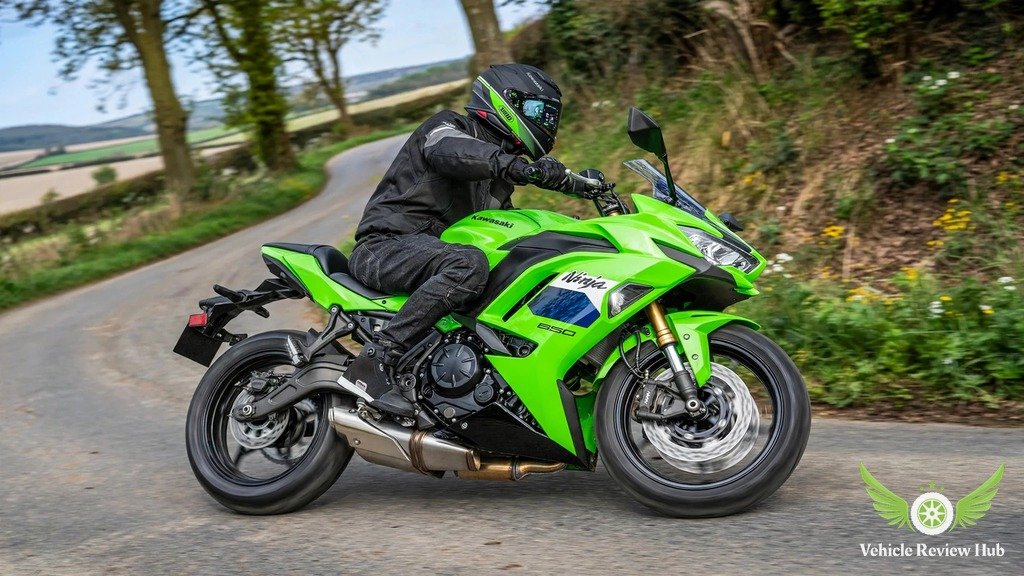
Sonny Brooks rides a 2025 Kawasaki Ninja 650 in the video below, so the bike on screen has the 41 mm telescopic fork and two-piston calipers, not the 2027 inverted fork and radial calipers. Treat his riding impressions as a guide to the engine, the seating position and the comfort of the bike, not as a test of the 2027 front end. This Kawasaki Ninja 650 review names the year plainly so the 2025 bike is never mistaken for the 2027 bike.
The Comfort Pick Since 2006
The Ninja 650 has been the comfort pick of its class since 2006, and the evidence for that claim is twenty years old. In January 2006, Motorcycle.com put the new Ninja 650R against the Suzuki SV650S, and the SV650S won on handling, power, brakes and suspension. The Ninja 650R won the comfort argument by being the easier and more upright bike, and the same split holds twenty years later. The reasons have not changed: upright bars, a low 30.9-inch seat, and a twin that makes its torque low down instead of chasing peak power. The 2027 bike makes 67 hp, the least of its four-bike set, against the SV650’s 75.1 hp, the R7’s 72.4 hp and the GSX-8R’s 81.8 hp. Its case is that the power it has arrives low down and is easy to use, and that the bike around it is the easiest to live with. No instrumented braking figure exists for the 650, so this Kawasaki Ninja 650 review does not quote one. The honest statement is that the hardware is now in line with the class, and the riding position is still the most upright of the four, which is why this Kawasaki Ninja 650 review calls the bike the comfort pick.
Origin Depends on the Era
Origin depends on the era, and the honest answer is that the recent bikes are built in Thailand. VIN decodes show that 2024 and 2025 Ninja 650s carry the ML5 prefix, which stands for Thailand and the Kawasaki Motors Enterprise plant at Amphur Pluak Daeng in Rayong. Bikes from 2013, 2018 and 2019 carry the JKA prefix for the same Rayong plant. The build origin of the 2006 to 2011 bikes was not verified from a VIN decode, so this Kawasaki Ninja 650 review does not state where the first-generation bikes were built. One database artefact deserves a warning. The NMVTIS database lists the 650’s horsepower as 50HP, which is wrong, and that figure should never be printed. The claimed output is 67.0 hp at 8,000 rpm to the ISO 4106 standard.
Kawasaki Ninja 650 Review: Pros, Cons and Verdict
The verdict of this Kawasaki Ninja 650 review is simple to state and worth spelling out. The bike keeps everything that made the 650 the comfort pick for twenty years and finally fixes the front end that had fallen behind its rivals. It is still the least powerful bike in its class with the simplest electronics, so the verdict in this Kawasaki Ninja 650 review depends on what the buyer values most.
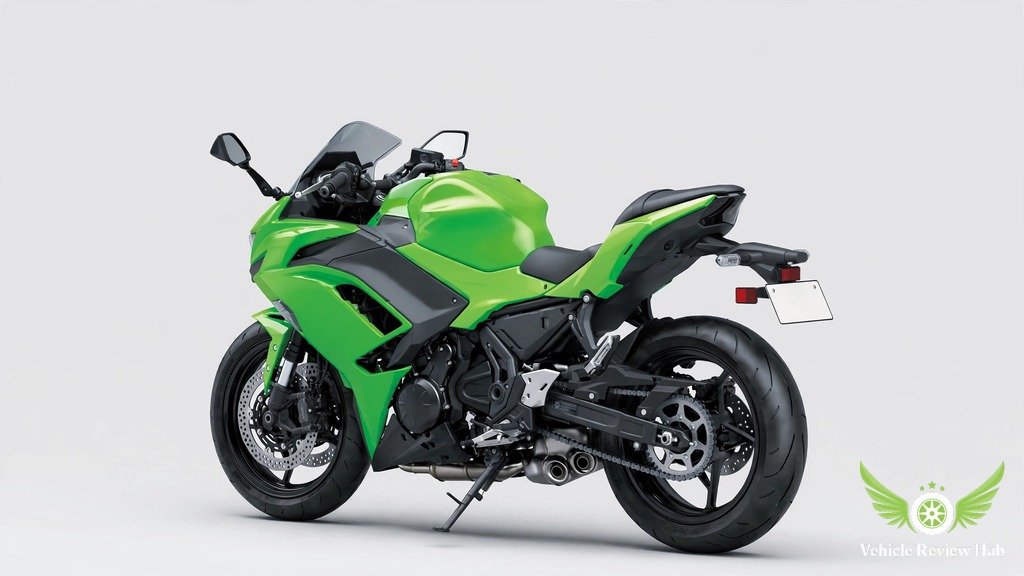
Main Advantages and Limitations of the Kawasaki Ninja 650
The advantages in this Kawasaki Ninja 650 review start with comfort and end with price. The upright bars, the 30.9-inch seat and the low-down torque make the 650 the easiest middleweight twin to ride every day, and the 2027 inverted fork and radial calipers give it the braking hardware the class had already adopted. The price is $8,099 for the base colours, which is the lowest MSRP of the four-bike set, and the delivered price of $8,784 is only $35 more than the SV650’s $8,749. The limitations are the mirror image. The engine makes 67 hp, which is the least of the four, and the electronics are the simplest: two-mode KTRC with no IMU, no cruise control, no riding modes and a quickshifter that costs extra. The bike is also about 2.2 lb heavier than the 2026 ABS despite the shorter wheelbase, and the 12-month warranty is the shortest in the class. RevZilla’s 2017 first ride and Ultimate Motorcycling’s 2023 review both describe the same balance of comfort over outright speed.
| Advantages | Limitations |
|---|---|
| 37 mm inverted Showa SFF-BP fork and radial four-piston calipers, new for 2027 | 67 hp is the least power of the four-bike set, behind the SV650, the R7 and the GSX-8R |
| Upright bars and a low 30.9-inch seat, the most comfortable riding position of the four | KTRC only, with no IMU, no cruise control and no riding modes |
| Lowest MSRP of the four at $8,099, with a $8,784 delivered price | Quickshifter is an accessory only, with no verified price |
| Twenty years on sale in the United States, with parts and knowledge easy to find | About 2.2 lb heavier than the 2026 ABS despite the shorter wheelbase |
| Simple servicing every 7,500 miles or yearly, with a 4.0-gallon tank | 12-month limited warranty, the shortest in the class |
Note: this Kawasaki Ninja 650 review pros and cons table weighs the 2027 bike against its own four-bike set, not against larger or smaller motorcycles. The SV650, the R7 and the GSX-8R are the three rivals named in the comparison blog, and their figures are the latest announced prices for each, labelled by model year in that blog.
12 Month Limited Warranty
The 2027 Ninja 650 carries a 12-month limited warranty, the same warranty the bike has carried for years. That is the shortest warranty in its four-bike set, and a buyer who values a long warranty should know it before signing. The bike’s reliability record softens the point. Only two recall campaigns exist in twenty years, both on early bikes: the 2010 brake-pedal campaign and the 2012 footpeg-circlip campaign, with nothing since 2012. A buyer who buys a bike with a documented service history is buying a proven machine, and that is the closing note of this Kawasaki Ninja 650 review. The final word of this Kawasaki Ninja 650 review is a recommendation with a condition. Buy the 2027 bike if comfort, price and a proven record matter more than outright power. Buy a leftover 2025 KRT Edition ABS at $7,999 total if the old fork and the old brakes do not bother you, because that bike costs $785 less than the 2027 bike delivered and carries the same engine. Step up from the Ninja 500 if you want more torque and more room, and read our Ninja 500 SE KRT Edition review before you spend the extra money. Riders coming from a 300 should read our Ninja 300 review, riders on a 125 should read our Ninja 125 review, and riders weighing the small-bike step should read our YZF-R3 review. The 2027 Ninja 650 is the comfort pick with a sharper front, and for the rider it suits, that is enough.
Kawasaki Ninja 650 Review Frequently Asked Questions
These are the questions buyers ask most about the 2027 Ninja 650, answered from the facts in this Kawasaki Ninja 650 review. The short version is a genuinely new front end, the same 67 hp twin, and a base price of $8,099.
What changed on the 2027 Ninja 650?
The front end changed. The 2027 bike gets a 37 mm inverted Showa SFF-BP fork and radial-mount four-piston calipers on dual 300 mm discs, replacing the 41 mm telescopic fork and two-piston calipers on petal discs of the 2026 bike. The wheelbase shortened by 0.6 inches to 54.9 inches, the seat dropped by 0.2 inches to 30.9 inches, and the bike gained about 2.2 lb to 427.8 lb in 50-state trim. Everything else carries over: the same 649cc twin, the same 4.3-inch TFT dash, the same two-mode KTRC and the same 12-month warranty.
How much does the 2027 Ninja 650 cost?
The base colours cost $8,099 and the premium colours cost $8,299, both before a $685 destination charge, so the delivered prices are $8,784 and $8,984. The $200 is a paint premium only; the hardware is identical. The 2027 base price is $100 cheaper than the 2026 ABS at $8,199, while the premium colours are $100 dearer. This Kawasaki Ninja 650 review prints both prices because the base and premium figures tell different stories. For context, the 2025 bike cost $7,399 without ABS and $7,999 with ABS; the $8,899 figure in Kawasaki’s live 2025 spec PDF is the 2024 price carried into a stale file.
What engine does the Ninja 650 have, and how much power does it make?
A 649cc liquid-cooled DOHC parallel twin, with an 83.0 mm bore and a 60.0 mm stroke and a 10.8:1 compression ratio. Kawasaki claims 67.0 hp at 8,000 rpm and 48.5 lb-ft at 6,700 rpm, both measured to ISO 4106, and this Kawasaki Ninja 650 review prints the ISO standard with the figure every time. Those figures are identical on the 2027, 2026, 2025 and 2024 spec sheets. The 67 hp figure is a crank claim, not a rear-wheel figure: the measured rear-wheel figures are about 60 to 61 hp, from MCN’s long-term test at 60.38 bhp and Rider Magazine’s dyno of the same engine in the Z650 at 60.6 hp.
Is the KRT Edition still available?
No. The KRT Edition was last sold as a 2025 model, in Lime Green, Ebony and Pearl Blizzard White, at $7,999 — the same price as the plain 2025 ABS, so the KRT paint was free. There is no KRT Edition for 2026 or 2027, and no KRT colour for 2027, so the 2027 Lime Green bike should not be described as a KRT Edition. This Kawasaki Ninja 650 review treats the KRT as paint and graphics only, never a performance trim. A new leftover 2025 KRT Edition ABS was listed at $7,999 total at Columbia Powersports in November 2026, which is $785 less than the 2027 bike delivered.
Is the Ninja 650 comfortable to ride every day?
Yes, and comfort is the bike’s case against its rivals. The handlebars are upright rather than clip-on, the seat is 30.9 inches high, and the twin makes its 48.5 lb-ft at 6,700 rpm, low down rather than at peak revs. The 2006 Motorcycle.com shootout is the evidence: the SV650S won on handling, power, brakes and suspension, and the Ninja 650R won the comfort argument as the easier, more upright bike. This Kawasaki Ninja 650 review calls it the comfort pick of its four-bike set, with the 2027 inverted fork and radial calipers adding the braking hardware the class had already adopted.
Who should buy the 2027 Ninja 650, and what is the warranty?
Buy it if comfort, price and a proven record matter more than outright power. The 2027 bike is the cheapest of its four-bike set on MSRP at $8,099, and its two recalls are both more than a decade old. The warranty is 12 months limited, the shortest in the class, so a buyer who values a long warranty should know that before signing. This Kawasaki Ninja 650 review also names the alternative: buy a leftover 2025 KRT Edition ABS at $7,999 total if the old fork and the old brakes do not bother you, because that bike costs $785 less than the 2027 bike delivered and carries the same engine.