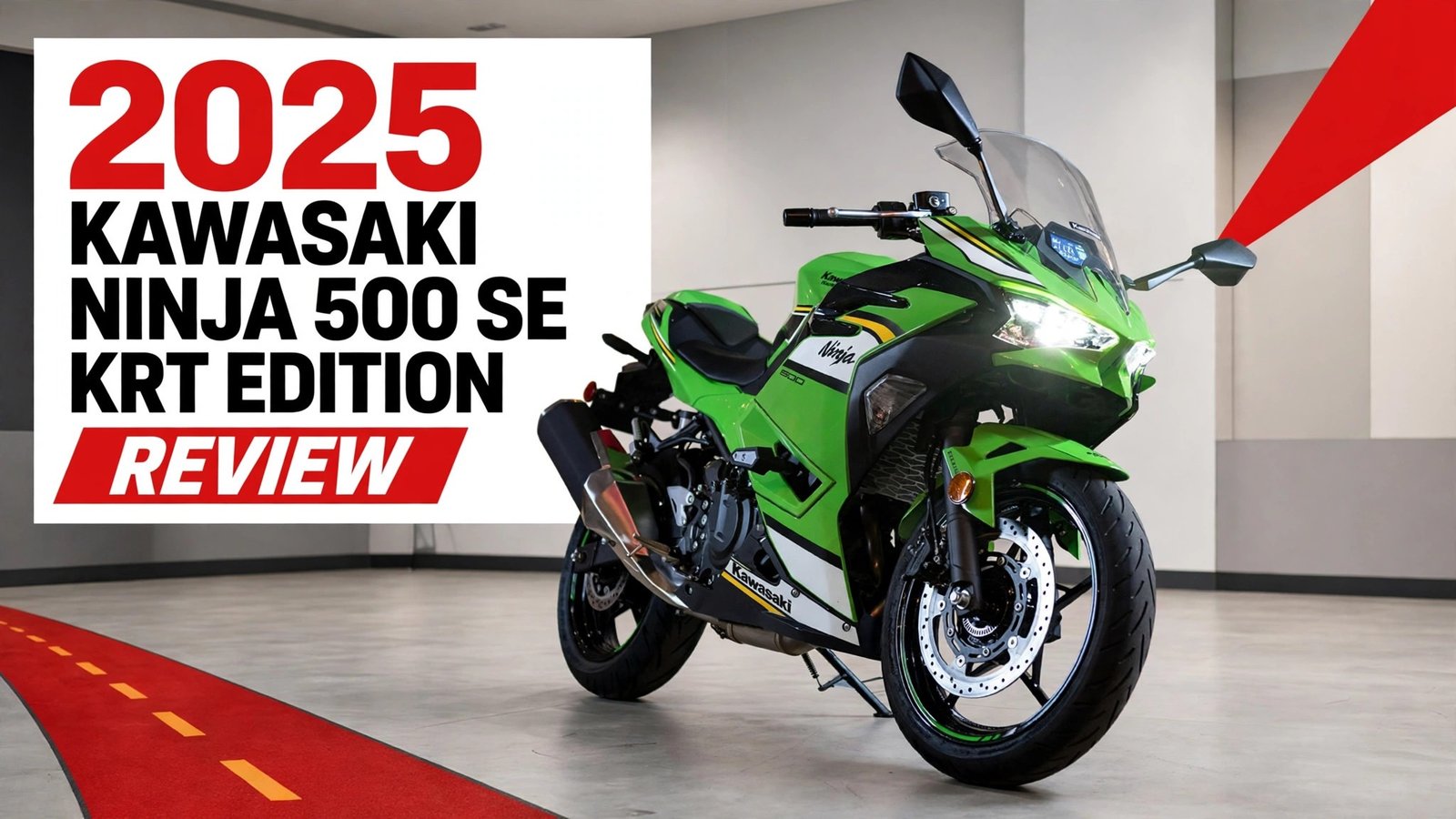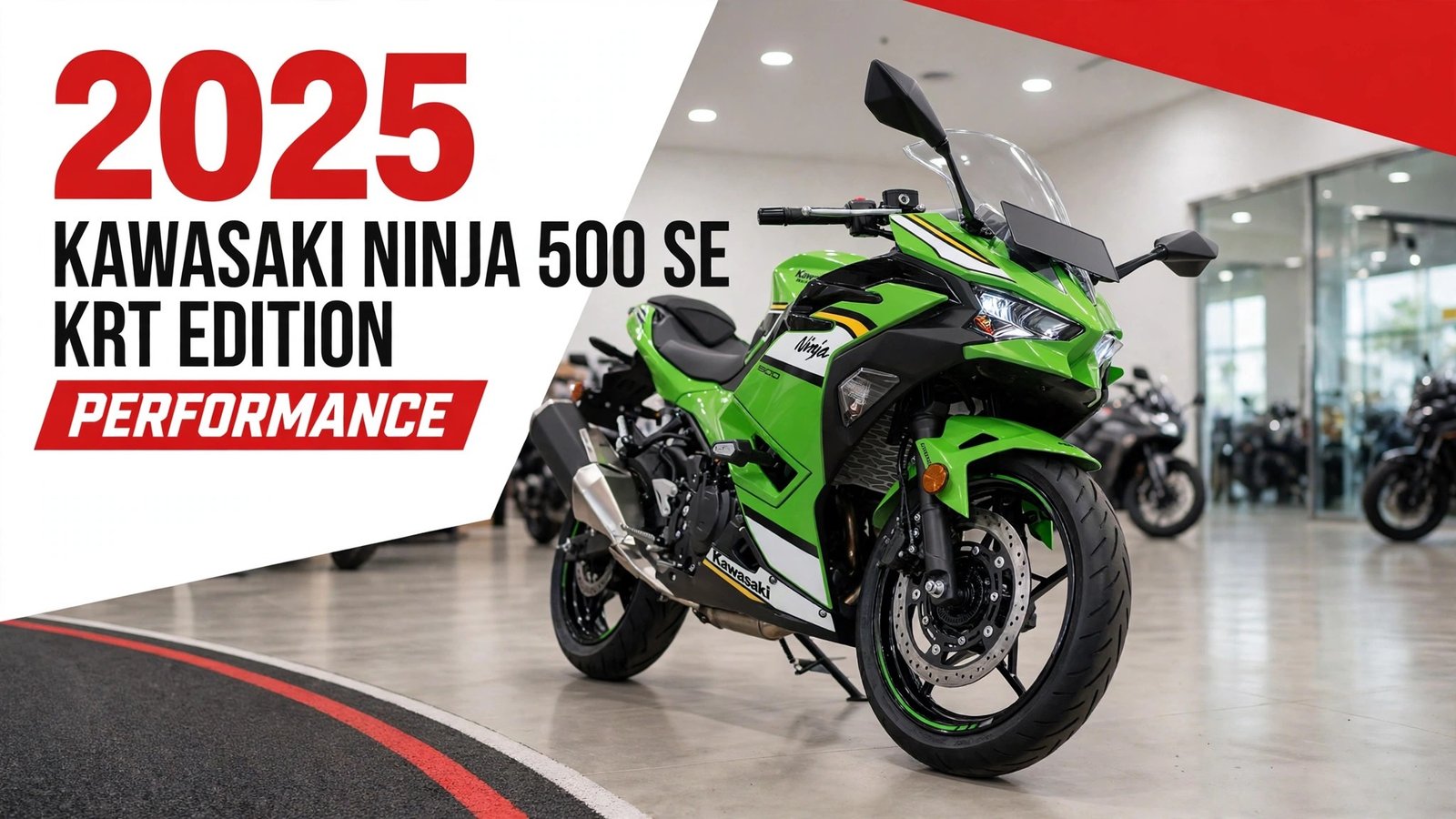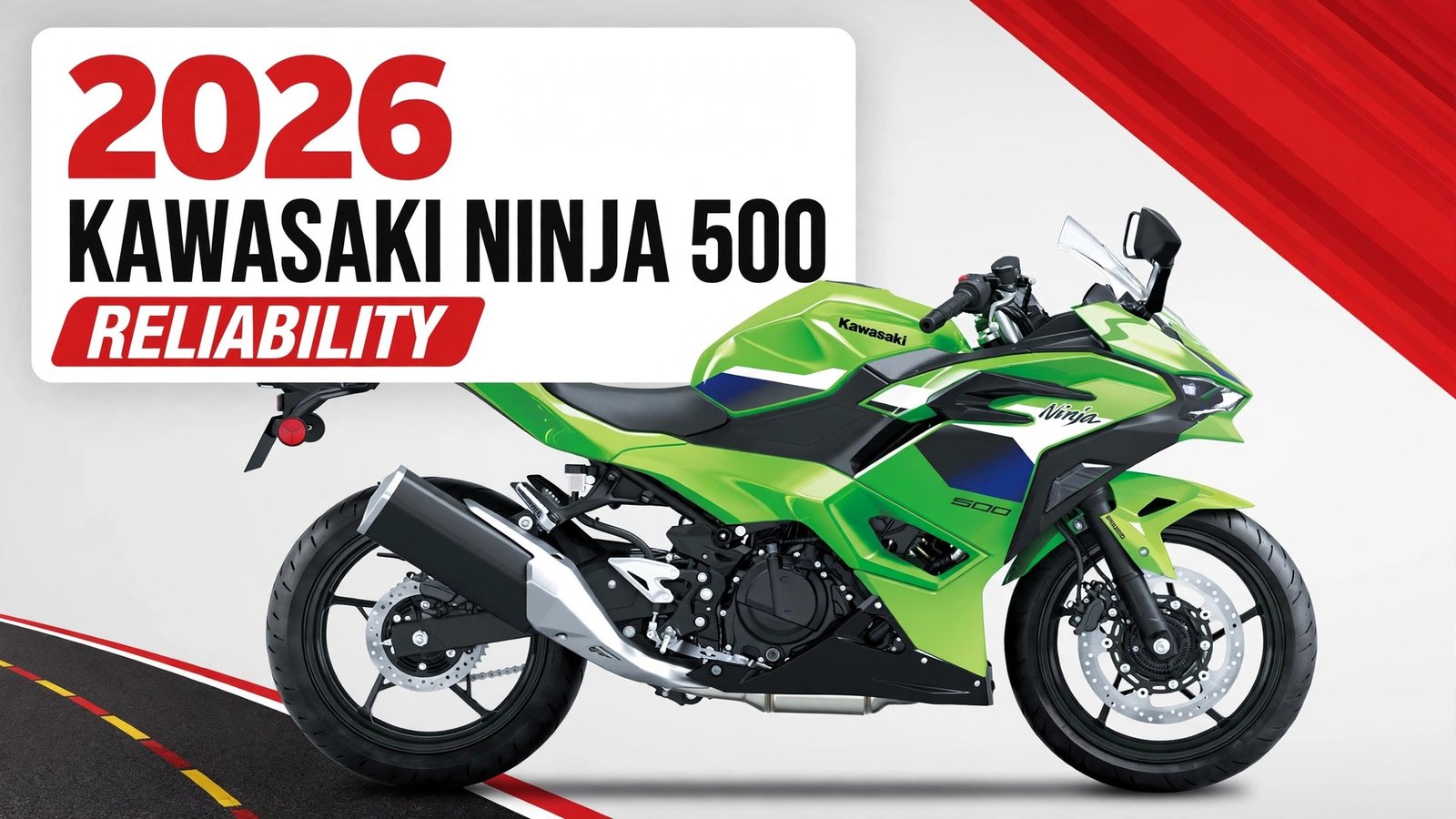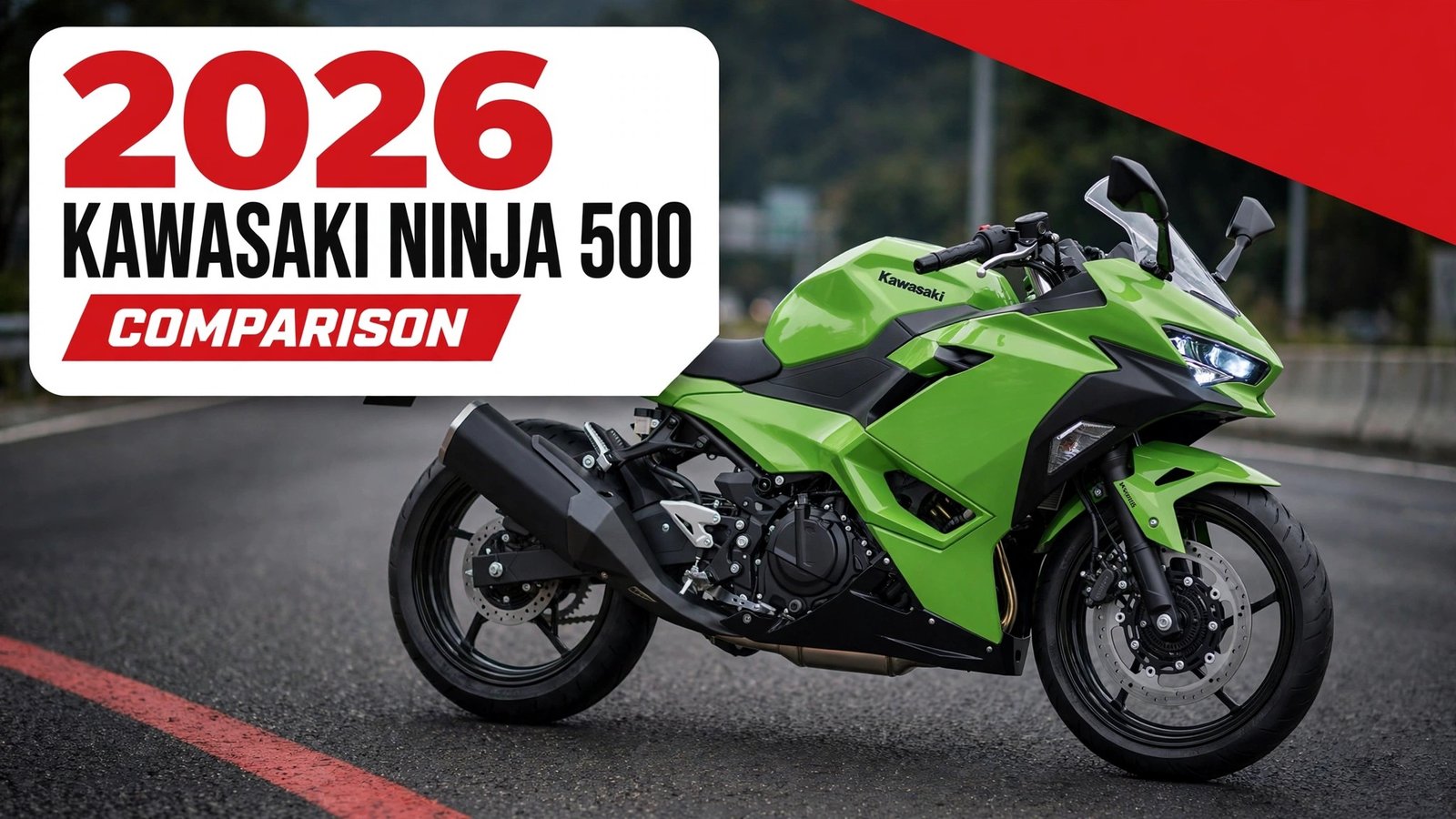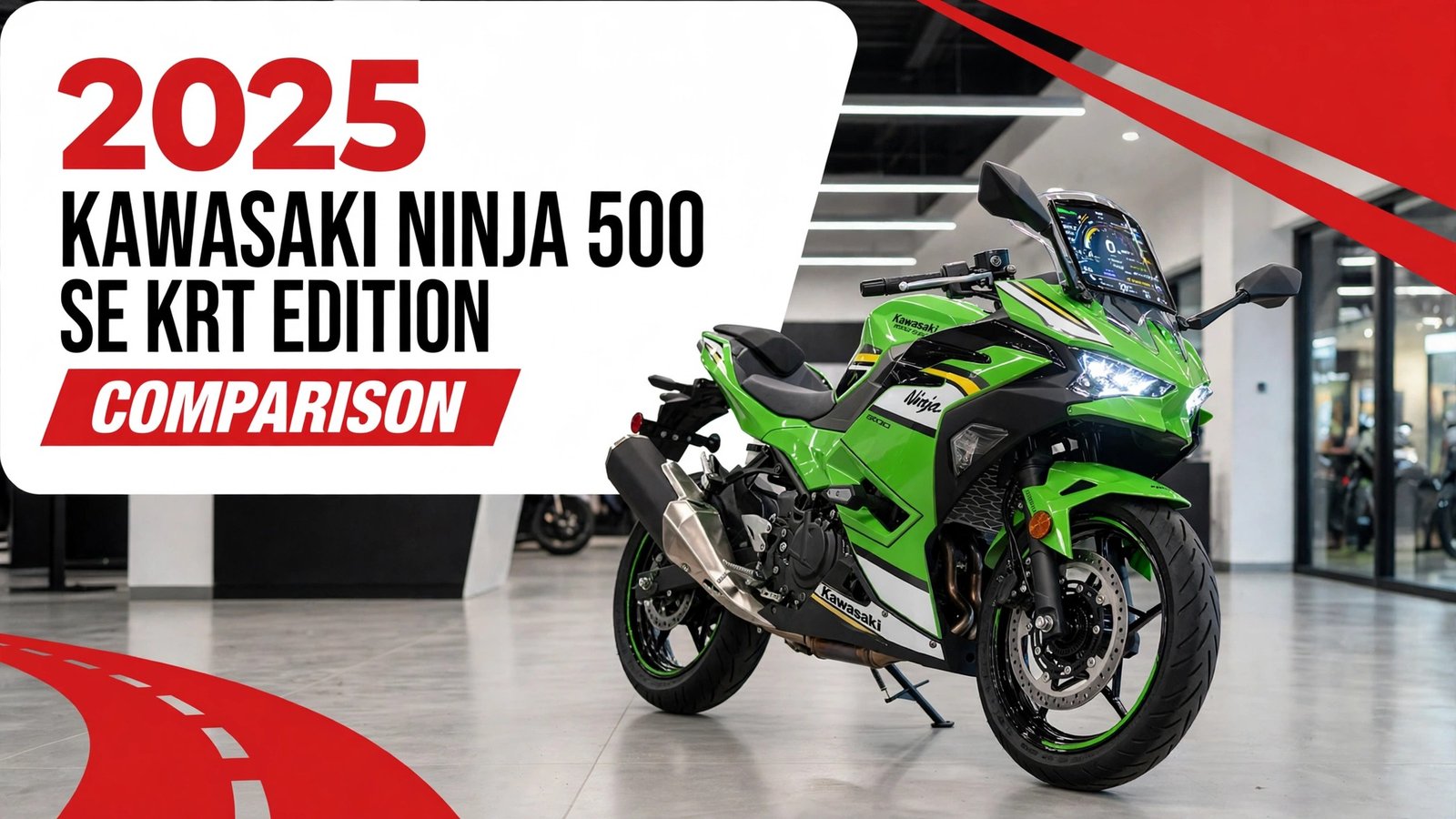
The Kawasaki Ninja 500 SE KRT Edition was the most expensive Ninja 500 in the United States, and the easiest to misunderstand. It sold for two model years only, 2024 and 2025, at $6,399 — mechanically identical to the plain SE ABS. The KRT paint was free; the premium bought comfort, not speed. This Kawasaki Ninja 500 SE KRT Edition comparison judges it against the rivals.
Short version: the SE KRT was a paint-and-equipment choice, not a performance one, and the smart money never paid the $6,399 sticker. Leftover new 2025 SE KRTs reached $4,999 in November 2026 — $2,150 less delivered than a new 2026 SE ABS. Read the full review for the deep dive, then use this Kawasaki Ninja 500 SE KRT Edition comparison to pick your rival. That $2,150 gap is the number this Kawasaki Ninja 500 SE KRT Edition comparison keeps coming back to.
Kawasaki Ninja 500 SE KRT Edition Overview and Its Closest Rivals
The SE KRT sits at the top of the Ninja 500 range, and the range is short. Kawasaki sold the 500 in six trims in 2024, from the $5,299 base bike to the $6,599 SE 40th Anniversary ABS, the SE KRT sharing the top step with the plain SE ABS at $6,399. For 2026 the trim is gone. The named rivals in this Kawasaki Ninja 500 SE KRT Edition comparison are the SE ABS, the RS 457, and the CBR500R. The family ladder runs from the Ninja 125 through the revived Ninja 300 to this bike, which replaced the Ninja 400.
Premium Bought Comfort, Not Speed
The SE KRT’s eleven SE items are all comfort, convenience, and appearance: a full-colour TFT dash with Rideology, KIPASS keyless ignition, a USB-C outlet, LED turn signals, a large windshield, a pillion seat cover, frame sliders, a tank pad, knee grip pads, a radiator screen, and the KRT colour and graphics. None adds a single horsepower. The engine is the same 451cc twin as every other Ninja 500 — 51.0 hp at 10,000 rpm, 31.7 lb-ft at 7,500 rpm. This Kawasaki Ninja 500 SE KRT Edition comparison is blunt about it: the sticker bought the best-equipped 500, not a faster one.
What the premium bought shows every day: the TFT’s big fonts, keyless ignition with gloves on, and the tall screen testers felt at speed. RevZilla’s first ride put the SE premium at $500 over the top ABS colour. This Kawasaki Ninja 500 SE KRT Edition comparison treats the premium as comfort with a paint job on top.
How the Four Bikes Differ at a Glance
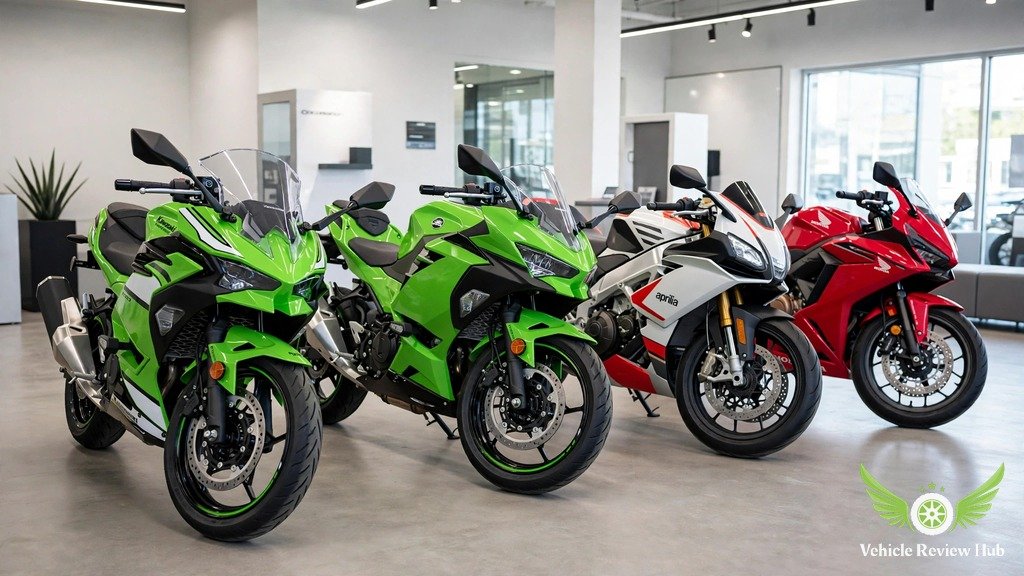
Four bikes, four answers. The SE KRT is the comfortable, well-equipped twin. The SE ABS is the same bike without the paint. The RS 457 is the electronics leader, with ride-by-wire, three modes, and traction control the Kawasaki cannot offer at any price. The CBR500R is the heaviest of the four, but brings Honda’s HSTC and a five-inch TFT. This Kawasaki Ninja 500 SE KRT Edition comparison puts the headline figures side by side first, then covers what the table cannot show.
| Figure | Ninja 500 SE KRT | Ninja 500 SE ABS | Aprilia RS 457 | Honda CBR500R |
|---|---|---|---|---|
| 2026 MSRP | Not sold (2025: $6,399) | $6,499 | $6,849 | $6,399 |
| Engine | 451cc parallel twin | 451cc parallel twin | 457cc parallel twin | 471cc parallel twin |
| Claimed power | 51.0 hp at 10,000 rpm | 51.0 hp at 10,000 rpm | 47 hp | 47 hp (EU A2 cap) |
| Claimed torque | 31.7 lb-ft at 7,500 rpm | 31.7 lb-ft at 7,500 rpm | 32 lb-ft | Not stated as a US figure |
| Curb / wet weight | 379.3 lb | 379.3 lb | 385 lb wet | 421 lb |
| Front fork | 41 mm telescopic | 41 mm telescopic | Upside-down | 41 mm inverted Showa SFF-BP |
| Rider aids | ABS only | ABS only | Traction control, 3 modes | HSTC traction control |
| Warranty | 12-month limited | 12-month limited | 24-month | 12-month limited |
Note: all Kawasaki figures are from the SE KRT’s own spec sheets; the RS 457 and CBR500R figures are the manufacturers’ stated figures for 2026. This Kawasaki Ninja 500 SE KRT Edition comparison never mixes a claimed figure with a measured one.
Kawasaki Ninja 500 SE KRT Edition vs Kawasaki Ninja 500 SE ABS
This is the strangest head-to-head in the whole Kawasaki Ninja 500 SE KRT Edition comparison, because the two bikes are the same motorcycle. Same engine, weight, dash, equipment, and $6,399 sticker in 2024 and 2025. The only difference is paint: the SE ABS wears Passion Red or black, the SE KRT wears Lime Green and Ebony with a Pearl Blizzard White accent in 2025. Our performance guide covers the shared engine on the road. This Kawasaki Ninja 500 SE KRT Edition comparison stays on the buying question: what does the KRT badge change?

Engine, Specs and Performance Side by Side
There is no performance difference to find, and the table below proves it by showing the same numbers twice. The one split worth naming is the rake: SE KRT sheets print 24.7 degrees, base and ABS sheets print 24.5, on the same frame and fork. This Kawasaki Ninja 500 SE KRT Edition comparison prints the SE KRT’s own 24.7-degree figure and names the 24.5-degree figure as the split. The other split is height: 46.5 inches with the tall screen, against 44.1 for the base and ABS.
| Figure | SE KRT Edition | SE ABS |
|---|---|---|
| 2024 MSRP | $6,399 | $6,399 |
| 2025 MSRP | $6,399 | $6,399 |
| 2026 MSRP | Not sold | $6,499 |
| Engine | 451cc parallel twin, 51.0 hp at 10,000 rpm, 31.7 lb-ft at 7,500 rpm | 451cc parallel twin, 51.0 hp at 10,000 rpm, 31.7 lb-ft at 7,500 rpm |
| Curb weight | 379.3 lb (381.5 lb 50-state) | 379.3 lb (381.5 lb 50-state) |
| Rake / trail | 24.7 degrees / 3.6 in | 24.7 degrees / 3.6 in (SE sheet) |
| Seat height | 30.9 in | 30.9 in |
| Dash | Full-colour TFT with Rideology | Full-colour TFT with Rideology |
| SE equipment | All eleven SE items, plus KRT paint | All eleven SE items, no KRT paint |
| Model code | EX500J | EX500J (SE ABS shares the J code family) |
Note: every figure above comes from Kawasaki’s own spec sheets — the 2024 sheet titled “NINJA 500 KRT EDITION SE ABS” and the 2025 sheet titled “NINJA 500 SE KRT EDITION ABS” — and the matching SE ABS sheets, which print the same $6,399 and 379.3 lb. This Kawasaki Ninja 500 SE KRT Edition comparison prints this trim’s own figure and flags the disagreement rather than picking one silently.
Price, Equipment and Which Suits Which Rider
The price delta between the SE KRT and the SE ABS is zero. Both were $6,399 in 2024 and 2025, delivered at $6,849 in 2024 with the $450 destination charge, and $6,999 or $7,049 in 2025 on a $600 or $650 destination charge — a dispute no Kawasaki document settles, so both figures are printed, labelled. A new SE KRT is a leftover hunt, and the leftovers reached $4,999 — $2,150 less delivered than a new 2026 SE ABS. This Kawasaki Ninja 500 SE KRT Edition comparison is clear: find a verified SE KRT leftover, buy the leftover.
Which rider suits which is almost a trick question — the rider is the same. The SE KRT suits the buyer who will hunt a leftover for the livery; the SE ABS suits the buyer who wants the same eleven SE items without the hunt. Our reliability guide covers the used-market check: the 2024 clutch recall (25V-146) covers the EX500J code. This Kawasaki Ninja 500 SE KRT Edition comparison treats the twin as one bike with two paint jobs.
Kawasaki Ninja 500 SE KRT Edition vs Aprilia RS 457
The RS 457 makes the SE KRT look old-fashioned, and it is the rival the Kawasaki beats on price. Aprilia’s 457 is a 457cc twin with ride-by-wire, three riding modes, traction control, a five-inch TFT, and an upside-down fork for $6,849. The SE KRT answers with a bigger dealer network, a $6,399 sticker that is now academic, and leftover prices that undercut the Aprilia by thousands. This Kawasaki Ninja 500 SE KRT Edition comparison places it here because the RS 457 is the one rival where the electronics gap is the whole story.
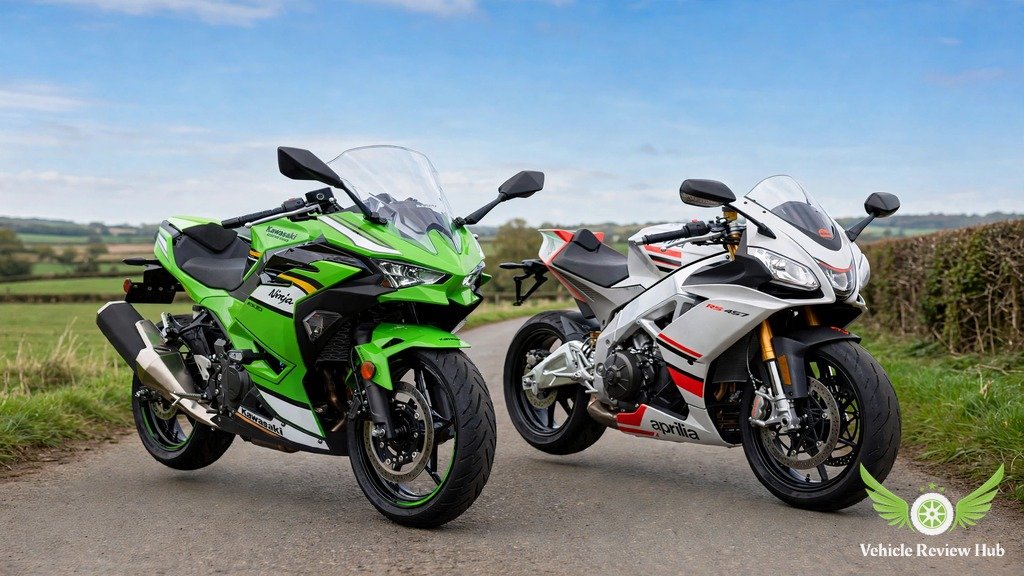
KD_06’s video below pits the Aprilia RS 457 against a Ninja 500 — the trim on screen is not confirmed as the SE KRT Edition, so treat its trim-specific claims with care. This Kawasaki Ninja 500 SE KRT Edition comparison uses it as a rival shootout, not a trim review.
Engine, Specs and Performance Side by Side
On paper the two twins are almost twins. The Kawasaki’s 451cc makes a claimed 51.0 hp at 10,000 rpm and 31.7 lb-ft at 7,500 rpm. The Aprilia’s 457cc makes a claimed 47 hp and 32 lb-ft. The Kawasaki claims more power; the Aprilia claims a touch more torque. The real difference is chassis and electronics: the RS 457 carries an upside-down fork, three riding modes, and traction control, while the SE KRT carries a 41 mm telescopic fork, no modes, and ABS only. This Kawasaki Ninja 500 SE KRT Edition comparison reads it this way: the Aprilia is the more modern motorcycle, and the Kawasaki is the lighter, simpler one.
| Figure | SE KRT Edition | Aprilia RS 457 |
|---|---|---|
| 2026 MSRP | Not sold (2025: $6,399) | $6,849 |
| Engine | 451cc parallel twin | 457cc parallel twin |
| Claimed power | 51.0 hp at 10,000 rpm | 47 hp |
| Claimed torque | 31.7 lb-ft at 7,500 rpm | 32 lb-ft |
| Weight | 379.3 lb curb | 350 lb dry / 385 lb wet |
| Power to weight | 0.134 hp per lb (claimed) | 0.122 hp per lb wet (claimed) |
| Front fork | 41 mm telescopic | Upside-down |
| Dash | Full-colour TFT, no modes | 5-inch TFT, 3 riding modes |
| Rider aids | ABS only | Traction control, ride-by-wire, 3 modes |
| Warranty | 12-month limited | 24-month |
Note: the RS 457’s wet weight of 385 lb is the figure to compare against the SE KRT’s 379.3 lb curb weight — the 350 lb dry figure is not the same basis, and this Kawasaki Ninja 500 SE KRT Edition comparison does not use it. The power-to-weight figures are both claimed-power figures, labelled as such — no US dyno exists for either bike. No instrumented figures are printed for either bike.
Price, Equipment and Which Suits Which Rider
The RS 457 costs more, and the gap is bigger than the stickers suggest. Its $6,849 MSRP sits $450 above the SE KRT’s $6,399, but Aprilia’s destination charge is dealer-set near $800, putting a delivered RS 457 near $7,649 — roughly $2,650 more than a leftover SE KRT at $4,999. The extra money buys ride-by-wire, three modes, traction control, an upside-down fork, and a 24-month warranty. This Kawasaki Ninja 500 SE KRT Edition comparison puts it plainly: the Aprilia is the better motorcycle on equipment, and the Kawasaki is the better buy on price. The Aprilia wins on equipment, the Kawasaki wins on price, and this Kawasaki Ninja 500 SE KRT Edition comparison stands by that split.
Kawasaki Ninja 500 SE KRT Edition vs Honda CBR500R
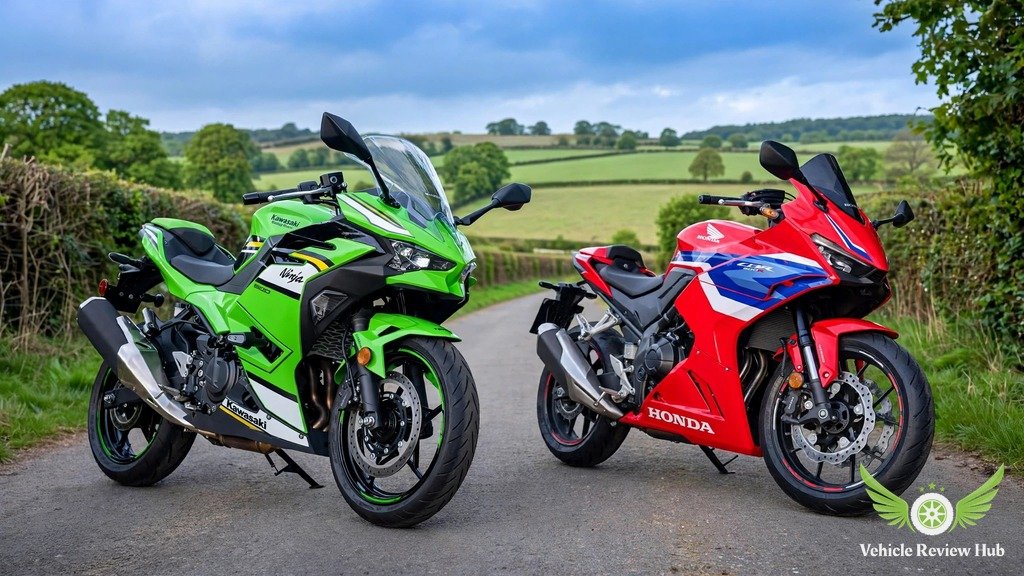
The CBR500R is the quiet rival in this Kawasaki Ninja 500 SE KRT Edition comparison, and the heaviest. Honda’s 471cc twin makes a claimed 47 hp under the European A2 cap; the only US evidence is a Cycle World dyno run at 43.20 hp at 8,280 rpm — a rear-wheel figure, not a crank figure. The Honda counters with an inverted Showa fork, dual front discs, and HSTC for the same $6,399 MSRP. The difference is weight: 421 lb against 379.3 lb.
Engine, Specs and Performance Side by Side
The engine story warns against reading figures without their basis. The SE KRT’s 51.0 hp is a claimed crank figure, ISO 4106. The CBR500R’s 47 hp is a European A2 cap figure, and the only US number is Cycle World’s rear-wheel dyno. This Kawasaki Ninja 500 SE KRT Edition comparison prints all three with their labels attached. What can be compared directly is weight and chassis: the Honda is 41.7 lb heavier, with a 55.5-inch wheelbase against 54.1, and a 31.1-inch seat against 30.9.
| Figure | SE KRT Edition | Honda CBR500R |
|---|---|---|
| 2026 MSRP | Not sold (2025: $6,399) | $6,399 |
| Engine | 451cc parallel twin | 471cc parallel twin |
| Claimed power | 51.0 hp at 10,000 rpm (ISO 4106) | 47 hp (EU A2 cap) |
| Measured power | No US dyno exists | 43.20 hp at 8,280 rpm, rear wheel (Cycle World) |
| Claimed torque | 31.7 lb-ft at 7,500 rpm | Not stated as a US figure |
| Measured torque | No US dyno exists | 29.77 lb-ft at 6,450 rpm, rear wheel (Cycle World) |
| Curb weight | 379.3 lb | 421 lb |
| Front fork | 41 mm telescopic | 41 mm inverted Showa SFF-BP |
| Front brake | Single 310 mm disc, 2-piston caliper | Dual 296 mm discs, 4-piston calipers |
| Dash | Full-colour TFT | 5-inch TFT |
| Rider aids | ABS only | HSTC traction control, ABS |
Note: the CBR500R’s measured figures are Cycle World’s rear-wheel dyno numbers, never compared against the SE KRT’s claimed crank figure. The chassis figures are from Honda’s own 2026 specifications page. This Kawasaki Ninja 500 SE KRT Edition comparison prints no top speed, quarter mile, or braking figure for either bike — none was verified.
Price, Equipment and Which Suits Which Rider
On the sticker the two bikes are level at $6,399. Delivered, they are $150 apart: the CBR500R at $6,999 with its $600 destination charge, against a 2024 SE KRT at $6,849. That $150 buys HSTC, the inverted Showa fork, and dual front discs, and costs 41.7 lb. Against a leftover SE KRT at $4,999, the Honda costs $2,000 more. This Kawasaki Ninja 500 SE KRT Edition comparison calls the CBR500R the better-equipped bike and the SE KRT the better-riding one. Lightness against equipment: that is the choice this Kawasaki Ninja 500 SE KRT Edition comparison comes down to.
Kawasaki Ninja 500 SE KRT Edition Price and Value Compared
Price is where this Kawasaki Ninja 500 SE KRT Edition comparison stops being a spec sheet and becomes a buying guide. The SE KRT’s sticker never changed at $6,399, but its real price changed twice. The 2025 charge is disputed — Motorcycle.com’s database says $600, SlashGear’s 2025 review says $650 — so a delivered 2025 was $6,999 or $7,049.
Leftover SE KRTs Reached $4,999
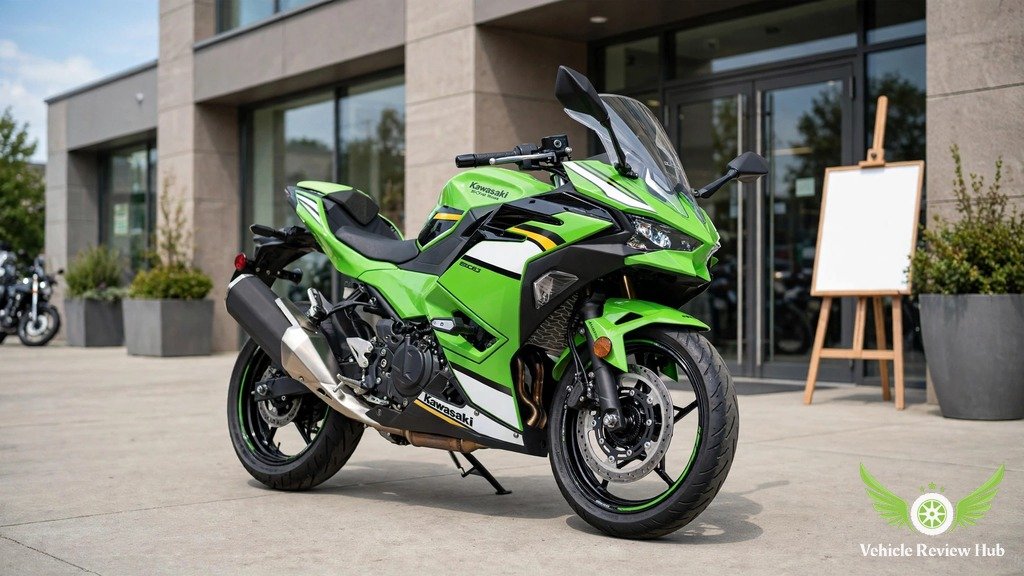
Two leftover listings were checked live in November 2026, both genuine SE KRT Editions at $4,999. Pilson Powersports, Mattoon, Illinois, lists a new 2025 Ninja 500 KRT Edition SE ABS, stock NA61166, at $4,999 — $1,400 under MSRP. Cycle Max, Honey Brook, Pennsylvania, lists a new 2025, stock A58533, at $4,999. One older cached snapshot showed $5,599 for the same stock number, so $4,999 is printed here as the November 2026 advertised price. This Kawasaki Ninja 500 SE KRT Edition comparison prints the stock numbers because a stock number is checkable, and a price without one is not.
The trap is the other $4,999. Many $4,999 listings are the non-SE KRT Edition, model code EX500H, retailed at $5,499 — a $500 discount, not $1,400. Miller’s Motorsports of Beaver Falls, Pennsylvania, is the example: a new 2025 Ninja 500 KRT Edition, model code EX500HSFAL, retail $5,499, total $4,999. Same $4,999 sign, $900 less saving, and no TFT, keyless ignition, USB-C, or tall screen. The check takes ten seconds: ask for the model code. EX500J is the SE KRT. EX500H is the non-SE KRT. Never pay $4,999 without the trim and the model code — this Kawasaki Ninja 500 SE KRT Edition comparison found three different bikes wearing the same price.
| Bike | MSRP | Destination | Delivered |
|---|---|---|---|
| 2024 SE KRT Edition | $6,399 | $450 | $6,849 |
| 2025 SE KRT Edition | $6,399 | $600 or $650 (disputed) | $6,999 or $7,049 |
| 2025 SE KRT leftover (Pilson / Cycle Max) | $6,399 | — | $4,999 advertised |
| 2026 SE ABS | $6,499 | $650 | $7,149 |
| 2027 SE ABS | $6,599 | $650 | $7,249 |
| 2027 ABS | $5,899 | $650 | $6,549 |
| 2026 CBR500R | $6,399 | $600 | $6,999 |
| 2026 Ninja 300 (revived) | $4,999 | $650 | $5,649 |
Note: the 2025 destination charge is printed as $600 and $650 because Motorcycle.com’s database and SlashGear’s 2025 review disagree, and no Kawasaki document settles it — the delivered 2025 figure is $6,999 or $7,049. The revived Ninja 300 is not a named rival in this Kawasaki Ninja 500 SE KRT Edition comparison — its $5,649 delivered price only sets the class floor, and at 388.1 lb it is 8.8 lb heavier than the SE KRT.
Running Costs and Resale Value Compared
Running costs are the same across the Kawasaki twins — the motorcycles are the same. The service chart calls for a service every 7,600 miles or yearly, with oil and filter at every service; oil is 2.3 litres with the filter, not the 400’s 2.0. The plugs are NGK LMAR9G, replaced at every service. Valve inspection falls at 15,200 miles, brake fluid at 15,200 miles or two years, chain slack 20 to 30 mm. No part prices were verified, so none are printed, and no resale percentage either — this Kawasaki Ninja 500 SE KRT Edition comparison has one used data point, not a market.
The used market for the SE KRT is thin, and that thinness is the finding. One verified used data point exists: a 2024 KRT Edition SE ABS at Crossbay Motorsports, Bay Shore, New York, with 15,413 miles, at $5,199 total in November 2026 — $1,200 under its $6,399 sticker. Two more listings were checked live, neither showing a price: a 2025 EX500 KRT SE with ABS at National Powersports, Pembroke, New Hampshire, with 823 miles, priced on application; and a used 2024 at RideNow Beach Boulevard, Jacksonville, Florida, with no price shown and no mileage stated. The used-buyer check for every 2024 bike in this Kawasaki Ninja 500 SE KRT Edition comparison is the clutch recall slice, January 22 to February 6, 2024: check the VIN and the white paint mark left of the first frame-number digit. A 2025 bike sits outside the recall entirely.
Kawasaki Ninja 500 SE KRT Edition Comparison Verdict and US Alternatives
The verdict in this Kawasaki Ninja 500 SE KRT Edition comparison is short — the numbers leave no room for more. At its $6,399 sticker the SE KRT was a paint-and-comfort choice over the identical SE ABS. At $4,999 leftover it is the best value in the 500 class, $2,150 less delivered than a new 2026 SE ABS and roughly $2,650 less than a delivered RS 457. The RS 457 is better on equipment and the CBR500R is the better-equipped Honda, but neither is $2,000 better than a leftover SE KRT. The base 500’s own comparison reaches the same conclusion from the other side.
Verdict: Buy the Leftover, Skip the Premium
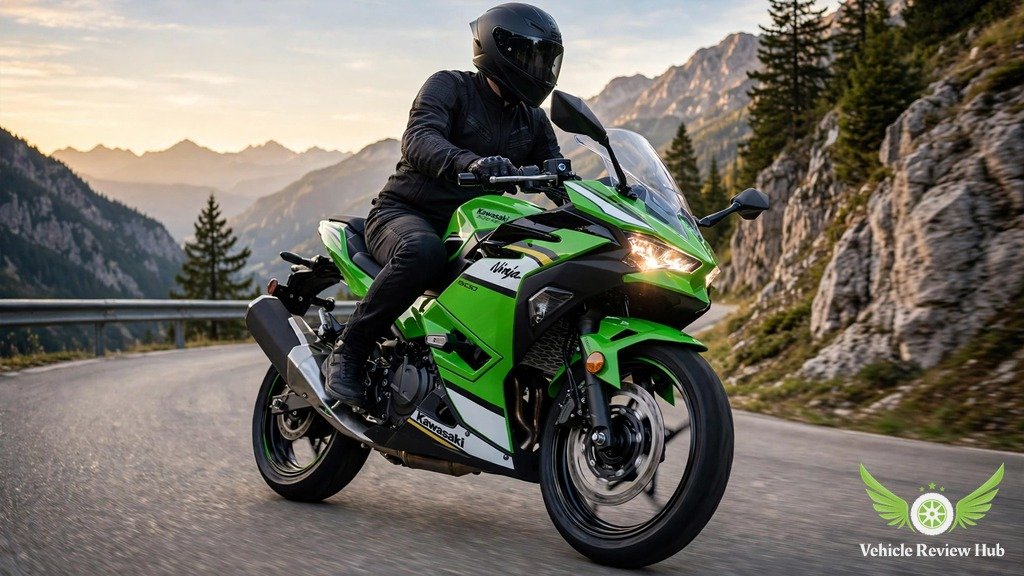
Buy the leftover. That is the verdict of this Kawasaki Ninja 500 SE KRT Edition comparison, and it holds while a verified new 2025 SE KRT sits at $4,999 with the EX500J code on its paperwork. At that price the TFT dash, keyless ignition, tall screen, frame sliders, and KRT livery cost $500 less than a base Ninja 500’s sticker. Skip the premium in both directions: do not pay $6,399 for an SE KRT when the SE ABS costs the same, nor $6,499 for a 2026 SE ABS when a leftover SE KRT costs $4,999. Check the model code, the VIN, and the white paint mark before you pay.
2026 450SS Brings Real Electronics (TC Arrived 2025)
The lateral alternative is the CFMOTO 450SS, and the year matters more than the badge. The 2026 450SS lists at $5,699: a 449cc 270-degree-crank twin with a claimed 51 hp and 29.5 lb-ft, 375 lb curb weight, upside-down fork, Brembo M40 calipers, and 0.136 hp per lb power-to-weight. But the 2023 and 2024 450SS had no traction control or ride modes at all; traction control only arrived in 2025. The 2026 and 2027 listings add traction control, tyre-pressure monitoring, RideSync, and a TFT dash. This Kawasaki Ninja 500 SE KRT Edition comparison names the year because a 2024 450SS and a 2026 450SS are different motorcycles where it matters — the electronics.
The 450SS is a lateral alternative, not a direct rival. Its freight charge is dealer-dependent, so no delivered price is printed here. Its dealer network is smaller than Kawasaki’s and its warranty is 24 months. What it offers is what the SE KRT cannot: a 51 hp twin with traction control, an upside-down fork, and Brembo brakes for $5,699. A rider who wants electronics on a budget should test the 2026 450SS before buying anything else in this Kawasaki Ninja 500 SE KRT Edition comparison. A rider who wants the KRT livery and the lowest price should buy the leftover SE KRT and never look back.
Kawasaki Ninja 500 SE KRT Edition Comparison Frequently Asked Questions
The SE KRT was a paint-and-equipment choice, not a performance one, and the smart money never paid the $6,399 sticker. This Kawasaki Ninja 500 SE KRT Edition comparison answers the six questions buyers ask most, from the identical SE ABS twin to the leftover price that makes it the best value in the 500 class.
How is the SE KRT Edition different from the plain Ninja 500 SE ABS?
It is not, mechanically. The two bikes share the same engine, weight, dash, equipment and $6,399 sticker in 2024 and 2025, so the price delta is zero. The only difference is paint: the SE ABS wears Passion Red or black, while the SE KRT wears Lime Green and Ebony with a Pearl Blizzard White accent in 2025. This Kawasaki Ninja 500 SE KRT Edition comparison treats the twin as one bike with two paint jobs. For 2026 the SE KRT is gone and the SE ABS costs $6,499, with the 2027 SE ABS at $6,599.
How does it compare with the Aprilia RS 457?
The RS 457 is the electronics leader: a 457cc twin with ride-by-wire, three riding modes, traction control, a five-inch TFT and an upside-down fork, for $6,849 MSRP. The SE KRT claims more power at 51 hp against 47, and a touch less torque at 31.7 lb-ft against 32, and it is lighter at 379.3 lb curb against 385 lb wet. Aprilia’s destination charge is dealer-set near $800, putting a delivered RS 457 near $7,649. This Kawasaki Ninja 500 SE KRT Edition comparison puts it plainly: the Aprilia is the better motorcycle on equipment, and the Kawasaki is the better buy on price.
How does it compare with the Honda CBR500R?
On the sticker the two bikes are level at $6,399. Delivered, the CBR500R is $6,999 with its $600 destination charge, against a 2024 SE KRT at $6,849. The Honda’s 47 hp is a European A2 cap figure; the only US evidence is Cycle World’s rear-wheel dyno at 43.20 hp. The Honda counters with an inverted Showa fork, dual front discs and HSTC traction control, but it is 41.7 lb heavier at 421 lb. This Kawasaki Ninja 500 SE KRT Edition comparison calls the CBR500R the better-equipped bike and the SE KRT the better-riding one.
Is a leftover SE KRT the best value?
Yes, while verified leftovers last. Two new 2025 SE KRTs were advertised at $4,999 in November 2026: Pilson Powersports in Mattoon, Illinois, stock NA61166, and Cycle Max in Honey Brook, Pennsylvania, stock A58533. That is $1,400 under the sticker, $2,150 less delivered than a new 2026 SE ABS, and roughly $2,650 less than a delivered RS 457. This Kawasaki Ninja 500 SE KRT Edition comparison is clear: find a verified SE KRT leftover, buy the leftover. The check takes ten seconds: ask for the model code. EX500J is the SE KRT. Many $4,999 listings are the non-SE KRT Edition, model code EX500H, retailed at $5,499, which is only a $500 discount.
What about the CFMOTO 450SS?
The 2026 450SS lists at $5,699: a 449cc 270-degree-crank twin with a claimed 51 hp and 29.5 lb-ft, 375 lb curb weight, an upside-down fork and Brembo M40 calipers. The year matters more than the badge: the 2023 and 2024 450SS had no traction control or ride modes at all, and traction control only arrived in 2025. Its freight charge is dealer-dependent, so no delivered price is printed here, and its warranty is 24 months. This Kawasaki Ninja 500 SE KRT Edition comparison names the year because a 2024 450SS and a 2026 450SS are different motorcycles where it matters: the electronics.
What should I pay for a used SE KRT?
There is no used price band and no resale percentage, because only one used data point was verified: a 2024 KRT Edition SE ABS at Crossbay Motorsports in Bay Shore, New York, with 15,413 miles, at $5,199 total in November 2026, which is $1,200 under its $6,399 sticker and $200 more than a new leftover. Two more listings were checked live, neither showing a price. For every 2024 bike, the used-buyer check is the clutch recall slice, 22 January to 6 February 2024: check the VIN and the white paint mark left of the first frame-number digit. A 2025 bike sits outside the recall entirely. This Kawasaki Ninja 500 SE KRT Edition comparison has one used data point, not a market, so it prints no band.