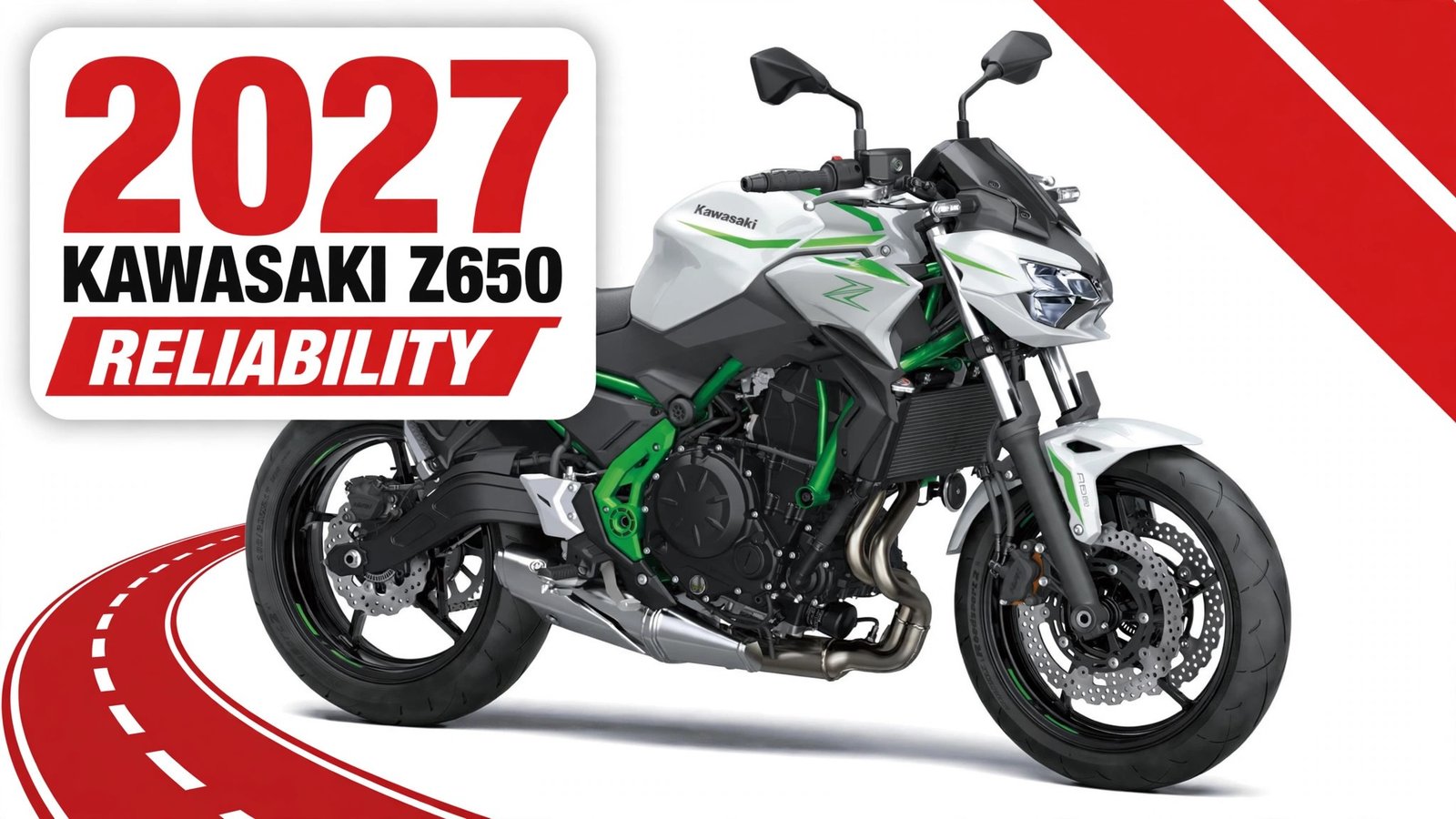
The Kawasaki Z650 has the cleanest recall record a buyer can hope for: zero recalls on its own NHTSA record, across every model year from 2017 to 2027. That does not make it maintenance-free — no bike is — but it does mean the ownership story is about servicing, not campaigns. This Kawasaki Z650 reliability guide works from the bike’s own manuals, not from aggregator pages, and the manuals are unusually clear: oil and filter every 7,500 miles, valve clearances inspected at 15,000 US miles, and a chain that asks for lube every 400 miles.
The same manuals are also why this Kawasaki Z650 reliability guide corrects the internet so often: aggregator pages print a 6,000-mile oil interval and a 42,000 km valve interval for this bike, and both are wrong for a US Z650. The sections below give the manual figures and name the errors — including the two Ninja 650 recalls so often listed against the wrong bike.
Kawasaki Z650 Reliability Overview
This Kawasaki Z650 reliability overview starts with the headline fact and then looks at what actually decides whether a used Z650 is a good buy. A clean recall record is a strong start, but mileage, storage and previous care matter more than any single specification. The Z650 is a simple machine — a 649cc parallel twin in a steel trellis frame, with no ride-by-wire, no IMU and no cornering ABS — and simple machines age well when they are serviced on time, which is the whole of Kawasaki Z650 reliability.
Zero Recalls on Its Record
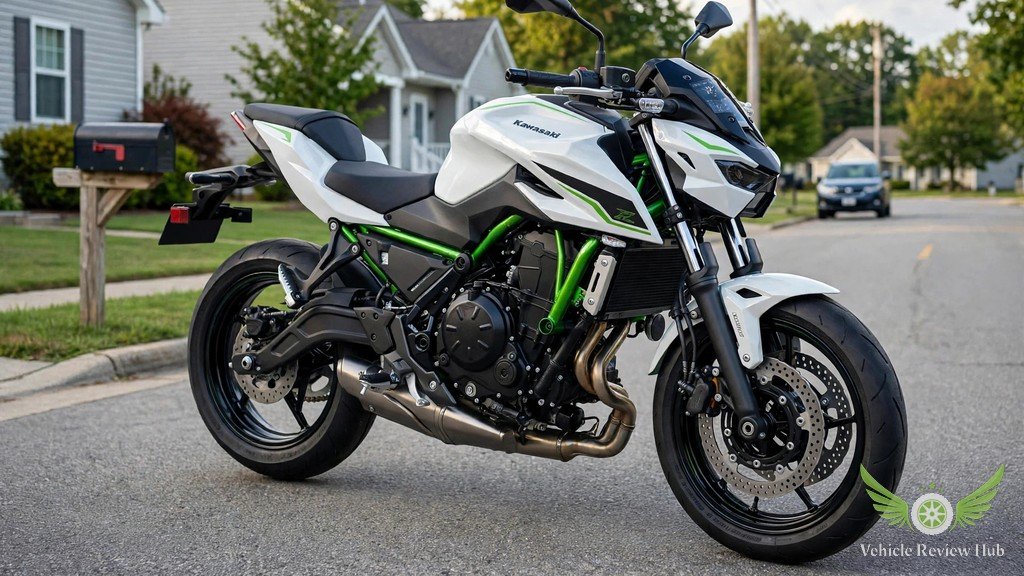
The strongest fact in this Kawasaki Z650 reliability guide is also the simplest: the Z650 has zero recalls on its own NHTSA record. The NHTSA recalls API returns Count 0 for every model year from 2017 to 2027, under both the “z650” and “er650” model names, and no Part 573 recall report for a Z650 was found. That is the bike’s own record — not the Ninja 650’s, and not a platform average. A buyer checking a Z650 by VIN should still run the check, because a clean model record does not guarantee a clean individual bike, but there is no campaign to look for.
How Mileage, Storage and Previous Care Affect Reliability
On a used Z650, the previous owner’s habits matter more to Kawasaki Z650 reliability than the model year. The Z650’s engine is a low-stress 649cc twin making a claimed 67.0 hp at 8,000 rpm on the 2027 Z650 S ABS spec sheet, and it tolerates mileage well — but only if the oil was changed on the manual’s schedule. This Kawasaki Z650 reliability guide treats service records as the first thing to ask for, because a missing record is the one defect no inspection can undo.
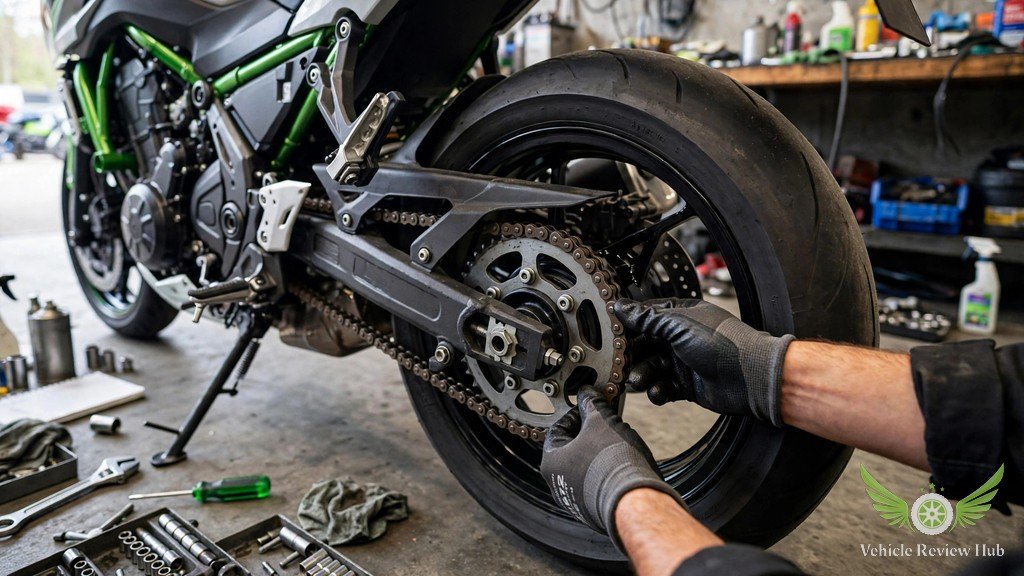
Storage matters because the Z650 is a steel-trellis bike with exposed fasteners and a chain final drive. A bike kept outside gathers corrosion on the chain and the fasteners, and a chain left dry for a season wears its sprockets faster than a chain lubed every 400 miles. Previous care shows in the small things: a clean chain, fresh brake fluid, tyres within their age, and a battery that holds a charge.
Kawasaki Z650 Common Problems and Wear Items
This Kawasaki Z650 reliability section deals with the problems buyers ask about first — and the honest answer is that the verified record is thin. There is no widely documented failure pattern for the Z650: no cam-chain-tensioner campaign, no clutch-shaft recall, no stator failure and no stop-sale. What follows is what testers and owners actually reported about Kawasaki Z650 reliability, kept separate from what was never documented.
Ninja’s Recalls Aren’t Its
The most common error in Z650 reliability pages is the easiest to correct: two Ninja 650 recalls are routinely listed against the Z650. Campaigns 10V-323 (2010, brake pedal) and 12V-081 (2012, footpeg circlips) belong to the Ninja 650, and both predate the Z650 entirely — the Z650 did not reach the US market until 2017. They are not this bike’s recalls, and no Z650 owner needs to check for them.
The confusion is understandable, because the two bikes share the 649cc platform and the Ninja 650 is the Z650’s faired twin. But a recall follows a model and a VIN range, not a platform, and the Z650’s own NHTSA record is clean.
Watch Items Stay Thin
The documented watch items for the Z650 are few, and they are annoyances rather than failures. Testers consistently report a vibration buzz between 4,000 and 5,000 rpm and again around 7,000–8,000 rpm — ZigWheels, Bennetts and Motorcycle.com all found it, and in Motorcycle.com’s 2017 shootout the tester put it plainly: more high-rpm vibration than the other bikes in the shootout, “but it never becomes annoying”. It is a comfort note, not a Kawasaki Z650 reliability defect, and no tester called it a deal-breaker.
The second watch item is the suspension: the Z650 won the Handling and Suspension categories in Motorcycle.com’s 2017 five-way shootout, but its springs are the softest of the group. Soft springs are a ride-quality choice, not a failure. Beyond those two items, the verified record is quiet: no widely documented failure pattern exists for this bike, and this Kawasaki Z650 reliability guide will not invent one.
Kawasaki Z650 Maintenance Schedule and Servicing
This Kawasaki Z650 reliability section gives the service schedule from the bike’s own owner’s-manual chart — the 2017 and 2021 manuals. The chart’s columns run 0.6 / 7.5 / 15 / 22.5 / 30 thousand miles, which is 1 / 12 / 24 / 36 / 48 thousand kilometres. Every figure below comes from that chart or from Service Manual 99924-1516-01, and where an aggregator disagrees with the chart, the chart wins on Kawasaki Z650 reliability.
Valves at 15,000 US Miles
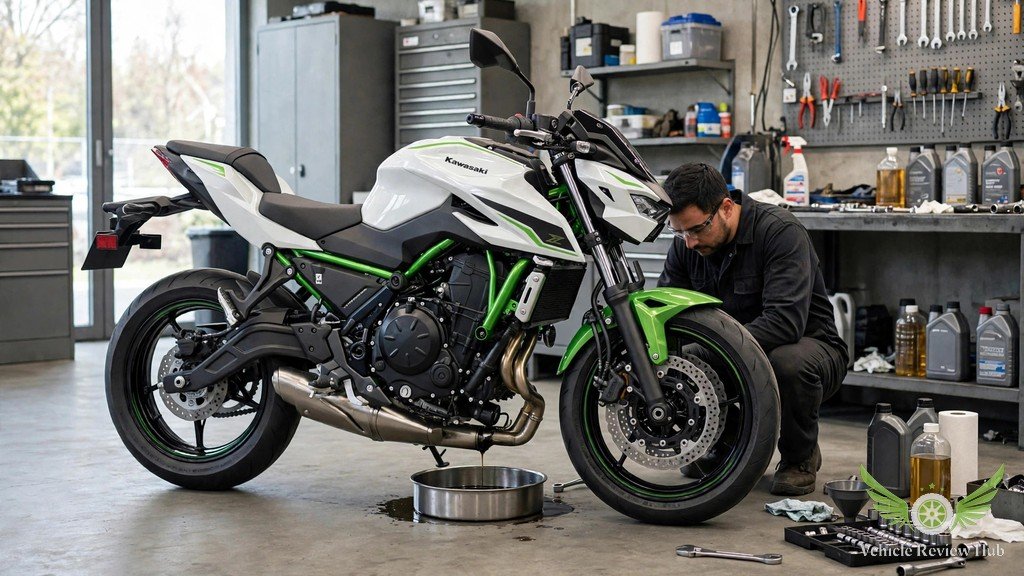
The valve check is the biggest single service on the Z650. The owner’s-manual chart says to inspect the valve clearances at 15,000 US miles (24,000 km) and every 15,000 miles after. The chart’s mile column reads 15,200 miles for the 24,000 km column; the US rounded figure is 15,000 miles, and this Kawasaki Z650 reliability guide prints “15,000 miles (24,000 km)”. The clearances themselves are 0.22–0.31 mm exhaust and 0.15–0.21 mm intake — values for the workshop.
The 42,000 km figure that appears on some pages is the non-US interval only. The service manual prints it as “Valve clearance (Other than US and CA Models): every 42,000 km / 26,250 mi”, and it is never the US figure. A US owner who waits 42,000 km — about 26,000 miles — has missed the 15,000-mile check by eleven thousand miles. The same US/non-US split applies to the Ninja 650, which is how the wrong figure crosses into Kawasaki Z650 reliability pages: a page that copies the global manual without reading the US line prints the wrong interval for an American bike.
Oil Is 7,500, Not 6,000
The first service comes at 600 miles (1,000 km), and after that the rhythm is simple: oil and oil filter are replaced at every service, every 7,500 miles or 12,000 km, or yearly — and the same service also replaces the air cleaner element and the spark plugs. MCN’s “Mid-size marvels” piece corroborates the rhythm in one line: “oil, filter, air filter, and plugs every 7500 miles; valve clearances every 15K.”
Aggregator pages that print a 6,000-mile oil interval for this bike are wrong, and so is MotoSpecDB’s “18,000 km air filter / 12,000 km plug” — the chart replaces both at every 7,500-mile service. The error matters for Kawasaki Z650 reliability because a buyer who follows the aggregator changes the oil early and the plugs late, which is exactly backwards. The oil itself is SAE 10W-40 (API SG/SH/SJ/SL/SM with JASO MA/MA1/MA2); capacity is 1.8 litres with a filter change, 1.6 litres drain-only, and 2.3 litres dry. The filter is part 16097-0008, torqued to 17.5 Nm, and the drain bolt takes 30 Nm.
| Service item | Interval | Notes |
|---|---|---|
| First service | 600 miles (1,000 km) | Break-in service |
| Engine oil + oil filter | Every 7,500 miles / 12,000 km or yearly | SAE 10W-40; 1.8 L with filter |
| Air cleaner element | Every 7,500 miles | Replaced at every service |
| Spark plugs (NGK CR9EIA-9 ×2) | Every 7,500 miles | Gap 0.8–0.9 mm; torque 13 Nm |
| Valve clearances — inspect | 15,000 US miles (24,000 km), then every 15,000 miles | Chart column reads 15,200 miles; exhaust 0.22–0.31 mm, intake 0.15–0.21 mm |
| Coolant, water hoses + O-rings | 22,500 miles / 36,000 km, then every 3 years | Coolant capacity 1.20 L |
| Brake fluid | 15,000 miles, then every 2 years | DOT 4 |
| Fuel filter | 15,000 miles and 30,000 miles | Fuel hose 5 years; brake hoses 4 years |
| Chain lube / slack check | Lube every 400 miles; slack check every 600 miles | Slack 20–30 mm |
Note: This Kawasaki Z650 reliability service table is taken from the owner’s-manual periodic maintenance chart and Service Manual 99924-1516-01. The 6,000-mile oil interval printed by some aggregators is wrong, and the 42,000 km valve figure is the non-US interval only — neither appears in this table as a US figure.
Kawasaki Z650 Tires, Brakes and Suspension Maintenance
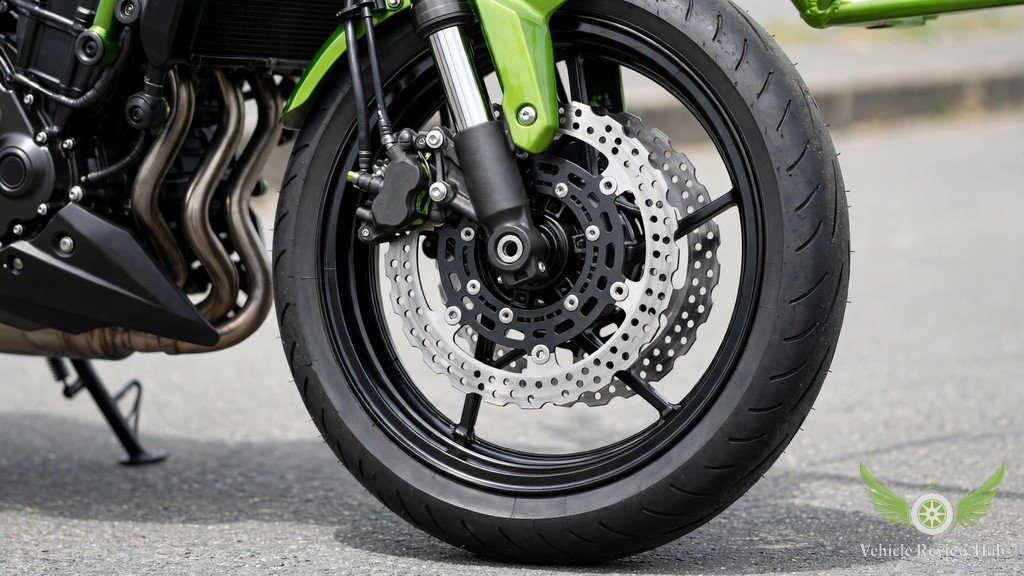
This Kawasaki Z650 reliability section covers the wear items a buyer can check in ten minutes with a gauge and a ruler: tyres, brakes and suspension. The Z650’s hardware is straightforward — dual 300 mm petal discs with two-piston calipers and ABS up front, a single 220 mm petal disc with a single-piston caliper and ABS at the rear, a 41 mm telescopic fork and a preload-adjustable rear shock — and none of it asks for anything exotic. Ultimate Motorcycling’s 2017 three-way comparison noted the Z650 “gets the steepest rake (by 0.8 degrees), and a short wheelbase” — a 24.0-degree rake, 3.9-inch trail and 55.5-inch wheelbase.
Manual Filings Aren’t Recalls
A buyer searching the Z650 on NHTSA’s site may find manufacturer communications filed for the bike — and may read them as recalls. They are not. A manufacturer communication is a technical service bulletin: a note from the maker to its dealers about a known symptom or a repair procedure. A recall is a safety campaign with a numbered population, a remedy and an owner notification.
This matters for the Z650 precisely because its recall record is clean: if a listing claims a Z650 “recall” but the only document behind it is a manufacturer communication, the claim is wrong. The Kawasaki Z650 reliability check is simple: ask for the campaign number. A real recall has one; a bulletin does not. The NHTSA recalls API is the authority for recalls, and for the Z650 it returns Count 0.
Tire, Brake and Suspension Checks That Matter
Tyre pressures are the cheapest Kawasaki Z650 reliability check on the bike and the one most often skipped. The manual prints 225 kPa front and 250 kPa rear, cold — and the manual prints 32 psi for the front. Print the kPa figures first, because that is what the manual leads with; the manual’s front figure is 32 psi. The tyres are 120/70ZR17 front and 160/60ZR17 rear, Dunlop Sportmax D214 stock.
Brakes ask for two Kawasaki Z650 reliability checks: pad thickness and fluid age. The front pads are EBC FA226HH across both calipers and the rear is EBC FA174HH, and the fluid is DOT 4, replaced at 15,000 miles and then every two years. Brake fluid absorbs water with age, so a bike with fresh pads and five-year-old fluid still needs the fluid changed. The 41 mm telescopic fork is non-adjustable up front, the rear shock adjusts for preload only, and the check is for leaking fork seals.
| Item | Specification | Service notes |
|---|---|---|
| Tyre pressures (cold) | 225 kPa front / 250 kPa rear | Manual prints 32 psi front; check weekly |
| Tyres | 120/70ZR17 front / 160/60ZR17 rear | Dunlop Sportmax D214 stock |
| Front brakes | Dual 300 mm petal discs, 2-piston calipers + ABS | Pads EBC FA226HH (both calipers) |
| Rear brake | Single 220 mm petal disc, single-piston caliper + ABS | Pads EBC FA174HH |
| Brake fluid | DOT 4 | Replace at 15,000 miles, then every 2 years |
| Chain slack | 20–30 mm (0.8–1.2 in.) | Check every 600 miles; lube every 400 miles |
| Fork / rear suspension | 41 mm telescopic fork; preload-adjustable rear shock | Check fork seals for leaks; rear preload only |
| Clutch / throttle free play | 2–3 mm each | Battery YTZ10S 12V 8.6Ah |
Note: This Kawasaki Z650 reliability wear-item table is taken from Service Manual 99924-1516-01 and the owner’s manual. Tyre pressures are printed in kPa first, as the manual prints them; the front pressure converts to 32 psi in the manual, not the rounded-up figure some aggregators print.
Kawasaki Z650 Maintenance and Ownership Costs
This Kawasaki Z650 reliability section looks at what the bike costs to keep, not just what it costs to buy. The 2027 Z650 S ABS is $7,899 plus $685 destination, or $8,584 delivered — the cheapest delivered bike in its middleweight class — and the running costs follow the same pattern. The price story is in the Kawasaki Z650 review blog; this Kawasaki Z650 reliability section is about the money after the purchase.
Fuel, Routine Servicing, Tires and Replacement Parts
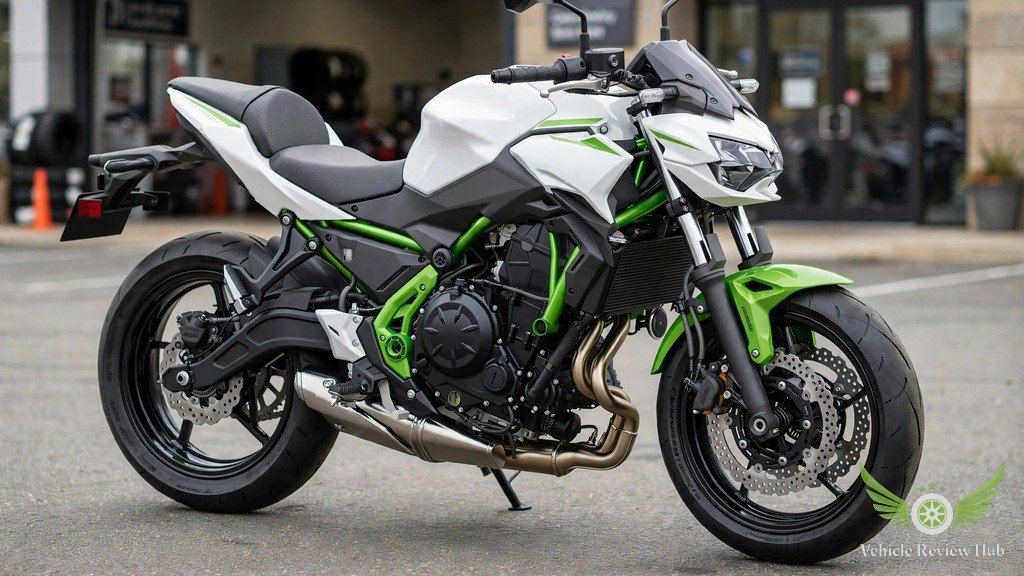
Fuel is the smallest running cost and the easiest to predict. Kawasaki publishes no MPG figure for the Z650, but the observed figures cluster tightly: Motorcycle.com observed 44 mpg in its 2017 shootout, and Bennetts saw about 53 mpg in normal riding and 50 mpg riding hard. With a 4.0-gallon tank that works out to roughly 175–210 miles between fill-ups. MCN’s review page lists a 165-mile tank range, and the full economy record is in the Kawasaki Z650 performance blog. Routine servicing follows the 7,500-mile rhythm: oil and filter, air filter and plugs at every service, with the valve inspection landing at 15,000 miles.
Replacement parts are where the Z650’s shared platform pays off: the bike shares its engine and much of its running gear with the Ninja 650, so filters, plugs, pads and chains are common stock at any Kawasaki dealer. Tyres are the biggest single consumable, and their life depends on riding style more than on any schedule. Dealer labour rates vary by region, so this Kawasaki Z650 reliability guide gives the service intervals and part numbers rather than a made-up dollar total.
42,000 km Is Not the US Figure
This heading exists because the 42,000 km valve figure is the single most expensive Kawasaki Z650 reliability mistake a Z650 owner can make from reading the wrong manual. The service manual prints the 42,000 km interval with the words “Other than US and CA Models” in front of it, and the US figure is 15,000 miles (24,000 km). An owner who follows the global figure waits about 26,000 miles between valve checks — eleven thousand miles past the US interval.
The same caution applies to every figure in this Kawasaki Z650 reliability guide: check the model designation before the number. The US bike is the one this guide covers, and its intervals are 7,500 miles for oil, filter, air filter and plugs, 15,000 miles for valves and brake fluid, and 22,500 miles for coolant. The used market rewards the same care — live Cycle Trader listings in November 2026 showed 2023 Z650s from $3,990 to $6,997 and 2024s from $6,249 to $6,997.
| Cost item | When it comes due | What it involves |
|---|---|---|
| Fuel | Every ride | 44–53 mpg observed; 4.0-gallon tank; roughly 175–210 miles per tank |
| Routine service | Every 7,500 miles or yearly | Oil + filter, air filter, plugs; filter 16097-0008, plugs NGK CR9EIA-9 ×2 |
| Valve inspection | 15,000 US miles, then every 15,000 miles | Largest single service; 42,000 km is the non-US interval only |
| Tyres | By wear and age | 120/70ZR17 front / 160/60ZR17 rear; Dunlop Sportmax D214 stock |
| Brake pads + fluid | Pads by wear; fluid at 15,000 miles, then every 2 years | Pads EBC FA226HH front / FA174HH rear; fluid DOT 4 |
| Chain + sprockets | Lube every 400 miles; slack check every 600 miles | Slack 20–30 mm; a dry chain wears sprockets faster |
| Coolant + hoses | 22,500 miles, then every 3 years | Coolant capacity 1.20 L |
Note: This Kawasaki Z650 reliability cost table lists when each item comes due and what it involves, using the owner’s-manual chart and the service manual. Dealer labour rates vary by region, so no dollar total is printed here — the intervals and part numbers above are what a dealer quotes against. Used prices are the November 2026 Cycle Trader range: 2023 Z650s $3,990–$6,997, 2024s $6,249–$6,997.
How to Keep a Kawasaki Z650 Reliable
This Kawasaki Z650 reliability section is the short version of everything above: the habits that keep a Z650 reliable are the same habits the manual asks for, done on time — and that is what keeps the bike reliable. The full rival picture is in the Kawasaki Z650 comparison blog.
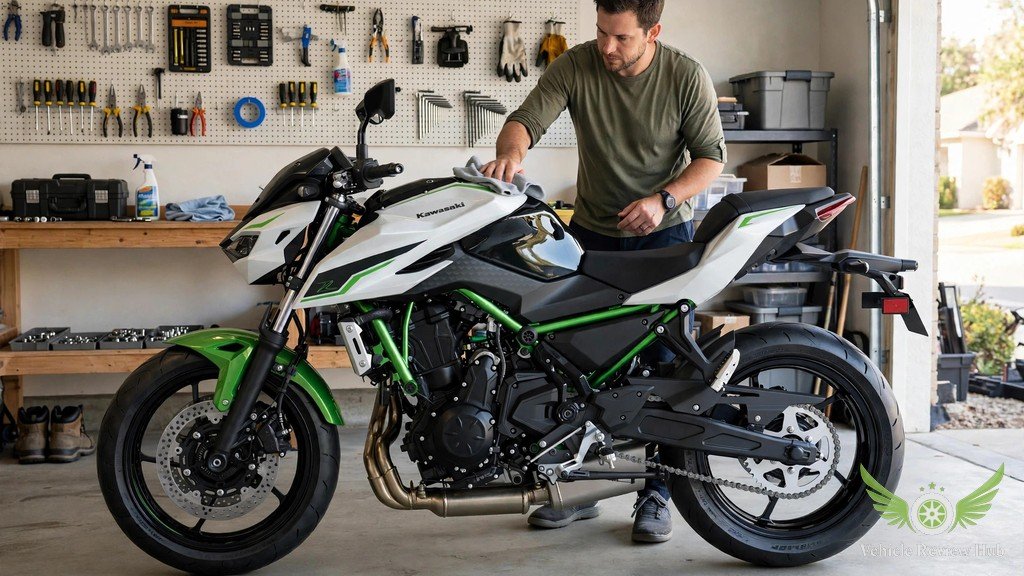
In the video below, a UK owner gives his honest opinion on the Kawasaki Z650 after three years of ownership. It is a UK bike and a UK owner’s experience — the same 649cc twin as the US bike, so the ownership lessons carry across, but the bike on screen is not a US-market machine.
Preventive Maintenance, Records and Regular Inspections
Preventive maintenance for Kawasaki Z650 reliability is a short list, and it works because the bike is simple. Change the oil and filter every 7,500 miles, replace the air filter and plugs at the same service, check the valve clearances at 15,000 miles, change the brake fluid at 15,000 miles and every two years after, and change the coolant at 22,500 miles. That is the whole programme, and a bike that gets it on time is a bike with Kawasaki Z650 reliability built in and no known failure pattern waiting in its future.
Records are the second half of the Kawasaki Z650 reliability programme. A stamped service book or a folder of receipts is worth more than a clean-looking bike with no history, because the two most expensive things on a Z650 — the valve inspection and the tyres — are also the two things a seller can hide. In Motorcycle.com’s 2017 shootout, the testers ranked the Z650 runner-up overall and first in Handling and Suspension.
VIN Check Still Comes First
Before any money changes hands, the first Kawasaki Z650 reliability step is to run the VIN through NHTSA’s recall lookup. The Z650’s model record is clean — zero recalls, Count 0 for every year 2017–2027 — but the VIN check is the authority for the individual bike, not the model page. A bike with a clean record can still hide crash damage, a salvage title or a skipped valve service. The VIN check takes two minutes and answers the one question no test ride can.
After the VIN, the checks are the ones this Kawasaki Z650 reliability guide repeats: service records showing oil every 7,500 miles and valves at 15,000, a lubed chain within its 20–30 mm slack, tyres within their age, and brake fluid within its two-year change. A well-kept Z650 has no widely documented failure pattern to fear, and the clean recall record means the buyer is shopping for condition, not for campaigns.
Kawasaki Z650 Reliability: Frequently Asked Questions
These are the questions buyers ask most about Kawasaki Z650 reliability — answered with only what the manuals and the NHTSA record can verify.
Does the Kawasaki Z650 have any recalls?
Zero on its own NHTSA record — the API returns Count 0 for every model year 2017–2027 under both “z650” and “er650”. The Ninja 650’s 2010 and 2012 campaigns are not this bike’s.
How often does the Z650 need an oil change?
Oil and filter every 7,500 miles or 12,000 km, or yearly, per the owner’s-manual chart. Aggregators that print 6,000 miles are wrong.
When do the Z650’s valves need checking?
Inspect the valve clearances at 15,000 US miles (24,000 km) and every 15,000 miles after. The 42,000 km figure is the non-US interval only — never the US figure.
What oil does the Z650 take?
SAE 10W-40 (API SG/SH/SJ/SL/SM, JASO MA/MA1/MA2). Capacity is 1.8 litres with a filter change, 1.6 litres drain-only, 2.3 litres dry. The filter is part 16097-0008.
What are the Z650’s tyre pressures and chain slack?
225 kPa front and 250 kPa rear, cold. Chain slack is 20–30 mm, checked every 600 miles and lubed every 400 miles.
What should I check before buying a used Z650?
Run the VIN through NHTSA’s recall lookup first, then check service records (oil every 7,500 miles, valves at 15,000), chain and sprockets, tyre age, and brake-fluid age. A well-kept Z650 has no widely documented failure pattern to fear.