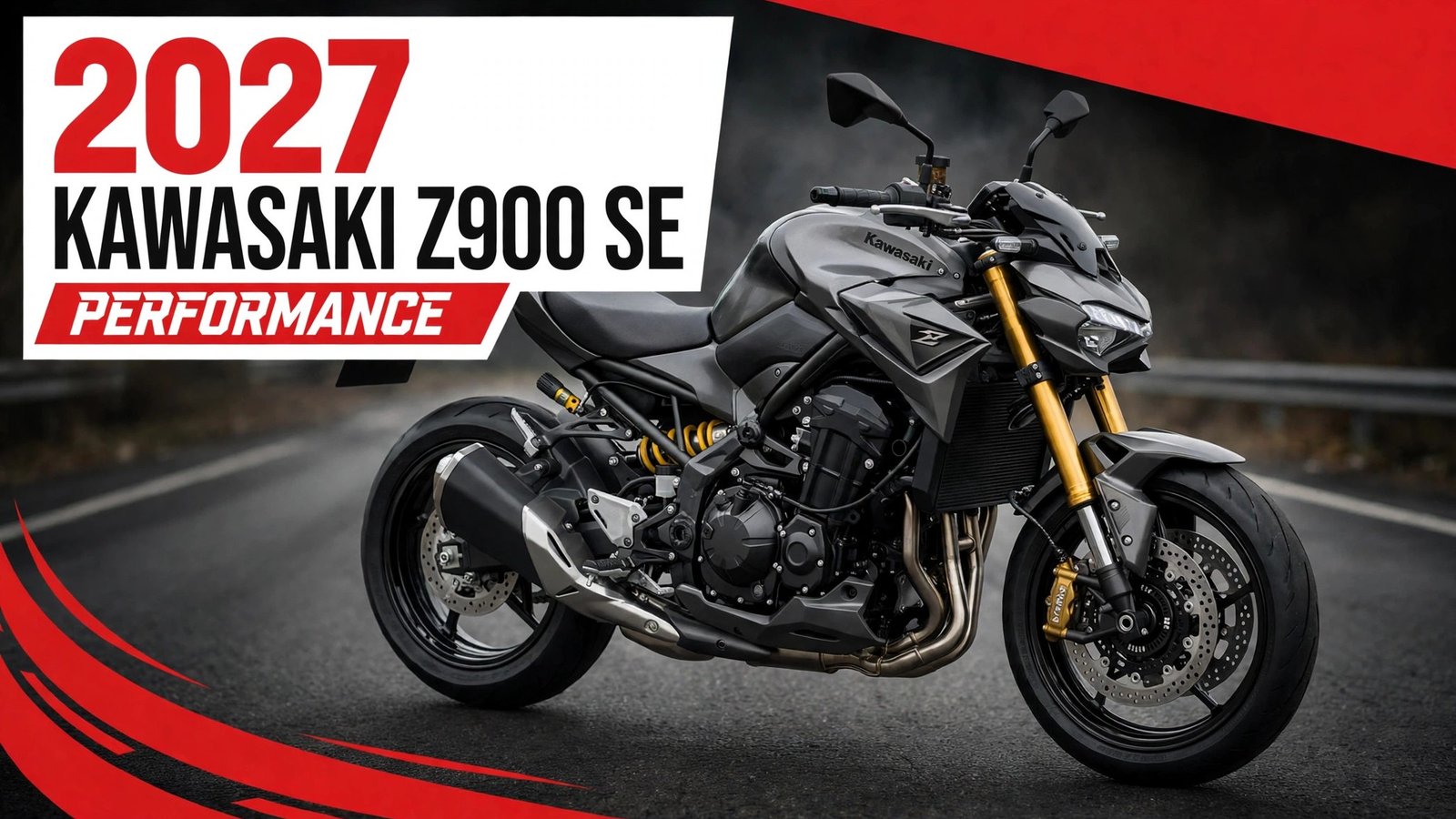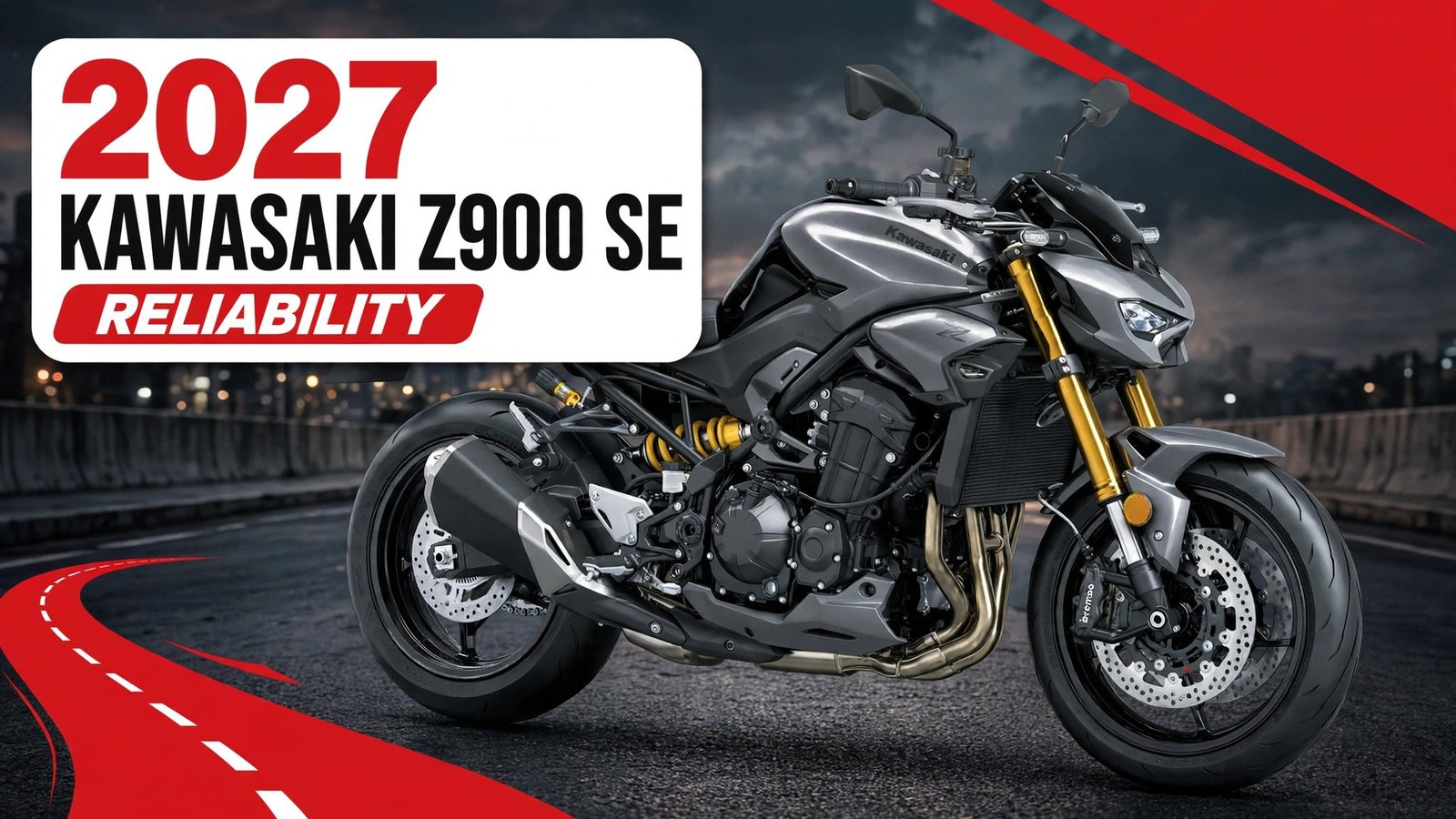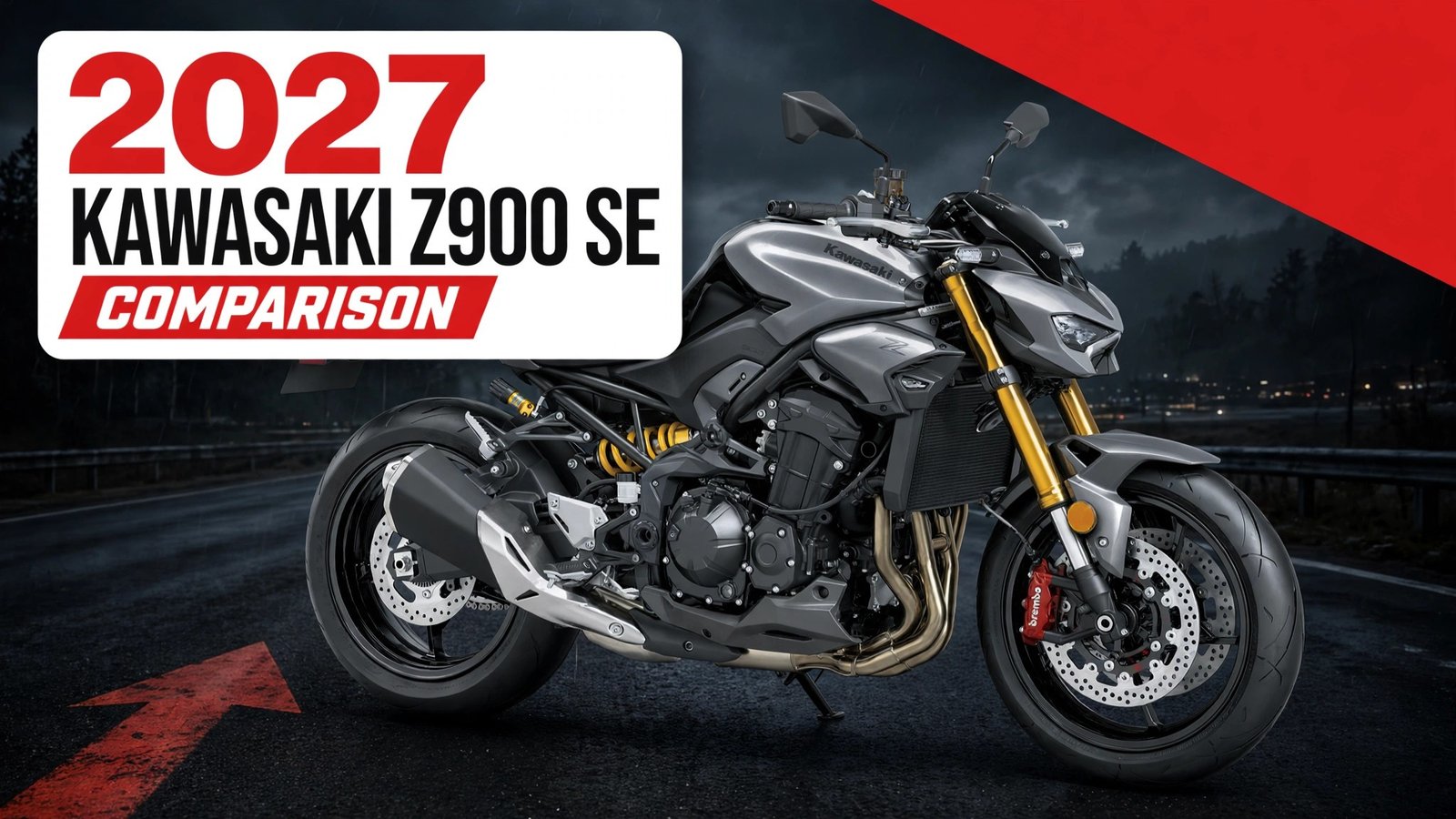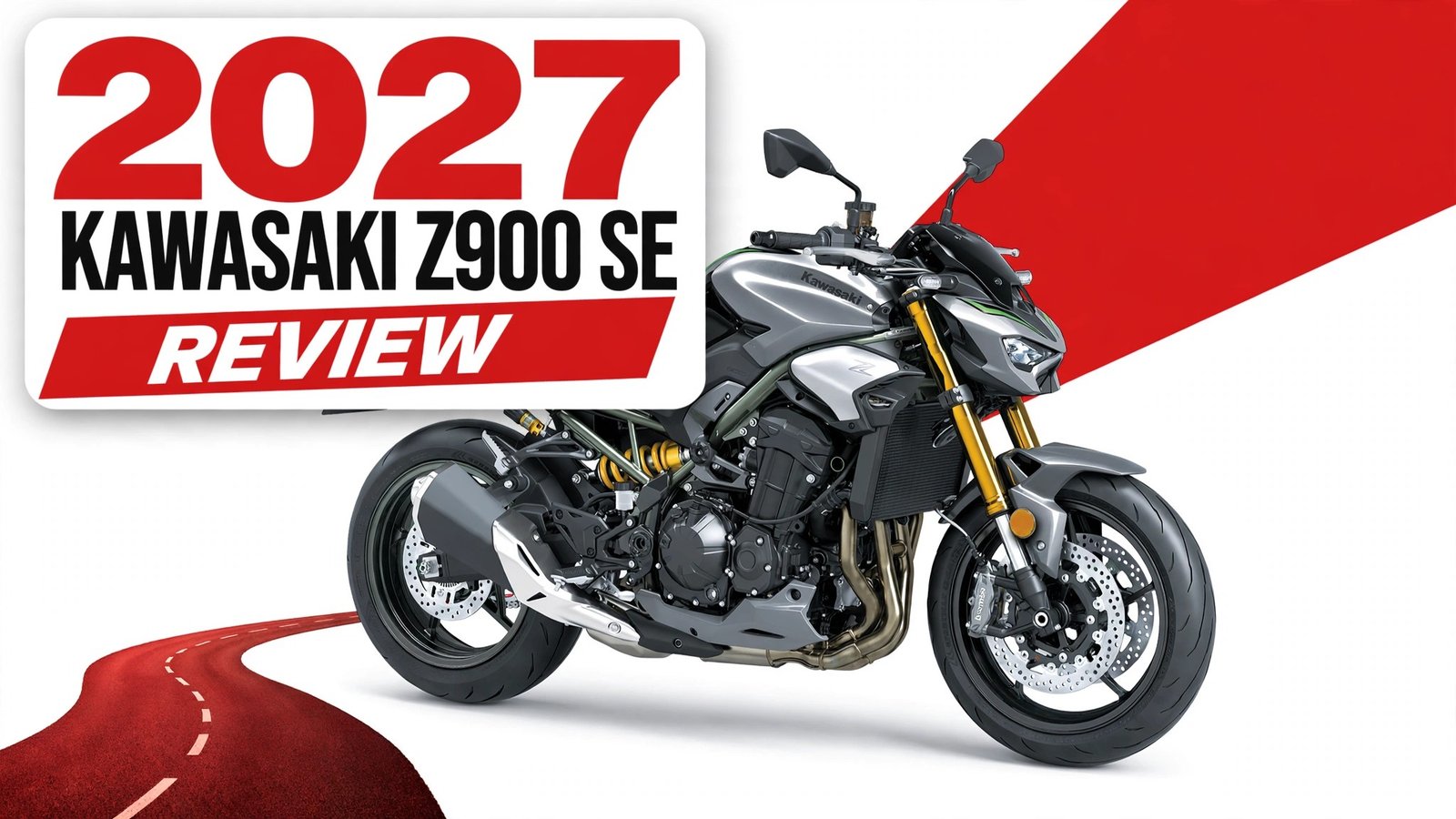
The 2027 Kawasaki Z900 SE costs $12,199 before destination, and $13,039 delivered — $2,000 more than the base Z900, for Brembo brakes, an Öhlins rear shock and a gold fork. This Kawasaki Z900 SE review starts with the question every buyer asks first: is that hardware worth two thousand dollars on a bike that makes exactly the same power as the standard one?
The short answer, from Cycle News’s 2022 first ride of the Gen 1 bike, is that the braking and suspension alone were “worth the money alone.” What this Kawasaki Z900 SE review found, tracing the SE from 2022 to the 2027 bike, is that the verdict still holds — but the premium has grown from $1,500 to $2,000, the fork’s brand is still disputed, and the SE finished last in the 2025 middleweight shootout.
Kawasaki Z900 SE Overview and Model-Year Updates
The SE is not a different motorcycle: it is the base Z900 ABS with a factory hardware package bolted on. The first thing this Kawasaki Z900 SE review had to settle is what that package has cost in every year, because the premium moved twice while the hardware barely changed.
Premium Was $1,500 Flat
Kawasaki held the SE premium at $1,500 flat across all three Gen 1 years: $10,699 against a $9,199 base in 2022, $10,899 against $9,399 in 2023, and $11,399 against $9,899 in 2024. The 2024 figures come from Kawasaki’s own spec sheet; the Motorcycle.com database lists $11,299 and $9,799 instead, and the premium is $1,500 on either side of that $100 disagreement. The premium then stepped to $1,850 in 2025 and to $2,000 in 2026 and 2027. Across the Gen 1 years, this Kawasaki Z900 SE review found the premium story simple: three years, one number — the creep came with the 2025 redesign.
Two SE Generations
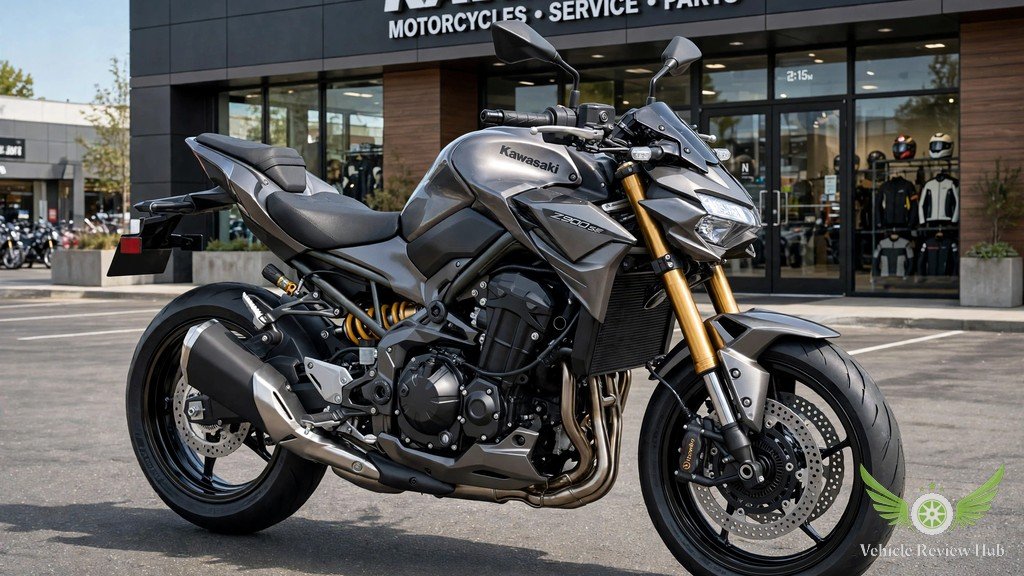
The SE comes in two generations, split by the 2025 redesign. The Gen 1 bike (2022–2024) is the cable-throttle Z900: no IMU, no quickshifter, no cruise control, a 4.3-inch TFT, petal discs, a 125 hp claim and a 31.5-inch seat. The Gen 2 bike (2025–2027) is the redesigned base bike with the SE package carried over unchanged: a five-axis IMU with cornering ABS, ride-by-wire, a quickshifter and cruise control, a 5-inch TFT, round discs, a 123.0 hp claim and a 31.9-inch seat. The SE hardware — Brembo M4.32 calipers, steel-braided lines, the Öhlins S46 shock and the gold fork — did not change in 2025; the bike around it did.
That distinction matters for buyers: a 2024 SE is the last pre-IMU SE, and a 2025 SE rides like a modern bike. This Kawasaki Z900 SE review treats the two generations as different buying decisions, not one bike with a facelift.
| Item | Gen 1 SE (2022–2024) | Gen 2 SE (2025–2027) |
|---|---|---|
| Electronics | No IMU; cable throttle; KTRC; no quickshifter; no cruise | IMU; ride-by-wire; KQS quickshifter; cruise control |
| Engine claim (US) | 125 hp @ 9,500 rpm | 123.0 hp @ 9,500 rpm (ISO 4106) |
| Torque (US) | 73.1 lb-ft @ 7,700 rpm | 73.1 lb-ft @ 7,700 rpm |
| Front fork | 41 mm inverted, gold (brand conflicted) | 41 mm inverted, gold, KYB |
| Rear shock | Öhlins S46, rebound + remote preload | Öhlins S46, rebound + remote preload |
Note: The SE package — Brembo brakes, Öhlins shock, gold fork — is identical in both generations; the changes in this table are the base bike’s 2025 redesign, as this Kawasaki Z900 SE review explains below.
One more fact belongs in the overview: no recall names a 2022-on bike. The NHTSA record shows three campaigns — 17V703 (2017–2018, shock mount holes), 18V866 (2018, hose and wire routing) and 19V083 (2019, service brakes and ABS contamination) — and all pre-dating the SE, which launched as a 2022 model. The 24V270 campaign is RS-only, not this bike’s recall. SE owners check by VIN; no SE owner action is required for any of these campaigns.
Kawasaki Z900 SE Engine and Specifications
The engine is where this Kawasaki Z900 SE review delivers its shortest verdict: the SE’s engine is the base bike’s engine, unchanged — same 948cc inline-four, same claim, same torque, every year. The premium buys no power at all.
Same Power as Standard
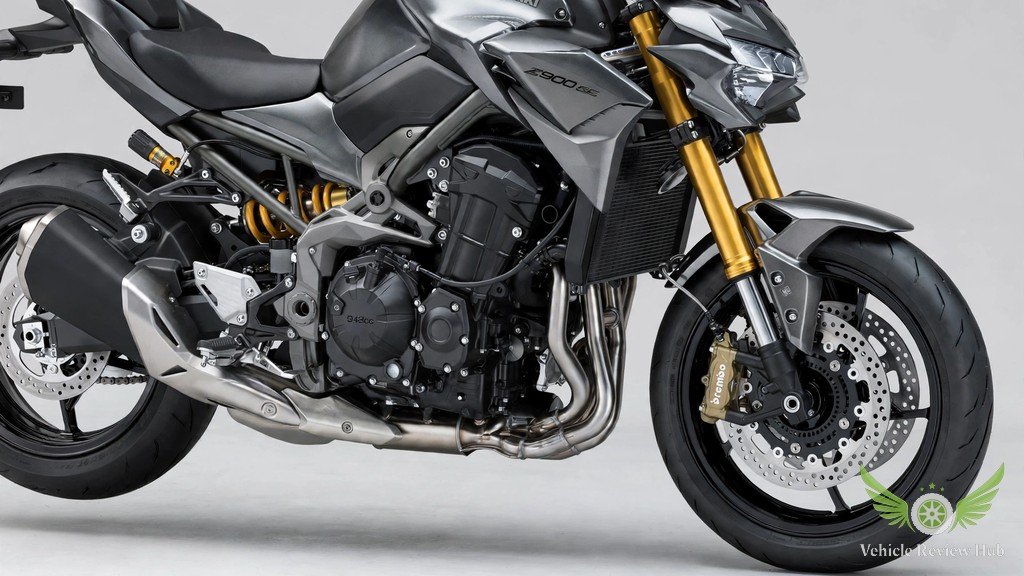
The numbers are the base bike’s numbers: before 2025 the US claim is 125 hp at 9,500 rpm; from 2025 it is 123.0 hp at 9,500 rpm (ISO 4106), with torque at 73.1 lb-ft at 7,700 rpm in every year. The engine is a liquid-cooled, DOHC, 16-valve inline-four displacing 948cc, with a 73.4 × 56.0 mm bore and stroke and 11.8:1 compression, fed by DFI with 36 mm throttle bodies and shifted through a six-speed gearbox with an assist-and-slipper clutch. That is the honest answer this Kawasaki Z900 SE review gives on power: nothing in the SE package touches the engine.
No published dyno figure for the SE itself exists in either generation, as of November 2026. The only rear-wheel figures this review can print are the base bike’s, labelled as the base bike’s: Cycle World measured 113.96 hp at 9,710 rpm on a 2020 Z900, Rider measured 113.3 hp at 9,800 rpm on a 2020 Z900 ABS, and Motorcycle.com measured 115.5 hp at 9,700 rpm on a 2020 Z900 ABS. Those are base-bike runs, not SE runs — the SE shares the engine, so they are the best available guide to what an SE makes at the wheel, but this Kawasaki Z900 SE review does not present them as SE measurements. The base bike’s performance figures are covered in full in the standard Z900 performance guide.
Only 2.2 lb Heavier
The SE carries 2.2 lb more than the base bike — 469.7 lb curb against 467.5 lb — and the gap is the same in both generations: on the Gen 2 bike the figures are 469.7 lb (49-state) and 471.9 lb (50-state) for the SE against 467.5 lb and 469.7 lb for the base. Cycle News weighed the 2025 SE at 471 lb with a full 4.5-gallon tank, matching the 50-state brochure figure. Two pounds on a bike making around 114 hp at the rear wheel is immeasurable; the SE is no faster than the base bike, and no slower in any way a rider could feel. This Kawasaki Z900 SE review counts the weight as a non-issue — the premium’s cost is money, not mass.
| Item | Gen 1 SE (2022–2024) | Gen 2 SE (2025–2027) |
|---|---|---|
| Engine | 948cc liquid-cooled DOHC 16-valve inline-four | 948cc liquid-cooled DOHC 16-valve inline-four |
| Power (US claim) | 125 hp @ 9,500 rpm | 123.0 hp @ 9,500 rpm (ISO 4106) |
| Torque (US) | 73.1 lb-ft @ 7,700 rpm | 73.1 lb-ft @ 7,700 rpm |
| Front suspension | 41 mm inverted fork, gold, rebound damping, 4.7 in | 41 mm inverted fork, gold, KYB, compression + rebound + preload, 4.7 in |
| Rear suspension | Öhlins S46, rebound + remote preload, 5.5 in | Öhlins S46, rebound + remote preload, 5.5 in |
| Front brakes | Dual 300 mm Brembo discs, Brembo M4.32 calipers, ABS, steel lines | Dual 300 mm Brembo discs, Brembo M4.32 calipers, ABS, steel lines |
| Rear brake | Single 250 mm disc, single-piston caliper, ABS | Single 250 mm disc, single-piston caliper, ABS |
| Front discs | Petal | Round |
| Tyres | Dunlop Sportmax Roadsport 2, 120/70 ZR17 / 180/55 ZR17 | Dunlop Sportmax Q5A, 120/70-17 / 180/55-17 |
| Seat height | 31.5 in (800 mm) | 31.9 in (810 mm) |
| Curb weight | 469.7 lb | 469.7 lb (49-state) / 471.9 lb (50-state) |
Note: Power, torque and weight are the figures that decide this Kawasaki Z900 SE review’s engine verdict — same power as the standard bike, 2.2 lb heavier, and no dyno of the SE itself.
Kawasaki Z900 SE Price and Market Availability
Price is where this Kawasaki Z900 SE review does its most careful work: the SE’s price history has a genuine $100 disagreement in it, and a destination charge that Kawasaki itself never publishes.
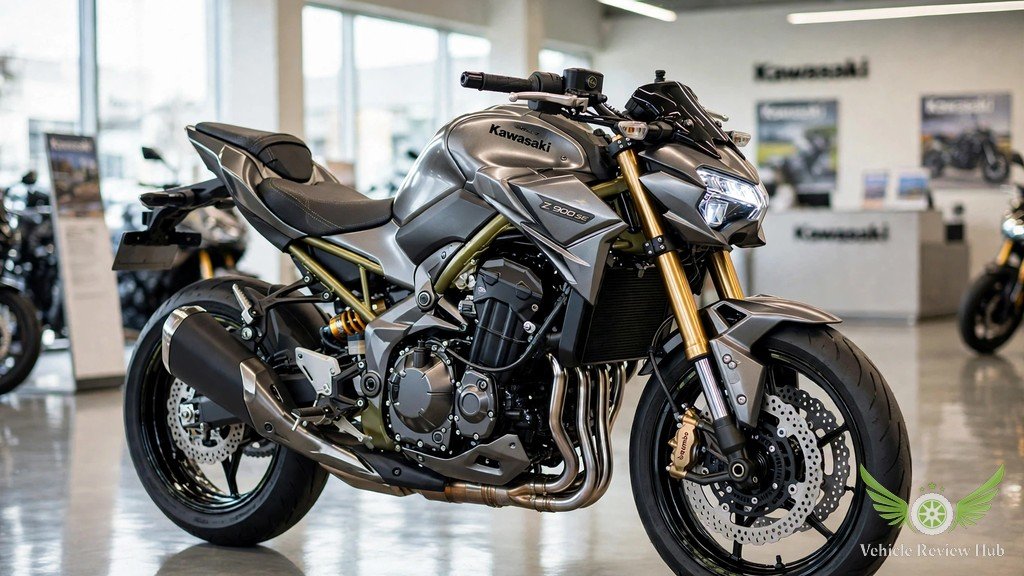
Kawasaki Z900 SE Price in the USA: $12,199 (2027)
The 2027 SE costs $12,199, per Kawasaki’s own 2027 spec sheet, and $840 destination takes it to $13,039 delivered. The base 2027 Z900 is $10,199 plus the same $840, or $11,039 delivered, so the SE premium in 2027 is $2,000 — the number at the top of this Kawasaki Z900 SE review. Powersports Business’s 2027 lineup report agrees on $12,199, and dealer listings print the same $12,199 plus $840.
2025 Destination Unresolved
Kawasaki publishes no destination charge on any spec sheet — the charge comes from the Motorcycle.com database, and the 2025 figure is the least settled of all. The database lists $815 for the 2025 SE, so the 2025 delivered price is $12,664 ($11,849 + $815) — but that $815 is the Motorcycle.com figure only, and this Kawasaki Z900 SE review labels it as such. The 2026 destination, $840, is inferred from the 2026 base bike’s page, so the 2026 delivered price of $12,839 is provisional. The 2022 SE’s destination was not found at all, so no 2022 delivered price can be computed. The 2023 price, $10,899, rests on the Motorcycle.com database alone, with a $460 destination for an $11,359 delivered figure. And the 2024 price carries the conflict this Kawasaki Z900 SE review promised: Kawasaki’s own sheet says $11,399, the Motorcycle.com database says $11,299, and the $1,500 premium is identical on either side.
| Model year | SE MSRP | Base MSRP | Premium | Destination | SE delivered |
|---|---|---|---|---|---|
| 2022 | $10,699 | $9,199 | $1,500 | Not found | Not computable |
| 2023 | $10,899 | $9,399 | $1,500 | $460 | $11,359 |
| 2024 | $11,399 | $9,899 | $1,500 | $475 | $11,874 |
| 2025 | $11,849 | $9,999 | $1,850 | $815 | $12,664 |
| 2026 | $11,999 | $9,999 | $2,000 | $840* | $12,839* |
| 2027 | $12,199 | $10,199 | $2,000 | $840 | $13,039 |
Note: This Kawasaki Z900 SE review prints the Kawasaki-sheet figures for 2024 ($11,399 / $9,899), with the Motorcycle.com database figures ($11,299 / $9,799) labelled as the conflicting side. *The 2026 destination is inferred from the base bike, so the 2026 delivered price is provisional. The 2023 price is Motorcycle.com database only.
Kawasaki Z900 SE Design, Features and Technology
The SE’s design story is a hardware story: the gold fork, the Brembo calipers and the Öhlins shock are the visual tells. This Kawasaki Z900 SE review covers what the premium buys, what it does not, and where the sources disagree.
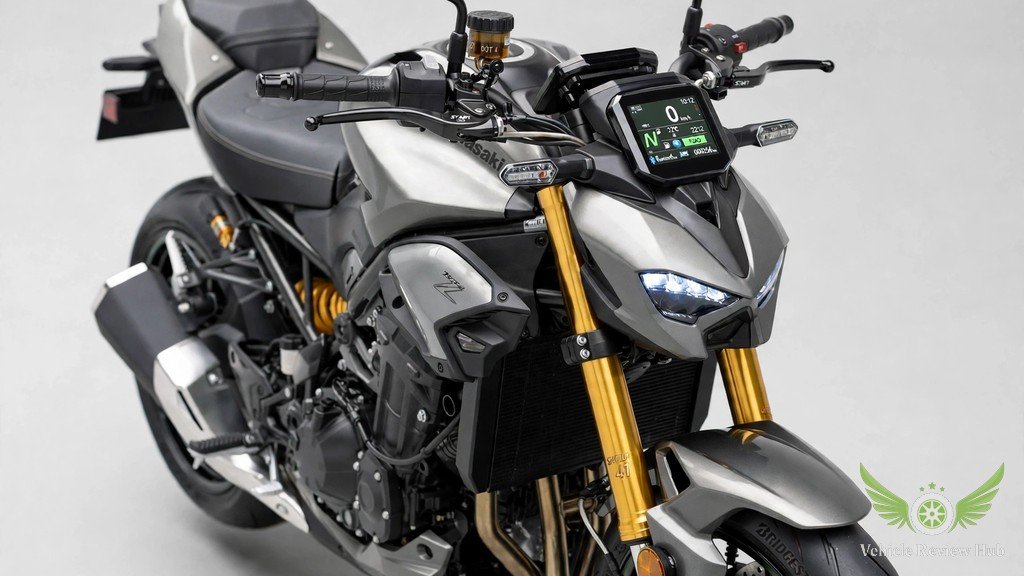
Gen 2 Buys No Electronics
Read plainly, this Kawasaki Z900 SE review finds the SE package adds no electronics over the Gen 2 base bike. The IMU, ride-by-wire, bidirectional quickshifter and cruise control on a 2025 or newer SE are the shared 2025 base-bike updates, not SE-exclusive equipment — a buyer paying the $1,850 (2025) or $2,000 (2026–2027) premium is paying for Brembo brakes, the Öhlins shock, the gold fork, the two-tone seat and the colours, not for electronics. The heading could be misread as saying the Gen 2 bike has no electronics; it has an IMU, a quickshifter and cruise control — it simply buys none of them with the SE premium.
Fork Brand Is Conflicted
The fork is the one place where this Kawasaki Z900 SE review cannot give a single answer, because the sources contradict each other and Kawasaki’s own sheets settle nothing. Cycle News’s 2022 first ride calls it a revised Showa fork, and SportBikesInc’s 2022 first ride agrees. Cycle World’s 2024 model page says the opposite: the SE features “an upgraded KYB fork.” Kawasaki’s own sheets name no fork brand in any year — 2024, 2025, 2026 and 2027 all say only “41 mm inverted fork.” For 2025 and newer, RevZilla, Motorcycle.com and Ultimate Motorcycling all call the Gen 2 fork a KYB, so this review prints KYB for the 2025-and-newer fork, labelled as per the first rides. For 2022–2024, the conflict stands as printed here, and no buyer should treat either brand as settled fact.
The adjustability is disputed too: Kawasaki’s own 2024 sheet lists the Gen 1 fork as rebound-damping adjustable only, Cycle News’s 2022 spec table calls it “fully adjustable,” and Cycle World says compression and rebound damping plus spring preload. For the Gen 2 fork the sheets agree — compression, rebound and preload — so the conflict is a Gen 1 problem only. This Kawasaki Z900 SE review prints the sheet’s rebound-only figure as Kawasaki’s stated figure and notes the reviews claim more.
Kawasaki Z900 SE Riding Experience and Comfort
On the road, this Kawasaki Z900 SE review leans on the people who rode it — Cycle News’s 2022 first ride of the Gen 1 bike, and the 2025 shootout that put the Gen 2 bike last of four. The two verdicts disagree, and the disagreement is the honest riding story.
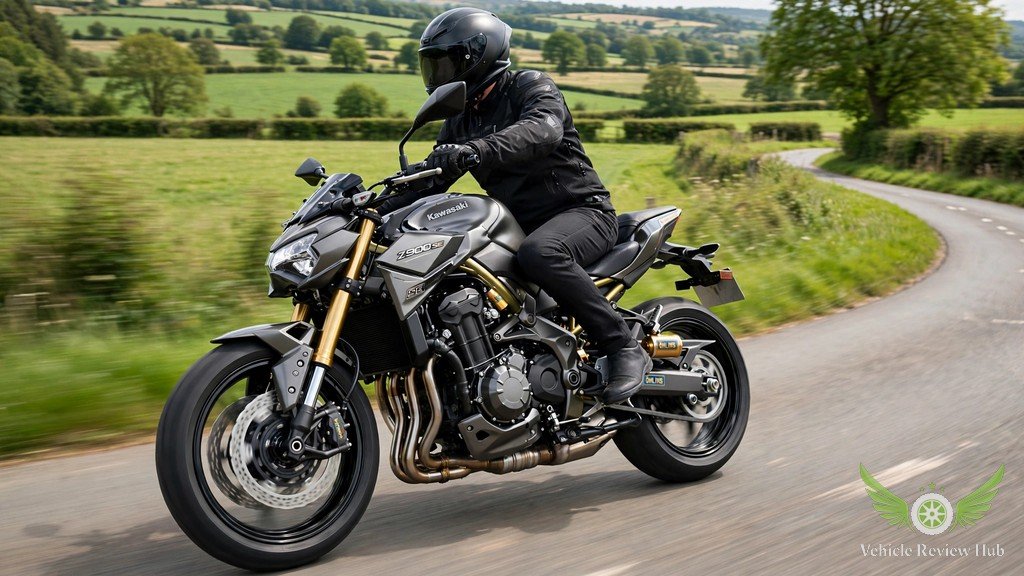
Cycle News’s first ride of the 2022 SE — the Gen 1 bike, cable throttle, no IMU, no quickshifter — with the verdict that became this review’s headline: “worth the money alone.”
One caution: the video’s description calls the fork “a new Showa fork,” the Showa side of the fork-brand conflict covered in the Design section — the video does not settle that question, and neither does this review.
That verdict is the spine of this Kawasaki Z900 SE review. Cycle News’s Rennie Scaysbrook wrote, “For the money, the Z900 SE is indeed a good buy,” and closed with the line that the braking and suspension improvement makes “the new Zee worth the money alone.” The review’s framing question was whether the extra cash was worth the cash paid, and its answer was yes — at the $1,500 premium, on the Gen 1 bike. It also noted the SE was only $500 cheaper than the 2022 Yamaha MT-09 SP, which already had an IMU, cruise control and Öhlins.
The Gen 2 bike’s riding story is less flattering. In Cycle News’s 2025 middleweight shootout the SE finished fourth of four, behind the MT-09 SP, the KTM 990 Duke and the Triumph Street Triple 765 RS. The testers praised the engine and the Dunlop Sportmax Q5A tyres, but marked the bike down for cramped ergonomics (riders from 5’10” to 6’2″ felt cramped on the lowest seat in the test, 31.9 inches) and base suspension settings that were “exceptionally soft.” One tester said that for short rides around town the Kawasaki would be his first choice, but long rides would be “a tiresome experience.” The 2025 bike’s measured fuel consumption in that test was 41.6 mpg — about 187 miles from the 4.5-gallon tank. Kawasaki publishes no MPG figure for the SE.
2026 Page Has a $500 Offer
For buyers shopping a leftover 2026 bike, this Kawasaki Z900 SE review notes a $500 saving that exists at dealer level — not on a Kawasaki page. Capital Powersports lists a 2026 Z900 SE ABS at $11,999 with a “Season of Savings – $500.00” line, taking it to $11,598, and Broward Motorsports lists a “$500 Kawasaki factory-to-dealer incentive” on the 2026 Z900. Whether Kawasaki USA’s own 2026 SE page carries the offer was not verified, so this Kawasaki Z900 SE review says only what the dealer pages show. The UK has a separate £500 saving on the 2026 Z900 range, ending 31 December 2026 — a UK-only offer, never a US figure, and this review never converts it to dollars.
12 Month Warranty
The warranty is 12 months, limited, in every SE year — the same as the base Z900, with no extended SE warranty. That matters for the verdict: the Brembo brakes, the Öhlins shock and the gold fork are factory-fitted and covered by the same warranty as the rest of the bike, which an aftermarket build can never offer. This Kawasaki Z900 SE review counts the warranty as part of the premium’s value: a $2,000 factory-fitted package under warranty is a different purchase from $2,000 of parts fitted in a garage.
Kawasaki Z900 SE Review: Pros, Cons and Verdict
The verdict of this Kawasaki Z900 SE review is a parts verdict, not a win claim. The SE finished last in the 2025 shootout — and still justifies its premium on hardware alone.
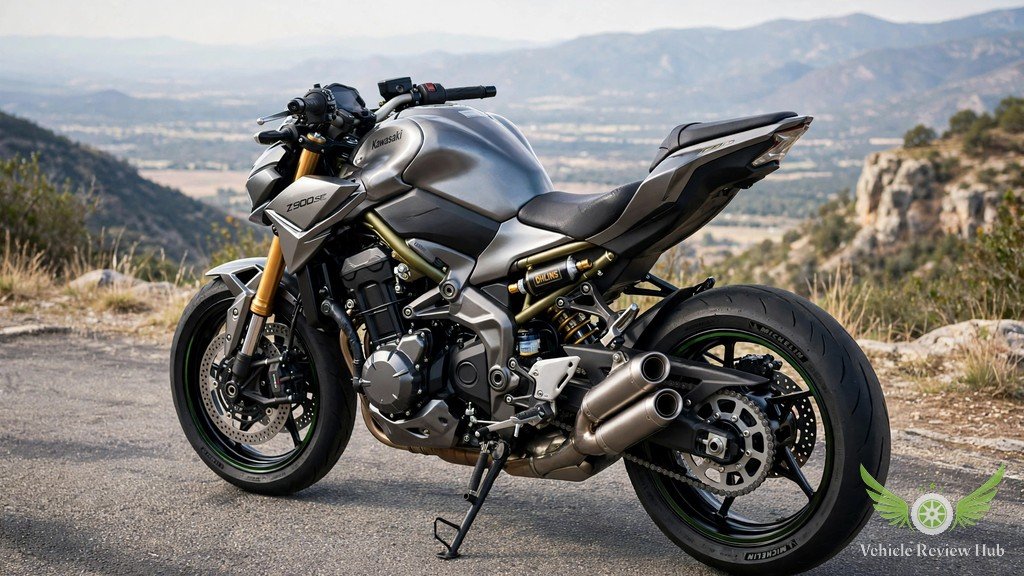
Main Advantages and Limitations of the Kawasaki Z900 SE
| Advantages | Limitations |
|---|---|
| Brembo M4.32 calipers + steel lines + Nissin radial master cylinder | Same power as the base — no speed gain for the premium |
| Öhlins S46 rear shock with remote preload adjuster | 2.2 lb heavier than the base bike |
| Fully-adjustable gold 41 mm fork (Gen 2: compression + rebound + preload) | Gen 1 fork brand and adjustability disputed between sources |
| Factory-fitted hardware under the 12-month warranty | Finished last (4th of 4) in Cycle News’s 2025 shootout |
| $360 cheaper delivered than the Yamaha MT-09 SP | $1,265 more delivered than the Honda CB1000 Hornet SP (2026 price) |
| Low 31.9-inch seat (Gen 2) / 31.5-inch seat (Gen 1) | Cramped ergonomics for taller riders in the shootout |
Note: This Kawasaki Z900 SE review weighs the same balance in the verdict below — the parts justify the premium even though the bike did not win the comparison.
Shock Alone: $1,224
The heading puts the shock alone at $1,224 — and the hedge this Kawasaki Z900 SE review applies is that the list price could not be verified from a primary source. Kawasaki’s parts catalogue confirms the part exists and publishes its number — 45014-0733 for the 2022 SE shock, 45014-0843 for the 2025 SE shock — but the catalogue publishes no list price, and no parts retailer surfaced a price for either number in this research. Treat $1,224 as the figure in this review’s source document, not as a price you can order at. The point survives without the price: the Öhlins S46 is the single most expensive SE component, and the premium — $1,500 in Gen 1, $2,000 in 2027 — buys a shock, brakes, fork and colours package whose parts, bought separately, exceed the premium. That is the argument the verdict rests on: the verified premium ladder and the verified part numbers, not $1,224.
So: buy the SE if you want the braking and suspension without going aftermarket, and if the $2,000 premium reads as a parts list rather than a price tag. Buy the base Z900 if you want the cheapest four-cylinder naked delivered and will never track the bike. Either way, you are buying the same engine — and in this Kawasaki Z900 SE review, that sameness is the point: the SE is the Z900, with the parts that matter already fitted. The standard Z900 review and the base bike’s comparison cover the standard bike’s case in full.
Kawasaki Z900 SE Review: Frequently Asked Questions
The questions buyers ask most in this Kawasaki Z900 SE review — answered from the verified prices and figures.
What is the Kawasaki Z900 SE?
The premium version of the Z900 naked, sold in the US since 2022. The short answer this Kawasaki Z900 SE review gives is simple: it is the base Z900 ABS plus Brembo M4.32 front brakes with steel lines, an Öhlins S46 rear shock, a fully-adjustable gold 41 mm inverted fork, and premium colours. Same 948cc engine, same power, same frame as the base bike.
How much does the 2027 Kawasaki Z900 SE cost?
$12,199 MSRP plus $840 destination, so $13,039 delivered. In this Kawasaki Z900 SE review the delivered figure is always shown with its arithmetic: the premium over the base 2027 Z900 ($10,199 + $840 = $11,039 delivered) is $2,000.
What changed on the Z900 SE for 2025?
The 2025 redesign is a base-bike redesign shared with the standard Z900. This Kawasaki Z900 SE review separates the base changes from the SE hardware: IMU with cornering ABS, ride-by-wire, a bidirectional quickshifter and cruise control, a 5-inch TFT, round front discs, a 123.0 hp claim (down from 125 hp), a 31.9-inch seat (up from 31.5), and Dunlop Sportmax Q5A tyres. The SE hardware — Brembo, Öhlins, gold fork — did not change.
Is the Z900 SE worth the extra money over the base Z900?
Cycle News’s 2022 verdict on the Gen 1 bike at the $1,500 premium was explicit, and this Kawasaki Z900 SE review quotes it verbatim: “For the money, the Z900 SE is indeed a good buy,” and the SE was “worth the money alone” for the braking and suspension improvement. At the 2027 $2,000 premium the same hardware case applies — but the SE finished last in the 2025 shootout, so “worth it” is a parts-value verdict, not a win claim.
Does the Z900 SE make more power than the standard Z900?
No. Same engine, same claim: 125 hp pre-2025, 123.0 hp from 2025, 73.1 lb-ft of torque every year. As this Kawasaki Z900 SE review shows, the SE is also 2.2 lb heavier than the base (469.7 lb vs 467.5 lb curb), so it is no faster — the premium buys brakes and suspension, not power.
What colours does the Z900 SE come in?
The 2027 SE comes in Metallic Matte Graphenesteel Gray / Metallic Matte Carbon Gray, and this Kawasaki Z900 SE review lists the earlier schemes too: the 2025 SE was Metallic Matte Graphite Gray / Ebony / Metallic Graphite Gray, and the 2022 and 2024 SEs were Metallic Spark Black / Metallic Matte Graphenesteel Gray / Candy Lime Green with a green frame. The 2023 SE’s colours were not verified from any source.