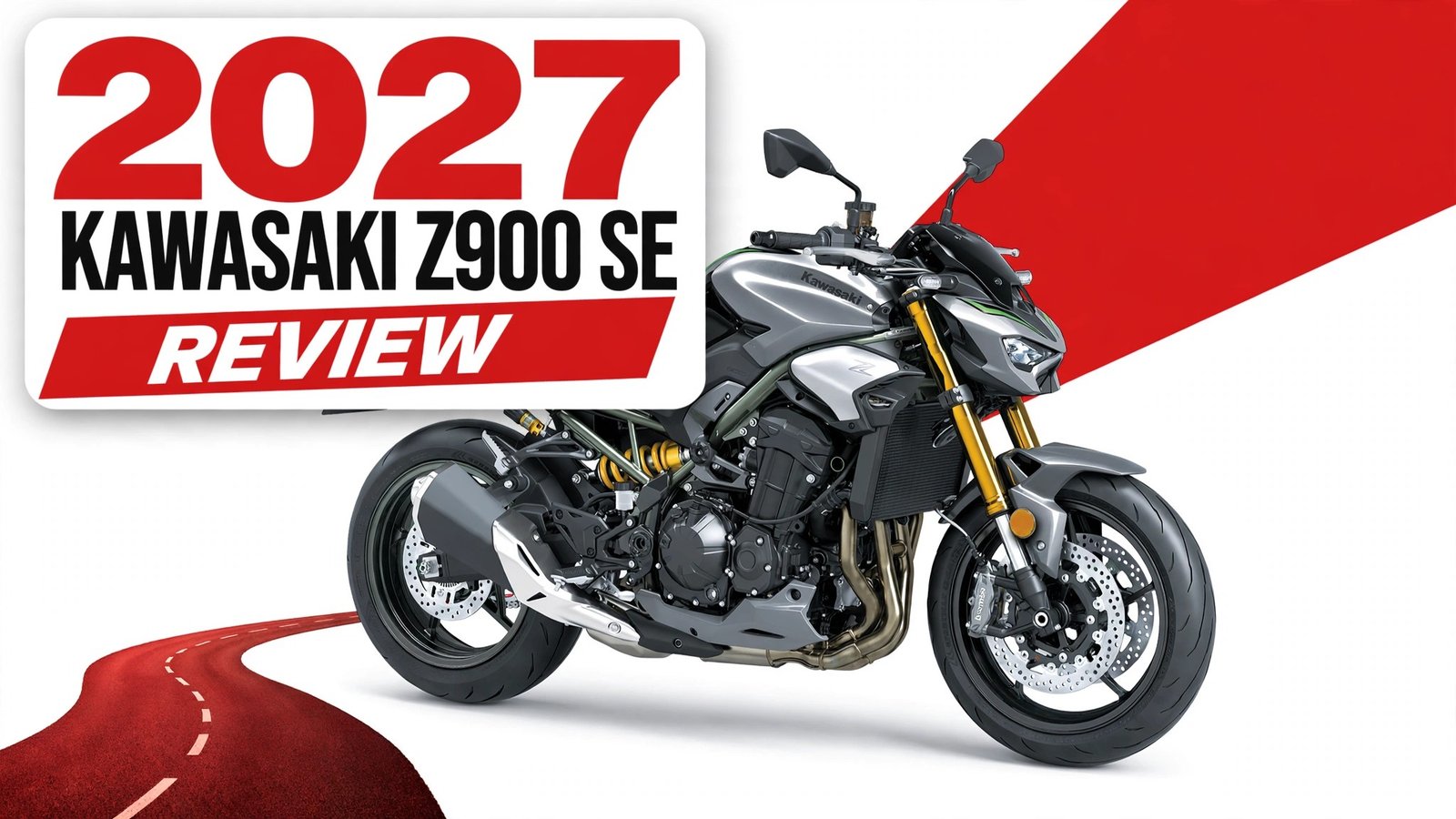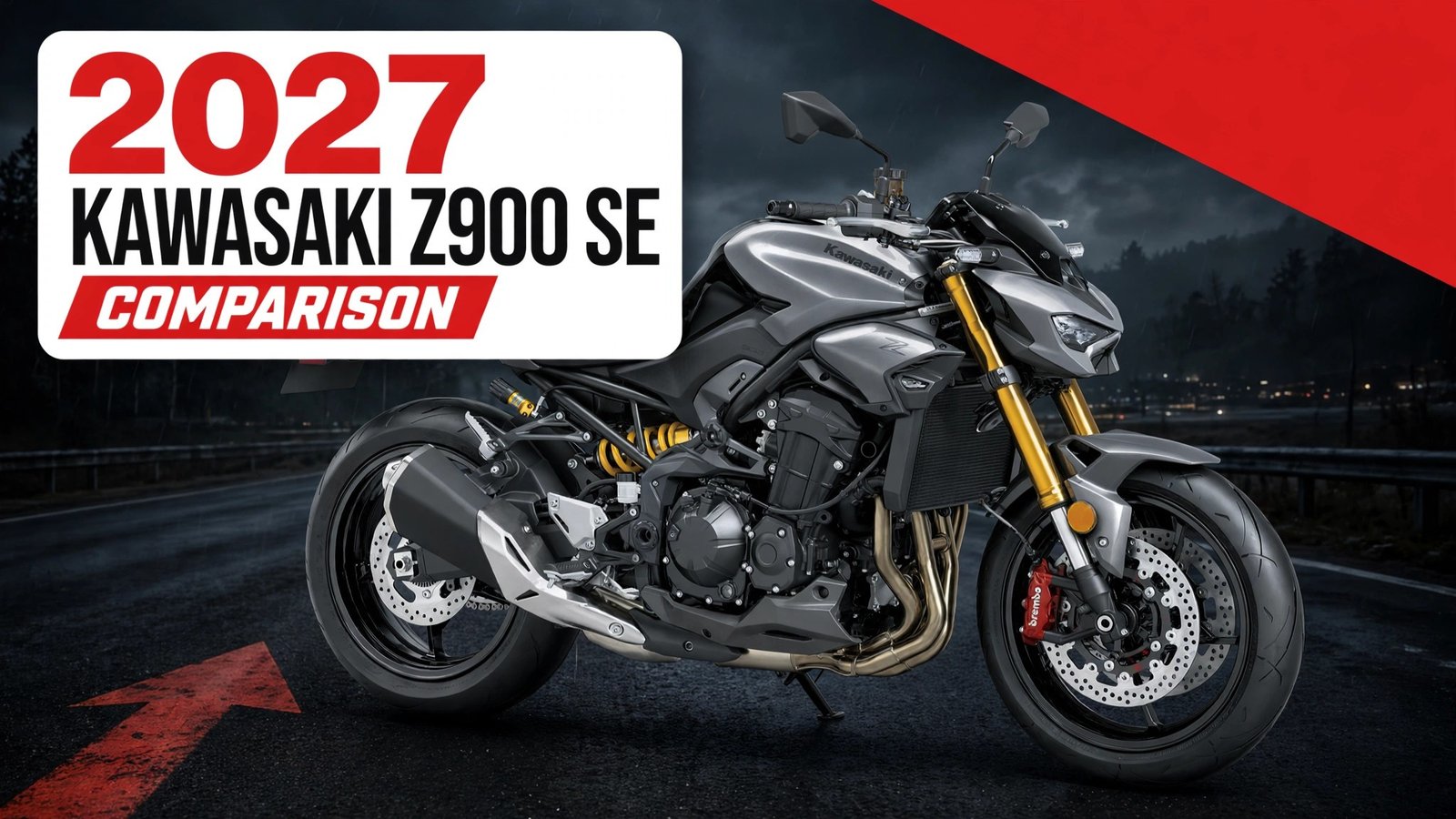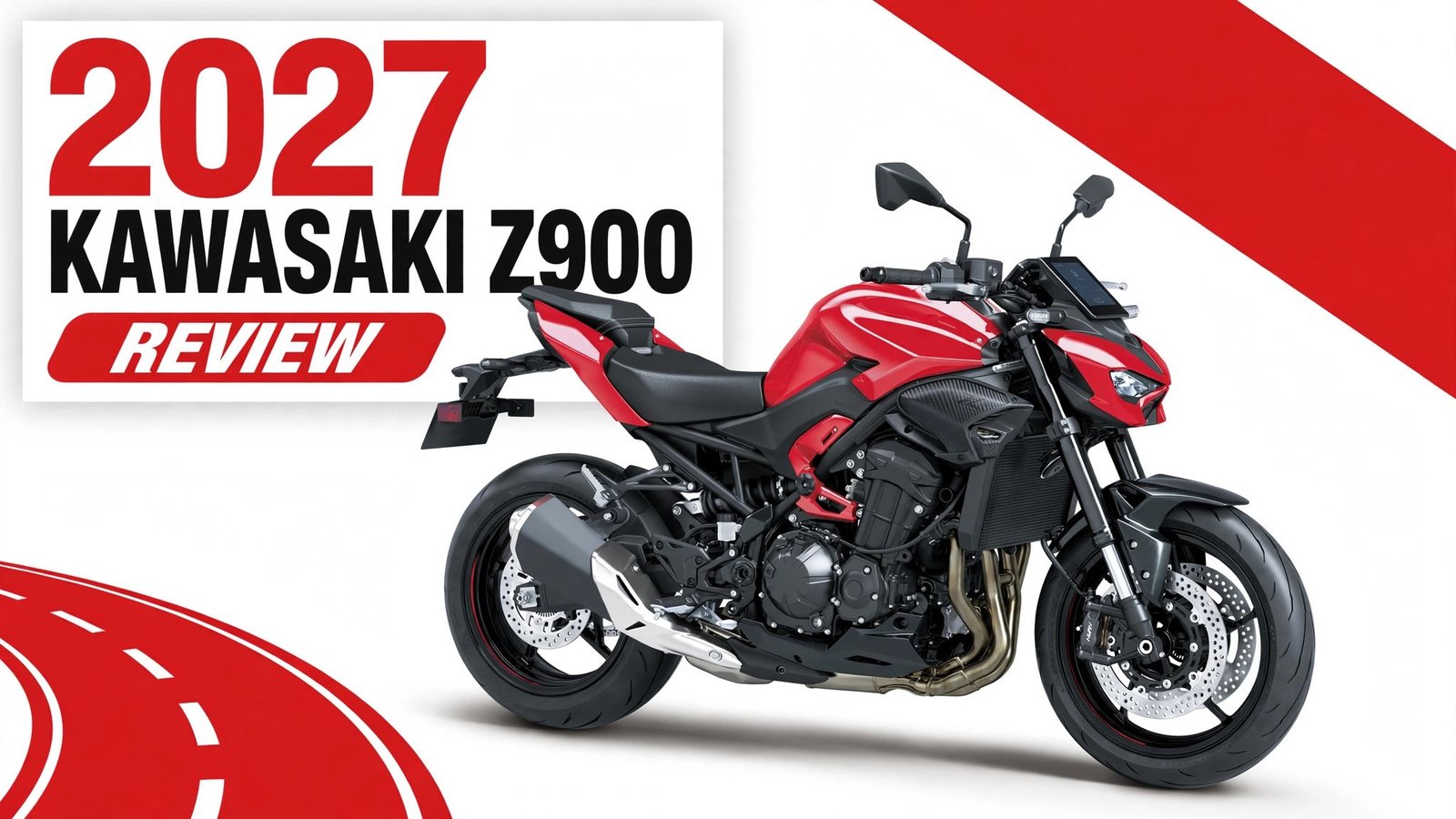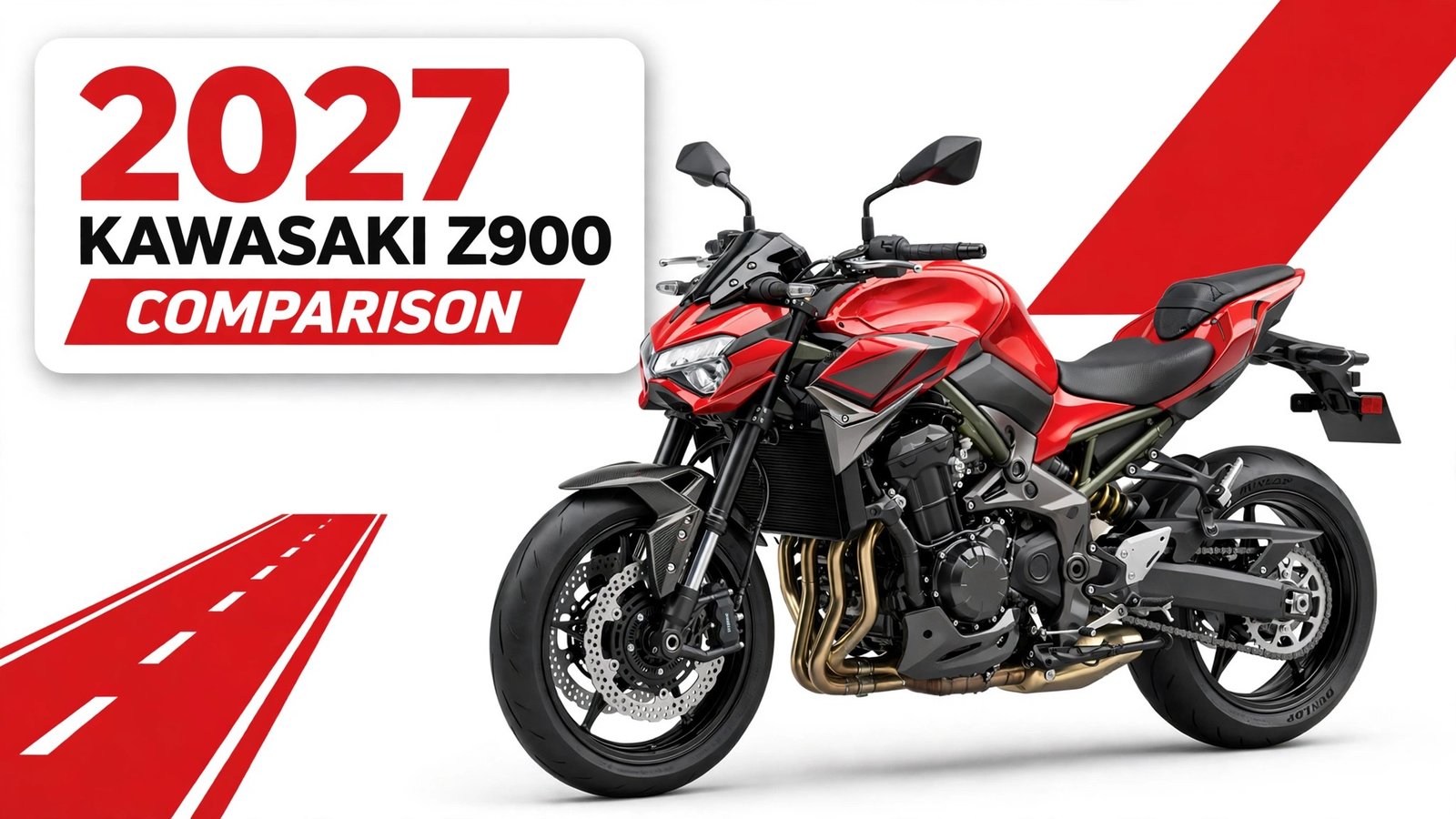
The 2027 Kawasaki Z900 costs $10,199 before destination, and $11,039 delivered — less than any of its three closest rivals. This Kawasaki Z900 comparison puts the Z900 against the Yamaha MT-09, the Suzuki GSX-S1000 and the Honda CB1000 Hornet SP on the numbers US buyers actually pay: delivered prices, claimed power, equipment and running costs, all verified from manufacturer pages and named tests.
The headline is simple: the Z900 is the cheapest four-cylinder naked delivered in 2027, and it undercuts the MT-09 by $560 despite the bigger engine. But the cheapest bike is not automatically the best buy, so this Kawasaki Z900 comparison weighs what each rival gives back for its extra money — the MT-09’s electronics, the Suzuki’s bigger engine, and the Hornet SP’s premium hardware.
Kawasaki Z900 Overview and Its Closest Rivals
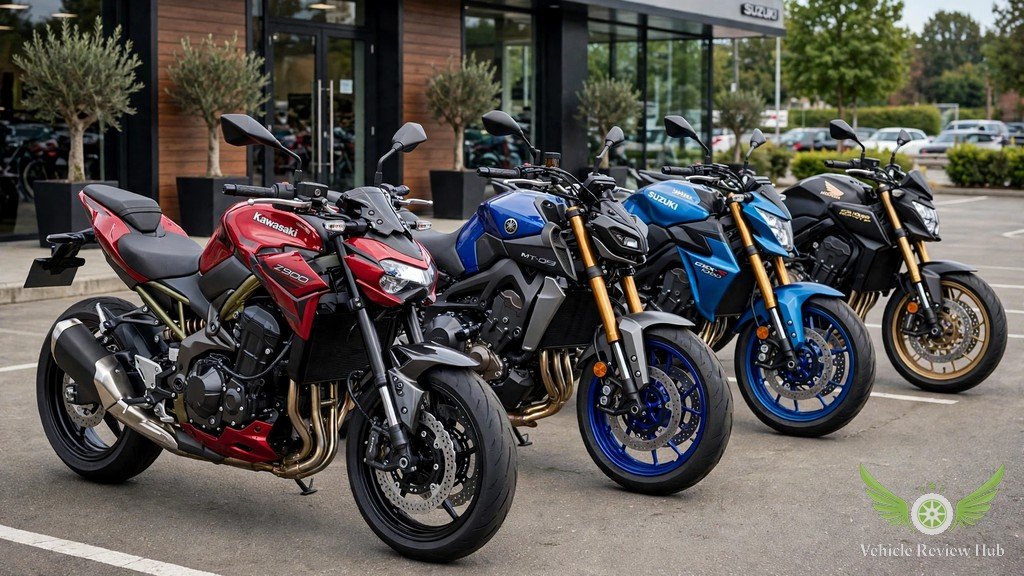
Three rivals, three different answers to the same question. The Yamaha MT-09 is the triple-cylinder benchmark, the Suzuki GSX-S1000 is the bigger-engined brute, and the Honda CB1000 Hornet SP is the premium hardware pick. This Kawasaki Z900 comparison starts with what they cost delivered, because that is where the Z900’s case begins.
2026 three-way comparison of the KTM 990 Duke, the Kawasaki Z900 and the Yamaha MT-09 SP — note the KTM 990 Duke is NOT one of this blog’s three rivals; the MT-09 SP is. STHLM Rides puts the three bikes through the same roads, and the Z900 and the MT-09 SP in the video are the same two bikes this comparison prices below.
Cheapest Four Delivered
Delivered price is the only honest price, because every bike carries a destination charge and the charges differ by hundreds of dollars. The Z900’s $840 destination is the highest of the four, and it still wins. The 2027 Z900 lists at $10,199 for the standard colours and $10,399 for Candy Persimmon Red, so the delivered price is $11,039 for the standard bike. The Suzuki GSX-S1000 lists at $10,798 with a $750 destination — $11,548 delivered, $509 more than the Z900. The Yamaha MT-09 lists at $10,899 with a $700 destination — $11,599 delivered, $560 more. The Honda CB1000 Hornet SP lists at $10,999 with a $775 destination — $11,774 delivered, $735 more, and that is the latest published (2026) price. This Kawasaki Z900 comparison uses delivered prices throughout, because an MSRP-only ranking would flatter the Suzuki and hide the destination gap.
| Bike (2027) | MSRP | Destination | Delivered | Engine | Claimed power |
|---|---|---|---|---|---|
| Kawasaki Z900 | $10,199 | $840 | $11,039 | 948cc inline-four | 123.0 hp @ 9,500 (US) |
| Suzuki GSX-S1000 | $10,798 | $750 | $11,548 | 999cc inline-four | 150 hp @ 11,000 (global) |
| Yamaha MT-09 | $10,899 | $700 | $11,599 | 890cc CP3 triple | 117 hp @ 10,000 |
| Honda CB1000 Hornet SP | $10,999* | $775 | $11,774* | 999cc inline-four | 129 hp (US) |
Note: The Hornet SP price is the latest published (2026) price — Honda had announced no 2027 price at the time of writing. The Z900 is the cheapest four-cylinder naked delivered in 2027, and the cheapest of the four bikes overall. This Kawasaki Z900 comparison ranks on delivered prices, MSRP plus destination.
How the Four Bikes Differ at a Glance
The four bikes differ in more than price, and this Kawasaki Z900 comparison weighs those differences on delivered price first. The Z900 and the Hornet SP share the same 31.9-inch seat height; the MT-09 sits tallest at 32.5 inches. The Hornet SP is the lightest at 465 lb curb and the Suzuki the heaviest at 472 lb. The Suzuki carries the biggest tank at 5.0 gallons; the MT-09’s 3.7 gallons is the smallest in the group. On electronics the MT-09 leads with its six-axis IMU and lean-sensitive aids, the Z900 matches it from 2025 with its own IMU, the Hornet SP has no IMU, and the Suzuki has neither an IMU nor cornering ABS. Those differences are the real decision in this Kawasaki Z900 comparison, not the badge.
Kawasaki Z900 vs Yamaha MT-09
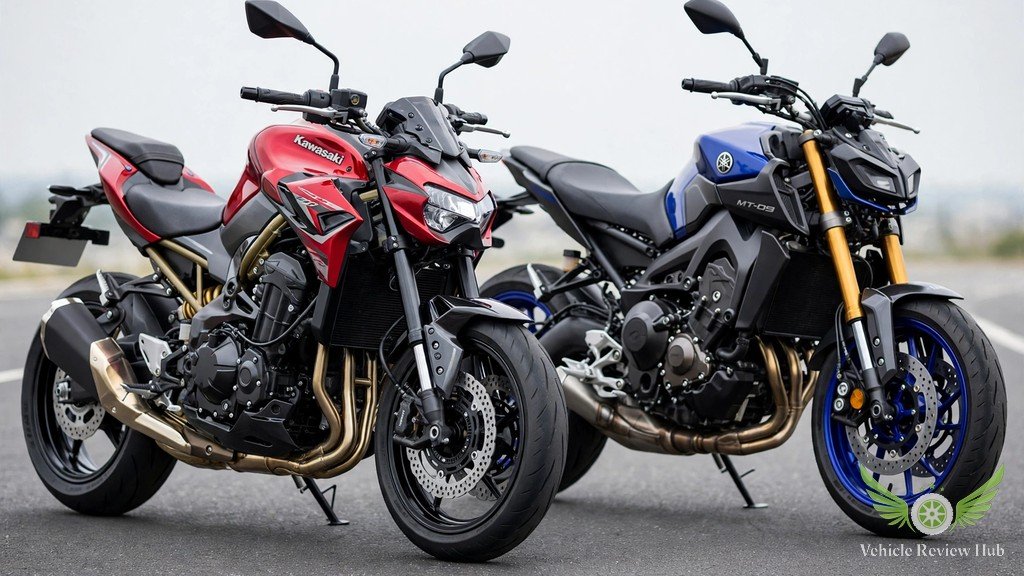
The MT-09 is the Z900’s closest rival on price and the bike it beat in the 2020 Bike-urious showdown — and the bike that beat the Z900 SE in Cycle News’ 2025 shootout, where the MT-09 SP finished first and the SE finished last. This Kawasaki Z900 comparison starts with the Yamaha — the fight the Z900 has to win twice, on price and on the road.
Engine, Specs and Performance Side by Side
The Z900’s 948cc inline-four claims 123.0 hp at 9,500 rpm and 73.1 lb-ft at 7,700 rpm for 2025–2027 (125 hp for 2017–2024, the same torque every year). The MT-09’s 890cc CP3 triple claims 117 hp at 10,000 rpm and 68.6 lb-ft at 7,000 rpm, per Cycle News’ 2024 MT-09 review. On the dyno, the Z900’s 2020 bike measured 113.96 hp at 9,710 rpm on Cycle World’s Dynojet 250i, with Rider measuring 113.3 hp and Motorcycle.com 115.5 hp on the same generation — full figures in the companion Z900 performance guide. No 2025-bike dyno has been published for either bike, so this Kawasaki Z900 comparison does not invent one. The Z900 has the bigger engine and the higher claimed peak, while the triple makes its torque lower and feels livelier at road speeds.
| Item | Kawasaki Z900 | Yamaha MT-09 |
|---|---|---|
| Engine | 948cc inline-four | 890cc CP3 triple |
| Claimed power | 123.0 hp @ 9,500 rpm (US) | 117 hp @ 10,000 rpm |
| Claimed torque | 73.1 lb-ft @ 7,700 rpm | 68.6 lb-ft @ 7,000 rpm |
| Seat height | 31.9 in | 32.5 in |
| Weight | 467.5 lb curb | 425 lb wet (claimed) |
| Fuel capacity | 4.5 gal | 3.7 gal |
| Wheelbase | 57.1 in | 56.3 in |
| Electronics | 6-axis IMU, lean-sensitive ABS/TC, cruise, quickshifter | 6-axis IMU, lean-sensitive TC/ABS, slide/lift/brake control, quickshifter, cruise |
| 2027 delivered price | $11,039 | $11,599 |
Note: The MT-09’s electronics are the most advanced of the four rivals, and the Z900 matches most of them from 2025 — the gap is the MT-09’s slide, lift and brake control, which the Z900 does not offer. This Kawasaki Z900 comparison counts the MT-09’s 3.7-gallon tank as its biggest practical weakness.
Price, Equipment and Which Suits Which Rider
On price the Z900 wins clearly: $11,039 delivered against the MT-09’s $11,599, a $560 gap in the Kawasaki’s favour despite the bigger engine, per Motorcycle.com’s 2027 MT-09 database page. Both bikes carry a 5-inch TFT, a bi-directional quickshifter and cruise control as standard, and both have a six-axis IMU with lean-sensitive traction control and ABS. The MT-09 adds slide control, lift control, brake control and a back-slip regulator, and its 32.5-inch seat is the tallest here. The Z900 answers with the lower seat, the bigger tank and the lower price. The rider who wants the most advanced electronics and the liveliest triple buys the MT-09; the rider who wants the four-cylinder, the lower seat and $560 in the pocket buys the Z900. This Kawasaki Z900 comparison calls the MT-09 the Z900’s hardest rival — and still the one it undercuts.
Kawasaki Z900 vs Suzuki GSX-S1000
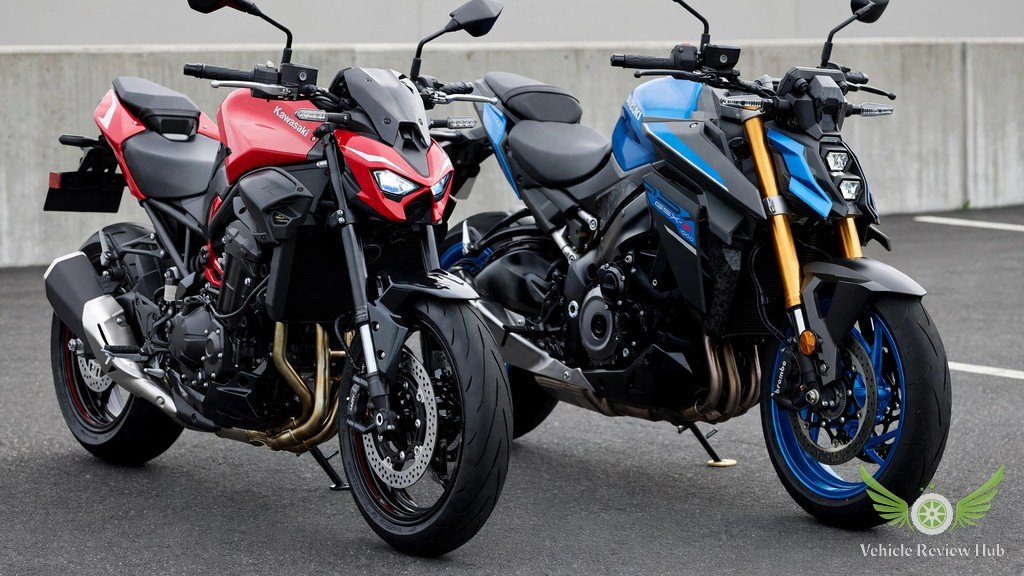
The Suzuki is the biggest engine in this Kawasaki Z900 comparison and, since its 2027 price cut, the closest rival on delivered price. Suzuki cut the GSX-S1000’s MSRP by $1,191 for 2027 — from $11,989 to $10,798 — with no mechanical change, according to Suzuki’s 2027 announcement, which moves it from the most expensive bike in the group to $509 behind the Z900. The full Suzuki story is in the companion GSX-S1000 review.
Engine, Specs and Performance Side by Side
The Suzuki’s 999cc GSX-R-derived inline-four is the largest engine here, and its claimed output is the highest on paper: 150 hp at 11,000 rpm and 78 lb-ft — but those are GLOBAL figures, because Suzuki USA publishes no power or torque for this bike, and this Kawasaki Z900 comparison labels them global on every use. The Z900’s US claim is 123.0 hp at 9,500 rpm and 73.1 lb-ft at 7,700 rpm. The gap is real — the Suzuki is the more powerful bike — but the Z900’s rear-wheel figures are verified (113.96 hp on Cycle World’s dyno) while no naked GSX-S1000 dyno exists in the record. The Suzuki is also the heaviest bike here at 472 lb curb against the Z900’s 467.5 lb. Its 5.0-gallon tank is the largest in the group, good for the longest range between fill-ups.
| Item | Kawasaki Z900 | Suzuki GSX-S1000 |
|---|---|---|
| Engine | 948cc inline-four | 999cc inline-four |
| Claimed power | 123.0 hp @ 9,500 rpm (US) | 150 hp @ 11,000 rpm (global) |
| Claimed torque | 73.1 lb-ft @ 7,700 rpm | 78 lb-ft (global) |
| Seat height | 31.9 in | 31.9 in |
| Curb weight | 467.5 lb | 472 lb |
| Fuel capacity | 4.5 gal | 5.0 gal |
| Wheelbase | 57.1 in | 57.5 in |
| Electronics | 6-axis IMU, lean-sensitive ABS/TC | S.I.R.S. — TC, ride modes, quickshifter; NO IMU, NO cornering ABS |
| 2027 delivered price | $11,039 | $11,548 |
Note: The Suzuki’s 150 hp and 78 lb-ft are global figures — Suzuki USA publishes no power or torque for the GSX-S1000, per TotalMotorcycle’s 2027 GSX-S1000 page. The Z900’s 123.0 hp is a US figure (ISO 4106). This Kawasaki Z900 comparison never prints the Suzuki’s global figures as US figures.
Price, Equipment and Which Suits Which Rider
The 2027 price cut changes this fight. At $11,548 delivered the Suzuki is $509 more than the Z900 — close enough that the bigger engine looks like value, per Motorcycle.com’s 2027 GSX-S1000 database page. But the equipment gap runs the other way: the Z900 has a six-axis IMU with lean-sensitive ABS and traction control, ride-by-wire and cruise control, while the Suzuki has no IMU and no cornering ABS — the least advanced electronics of the four rivals. Both bikes have a 5-inch TFT, a bi-directional quickshifter and fully adjustable suspension, but the Suzuki’s kit is older thinking. The rider who wants the most power for the money and the longest range buys the Suzuki; the rider who wants modern rider aids, the lower price and the lighter bike buys the Z900. This Kawasaki Z900 comparison gives the Suzuki the power crown and the Z900 the value crown — and the $509 gap is small enough that either answer is honest.
Kawasaki Z900 vs Honda CB1000 Hornet SP
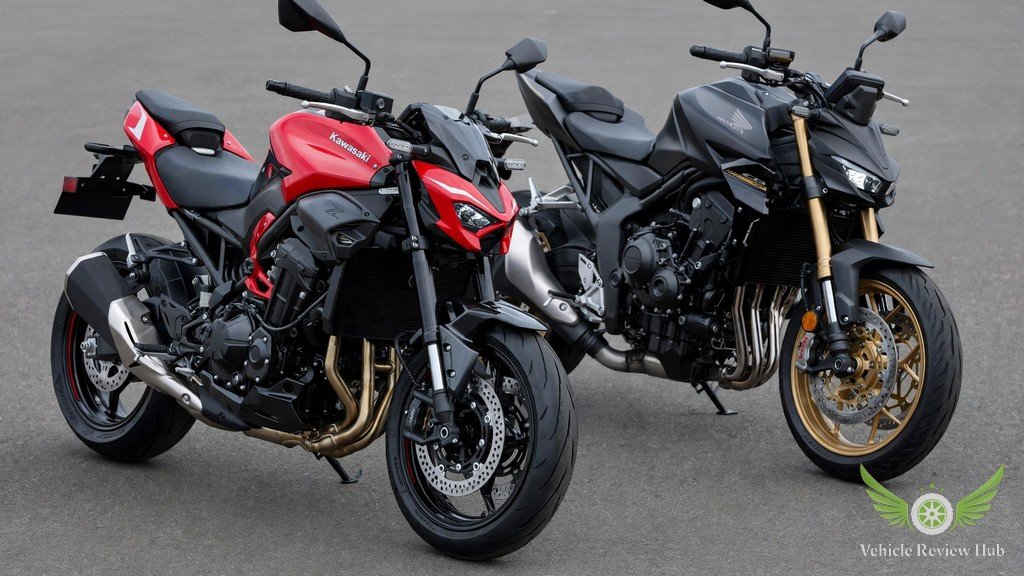
The Hornet SP is the premium pick in this Kawasaki Z900 comparison — the best suspension and brake hardware of the four rivals, the second-most power, and the highest delivered price. It costs $735 more than the Z900 delivered, and the question is whether its hardware is worth the premium.
Engine, Specs and Performance Side by Side
The Hornet SP’s 999cc Fireblade-derived inline-four makes 129 hp in US trim according to TopSpeed, citing Honda US — the US bike is detuned for noise against the EU bike’s 155 hp, and Honda USA publishes no horsepower or torque figure of its own, so this Kawasaki Z900 comparison never attributes a Honda-USA power figure. The Z900’s US claim is 123.0 hp at 9,500 rpm and 73.1 lb-ft at 7,700 rpm. The Hornet SP’s EU torque is 107 Nm (78.9 lb-ft), labelled EU only, and no US torque figure exists. The two bikes share a 31.9-inch seat height and a 4.5-gallon tank, and the Hornet SP is the lighter bike at 465 lb curb against the Z900’s 467.5 lb. Where the Honda pulls clear is hardware: a fully adjustable 41 mm Showa SFF-BP fork, an Öhlins TTX36 rear shock and Brembo Stylema four-piston calipers — the best suspension and brake kit of the four rivals on paper, per Honda’s Hornet SP page.
| Item | Kawasaki Z900 | Honda CB1000 Hornet SP |
|---|---|---|
| Engine | 948cc inline-four | 999cc inline-four (Fireblade-derived) |
| Claimed power | 123.0 hp @ 9,500 rpm (US) | 129 hp (US, TopSpeed); 155 hp (EU) |
| Claimed torque | 73.1 lb-ft @ 7,700 rpm | 78.9 lb-ft (EU only); no US figure |
| Seat height | 31.9 in | 31.9 in |
| Curb weight | 467.5 lb | 465 lb |
| Fuel capacity | 4.5 gal | 4.5 gal |
| Wheelbase | 57.1 in | 57.3 in |
| Suspension/brakes | 41 mm inverted fork, back-link shock, radial calipers | Showa SFF-BP fork, Öhlins TTX36, Brembo Stylema |
| Delivered price | $11,039 (2027) | $11,774* (latest published, 2026) |
Note: The Hornet SP’s price is the latest published (2026) price — Honda had announced no 2027 price at the time of writing. Its 129 hp is a US figure from TopSpeed; Honda USA publishes no power figure. This Kawasaki Z900 comparison counts the Honda’s hardware as the best in the group and its price as the highest.
Price, Equipment and Which Suits Which Rider
The Hornet SP costs $11,774 delivered — $735 more than the Z900 — and it spends that money on hardware: the Showa SFF-BP fork, the Öhlins TTX36 shock and the Brembo Stylema calipers are a clear step above the Z900’s base suspension and brakes. The Honda has no IMU, so its ABS is standard, while the Z900’s IMU gives it cornering ABS and traction control. The Z900 SE closes the hardware gap with its Brembo M4.32 calipers, Öhlins S46 shock and fully adjustable gold KYB fork — but the SE costs $13,039 delivered, $1,265 more than the Hornet SP. The rider who wants the best-equipped bike for the least money buys the Hornet SP; the rider who wants the cheapest four-cylinder naked and lean-sensitive electronics buys the Z900. This Kawasaki Z900 comparison calls the Hornet SP the better-equipped buy and the Z900 the cheaper buy — and at $735 apart, the choice is about hardware, not money.
Kawasaki Z900 Price and Value Compared
Price is where this Kawasaki Z900 comparison is decided, because the four bikes are closer on the road than they are on the sticker. The Z900 wins on delivered price, the SE and the SP trims move the goalposts, and a leftover 2024 splits the Z900 itself into two different bikes.
Leftover 2024s Split Eras
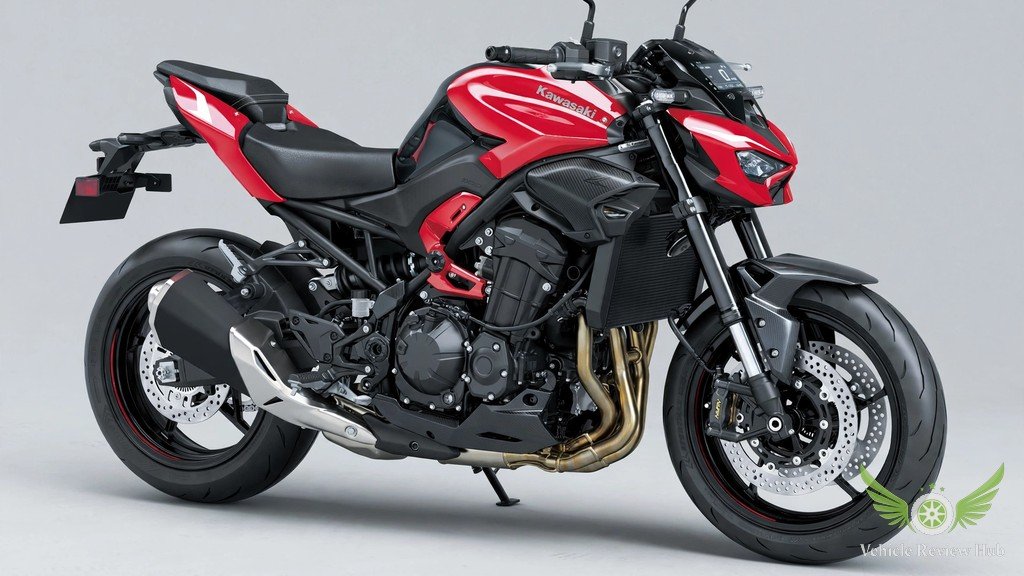
A leftover 2024 Z900 is a different bike from a 2025 in the ways that matter. The 2024 is the last pre-IMU model: cable throttle, no cruise control, no quickshifter, a 4.3-inch TFT, petal front discs and a 125 hp claim, at $9,799. The 2025 adds the six-axis IMU, ride-by-wire, cruise control, a bi-directional quickshifter, a 5-inch TFT and round front discs for $9,999 — $200 more for the electronics that define the current bike. Buy the leftover 2024 only at a discount that reflects the missing electronics, because the two bikes are not interchangeable. The same split applies to the SE: the 2024 SE costs $11,299 without the IMU, while the 2025 SE costs $11,849 with the full Era-3 kit. This Kawasaki Z900 comparison treats a 2024 and a 2025 as two different purchases, not two prices for the same bike.
| Item | 2024 Z900 | 2025 Z900 |
|---|---|---|
| IMU | None | 6-axis IMU |
| Throttle | Cable | Ride-by-wire |
| Cruise control | No | Standard |
| Quickshifter | No | Bi-directional KQS |
| Dash | 4.3-in TFT | 5-in TFT |
| Front discs | Petal | Round |
| Claimed power | 125 hp | 123.0 hp |
| MSRP | $9,799 | $9,999 |
Note: The 2025 bike’s claimed peak power actually fell — 125 hp to 123.0 hp — while its mid-range, fuel economy and electronics all improved. This Kawasaki Z900 comparison prices the 2024 only as a discounted leftover, never as the equal of the 2025.
Running Costs and Resale Value Compared
Running costs are where the four bikes converge. The Z900’s observed fuel economy is 42.5 mpg from Rider’s 2017 test and 41.6 mpg from Cycle News’ 2025 SE test, which puts its 4.5-gallon tank at roughly 187–191 miles between fill-ups. No observed MPG figure was verified for the three rivals, so this Kawasaki Z900 comparison prints none for them — and no resale value, service bill or insurance figure was verified for any of the four bikes, so none appears here either. What is verified is the warranty: the Z900 carries a 12-month limited warranty, and the Suzuki and the Honda carry 12-month unlimited-mileage limited warranties. The service routine is the same short list — oil and filter every 7,600 miles, valve clearances inspected every 15,200 miles — detailed in the companion Z900 reliability guide. The cheapest bike to buy is also among the cheapest to run, and the delivered-price gaps in this Kawasaki Z900 comparison are the only ownership costs that can be stated as fact.
Kawasaki Z900 Comparison Verdict and US Alternatives
Four bikes, four honest answers. The Z900 wins this Kawasaki Z900 comparison on delivered price and on value, but it does not win on everything — and the verdict is worth stating plainly, because the rivals each take a crown of their own.
Verdict: Value, Not Victory
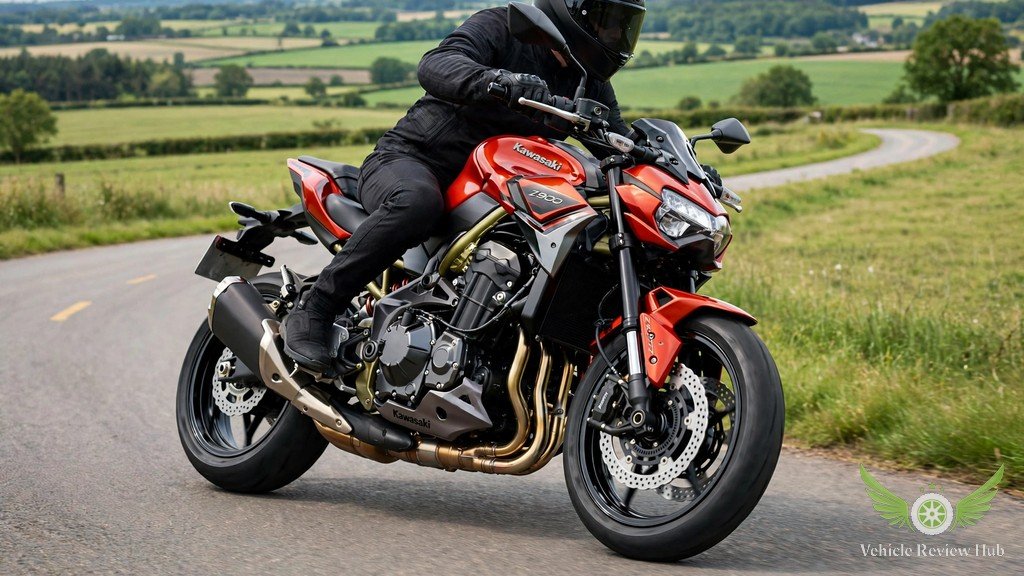
The verdict is value, not victory. The Z900 is the cheapest four-cylinder naked delivered in 2027 at $11,039, and it is the cheapest of the four bikes in this Kawasaki Z900 comparison by $509 over the Suzuki, $560 over the MT-09 and $735 over the Hornet SP. It has the lean-sensitive electronics the Suzuki and the Honda lack, the lower seat the MT-09 lacks, and the four-cylinder character the triple cannot copy. It does not have the most power — the Suzuki’s global 150 hp and the Hornet SP’s 129 hp US both beat its 123.0 hp — and it does not have the best hardware. The Z900’s case in this Kawasaki Z900 comparison is that it gives away the least while costing the least: the best value in the group, not the best bike in every measure. The alternatives are real: the MT-09 for the liveliest triple and the most advanced aids, the GSX-S1000 for the biggest engine, the Hornet SP for the best hardware. None of them is the wrong buy — but none of them is $11,039 either. The full story of the bike itself — its price, its specs and how it rides — is in the companion Z900 review.
SP Costs $360 More Than SE
The premium-bike arithmetic is just as clear. The 2027 Yamaha MT-09 SP costs $12,699 plus a $700 destination charge — $13,399 delivered — against the 2027 Z900 SE at $12,199 plus $840 — $13,039 delivered, per Yamaha’s 2027 pricing announcement and TotalMotorcycle’s 2027 Kawasaki roundup. The MT-09 SP costs $360 more than the Z900 SE on a delivered basis, and this Kawasaki Z900 comparison shows the working: the MSRP gap is $500 ($12,699 against $12,199), and the delivered gap narrows to $360 because Yamaha’s $700 destination charge is $140 lower than Kawasaki’s $840. The SP answers with a fully adjustable KYB fork, an Öhlins shock, Brembo Stylema calipers and keyless ignition; the SE answers with Brembo M4.32 calipers, an Öhlins S46 shock and a gold KYB fork at $360 less. Either premium bike is a fair buy — but the $360 gap is delivered money, not MSRP money, and this Kawasaki Z900 comparison counts it that way.
Kawasaki Z900 Comparison: Frequently Asked Questions
The questions buyers ask most when they put the Z900 against its rivals — answered from the verified delivered prices and figures in this Kawasaki Z900 comparison.
Which is cheaper delivered, the Z900 or the MT-09?
The Z900: $10,199 + $840 = $11,039 delivered, against the MT-09’s $10,899 + $700 = $11,599. The Z900 is $560 cheaper delivered despite the bigger engine, and this Kawasaki Z900 comparison ranks both bikes on delivered prices throughout.
Which is the cheapest four-cylinder naked delivered?
The 2027 Z900 at $11,039 delivered. The Suzuki GSX-S1000 is $11,548 delivered and the Honda CB1000 Hornet SP is $11,774 delivered (latest published price) — the Z900 undercuts both, and this Kawasaki Z900 comparison calls it the cheapest four-cylinder naked delivered in 2027.
How much more is the MT-09 SP than the Z900 SE?
$360 on a delivered basis: the MT-09 SP is $12,699 + $700 = $13,399, the Z900 SE is $12,199 + $840 = $13,039. The MSRP gap is $500; the delivered gap narrows because Yamaha’s destination charge is $140 lower — the delivered arithmetic this Kawasaki Z900 comparison uses throughout.
Z900 or GSX-S1000 — which is more powerful?
The GSX-S1000, on paper: 150 hp (global figure) against the Z900’s 123 hp (US figure). But this Kawasaki Z900 comparison notes the Z900 is $509 cheaper delivered ($11,039 vs $11,548), has lean-sensitive electronics the Suzuki lacks (no IMU on the GSX-S1000), and carries a smaller 4.5-gallon tank against the Suzuki’s 5.0 gallons.
Z900 or Hornet SP — which is better value?
The Hornet SP brings more power (129 hp US) and better hardware (Brembo Stylema calipers, Öhlins TTX36 shock, Showa SFF-BP fork) for $11,774 delivered — $735 more than the Z900’s $11,039. The Z900 is the cheaper buy; the Hornet SP is the better-equipped buy — the verdict this Kawasaki Z900 comparison reaches on value.
Should I buy a leftover 2024 or a 2025 Z900?
They are different bikes: the 2024 is the last pre-IMU model (no ride-by-wire, no cruise, no quickshifter, petal discs, 125 hp claim, $9,799), while the 2025 adds the IMU, ride-by-wire, cruise, quickshifter, 5-inch TFT and round discs for $9,999. Buy the leftover 2024 only at a discount that reflects the missing electronics — the rule this Kawasaki Z900 comparison applies to any leftover.