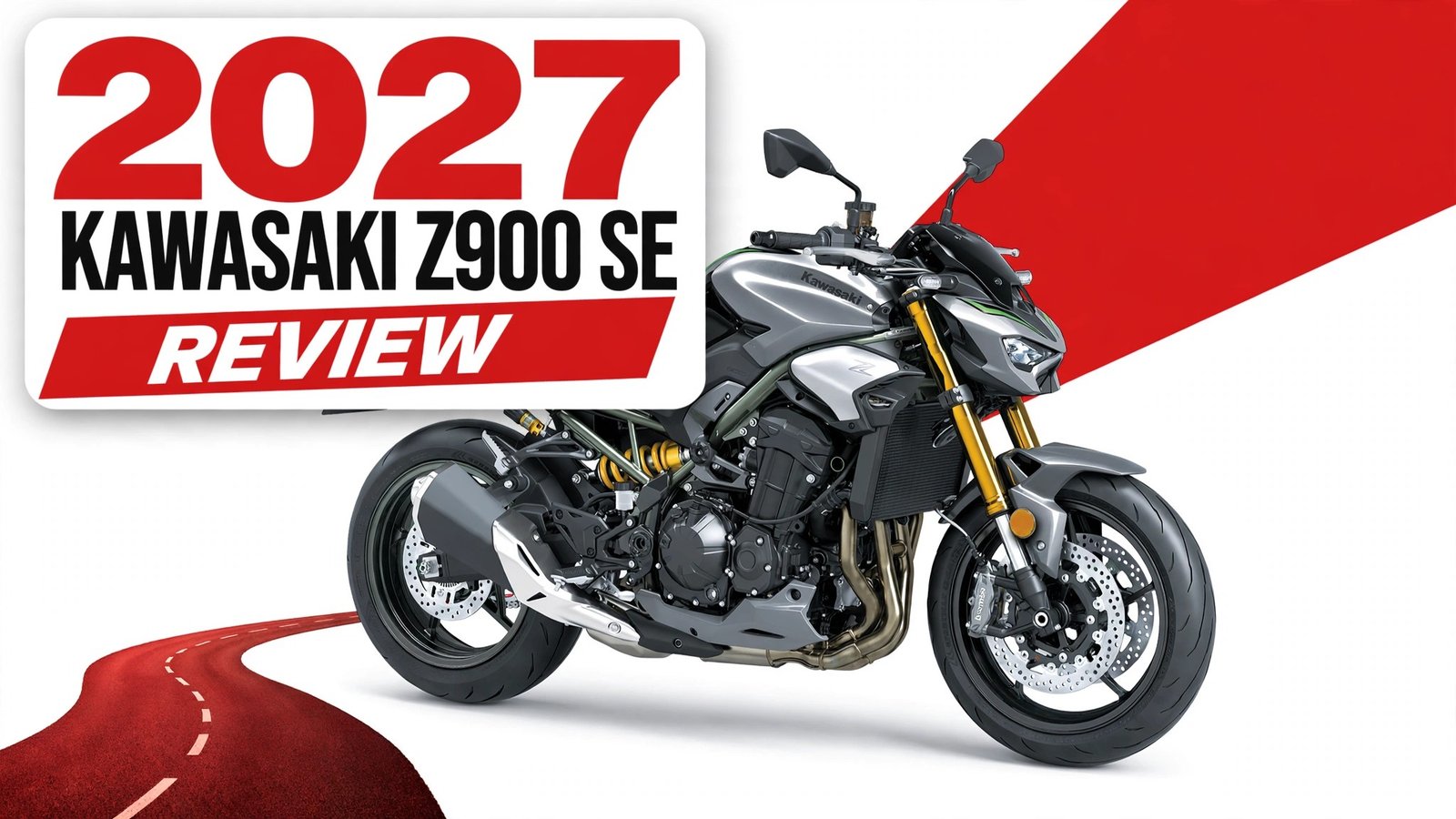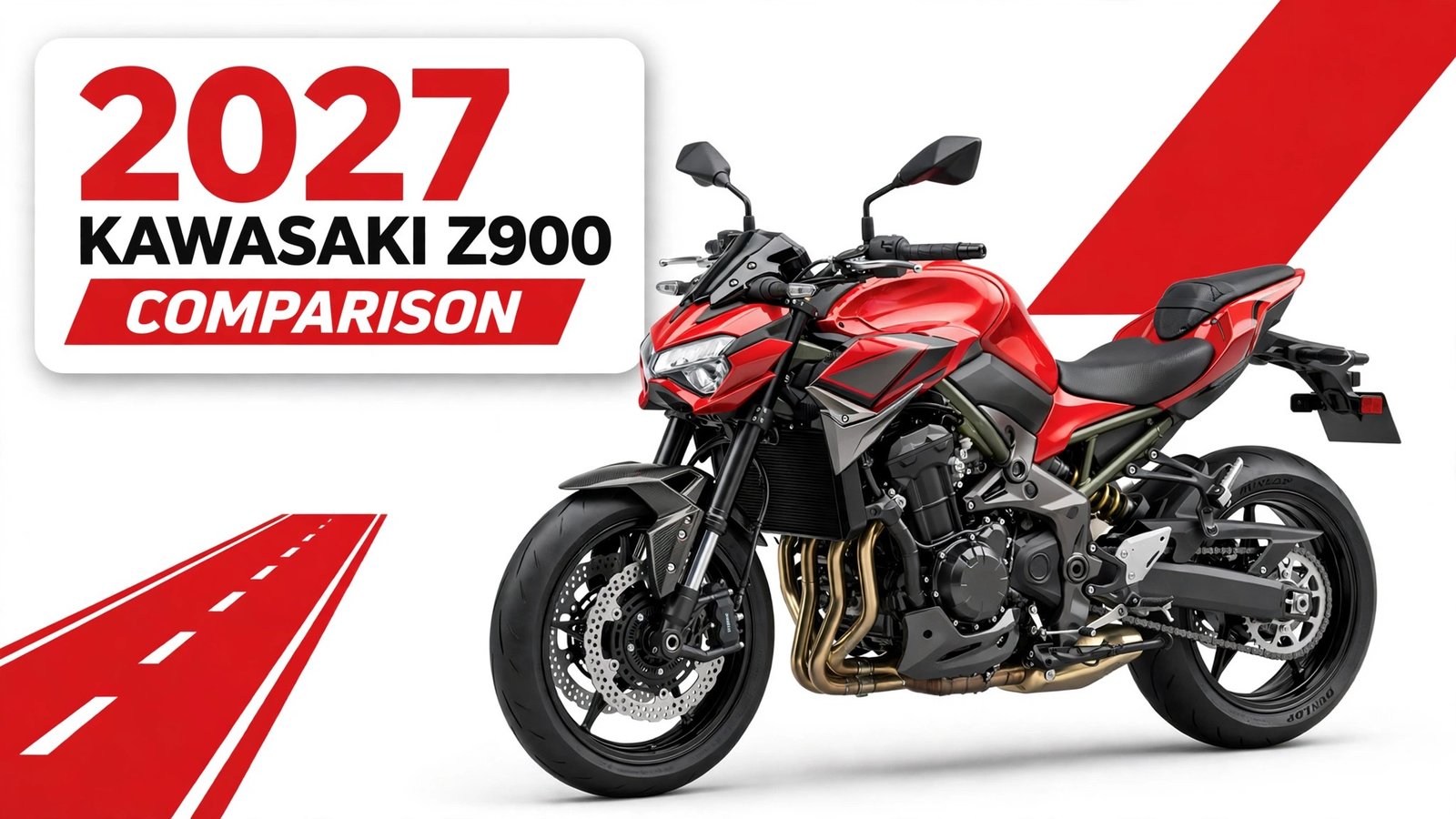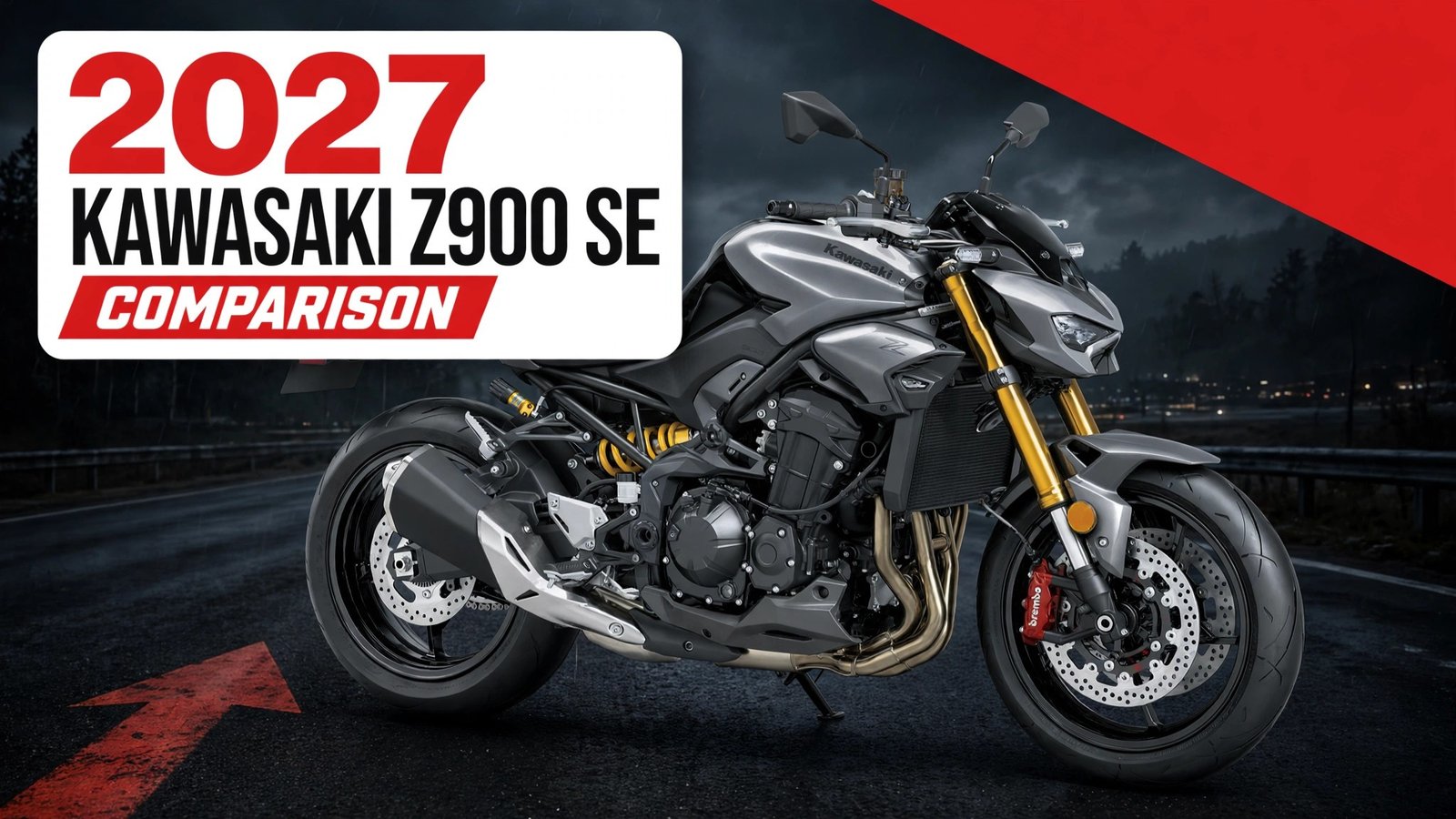
The 2027 Kawasaki Z900 SE costs $13,039 delivered — a number that only means something next to its three rivals: the Yamaha MT-09 SP at $13,399, the Honda CB1000 Hornet SP at $11,774, and the base Kawasaki Z900 at $11,039, all delivered. This Kawasaki Z900 SE comparison puts the SE against all three on price, power and hardware, and it does not hand the SE a win it did not earn.
The honest headline is parity, not victory. The SE finished last in Cycle News’s 2025 middleweight shootout, costs $1,265 more delivered than the Hornet SP, and is the heaviest bike in this Kawasaki Z900 SE comparison. What it offers instead is factory Brembo and Öhlins hardware at $360 under the MT-09 SP.
Kawasaki Z900 SE Overview and Its Closest Rivals
The SE’s three rivals are the bikes a 2027 buyer actually cross-shops: the Yamaha MT-09 SP, which beat the SE in the only group test it ever entered; the Honda CB1000 Hornet SP, the cheapest and most powerful bike here; and the base Kawasaki Z900, the same motorcycle minus the premium hardware. This Kawasaki Z900 SE comparison covers all three in turn.
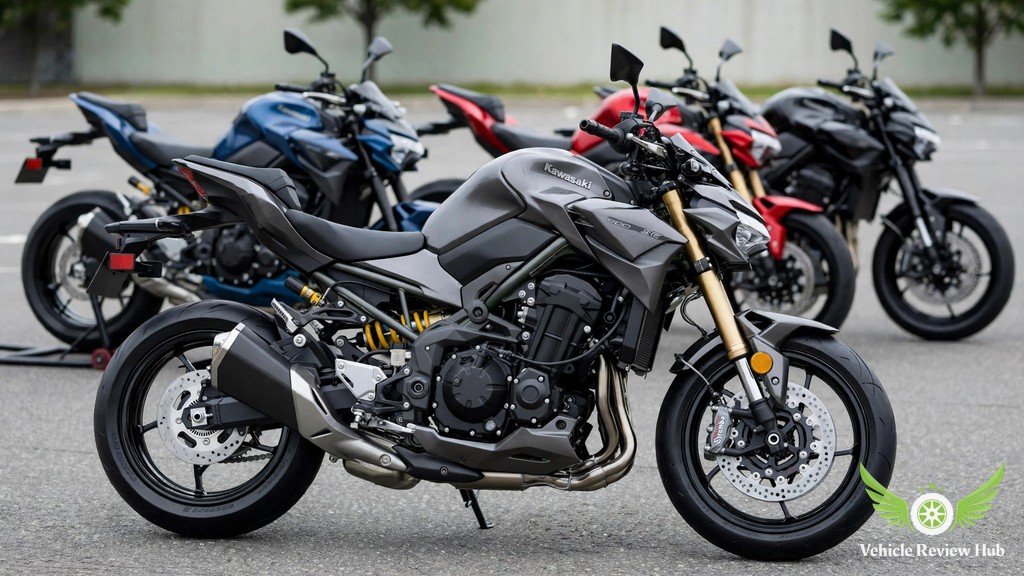
Cycle News’s 2025 middleweight shootout is the only group test in this Kawasaki Z900 SE comparison. The video shows the SE against the Yamaha MT-09 SP, the KTM 990 Duke and the Triumph Street Triple 765 RS, and the SE finished last, fourth of four. Two gaps matter: the Honda CB1000 Hornet SP, one of this comparison’s three rivals, was scheduled but not available, so it does not appear; and the Duke and the Street Triple are in the video but are not among this blog’s three rivals.
Parity, Not a Verdict Win
The SE does not win this Kawasaki Z900 SE comparison on paper. It is the heaviest bike here at 469.7 lb, the second-most expensive delivered at $13,039, and it finished last in the 2025 shootout. Handing the SE a win on those facts would be inventing one.
What the SE offers is parity plus value: the same 948cc inline-four and 123.0 hp as the base Z900, premium hardware the rivals do not offer at this price, and a delivered price $360 under the MT-09 SP and $1,265 over the Hornet SP. The verdict this Kawasaki Z900 SE comparison reaches is “parts justify it” — not “the SE is the best bike here”.
How the Four Bikes Differ at a Glance
Four bikes, four different answers: the SE is the torquier four with the premium brakes and shock; the MT-09 SP is the lightest and the shootout winner; the Hornet SP is the most powerful on paper and the cheapest delivered; the base Z900 is the cheapest four-cylinder naked delivered in its class.
| Bike | Engine | Power (US claim) | Torque (US) | Curb weight | Delivered (2027) |
|---|---|---|---|---|---|
| Kawasaki Z900 SE | 948cc inline-four | 123.0 hp @ 9,500 rpm | 73.1 lb-ft @ 7,700 rpm | 469.7 lb (49-state) / 471.9 lb (50-state) | $13,039 ($12,199 + $840) |
| Yamaha MT-09 SP | 890cc CP3 triple | 117 hp @ 10,000 rpm | 68.6 lb-ft @ 7,000 rpm | 427.9 lb | $13,399 ($12,699 + $700) |
| Honda CB1000 Hornet SP | 999cc inline-four | 129 hp (US, TopSpeed) / 155 hp (EU) | US torque not verified | ~467 lb (EU kerb) | $11,774* ($10,999 + $775) |
| Kawasaki Z900 (base) | 948cc inline-four | 123.0 hp @ 9,500 rpm | 73.1 lb-ft @ 7,700 rpm | 467.5 lb (49-state) / 469.7 lb (50-state) | $11,039 ($10,199 + $840) |
Note: *The Hornet SP price is the latest published (2026) figure — the 2027 price was not verified, so this Kawasaki Z900 SE comparison labels it 2026 on every use. Its US torque was not verified, and its weight is the EU kerb figure.
Kawasaki Z900 SE vs Yamaha MT-09 SP
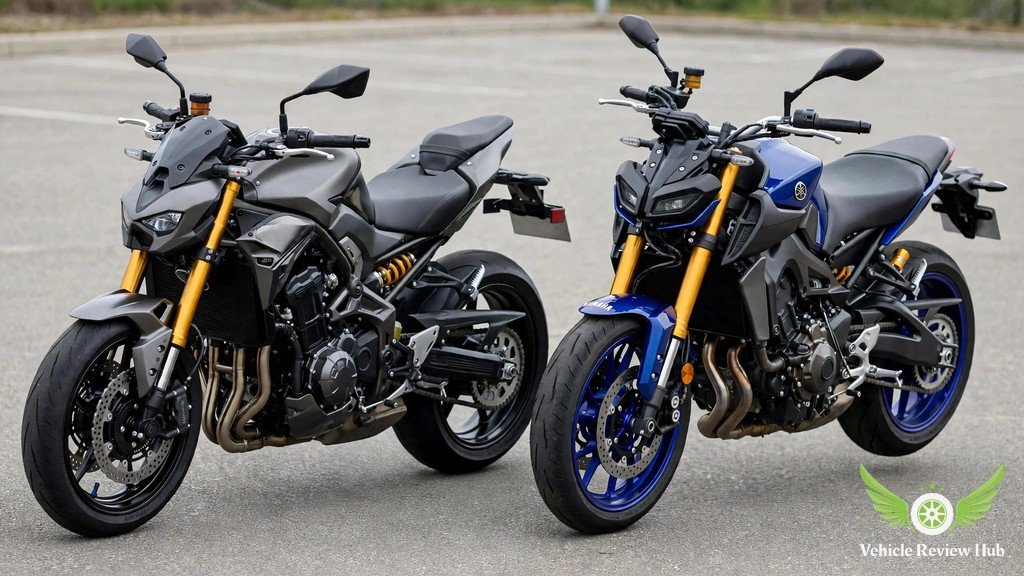
The MT-09 SP is the bike the SE lost to, and the pairing is the sharpest in this Kawasaki Z900 SE comparison: the shootout’s winner against its last-place finisher, separated by $360 delivered. The SP’s 890cc CP3 triple claims 117 hp and 68.6 lb-ft, but the SP weighs 427.9 lb against the SE’s 469.7 lb.
Engine, Specs and Performance Side by Side
On paper the SE has the stronger engine and the SP has the lighter bike. The SE’s 948cc four claims 123.0 hp and 73.1 lb-ft; the SP’s 890cc triple claims 117 hp and 68.6 lb-ft. The SE carries the bigger tank and the lower seat. The shootout’s testers found the SE cramped for riders from 5’10” to 6’2″, its base settings “exceptionally soft”, and its chassis “a little dated”.
Neither bike has a measured rear-wheel figure to quote here. No published dyno figure for the SE itself exists as of November 2026; the figures quoted for the platform are the base bike’s, labelled as such — Cycle World measured 113.96 hp at 9,710 rpm on a 2020 base Z900. Both bikes carry KYB forks and Öhlins rear shocks, IMUs, quickshifters and cruise control, per RevZilla’s 2025 first ride. The hardware is a draw; the weight is not, and this Kawasaki Z900 SE comparison does not pretend otherwise.
Price, Equipment and Which Suits Which Rider
On price the SE wins the narrow contest: $13,039 delivered ($12,199 + $840) against the SP’s $13,399 delivered ($12,699 + $700) — $360 cheaper delivered, $500 cheaper on MSRP, because Yamaha’s $700 destination charge is $140 lower than Kawasaki’s $840. The shootout’s verdict still stands, and this Kawasaki Z900 SE comparison does not invert it.
The SE suits the rider who wants the four’s smoothness, the bigger tank, the lower seat and the $360 saving in this Kawasaki Z900 SE comparison; the SP suits the rider who wants the lightest bike, the triple’s character and the shootout win. In 2022 the SE at $10,699 was only $500 cheaper than the MT-09 SP at $11,199 — and the SP already had an IMU, cruise control and Öhlins while the Gen 1 SE had none of those, per Cycle News’s 2022 SE review.
| Item | Kawasaki Z900 SE | Yamaha MT-09 SP |
|---|---|---|
| Engine | 948cc inline-four | 890cc CP3 triple |
| Power (US claim) | 123.0 hp @ 9,500 rpm | 117 hp @ 10,000 rpm |
| Torque (US) | 73.1 lb-ft @ 7,700 rpm | 68.6 lb-ft @ 7,000 rpm |
| Curb weight | 469.7 lb (49-state) / 471.9 lb (50-state) | 427.9 lb |
| Seat height | 31.9 in | 32.5 in |
| Fuel tank | 4.5 gal | 3.7 gal |
| Delivered price (2027) | $13,039 | $13,399 |
Note: The SE claims 6 hp and 4.5 lb-ft more but carries about 42 lb more weight, and this Kawasaki Z900 SE comparison prices the gap at $360 delivered in the SE’s favour — $500 on MSRP, narrowed by Yamaha’s $140-lower destination charge.
Kawasaki Z900 SE vs Honda CB1000 Hornet SP
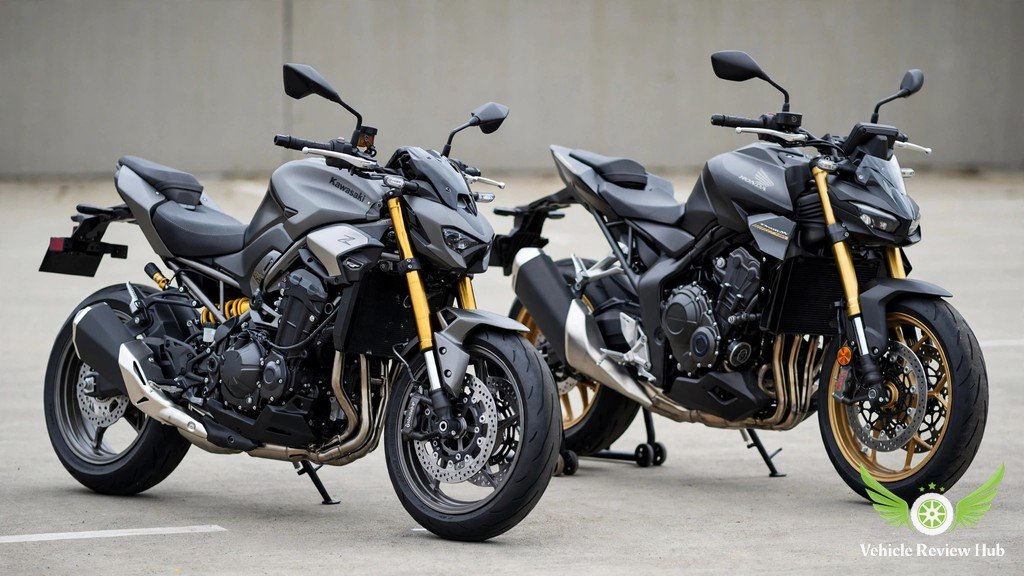
The Hornet SP is the pairing where the SE loses on price and wins on nothing but hardware philosophy. The Honda is the most powerful bike in this Kawasaki Z900 SE comparison on paper and the cheapest delivered — $11,774 against the SE’s $13,039. The SE’s case is its inline-four character and its Brembo and Öhlins hardware.
Engine, Specs and Performance Side by Side
The Hornet SP’s 999cc inline-four claims 129 hp in the US, per TopSpeed, against the SE’s 123.0 hp — the Honda is the more powerful bike on paper in this Kawasaki Z900 SE comparison by either measure, since its European figure is 155 hp. The SE counters with torque it can name: 73.1 lb-ft at 7,700 rpm. The Hornet SP’s US torque figure was not verified and is not printed here.
The hardware philosophies differ. The Hornet SP’s premium hardware is its Showa SFF-BP fork and Öhlins TTX36 rear shock; the SE counters with Brembo M4.32 calipers, an Öhlins S46 shock and a fully-adjustable gold KYB fork. There is no head-to-head shootout result: the Hornet SP was scheduled for Cycle News’s 2025 shootout but was not available, so the test ran without it, and this Kawasaki Z900 SE comparison invents no placing for a bike that was never in the test.
Price, Equipment and Which Suits Which Rider
On price the Hornet SP is the value buy, full stop: $11,774 delivered (latest published price, 2026 — $10,999 + $775) against the SE’s $13,039, so the SE costs $1,265 more delivered. The SE’s case is its hardware, not a price win over Honda.
The Hornet SP suits the rider who wants the most power per dollar and the lowest delivered price in this Kawasaki Z900 SE comparison. The SE suits the rider who wants the torquier four at lower revs, the Brembo brakes and the Öhlins shock — and who will pay $1,265 over the Honda for them. The 2027 Hornet SP price was not verified, so $11,774 stays labelled 2026.
| Item | Kawasaki Z900 SE | Honda CB1000 Hornet SP |
|---|---|---|
| Engine | 948cc inline-four | 999cc inline-four |
| Power (US claim) | 123.0 hp @ 9,500 rpm | 129 hp (US, TopSpeed) / 155 hp (EU) |
| Torque (US) | 73.1 lb-ft @ 7,700 rpm | US torque not verified |
| Curb weight | 469.7 lb (49-state) / 471.9 lb (50-state) | ~467 lb (EU kerb) |
| Seat height | 31.9 in | Not verified |
| Premium hardware | Brembo M4.32 + Öhlins S46 + gold KYB fork | Showa SFF-BP fork + Öhlins TTX36 shock |
| Delivered price | $13,039 (2027) | $11,774 (latest published, 2026) |
Note: The Hornet SP is $1,265 cheaper delivered than the SE, and this Kawasaki Z900 SE comparison does not claim otherwise. Its $11,774 price is the labelled 2026 figure; its US torque and seat height were not verified and are not printed.
Kawasaki Z900 SE vs Kawasaki Z900
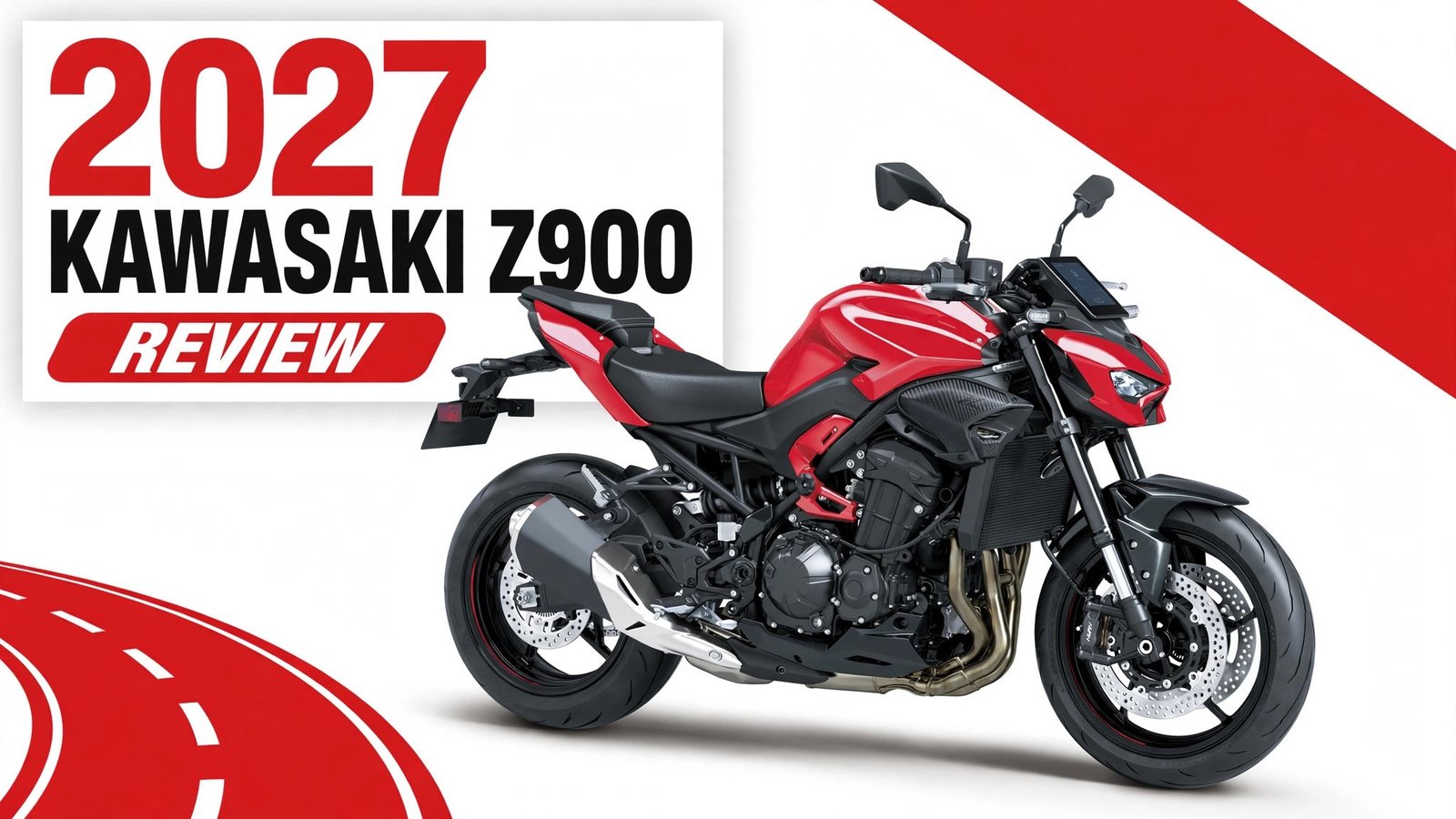
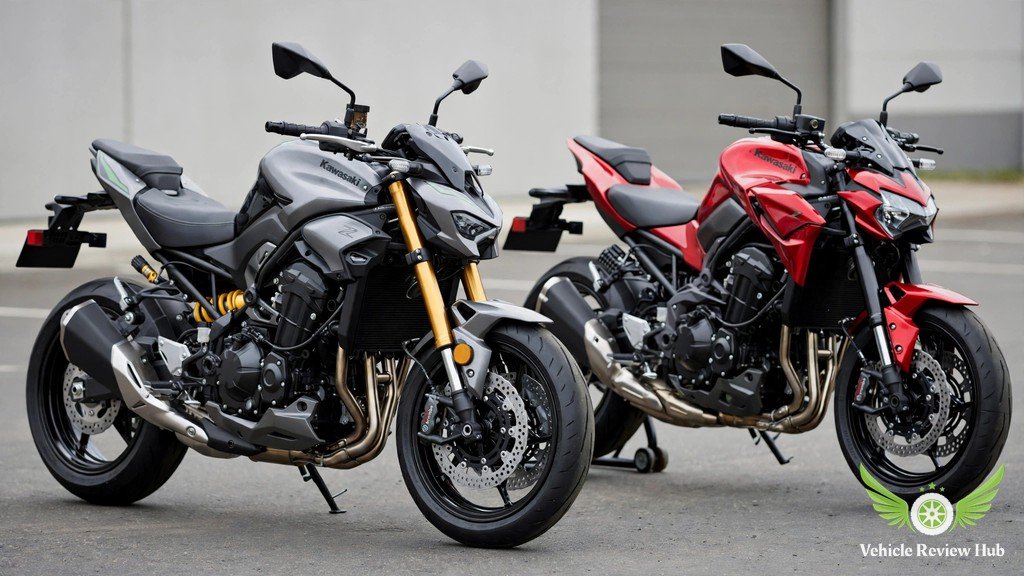
The base Z900 is the simplest pairing in this Kawasaki Z900 SE comparison: the two bikes are the same motorcycle with different hardware. Same 948cc engine, same 123.0 hp and 73.1 lb-ft, same frame, gearbox, electronics and tank. The differences are only the Brembo brakes, the Öhlins shock, the gold fork, the two-tone seat, the USB-C port and the premium colours — plus 2.2 lb.
Engine, Specs and Performance Side by Side
There is no performance difference to find, and this Kawasaki Z900 SE comparison does not invent one. The SE claims the same 123.0 hp and 73.1 lb-ft as the base bike and carries 2.2 lb more, so it is no faster. The $2,000 premium buys braking and suspension, not horsepower.
The hardware differences are the whole comparison. The SE gets Brembo M4.32 calipers on dual 300 mm discs with steel lines and a Nissin radial master cylinder, where the base bike has conventional Nissin calipers and a conventional master cylinder. The SE’s rear shock is an Öhlins S46, where the base bike has a KYB shock, and the SE’s gold 41 mm fork is fully adjustable on the Gen 2 bike.
Price, Equipment and Which Suits Which Rider
The price gap is exactly the premium in this Kawasaki Z900 SE comparison: base $11,039 delivered ($10,199 + $840) against SE $13,039 delivered ($12,199 + $840) — $2,000, the same in 2026 and 2027, after $1,500 across the Gen 1 years and $1,850 for 2025. The base suits the rider who wants the cheapest four-cylinder naked delivered in its class and who will never track the bike, and the base Z900 comparison carries the full value case for the cheaper bike.
Cycle News’s 2022 verdict is still the SE’s case: “For the money, the Z900 SE is indeed a good buy” — the braking and suspension improvement made “the new Zee worth the money alone” at the $1,500 premium. At the 2027 $2,000 premium the same hardware case applies, and this Kawasaki Z900 SE comparison reaches the same conclusion: the parts are worth the money and the base bike is not “missing” anything essential.
| Item | Kawasaki Z900 SE | Kawasaki Z900 (base) |
|---|---|---|
| Engine | 948cc inline-four | 948cc inline-four |
| Power / torque (US claim) | 123.0 hp @ 9,500 rpm / 73.1 lb-ft @ 7,700 rpm | 123.0 hp @ 9,500 rpm / 73.1 lb-ft @ 7,700 rpm |
| Curb weight | 469.7 lb (49-state) / 471.9 lb (50-state) | 467.5 lb (49-state) / 469.7 lb (50-state) |
| Front brakes | Brembo M4.32 calipers, steel lines, Nissin radial master cylinder | Nissin calipers, conventional master cylinder |
| Rear shock | Öhlins S46, rebound + remote preload | KYB shock |
| Front fork | Gold 41 mm, fully adjustable (compression, rebound, preload) | 41 mm inverted fork |
| Seat / USB-C | Two-tone seat, USB-C standard | Standard seat, USB-C optional |
| Delivered price (2027) | $13,039 | $11,039 |
Note: The $2,000 gap is exactly the SE premium, and this Kawasaki Z900 SE comparison counts it as a hardware price, not a speed price — same engine, same power, 2.2 lb heavier.
Kawasaki Z900 SE Price and Value Compared
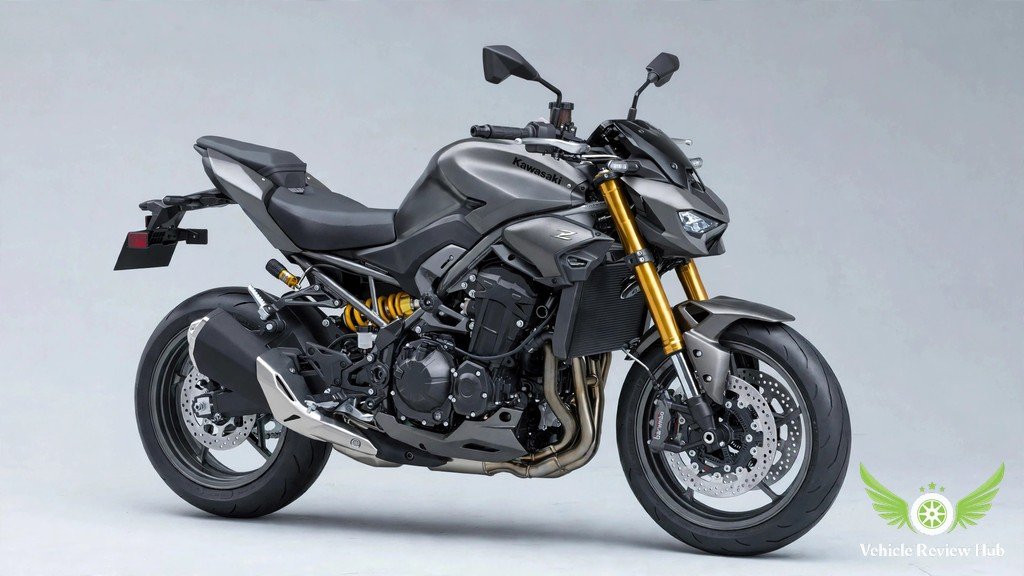
Price is where this Kawasaki Z900 SE comparison turns from a spec sheet into a buying decision. The SE’s premium ladder is $1,500 flat across the Gen 1 years, $1,850 for 2025, and $2,000 for 2026 and 2027 — Powersports Business’s 2027 lineup confirms the $12,199 SE price. The table below prices every SE year delivered.
Used Keeps $1,000 to $1,500
The heading puts the used SE premium at $1,000 to $1,500, and this Kawasaki Z900 SE comparison prints that figure only as the document’s heading — it was not verified as a tight range. Observed US listings from November 2026 show same-year gaps from near zero to about $1,990: a 2023 SE at $8,995 against 2023 base bikes at $7,293 to $8,750, and 2026 averages of $10,240 for the SE against $8,250 for the base on 1000PS. Treat the premium as roughly $1,000 to $1,500 in the best cases.
The pattern behind the spread is the same one this Kawasaki Z900 SE comparison found in the new prices: the premium holds best on low-mileage bikes with full service records and washes out fastest on high-mileage bikes. A used SE with a weeping Öhlins shock or sticking Brembo pistons loses its premium first.
Running Costs and Resale Value Compared
Running costs are the base bike’s costs in this Kawasaki Z900 SE comparison: the SE shares the Z900 platform’s service schedule, so oil and filter fall due every 7,600 miles, valves every 15,200 miles, and the chain wants lube every 400 miles. Fuel is the cheapest line — Cycle News measured 41.6 mpg for the 2025 SE, about 187 miles from the 4.5-gallon tank. The Brembo pads and the Öhlins shock cost more to replace, and the reliability guide prices the service items the SE adds.
Resale follows the same split: the SE holds its hardware premium only while the hardware is in good order. Keep the service records, the preload adjuster moving and the caliper pistons free. The 12-month warranty covers the first year; after that the owner’s inspections are the warranty — the same discipline the full review applies to the purchase decision itself.
| Model year | SE MSRP | Base MSRP | SE premium | Destination | SE delivered |
|---|---|---|---|---|---|
| 2022 | $10,699 | $9,199 | $1,500 | Not found | Not computable |
| 2023 | $10,899* | $9,399* | $1,500 | $460* | $11,359* |
| 2024 | $11,399 | $9,899 | $1,500 | $475 | $11,874 |
| 2025 | $11,849 | $9,999 | $1,850 | $815† | $12,664 |
| 2026 | $11,999 | $9,999 | $2,000 | $840‡ | $12,839‡ |
| 2027 | $12,199 | $10,199 | $2,000 | $840 | $13,039 |
Note: *2023 figures are Motorcycle.com database only — no Kawasaki sheet exists for 2023. †2025 destination is the Motorcycle.com figure only. ‡2026 destination is inferred from the base bike. No 2022 delivered price is printed. The 2024 figures are Kawasaki’s own sheet figures ($11,399 SE / $9,899 base); the Motorcycle.com database lists $11,299 / $9,799, and this Kawasaki Z900 SE comparison prints the sheet figures with the conflict labelled.
Kawasaki Z900 SE Comparison Verdict and US Alternatives
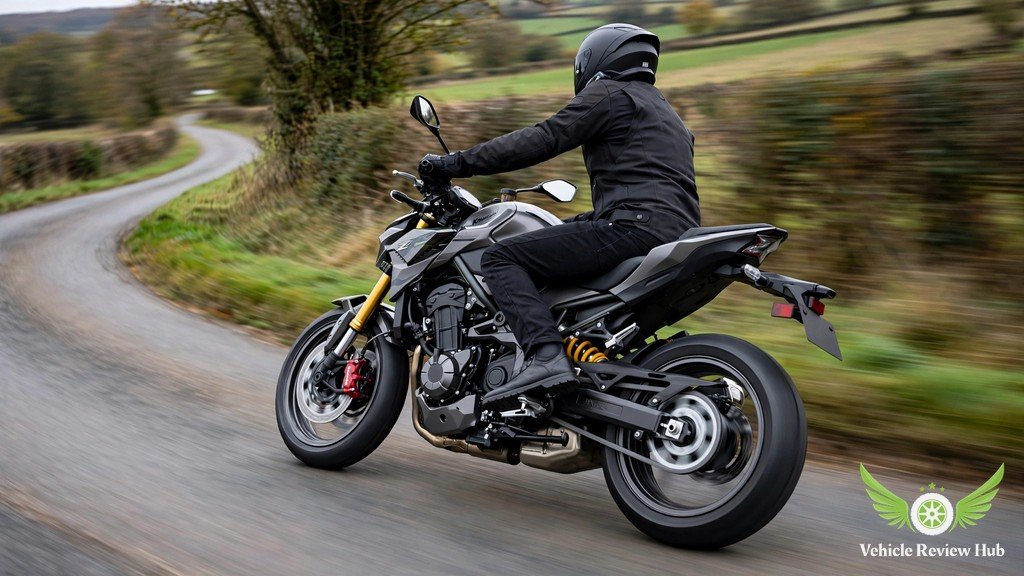
The verdict this Kawasaki Z900 SE comparison reaches is narrow on purpose: the parts justify the premium, and nothing more is claimed. The SE does not win the shootout, does not beat the Hornet SP on price, and is not faster than the base bike. What it does is put factory Brembo and Öhlins hardware on a 948cc four for $2,000 over the base and $360 under the MT-09 SP delivered.
Verdict: Parts Justify It
The $2,000 premium for 2027 buys Brembo M4.32 calipers, an Öhlins S46 shock, a fully-adjustable gold fork, a two-tone seat, USB-C and premium colours, fitted by the factory under a 12-month warranty, at $13,039 delivered, per Kawasaki’s 2027 SE spec sheet — still $360 under the MT-09 SP at $13,399. The SE does not win the shootout and does not beat the Hornet SP on price. It justifies its premium on parts value alone, and this Kawasaki Z900 SE comparison states that verdict with the figures.
Buy the SE if the brakes and the shock are what you want, fitted by the factory rather than bought aftermarket. Buy the base Z900 if $2,000 matters more than the hardware — same bike, same power, cheapest four-cylinder naked delivered at $11,039. Buy the MT-09 SP if you want the lightest bike and the shootout winner for $360 more delivered. Buy the Hornet SP if you want the most power per dollar at $11,774. No single winner emerges from this Kawasaki Z900 SE comparison — the four bikes answer four different questions.
Duke Charges for Its QS
The KTM 990 Duke is not one of this blog’s three rivals, and this Kawasaki Z900 SE comparison says so in the first sentence: the Duke appears here only because it is the third bike in the comparison video, where it finished second, and because its quickshifter is an option, not standard equipment. The 990 Duke’s Quickshifter+ costs extra — KTM’s Demo Mode lets owners try it free for the first 1,500 km, then they must pay.
On the 2026 990 Duke R, the all-encompassing Tech Pack — quickshifter plus Track Pack plus Motor Slip Regulation plus cruise control — is $899.99, taking the bike from $13,399 to $14,298 as tested. On the Gen 2 SE, the MT-09 SP and the Hornet SP, the quickshifter is standard. The SE’s $2,000 premium buys the hardware fitted; the Duke’s headline price does not include the quickshifter — a gap this Kawasaki Z900 SE comparison flags plainly. The performance guide covers the SE’s own quickshifter as part of the shared Gen 2 electronics.
Kawasaki Z900 SE Comparison: Frequently Asked Questions
The questions buyers ask most about this Kawasaki Z900 SE comparison — answered from the verified figures.
Is the Z900 SE cheaper than the Yamaha MT-09 SP?
Yes, by $360 delivered in this Kawasaki Z900 SE comparison: the 2027 SE is $12,199 + $840 = $13,039 delivered, and the 2027 MT-09 SP is $12,699 + $700 = $13,399 delivered. The MSRP gap is $500; the delivered gap narrows to $360 because Yamaha’s destination charge ($700) is $140 lower than Kawasaki’s ($840).
Is the Z900 SE cheaper than the Honda CB1000 Hornet SP?
No — the Hornet SP is $1,265 cheaper delivered: $10,999 + $775 = $11,774 (2026 price — the 2027 price was not verified) against the SE’s $13,039. The Hornet SP is the value buy on price; the SE’s case is its hardware, not a price win over Honda.
Is the SE worth $2,000 more than the base Z900?
The $2,000 (2027) buys Brembo M4.32 brakes, an Öhlins S46 shock, a fully-adjustable gold fork, a two-tone seat, USB-C and premium colours, fitted by the factory under the 12-month warranty. Same engine, same power, 2.2 lb heavier — so the premium buys no speed. Cycle News’s 2022 verdict was that the hardware alone was “worth the money alone” at the $1,500 premium.
Which is the best bike of the four?
No single winner: the MT-09 SP won Cycle News’s 2025 shootout and is the lightest bike here; the Hornet SP is the most powerful on paper and the cheapest delivered; the base Z900 is the cheapest four-cylinder naked delivered; the SE finished last in that shootout but is the only bike here that pairs the inline-four with factory Brembo and Öhlins hardware at $360 under the SP. “Parts justify it” is the SE’s verdict in this Kawasaki Z900 SE comparison — not a win claim.
Does a used Z900 SE hold its premium?
The $1,000–$1,500 used premium in the doc’s heading was not verified as a tight range. Observed US listings from November 2026 show same-year gaps from near zero to about $1,990 — for example a 2023 SE at $8,995 against 2023 base bikes at $7,293–$8,750, and 2026 averages of $10,240 (SE) versus $8,250 (base) on 1000PS. Treat it as roughly $1,000–$1,500 in the best cases, less when mileage and condition differ.
Does the KTM 990 Duke charge extra for its quickshifter?
Yes. The 990 Duke’s up-and-down quickshifter (Quickshifter+) is an option, not standard — KTM’s Demo Mode lets you try it free for the first 1,500 km, then you pay. On the 2026 990 Duke R the all-encompassing Tech Pack is $899.99, taking the bike from $13,399 to $14,298 as tested. On the Gen 2 SE, the MT-09 SP and the Hornet SP, the quickshifter is standard. The Duke is not one of this Kawasaki Z900 SE comparison’s three rivals — it appears here because it is the third bike in the comparison video.