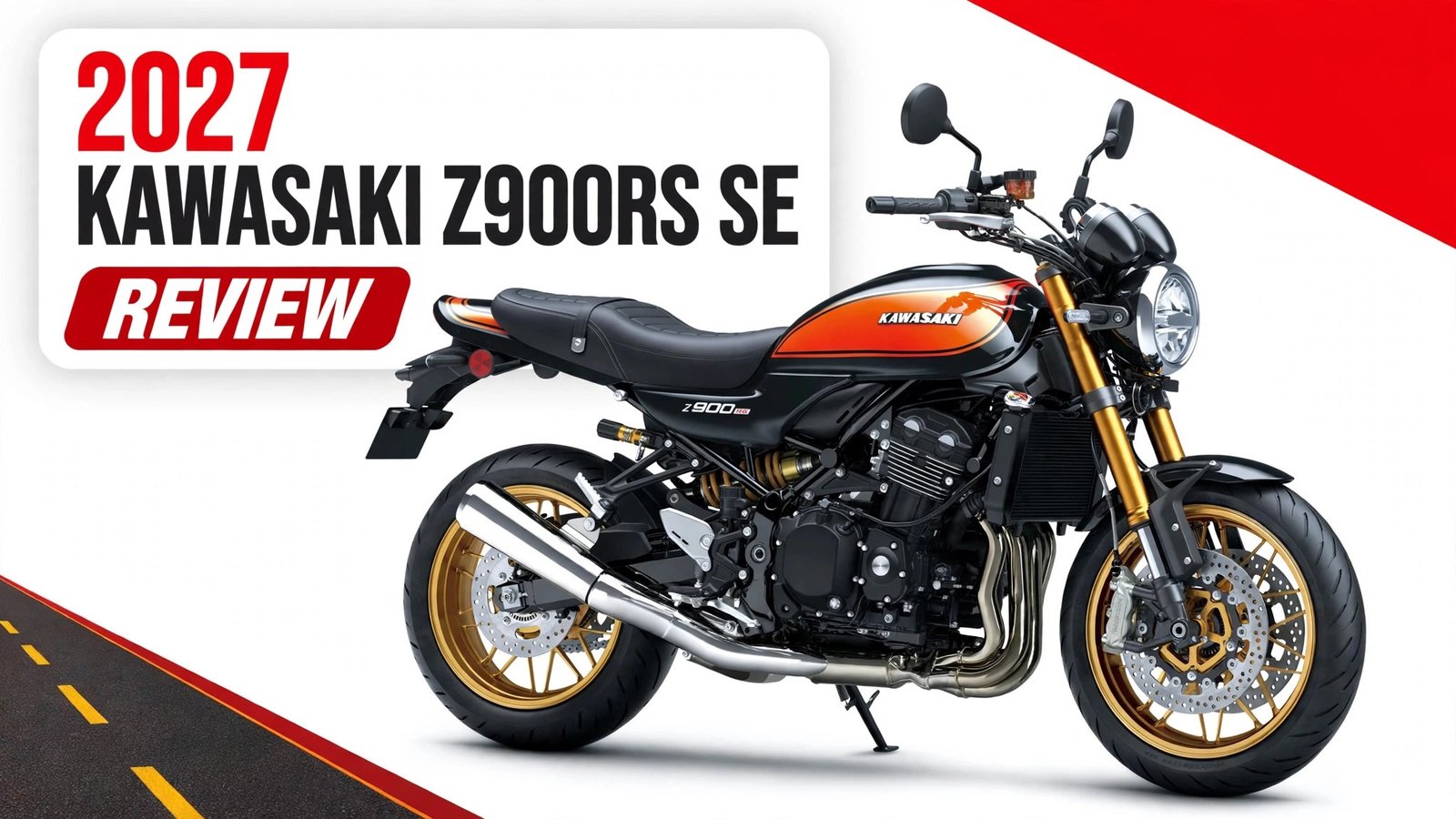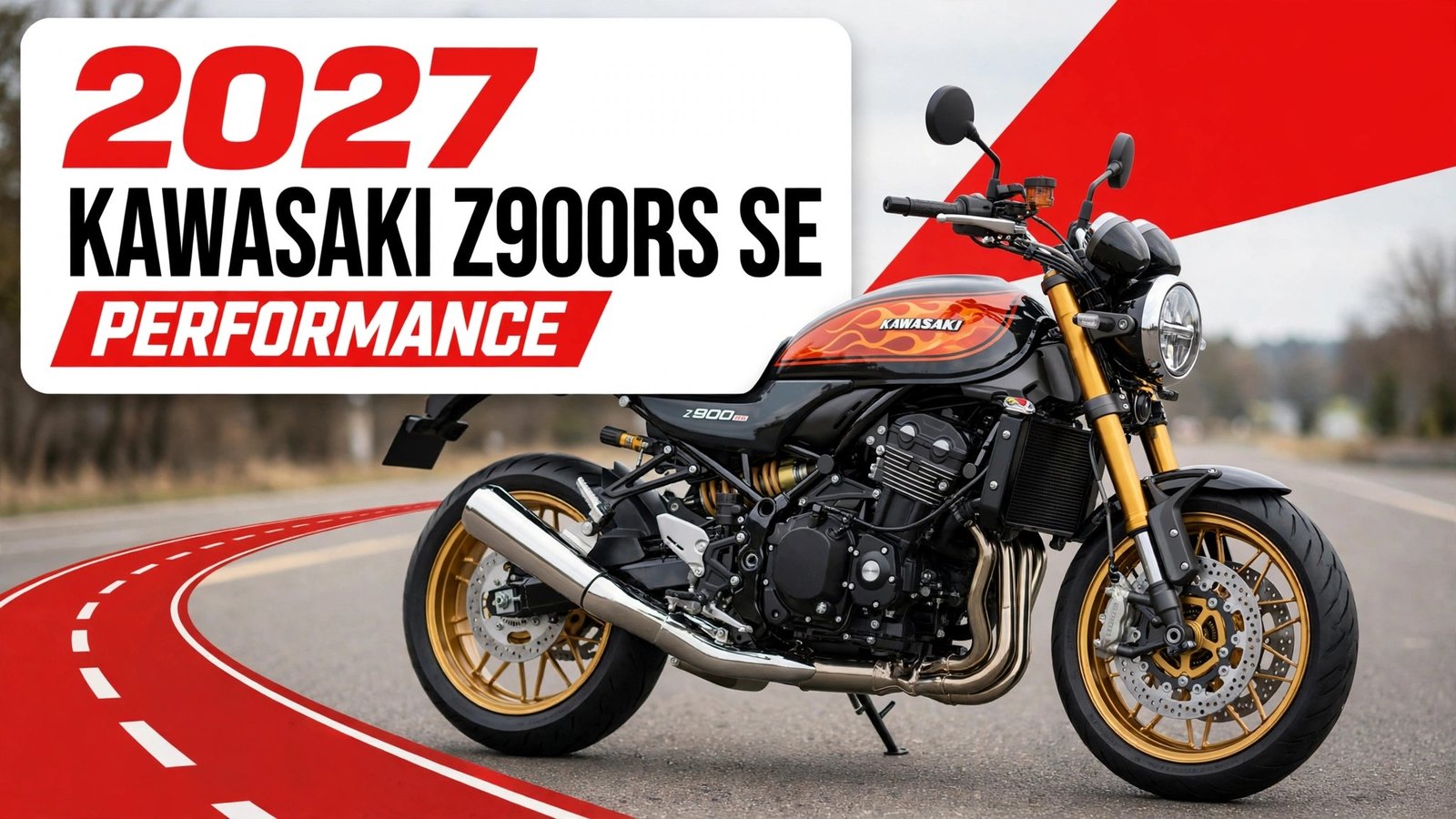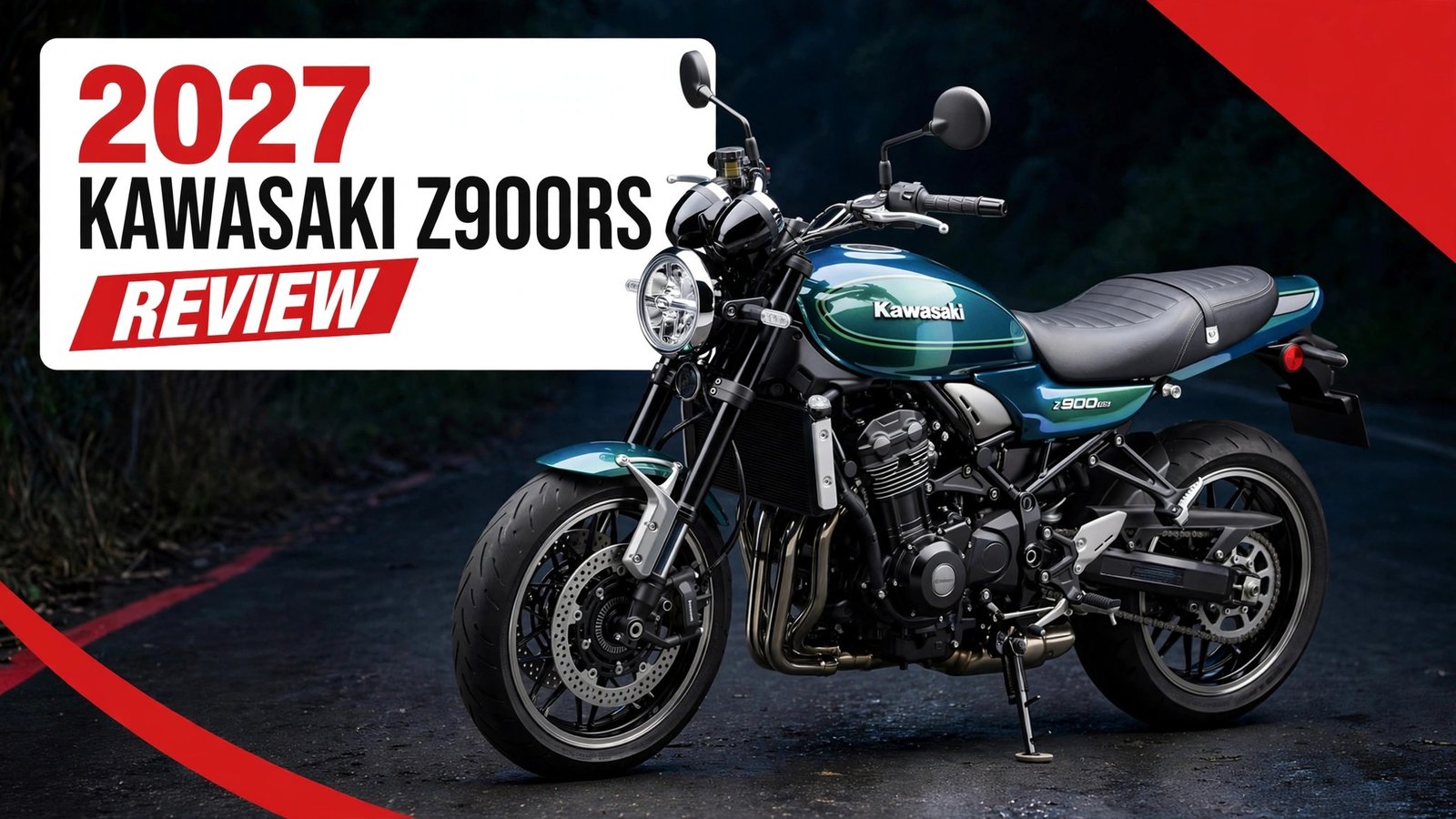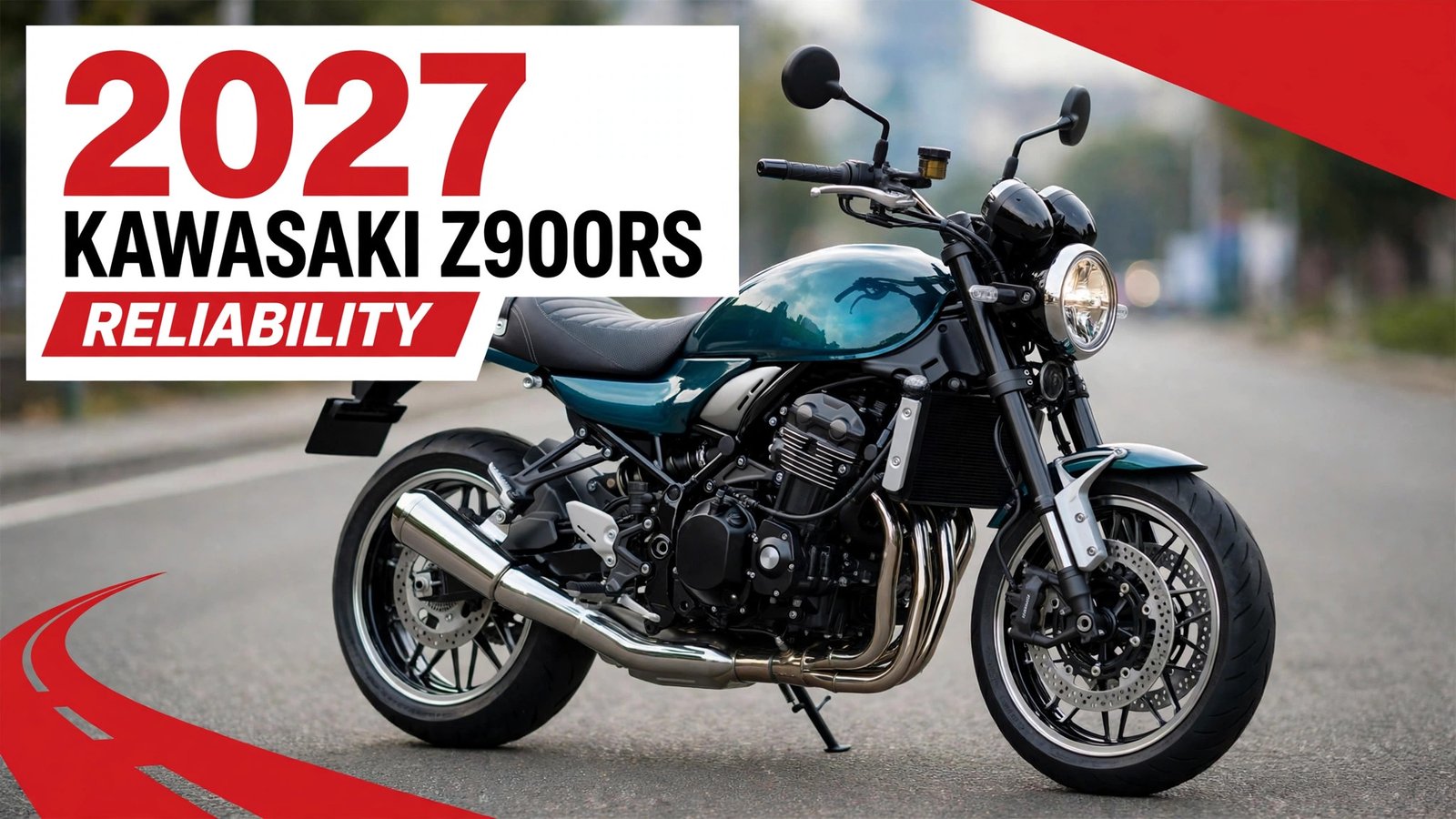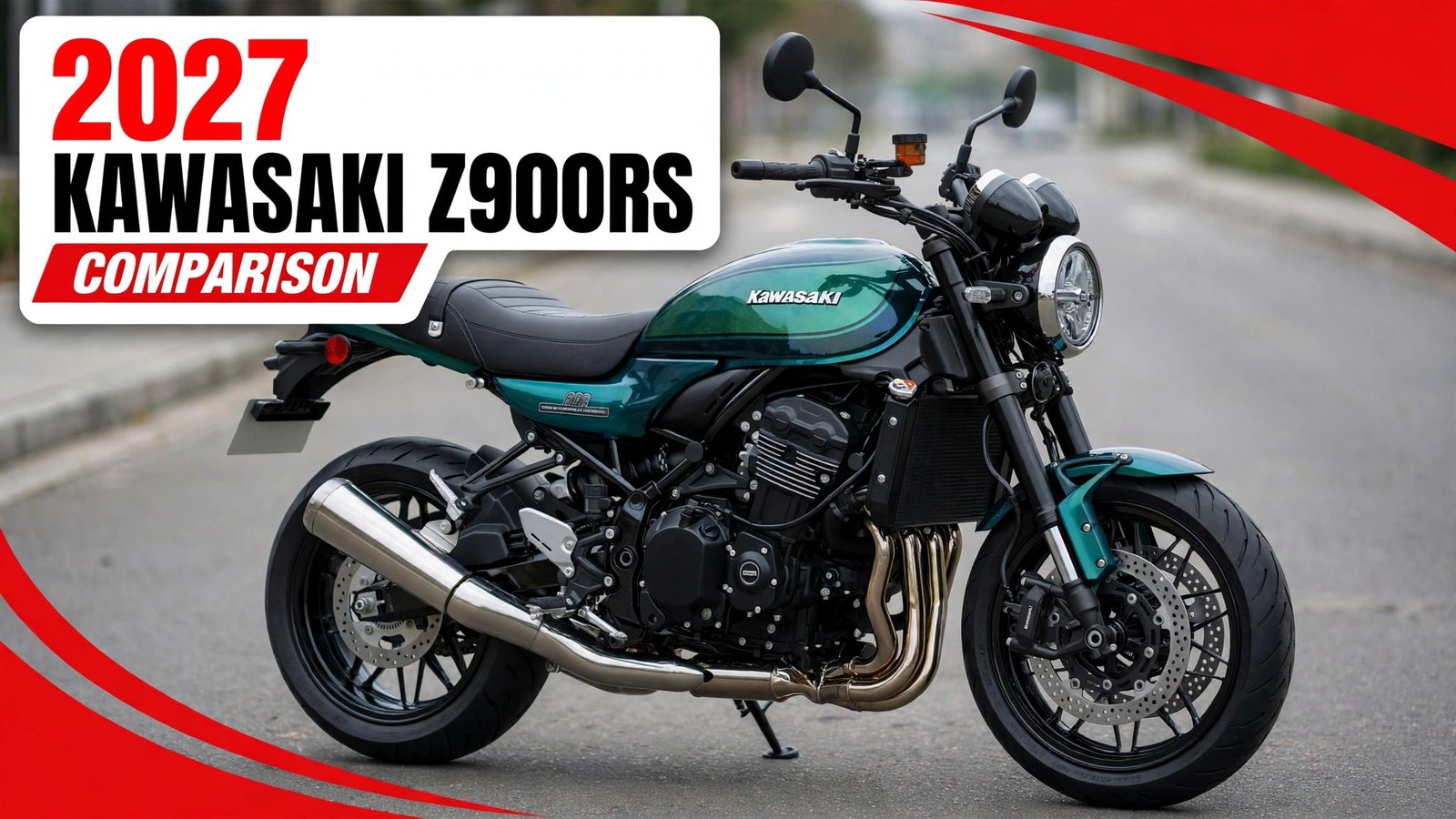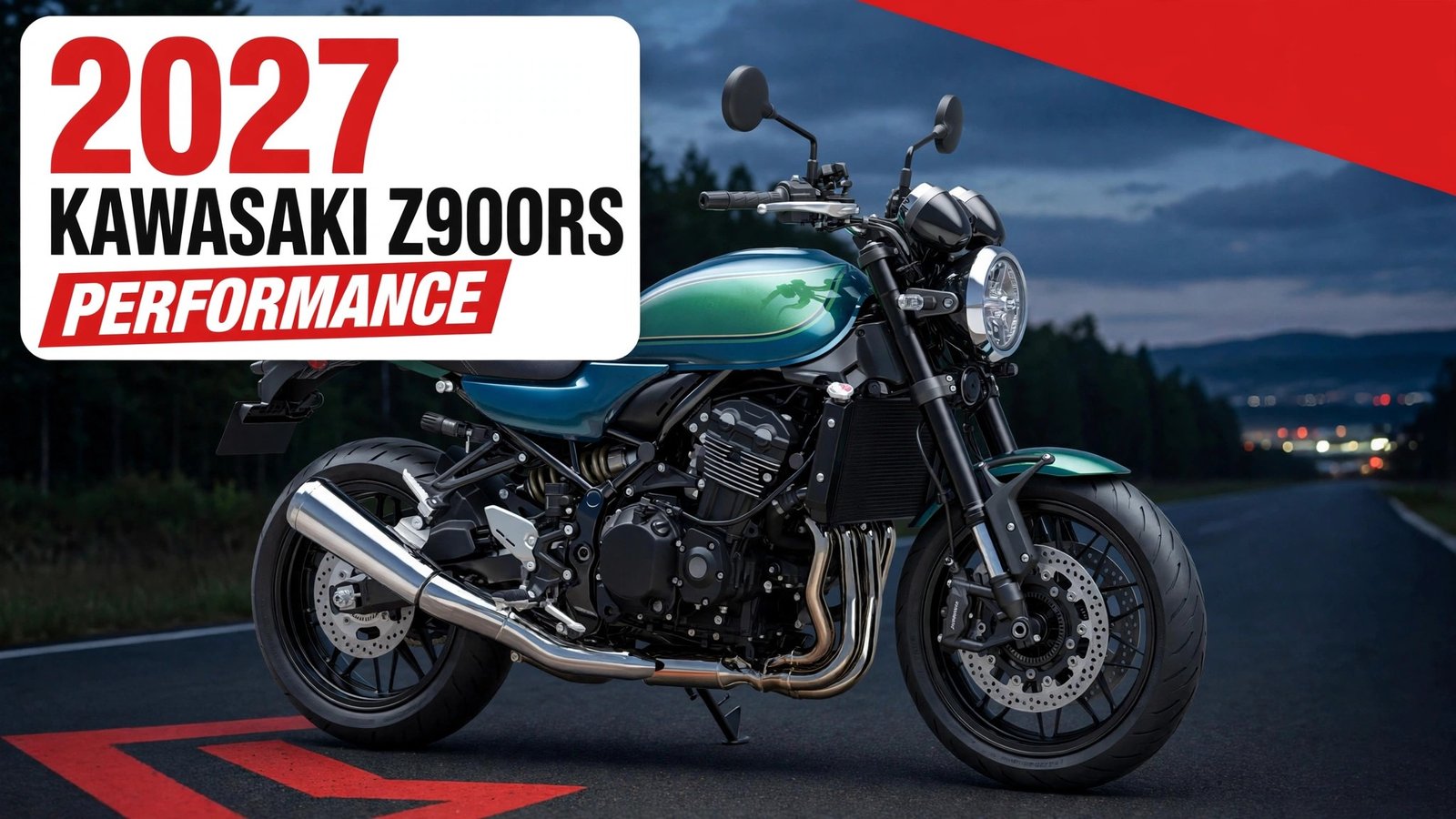
The Kawasaki Z900RS was never built to win a horsepower war. Its 948cc inline-four claims 111 hp before 2026 and 115.0 hp from 2026 — modest next to the Z900 that shares its engine — and this Kawasaki Z900RS performance guide starts there because the numbers on paper miss the point. The RS is tuned for the midrange, where street riding actually happens, and every dyno run on a stock RS tells the same story: less peak power than its rivals, more torque where riders use it.
What follows is every verified Kawasaki Z900RS performance figure — dyno runs, top speed, acceleration, braking and fuel economy — each labelled with the publication, the bike and the year, because dyno figures from different days and machines cannot be compared. The headline numbers are 97.4 hp on Motorcycle.com’s long-term dyno, 100.1 hp in Rider Magazine’s comparison test, an indicated 142 mph on the speedometer, and 39 to 40 mpg over 2,000 miles of real riding.
Kawasaki Z900RS Engine Performance and Power Delivery
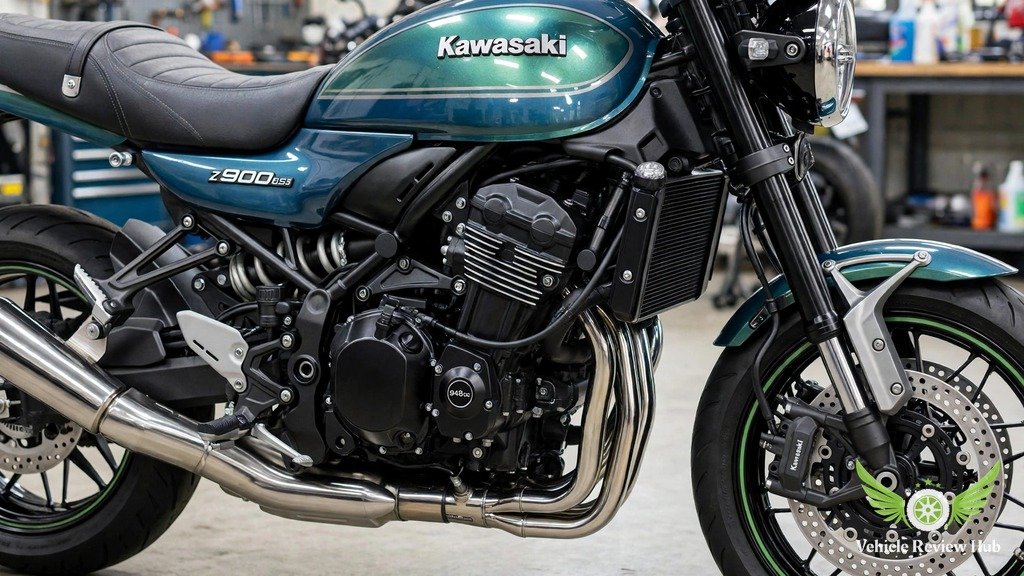
The RS engine is the Z900’s 948cc inline-four retuned for midrange: revised cams, lower compression, a heavier flywheel and narrower headers. This Kawasaki Z900RS performance section puts every published dyno run side by side — and the spread between them, from 94.65 hp to 100.4 hp, says as much about dynos as it does about the bike.
Long-Term Dyno: 97.4 hp
Cycle World’s dyno video below shows the 2020 Z900RS Cafe on the rollers — the run that produced 94.65 hp at 8,590 rpm and 63.51 lb-ft at 6,040 rpm on Cycle World’s Dynojet 250i. That is the pre-2026 engine’s figure, not the 2026 bike’s: the 2026 engine’s dyno number is Motorcycle.com’s 100.4 hp on its 2026 SE, a different bike on a different dyno.
Motorcycle.com’s long-term 2018 RS made 97.4 hp at 8,600 rpm at the rear wheel, with its torque — 64.5 lb-ft — spread flat between 5,900 and 7,800 rpm. That flat spread is the whole character of the engine: it does not spike at the top, it pulls evenly through the rev range a street rider uses. The same article notes the Z900 made 115.1 hp at 9,800 rpm on a different dyno, so the two numbers must never be compared. Dyno variance is real, and this Kawasaki Z900RS performance guide prints each figure with its dyno attached.
The 2026 engine is a different story at the crank: new cam profiles, compression up from 10.8:1 to 11.8:1, a crankshaft with roughly 10 percent less flywheel mass and a 43-tooth rear sprocket. The US claim rises from 111 hp at 8,500 rpm to 115.0 hp at 9,300 rpm, and torque from 72.3 lb-ft at 6,500 rpm to 73.0 lb-ft at 7,700 rpm — the clearest single statement of Kawasaki Z900RS performance progress. On Motorcycle.com’s dyno, the 2026 SE made 100.4 hp at 9,200 rpm and 65.6 lb-ft at 7,600 rpm — the highest rear-wheel number ever published for a stock RS, but a different bike on a different dyno from the 97.4 hp long-term figure, so it is never presented here as the RS gaining 3 hp.
Comparo Bike Made 100.1
Rider Magazine’s comparison test put the 2020 Z900RS on Jett Tuning’s dyno against the 2019 Honda CB1000R and the 2020 Suzuki Katana, same dyno, same day — the only apples-to-apples dyno comparison in this Kawasaki Z900RS performance guide. The RS made 100.1 hp at 8,500 rpm and 67.5 lb-ft at 8,500 rpm. The Katana made 142.1 hp at 10,300 rpm and 75.9 lb-ft at 9,200 rpm; the CB1000R made 125.5 hp at 9,800 rpm and 70.6 lb-ft at 8,300 rpm. On peak power the RS is the weakest bike in the test by a wide margin, and Rider Magazine’s verdict is that in the midrange it gives the Suzuki a run for its money and leaves the Honda in the dust, with the Honda much weaker than the Suzuki and Kawasaki below 7,500 rpm.
Two more dyno runs fill out the picture. Cycle World measured the 2022 Z900RS SE at 95.24 hp at 8,620 rpm and 64.03 lb-ft at 6,150 rpm on the same Dynojet 250i as the Cafe run. Rider Magazine’s own 2019 RS road test recorded 100 hp at 8,500 rpm and 67.5 lb-ft at 6,700 rpm. And the gap to the naked Z900 is real: Cycle World measured the Z900 at 113.96 hp and 67.30 lb-ft on the same Dynojet 250i, so the RS gives up about 19 hp at the rear wheel to the Z900 — the Kawasaki Z900RS performance trade-off for its midrange tune. The full review of that trade-off is in the Kawasaki Z900RS review, and the Z900’s own figures are in the base Z900 performance guide.
| Bike (year) | Publication / dyno | Rear-wheel hp | Rear-wheel torque |
|---|---|---|---|
| 2018 Z900RS (long-term) | Motorcycle.com | 97.4 hp @ 8,600 rpm | 64.5 lb-ft, flat 5,900–7,800 rpm |
| 2020 Z900RS (comparo) | Rider Magazine / Jett Tuning | 100.1 hp @ 8,500 rpm | 67.5 lb-ft @ 8,500 rpm |
| 2020 Z900RS Cafe | Cycle World / Dynojet 250i | 94.65 hp @ 8,590 rpm | 63.51 lb-ft @ 6,040 rpm |
| 2022 Z900RS SE | Cycle World / Dynojet 250i | 95.24 hp @ 8,620 rpm | 64.03 lb-ft @ 6,150 rpm |
| 2026 Z900RS SE | Motorcycle.com | 100.4 hp @ 9,200 rpm | 65.6 lb-ft @ 7,600 rpm |
Note: Figures from different dynos cannot be compared with each other — only the Rider Magazine comparison bikes shared a dyno on the same day. The 2026 SE figure comes from a different engine on a different dyno from the 97.4 hp long-term bike. This Kawasaki Z900RS performance guide never blends dyno figures and never presents an aggregator estimate as a measured figure.
Kawasaki Z900RS Top Speed and Acceleration
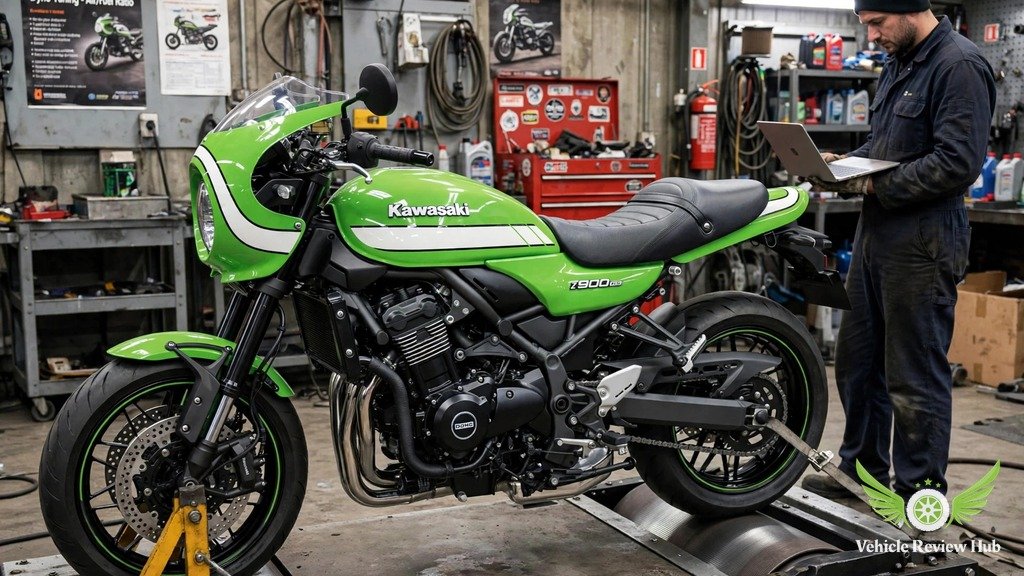
Top speed is the shortest section in this Kawasaki Z900RS performance guide, and that is the point: Kawasaki publishes no top speed for the RS, and no publication has ever published a GPS-verified figure for a stock bike. The only number in circulation is a speedometer reading, and it comes with a story.
142 mph Was Indicated Only
Motorcycle.com’s long-term tester saw 142 on the speedometer — uphill, with a little left in the bike, but running out of real estate. That is a speedometer reading on an uphill stretch, not a GPS or timed measurement, and this Kawasaki Z900RS performance guide prints it exactly that way: 142 mph indicated. It is never presented as a measured top speed, because no timed or GPS figure exists to support that claim.
The upright riding position is part of the story: the RS sits its rider bolt upright behind a round headlamp with no wind protection, so the speedometer climbs more slowly than the engine would allow and the rider feels every mile per hour. That is why the top-speed question matters less in Kawasaki Z900RS performance than the midrange does.
No Official Top Speed
Kawasaki publishes no top speed for the RS, or for the Z900 either. No publication has published a GPS-verified top speed for a stock RS. What the RS does have is measured acceleration, from Cycle World’s test programme on the 2020 Cafe — the only timed figures verified for any RS, and the only ones this Kawasaki Z900RS performance guide prints.
| Test (Cycle World, 2020 Z900RS Cafe) | Figure |
|---|---|
| 0–60 mph | 3.5 s |
| Quarter-mile | 11.85 s @ 116.54 mph |
| Braking 60–0 mph | 132.1 ft |
| Braking 30–0 mph | 34.6 ft |
| Wet weight | 479 lb |
Note: Every figure in this table is Cycle World tested on the 2020 Z900RS Cafe, from the same test programme as the 94.65 hp dyno run. No timed Kawasaki Z900RS performance figure exists for the 2026 bike, the base RS or the SE — do not carry the Cafe’s numbers onto them. Cycle World also measured the Cafe’s seat height at 32.4 in, not the sheet figure of 31.9 in for the 2027 bike.
Kawasaki Z900RS Mileage and Fuel Economy
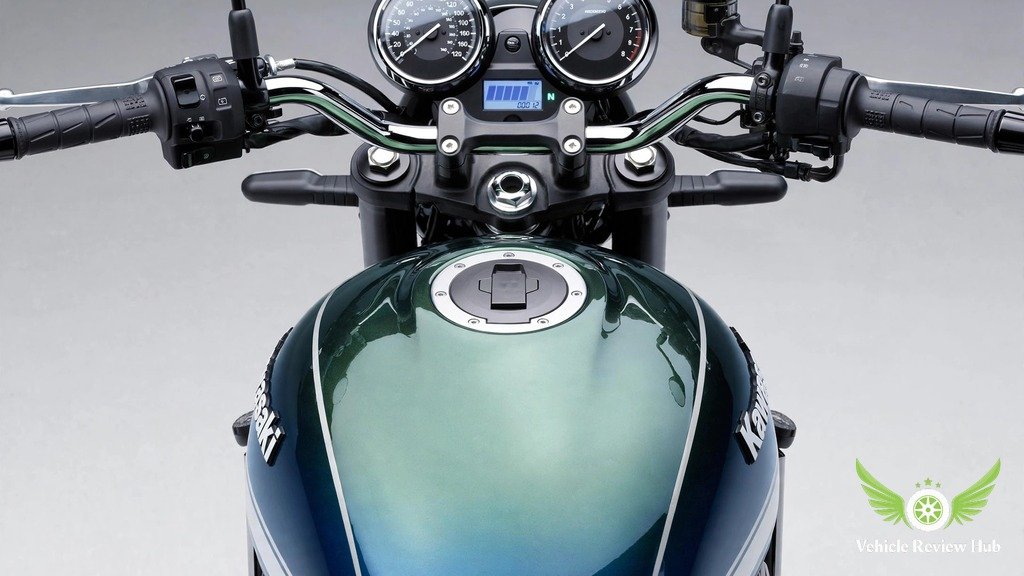
Fuel economy is where the RS surprises people — in a good way. This Kawasaki Z900RS performance guide’s mileage figures come from long-term testing, not from a brochure, because Kawasaki has never published an MPG figure for the bike.
39 to 40 mpg Long-Term
Motorcycle.com’s long-term Kawasaki Z900RS performance test averaged 39 to 40 mpg over about 2,000 miles on its 2018 bike, and the tester noted the figure was impressive given how much throttle the bike was getting. That is the headline figure for this Kawasaki Z900RS performance guide: a 948cc four-cylinder retro returning around 40 mpg in enthusiastic real-world riding, from a 4.5-gallon tank.
Two more observed figures fill out the picture. Motorcycle.com’s 2026 SE returned a consistent 37 mpg under hard riding. CityBike’s 2018 test returned 35 mpg — a different rider in different conditions, usable only as a labelled second observation, never as the headline. All three Kawasaki Z900RS performance figures are observed averages, not manufacturer claims, and they sit within a 5 mpg band.
Kawasaki Publishes No MPG
Kawasaki publishes no MPG figure for the RS on any spec sheet, in any model year. That absence matters: the EPA combined figure that appears on some database pages for the RS is a database figure, not a Kawasaki claim, and this Kawasaki Z900RS performance guide does not print it as one. What can be quoted is Cycle News’s observation on the 2026 SE that fuel range is adequate for 170-mile rides — Cycle News’s words, and the only fuel-range statement this Kawasaki Z900RS performance guide quotes.
| Bike / test | Source | Observed mpg |
|---|---|---|
| 2018 RS long-term, ~2,000 miles | Motorcycle.com | 39–40 mpg |
| 2026 SE, hard riding | Motorcycle.com | 37 mpg |
| 2018 RS test | CityBike | 35 mpg |
Note: All three figures are observed averages from different riders, bikes and conditions — not manufacturer claims. Kawasaki publishes no MPG for the RS. The Yamaha XSR900’s 49 mpg combined is Yamaha’s own figure for a different bike, used only in the comparison section below to frame Kawasaki Z900RS performance against its closest rival.
Kawasaki Z900RS Real-World Riding Experience
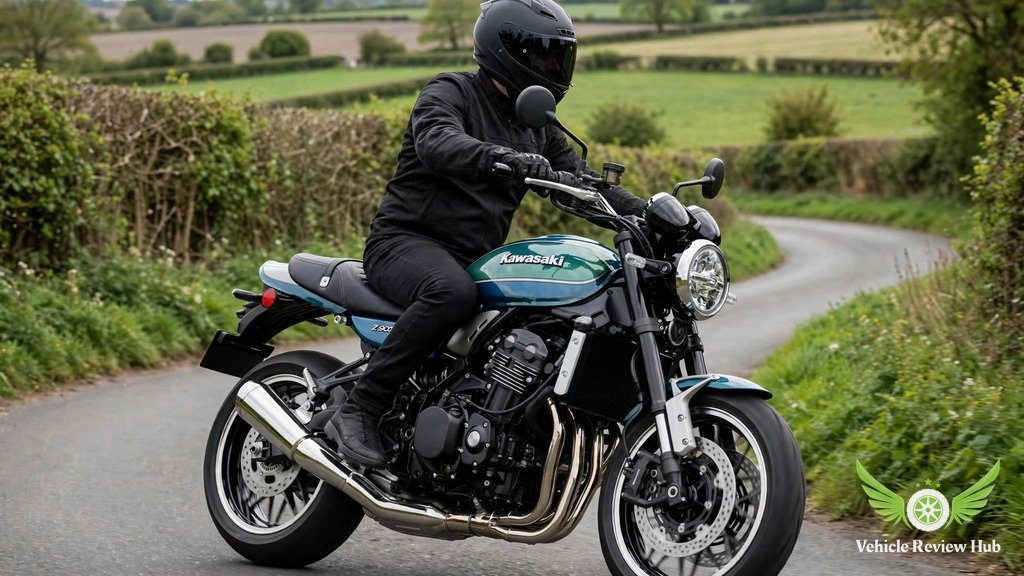
Numbers stop mattering the moment the road bends, and this is where this Kawasaki Z900RS performance guide turns from figures to feel. The RS earns its keep in the midrange, in town and on back roads — and its one famous flaw is a throttle, not an engine.
The Riding Experience Buyers Actually Talk About
Motorcycle.com’s long-term test is the clearest account of Kawasaki Z900RS performance on the road: the engine was retuned to deliver its torque sooner, the 5,500 to 8,500 rpm range is where the RS pulls hardest, and its peak torque of 64.5 lb-ft arrives evenly between 5,900 and 7,800 rpm. The torque curve is broad and flat — Motorcycle.com’s Cafe review calls it the very definition of broad and flat — which means the bike does not need to be revved to be quick.
The 2026 engine keeps that character and adds urgency at the top. New cams, 11.8:1 compression and a crankshaft with roughly 10 percent less flywheel mass lift the Kawasaki Z900RS performance claim to 115.0 hp at 9,300 rpm, and the 43-tooth rear sprocket shortens the gearing slightly. The riding position helps too: a wide, flat handlebar, a bench seat and footpegs set for comfort rather than ground clearance, with Kawasaki’s 2026 press release calling it a new relaxed riding position. The RS is built for back roads and town streets — and the full comfort and ergonomics story is in the Kawasaki Z900RS review.
Snatchy Throttle, Then Cured
The snatchy low-speed throttle is the single most-reported rideability finding on pre-2026 RS bikes, and this Kawasaki Z900RS performance guide tells it as a three-act story. Act one, 2018 to 2021: Cycle News called the 2018 bike’s throttle response wretched, and Motorcycle.com’s Cafe review noted an issue with abruptness on off-to-on throttle transitions. The cause was the fuel map, aimed at cutting emissions by leaning out the fuel-air mixture.
Act two, 2022: revised mapping improved it. Cycle News wrote that the throttle no longer felt like firing a tommy gun and that the abruptness was largely eradicated. Act three, 2026: ride-by-wire cured it, the last fix in the Kawasaki Z900RS performance story. MCN writes that the new engine and electronic throttle valves deliver the end of that initial snatchiness, Ultimate Motorcycling writes that ride-by-wire cures the abrupt low-speed throttle response of earlier Z900RS models, and Cycle News writes that the electronic throttle valves reduce the abruptness that was present in earlier versions. It is a finding, not a fault — never a defect and never a recall — and the reliability angle is covered in the Kawasaki Z900RS reliability guide.
Kawasaki Z900RS Handling, Braking and Stability
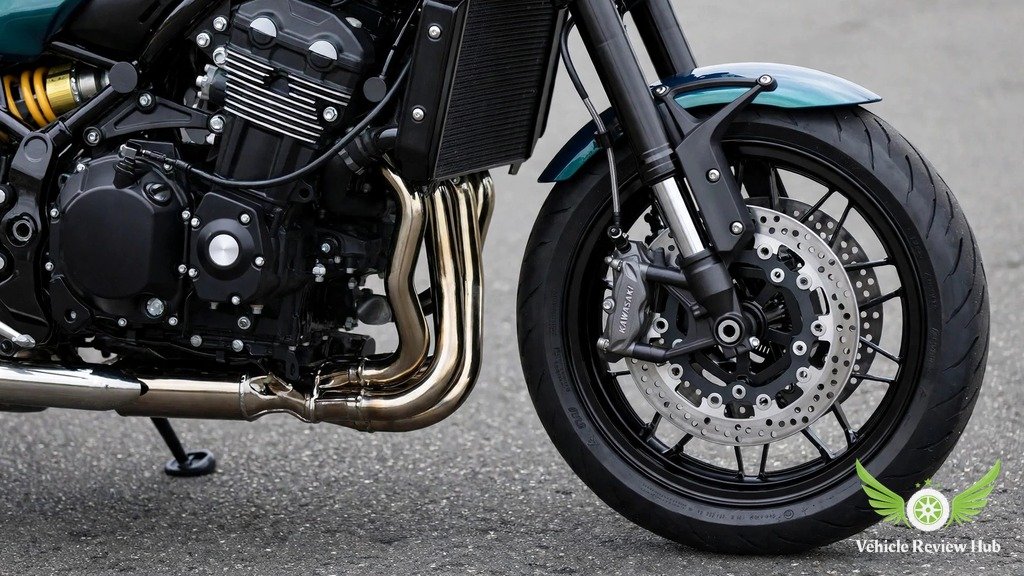
The RS is not a track bike pretending to be a retro, and its handling shows it. This Kawasaki Z900RS performance section covers the comparison test where the RS beat bigger, faster bikes where it counts — below 7,500 rpm — and the real-road behaviour that makes owners keep the bike.
Best Midrange in Comparo
Rider Magazine’s comparison test is the strongest evidence for the midrange. On Jett Tuning’s dyno the RS made 100.1 hp at 8,500 rpm against the Katana’s 142.1 hp and the CB1000R’s 125.5 hp — the weakest peak figure in the test by a wide margin. The torque peaks tell the real story: the RS peaks at 8,500 rpm, the Katana at 9,200 rpm and the Honda at 8,300 rpm, and below 7,500 rpm the Honda is much weaker than the Suzuki and Kawasaki. Rider Magazine’s verdict on Kawasaki Z900RS performance is that in the midrange the Kawasaki gives the Suzuki a run for its money and leaves the Honda in the dust. The RS does not win the dyno chart; it wins the rev range where street riding happens.
| Bike (same dyno, same day) | Peak hp | Peak torque |
|---|---|---|
| 2020 Kawasaki Z900RS | 100.1 hp @ 8,500 rpm | 67.5 lb-ft @ 8,500 rpm |
| 2020 Suzuki Katana | 142.1 hp @ 10,300 rpm | 75.9 lb-ft @ 9,200 rpm |
| 2019 Honda CB1000R | 125.5 hp @ 9,800 rpm | 70.6 lb-ft @ 8,300 rpm |
Note: All three bikes were tested on Jett Tuning’s dyno on the same day for Rider Magazine’s comparison test — the only apples-to-apples dyno comparison in this Kawasaki Z900RS performance guide. The RS is weakest on peak power and strongest below 7,500 rpm, which is the midrange story in one sentence.
Handling, Braking and Stability on Real Roads
On real roads the RS is neutral and predictable in corners, in Cycle News’s words, and planted and confidence-inspiring. MCN calls it the most fun and rewarding to ride in that joyous mid-range. It is not razor-sharp like a Z900 or 1100, but that is not its mission: the trellis frame, the 41 mm inverted fork and the horizontal back-link rear shock are set up for stability and comfort, not for lap times.
The brakes match the mission. Dual 300 mm round front discs with opposed four-piston radial-mount monobloc calipers and a radial-pump master cylinder stop the bike from 60 mph in 132.1 ft, Cycle World tested on the 2020 Cafe — a hard Kawasaki Z900RS performance number, not a claim. The 2026 update adds an IMU-fed ABS and Kawasaki Cornering Management Function, which modulate brake force and engine power. At 476.3 lb the 2026 and 2027 bikes are heavy for a naked — about 2 lb heavier than the 2024 bike — and the weight is the price of the steel trellis frame. The stability it buys is the trade-off, and this Kawasaki Z900RS performance guide calls it a fair one for the bike’s purpose.
Kawasaki Z900RS Performance Compared With Other Sport Bikes
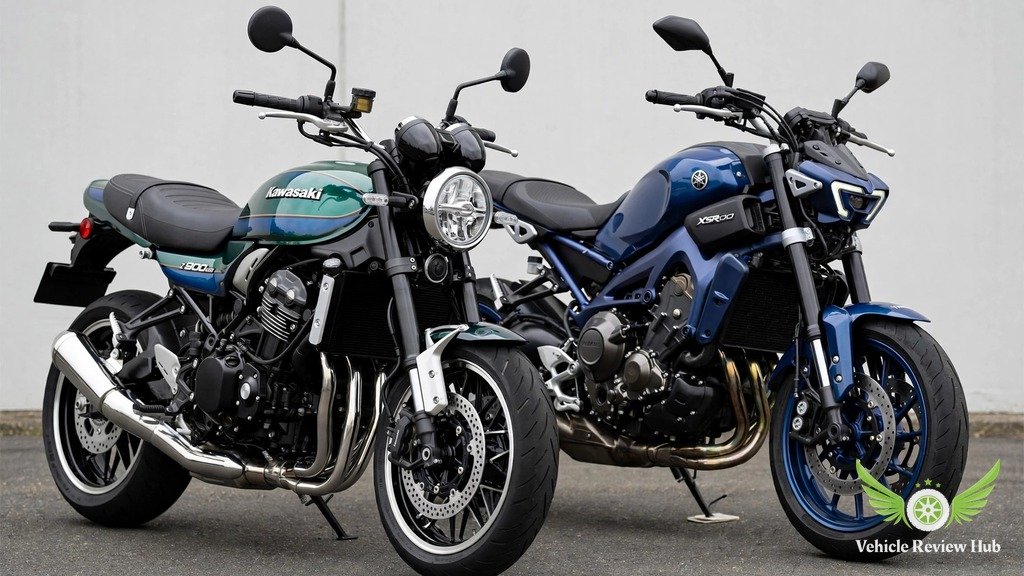
The RS does not race its rivals on paper and win. This Kawasaki Z900RS performance comparison keeps the XSR900 close because it is the only rival that matches the RS on price and beats it on paper.
Kawasaki Z900RS vs Yamaha XSR900
The Yamaha XSR900 is the RS’s natural rival: a retro-styled naked with a 890cc CP3 triple claiming 117 hp at 10,000 rpm and 68.6 lb-ft at 7,000 rpm, a 425 lb wet weight and 49 mpg combined on Yamaha’s own figure. On paper the Yamaha is lighter by 51 lb, stronger by 2 hp and thriftier by roughly 10 mpg — and cheaper, at $10,599 plus a $700 destination charge, $11,299 delivered against the RS’s $12,999 plus $840, $13,839 delivered. The gap is $2,540, and this Kawasaki Z900RS performance comparison does not hide it.
What the RS answers with is torque and room. Its 73.0 lb-ft at 7,700 rpm beats the Yamaha’s 68.6 lb-ft, and that torque gap is the Kawasaki Z900RS performance answer to the XSR900’s paper advantage. Its larger 948cc four and roomier chassis suit bigger riders better than the XSR900’s compact CP3 package. The Yamaha is the sharper, lighter, cheaper bike; the RS is the roomier, torquier, more heritage-laden one. The full price and value comparison, including the Triumph Speed Twin 1200 and Bonneville T120, is in the Kawasaki Z900RS comparison guide.
| Figure (2027) | Kawasaki Z900RS | Yamaha XSR900 |
|---|---|---|
| Engine | 948cc inline-four | 890cc CP3 triple |
| Power (US claim) | 115.0 hp @ 9,300 rpm | 117 hp @ 10,000 rpm |
| Torque | 73.0 lb-ft @ 7,700 rpm | 68.6 lb-ft @ 7,000 rpm |
| Weight | 476.3 lb curb | 425 lb wet |
| Fuel economy | 39–40 mpg observed | 49 mpg combined (Yamaha) |
| Delivered price | $13,839 | $11,299 |
Note: The weights are measured differently — curb weight for the RS, wet weight for the XSR900 — and the fuel figures are different kinds too: observed averages for the RS against Yamaha’s combined claim for the XSR900. Neither pair is like-for-like. All figures are year-labelled 2027, and the delivered prices use each brand’s 2027 destination charge.
Is the Kawasaki Z900RS Suitable for Beginner Riders?
No — and no publication recommends the RS as a first bike. A 948cc four claiming 115.0 hp, weighing 476.3 lb and costing $12,999 before fees is too much motorcycle for a beginner, however friendly its midrange feels. The weight matters most exactly where a new rider is weakest: low-speed turns, parking lots and emergency stops. The RS belongs to experienced riders, and this Kawasaki Z900RS performance guide says so plainly.
A beginner who wants the retro look has a better door into the family: the Kawasaki Z650RS, the 689cc retro-styled sibling at a lower weight, lower power and lower price. That is this writer’s judgement, not a tested claim, and the details are in the Kawasaki Z650RS review. The RS rewards experience; the Z650RS is the bike that builds it.
Kawasaki Z900RS Performance FAQs
The six questions below are the ones buyers ask most about how the RS performs, answered from the verified figures in this Kawasaki Z900RS performance guide. Every dyno figure names its publication, its bike and its year.
How much power does the Kawasaki Z900RS make on a dyno?
It depends on the dyno. Motorcycle.com’s long-term 2018 bike made 97.4 hp at the rear wheel; Rider Magazine’s 2020 comparo bike made 100.1 hp on Jett Tuning’s dyno; Cycle World’s 2020 Cafe made 94.65 hp on its Dynojet 250i; and Motorcycle.com’s 2026 SE made 100.4 hp. The US claim is 115.0 hp at 9,300 rpm for 2026 and later bikes, and 111 hp at 8,500 rpm for earlier ones.
What is the top speed of the Kawasaki Z900RS?
Kawasaki publishes no top speed for the RS, so there is no official Kawasaki Z900RS performance top-speed figure. The only figure in circulation is Motorcycle.com’s long-term tester seeing an indicated 142 mph on the speedometer — uphill, with a little left in the bike. That is a speedometer reading, not a measured top speed, and no GPS-verified figure exists for a stock RS.
What mileage does the Z900RS get?
Motorcycle.com averaged 39 to 40 mpg over about 2,000 miles on its long-term 2018 bike, and the 2026 SE returned 37 mpg under hard riding. Kawasaki publishes no MPG figure for the RS, so every mileage number for this bike is an observed average, never a manufacturer claim.
Is the Z900RS throttle snatchy?
On 2018 to 2021 bikes, yes — the fuel map was set lean for emissions, and the off-to-on throttle transition was abrupt. Revised mapping improved it in 2022, and the 2026 ride-by-wire system cures it, according to MCN, Ultimate Motorcycling and Cycle News. It was a rideability finding, never a defect or a recall.
How fast is the Z900RS to 60 mph?
Cycle World’s Kawasaki Z900RS performance test put the 2020 Z900RS Cafe at 3.5 seconds to 60 mph, with a quarter-mile of 11.85 seconds at 116.54 mph. That is the only timed acceleration figure verified for any RS.
Is the Z900RS good for beginners?
No. With a 948cc engine, 115.0 hp, a 476.3 lb curb weight and a $12,999 price, the RS is too much motorcycle for a first rider, and no publication recommends it as one. A beginner after the retro look is better served by the smaller Kawasaki Z650RS.