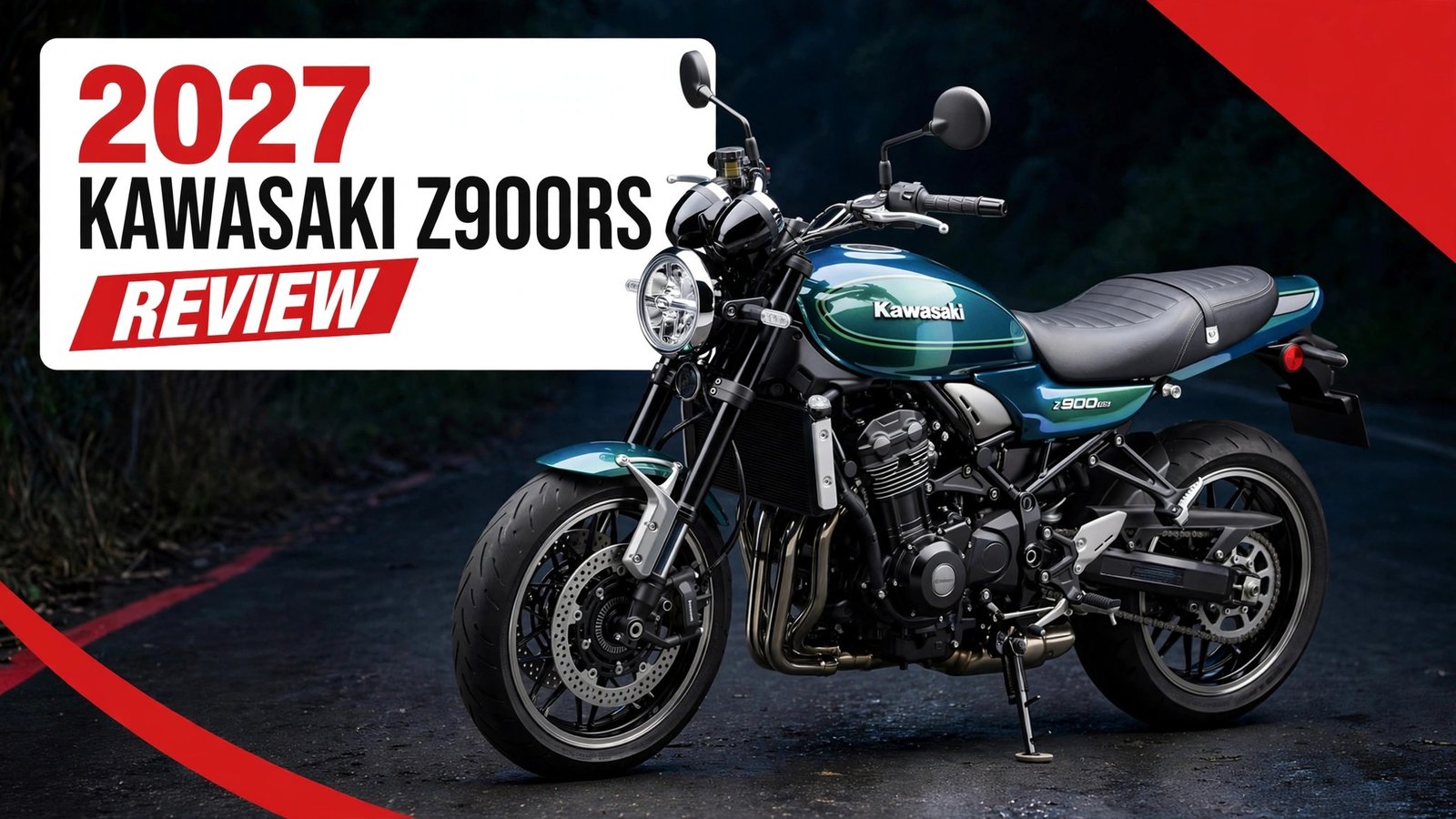
The 2027 Kawasaki Z900RS costs $12,999 before destination — $13,839 delivered — and this Kawasaki Z900RS review starts there because the price is the whole argument. The bike is a retro naked built on the modern Z900’s 948cc inline-four, retuned for midrange, dressed in Z1 clothes, and sold at a $2,800 premium over the Z900 that shares its engine. For 2026, Kawasaki finally gave it the electronics it had been missing: ride-by-wire, a six-axis IMU, a quickshifter and cruise control.
The honest headline of this Kawasaki Z900RS review is that the 2026 update fixes the bike’s biggest weakness and leaves its biggest strength untouched. The electronics gap is closed. The midrange-rich engine, the analogue dials and the Z1 styling are exactly as they were. What follows is the price ladder, the engine figures, the design and technology, the riding experience, and a verdict — every figure tied to its source.
Kawasaki Z900RS Overview and Model-Year Updates
This Kawasaki Z900RS review begins with the 2026 update, the biggest change the bike has had since it went on sale in the USA in 2018. Everything before 2026 is the original recipe: cable throttle, no IMU, no quickshifter, no cruise. Everything from 2026 on is a different motorcycle underneath the same retro bodywork.
2026 Is a Major Update
Kawasaki’s own press release, dated 3 November 2025, calls the 2026 family “Legends Never End”. The headline changes are electronic: Electronic Throttle Valves (ride-by-wire) replace the cable, a Bosch six-axis IMU arrives with Kawasaki Cornering Management Function, traction control becomes a two-mode system, a Kawasaki Quick Shifter works up and down from as low as 1,500 rpm, electronic cruise control becomes standard, and the bike gains smartphone connectivity through RIDEOLOGY.
The engine was revised to match: new cam profiles with more lift and duration, compression up from 10.8:1 to 11.8:1, new lightweight pistons, a crankshaft with roughly 10% less flywheel mass, a 43-tooth rear sprocket in place of the 42-tooth one, and a new megaphone-style silencer extended by 70 mm. Claimed output rises from 111 hp to 115.0 hp at 9,300 rpm, and torque from 72.3 lb-ft at 6,500 rpm to 73.0 lb-ft at 7,700 rpm. For a bike that changed so little between 2018 and 2025, this Kawasaki Z900RS review treats 2026 as a new chapter, not a facelift.
In the video below, 1000PS presenter Zonko delivers his verdict on the 2026 Z900RS SE after riding it for an entire season — the season-long view this Kawasaki Z900RS review leans on. It is the SE, not the base bike — gold forks, Öhlins shock, Brembo brakes and Fireball paint — and it covers the ride-by-wire throttle, the IMU, the quickshifter and cruise control, and the smoother throttle response. One warning: the 116 hp figure Zonko quotes is the Euro figure. The US claim is 115 hp.
SE Was US-Sold After All
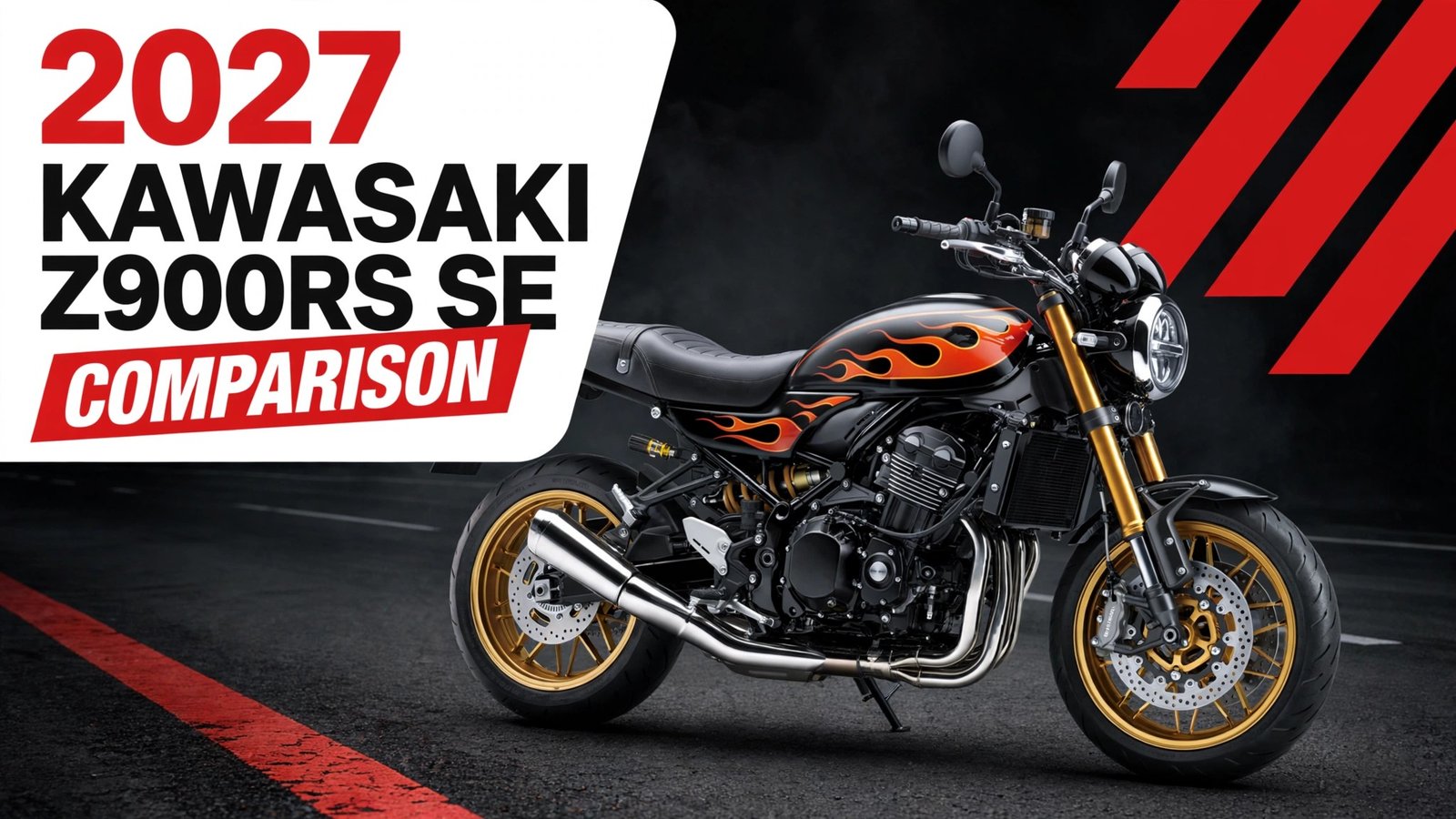
The SE was US-sold from 2022 — a fact that surprises buyers who assumed it was a Europe-only special. The 2022 SE cost $13,449 in the USA — $1,700 more than the $11,749 base bike that year — and Cycle News rode a US SE in August 2022. The SE’s US history matters to this Kawasaki Z900RS review because the SE is the version most reviewers ride: Brembo M4.32 calipers, Öhlins S46 rear shock, gold fork outer tubes and gold wheels, USB-C outlet and Fireball paint.
SE prices since then: $14,149 in 2024 and 2025, $14,599 in 2026 and $14,699 in 2027, with the premium over the base holding at $1,700 in 2026 and 2027. One gap in the record: no 2023 SE price was verified — the Kawasaki sheets return 404 and every alternate database page did too — so no 2023 SE price appears here. The SE’s hardware is the benchmark the base bike is judged against, and this Kawasaki Z900RS review judges the base bike against it in the verdict below.
Kawasaki Z900RS Engine and Specifications
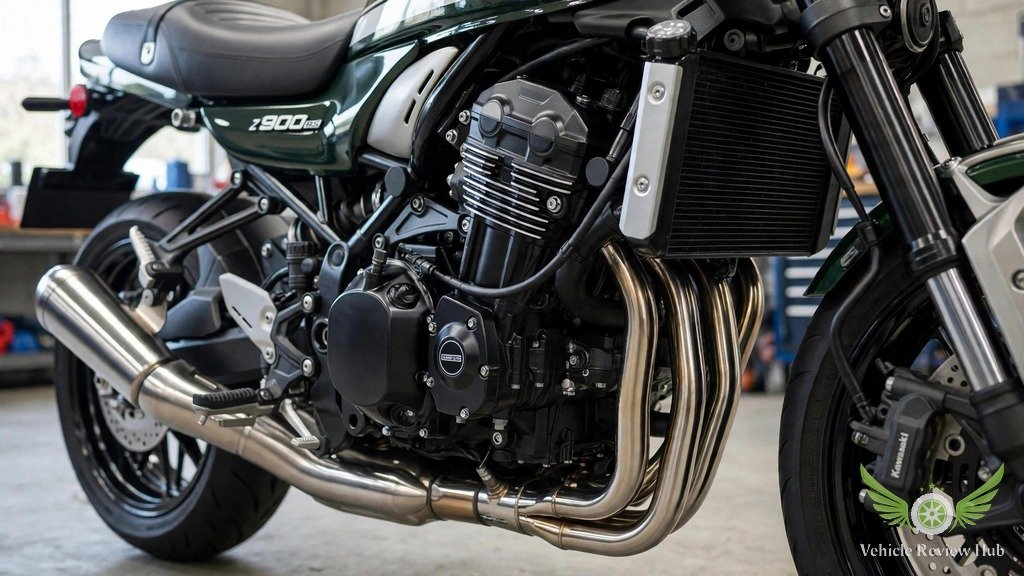
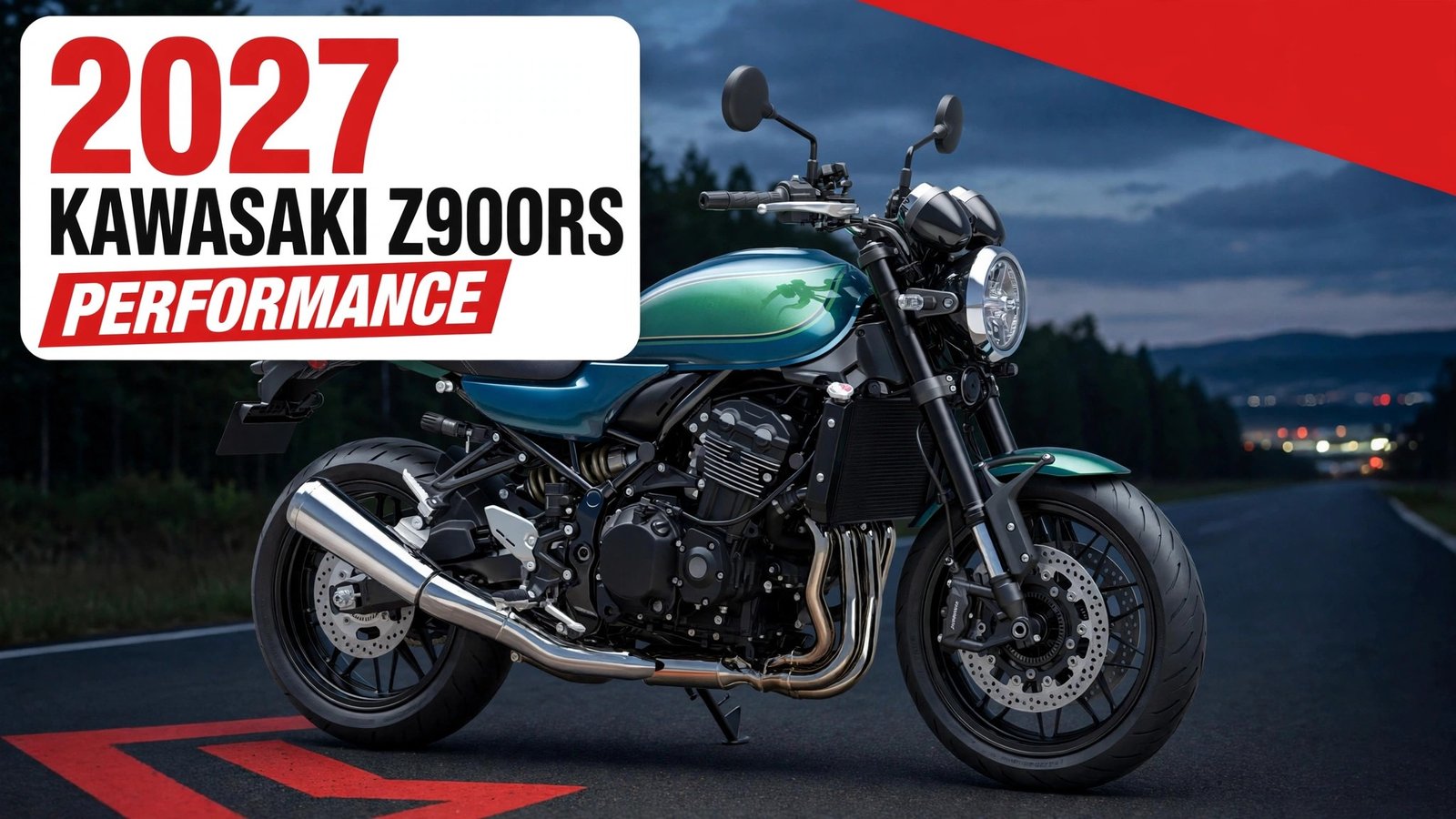
The engine is the heart of this Kawasaki Z900RS review: the same 948cc liquid-cooled DOHC 16-valve inline-four that powers the Z900, retuned for midrange instead of top end. Revised cams, lower compression before 2026, a heavier flywheel, a second gear-driven balancer and narrower headers all push the torque down the rev range, where street riding actually happens.
| Spec | 2018 | 2024 | 2026 | 2027 |
|---|---|---|---|---|
| Power (US, ISO 4106) | 111 hp @ 8,500 rpm | 111 hp @ 8,500 rpm | 115.0 hp @ 9,300 rpm | 115.0 hp @ 9,300 rpm |
| Torque (US) | 72.3 lb-ft @ 6,500 rpm | 72.3 lb-ft @ 6,500 rpm | 73.0 lb-ft @ 7,700 rpm | 73.0 lb-ft @ 7,700 rpm |
| Compression | 10.8:1 | 10.8:1 | 11.8:1 | 11.8:1 |
| Seat height | 32.9 in | 32.9 in | 31.9 in (sheet) | 31.9 in (sheet) |
| Curb weight | 471.9 lb | 474.1 lb | 476.3 lb | 476.3 lb |
| Wheelbase | 57.9 in | 57.9 in | 57.7 in | 57.7 in |
| Ground clearance | 5.1 in | 5.1 in | 5.3 in | 5.3 in |
| Fuel capacity | 4.5 gal | 4.5 gal | 4.5 gal | 4.5 gal |
| Front fork | 41 mm inverted, 13-way / 11-way | 41 mm inverted, 13-way / 11-way | 41 mm inverted, 12-way / 10-way | 41 mm inverted, 12-way / 10-way |
Note: All figures are Kawasaki USA sheet figures. The 2026 bike is about 2 lb heavier than the 2024 bike despite the lighter flywheel. Bore and stroke (73.4 × 56.0 mm), displacement (948cc), the six-speed gearbox and the 82.7 in overall length are unchanged every year, and this Kawasaki Z900RS review prints the seat heights exactly as the sheets print them. That is the sheet discipline this Kawasaki Z900RS review applies to every table. Fuel capacity is 4.5 gal on the sheet; the press release’s styling section says “4.4-gallon tank” — the sheet figure is printed here with the conflict labelled.
Dials Stay, No TFT Ever
The 2026 update keeps the twin analogue-style dials with spindle-finished faces and a multi-function LCD with a negative display — and the dials are part of why this Kawasaki Z900RS review keeps coming back to the word retro. No TFT was added in 2026 or 2027: the LCD simply gains cruise, app-connection and RIDEOLOGY readouts alongside the gear indicator, fuel gauge, remaining range and temperatures. Riders who want a colour touchscreen should look elsewhere.
115 hp From 2026
Kawasaki’s US claim for the 2026 engine is 115.0 hp at 9,300 rpm, up from 111 hp at 8,500 rpm on every bike from 2018 to 2025, and torque moves from 72.3 lb-ft at 6,500 rpm to 73.0 lb-ft at 7,700 rpm. The gain comes from the new cams, the 11.8:1 compression and the reworked airbox, not from a bigger engine: displacement stays 948cc.
Measured power is lower, as always. On Motorcycle.com’s dyno, the 2026 SE made 100.4 hp at 9,200 rpm and 65.6 lb-ft at 7,600 rpm at the rear wheel, and Cycle News’s 2026 SE review confirms the 115 hp claim. That gap between claim and rear wheel is normal, and this Kawasaki Z900RS review prints both figures with their sources attached. The full dyno story — the long-term 2018 bike’s 97.4 hp and the 2020 comparison bike’s 100.1 hp — is in the performance guide.
Kawasaki Z900RS Price and Market Availability
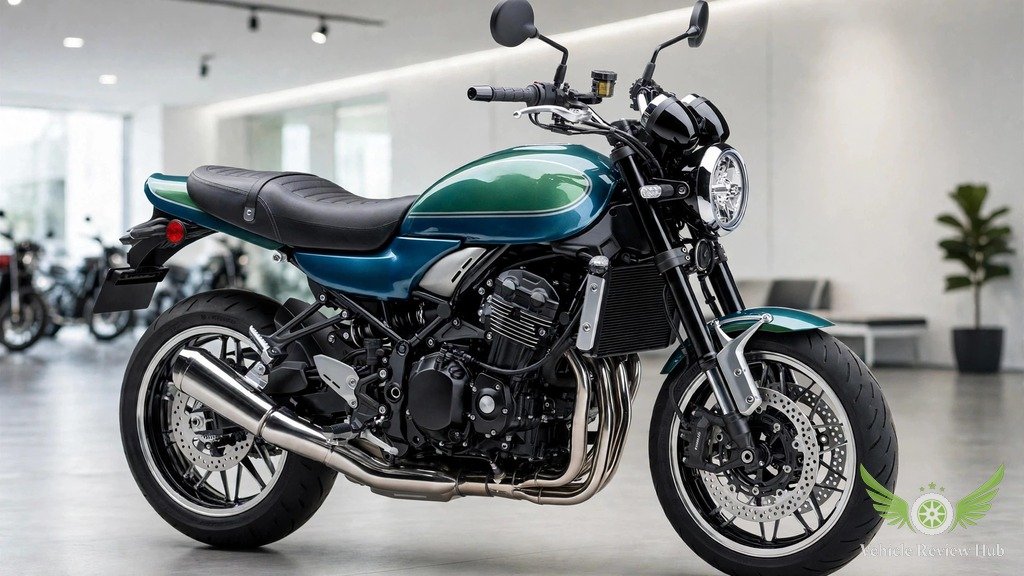
Price is where this Kawasaki Z900RS review gets concrete. The table below is the full US MSRP ladder for the base RS ABS, with the destination charge verified per year and the delivered price shown with its arithmetic.
| Year | MSRP | Destination | Delivered |
|---|---|---|---|
| 2018 | $10,999 | Not verified | Not computable |
| 2019 | $11,199 | $380 (MO-db) | $11,579 |
| 2020 | $11,199 | $410 | $11,609 |
| 2021 | $11,299 | $410 | $11,709 |
| 2022 | $11,749 | $430 | $12,179 |
| 2023 | $11,949 | $460 | $12,409 |
| 2024 | $12,149 | $475 | $12,624 |
| 2025 | $12,649 | $815 | $13,464 |
| 2026 | $12,899 | $840 | $13,739 |
| 2027 | $12,999 | $840 | $13,839 |
Note: The 2018 destination charge was not verified, so no 2018 delivered price is printed — the Z900’s $370 destination belongs to a different model. The 2019 destination is $380 on the Motorcycle.com database, while a DX1 dealer brochure prints $410; this Kawasaki Z900RS review adopts $380 and names the conflict. The 2025 figures are sheet-unverified: no 2025 RS sheet exists, so the $12,649 MSRP and $815 destination rest on the Motorcycle.com database and SlashGear.
Kawasaki Z900RS Price in the USA: $12,999 (2027)
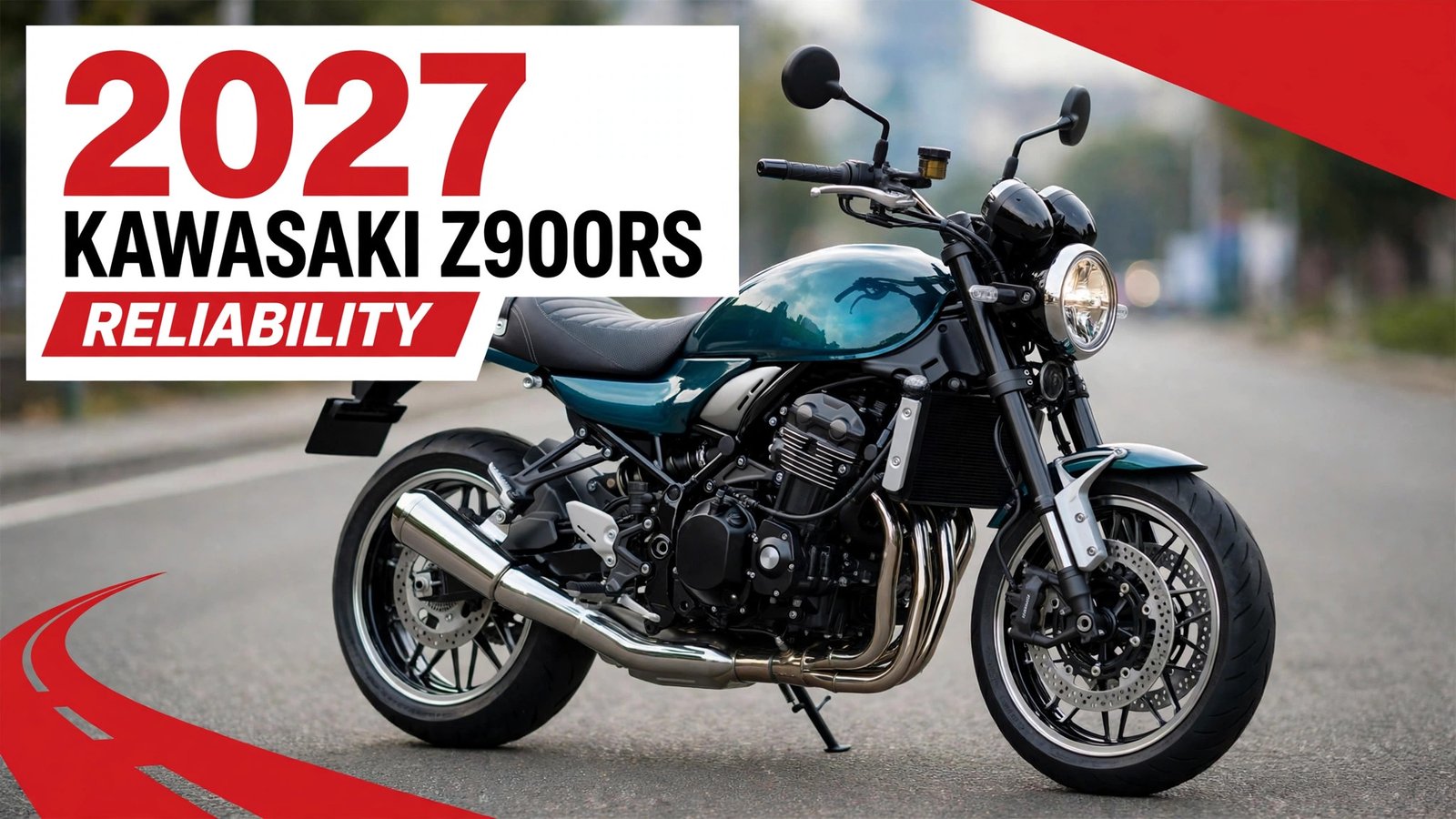
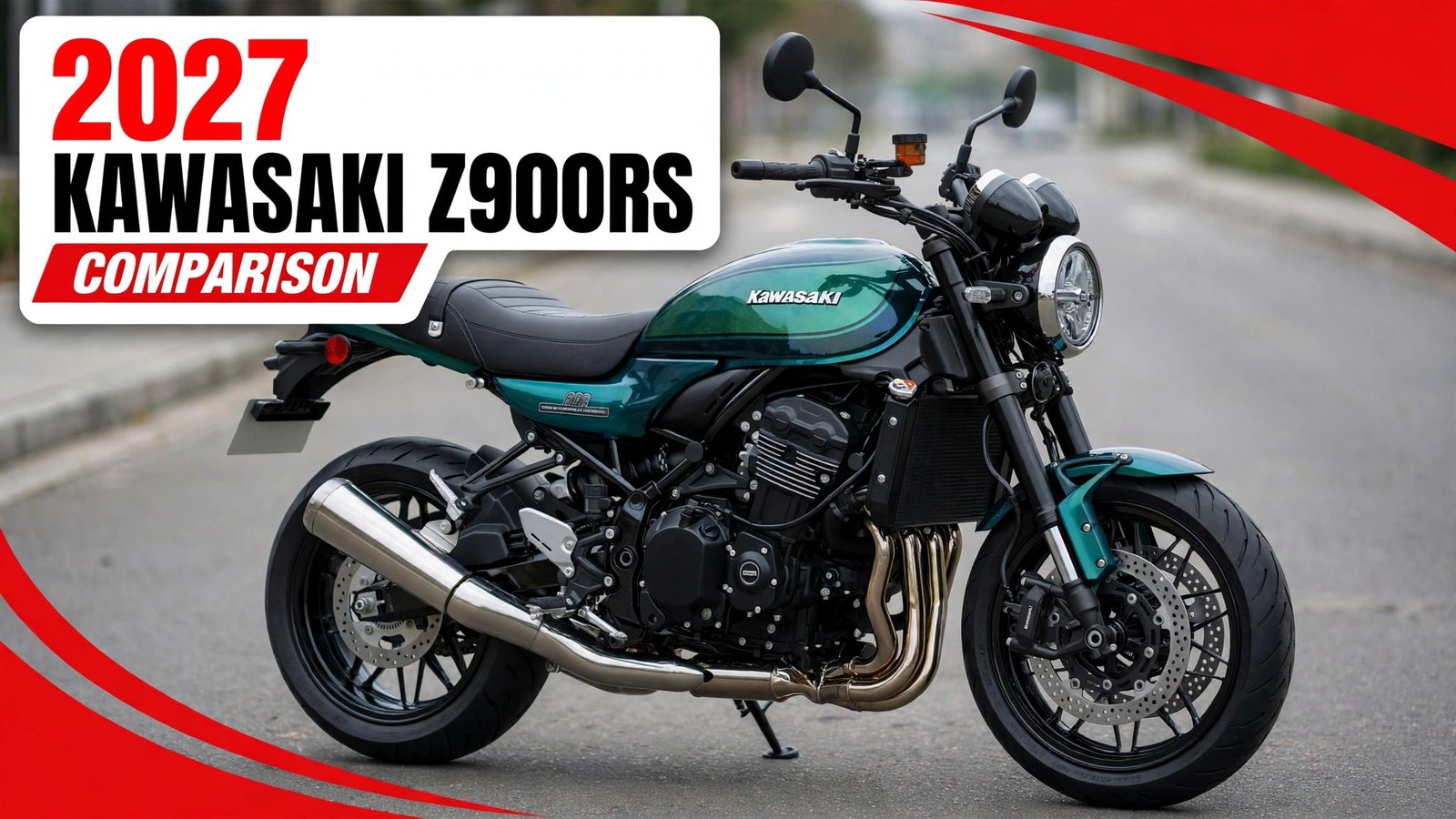
The 2027 base bike costs $12,999 MSRP, plus an $840 destination charge, for $13,839 delivered, on the 2027 spec sheet. The colour is Candy Greenish Blue, and the bike carries the full 2026 update: ride-by-wire, IMU, quickshifter, cruise and the 115 hp engine. The Cafe costs $13,399 MSRP ($14,239 delivered) and the SE costs $14,699 MSRP ($15,539 delivered), with both destinations labelled as Motorcycle.com database figures for those trims.
For that money, this Kawasaki Z900RS review finds the RS buys a motorcycle with no direct rival at its price: the Yamaha XSR900 undercuts it by $2,540 delivered, and the Triumph Bonneville T120 costs $931 more delivered. The RS sits between them — more expensive than the Japanese triple, cheaper than the British twin, and the only one of the three with a 1972 Z1 bloodline. The full comparison is in the comparison blog.
| Model (2027) | MSRP | Destination | Delivered | Seat | Colour / Hardware |
|---|---|---|---|---|---|
| Z900RS ABS | $12,999 | $840 | $13,839 | 31.9 in | Candy Greenish Blue |
| Z900RS CAFE ABS | $13,399 | $840 (MO-db) | $14,239 | 32.3 in | Candy Tone Red; front cowl, drop bars, stepped seat |
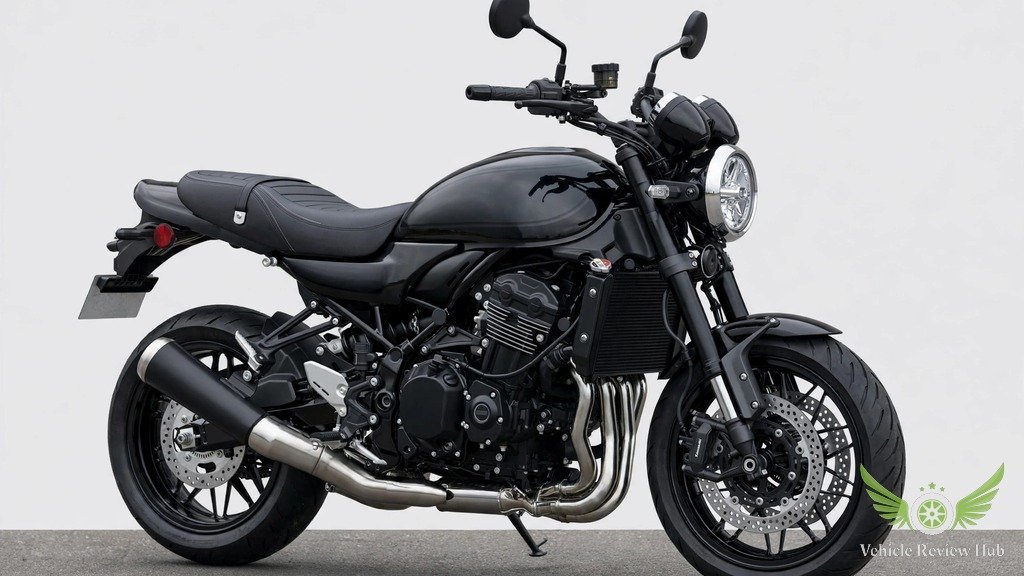
| Z900RS SE ABS | $14,699 | $840 (MO-db) | $15,539 | 32.3 in | Metallic Spark Black (Fireball); Brembo M4.32, Öhlins S46, gold fork and wheels, USB-C |
Note: The base bike’s $840 destination is confirmed by the Motorcycle.com database and dealer listings; the Cafe and SE $840 figures are the Motorcycle.com database figures for those trims, labelled as such. The SE’s $1,700 premium over the base in 2027 pays for the Brembo brakes, Öhlins shock, gold hardware and USB-C — not for the Fireball paint, which carries no separate upcharge. That is the finding this Kawasaki Z900RS review prints in place of a premium that does not exist.
Premium: $2,800 Over Z900
The $2,800 question runs through this Kawasaki Z900RS review, and the arithmetic is simple: the 2027 Z900 costs $10,199 MSRP plus the same $840 destination, or $11,039 delivered, against the RS at $13,839 — $2,800 on MSRP and $2,800 delivered alike, because both bikes carry the same destination charge.
What the $2,800 buys is the retro styling, the midrange retune, the bench seat and upright ergonomics, and the Z1 heritage — the same 948cc engine family, a different motorcycle. It does not buy horsepower: the Z900 claims 123.0 hp in 2027 against the RS’s 115.0 hp. Buyers who want the fastest naked for the money should read the base Z900 review.
Kawasaki Z900RS Design, Features and Technology
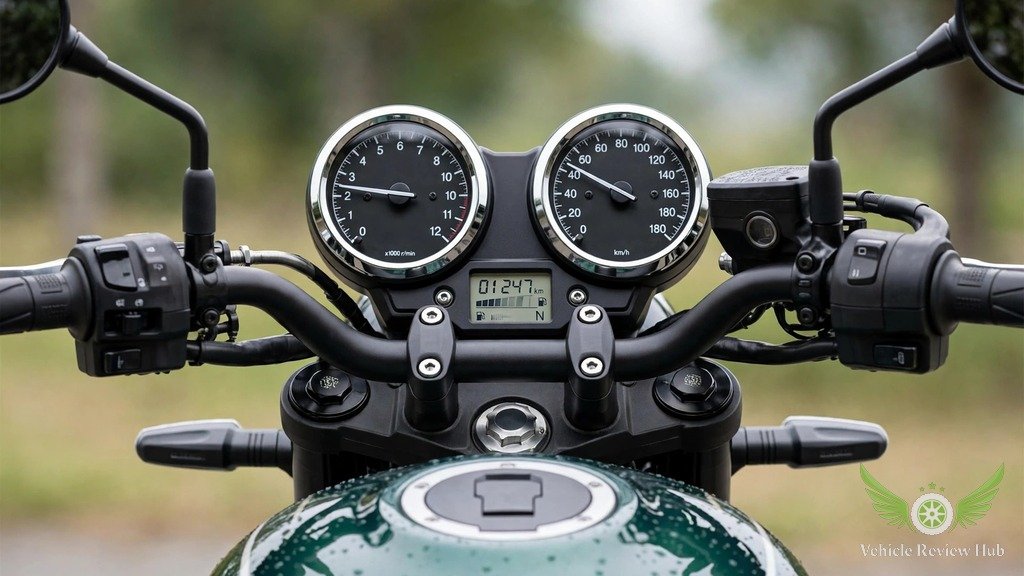
The 2026 electronics are the reason this Kawasaki Z900RS review spends a whole section on technology. Before 2026 the RS trailed its rivals on equipment — cable throttle, no IMU, no quickshifter, no cruise. The update closes that gap in one stroke.
| Feature | Pre-2026 (2018–2025) | 2026+ |
|---|---|---|
| Throttle | Cable | Ride-by-wire (ETV) |
| IMU | None | Bosch 6-axis |
| Traction control | KTRC, 3 modes | KTRC, 2 modes |
| Quickshifter | Not fitted | KQS up/down, standard |
| Cruise control | Not fitted | Electronic, standard |
| Smartphone connectivity | Not fitted | RIDEOLOGY, standard |
| Cornering management | Not fitted | KCMF, standard |
Note: Traction control goes from three modes before 2026 to two modes from 2026 — do not carry the three-mode figure into the 2026 bike. “Power Modes” appears on the spec sheet’s electronics line but is not listed as a feature here; see the “Power Modes: Sheet vs Tester” section below for the full conflict.
IMU, Cruise and QS Arrive
The IMU is the single biggest reason this Kawasaki Z900RS review calls the 2026 bike a different motorcycle underneath. The Bosch six-axis unit measures acceleration on three axes plus roll, yaw and pitch, and it feeds Kawasaki Cornering Management Function, which modulates brake force and engine power through a corner, working with the traction control and the IMU-fed ABS. First rides confirm it works invisibly — the bike simply feels more composed mid-corner.
The quickshifter and cruise control are the everyday wins. The Kawasaki Quick Shifter works up and down from as low as 1,500 rpm, with a contactless sensor, and the electronic cruise control holds speed from the left handlebar, disengaging on the brake, clutch, throttle-close or a shift into first or second gear. Smartphone connectivity through RIDEOLOGY THE APP MOTORCYCLE is standard, with a Bluetooth unit inside the right-side cover feeding the LCD readouts and call and message notices.
Japan-Built, JKA VINs
Every Z900RS is built in Japan, and the VIN proves it: every RS carries a JKA VIN, with J standing for Japan, confirmed by the NHTSA recall VIN ranges, all of which start JKAZR. The contrast with the Z900 sibling is sharp — the Z900 is Thailand-built, with ML5 VINs. The 2027 RS model code is ZR902AVFBL.
That Japan-built status is a small but real part of this Kawasaki Z900RS review’s heritage argument: the Z1 was a Japanese motorcycle, and the RS is built in the country that built it.
Kawasaki Z900RS Riding Experience and Comfort
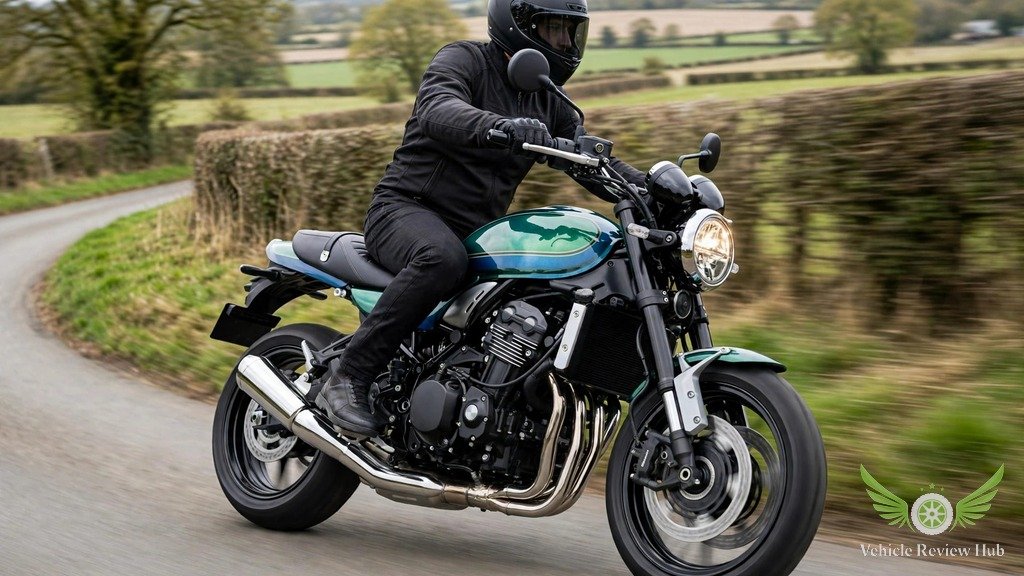
Comfort is where this Kawasaki Z900RS review gets honest about who the bike fits. The riding position is upright and relaxed — a wide, flat handlebar, a bench seat, footpegs set for comfort rather than ground clearance — and Kawasaki’s 2026 press release calls it a “NEW relaxed riding position”. The 2026 bike is also narrower and lower: overall width falls from 34.1 in to 32.1 in, and height from 45.3 in to 44.7 in.
Seat Height Prints Conflict
The seat-height argument is the messiest corner of this Kawasaki Z900RS review, because Kawasaki disagrees with itself. The US spec sheets for 2026 and 2027 print 31.9 in for the base bike and 32.3 in for the SE and Cafe. Kawasaki’s own 2026 press release prints 32.8 in in its ergonomics section — 0.9 in higher than its own sheet. UK and European sources still print the pre-2026 figure of 835 mm (32.9 in) for the standard bike and 845 mm for the SE — Bennetts prints the same pair — and MCN’s at-a-glance box prints 33.3 in against the SE’s 845 mm figure. This review adopts the US sheet figures and names the conflict, because a rider who measures roughly 32.9 in is not wrong — the documents disagree with each other.
One figure must never be used as the standard: 810 mm is the ERGO-FIT Low Seat, which drops the height by 25 mm from 835 mm — it is not the standard seat height, even though the 31.9 in sheet figure converts to about 810 mm by arithmetic. The SE sits 0.4 in taller than the base on the sheets, because the Öhlins shock raises the rear a fraction and lifts ground clearance from 5.3 in to 5.5 in.
12 Month Warranty
The warranty is 12 months, limited, on every RS from 2018 to 2027 — and the 12-month warranty is short, and this Kawasaki Z900RS review says so plainly. Triumph gives its Bonneville T120 24 months with unlimited mileage, and Yamaha’s XSR900 carries 12 months too.
The recall remedies — all three of them, including the 2024 front-tyre campaign — are free at a Kawasaki dealer. The full recall record, the maintenance schedule and the ownership costs are in the reliability guide.
Kawasaki Z900RS Review: Pros, Cons and Verdict
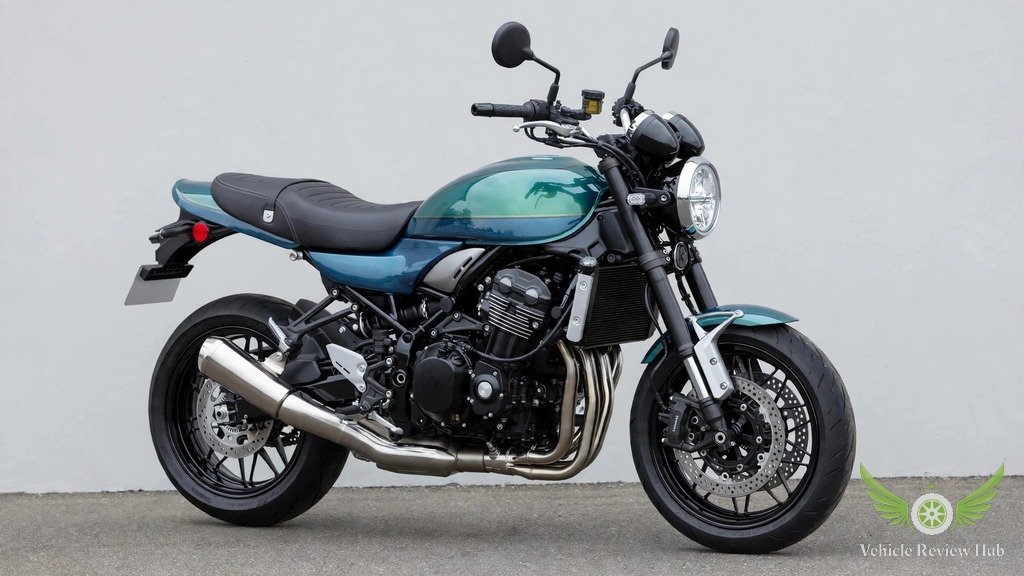
The verdict of this Kawasaki Z900RS review is simple: the 2026 update makes the RS the bike it always should have been, and the price is the only real argument against it. The electronics gap is closed, the engine is stronger, and the styling was never the problem.
| Advantages | Limitations |
|---|---|
| 2026 electronics — IMU, quickshifter, cruise — close the tech gap with rivals | $2,800 more than the Z900 that shares its engine |
| Broad, flat midrange torque; pulls hardest where street riding happens | 476.3 lb — heavy for a naked |
| Genuine Z1 retro styling: teardrop tank, round mirrors, bullet dials | 12-month warranty is half the Triumph’s 24 months |
| Japan-built quality, JKA VINs on every bike | Seat-height figures conflict across Kawasaki’s own documents |
| Comfortable upright ergonomics and bench seat | No TFT for buyers who expect one |
| SE version adds Brembo and Öhlins for $1,700 | 39–40 mpg observed is thirsty next to the XSR900’s 49 mpg combined |
Note: The advantages and limitations above are the findings of this Kawasaki Z900RS review. The 39–40 mpg figure is Motorcycle.com’s long-term observed average on the 2018 bike, not a Kawasaki claim.
Main Advantages and Limitations of the Kawasaki Z900RS
The advantages start with the update and end with the heritage, and this Kawasaki Z900RS review weighs them against the $2,800 premium. The 2026 electronics — IMU, quickshifter, cruise — bring the RS level with rivals that used to out-spec it. The midrange is the engine’s real talent: the torque curve is broad and flat, peaking between 5,900 and 7,800 rpm on Motorcycle.com’s long-term dyno, and the bike pulls hardest where street riding actually happens.
The limitations are the price, the weight and the warranty. At $13,839 delivered the RS costs $2,800 more than the Z900 that shares its engine, and $2,540 more than the XSR900. At 476.3 lb it is a heavy naked, and the 12-month warranty is half the Triumph’s. The seat-height paperwork is a mess, and the bike has no TFT for buyers who expect one.
Power Modes: Sheet vs Tester
The power-modes question is the one place this Kawasaki Z900RS review refuses to pick a side, because the evidence points both ways. Kawasaki’s 2026 and 2027 USA spec sheets list “Power Modes” in the Electronic Rider Aids line — and the Latin America sheets and dealer listings copy it. Kawasaki’s own 2026 press release never mentions power modes in ten pages, even while describing the electronics in full. Ultimate Motorcycling, riding the US 2026 SE, writes “don’t go looking for power modes”. Cycle News writes of “variable ride modes” without naming a mode. This review prints the conflict and settles nothing: the sheet lists it, the press release is silent, and the tester who rode the bike says it is not there.
What is certain is the traction control: KTRC Mode 1 and Mode 2 are the only selectable electronic modes the testers confirm on the 2026 bike — Mode 1 least intrusive, Mode 2 more interventionist. Pre-2026 sheets list three KTRC modes; do not carry that figure into 2026.
Buy the RS if you want the Z1 dream with modern electronics and you are willing to pay $2,800 over the Z900 for it. Buy the XSR900 if you want the better value, and the T120 if you want the more traditional Bonneville. Buyers who want a smaller, cheaper retro should look at the smaller Z650RS. This Kawasaki Z900RS review ends where it started: at $13,839 delivered, the RS is the most expensive way into the retro four-cylinder class — and, since 2026, the most complete.
Kawasaki Z900RS Review: Frequently Asked Questions
The six questions below are the ones buyers ask most about the RS, answered from the verified figures in this Kawasaki Z900RS review. Prices are US figures for the year stated.
How much does the 2026 Kawasaki Z900RS cost in the USA?
The 2026 bike costs $12,899 MSRP plus an $840 destination charge, or $13,739 delivered. The 2027 bike is $12,999 MSRP, $13,839 delivered. Both are Kawasaki USA sheet figures, and this Kawasaki Z900RS review uses the delivered price everywhere.
What changed on the Z900RS for 2026?
Ride-by-wire throttle, a six-axis IMU, cornering management, a two-mode traction control, an up-and-down quickshifter, cruise control and smartphone connectivity, plus a revised engine with new cams and 11.8:1 compression making 115 hp, up from 111 hp — the biggest update since 2018, and the one this Kawasaki Z900RS review treats as a new chapter for the bike.
Was the Z900RS SE sold in the USA?
Yes — and the SE’s US history is one of the surprises in this Kawasaki Z900RS review. The SE was US-sold from 2022 — $13,449 that year — with Brembo brakes, an Öhlins rear shock, gold forks and wheels, and Fireball paint. The 2026 SE is $14,599 and the 2027 SE is $14,699.
Is the Z900RS built in Japan?
Yes. Every RS carries a JKA VIN — J stands for Japan — confirmed by the NHTSA recall VIN ranges, which all start JKAZR. That is the Japan-built evidence this Kawasaki Z900RS review relies on.
Does the 2026 Z900RS have a TFT display?
No. It keeps the twin analogue-style dials with a multi-function LCD — no TFT was added in 2026 or 2027 — and this Kawasaki Z900RS review counts the dials as a feature, not a gap.
What is the seat height of the 2027 Z900RS?
Kawasaki’s US spec sheet prints 31.9 inches (32.3 inches for the SE) — the figures this Kawasaki Z900RS review adopts. Note the conflict: Kawasaki’s own 2026 press release prints 32.8 inches and UK sources print 835 mm (32.9 inches) — see the “Seat Height Prints Conflict” section of this Kawasaki Z900RS review above.