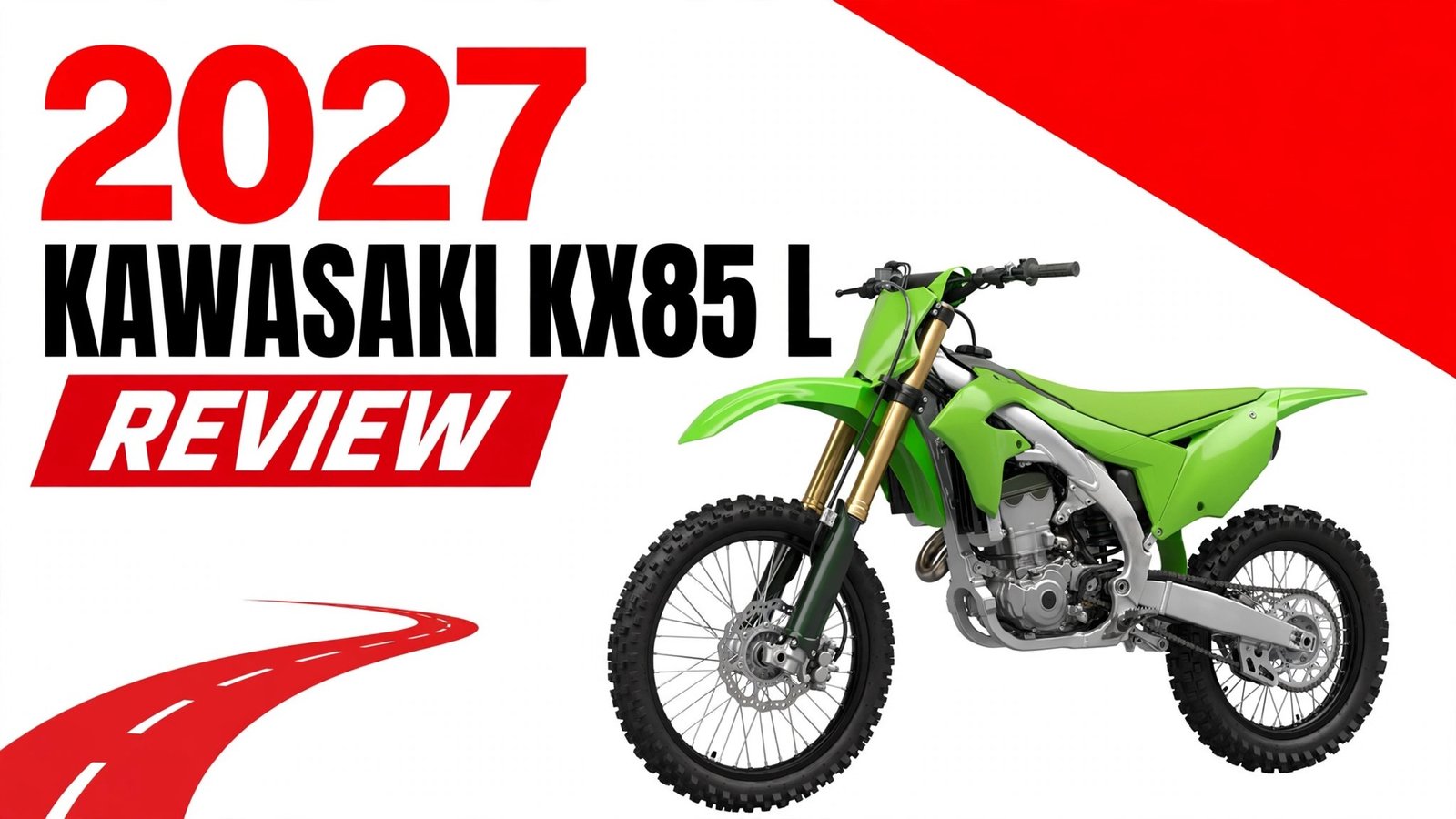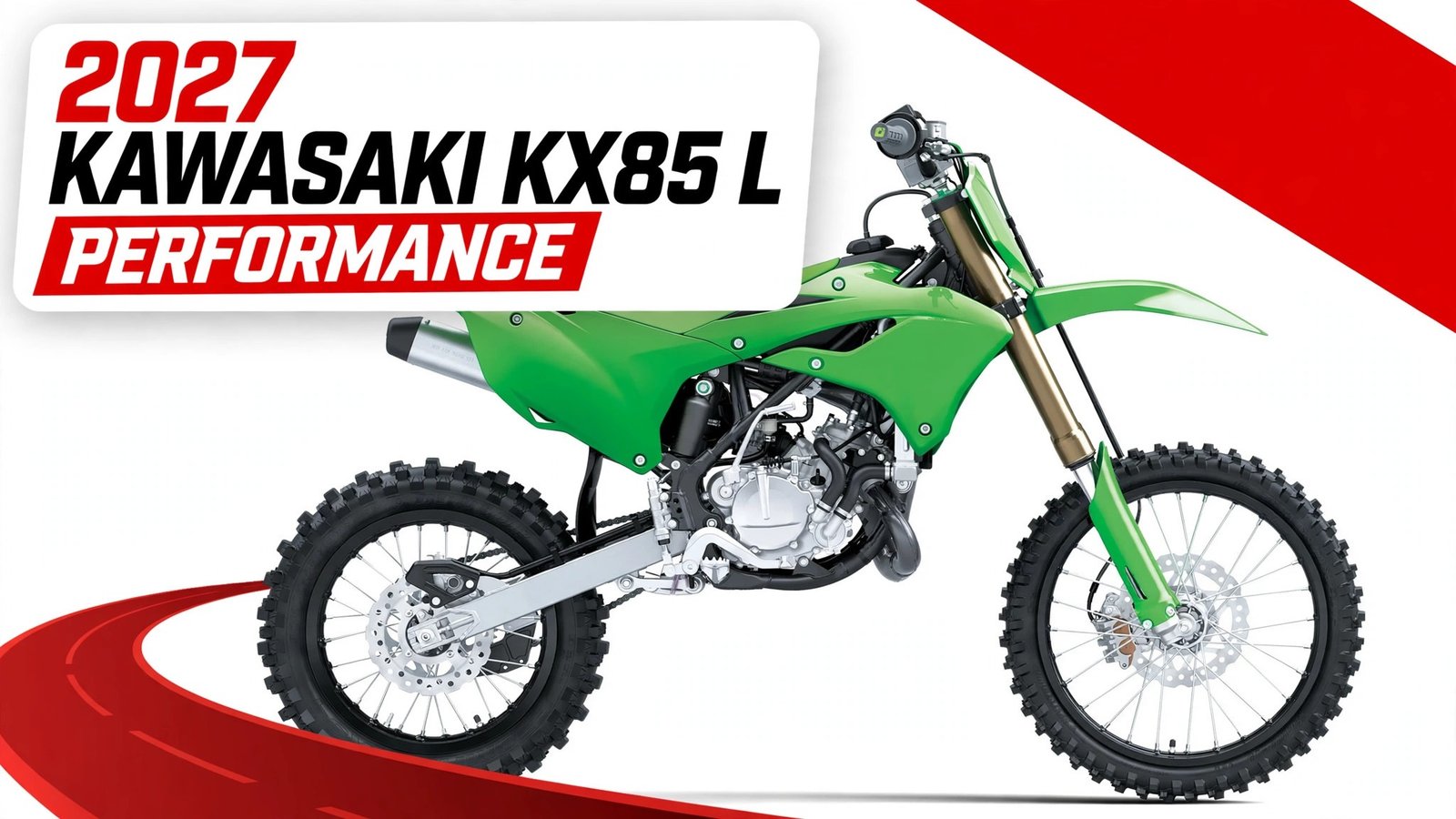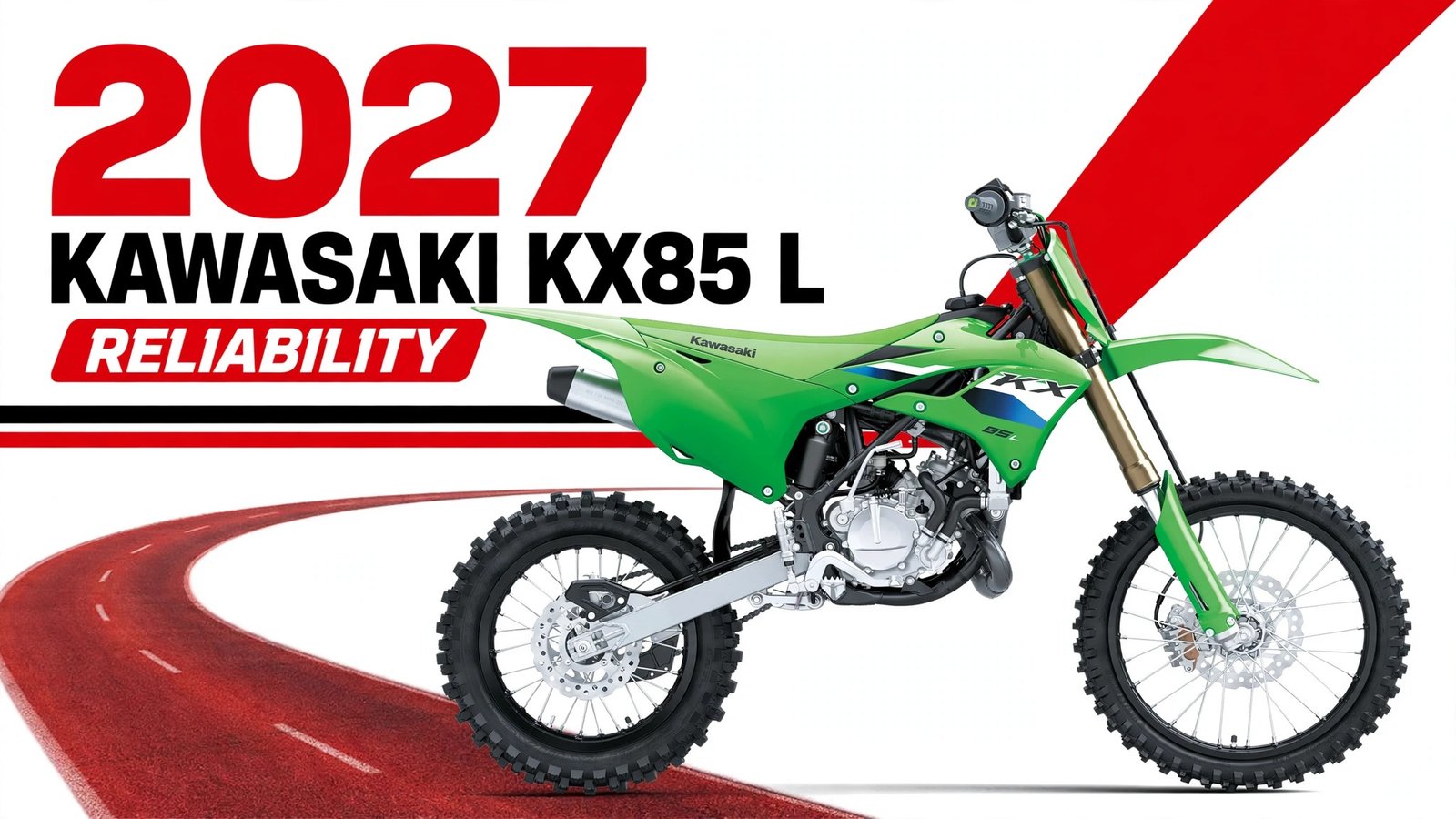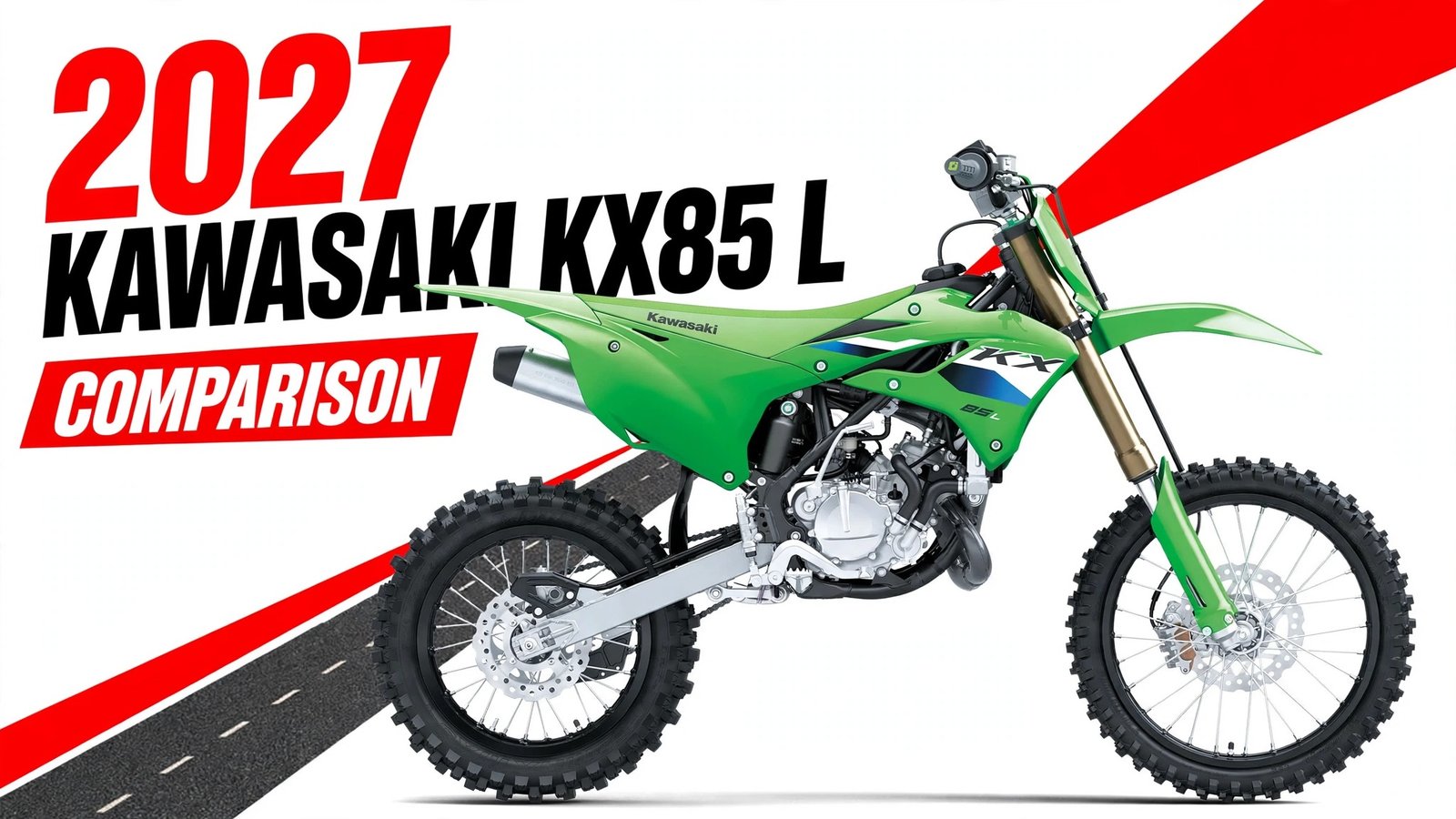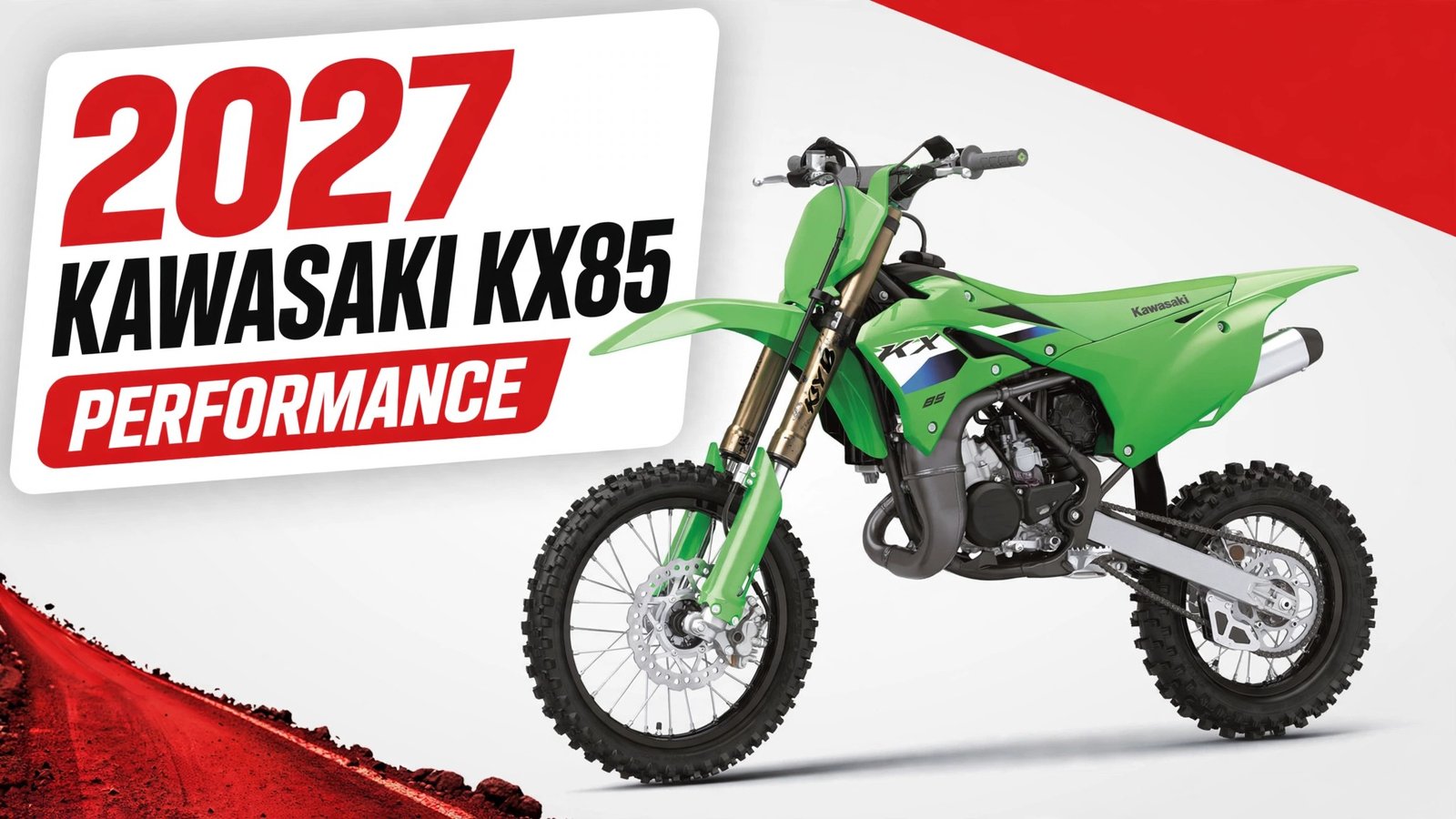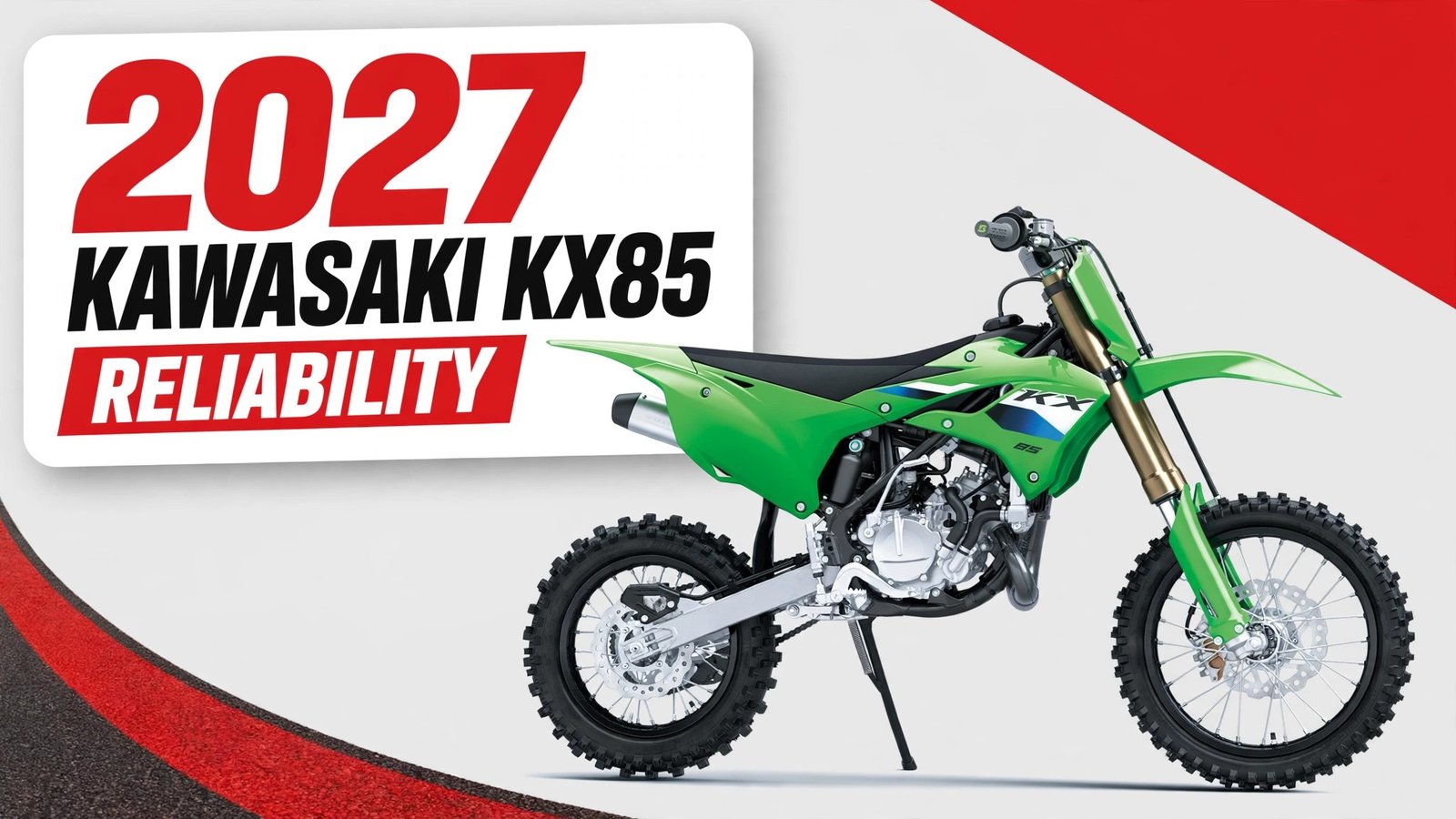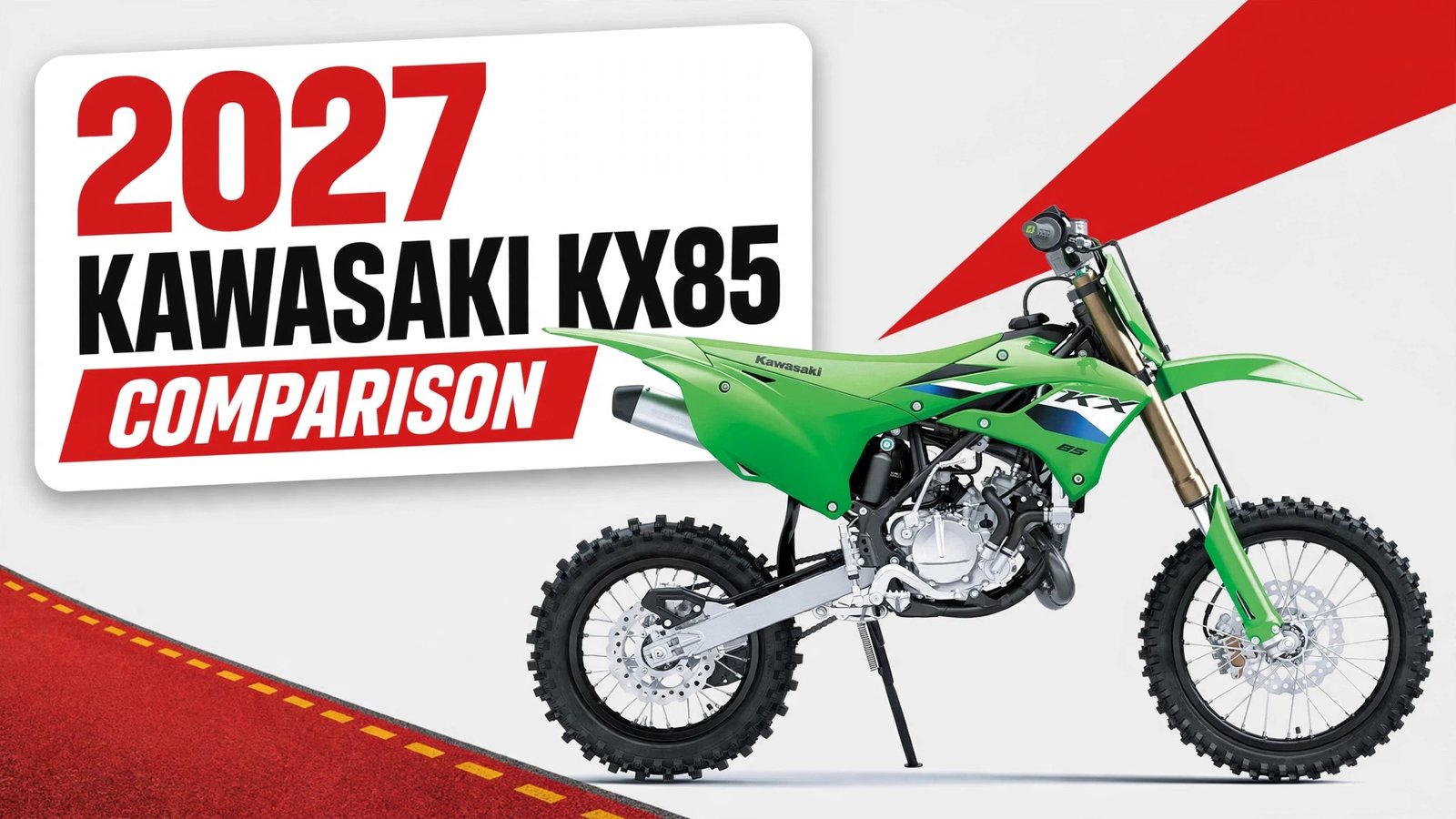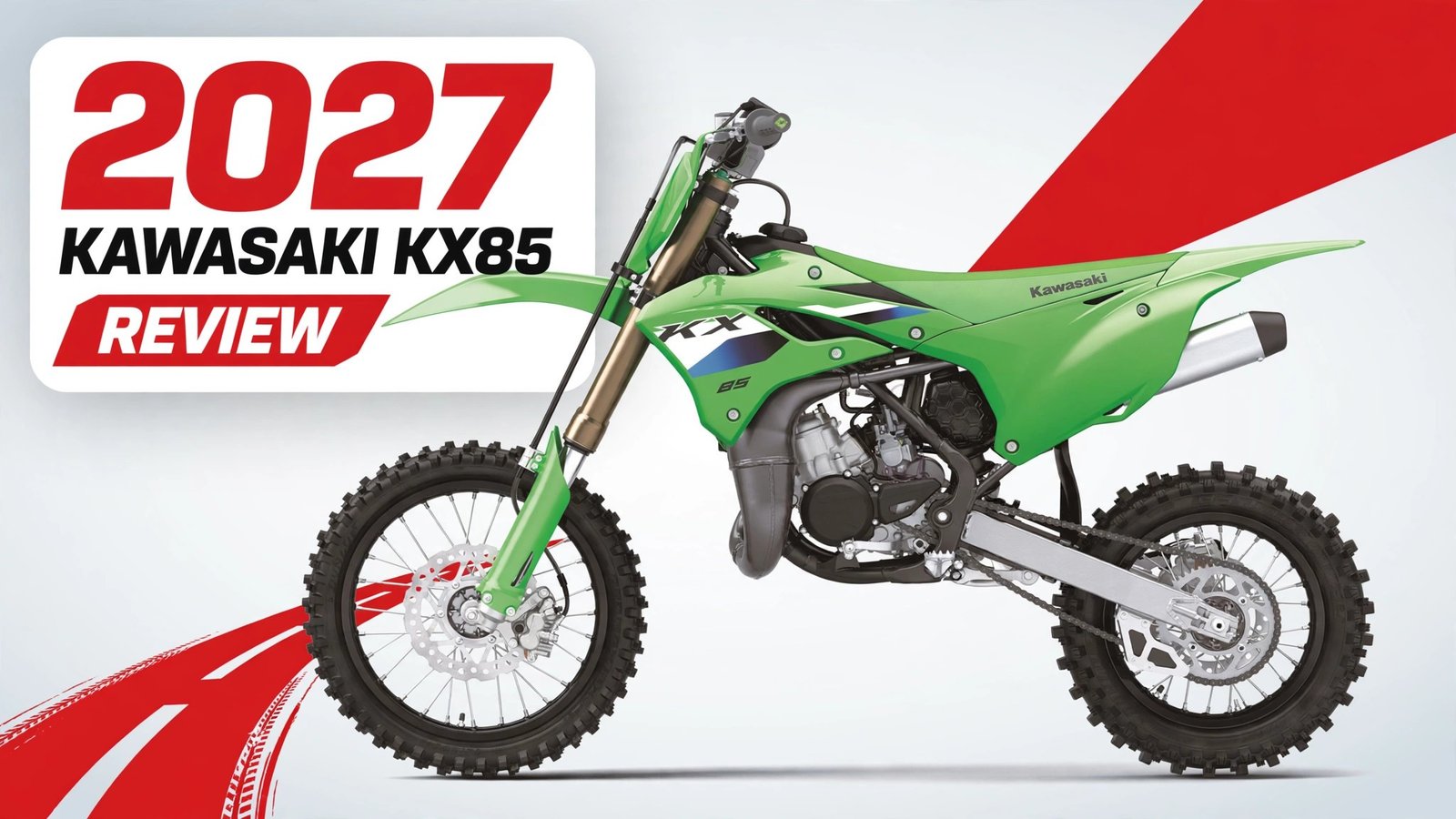
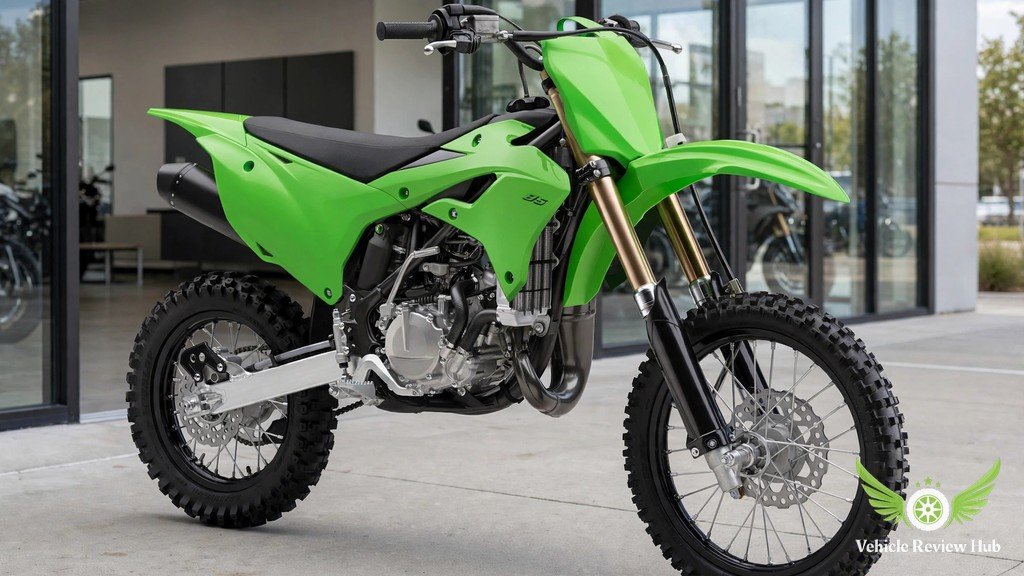
The 2027 Kawasaki KX85 costs $4,999, and for the first time in a dozen years it is a genuinely different bike underneath. Kawasaki’s second big revamp landed for 2026, and it touched almost everything except the engine: a 43 mm KYB fork, 240 mm front and 220 mm rear brakes, a stiffer frame, Renthal bars and a new big-wheel L version that is new to the USA. This Kawasaki KX85 review works through what changed, what did not, and whether the cheapest 85 in the class still makes sense for a young racer.
The short version of this Kawasaki KX85 review is that the bike got much better where it was weakest — suspension and brakes — while keeping the same 84cc two-stroke engine and the same $4,999 price as the 2026 bike. It is still sold as-is with no warranty, still has no lights or instruments, and still asks its rider to work the clutch. What follows is the full picture.
Kawasaki KX85 Overview and Model-Year Updates
The KX85 has lived a long life with very few changes, which is what makes the 2026 revamp worth understanding before anything else in this Kawasaki KX85 review. Kawasaki updated the bike twice — once in 2014 and again in 2026 — and the 2027 bike is a carryover except for graphics.
Second Big Revamp in 2026
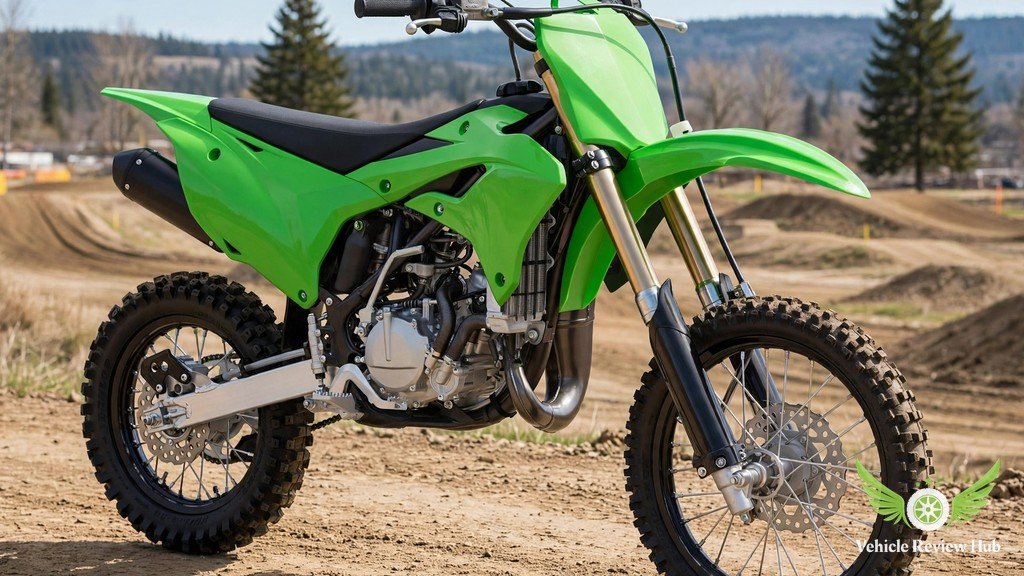
The second big revamp in 2026 was a chassis-only revamp — the 84cc engine carried over unchanged, a point this Kawasaki KX85 review keeps coming back to because it shapes everything from the dyno story to the price. What changed was the running gear: a fully adjustable 43 mm KYB fork in place of the old 36 mm unit, 240 mm front and 220 mm rear disc brakes, a reworked rear shock, a stiffer high-tensile steel perimeter frame, Renthal Fatbar handlebars, ODI Lock-On grips, ERGO-FIT bar mounts and Dunlop Geomax MX34 tyres. The first revamp was in 2014, after the bike had gone roughly unchanged since 2002, and the 2027 bike is identical to the 2026 bike except for minor graphic changes.
Despite the aluminium bars, steering stem and rear sprocket, the bike got heavier: 164.4 lb in 2025 became 168.4 lb with fuel in 2026, a 4.0 lb gain. Kawasaki also stretched the steering head pipe by 25 mm, lowered and widened the footpegs, and flattened the tank and seat for a slimmer feel. Cycle News called the 2026 updates the most significant in recent memory, and its July 2026 review is the first test of the revamped bike — more on that in the riding section of this Kawasaki KX85 review.
L Is New to the USA
The L is the large-wheel KX85, and it is new to the USA for 2026 — Kawasaki’s own spec-sheet URLs for a 2024 or 2025 KX85 L return 404, while the 2026 and 2027 sheets are live, and the January 2026 press release lists it as a NEW KX85 L model. One caveat matters for accuracy: the big-wheel concept itself is not new. The 2015 owner’s manual covers a big-wheel KX85D alongside the standard KX85C, so the L nameplate is what is new to the USA, not the idea of a bigger-wheeled 85.
What the L buys is size: 19-inch front and 16-inch rear wheels instead of 17 and 14, a 34.1-inch seat instead of 32.7, a 51.6-inch wheelbase instead of 49.8, and 12.0 inches of rear travel instead of 10.8. It costs $200 more — $5,199 against $4,999 — and weighs 4.0 lb more with fuel. For a taller rider who has outgrown the standard bike’s fit but is not ready for the KX112, the L is the intermediate step, and this Kawasaki KX85 review treats it as a fit choice rather than a performance upgrade, because the engine, brakes and fork are identical.
Kawasaki KX85 Engine and Specifications
The engine is the one part of the bike Kawasaki left alone, and that is the key to this Kawasaki KX85 review’s performance story: the 84cc two-stroke carried over from 2014 through the 2026 revamp, so the only US dyno figure ever published still applies. The spec sheet lists no horsepower figure at all — Kawasaki publishes none — so the numbers below come from the sheet and the one magazine dyno test.
84cc, KIPS Power Valve
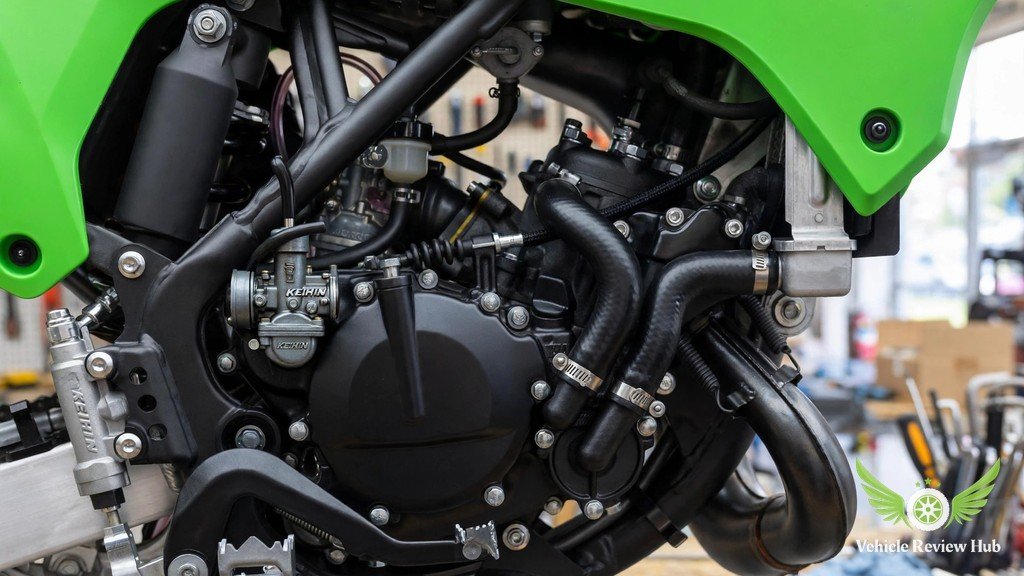
The KX85 runs an 84cc liquid-cooled two-stroke single with a bore and stroke of 48.5 by 45.8 mm, a KIPS exhaust power valve, a 28 mm Keihin PWK28 carburettor and a six-speed manual gearbox with a wet multi-disc clutch. The carburettor deserves emphasis because it is a common point of confusion: the KX85 uses a Keihin, not the Mikuni fitted to the smaller KX65. The KIPS valve is a two-piece independent design inherited from the old KX125, and the cylinder is Nikasil-lined with a single piston ring. Ignition is a digital CDI with a direct-coupler igniter, and the bike is kick start only, which is one more reason this Kawasaki KX85 review calls it a pure race bike rather than a trail bike.
On power, the only citable US figure is Motocross Action’s 2014 dyno test, which measured 22.68 hp and 10.02 lb-ft from the 2014 bike — up from 18.79 hp on the 2013 machine, a 17 percent gain that came with the first revamp. The same test noted the KTM 85 SX made about 2 hp more. No one has published a newer KX85 dyno figure since, and because the engine carried over unchanged into the 2026 bike, the 2014 number remains the reference — with the caveat that no one has dyno’d a 2026 bike in print or on the web. The full dyno story, including the unsourced 28.97 hp claim that circulates on aggregator sites, is worked through in our Kawasaki KX85 performance guide, and the 2014 figure is the one this Kawasaki KX85 review treats as the reference.
| Item | 2027 Kawasaki KX85 |
|---|---|
| Engine | 84cc two-stroke single, KIPS power valve, liquid-cooled |
| Bore x stroke | 48.5 x 45.8 mm |
| Compression ratio | 10.9:1 (low speed) / 9.0:1 (high speed) |
| Carburettor | 28 mm Keihin PWK28 |
| Gearbox | 6-speed, wet multi-disc manual clutch |
| Front suspension | 43 mm inverted KYB fork, 10.8 in travel |
| Rear suspension | Uni-Trak single shock, 10.8 in travel |
| Brakes | 240 mm front / 220 mm rear petal discs |
| Seat height | 32.7 in |
| Curb weight | 160.3 lb without fuel / 168.4 lb |
| Fuel capacity | 1.32 gal |
| Tyres | 70/100-17 front, 90/100-14 rear (Dunlop Geomax MX34) |
Note: Figures in this Kawasaki KX85 review’s spec table are from Kawasaki’s 2027 spec sheet. Kawasaki publishes no horsepower or torque figure for the KX85, and the 22.68 hp dyno figure in the text comes from Motocross Action’s 2014 test of the 2014 bike.
Fork Grew to 43mm KYB
The fork is the single biggest change in the 2026 revamp. The old 36 mm KYB inverted fork, which adjusted compression only, gave way to a 43 mm KYB inverted fork with compression and rebound adjustment, Kashima-coated outer tubes and leaf-valve spring internals. The rear Uni-Trak shock gained a high-speed compression adjuster alongside its existing low-speed compression, rebound and preload settings, with a thicker 14 mm shock rod and a longer 390 mm cylinder. Travel stayed at 10.8 inches at both ends on the standard bike; only the L and the KX112 get 12.0 inches at the rear, and that split is one detail this Kawasaki KX85 review flags because combined spec tables sometimes blur it.
Kawasaki KX85 Price and Market Availability
Price is where this Kawasaki KX85 review starts to make its case. The 2027 KX85 lists at $4,999, unchanged from 2026, and it undercuts every rival in its class by at least $200. The full ladder below uses Kawasaki’s own spec sheets, with destination charges labelled as dealer-sourced because Kawasaki does not print them.
| Model year | MSRP | Destination | Delivered |
|---|---|---|---|
| 2027 | $4,999 | $315 | $5,314 |
| 2026 | $4,999 | $315 | $5,314 |
| 2025 | $4,949 | $305 | $5,254 |
| 2024 | $4,949 | $255 | $5,204 |
| 2023 | $4,699 | $245 | $4,944 |
Note: MSRP figures are from Kawasaki’s own spec sheets; destination charges are dealer- and motorcycle.com-sourced, never Kawasaki-published, and carry roughly $10–15 of source variance. The 2024 MSRP is $4,949 — motorcycle.com’s $4,899 figure is $50 low and is not used. Delivered prices in this Kawasaki KX85 review are MSRP plus destination.
Kawasaki KX85 Price in the USA: $4,999 (2027)
The 2027 price is verified three ways: Kawasaki’s 2027 spec sheet, the June 2, 2026 press release and Kawasaki’s 2027 model page all print $4,999, and the 2026 bike cost the same. That flat price matters because the 2026 revamp added real hardware without a price rise. Add the $315 destination charge and the delivered price is $5,314. One warning: discounted dealer advertisements are not MSRP. New 2025 bikes were advertised as low as $3,488 on dealer listings, and a 2024 was listed at $3,904 after offers — those are discounted advertised prices, not the manufacturer’s price, and this Kawasaki KX85 review labels them as such wherever they appear.
L Costs $200 More
The arithmetic is simple and verified for both 2026 and 2027: $5,199 minus $4,999 is exactly $200, and the delivered gap is the same $200 because both bikes carry the same $315 destination charge. For that $200 a family buys the bigger wheels, the taller seat and the extra 1.2 inches of rear travel — fit, not power. Kawasaki also offers up to $200 in holiday cash plus up to $700 in factory savings on 2025–2027 KX85s through December 31, 2026, though “up to” is doing real work there: a dealer page listed $500 in savings on a 2026 KX85, so the $700 is a ceiling, not a guaranteed figure on every unit — a distinction this Kawasaki KX85 review keeps because the offer is easy to overstate.
Kawasaki KX85 Design, Features and Technology
The KX85 looks like a small KX250 and is built like one, with one honest omission: there is nothing on it that does not make it faster around a track. This Kawasaki KX85 review’s design section covers what the bike has, what it deliberately lacks, and the one claim buyers should not make.
Brakes Grew to 240 and 220
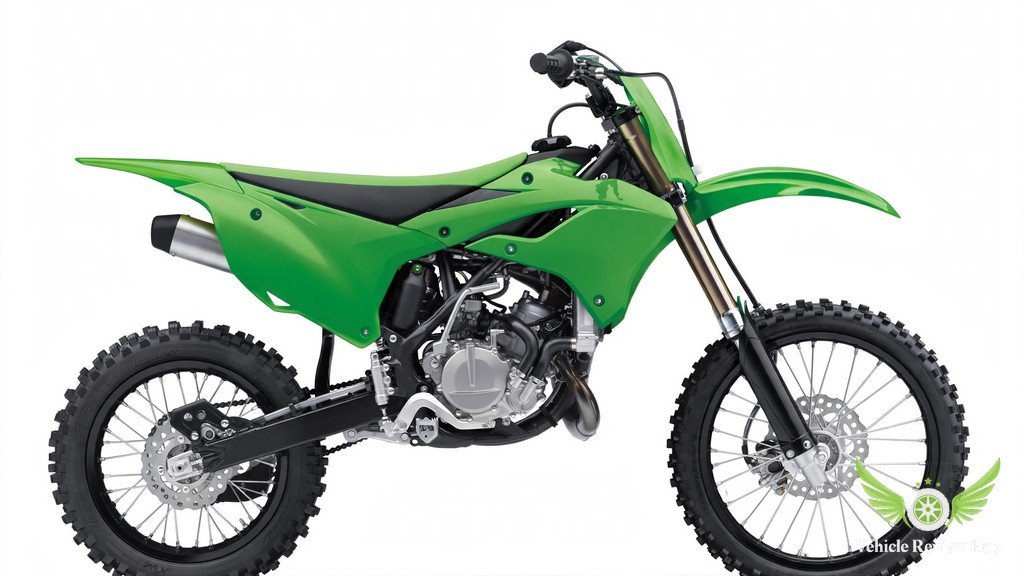
The 2026 brake package is the other half of the revamp’s value. The front disc grew from 220 mm to 240 mm with a KX250-style Nissin master cylinder and caliper running dual 25 mm pistons, and the rear disc grew from 184 mm to 220 mm with a refined master cylinder for a shorter pedal stroke. Both discs are petal-shaped. The 2014 shootout had already ranked the KX85’s brakes the most usable in the class — testers called them “baby bear’s porridge”, gentle enough for young riders where the KTM’s were too touchy — and the bigger 2026 hardware keeps that friendly character while adding stopping power. No publication has ever measured a stopping distance for the KX85, so this Kawasaki KX85 review states no braking figure.
Elsewhere the design is pure competition hardware: a high-tensile steel perimeter frame with the steering head pipe extended 25 mm, black alumite rims, a brushed-aluminium swingarm, a flat-topped tank, a slim flat seat and wider shrouds. There are no lights, no instruments, no electric start and no mirrors — the spec sheet lists none of them, and the owner’s manual states the bike is a competition model for closed-course sanctioned events only. The ERGO-FIT system gives eight handlebar positions, four fore-and-aft by two heights, so the cockpit grows with the rider — a detail this Kawasaki KX85 review highlights.
No Spark Arrestor Claim
One claim this Kawasaki KX85 review will not make is that the bike has no spark arrestor. Spark arrestor fitment could not be verified from any Kawasaki source, and the defensible statement is the one the manual actually makes: the KX85 is a closed-course competition machine, not for public streets or general off-road recreational riding. Buyers who ride on land that requires a spark arrestor should confirm fitment with the dealer rather than trusting a guide that asserts it either way.
Kawasaki KX85 Riding Experience and Comfort
Riding experience is where the KX85’s two personalities show: a mellow, metered engine that testers keep calling beginner-friendly, bolted to a race bike that Kawasaki says is not for beginners at all. This Kawasaki KX85 review sorts that contradiction out with the manual in one hand and the test reports in the other.
For Experienced Young Riders
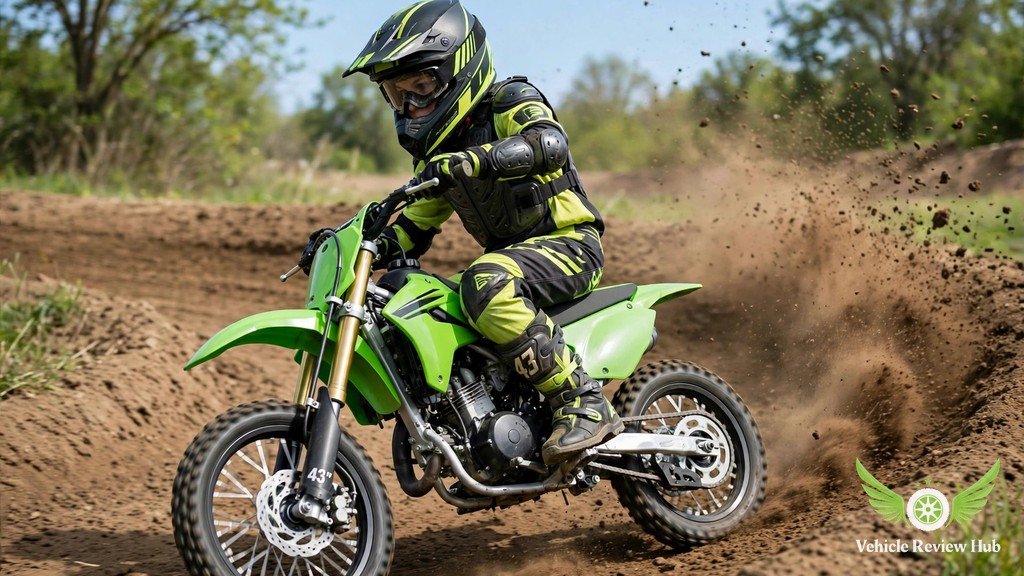
Kawasaki’s manual is blunt: the KX85 is “a high performance off-road motorcycle designed for experienced young riders. It is not suitable for beginners.” It is a six-speed manual-clutch two-stroke with a high-rpm powerband, and the rider has to work the clutch to keep it on the pipe. Cycle News’s July 2026 test of the actual revamped bike found exactly that — the 85 “favors aggressive riding and high rpm, requiring more clutch work, especially when exiting corners”, with a narrower high-rev window than the tester’s Husqvarna TC85. The honest reading is that the bike suits a young rider graduating from a KX65 or a trail bike who already rides, shifts and clutches — a novice racer, not a novice rider — and that distinction is the most useful line in this Kawasaki KX85 review for a parent shopping a first race bike.
The testers’ softer side is real too. Motocross Action’s 2014 test called the power “metered” and “easy to ride for all ages and skill levels”, Dirt Bike Magazine’s 2022 test called it “great for beginner or novice riders right off the showroom floor, because the power is smooth and usable”, and the 2025 shootout said the suspension suits lighter novice-level riders in the 60–80 lb range. None of that makes it a first-ever bike — for a child who has never ridden, the right machine is a trail bike — but it does make the KX85 a forgiving first race bike, which is the verdict this Kawasaki KX85 review settles on.
Sold As-Is, No Warranty
The warranty position is the starkest in the class. Kawasaki’s owner’s manuals state the bike is sold as-is, with all faults, and that there are no warranties expressed or implied — a disclaimer worded identically across the 2009, 2013, 2016 and 2018 manuals. That is a real ownership difference against the Yamaha YZ85’s 30-day limited warranty and the KTM and Husqvarna one-year cover from 2027. It also shapes the used market: there is no factory safety net, so a buyer checks the bike, not the paperwork — a point this Kawasaki KX85 review repeats. Our Kawasaki KX85 reliability guide covers the maintenance schedule and the one CPSC recall in full.
One more thing the manual does not do is set a rider weight limit. A full-text search of the 168-page 2015 manual finds no pound figure at all — the factory suspension is described only as set up for a medium-weight rider of intermediate ability, with lighter and heavier spring options. Do not carry the smaller KX65’s under-121-lb figure across; it belongs to that bike, not this one. For contrast, the rival KTM 85 SX manual does state a maximum rider weight of 75 kg (165 lb) — a KTM figure, not Kawasaki’s — and this Kawasaki KX85 review states that contrast plainly.
Cycle News took the 2026 bike to the track with 15-year-old tester Myles Abbott, who rides both the KX85 and the bigger KX112 in the video — the two bikes appear one at a time, not side by side — and compares them with the KTM Super Mini and Husqvarna 85 he normally rides. Watch it below:
Kawasaki KX85 Review: Pros, Cons and Verdict
Time to total it up. This Kawasaki KX85 review’s verdict is that the 2026 revamp fixed the bike’s two real weaknesses — suspension and brakes — without touching its price or its engine, and that leaves a bike that is the cheapest 85 in the class, the easiest to ride slowly, and the slowest at the sharp end.
Main Advantages and Limitations of the Kawasaki KX85
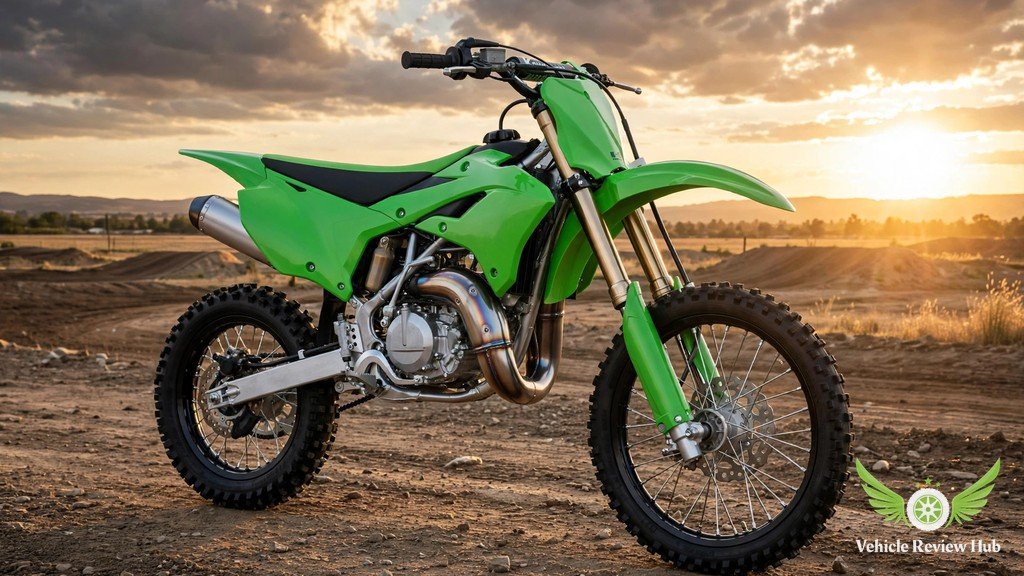
The advantages start with price and fit. At $4,999 the KX85 is $200 cheaper than the Yamaha YZ85 and roughly $2,000 cheaper than the Austrian pair, and its 32.7-inch seat is the lowest in the class. The 2026 fork and brakes are genuinely modern — 43 mm KYB with compression and rebound, 240 mm front disc — and the engine’s metered, linear power makes it the most forgiving 85 to ride at novice pace. The linkage rear suspension, which the Austrians lack, and the huge used-parts and aftermarket base from a design that ran largely unchanged from 2014 to 2025 are real ownership advantages too, and they are why this Kawasaki KX85 review keeps the bike on the shortlist despite its power deficit.
The limitations are just as clear. On the only US dyno ever published, the KX85 made 22.68 hp against about 24.68 hp for the KTM, and the 2025 shootout ranked it third of three groups, calling it “not race-ready in stock form” with an engine “too slow” and suspension “too soft” for heavier riders. The suspension suits 60–80 lb novice riders unless re-sprung, the brakes felt weaker than the tester’s Husqvarna and KTM in the 2026 Cycle News test, and the bike is sold as-is with no warranty. There is also exactly one recall in its history — CPSC recall 01-065 from 2001, when the rear brakes on about 18,000 bikes across all 2001 KX models could fail; zero injuries were reported, and no KX85 recall has followed since. Weighing both sides is what this Kawasaki KX85 review is for.
Old MSRPs Conflict in Print
A buyer researching prices will trip over three conflicting figures, so this Kawasaki KX85 review settles them here. The 2024 MSRP is $4,949 — Kawasaki’s own 2024 spec sheet and dealer brochures print it, while motorcycle.com’s 2024 page prints $4,899, which is $50 low and matches no Kawasaki document. The $4,699 figure on some aggregator pages is the stale 2023 MSRP presented as a 2026 price; Kawasaki’s 2026 MSRP is $4,999. And the $4,950 on one auto site is a one-dollar rounding of the 2025 price. The rule that sorts all three is simple: Kawasaki’s own spec sheet governs, and this Kawasaki KX85 review uses it. For the full head-to-head on price, power and hardware against the Yamaha, KTM and Husqvarna, see our Kawasaki KX85 comparison.
Kawasaki KX85 Review FAQs
These are the questions US buyers ask about the 2027 KX85, answered from the verified facts in this Kawasaki KX85 review.
How much does the 2027 Kawasaki KX85 cost?
$4,999 MSRP plus a $315 destination charge, or $5,314 delivered. The large-wheel KX85 L is $5,199 plus $315, or $5,514 delivered. The price was $4,949 in 2024–2025 and $4,699 in 2023, and this Kawasaki KX85 review uses Kawasaki’s own spec sheets for every one of those figures.
What changed on the KX85 for 2026?
A second big revamp, and it was chassis-only: a 43 mm KYB fork up from 36 mm, now with compression and rebound adjustment, bigger 240 mm front and 220 mm rear brakes, a reworked rear shock, a stiffer frame, Renthal Fatbar and ODI grips, ERGO-FIT bar mounts and Dunlop MX34 tyres. The 84cc engine is unchanged, and the 2027 bike is identical except for graphics — the full change list is in the overview section of this Kawasaki KX85 review.
What is the KX85 L?
The large-wheel KX85, new to the USA for 2026. It runs 19-inch front and 16-inch rear wheels instead of 17 and 14, a 34.1-inch seat instead of 32.7, and 12.0 inches of rear travel instead of 10.8, for $200 more — $5,199 MSRP. The big-wheel idea itself is older than the L nameplate, which the 2015 manual’s KX85D proves, as this Kawasaki KX85 review notes.
Is there a warranty on the KX85?
No. Kawasaki sells it as-is with no warranty at all in the USA, a position stated identically in the 2009–2018 owner’s manuals. The Yamaha YZ85 carries a 30-day limited warranty and the KTM and Husqvarna offer one year from 2027, so the KX85 is the outlier here — a fact this Kawasaki KX85 review flags.
What age or size rider is the KX85 for?
Kawasaki says it is designed for experienced young riders and not suitable for beginners, and it publishes no rider weight limit at all. The 85cc class spans ages 10–15, and the stock suspension suits lighter novice-level riders in the 60–80 lb range unless re-sprung — a point this Kawasaki KX85 review makes in the riding section.
Can I get money off a new KX85?
Possibly. Kawasaki’s homepage offers up to $200 in holiday cash plus up to $700 in factory savings on 2025–2027 KX85s, valid through December 31, 2026. “Up to” is the key phrase — the $700 is a maximum, not a guaranteed figure on every unit, and this Kawasaki KX85 review keeps that wording.