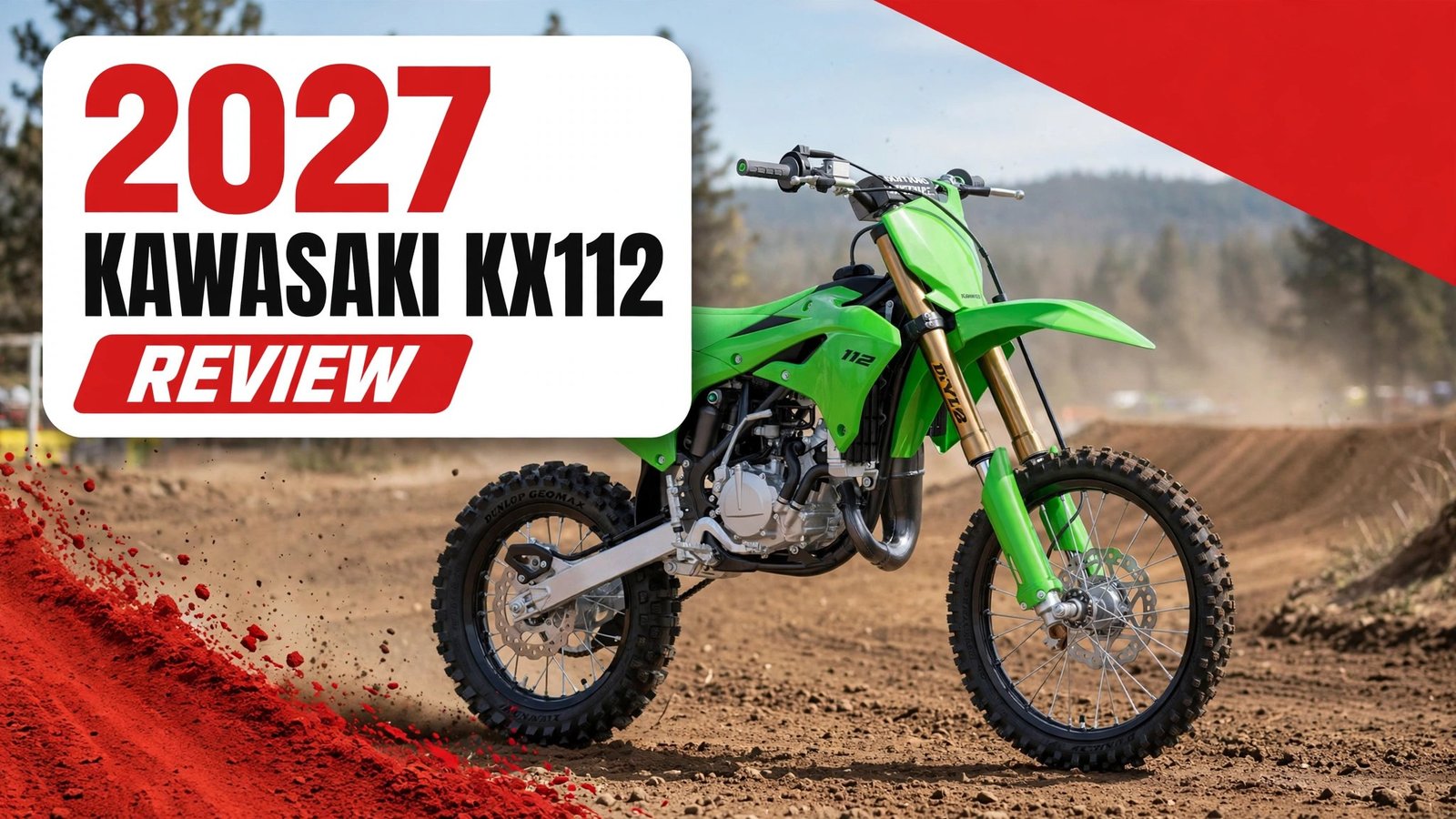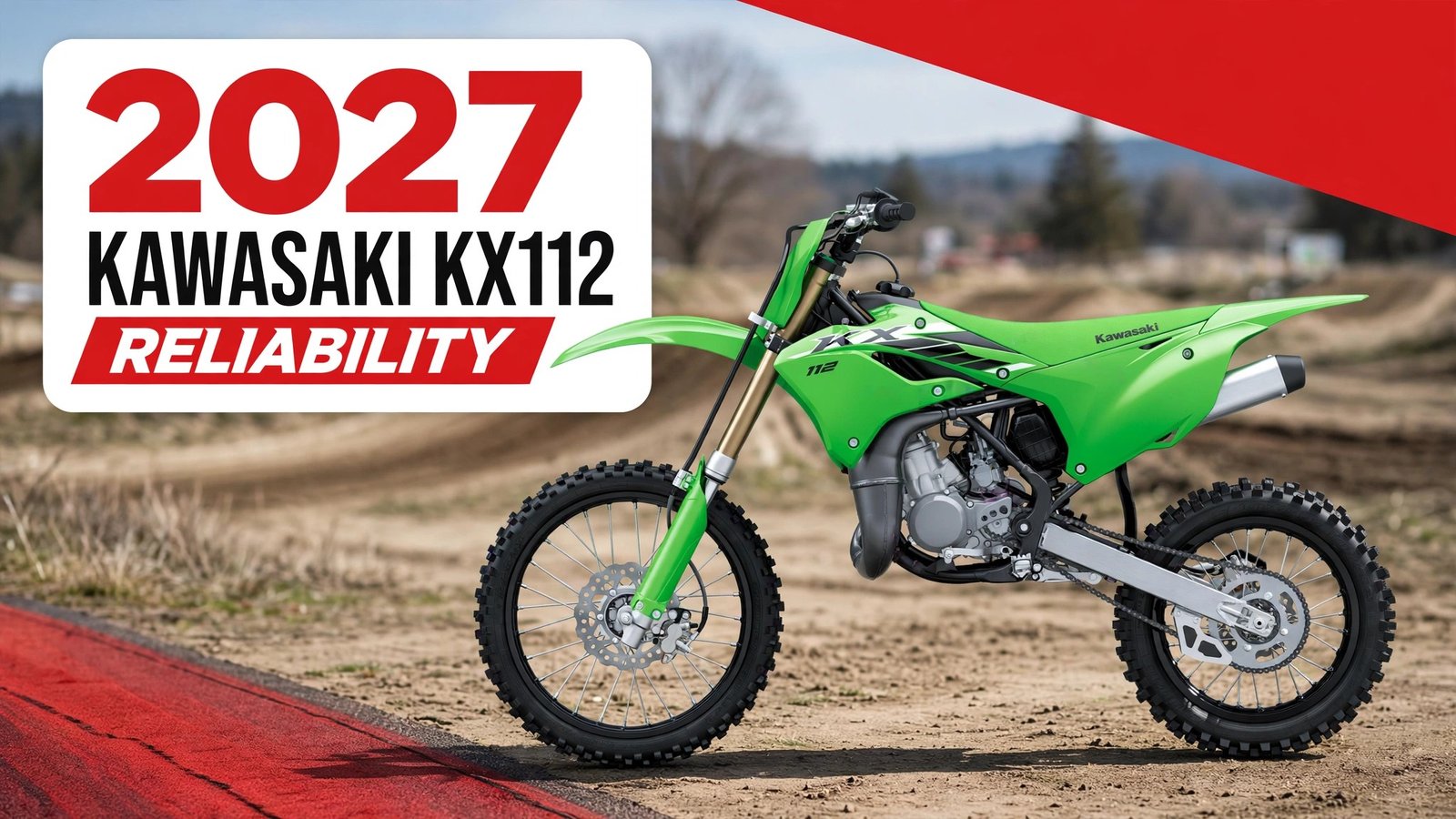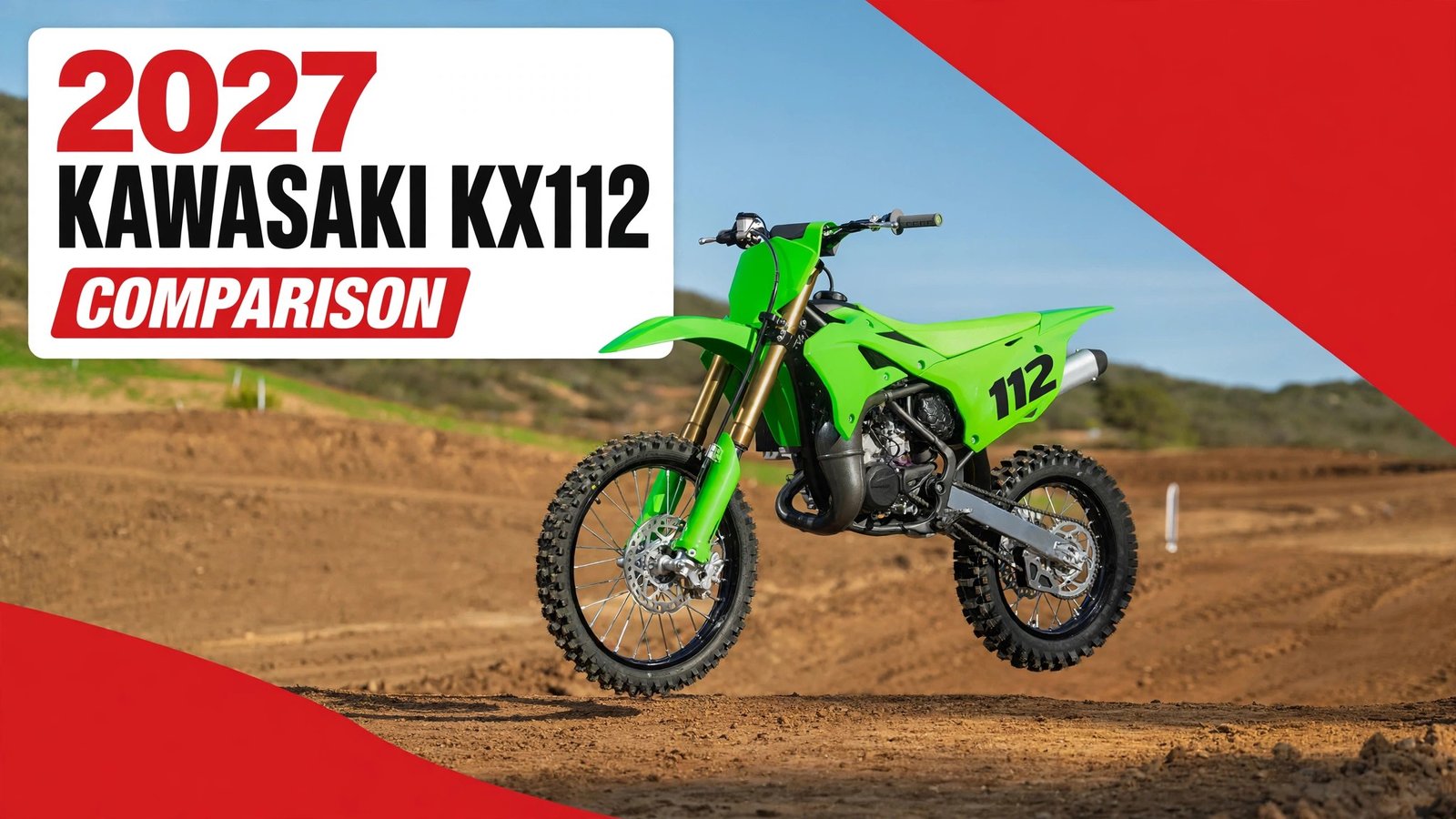
The 2027 Kawasaki KX112 is a bike whose performance is easy to misread: Kawasaki publishes no power figure, no top speed and no fuel-economy number, and the aggregator pages that fill the gap print figures no test ever produced. This Kawasaki KX112 performance guide starts from what is verified: a real dyno figure from Motocross Action Magazine, five ride tests, and a 2026 paired review in which a 15-year-old tester called the 112 the clear favourite.
The honest picture is a bike with more usable power than any 85, a chassis revamped for 2026, and no instrumented speed or economy test anywhere. That is the thread through this Kawasaki KX112 performance guide: what the tests measured, what they only felt, and what nobody has measured at all.
Kawasaki KX112 Engine Performance and Power Delivery
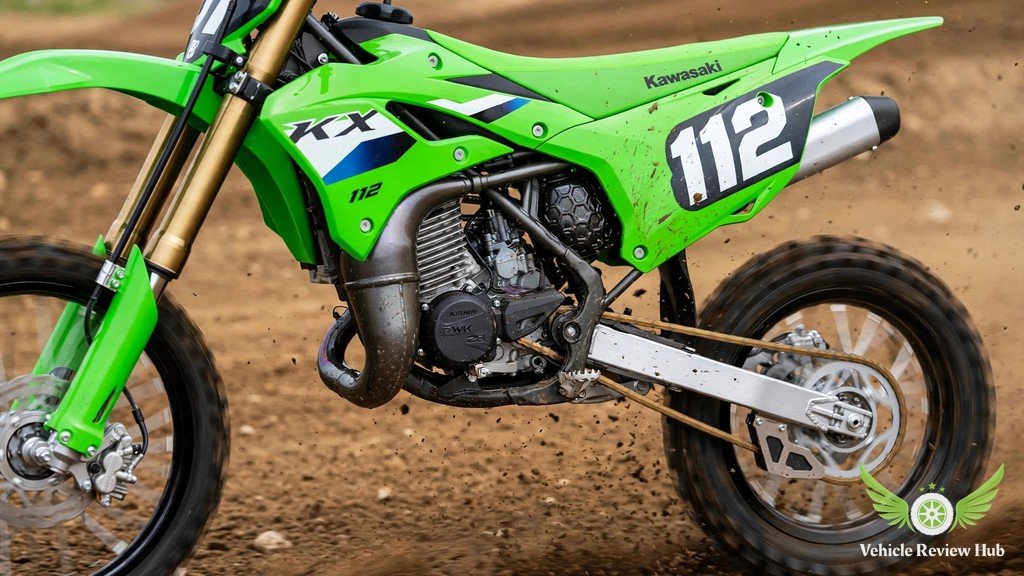
The engine is the same 112cc two-stroke single the KX112 has carried since 2022 — the same engine the KX112 review covers — and that is good news for this Kawasaki KX112 performance guide, because the one dyno figure in the class belongs to that engine. Kawasaki publishes no power figure of its own, so the numbers below come from the magazine that put the bike on a dyno.
Cycle News: Clear Favourite
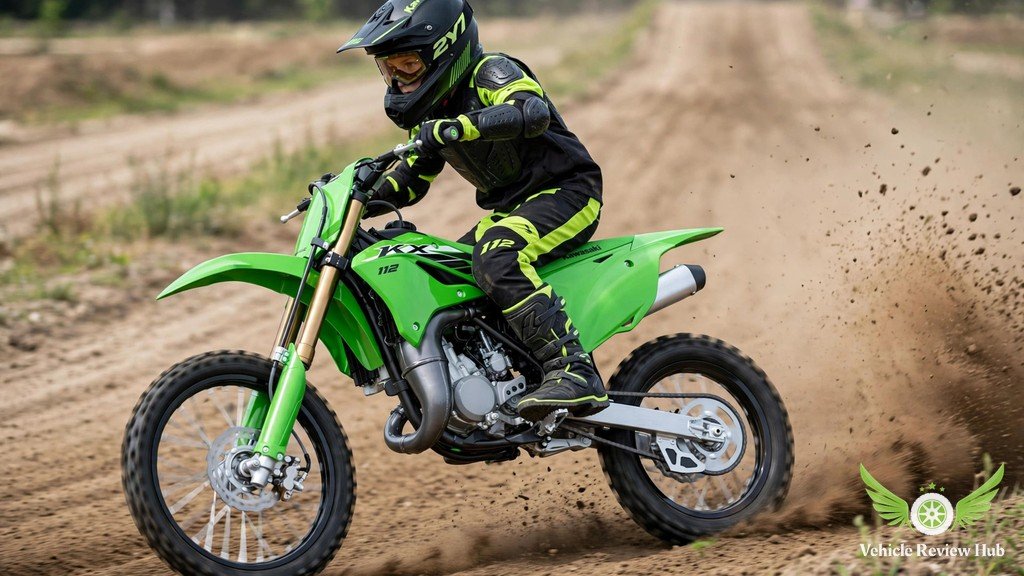
The strongest verdict on the 112 comes from Cycle News, in a paired review of the 2026 KX85 and KX112 published on July 10, 2026, by Ryan Nitzen with 15-year-old tester Myles Abbott, 118 lb and 5 feet 5 inches. The article is a two-bike review, not a shootout, and it measured nothing with instruments — but its verdict is unambiguous. For the test rider, Cycle News called the KX112 the clear favourite, writing that its smoother power delivery, larger wheels and improved suspension made it easier to ride across a wider range of terrain.
That verdict carries weight because it came from a rider who races a Husqvarna TC85 and a KTM 105 Supermini of his own. The 112 grew on him through the day, the article says, and nothing stood out as a major weakness; the 85 remained a solid option for riders moving up through the youth ranks. This Kawasaki KX112 performance guide treats the Cycle News verdict as the headline test result, because it is the only test of the current bike that names a favourite.
Broader, More Forgiving Power
The 112 won the comparison on its power character. Cycle News writes that the KX112 had a broader, more forgiving power character, with the extra 27cc producing stronger low-end torque and letting the rider maintain momentum without relying on the clutch. That is the 112’s defining trait in this Kawasaki KX112 performance guide: not the fastest bike in the class on paper, but the easiest one to keep moving.
The 2022 tests say the same thing, and they are worth quoting because the engine is unchanged. Motocross Action Magazine found the 2022 bike smooth on the bottom end, pulling from 7,000 rpm to its 11,600 rpm peak. Ultimate Motorcycling, with a 5-foot, 88-lb rider moving up from an 85, wrote that a rider can wring its neck like an 85 or short-shift on its torque. The dyno behind those impressions is the only one in the class: Motocross Action Magazine dyno’d the 2022 KX112 at 24.96 hp and 11.6 lb-ft stock, 25.9 hp and 11.9 lb-ft with a Pro Circuit pipe, peaking at 11,600 rpm. The engine is unchanged since 2022, so that is the best datapoint for the 2027 bike — a 2022-bike dyno, never a 2026 or 2027 dyno, and this Kawasaki KX112 performance guide labels it that way every time.
Motocross Action Magazine also filmed its 2022 test at Glen Helen Raceway, and the video below is that test: the bike shown is the pre-2026-revamp model, with the 36 mm fork, 220/184 mm brakes, Dunlop MX33 tyres and the older frame and ergonomics, but the 112cc engine in it is the same unit the 2027 bike carries, and this Kawasaki KX112 performance guide labels the footage as a 2022 test.
| Dyno figure | Kawasaki KX112 | Kawasaki KX85 (context) |
|---|---|---|
| Peak horsepower | 24.96 hp (stock, MXA 2022) | 22.68 hp (MXA 2014) |
| Peak torque | 11.6 lb-ft (stock, MXA 2022) | 10.02 lb-ft (MXA 2014) |
| With Pro Circuit pipe | 25.9 hp / 11.9 lb-ft (MXA 2022) | Not tested |
| Peak rpm | 11,600 rpm | Not published |
| Kawasaki published figure | None on any 2022–2027 spec sheet | None |
Note: The two bikes were dyno’d eight years apart on different days, so the gap is an indication, not a same-day comparison. The KX112 figures are the 2022 bike’s; the engine is unchanged for 2027, and this Kawasaki KX112 performance guide prints no 2026 or 2027 dyno figure because none exists.
Kawasaki KX112 Top Speed and Acceleration
Top speed and acceleration are where this Kawasaki KX112 performance guide has the least to report, and that is itself the finding. No magazine, no manufacturer and no timed test has ever published a tested top speed, a 0–60 mph time or a quarter-mile time for the KX112. The numbers that circulate online are estimates with no test behind them, and the section below separates the one real datapoint — the dyno — from everything else.
No Tested Top Speed Exists
No publication has ever published a tested KX112 top speed. Motocross Action Magazine’s 2022 race test measured the dyno only; Cycle News’s 2026 review, Dirt Bike Magazine’s 2026 test and Ultimate Motorcycling’s 2022 review measured nothing at all. A search of the magazines that cover this class found no tested figure, and this Kawasaki KX112 performance guide will not invent one.
The only context available is gearing, and this Kawasaki KX112 performance guide prints it as spacing, not speed: primary reduction 3.400 (68/20), first gear 2.538 (33/13), second 1.875 (30/16), third 1.500 (27/18) and fourth 1.250 (25/20), with a 51-tooth rear sprocket and a 13-tooth front sprocket.
Junk Power Figures Circulate
Because Kawasaki publishes no power figure and no top speed, aggregator pages have filled the gap with numbers no test produced, and this Kawasaki KX112 performance guide names the worst of them for buyers to recognise. One aggregator lists the 112 at 7.2 hp and 8.0 Nm — absurd for a 112cc race two-stroke that dyno’d at 24.96 hp, and the same page carries the wrong bore, stroke and compression, because it has merged the KX112 with the KLX110R four-stroke. Another page pairs the real 24.96 hp figure with an “approximately 80 mph” top speed that has no test behind it. Other pages print 80 kmph, 95 to 105 km/h, or a 0–60 mph time of 12 to 13 seconds “approximately” — none names a test or a source. The 80 mph and 80 kmph figures cannot both be right — 80 kmph is about 50 mph — and the spread proves no tested figure exists. One comparison table even lists “24033 bhp” for the 112 — a data glitch, not a figure, and proof these numbers are machine-generated. A buyer reading this Kawasaki KX112 performance guide should treat every aggregator power, speed and economy figure as unverified unless it traces back to the MXA dyno or a named test.
Kawasaki KX112 Mileage and Fuel Economy
Fuel economy is the shortest section in this Kawasaki KX112 performance guide — there is nothing to report. No MPG figure exists for the KX112: Kawasaki publishes none, no magazine test has measured one, and the bike has no speedometer or odometer. The 1.32-gallon tank is sized for motos, not for mileage, and the bike is ridden only on closed courses, so mileage was never tested — for this bike, it is not a measurable or meaningful spec.
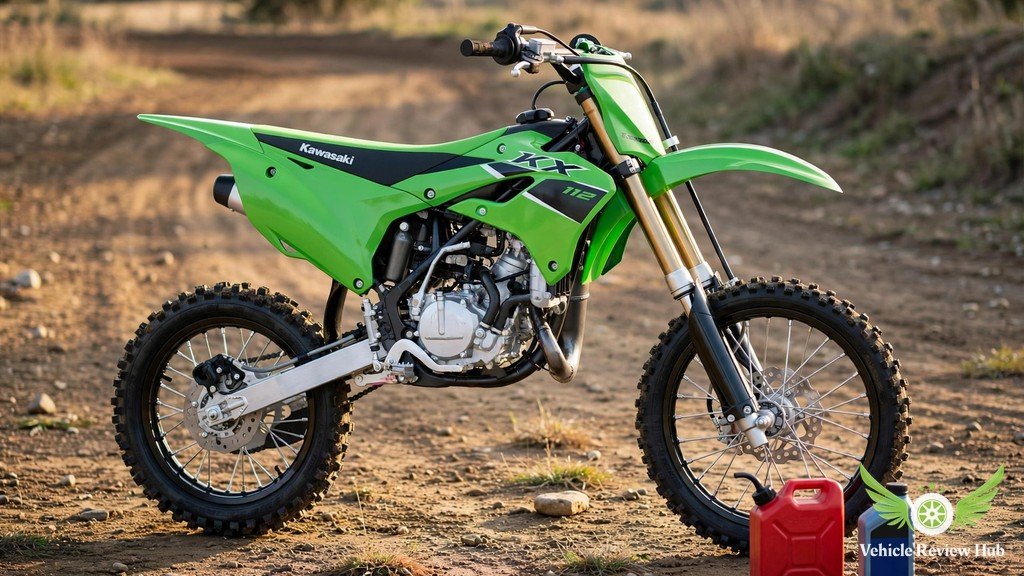
No MPG for a Premix Racer
The absence of an MPG figure is not an oversight; it follows from what the bike is. A premix two-stroke race bike burns a gasoline-and-oil mixture at racing revs on a closed course, and its fuel use changes with the track, the rider and the jetting. No manufacturer publishes economy for a bike like this, and no test has tried to measure it. The figures on aggregator pages — 25 to 28 km/l, 24.18 kmpl, 18 to 24 kmpl “owner reported” — are Indian-market boilerplate with no test behind them, and this Kawasaki KX112 performance guide does not print any of them as fact.
Premix 32 to 1 After Break-In
The one verified fuel figure is the premix ratio: 32 to 1. Kawasaki’s spec listings print “Lubrication: Pre-mix (32:1)”, the family owner’s manual states a 32-to-1 mixture — about 4 fluid ounces of oil per gallon — and the bike itself carries a factory 32:1 sticker. At 32 to 1, the 1.32-gallon tank takes 5.28 fluid ounces of two-stroke oil per full tank, a figure this Kawasaki KX112 performance guide prints because owners ask it constantly. The heading’s “after break-in” wording needs care: the family manual’s break-in procedure specifies low and moderate speeds for the first hour, a hotter spark plug option during break-in and a piston-ring replacement after break-in, but no different fuel and oil ratio. No saved manual text anywhere states a 16-to-1 break-in ratio, so this guide does not print one. The 32-to-1 ratio is the running ratio; break-in is a separate low-speed procedure.
Kawasaki KX112 Real-World Riding Experience
Five ride tests exist for the KX112 — two of the 2026 bike, three of the 2022 bike — with no shootout and no instrumented test. What follows in this Kawasaki KX112 performance guide is what those tests actually said about riding the bike, including the places where the testers disagreed. Nothing here is invented; every impression is attributed to the test that reported it.
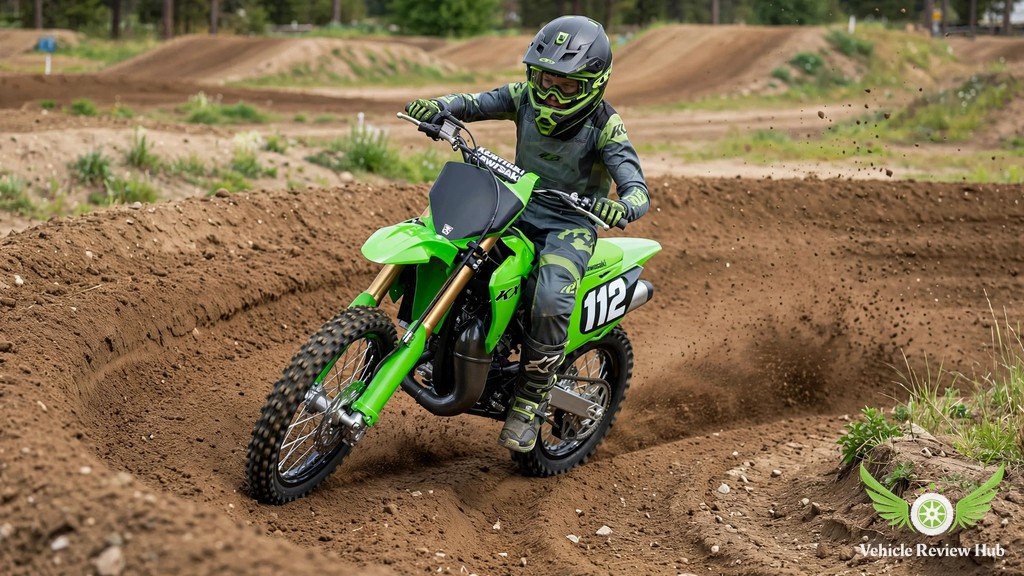
The Riding Experience Buyers Actually Talk About
The experience buyers actually talk about is a bike that is easier to ride fast than an 85 and harder to ride at its limit than the magazines expected. Cycle News’s tester, 5 feet 5 inches and 118 lb, found the 112 the favourite for its smoothness and ease of riding, especially for taller riders, and praised its wider seat and roomier cockpit over jumps, helped by the 2026 ergonomics of Renthal Fatbar, wider pegs and slim flat seat. This Kawasaki KX112 performance guide notes that the comfort story is a track story, not a road story — there is no long-distance comfort to report on a closed-course supermini.
The feel notes are less flattering, and they belong in any honest account. Cycle News reports that the cable clutch has a more immediate engagement point, somewhat on-off against the wider range of the European bikes’ hydraulic clutches, and that both Kawasakis vibrated more than the tester’s own bikes as engine speed climbed. Dirt Bike Magazine’s 2026 test found both bikes running slightly lean from the factory, with a lean bog off the bottom, and recommended Pro Circuit jetting. Motocross Action Magazine wanted stiffer clutch springs on the 2022 bike to stop clutch slip as it got hot. None of these is a failure; together they are the price of the bike’s $1,450 saving over the KTM.
Less Clutch Work Than the 85
The 112’s advantage over the 85 is most visible in how little clutch it asks for. Cycle News writes that the 85 favours aggressive riding and high rpm, requiring more clutch work, especially exiting corners, with a narrower high-rev window that demands more effort near the redline. The 112, with stronger low-end torque, lets the rider maintain momentum without relying on the clutch — the direct reason it was the test’s favourite, and the difference a buyer will feel first in this Kawasaki KX112 performance guide.
Two counter-notes keep the claim honest: Dirt Bike Magazine’s 2026 rider found the 112 harder to keep in the meat of the powerband than the 85, and Motocross Action Magazine’s testers preferred a KTM 105’s snap out of corners. The broader, more forgiving claim is a 112-versus-85 claim, not a 112-versus-everything claim, and this Kawasaki KX112 performance guide says so plainly.
Kawasaki KX112 Handling, Braking and Stability
Handling is where the 2026 revamp shows most clearly, and this Kawasaki KX112 performance guide measures it with the spec sheet — no instrumented handling test exists. The fork grew from 36 mm to a 43 mm KYB inverted unit with compression and rebound, rear travel grew from 10.8 to 12.0 inches through a revised Uni-Trak linkage rod — linkage, not a longer swingarm — and the brakes grew from 220/184 mm to 240/220 mm.
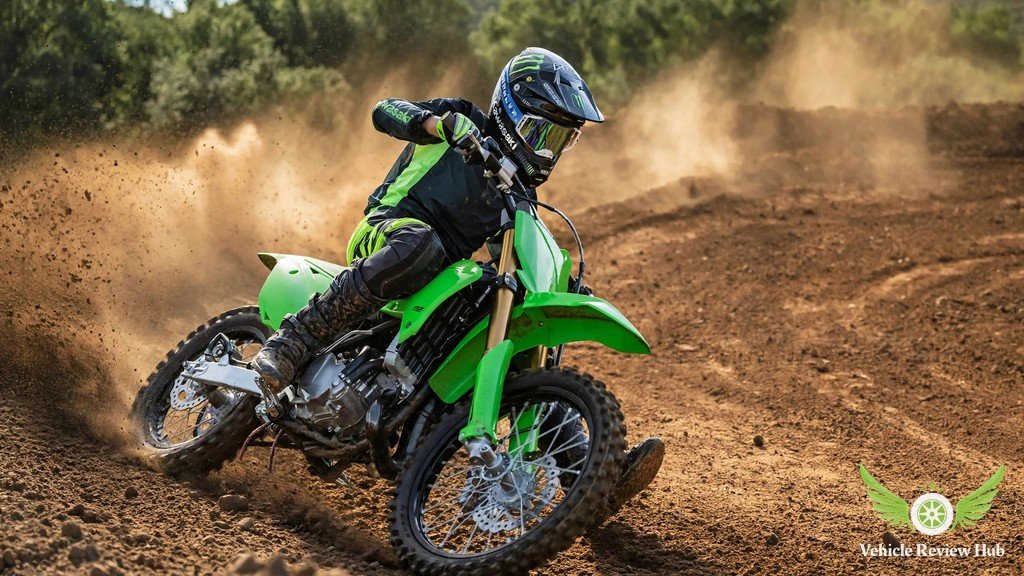
Tracked Better Than the KX85
Cycle News’s verdict on the rough stuff is direct: the KX112 showed its best traits in rough sections, and thanks to its larger wheels and additional suspension travel, it tracked through bumps better than the KX85. The mechanism is the hardware, verified on Kawasaki’s own 2027 spec sheet: 19/16-inch wheels against the standard 85’s 17/14, 12.0 inches of rear travel against 10.8, a 51.6-inch wheelbase against 49.8, and 4.6 inches of trail against 4.1. The same article adds that the 112 felt lower to the ground than the KTM 105 Supermini, letting the tester stand flat-footed. This Kawasaki KX112 performance guide credits the tracking advantage to the wheels and the travel, not to any single part.
The 2022 tests agree, with the older chassis labelled as such: Ultimate Motorcycling wrote that the larger wheels encourage railing berms rather than squaring them off, and praised the extra half-inch of trail and longer wheelbase over the 85. Motocross Action Magazine liked the 2022 bike’s ability to carve through corners and found the stock suspension comfortable through acceleration bumps, though it raised the forks 6 mm for front-end traction. The 2026 bike answers the 2022 complaints — the too-soft suspension and bending steel bars are gone, replaced by the 43 mm fork, the revised shock and the Renthal Fatbar — and this Kawasaki KX112 performance guide dates every 2022 complaint so it is never read as a 2026 verdict. Cycle News’s 2026 testers stiffened the suspension during their day, raising shock preload and fork compression, and reported more confidence — no lap times were published.
Handling, Braking and Stability on Real Roads
There is no road test of the KX112, and this Kawasaki KX112 performance guide says so plainly rather than dressing track notes up as road behaviour. The bike is a closed-course competition model, not street-legal and never road-tested, and no stopping distance exists for it. On braking, Cycle News’s tester felt the upgraded brakes were not quite as strong as his Husqvarna and KTM’s. Stability is geometry — 29.2 degrees of rake, 4.6 inches of trail, a 51.6-inch wheelbase and 13.0 inches of clearance — plus the track impressions above. A buyer who wants road manners should look at a dual-sport or a trail bike; the 112’s handling is a track quality, measured in berms and rough sections.
| Chassis item (2027) | Kawasaki KX112 | 2022–2025 bike |
|---|---|---|
| Front fork | 43 mm KYB inverted, compression + rebound, 10.8 in | 36 mm cartridge, compression only, 10.8 in |
| Rear shock | Uni-Trak, hi-lo compression + rebound + preload, 12.0 in | Uni-Trak, compression + rebound + preload, 10.8 in |
| Front brake | 240 mm petal disc, dual-piston caliper | 220 mm petal disc, dual-piston caliper |
| Rear brake | 220 mm petal disc, single-piston caliper | 184 mm petal disc, single-piston caliper |
| Rake / trail | 29.2 degrees / 4.6 in | 29.0 degrees / 4.3 in |
| Wheelbase | 51.6 in | 51.6 in (unchanged) |
| Seat height | 34.1 in | 34.3 in |
| Tyres | Dunlop Geomax MX34, 70/100-19 / 90/100-16 | Dunlop Geomax MX33 |
Note: All figures from Kawasaki’s own 2027 KX112 spec sheet and the January 2026 press release; the 2022–2025 column is the pre-revamp spec. The rear-travel gain came from a revised Uni-Trak linkage rod, not a longer swingarm, and this Kawasaki KX112 performance guide prints no measured braking distance because none exists.
Kawasaki KX112 Performance Compared With Other Sport Bikes
The rivals in this section are motocross minis, not sport bikes, compared on 2027 figures. This Kawasaki KX112 performance guide compares the 112 with the KTM 85 SX 19/16, its closest rival on price and class fit, and then answers the beginner question every parent asks.
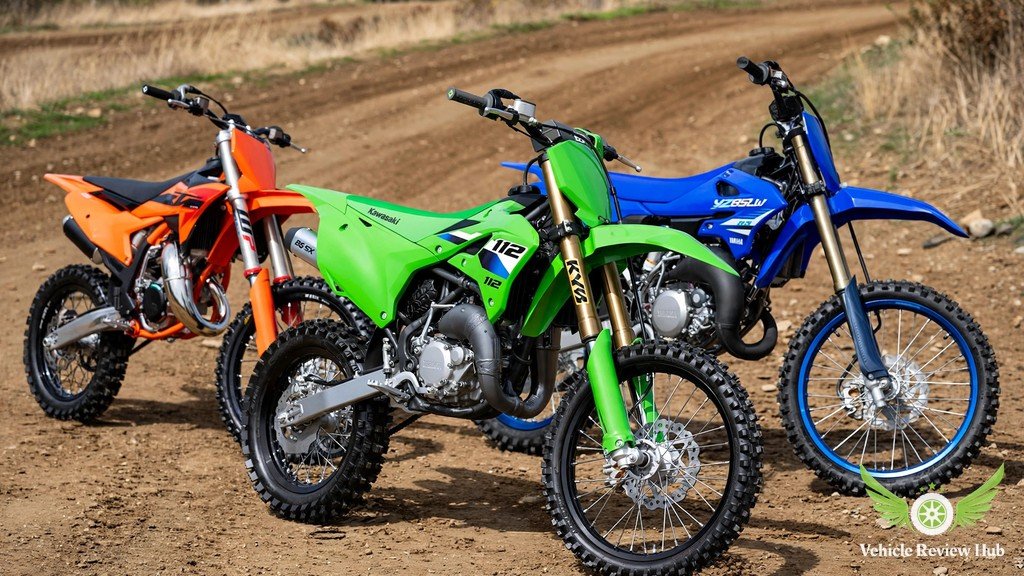
Kawasaki KX112 vs KTM 85 SX 19/16
The KTM costs $1,450 more on MSRP — $7,249 against the KX112’s $5,799 — and $1,560 more delivered, $7,674 against $6,114 computed. For that money it is 12.8 lb lighter without fuel, with a hydraulic clutch against the Kawasaki’s cable, an adjustable power valve and WP XACT forks. The KX112 answers with 27.1cc more displacement, a linkage rear shock against the KTM’s linkage-less PDS, 0.6 inches more rear travel and the class’s only dyno figure. Neither manufacturer publishes a power figure, and no 2027 dyno of either bike exists, so this Kawasaki KX112 performance guide makes no power claim for the KTM — the only dyno-anchored comparison is the 2022 MXA figure of 24.96 hp for the 112 against a KTM 105 at about 26.5 hp, and that is a 105, not the 85 SX.
| Item (2027) | Kawasaki KX112 | KTM 85 SX 19/16 |
|---|---|---|
| Engine | 112cc, 52.5 x 51.6 mm, KIPS | 84.9cc, Keihin PWK 28 |
| Front fork | 43 mm KYB, 10.8 in | WP XACT 43 USD, 10.9 in |
| Rear travel | 12.0 in, Uni-Trak linkage | 11.4 in, WP PDS (no linkage) |
| Weight w/o fuel | 164.9 lb | 152.1 lb |
| Seat height | 34.1 in | 34.3 in |
| MSRP | $5,799 | $7,249 |
Note: KTM figures from KTM’s own 2027 model and tech-specs pages; KX112 figures from Kawasaki’s own 2027 spec sheet. The KX112’s $6,114 delivered total is computed on the single-source $315 destination charge, and this Kawasaki KX112 performance guide prints no KTM power figure because KTM publishes none.
Is the Kawasaki KX112 Suitable for Beginner Riders?
No — not as a first-ever bike. Kawasaki’s family manual says the KX minis are high-performance off-road motorcycles designed for experienced young riders and not suitable for beginners, and the 112 is a six-speed manual-clutch two-stroke with a narrow high-rev powerband and no beginner aids. The wording comes from the KX85/KX100 family manual, since no manual names the KX112 itself. The yes side is narrower: as a first race bike for a young rider graduating from a KX85 or KX65 who already rides, shifts and clutches, the 112 is the step up the manual means — Motocross Action Magazine puts its intended rider at 12 to 16 years old, racing in the Supermini class. For a true beginner, this Kawasaki KX112 performance guide points at the KLX110R instead: a 112cc air-cooled four-stroke with a four-speed automatic centrifugal clutch, no clutch lever to learn, a parental throttle limiter, a 26.8-inch seat and a $2,899 price. The KLX110R L, with a manual clutch, is the step after that.
Kawasaki KX112 Performance FAQs
The questions US buyers ask about the 2027 Kawasaki KX112’s performance, answered from the verified figures in this Kawasaki KX112 performance guide.
How much horsepower does the Kawasaki KX112 make?
Kawasaki publishes no power figure, but a dyno does exist: Motocross Action Magazine dyno’d the 2022 KX112 at 24.96 hp and 11.6 lb-ft stock, 25.9 hp and 11.9 lb-ft piped, peaking at 11,600 rpm. The engine is unchanged since 2022, so that is the best datapoint in this Kawasaki KX112 performance guide — a 2022-bike dyno, not a 2026 or 2027 dyno.
What is the top speed of the Kawasaki KX112?
No tested top speed exists for the KX112 — no magazine or manufacturer has measured it. The 80 mph and 80 kmph figures that circulate cannot both be right, and neither names a test, so this Kawasaki KX112 performance guide prints neither as fact.
What is the fuel economy of the Kawasaki KX112?
No MPG figure exists — no test has measured one and Kawasaki publishes none. It is a premix two-stroke race bike with no speedometer or odometer, so mileage was never tested, and this Kawasaki KX112 performance guide prints no economy number for it.
What is the premix ratio for the Kawasaki KX112?
32 to 1, per Kawasaki’s spec listings and the family owner’s manual. The 1.32-gallon tank takes 5.28 fluid ounces of oil per full tank. No break-in ratio is stated in any saved manual text, so this Kawasaki KX112 performance guide prints no 16-to-1 break-in figure as a manual fact.
Is the KX112 faster than the KX85?
In the only head-to-head test, yes in feel: Cycle News’s tester called the 112 the clear favorite over the 85, with broader, more forgiving power and less clutch work. The dyno gap is 24.96 hp for the KX112 (MXA 2022) against 22.68 hp for the KX85 (MXA 2014) — different years and dynos, so this Kawasaki KX112 performance guide treats it as an indication, not a same-day comparison.
Is the Kawasaki KX112 good for beginners?
No. Kawasaki’s family manual says it is a high-performance off-road motorcycle for experienced young riders, not suitable for beginners. It has a manual clutch, a narrow high-rev powerband and no beginner aids. The beginner pick in this Kawasaki KX112 performance guide is the KLX110R, with its automatic clutch and $2,899 price.