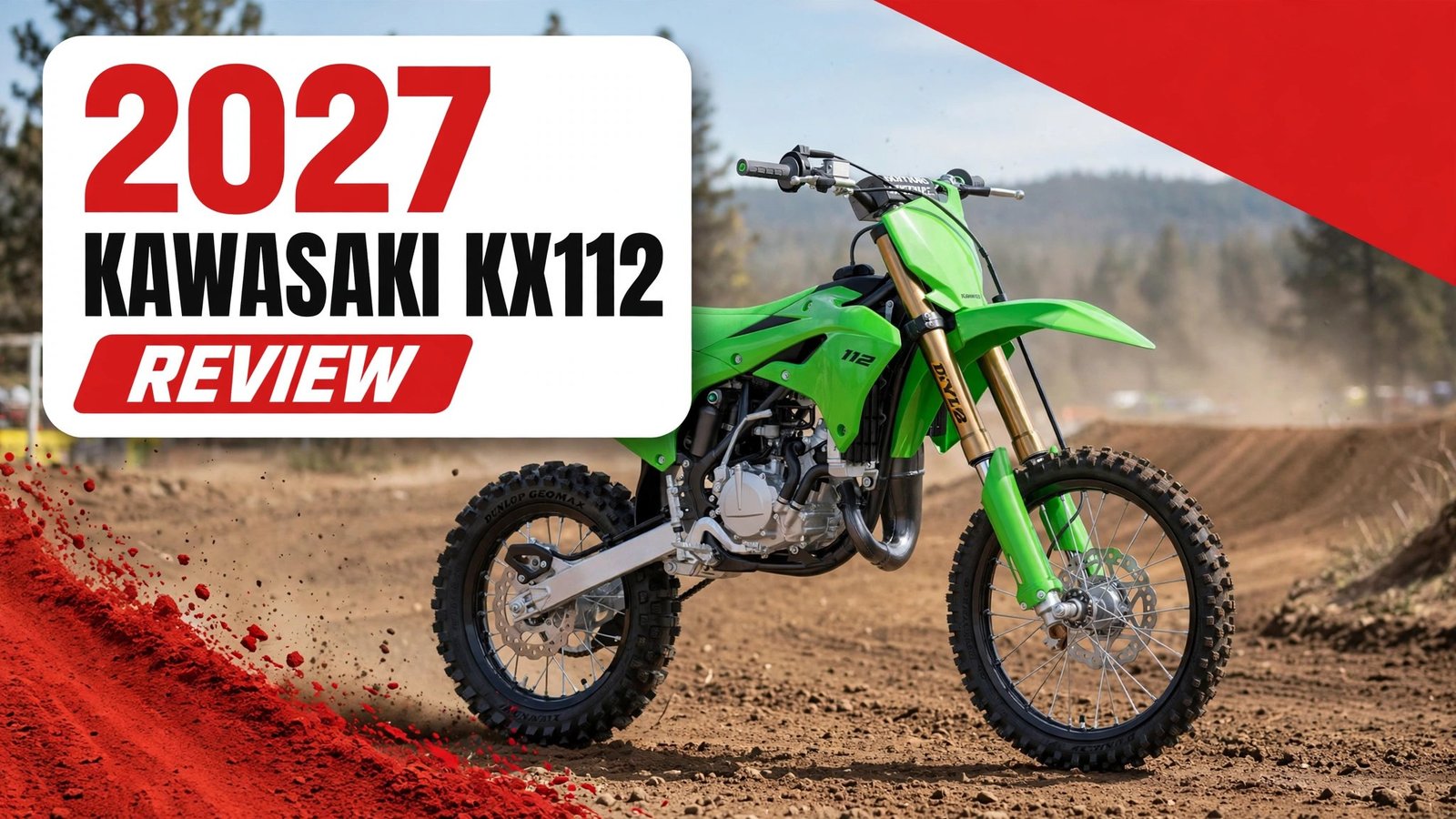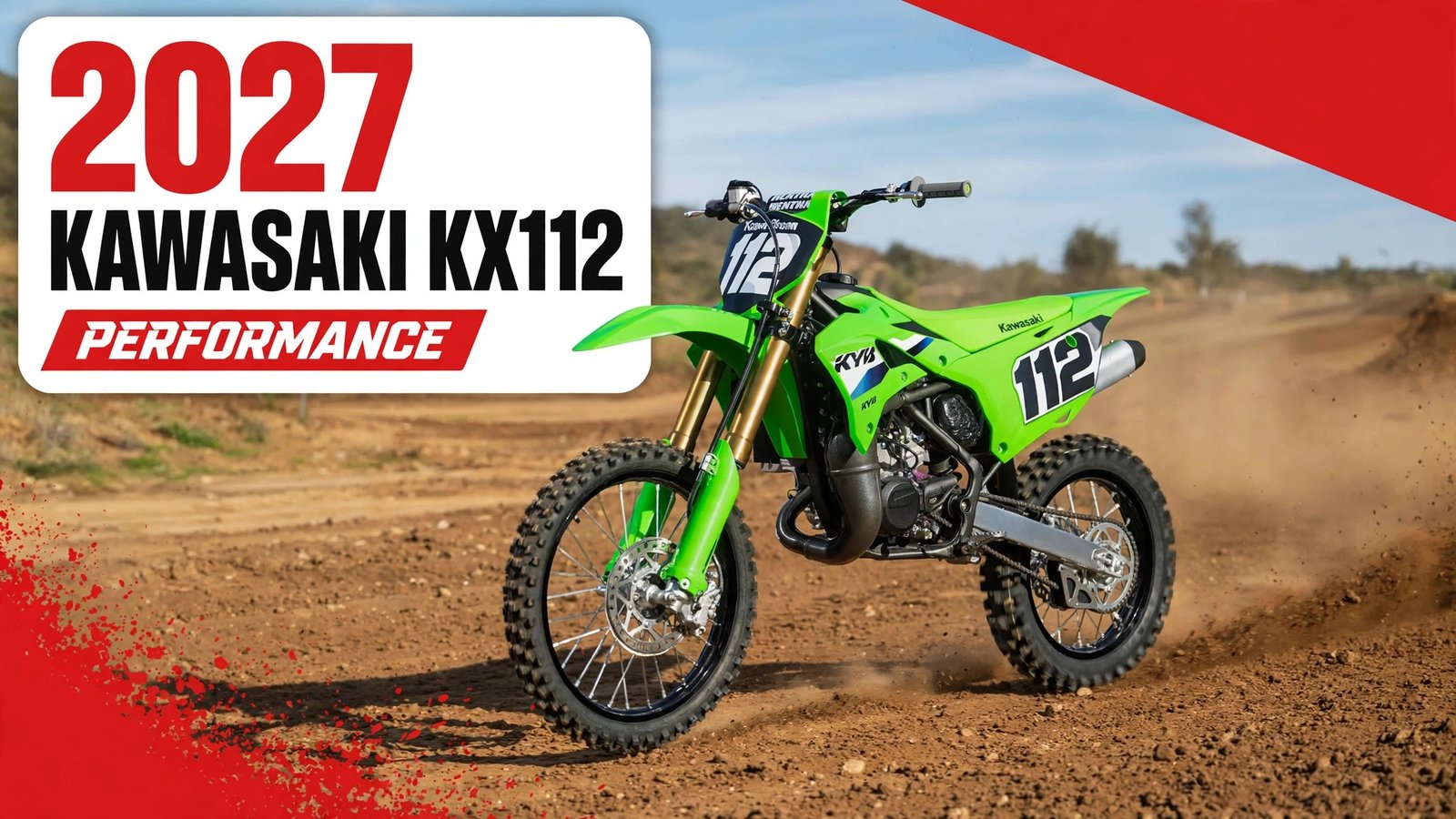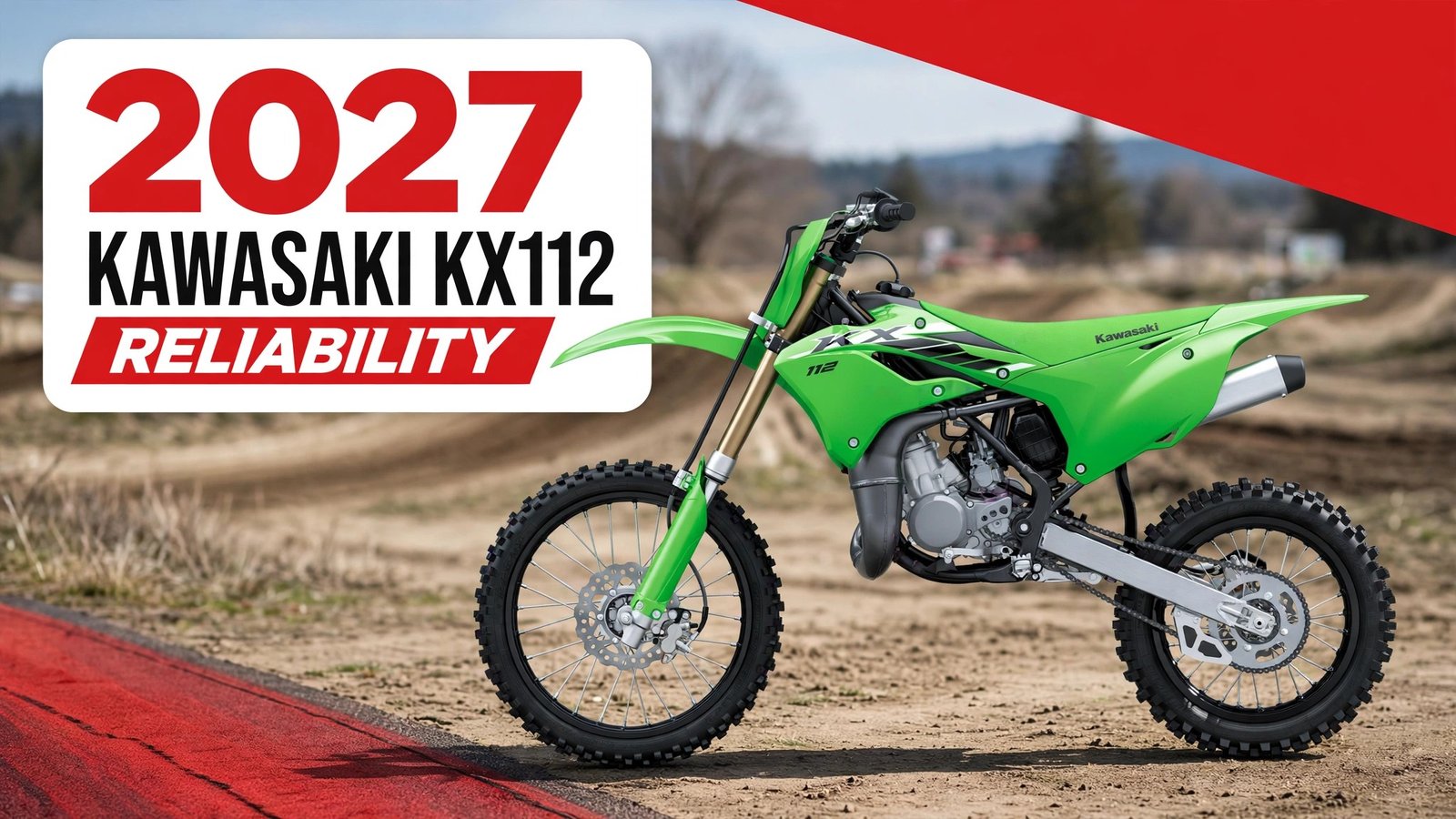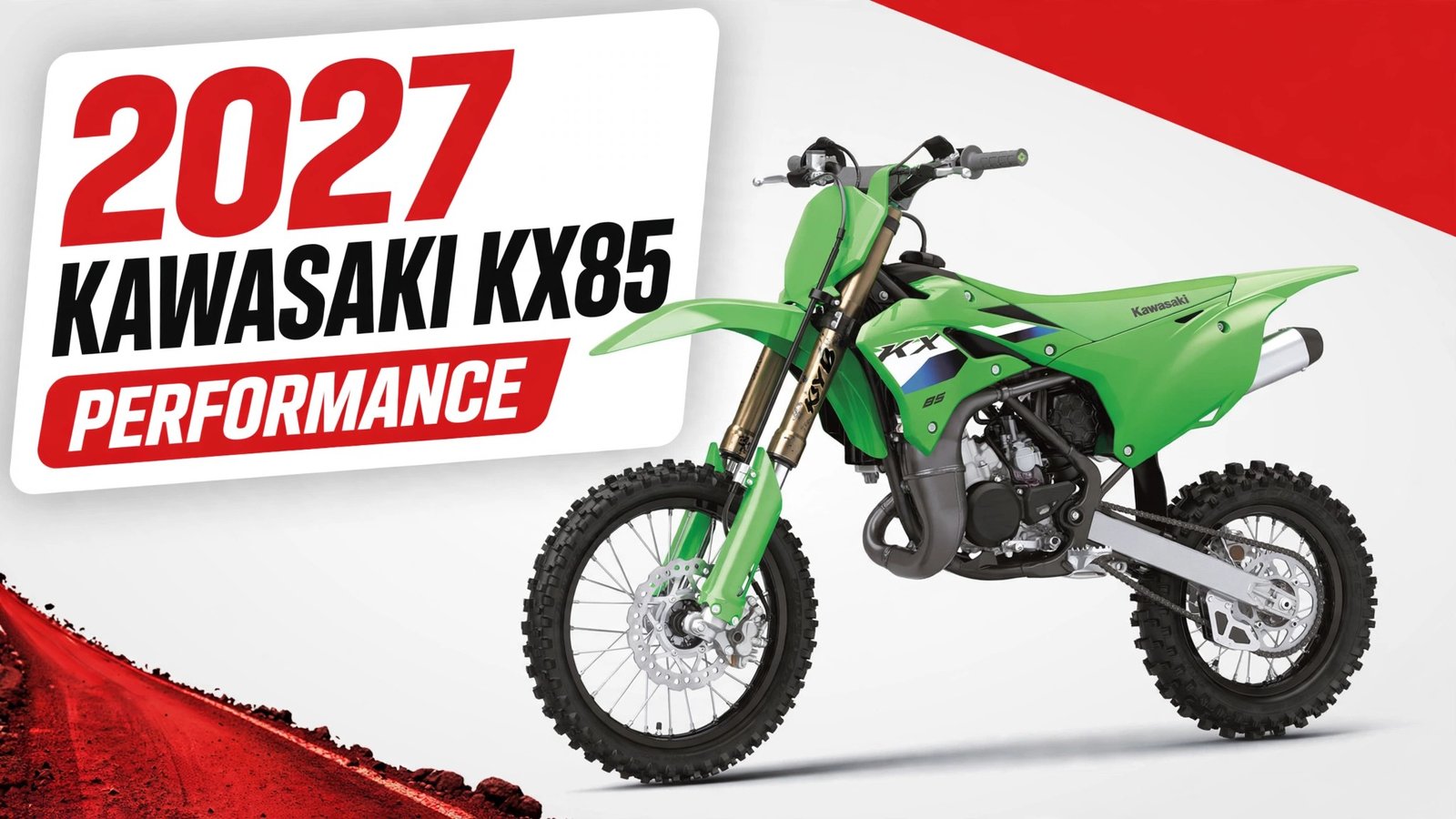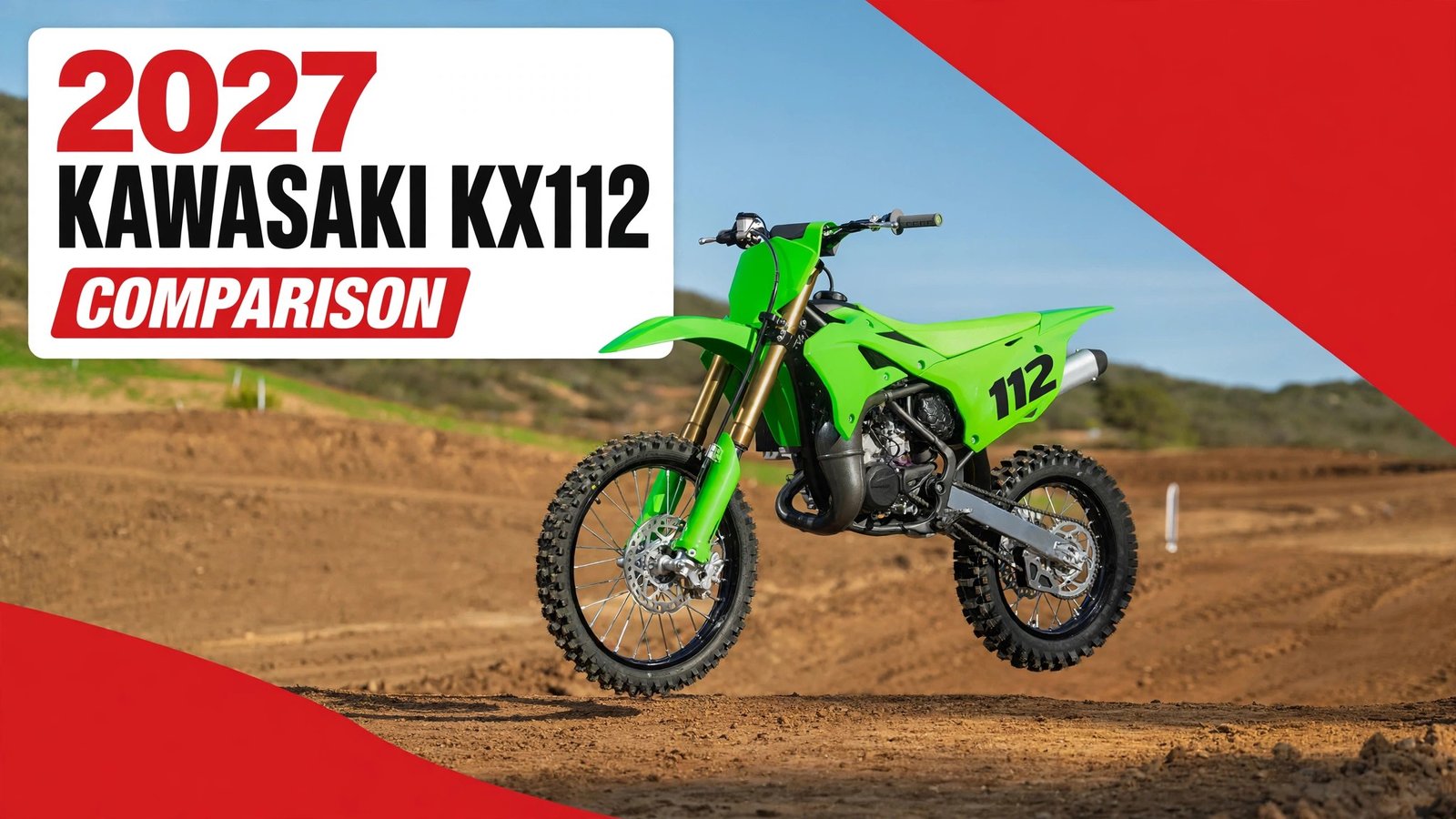
The 2027 Kawasaki KX112 costs $5,799, and that number only makes sense next to the bikes around it. Below it sits the KX85 L at $5,199 — the same chassis with a smaller engine. Above it sits the KTM 85 SX 19/16 at $7,249, the lightest and most expensive bike in the class. Between them is the Yamaha YZ85LW at $5,399. This Kawasaki KX112 comparison puts the 112 against all three on price, specs, class fit and running costs, with every figure verified for the 2027 models.
Kawasaki KX112 Overview and Its Closest Rivals
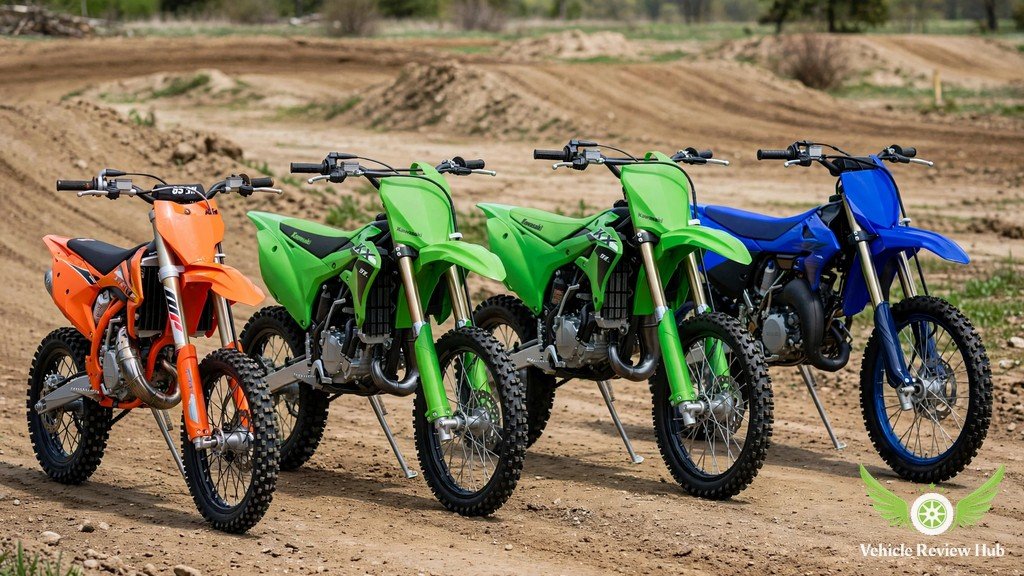
Kawasaki’s 2027 line gives the 112 one sibling, the KX85 L; the class adds the Yamaha YZ85LW and the KTM 85 SX 19/16. All four are 2027 US models on 19/16-inch wheels. The KX112 review covers the bike itself; this Kawasaki KX112 comparison covers it against its rivals, keeping the years separate.
The Only Factory Supermini
Kawasaki is the only manufacturer that builds a showroom-stock supermini. Motocross Action Magazine’s 2025 85cc shootout says Kawasaki is “the only manufacturer to produce a showroom-stock Supermini” and now sells more KX112s than KX85s. KTM’s answer is a $900 Factory 105cc top-end kit, self-installed — a parts-bin upgrade, not a bike. The MXA 2025 85cc shootout is the source for the claim, and it matters because it is a class definition, not a marketing line.
The class itself is the AMA’s Supermini 12-16: two-stroke engines from 79cc to 112cc, with a maximum wheel size of 19 inches front and 16 inches rear. The KX112, at 112cc on 19/16-inch wheels, sits exactly at the top of that displacement band. It is not eligible for any 85cc class, because those cap displacement at 85cc and the 112 is 27cc over. That is the point of the bike: a rider ageing out of the 85cc classes gets a bridge instead of a jump to a full-size 125. That is why the supermini question sits at the centre of this Kawasaki KX112 comparison.
How the Four Bikes Differ at a Glance
Four bikes, one class, and a $2,050 spread from cheapest to dearest — the table below is the whole Kawasaki KX112 comparison on one page.
| Spec | Kawasaki KX112 | Kawasaki KX85 L | Yamaha YZ85LW | KTM 85 SX 19/16 |
|---|---|---|---|---|
| MSRP (2027) | $5,799 | $5,199 | $5,399 | $7,249 |
| Destination / freight | $315 (single-source) | $315 (single-source) | $320 (Yamaha-published) | $425 (KTM-published) |
| Delivered | $6,114 (computed) | $5,514 | $5,719 | $7,674 |
| Engine | 112cc 2-stroke, KIPS, 52.5 × 51.6 mm | 84cc 2-stroke, KIPS, 48.5 × 45.8 mm | 85cc 2-stroke, YPVS, 47.5 × 47.8 mm | 84.9cc 2-stroke, Keihin PWK 28 |
| Claimed power | None published | None published | None published | None published |
| Dyno (MXA) | 24.96 hp (2022 bike) | None (standard 85: 22.68 hp, 2014) | None | None |
| Transmission | 6-speed, cable clutch | 6-speed, cable clutch | 6-speed, wet clutch | 6-speed, hydraulic clutch |
| Wheels / tyres | 19/16 in, Dunlop MX34 | 19/16 in, Dunlop MX34 | 19/16 in, Dunlop MX3SF/MX3S | 19/16 in, Maxxis MX-ST |
| Seat height | 34.1 in | 34.1 in | 34.8 in | 34.3 in |
| Weight | 164.9 lb w/o fuel | 164.5 lb w/o fuel | 165 lb wet | 152.1 lb w/o fuel |
| Fuel capacity | 1.32 gal | 1.32 gal | 1.3 gal | 1.43 gal |
| Front fork | 43 mm KYB, 10.8 in | 43 mm KYB, 10.8 in | 36 mm KYB, 10.8 in | WP XACT 43, 10.9 in |
| Rear shock | Uni-Trak linkage, 12.0 in | Uni-Trak linkage, 12.0 in | KYB linkage, 11.3 in | WP XACT PDS, 11.4 in |
| Brakes | 240/220 mm petal | 240/220 mm petal | 220/190 mm wave | 240/220 mm |
| Wheelbase | 51.6 in | 51.6 in | 50.6 in | Not published |
| Ground clearance | 13.0 in | 13.0 in | 14.2 in (max) | 13.1 in |
| Warranty | None (as-is) | None (as-is) | 30-day limited | 1-year Premium |
Note: All four bikes are 2027 US models. The two Kawasaki destination figures of $315 are single-source (Kawasaki publishes no destination charge), so the $6,114 and $5,514 delivered prices are computed; the Yamaha’s $320 and the KTM’s $425 are maker-published. Weights are not like-for-like: the Kawasakis are without fuel (172.8 lb and 172.4 lb fueled), the Yamaha’s 165 lb is wet and fueled, and the KTM’s 152.1 lb is without fuel. The dyno row is the only measured power figure in this Kawasaki KX112 comparison — MXA’s 2022 KX112 test at 24.96 hp.
Kawasaki KX112 vs Kawasaki KX85 L
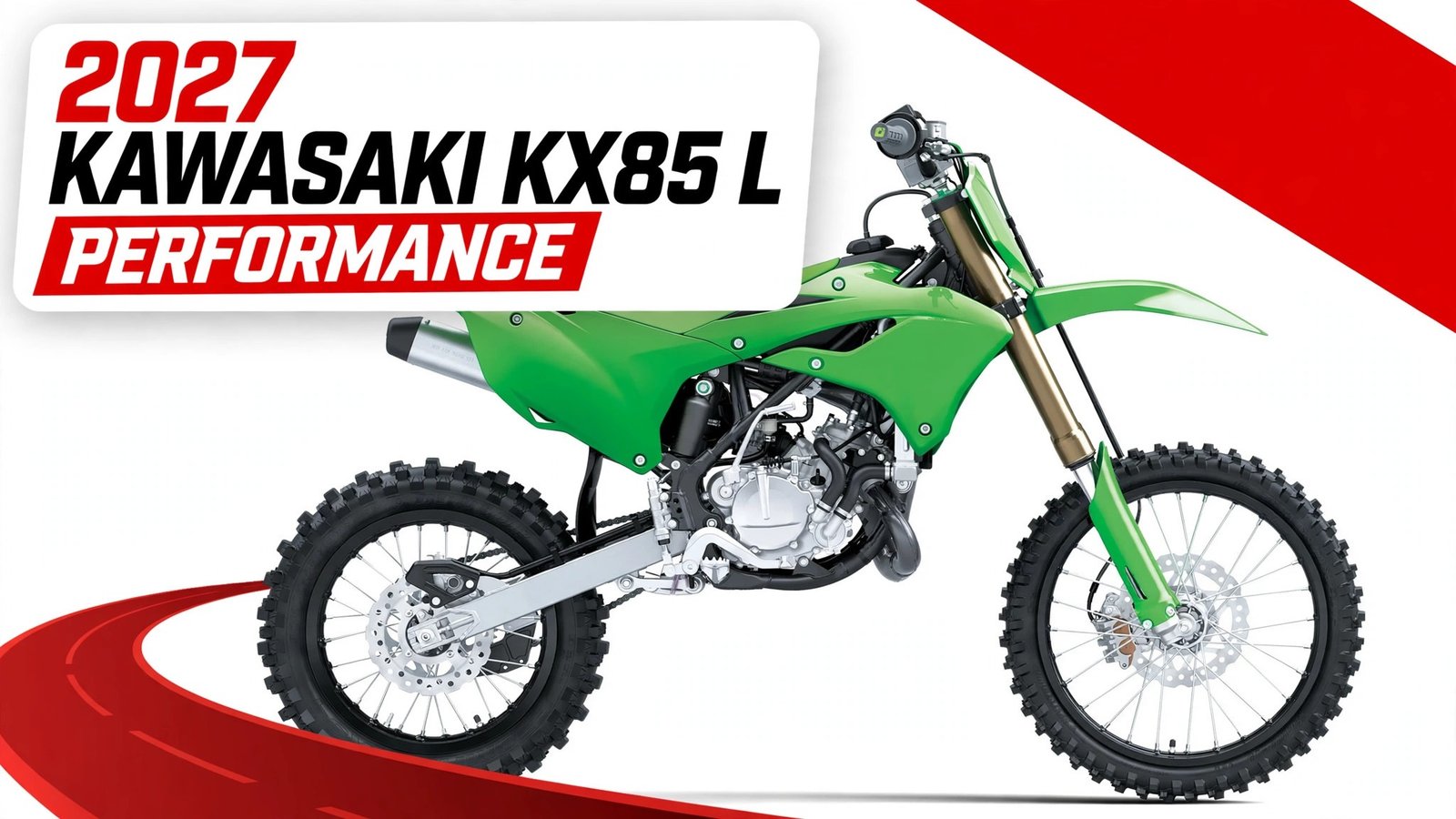
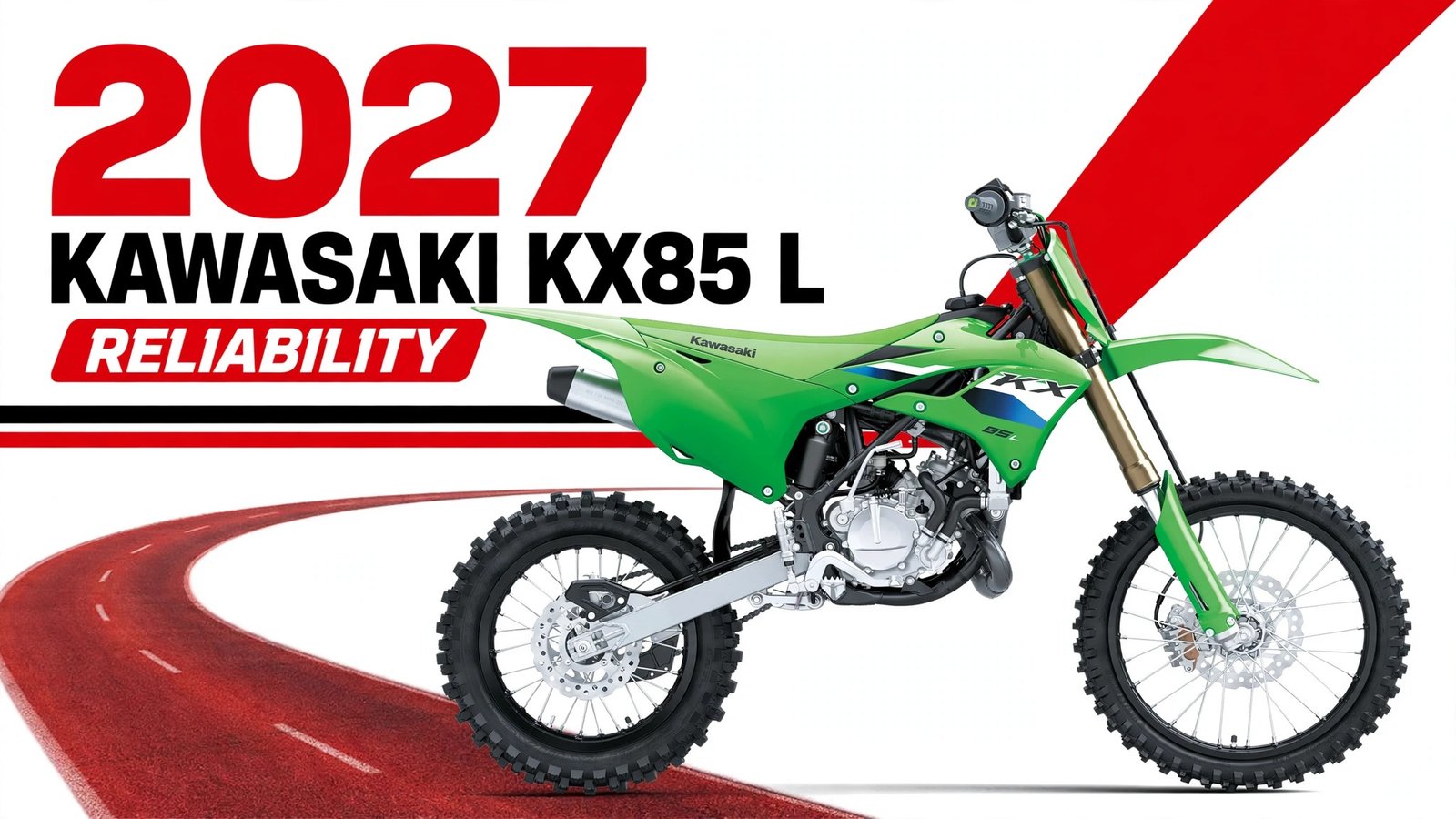
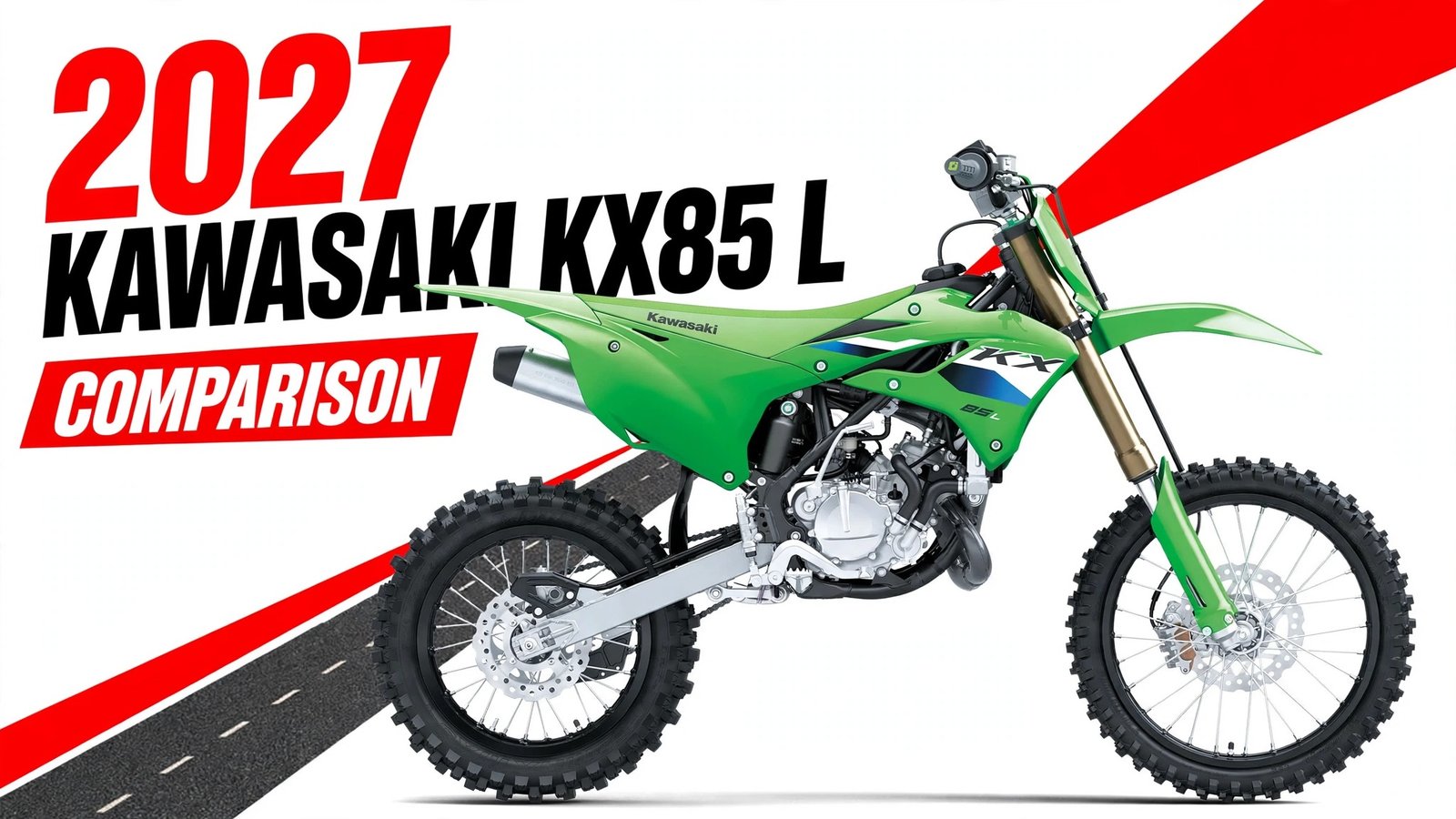
The KX85 L is the closest rival the KX112 has, because it is the same bike with a smaller engine. A diff of Kawasaki’s own 2027 spec sheets shows exactly six differences between them: name, MSRP, displacement, bore and stroke, compression, and 0.4 lb of weight. Everything else — fork, brakes, wheels, tyres, seat, tank, colour — is identical. That makes this the simplest head-to-head: one question, $600, and what it buys. That is the question this Kawasaki KX112 comparison answers first.
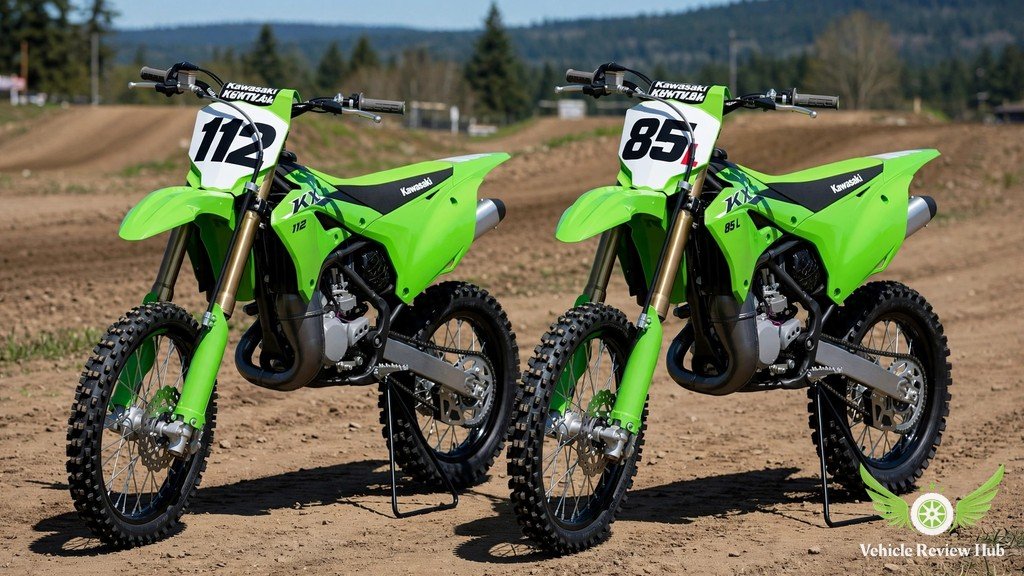
In this owner video, Eli and his dad talk through their new 2026 Kawasaki KX112 and how it compares with the family’s 2024 KX85 after a first ride — a garage walkaround and first-impressions chat, not a ridden head-to-head; the KX85 appears only briefly, and the riding footage is in their separate 360 video. The Yamaha and KTM never appear in it, so this Kawasaki KX112 comparison judges them on specs and prices alone.
Engine, Specs and Performance Side by Side
The $600 buys a stroked engine and nothing else. The KX112 is the KX100’s engine taken 5.8 mm further: same 52.5 mm bore, stroke 45.8 mm to 51.6 mm, 99cc to 112cc, with a 6-speed gearbox and a 99 mm rod. The L is the standard 84cc two-stroke, 48.5 mm bore by 45.8 mm stroke, with the same Keihin PWK28 carburettor and the same KIPS power-valve system. Compression differs — 9.9:1 and 8.6:1 on the 112 against 10.9:1 and 9.0:1 on the L — but that is a spec-sheet line, not a riding difference.
Cycle News’s 2026 paired test of the two bikes called the 112 the “clear favourite”, with “broader, more forgiving power” and less clutch work than the 85, and its 15-year-old, 118 lb tester picked the 112 over the 85. The Cycle News 2026 KX85 and KX112 review is the only head-to-head test of the pair. The dyno gap points the same way: Motocross Action Magazine’s 2022 test measured the KX112 at 24.96 hp and 11.6 lb-ft, against 22.68 hp for the standard KX85 on a 2014 MXA dyno run. Those are different years and different dynos, so treat the gap as an indication, not a same-day measurement. The dyno gap is the only measured power difference in this Kawasaki KX112 comparison.
Price, Equipment and Which Suits Which Rider
The gap is $600 on MSRP and $600 delivered: $5,799 against $5,199, or $6,114 against $5,514 with the same $315 single-source destination charge on both — Kawasaki publishes no destination charge, so both delivered totals are computed. Equipment is identical: same 43 mm KYB fork, Uni-Trak rear at 12.0 inches, 240/220 mm petal brakes, 19/16-inch wheels on MX34 tyres, 34.1-inch seat, 1.32-gallon tank, Lime Green. The only weight difference is 0.4 lb — 164.9 lb against 164.5 lb without fuel — which is the engine, not the chassis.
Which rider suits which bike is a class question. The L is the big-wheel 85 for a rider still racing the 85cc classes — it fits 85cc 12-15 and 85cc 9-13, and Supermini 12-16 as well. The 112 is for the rider ageing out of the 85cc classes into Supermini 12-16, where its 112cc sits at the top of the 79–112cc band, or for the taller, heavier 85 graduate who wants broader power without jumping to a full-size 125. If the rider is still racing 85cc classes, the L is the bike and the $600 stays in the pocket. If the rider has outgrown them, the 112 is the only factory-built step that exists, and the $600 is the whole price of that step. That is the $600 question this Kawasaki KX112 comparison was written to answer.
Kawasaki KX112 vs KTM 85 SX 19/16
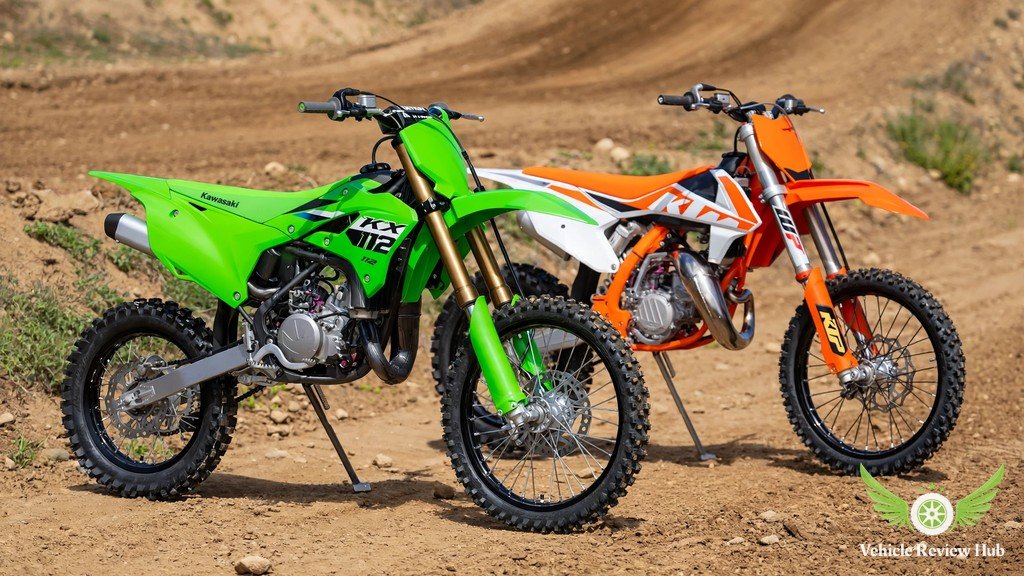
The KTM is the most expensive bike in this Kawasaki KX112 comparison and the lightest: $1,450 more on MSRP, $1,560 delivered. The Austrian bike brings a hydraulic clutch, an adjustable power valve and WP XACT air forks; the Kawasaki brings 27.1cc more displacement, a linkage rear and a much lower price.
Engine, Specs and Performance Side by Side
The KTM’s engine is an 84.9cc single two-stroke with a Keihin PWK 28 carburettor; KTM’s 2027 tech-specs page does not publish its bore and stroke, and the 47 × 48.95 mm figure comes from older KTM copy and a Husqvarna table, so this Kawasaki KX112 comparison prints it only with that caveat. Against it, the 112’s 112cc is 27.1cc bigger on the same 28 mm carburettor and 6-speed gearbox. The KTM’s clutch is hydraulic where the Kawasaki’s is cable, and its power valve is adjustable where the KX112’s KIPS is not. No 2027 dyno of either bike exists, and no maker publishes a power figure for either one — the only measured figure anywhere in this Kawasaki KX112 comparison is MXA’s 2022 KX112 dyno at 24.96 hp. The derived 26.5 hp figure belongs to a 105cc KTM, a different bike, and is not the 19/16’s power. The KX112 performance guide covers the dyno in full.
The chassis gap is narrower than the price gap. The KTM runs WP XACT 43 mm USD air forks at 10.9 inches against the Kawasaki’s 43 mm KYB spring forks at 10.8 inches, and a WP XACT PDS mono shock at 11.4 inches against the Kawasaki’s Uni-Trak linkage shock at 12.0 inches — linkage-less PDS against a linkage design. Brakes are a wash at 240/220 mm on both, though the KTM’s are Formula four-piston front and two-piston rear per dealer copy. Wheels are the same 19/16-inch size; the KTM rolls on Excel rims with Maxxis MX-ST tyres against the Kawasaki’s Dunlop MX34. Seat height is close at 34.3 inches against 34.1, and the KTM’s wheelbase is not published, so no wheelbase comparison can be printed honestly. On paper, the chassis gap is the smallest gap in this Kawasaki KX112 comparison.
Price, Equipment and Which Suits Which Rider
The KTM costs $7,249 against the KX112’s $5,799 — $1,450 more on MSRP — and $7,674 against $6,114 delivered, a $1,560 gap. Both delivered totals are built on maker-published freight: $425 on KTM’s own model page, $315 single-source on the Kawasaki side, so the KX112’s $6,114 is computed and labelled as such. The KTM 19/16 itself costs $300 more than the standard 17/14-inch KTM 85 SX at $6,949, buying a 1.0-inch taller seat, 2.2 lb more weight and 1.0 inch more ground clearance, with the same engine, travel and brakes. The KTM is also the only bike in this Kawasaki KX112 comparison with a real warranty: a one-year Premium Manufacturer’s Warranty from model year 2027, against the Kawasaki’s as-is, no-warranty sale.
Which rider suits which bike comes down to weight and wallet. The KTM is 12.8 lb lighter without fuel — 152.1 lb against the KX112’s 164.9 lb — and that is the single biggest performance difference between the two bikes, bigger than any engine gap. The Kawasaki answers with $1,450 kept in the pocket, 27.1cc more displacement, a linkage rear shock and the only measured dyno figure in the class. For a rider who races Supermini 12-16 and wants the cheapest competitive bike in it, the 112 is the value pick in this Kawasaki KX112 comparison. That is the value case this Kawasaki KX112 comparison makes for the 112. For a rider whose budget stretches, the KTM is the premium pick — lightest, hydraulic clutch, warranty — at a premium price.
Kawasaki KX112 vs Yamaha YZ85LW
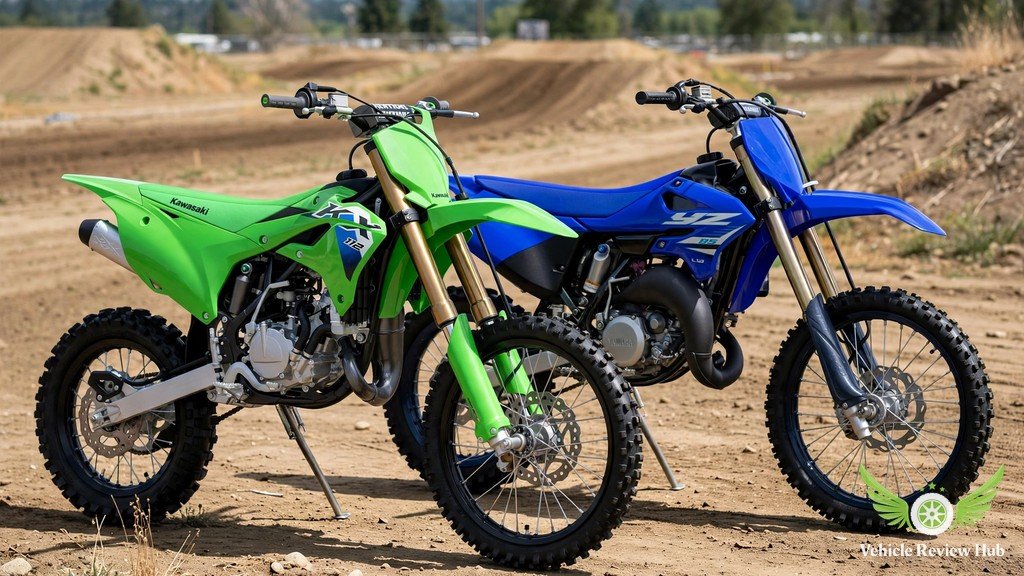
The Yamaha is the cheapest rival in this Kawasaki KX112 comparison after the KX85 L, and the only cheaper bike with a warranty. It is $400 cheaper on MSRP and $395 cheaper delivered, taller, lighter and better warranted. The 112 answers with more displacement, bigger brakes and a bigger fork.
Engine, Specs and Performance Side by Side
The Yamaha’s engine is an 85cc two-stroke single, 47.5 mm bore by 47.8 mm stroke, with a reed-valve intake, Yamaha’s YPVS power valve and a new-for-2027 VForce4R reed, fed by an Astemo Keihin PWK28. Against it, the KX112’s 112cc is 27cc bigger, with the same 28 mm carburettor size and the same 6-speed gearbox. Neither maker publishes a power figure, and no head-to-head dyno of the two exists — the only measured figure in this Kawasaki KX112 comparison remains MXA’s 2022 KX112 dyno at 24.96 hp, which belongs to the Kawasaki alone. No same-dyno comparison settles it, so this Kawasaki KX112 comparison judges the engines on displacement and hardware alone.
The chassis comparison favours the Kawasaki on hardware and the Yamaha on size: a 43 mm KYB fork against the Yamaha’s 36 mm KYB cartridge fork, both at 10.8 inches of travel, and a Uni-Trak linkage rear at 12.0 inches against the Yamaha’s KYB linkage shock at 11.3 inches. Brakes go to the Kawasaki too, 240/220 mm petal against the Yamaha’s 220/190 mm wave. The Yamaha answers with a taller seat at 34.8 inches against 34.1, more clearance at 14.2 inches maximum against 13.0, and a lighter fueled weight of 165 lb against 172.8 lb.
Price, Equipment and Which Suits Which Rider
The Yamaha costs $5,399 against the KX112’s $5,799 — $400 less on MSRP — and $5,719 against $6,114 delivered, $395 less. The Yamaha’s $320 destination charge is published on Yamaha’s own 2027 YZ85LW model page, which also prints the $5,719 total, so the Yamaha’s delivered figure is maker-published where the Kawasaki’s $6,114 is computed and labelled as such. The Yamaha is the only bike besides the KTM in this Kawasaki KX112 comparison with any warranty at all: a 30-day limited factory warranty, against the Kawasaki’s as-is sale with none. The YZ85LW is the big-wheel version of the standard YZ85, costing $200 more than the $5,199 standard bike for the 19/16-inch wheels, a 1.7-inch taller seat and 4 lb more wet weight.
Which rider suits which bike is a fit question. The Yamaha’s taller seat and lighter weight suit the taller, lighter rider, and its 30-day warranty is worth something to a first-time buyer. The Kawasaki suits the rider who wants the most displacement and the biggest brakes in the class, and the only factory supermini. If the rider still races 85cc classes, the Yamaha keeps that option open; the 112, at 112cc, does not. If the rider is moving into Supermini 12-16, the 112 is the only factory-built bike for it, and the Yamaha’s $400 saving does not buy a supermini. That fit question is the closest call in this Kawasaki KX112 comparison.
Kawasaki KX112 Price and Value Compared
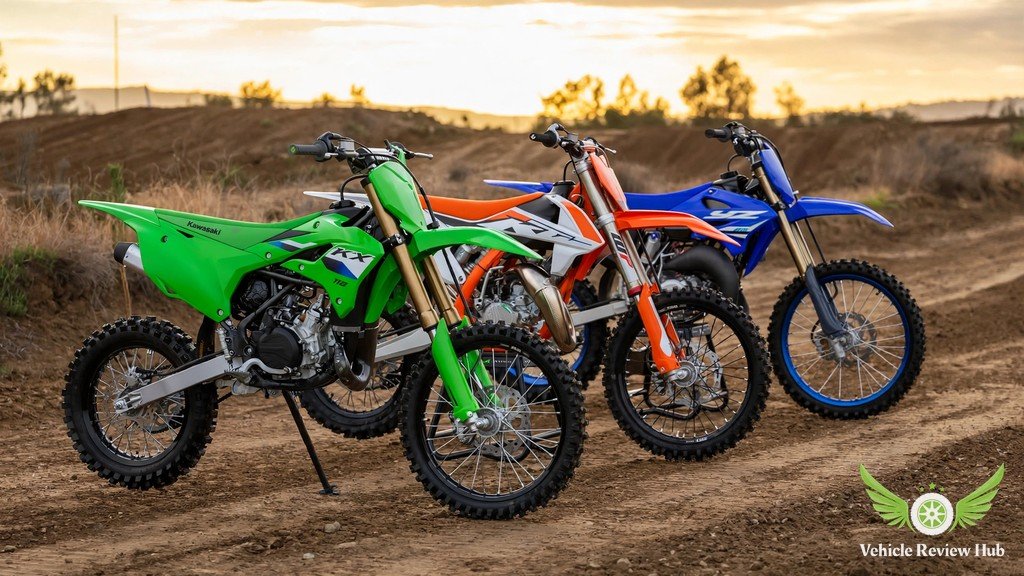
The price ladder is the whole Kawasaki KX112 comparison in four rows. Every delivered figure is labelled for how it was built. The ladder is the spine of this Kawasaki KX112 comparison.
| Bike | MSRP | Destination / freight | Delivered |
|---|---|---|---|
| Kawasaki KX85 L | $5,199 | $315 (single-source) | $5,514 |
| Yamaha YZ85LW | $5,399 | $320 (Yamaha-published) | $5,719 |
| Kawasaki KX112 | $5,799 | $315 (single-source) | $6,114 (computed) |
| KTM 85 SX 19/16 | $7,249 | $425 (KTM-published) | $7,674 |
Note: The ladder runs $5,199 → $5,399 (+$200) → $5,799 (+$400) → $7,249 (+$1,450), putting the KX112 $600 above the L and $1,450 below the KTM. Kawasaki publishes no destination charge, so the two Kawasaki delivered figures are computed on the single-source $315, and its offers run up to $700 in factory-to-dealer incentive plus up to $200 in holiday cash through December 31, 2026, both dealer-dependent.
Austrian Weights Exclude Fuel
The KTM’s weight advantage is real but easy to overstate by mixing measurement bases. The KTM’s 152.1 lb and the KX112’s 164.9 lb are both without fuel, so the like-for-like gap is 12.8 lb. The Yamaha’s 165 lb is wet and fueled, so the fueled comparison is 172.8 lb against 165 lb — a 7.8 lb gap. Comparing the KTM’s 152.1 lb without fuel against a fueled figure would invent a 20 lb advantage that does not exist. Weights are where this Kawasaki KX112 comparison has to be most careful, and the honest reading is that the KTM is the lightest bike in the class by a clear but not enormous margin.
Running Costs and Resale Value Compared
Running costs favour the Kawasaki on tyres and hurt it on pistons: a tyre set is identical to the KX85 L’s at $148.98 at BTO Sports retail or $177.90 at MSRP for the MX34 pair. The piston is the expensive line: the 112’s own piston, part 13001-0833, was last seen at $194.62 on Partzilla in a December 2025 crawl, roughly double the KX85’s piston at $101.65, and the ring price is unverified. The Wiseco Pro-Lite kit PK1908 at $173.08 is a full kit for less than the OEM piston alone. The KX112 reliability guide prices the piston job in full. On resale, no verified figures exist for any of the four bikes, so no ranking can be printed. That is the running-cost picture this Kawasaki KX112 comparison can print honestly: the KX112 is the cheapest Japanese big-wheel supermini to buy and the KTM the most expensive — and resale is unverified for all of them.
Kawasaki KX112 Comparison Verdict and US Alternatives
The verdict in this Kawasaki KX112 comparison is not one bike for everyone. It is one bike per rider: four bikes, four prices, no bad option among them.
Verdict: $600 Buys the Stroke
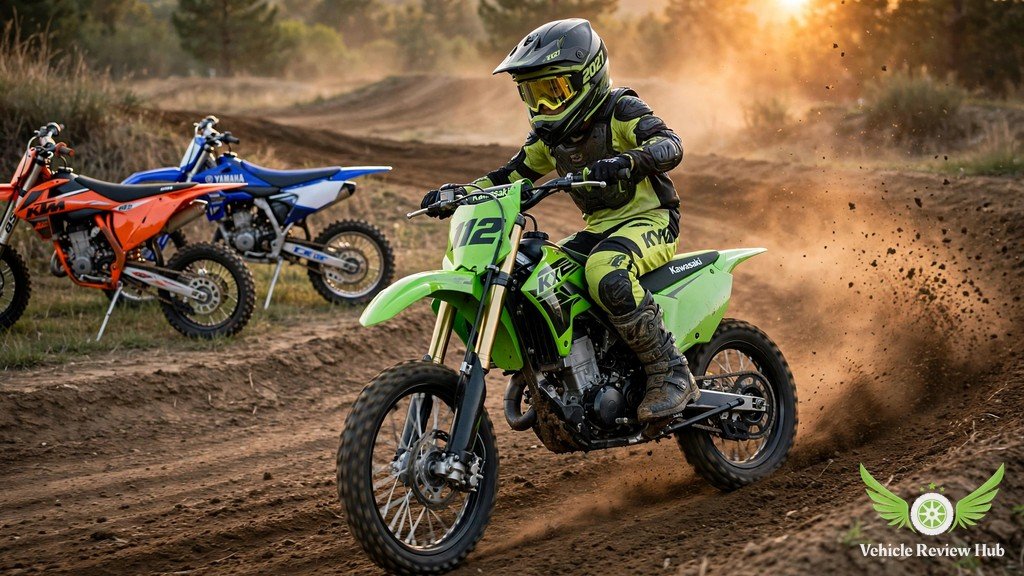
The $600 buys the stroke, and that is the whole verdict of this Kawasaki KX112 comparison. For $600 over the KX85 L, the buyer gets 28cc more displacement, the MXA-verified 24.96 hp and Supermini 12-16 eligibility on an otherwise identical chassis. Against the Yamaha, the 112 costs $400 more and buys 27cc, bigger brakes and a bigger fork; against the KTM, it saves $1,450 and gives up 12.8 lb and a hydraulic clutch. For the Supermini rider, the 112 is the only factory-built bike in the class and the value pick. For the 85cc-class rider, the L is the pick and the $600 stays in the pocket.
YZ125 Is the Full-Size Step
The step after the KX112 is a full-size 125 two-stroke, and the named one in this Kawasaki KX112 comparison is the Yamaha YZ125 at $7,199 MSRP — $1,400 more than the 112. The YZ125 brings a 125cc engine, full-size 21/19-inch wheels and a 38.6-inch seat against the 112’s 34.1 inches, at 212 lb ready-to-ride. The Yamaha YZ125 model page confirms the $7,199 MSRP, but no destination charge is verified from Yamaha’s own page, so no delivered YZ125 figure is printed here. The KX112 is the bridge for the Supermini graduate, not the destination — and the YZ125 is where the bridge leads. That is the step this Kawasaki KX112 comparison points to.
Kawasaki KX112 Comparison FAQs
US buyers’ questions on choosing between the KX112 and its rivals, answered from the verified figures in this Kawasaki KX112 comparison.
Which is cheaper, the Kawasaki KX112 or the Kawasaki KX85 L?
The KX85 L. It is $5,199 against the KX112’s $5,799 — $600 cheaper on MSRP and $600 cheaper delivered ($5,514 against $6,114). The $600 buys the stroke in this Kawasaki KX112 comparison: 28cc more and Supermini eligibility, on an otherwise identical chassis.
Is the KX112 the only factory supermini?
Yes. Per MXA’s 2025 85cc shootout, Kawasaki is “the only manufacturer to produce a showroom-stock Supermini” — KTM sells only a $900 Factory 105cc top-end kit, self-installed. The KX112 fits the AMA Supermini 12-16 class (79–112cc, 19/16-inch wheels maximum) exactly, which is the class this Kawasaki KX112 comparison is built around.
Which is cheaper, the KX112 or the KTM 85 SX 19/16?
The KX112, by $1,450 on MSRP ($5,799 against $7,249) and $1,560 delivered ($6,114 computed against $7,674). The KTM is 12.8 lb lighter and has a hydraulic clutch; the KX112 has 27.1cc more displacement, a linkage rear and 0.6 inches more rear travel — the widest price gap in this Kawasaki KX112 comparison.
Which is cheaper, the KX112 or the Yamaha YZ85LW?
The Yamaha. It is $5,399 against the KX112’s $5,799 — $400 cheaper on MSRP and $395 cheaper delivered ($5,719 against $6,114 computed). The Yamaha is also 7.8 lb lighter fueled and carries a 30-day warranty; the KX112 wins on displacement, brakes, fork and rear travel in this Kawasaki KX112 comparison.
What is the next bike after the KX112?
A full-size 125 two-stroke — the Yamaha YZ125 is the named step at $7,199 MSRP ($1,400 more than the KX112), with full-size 21/19-inch wheels and a 38.6-inch seat — the step this Kawasaki KX112 comparison points to. The KX112 is the bridge for the Supermini graduate, not the destination.
Which of the four rivals holds its value best?
No verified resale figures exist for any of the four bikes in this research, so no resale ranking can be printed. The honest answer in this Kawasaki KX112 comparison is that the KX112 is the cheapest Japanese big-wheel supermini to buy and the KTM the most expensive — resale is unverified for all of them.