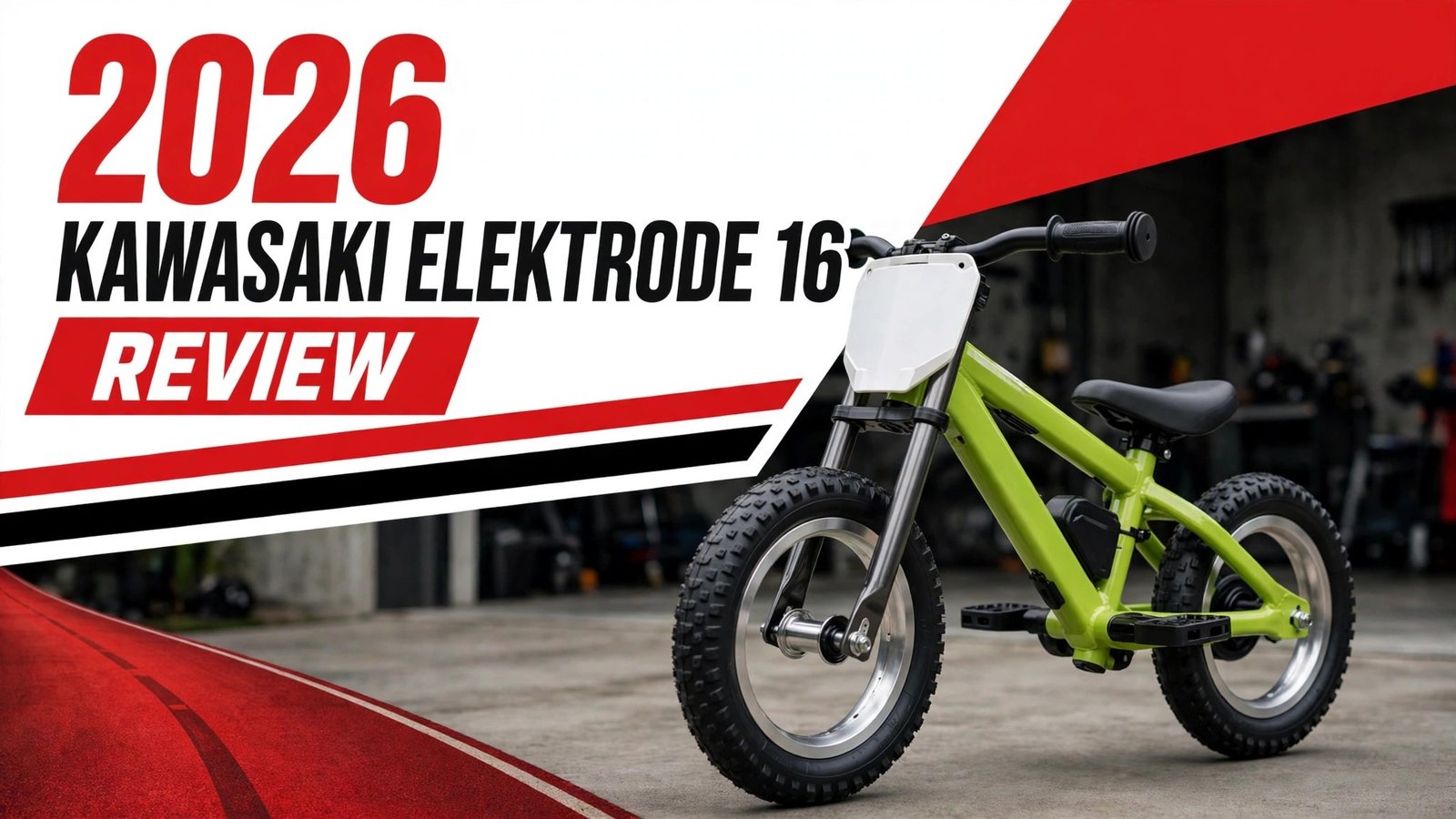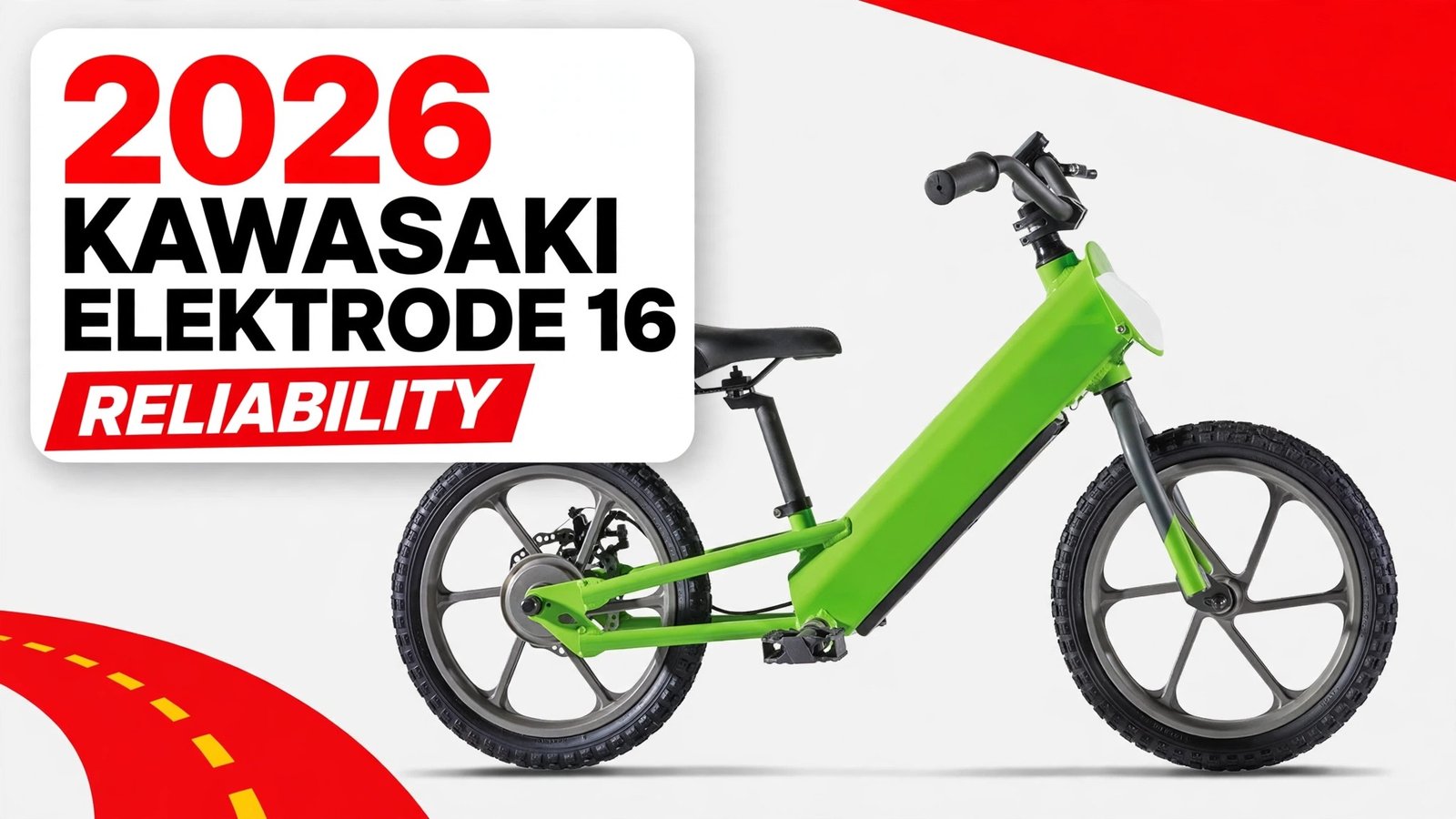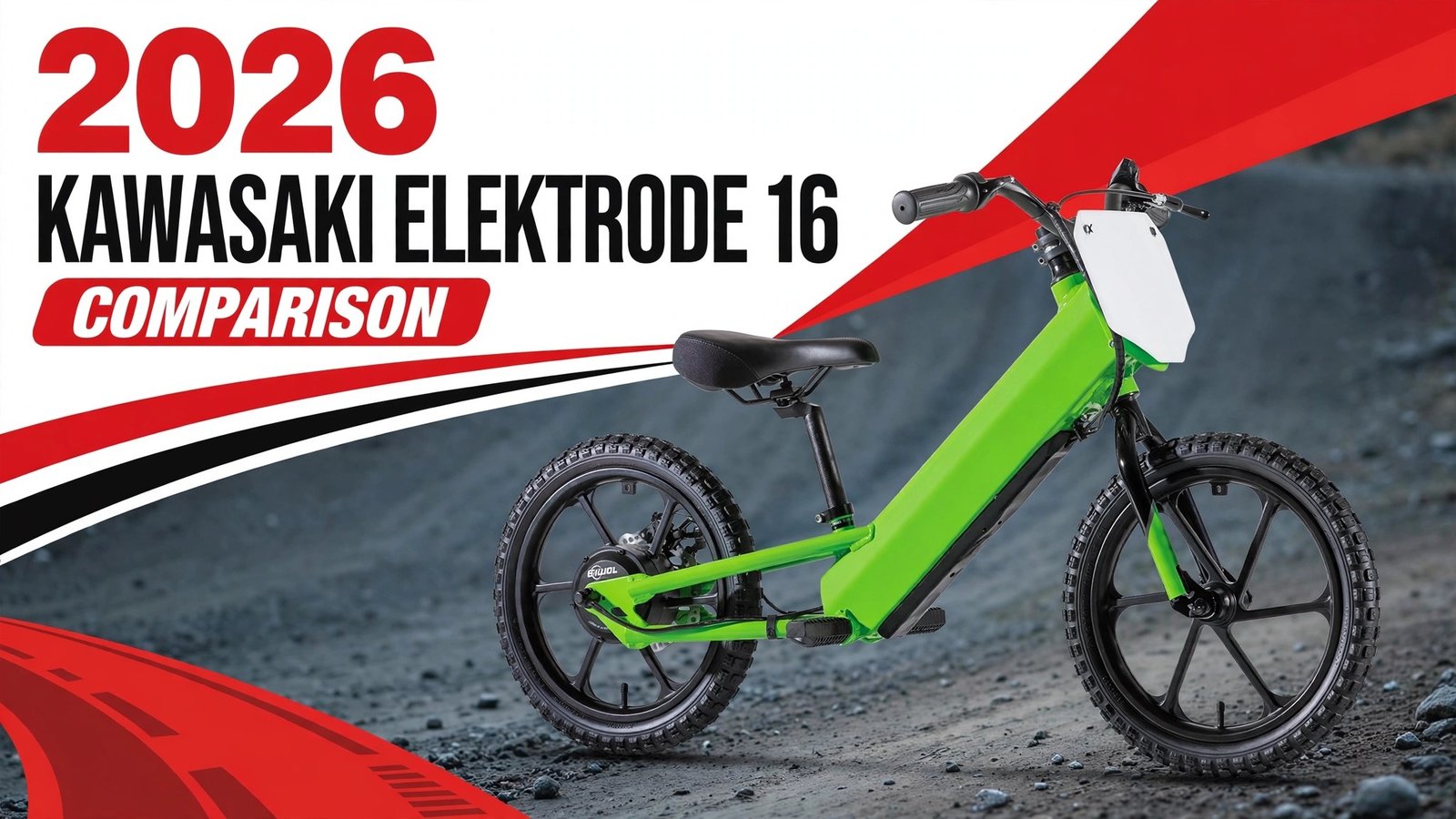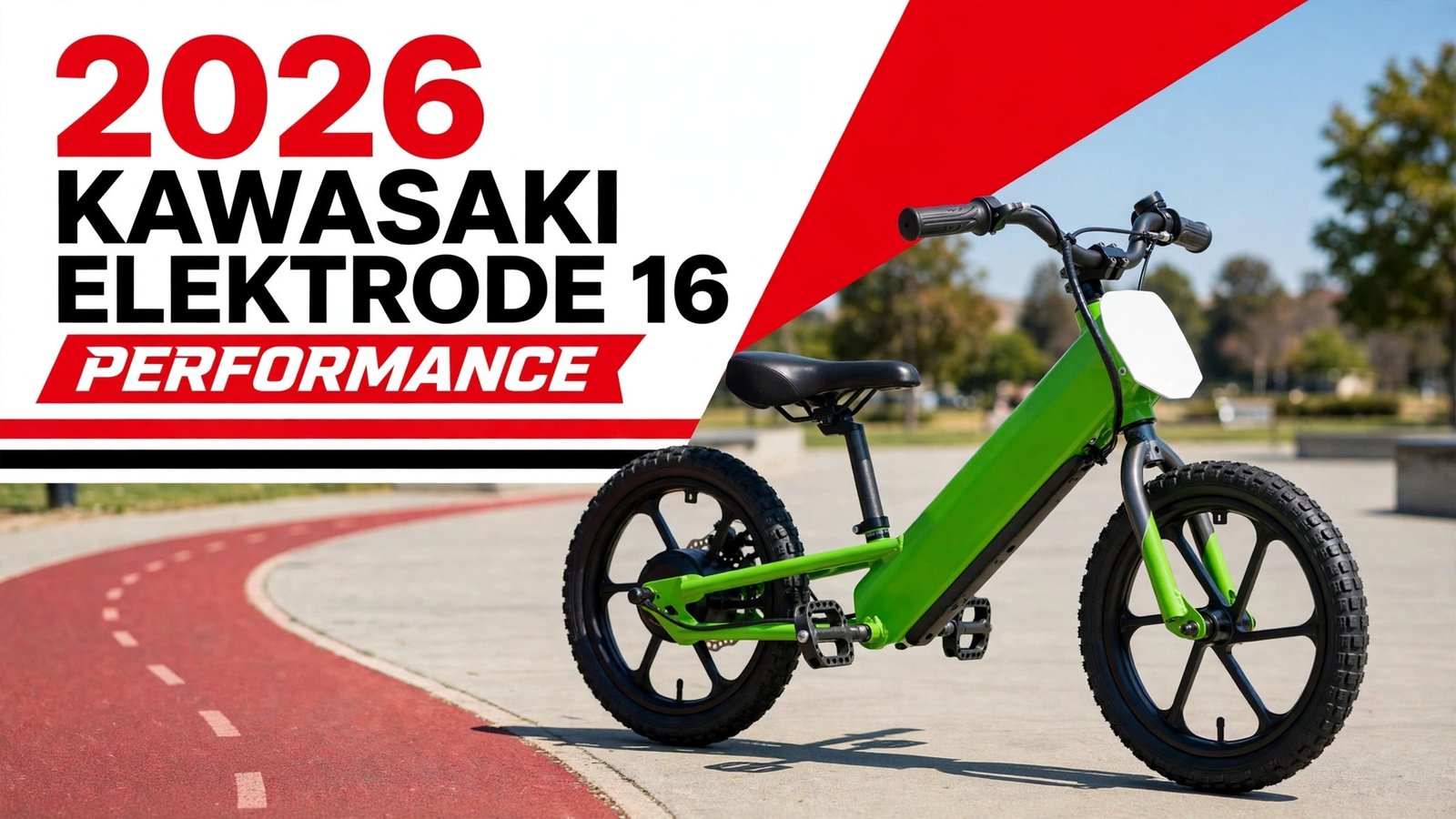
A kids’ balance bike does not need much power to feel fast — not when the rider is four years old and the top speed is 13 mph. This Kawasaki Elektrode 16 performance guide looks at exactly how that speed is made, how long it lasts, and how it feels to the child riding it, because a spec sheet only tells half the story.
The Elektrode 16 runs on a 250W hub motor with three passcode-locked speed modes, a battery built into the frame, and a claimed run time of more than two and a half hours. What follows in this Kawasaki Elektrode 16 performance guide is the measured side of those claims — what Kawasaki prints, what independent testers recorded, and where the bike’s limits really sit.
Kawasaki Elektrode 16 Engine Performance and Power Delivery
There is no petrol engine here, so the “engine” in this Kawasaki Elektrode 16 performance guide is the electric drive: a 250W brushless motor built into the rear wheel, a 36V battery hidden in the frame, and a handlebar dash that puts the speed modes behind a parental passcode.
Three Modes: 5, 7.5, 13 mph
The Elektrode 16 has three speed modes, and a parent chooses between them. Low caps the bike at 5 mph, Mid at 7.5 mph and High at 13 mph — Kawasaki’s claimed figures. The modes are selected on the handlebar LCD dash, which also shows the battery level and carries the on/off switch, and a parent sets a passcode so a child cannot raise the speed alone. A three-year-old starts in Low and stays there until a parent decides otherwise, the bike grows with the rider by permission, not by accident.
Independent testing backs the claimed figures up closely. Ultimate Motorcycling put a GPS on a 2024 bike ridden by its tester Henry, then aged four turning five, and recorded 4.8 mph in Low, 7.2 mph in Mid and 12.6 mph in High — 0.2 to 0.4 mph under Kawasaki’s claims in every mode. That gap is small, and Kawasaki’s own footnote explains it: top speed varies with battery age, charge, charge cycles, rider weight, speed and conditions. The measured figures are the only independent speed test on record for this bike, and they confirm the claimed modes rather than contradicting them — the result this Kawasaki Elektrode 16 performance guide reports first, because it is the foundation of everything that follows.
Kawasaki’s quick-start video sets out the pre-ride steps and the handlebar display in on-screen text, and it closes with children riding.
The dash the video shows is the same one a parent uses to set the passcode and choose the mode — the control centre of the Kawasaki Elektrode 16 performance a child actually rides with.
Faster High Mode for 2025
The heading says “faster”, and it needs a careful reading. The 2025 Elektrode 16 did get a revised ECU, and Kawasaki’s own model page lists “revised ECU for quicker acceleration in high mode” among the 2025 changes — but the top speed did not move. High mode is still capped at 13 mph, the same as the 2023 and 2024 bikes. What changed is how quickly the bike reaches that cap in High mode, not the cap itself. A parent buying a 2025 bike for its “faster” high mode is buying quicker throttle response, and this Kawasaki Elektrode 16 performance guide says so plainly so the heading is not misread.
That distinction matters for the youngest riders most of all. A quicker launch in High mode is still a 13 mph bike, and a child in Low mode at 5 mph feels none of the change at all. The 2025 update also added a Black colour option next to Lime Green, but the motor, battery and speed modes are otherwise unchanged, so the 2025 Kawasaki Elektrode 16 performance is the same bike with a quicker launch.
| Mode | Kawasaki claim | Ultimate Motorcycling GPS-measured |
|---|---|---|
| Low | 5 mph | 4.8 mph |
| Mid | 7.5 mph | 7.2 mph |
| High | 13 mph | 12.6 mph |
Note: Kawasaki’s claimed figures are from the 2023–2025 spec sheets; the measured figures are Ultimate Motorcycling’s GPS readings on a 2024 bike ridden by tester Henry, aged four turning five — the figures this Kawasaki Elektrode 16 performance guide prints for every mode. Kawasaki’s own footnote says top speed varies with battery age, charge, cycles, rider weight, speed and conditions.
Kawasaki Elektrode 16 Top Speed and Acceleration
Top speed is the number every parent asks about first, and on the Elektrode 16 it is a small number with a hard ceiling. This part of the Kawasaki Elektrode 16 performance guide separates the claimed cap from the measured reality, and acceleration from speed — because on this bike they are two different things.
Is the Kawasaki Elektrode 16 Fast?
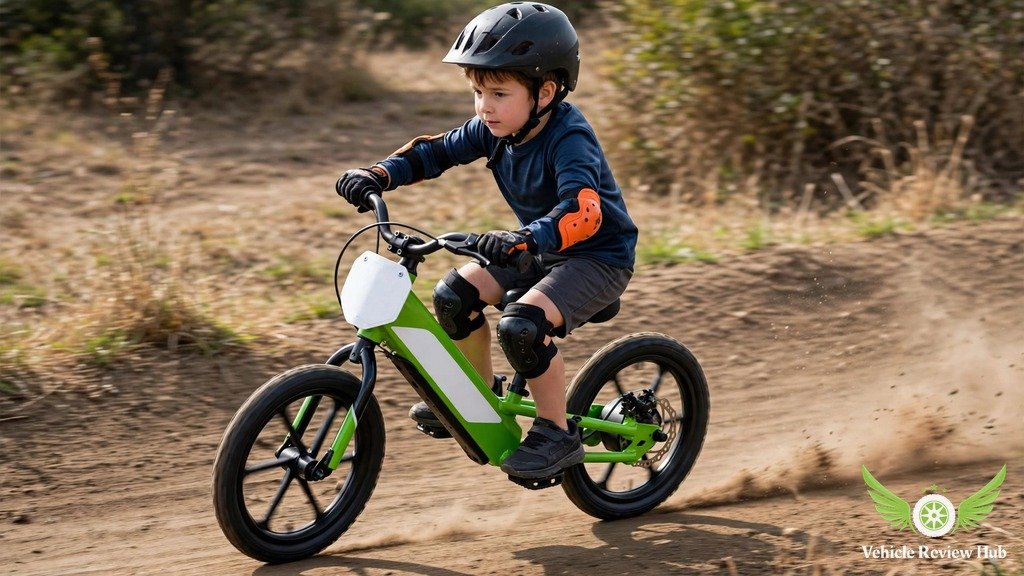
Fast depends on who is riding. For a three-year-old on a first powered bike, 13 mph feels quick — roughly twice a brisk adult running pace, and silent. Ultimate Motorcycling’s verdict on the power delivery captures the balance: “Being electric-powered, there is no shortage of grunt. The impressive torque output encouraged Henry to tackle momentum-killing hills, blast through tire-swallowing piles of leaves, into the mud, and across wet, sandy playgrounds. Nothing stopped Henry and the Elektrode.” That is the honest answer this Kawasaki Elektrode 16 performance guide gives on speed: quick where it counts for a small rider, on hills and loose ground, rather than fast in a straight line.
13 mph Is the Factory Cap
Thirteen miles per hour is a factory cap, not a suggestion. The controller limits the motor at that speed in High mode, and there is no faster mode and no published way to raise it — the passcode lock controls which mode a child can select, not how fast each mode goes. That matters against faster rivals: the Orion e16X claims 20 mph in High, and its adult-only Race Mode claims 26 mph, so a child who outgrows 13 mph will outgrow the Elektrode 16 itself. Kawasaki’s choice is deliberate — a 13 mph ceiling keeps the bike in first-bike territory for ages three to eight, and the 2025 revised ECU only shortens the time to get there, a change this Kawasaki Elektrode 16 performance guide treats as acceleration, not speed.
There is also no timed acceleration figure to quote. No publication has timed the Elektrode 16 from a standstill to its top speed, so this Kawasaki Elektrode 16 performance guide prints no acceleration time and no quarter-mile figure — any number claiming to be one would be invented. What testers do report is that the electric drive pulls cleanly from a standstill, with no clutch to slip and no gears to change, and that the instant response of the hub motor makes the bike feel lively at speeds that look slow on paper.
Kawasaki Elektrode 16 Mileage and Fuel Economy
“Mileage” on an electric balance bike means run time and miles per charge, not fuel economy — there is no petrol to burn and no fuel-economy figure to print. This part of the Kawasaki Elektrode 16 performance guide covers the two numbers that matter: how long the battery lasts, and how far it goes.
150-Plus Minutes Claimed
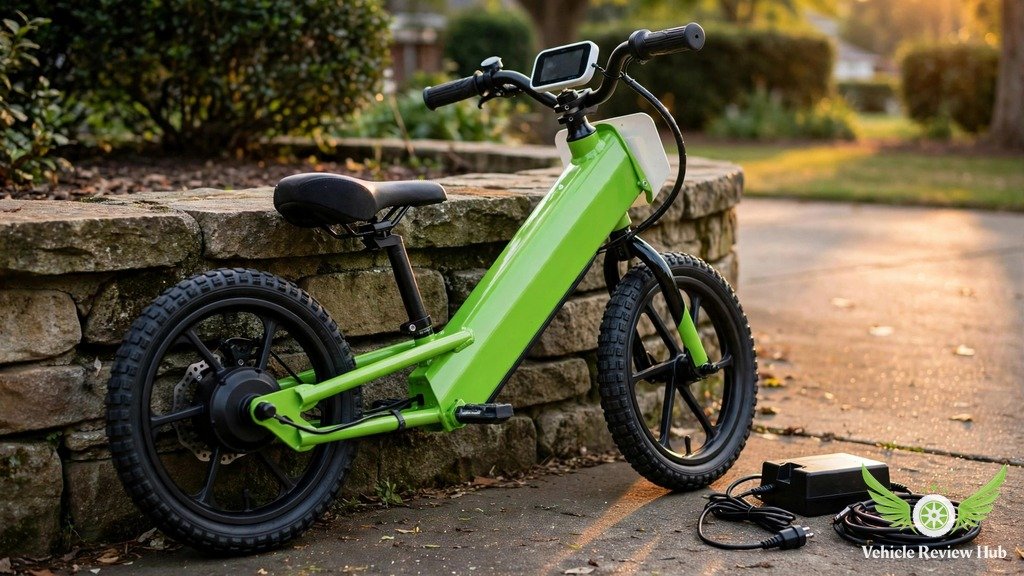
Kawasaki claims 150-plus minutes of run time and about nine miles of range per charge from the 36V 5.1Ah battery, a 187.2Wh pack built into the frame — the run-time figures this Kawasaki Elektrode 16 performance guide uses as its baseline. Charging takes about 2.5 hours on a standard 110-V home outlet, and Kawasaki rates the pack for 500 charge cycles before it drops to 80 percent of its original capacity. The bike also powers itself off after 10 minutes of inactivity, which protects the charge between rides — a small detail this Kawasaki Elektrode 16 performance guide counts in the run-time story.
The claim holds up in tester hands. Ultimate Motorcycling’s review reports: “We have never had issues with the 5.1 amp-hour lithium-ion battery. Kawasaki claims 2.5 hours of run time and nine miles of range — that’s a long way on a dirt bike this small. Henry never depleted the battery in a day, even when sharing the Elektrode with big sister Avery.” The Drive’s first impression agrees: its tester Gigi rode for over two and a half hours per charge. Two families, two children, the same result — the battery outlasts the rider, and that shapes this Kawasaki Elektrode 16 performance guide more than the claimed minutes do.
| Item | Kawasaki claim | What testers found |
|---|---|---|
| Run time | 150+ minutes | Never depleted in a day, even shared (Ultimate Motorcycling) |
| Range | About 9 miles | No independent range test published |
| Charge time | About 2.5 hours | Over 2.5 hours per charge (The Drive) |
| Battery life | 500 cycles to 80% capacity | No long-term cycle test published |
Note: Kawasaki’s claimed figures are from the 2023–2025 spec sheets; the tester evidence is Ultimate Motorcycling’s 2024 review and The Drive’s first impression, both with their own children riding the bike — the figures this Kawasaki Elektrode 16 performance guide uses for run time and range.
No MPG: Miles per Charge
The Elektrode 16 has no miles-per-gallon figure, because it burns no fuel — and no efficiency conversion belongs here either, since Kawasaki publishes no energy-consumption figure to convert from. The honest equivalents are the ones above: about nine miles and 150-plus minutes per charge, both Kawasaki claims, both broadly confirmed by testers. A full charge holds 187.2 watt-hours — a fraction of a kilowatt-hour from a home outlet — but without a published consumption figure per mile, any cost-per-mile number would be a guess, and this Kawasaki Elektrode 16 performance guide does not guess. The running-cost story is simple: charge it, ride it, and there is no fuel bill.
Kawasaki Elektrode 16 Real-World Riding Experience
Spec-sheet numbers say what a bike can do; testers say what it actually does with a child on it. This part of the Kawasaki Elektrode 16 performance guide leans on the two families who put their own children on the bike — Ultimate Motorcycling’s Henry, aged four turning five, and The Drive’s Gigi — because their riding days are the closest thing to a real-world test.
The Riding Experience Buyers Actually Talk About
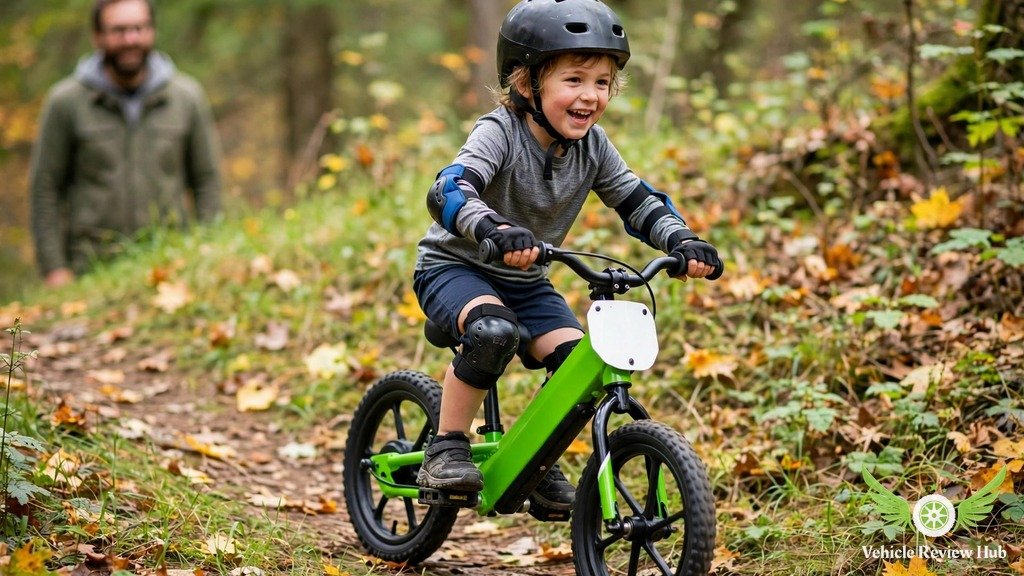
The riding buyers talk about is not about top speed. It is about a small bike that keeps going: through mud, leaves and wet sand, up momentum-killing hills, and across playgrounds where a petrol bike would not be welcome. Ultimate Motorcycling’s Henry rode the Elektrode 16 through all of it, and the review’s verdict is that nothing stopped the bike — the electric drive’s instant response and the low centre of gravity did the work, with the 16-inch wheels rolling over obstacles. The bike is also nearly silent, and Ultimate Motorcycling notes the practical result: “you can ride the Elektrode in plenty of places where an ICE-powered motorcycle would not be welcome.” For a parent, that silence is a performance feature in itself — it decides where the bike can be ridden, not just how fast, a point this Kawasaki Elektrode 16 performance guide counts among the bike’s real strengths.
The other thing buyers talk about is fit. The seat drops to 16.1 inches at its lowest, adjusted with a 4 mm hex key that Ultimate Motorcycling calls simple, and the adjustable handlebar “seems large, but allows plenty of room for Henry to move around the cockpit.” A child who starts at three in Low mode at 5 mph can keep the same bike until eight, raising the modes by permission as the passcode allows — and that is the riding experience this Kawasaki Elektrode 16 performance guide keeps coming back to.
All-Day Battery, Say Testers
The strongest performance claim in this Kawasaki Elektrode 16 performance guide is also the simplest: the battery lasts longer than the child does. Ultimate Motorcycling’s Henry never depleted it in a day, even when sharing the bike with his big sister Avery, and The Drive’s Gigi rode for over two and a half hours per charge — both comfortably inside Kawasaki’s 150-plus-minute claim. That matters more than the top speed for a family day out: a bike that runs all afternoon needs no spare battery, no mid-day charge and no plan B, while a rival with a 30-to-60-minute run time needs a second pack. The trade is the weight — 31.97 lb, the heaviest in the class — but for the child riding it, the low centre of gravity keeps the bike planted.
Kawasaki Elektrode 16 Handling, Braking and Stability
Handling on a kids’ balance bike is about confidence, not cornering speed: a low seat, a brake a small hand can reach, and a bike that stays planted when the ground gets loose. This part of the Kawasaki Elektrode 16 performance guide covers the one real ergonomic complaint testers found, and the braking and stability that surround it.
Too Fat Grips for Small Hands
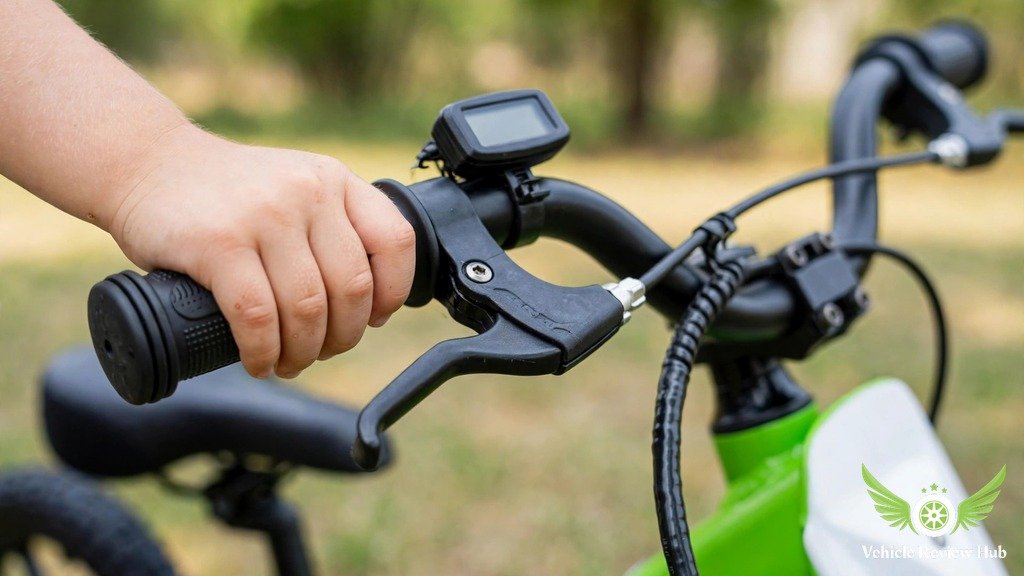
The one performance complaint that every buyer should know about is the grips. Ultimate Motorcycling’s tester writes it plainly: “Unfortunately, the grip diameter is too large for young hands. Even when Henry’s odometer clicked over to five years old, he couldn’t hold onto the grips as easily as I’d like.” That is a verbatim tester complaint, and the single most repeated criticism of the bike in any review. It matters because the grips are the child’s only connection to the steering and the throttle. Parents of the youngest riders should know about it before buying, and this Kawasaki Elektrode 16 performance guide flags it for exactly that reason, even though the rest of the bike earns praise.
Handling, Braking and Stability on Real Roads
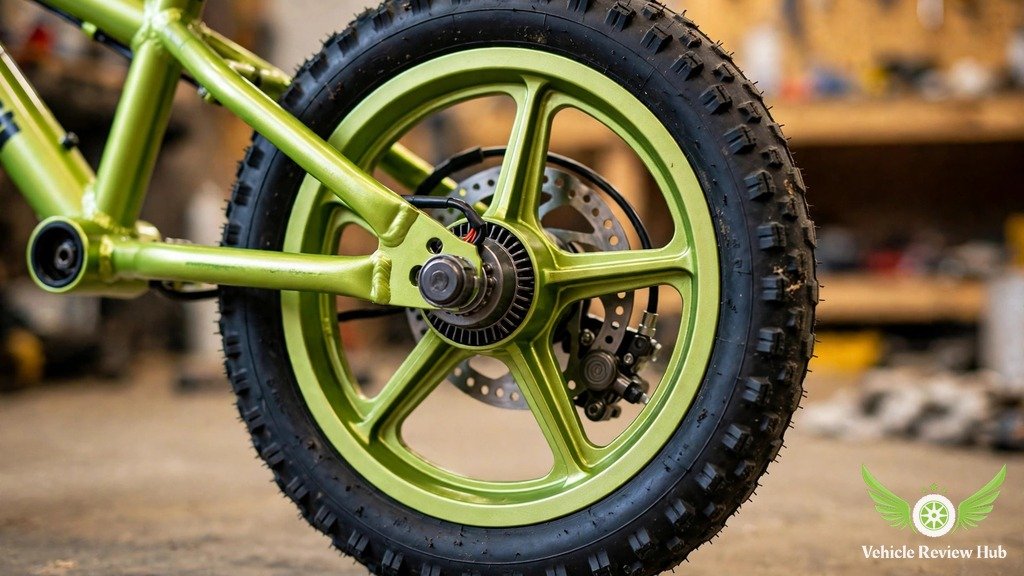
Beyond the grips, the handling story is strong. The battery sits low in the aluminium frame, which gives the bike a low centre of gravity, and the 16-inch cast aluminium wheels roll over obstacles with the Duro knobby tyres giving what Ultimate Motorcycling calls traction “good at both ends”. There is no suspension — the 28.8 mm steel fork is rigid and the rear is rigid — but Ultimate Motorcycling notes the lack of it “didn’t bother Henry”, and the rigid frame keeps the handling predictable. Braking is a single rear 160 mm mechanical disc, worked by a close-reach lever on the left handlebar that Ultimate Motorcycling calls “perfectly sized for Henry’s hands”. There is no front brake at all, by design: one lever, one brake, nothing for a three-year-old to confuse — and that simplicity is a performance choice this Kawasaki Elektrode 16 performance guide rates as a genuine advantage for a first bike.
Kawasaki Elektrode 16 Performance Compared With Other Sport Bikes
The heading says “sport bikes”, and it needs a correction before anything else: none of these bikes is a sport bike. The STACYC, the Orion and the KTM Replica are kids’ electric balance bikes, the same as the Elektrode 16, and this part of the Kawasaki Elektrode 16 performance guide compares them as what they are — first powered bikes for children, judged on speed, run time, weight and price. On price the Elektrode 16 is the dearest of the four at $1,099, with a $50 Freight and Materials surcharge on top, and the full price ladder is in the comparison.
Kawasaki Elektrode 16 vs STACYC 16eDRIVE Brushless
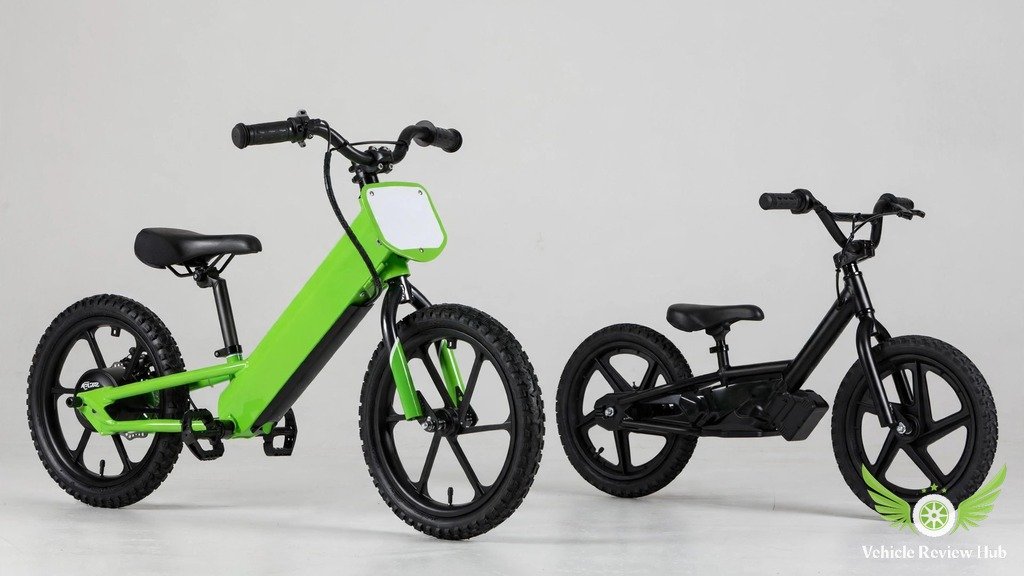
The STACYC 16eDRIVE Brushless is the bike the Elektrode 16 was built to answer, and Ultimate Motorcycling’s verdict on the Kawasaki is that it is “a legitimate alternative to the Stacyc” — high praise for a first attempt. On speed the two are close: the STACYC’s 2025 brochure lists modes of about 6, 8 and 13.5 mph against the Elektrode’s claimed 5, 7.5 and 13 mph (the 2024 brochure listed about 5, 7.5 and 13 mph), and both top out at roughly the same pace. Where they separate is run time and weight. The Elektrode claims 150-plus minutes per charge against the STACYC’s 30 to 60 minutes, but the STACYC’s 20V 4Ah battery swaps out in seconds — a spare 5Ah pack costs $195 — while the Elektrode’s in-frame battery cannot be swapped at all, so a flat battery ends the ride. The STACYC is also nearly 13 lb lighter at 19 lb with its battery, against the Elektrode’s 31.97 lb, and it costs $50 less at $1,049. The Elektrode answers with a disc brake against the STACYC’s rear drum, cast wheels against composite rims, a younger start at age three, and a 99.5 lb rider-weight limit against under 75 lb. For a family choosing between them, the question is run time and fit against weight and the spare-battery option — and this Kawasaki Elektrode 16 performance guide gives both sides fairly.
| Item | Elektrode 16 | STACYC 16eDRIVE Brushless |
|---|---|---|
| MSRP | $1,099 (+ $50 freight) | $1,049 |
| Top speed | 13 mph claimed (12.6 measured) | ~13.5 mph (2025 brochure) |
| Run time | 150+ min claimed | 30–60 min |
| Battery | 36V 5.1Ah in-frame, not swappable | 20V 4Ah swappable |
| Weight | 31.97 lb | 19 lb |
| Ages | 3–8 | 5–7 |
| Brakes | Rear 160 mm disc | Rear drum |
Note: STACYC’s mode figures are from its 2025 brochure (~6/8/13.5 mph); the 2024 brochure listed ~5/7.5/13 mph. The Elektrode’s measured 12.6 mph is Ultimate Motorcycling’s GPS figure. Prices are current MSRP; the Elektrode’s $50 is a Freight and Materials surcharge, not a destination charge — the comparison this Kawasaki Elektrode 16 performance guide makes in full in the table above.
Is the Kawasaki Elektrode 16 Suitable for Beginner Riders?
Yes — unambiguously. The Elektrode 16 is designed as a first powered bike for ages three to eight, and every part of its performance is aimed at a beginner: a 5 mph low mode behind a parental passcode, so a child cannot raise the speed alone; a 13 mph ceiling, so the bike never gets fast enough to frighten a new rider; a rear disc brake on a single close-reach lever, so there is one thing to learn instead of two; and a low seat that drops to 16.1 inches, so a three-year-old can touch the ground. The cautions are the ones already in this Kawasaki Elektrode 16 performance guide: grips too large for the smallest hands, and 31.97 lb for a parent to lift into a car. Neither stops a beginner from riding it — Henry started at four and never looked back — and the review and the reliability guide cover the rest of the ownership story for a first bike.
Kawasaki Elektrode 16 Performance: Frequently Asked Questions
The questions below cover the performance points parents ask most, answered directly from the facts in this Kawasaki Elektrode 16 performance guide.
How fast does the Kawasaki Elektrode 16 go?
13 mph in High mode, on Kawasaki’s claim — and Ultimate Motorcycling measured 12.6 mph on a GPS, so the claim holds up. Low mode is 5 mph and Mid is 7.5 mph, both behind a parental passcode.
What are the three speed modes?
Low at 5 mph, Mid at 7.5 mph and High at 13 mph, selected on the handlebar LCD dash. A parent sets a passcode so a child cannot change modes alone — and this Kawasaki Elektrode 16 performance guide notes the measured figures too: 4.8, 7.2 and 12.6 mph.
Is the 2025 high mode faster?
Not faster — quicker. The 2025 revised ECU improves acceleration in High mode, but the top speed is still 13 mph, the same as the 2023 and 2024 bikes — the distinction this Kawasaki Elektrode 16 performance guide makes in the Faster High Mode section, and Kawasaki’s own model page lists the revised ECU the same way.
How many miles does it go per charge?
About nine miles claimed, or 150-plus minutes of run time. Testers report a full day of riding without depleting the battery — Ultimate Motorcycling’s Henry never ran it flat, even sharing the bike with his sister — the run time this Kawasaki Elektrode 16 performance guide treats as the bike’s strongest number.
What is the Elektrode 16’s MPG?
It has none — it is electric, so there is no fuel economy figure to print. The right figures are about nine miles and 150-plus minutes per charge, and this Kawasaki Elektrode 16 performance guide uses those instead.
Is the Elektrode 16 good for a beginner?
Yes. It is designed as a first powered bike: ages three to eight, a 5 mph low mode, a passcode lock so a child cannot raise the speed alone, and a 13 mph ceiling — the beginner answer this Kawasaki Elektrode 16 performance guide gives without hedging.
Are the grips too big for small hands?
Ultimate Motorcycling’s tester found exactly that — even at age five, his son could not hold the grips as easily as his father liked. It is the bike’s most repeated criticism, and parents of the youngest riders should know about it — the complaint this Kawasaki Elektrode 16 performance guide flags for every buyer.