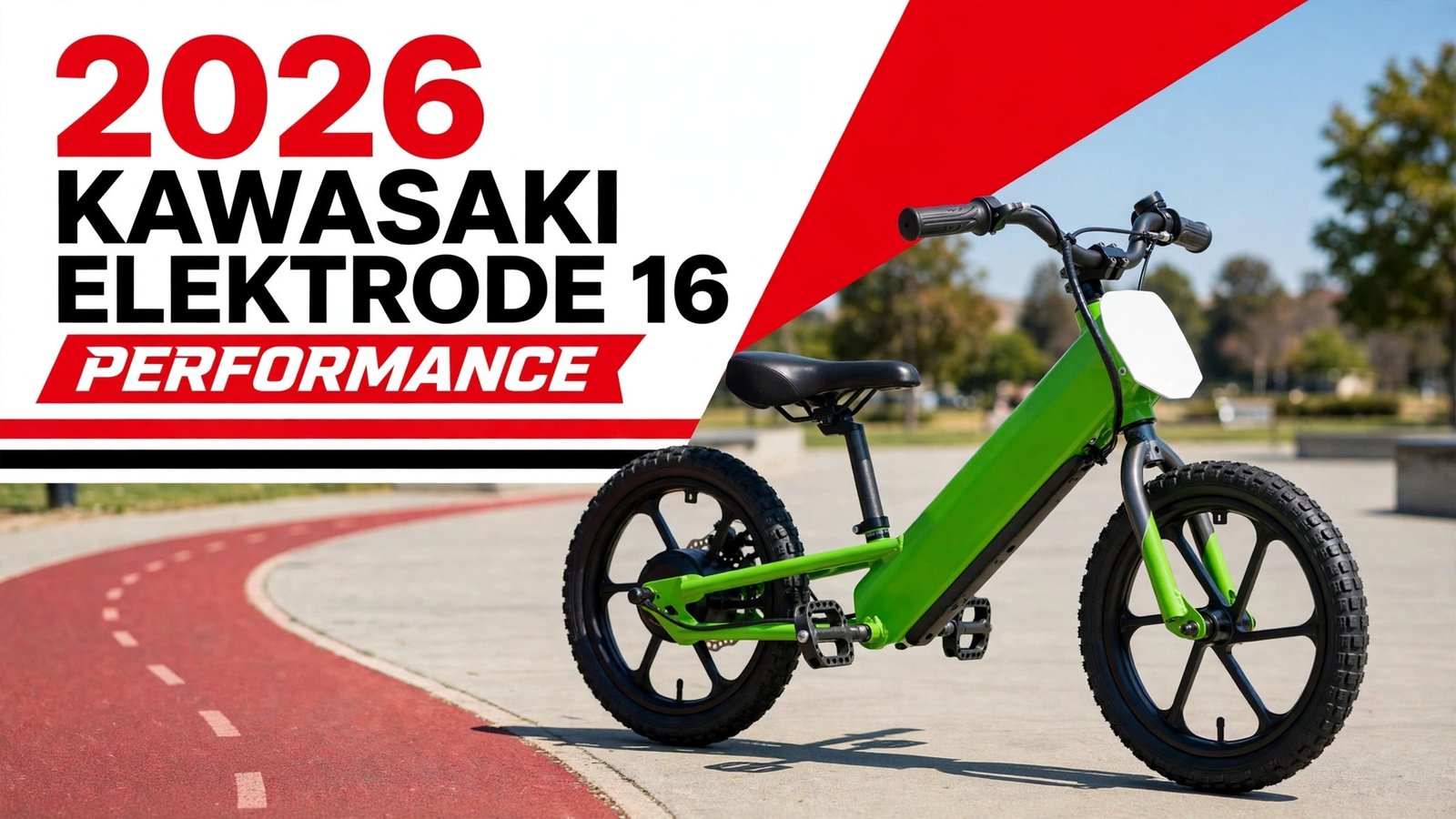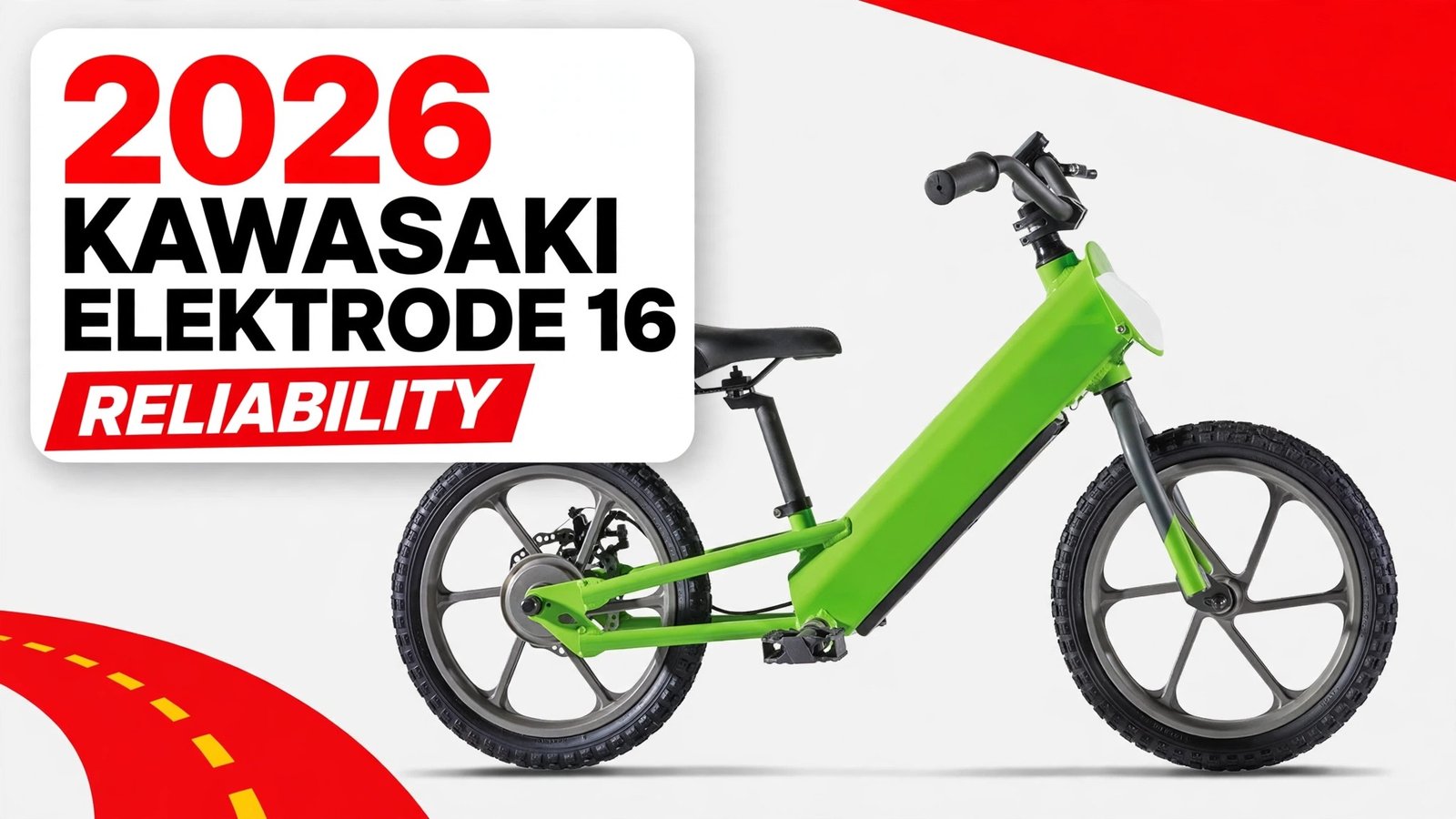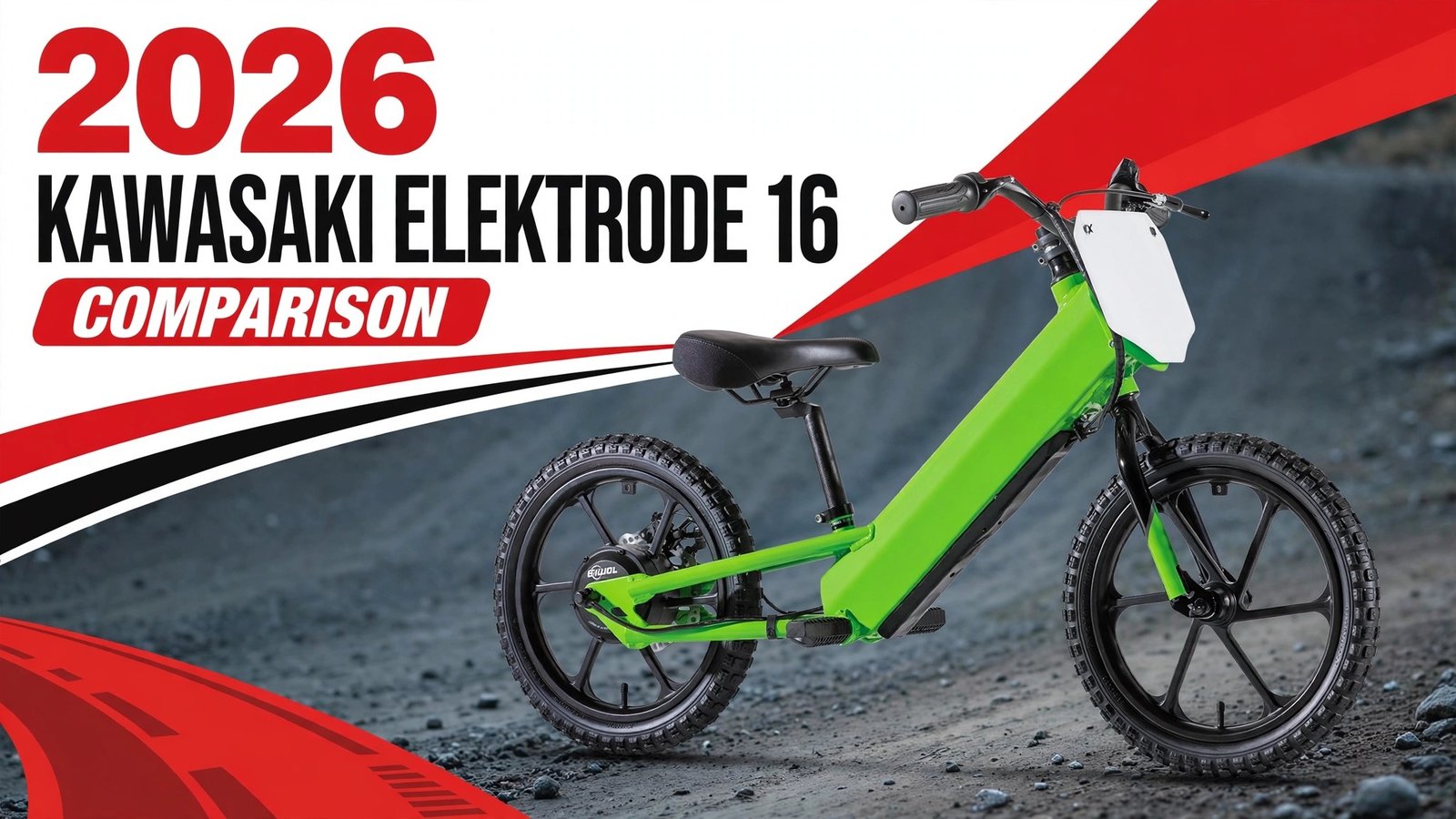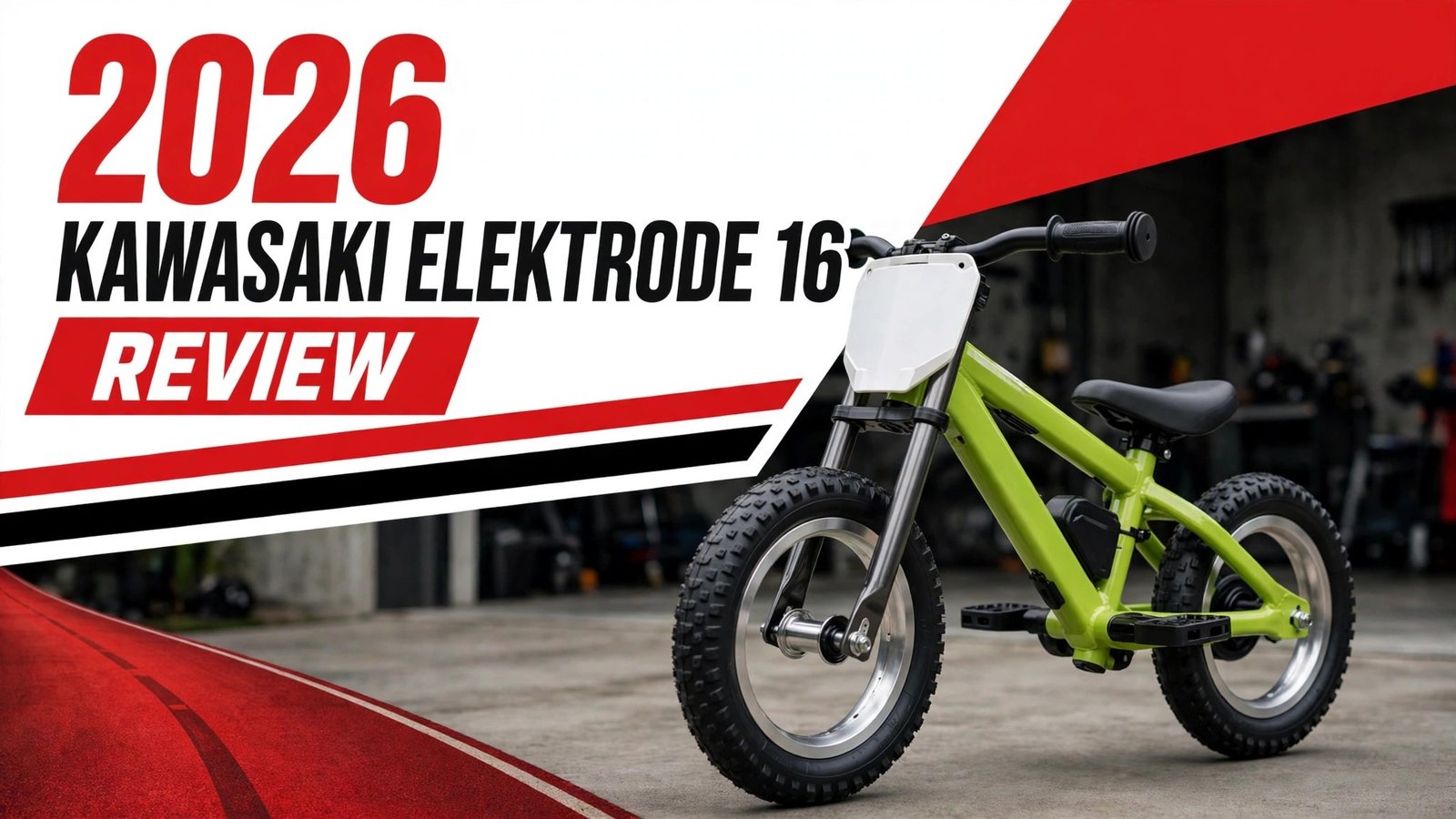
Kawasaki’s first electric two-wheeler is not a motorcycle at all. It is a small balance bike for children aged three to eight, with 16-inch wheels, a 250W hub motor and a top speed of 13 mph, and this Kawasaki Elektrode 16 review looks at the bike exactly as it is: a first powered ride for a child, built by a motorcycle maker rather than a toy company. That distinction runs through this Kawasaki Elektrode 16 review. The price has not moved since launch, the battery lives inside the frame, and the speed modes sit behind a parental passcode.
That combination makes the Elektrode 16 unusual: no engine to tune, no petrol to buy, no clutch to learn. The questions that matter are different — how long the battery lasts, whether a three-year-old can reach the controls, and whether the bike is worth $1,099 when rivals cost less — and this Kawasaki Elektrode 16 review answers them from Kawasaki’s own spec sheets and from the testers who put their own children on the bike.
Kawasaki Elektrode 16 Overview and Model-Year Updates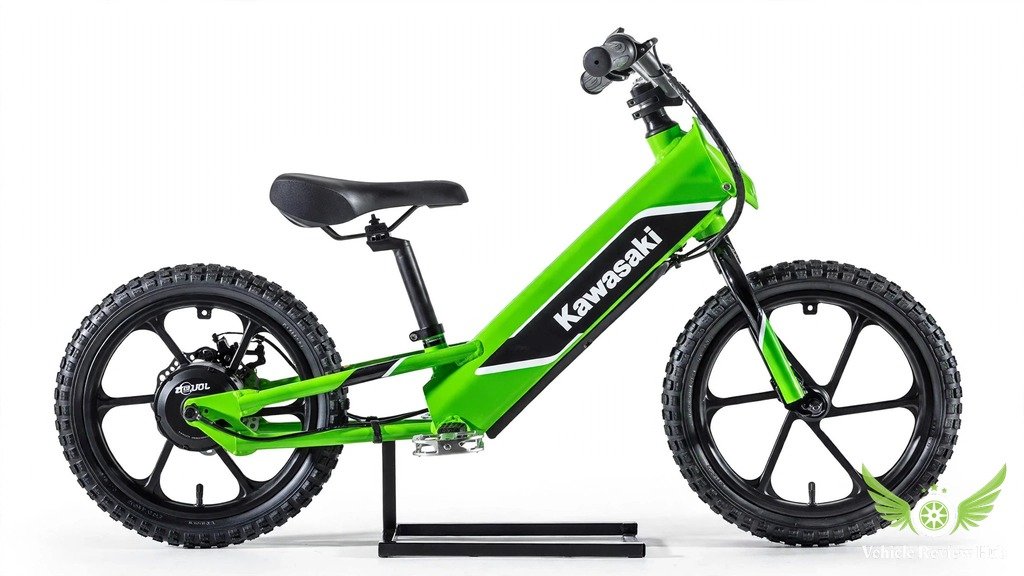
The Elektrode 16 arrived in June 2022 as a 2023 model, and three model years later it is still the same bike at the same price, with one name change and one colour added. This section of the Kawasaki Elektrode 16 review traces those updates and the price story that has stayed frozen since day one.
The 16 Was Added in 2025
The heading is not quite right. The “16” was added in 2024, not 2025. Kawasaki launched the bike on June 7, 2022 as the 2023 ELEKTRODE, with no number in the name, and the 2023 spec sheet is titled simply “ELEKTRODE”. The “16” first appears on the 2024 spec sheet, titled “ELEKTRODE 16” at the same $1,099 price. The 2025 sheet keeps the name, adds Black next to Lime Green, and lists a revised ECU for quicker acceleration in high mode. So the name changed once, in 2024, and the 2025 update was about colour and electronics, not the name — a correction this Kawasaki Elektrode 16 review makes once and moves on from.
Price Frozen Since Launch
Three model years, one price — the headline number of this Kawasaki Elektrode 16 review. The June 7, 2022 launch press release set the MSRP at $1,099, and the 2024 and 2025 spec sheets print $1,099 again. The 2023 sheet itself says BASE MSRP “TBA”, so the launch figure comes from the press release. Kawasaki has not raised the price once in three years — the STACYC 16eDRIVE Brushless sits at $1,049 and the Orion e16X at $999, so the bike in this Kawasaki Elektrode 16 review has stayed the most expensive of the four while holding its price flat. That frozen price is one of the strongest findings in this Kawasaki Elektrode 16 review. Dealer discounts do appear — $699 at Reynolds, $999 at Tri County, $895 at R/T Powersports in a Black Friday sale — but those are dealer sale prices, not a change to the $1,099 MSRP.
Kawasaki’s own launch film for the 2023 Elektrode (the 16) shows children riding the lime-green bike outdoors, and it shows the bike’s scale against its riders clearly, though it gives no measurements.
Kawasaki Elektrode 16 Engine and Specifications
There is no engine on the Elektrode 16 in the petrol sense, so the “engine” section of this Kawasaki Elektrode 16 review is about the electric drive system: a 250W hub motor, a 36V battery hidden in the frame, and a rear disc brake.
| Item | Figure |
|---|---|
| Motor | 250W Eiwol in-wheel brushless (0.33 hp) |
| Battery | 36V 5.1Ah (187.2Wh) lithium-ion, in-frame |
| Charge time | About 2.5 hours, 110-V home outlet |
| Run time | 150+ minutes claimed |
| Range | About 9 miles claimed |
| Speed modes | Low 5 mph / Mid 7.5 mph / High 13 mph |
| Brakes | Rear 160 mm mechanical disc only |
| Suspension | None — rigid fork and rigid rear |
| Seat height | 16.1–20.5 in, adjustable |
| Rider age | 3–8 years |
| Max rider weight | 99.5 lb |
| Curb weight | 31.97 lb |
Note: Figures are from Kawasaki’s own 2023, 2024 and 2025 spec sheets, as used throughout this Kawasaki Elektrode 16 review; top speed varies with battery age, charge, rider weight and conditions, per Kawasaki’s own footnote.
Battery Lives in the Frame
The battery is a 36V 5.1Ah lithium-ion pack, 187.2Wh, built into the aluminium frame — the single biggest difference between the Elektrode 16 and its rivals. It cannot be swapped, and that single fact shapes this Kawasaki Elektrode 16 review more than any other. A STACYC rider can pull a spent 20V pack out and click a fresh one in; an Orion rider can do the same with its removable 36V 8Ah pack. The trade is deliberate: the weight sits low in the frame, giving the bike its low centre of gravity, and the frame protects the pack from dirt, mud, rocks and falls. Kawasaki rates the pack for 500 charge cycles before it drops to 80 percent of its original capacity, and charging takes about 2.5 hours on a standard 110-V home outlet, with the connector under the frame and the charger included. The bike powers itself off after 10 minutes of inactivity, which protects the charge between rides. None of that changes the headline: the battery’s placement is the design decision this Kawasaki Elektrode 16 review keeps coming back to, because it explains the weight, the run time and the low centre of gravity in one stroke.
Rear Disc, No Front Brake
The Elektrode 16 has one brake: a rear 160 mm mechanical disc, worked by a close-reach lever on the left handlebar. There is no front brake at all, and that is a deliberate choice for a first bike rather than a missing part — a small child squeezes one lever and the rear wheel slows, the same layout as a motorcycle’s rear brake. Ultimate Motorcycling’s Henry found the lever perfectly sized for his hands, and the disc is a proper mechanical unit parents can check and replace. One caution: The Drive’s first impression mentions a front brake, but that is an error — Kawasaki’s spec sheets and Ultimate Motorcycling’s spec box both confirm the rear disc only. There is also no suspension: the 28.8 mm steel fork is rigid, the rear is rigid, and the bike rolls on 16 x 2.125 Duro knobby tyres with Schrader valves and tubes. Ultimate Motorcycling notes the lack of suspension didn’t bother Henry. For a parent, the takeaway is simple — one lever, one brake, nothing to confuse a three-year-old — and it is one more reason this Kawasaki Elektrode 16 review rates the bike as a genuine first powered ride. One brake, one lever, no confusion: the setup this Kawasaki Elektrode 16 review recommends for a first bike.

Kawasaki Elektrode 16 Price and Market Availability
Price is the simplest part of this Kawasaki Elektrode 16 review to state and the hardest to judge, because the number has not changed in three years while the rivals around it have.
| Model year | Name on the sheet | MSRP | Freight surcharge | Out-the-door before tax and fees |
|---|---|---|---|---|
| 2023 | ELEKTRODE | $1,099* | $50 | $1,149 |
| 2024 | ELEKTRODE 16 | $1,099 | $50 | $1,149 |
| 2025 | ELEKTRODE 16 | $1,099 | $50 | $1,149 |
Note: *The 2023 spec sheet itself says BASE MSRP “TBA”; the $1,099 figure comes from Kawasaki’s June 7, 2022 launch press release. The $50 is a Freight and Materials surcharge, not a destination charge, and the $1,149 total is before tax and dealer fees. This Kawasaki Elektrode 16 review uses the same arithmetic throughout.
Kawasaki Elektrode 16 Price in the USA: $1,099 (2025)
The 2025 Elektrode 16 costs $1,099 in the USA, the same figure as the 2023 launch and the 2024 model, and the 2025 model is the current one — Kawasaki has announced no 2026 model year as of late November 2026, and its model page still shows the 2025 bike. The price buys the Lime Green bike or, since 2025, a Black one. What the $1,099 does not include is freight: a $50 Freight and Materials surcharge on top takes the out-the-door figure to $1,149 before tax and dealer fees. Some dealers list the bike at $1,149 already — the MSRP plus the $50 freight, not a markup. Against the rivals, the Elektrode 16 is the dearest of the four on MSRP — the Orion e16X is $999, the STACYC 16eDRIVE Brushless is $1,049 and the KTM Replica is $1,080 — so the Kawasaki asks $19 more than the KTM and $50 more than the STACYC before freight, and $100 more than the STACYC once the $50 freight is added. Dealer discounts soften that in practice — $699 at Reynolds, $749 at Holzhauers, $895 at R/T Powersports in a Black Friday sale and $999 at Tri County — but those are dealer sale prices, and this Kawasaki Elektrode 16 review quotes the $1,099 figure as the price that matters for comparison.
No Destination Figure Published
Unlike Kawasaki’s motorcycles, the Elektrode 16 has no destination charge published anywhere — not on the spec sheets, the model page or the press releases. The only freight figure that exists is the $50 Freight and Materials surcharge, documented by the Watercraft Journal holiday guide and corroborated by an Altus Motorsports listing. Call it exactly what it is: a freight surcharge, never a destination charge. Buyers ordering direct from Kawasaki’s own site had a simpler answer in late 2026, with free shipping on Elektrode orders through December 31, 2026 — a promo, not a price cut, that removes the freight question entirely for online buyers. Either way, the out-the-door maths in this Kawasaki Elektrode 16 review stays the same: $1,099 plus $50 freight, before tax and fees. The step up is worth a mention too: the Elektrode 20 and 20FS both cost $2,199, exactly double the 16, with a 750W motor and a 24 mph top speed for riders aged eight and up — the Elektrode 20 review covers that step in full.

Kawasaki Elektrode 16 Design, Features and Technology
The design is where Kawasaki’s motorcycle background shows most clearly, and this part of the Kawasaki Elektrode 16 review looks at the passcode lock, the KX styling and the way a very small bike fits a very small rider.
Passcode Locks the Speed Modes
The signature safety feature is the passcode parental lock. The three speed modes — Low 5 mph, Mid 7.5 mph and High 13 mph — are selected on a handlebar LCD dash that also shows battery level and carries the on/off switch, and a parent sets a passcode so a child cannot raise the speed alone. A three-year-old starts in Low at 5 mph and stays there until a parent decides otherwise: the bike grows with the rider by permission, not by accident. Ultimate Motorcycling’s tester used the lock exactly that way with his son Henry, and the bigger Elektrode 20 does not have it — Cycle News notes that on the 20 there is no safeguard that can stop the kid from changing it themselves. The dash is simple enough for a child to read. It is the feature this Kawasaki Elektrode 16 review would put first in any shortlist for a three-year-old.
How the Design Balances Style, Comfort and Practicality
The Elektrode 16 wears KX styling — lime green plastics, a white front number plate in the KX style, and an aluminium frame that hides the battery completely — so it reads as a small Kawasaki motocross bike, not a toy. That styling is not just paint: the cast aluminium 16-inch wheels are stronger than the composite rims on the STACYC, and the foldable steel footpegs have rubber grips and fold up in a tip-over. Comfort comes from fit rather than softness: with no suspension, the seat, the bar position and the grip size do the work. The seat adjusts from 16.1 to 20.5 inches with a 4 mm hex key, which Ultimate Motorcycling calls simple, and the adjustable handlebar gives a growing child room to move around the cockpit. Tyres with tubes and Schrader valves make servicing easy for parents, per the TotalMotorcycle guide. Taken together, the design is the reason this Kawasaki Elektrode 16 review treats the bike as a small motorcycle in miniature rather than a toy with a motor.

Kawasaki Elektrode 16 Riding Experience and Comfort
Riding impressions for a kids’ balance bike come from the children who rode it, so this section of the Kawasaki Elektrode 16 review leans on Ultimate Motorcycling’s Henry, aged four turning five, and The Drive’s Gigi — the two testers who put their own children on the bike. The performance guide covers the measured speeds and run time in detail; this section is about fit and comfort.
Seat Drops to 16.1 Inches
The seat drops to 16.1 inches at its lowest, and that number matters more than any other dimension on this bike, because it decides whether a three-year-old can touch the ground. Kawasaki’s range is 16.1 to 20.5 inches, adjusted with a 4 mm hex key — over four inches of adjustability on a bike whose whole wheel is only 16 inches across. Ultimate Motorcycling found the adjustment simple. The low seat pairs with a rider-height range of 37 to 55 inches and an age range of three to eight years, the youngest start in the class, since the STACYC 16e starts at five. One figure to ignore: Ultimate Motorcycling’s text at one point gives 16.1 to 21.5 inches, but Kawasaki’s sheets say 20.5 inches maximum, and the sheets win. The maximum rider weight is 99.5 lb, which is also the highest in the class — the STACYC’s limit is under 75 lb — so the bike fits bigger kids too. That combination — a low seat, a wide height range and the highest weight limit in the class — is why this Kawasaki Elektrode 16 review says the bike fits more children than any rival.
Riding Position and Comfort Over Longer Distances
Over longer distances — a full afternoon at the park rather than a highway run — the Elektrode 16’s comfort story is about the low, stable riding position and the battery that outlasts the rider. Ultimate Motorcycling’s review reports that Henry never depleted the battery in a day, even sharing the bike with his big sister Avery, and The Drive’s first impression says Gigi rode for over two and a half hours per charge, matching Kawasaki’s claim of 150-plus minutes and about nine miles. The bike is nearly silent, so it can be ridden in plenty of places where a petrol-powered motorcycle would not be welcome, per Ultimate Motorcycling. The low centre of gravity keeps it planted. The one real comfort complaint is the grips: Ultimate Motorcycling’s tester writes that the grip diameter is too large for young hands, and that even when Henry turned five he could not hold onto the grips as easily as his father would like. It is a small flaw on a bike that otherwise fits its riders well, but parents of the youngest riders should know about it before buying — and this Kawasaki Elektrode 16 review flags it for exactly that reason.

Kawasaki Elektrode 16 Review: Pros, Cons and Verdict
Pulling the review together means weighing the heaviest and dearest bike in its class against one that also runs longest, starts youngest and carries the strongest dealer network. This verdict section of the Kawasaki Elektrode 16 review does that honestly, with the rival numbers below and the full four-bike comparison alongside.
| Bike | MSRP | Run time | Weight | Ages |
|---|---|---|---|---|
| Orion e16X | $999 | 4 hours claimed | 29 lb* | 4–8 |
| STACYC 16eDRIVE Brushless | $1,049 | 30–60 min | 19 lb | 5–7 |
| KTM Replica 16eDRIVE | $1,080 | 30–60 min | About 20 lb | 4–8 |
| Kawasaki Elektrode 16 | $1,099 (+ $50 freight) | 150+ min claimed | 31.97 lb | 3–8 |
Note: *Orion’s own site says 29 lb; dealer listings say 33 lb. The Elektrode 16 is the heaviest of the four and the dearest on MSRP, and this Kawasaki Elektrode 16 review gives both facts in full below.
Main Advantages and Limitations of the Kawasaki Elektrode 16
The advantages in this Kawasaki Elektrode 16 review start with run time. Kawasaki claims 150-plus minutes and about nine miles per charge, and both testers who rode the bike backed that up in practice — a full day of riding without depleting the battery. The passcode lock is the best safety feature in the class, the rear disc is a proper motorcycle-style unit, the cast wheels are tougher than composite rims, and the age range starts at three — two years earlier than the STACYC. The limitations are equally clear. At 31.97 lb the Elektrode 16 is the heaviest bike in its class by a wide margin, and at $1,099 the dearest. The battery cannot be swapped, so a flat battery ends the ride while a STACYC rider clicks in a spare $195 pack. The grips are too big for the smallest hands, there is no suspension, and there is no front brake — though the last two are design choices rather than oversights. The warranty is short on the electrics, too: 90 days on the battery, motor, controller and charger, against 12 months on the frame and fork, a split the reliability guide covers in detail. That mix is the honest balance this Kawasaki Elektrode 16 review leaves buyers with.
Heaviest Bike in Its Class
The weight figure deserves its own section because it is the one number that surprises every buyer: 31.97 lb. The STACYC 16eDRIVE Brushless weighs 19 lb with its battery, the KTM Replica about 20 lb, and the Orion e16X 29 lb on Orion’s own figures — dealer listings say 33 lb. The Elektrode 16 is nearly 13 lb heavier than the STACYC — a lot when the rider weighs 40 lb. The weight comes from the in-frame battery, the cast wheels and the aluminium frame — but parents will feel it lifting the bike into a car. For a child riding it, the weight matters less: the low centre of gravity keeps it stable, and Henry rode it through mud, leaves and wet sand without the weight stopping him. Parents who lift the bike daily will notice it more than the child riding it, and this Kawasaki Elektrode 16 review says so plainly.
Kawasaki Elektrode 16 Review: Frequently Asked Questions
The questions below cover the points parents ask most, answered directly from the facts in this Kawasaki Elektrode 16 review.
What age is the Kawasaki Elektrode 16 for?
Ages three to eight, for riders 37 to 55 inches tall and up to 99.5 lb. It is the only bike in its class that starts at age three — the STACYC 16e starts at five — and the low mode’s 5 mph cap behind a parental passcode is what makes that young start safe, which is why this Kawasaki Elektrode 16 review puts the age range first.
How much does the Kawasaki Elektrode 16 cost?
The MSRP is $1,099, unchanged across the 2023, 2024 and 2025 model years — the frozen price this Kawasaki Elektrode 16 review opens with. Expect a $50 Freight and Materials surcharge on top, so $1,149 before tax and dealer fees; dealers were discounting to $699–$999 in late 2026.
When was the “16” added to the name?
In 2024. The 2023 launch model was called simply “ELEKTRODE”, and the 2024 spec sheet is the first titled “ELEKTRODE 16” — a correction this Kawasaki Elektrode 16 review makes against the doc heading.
Does the Elektrode 16 have a front brake?
No. The rear 160 mm mechanical disc is the only brake, worked by a close-reach lever on the left handlebar. There is no front brake by design, and this Kawasaki Elektrode 16 review notes the correction because several early write-ups got it wrong.
How long does the battery last per charge?
Kawasaki claims 150-plus minutes and about nine miles. Ultimate Motorcycling’s tester never depleted the battery in a day, even sharing the bike with his sister, and The Drive’s Gigi rode for over two and a half hours per charge — verified in practice, not just on paper, as this Kawasaki Elektrode 16 review notes.
Can the battery be swapped for a fresh one?
No. The battery is built into the frame and cannot be swapped; a flat battery means waiting out the roughly 2.5-hour charge. The STACYC and Orion rivals use swappable packs, and a spare STACYC 5Ah pack costs $195 — the honest counter-argument to the longer run time.
Is the Elektrode 16 the heaviest bike in its class?
Yes: 31.97 lb, against 19 lb for the STACYC, 29 lb for the Orion and about 20 lb for the KTM Replica — the figure this Kawasaki Elektrode 16 review treats as the bike’s biggest drawback. The weight buys a low centre of gravity and the longest claimed run time.