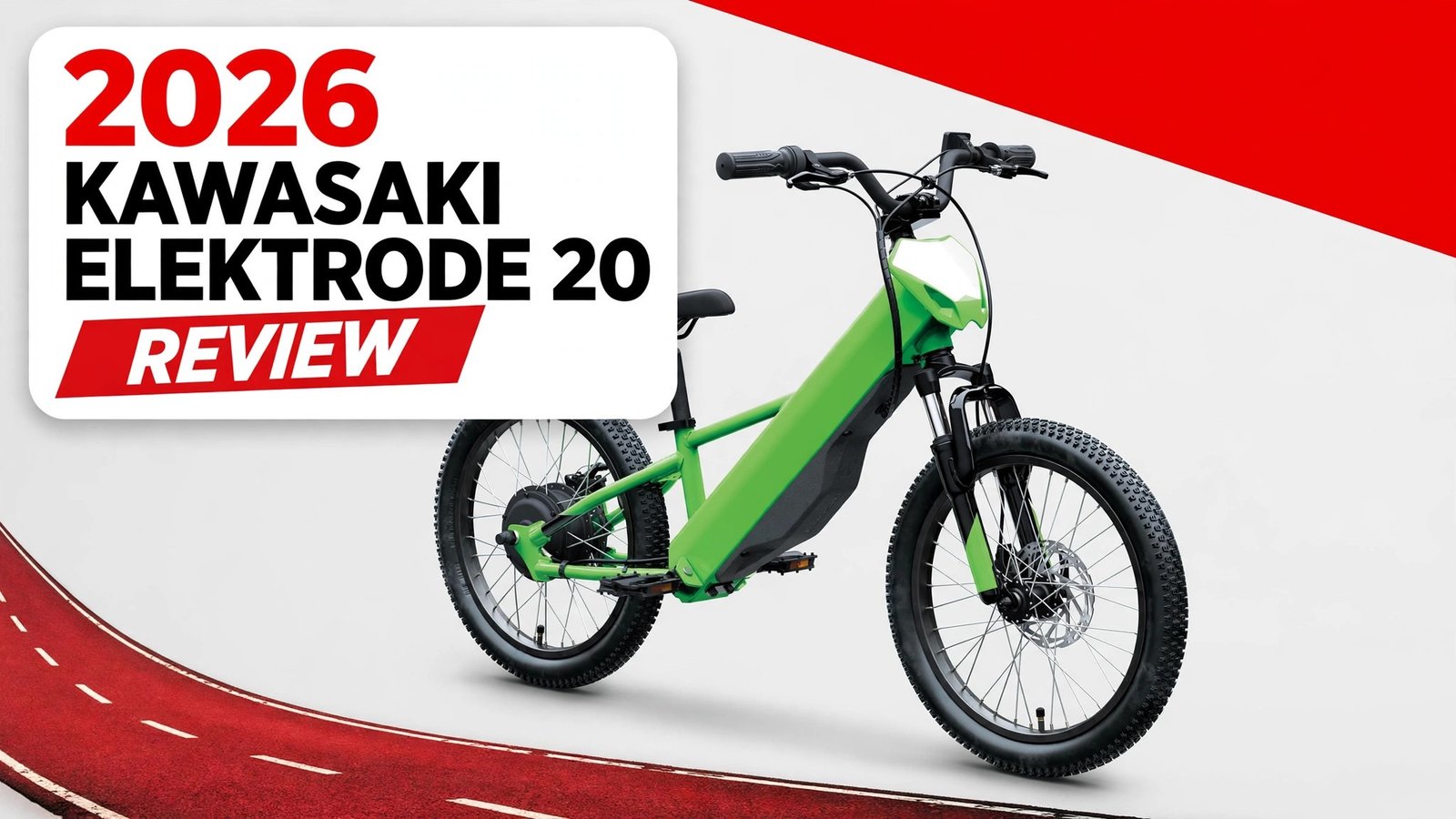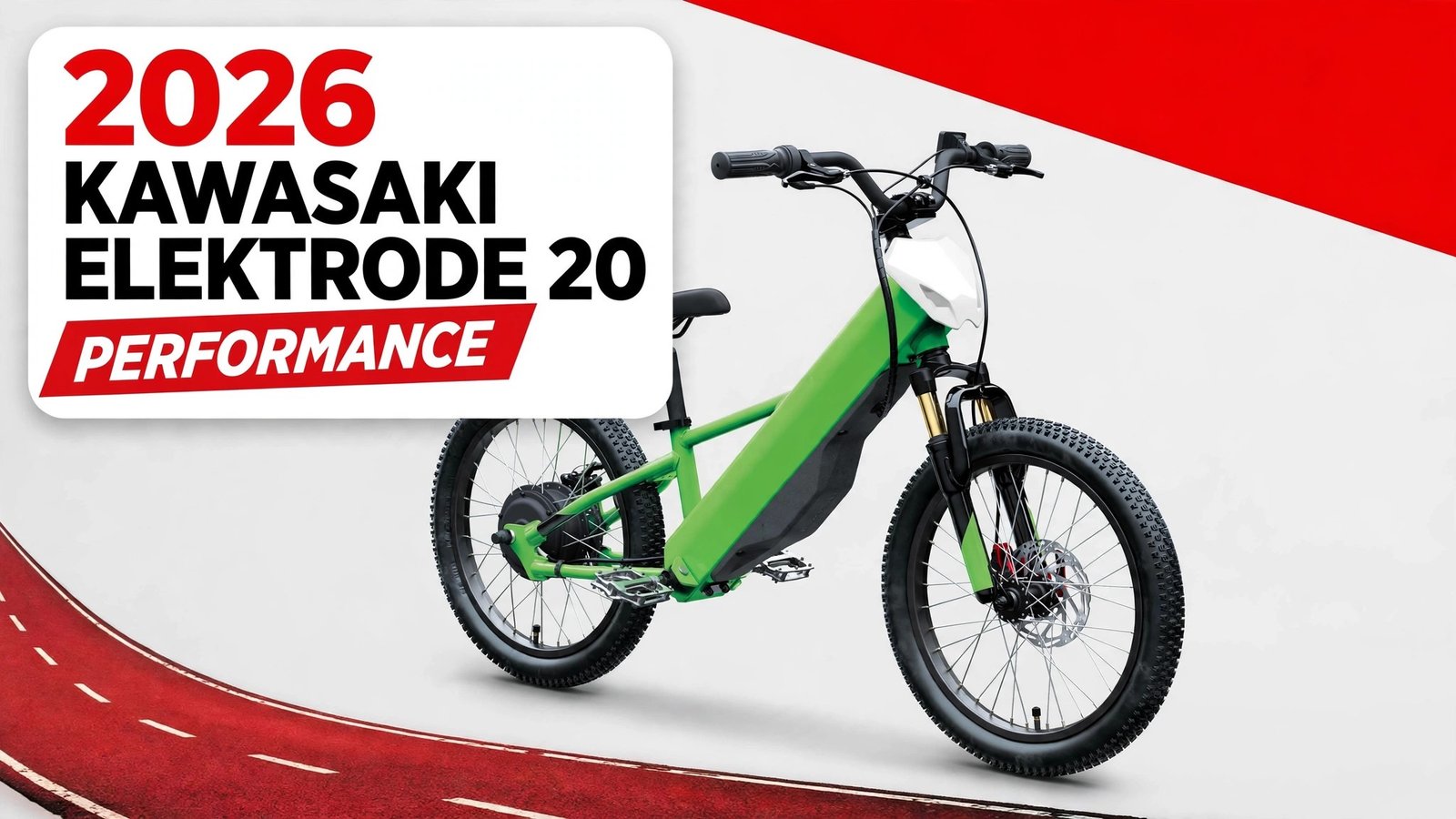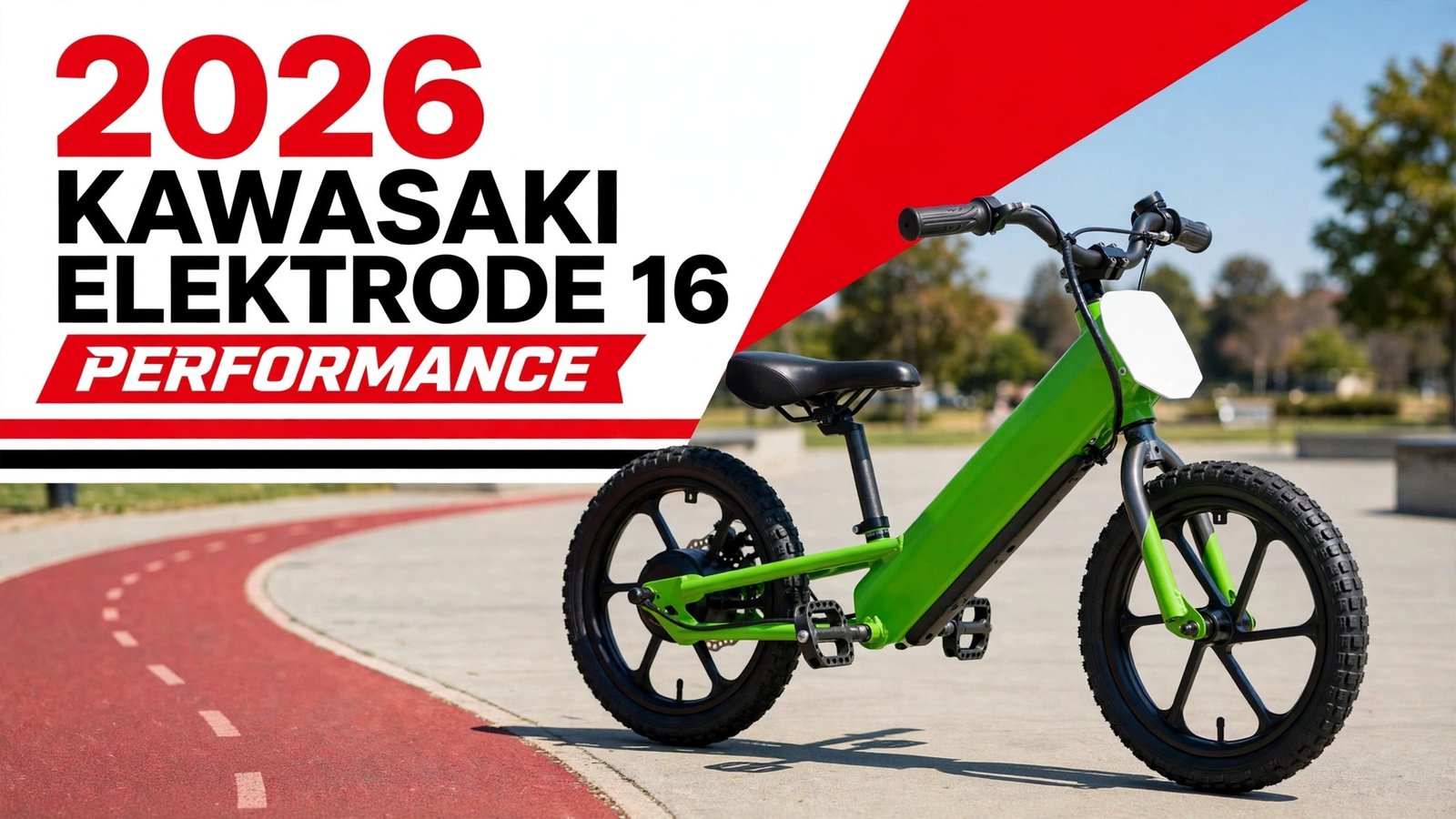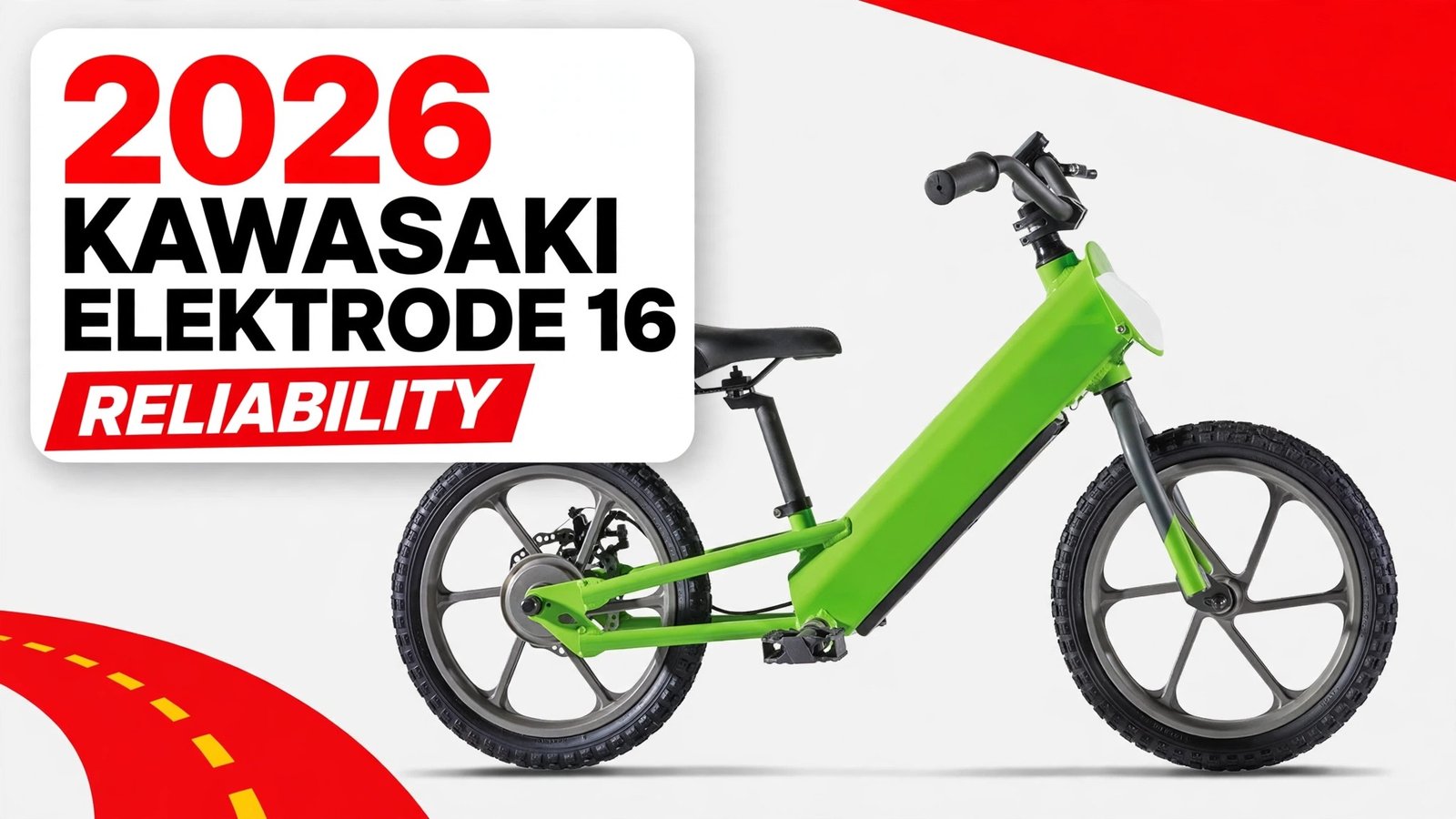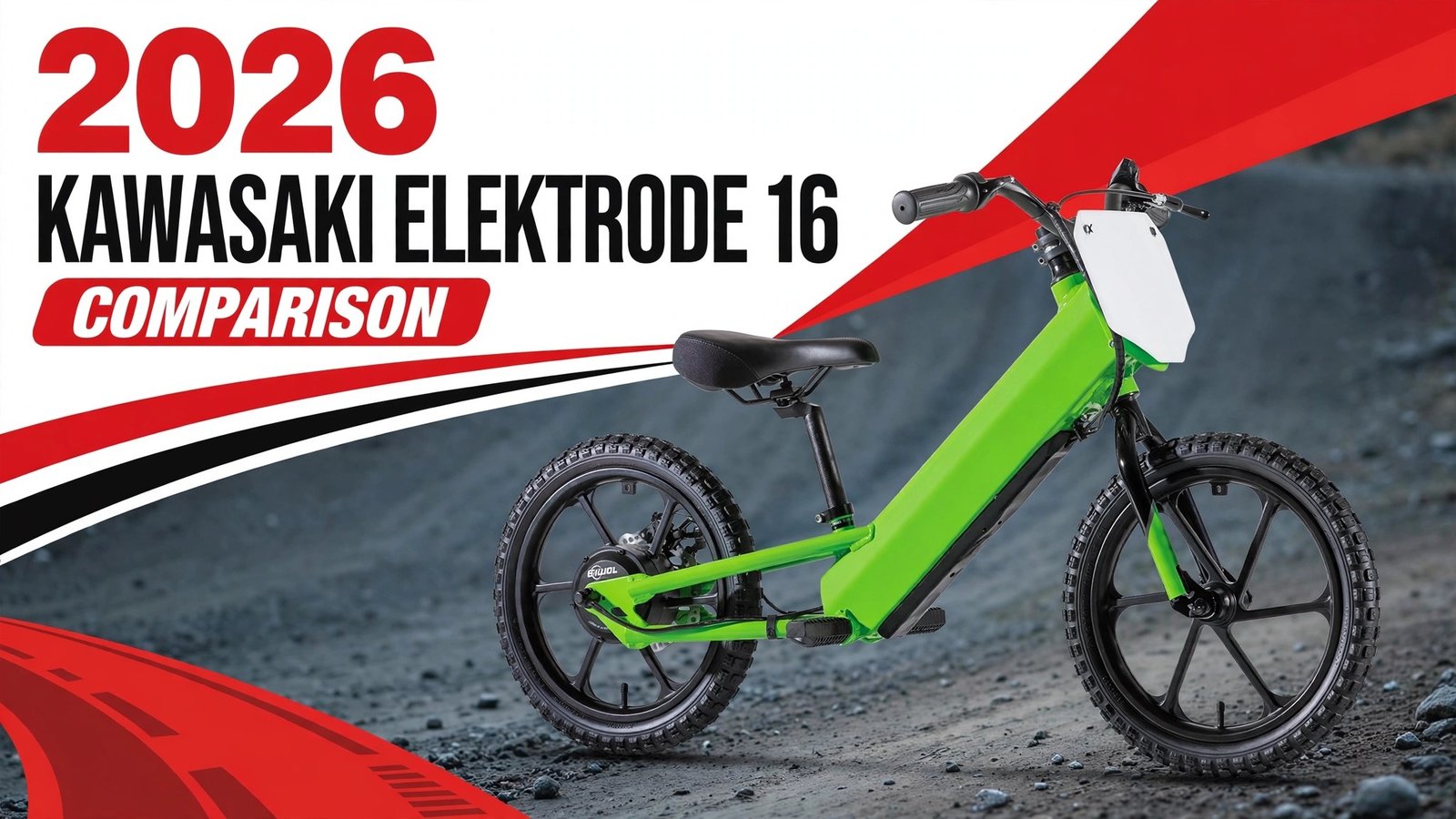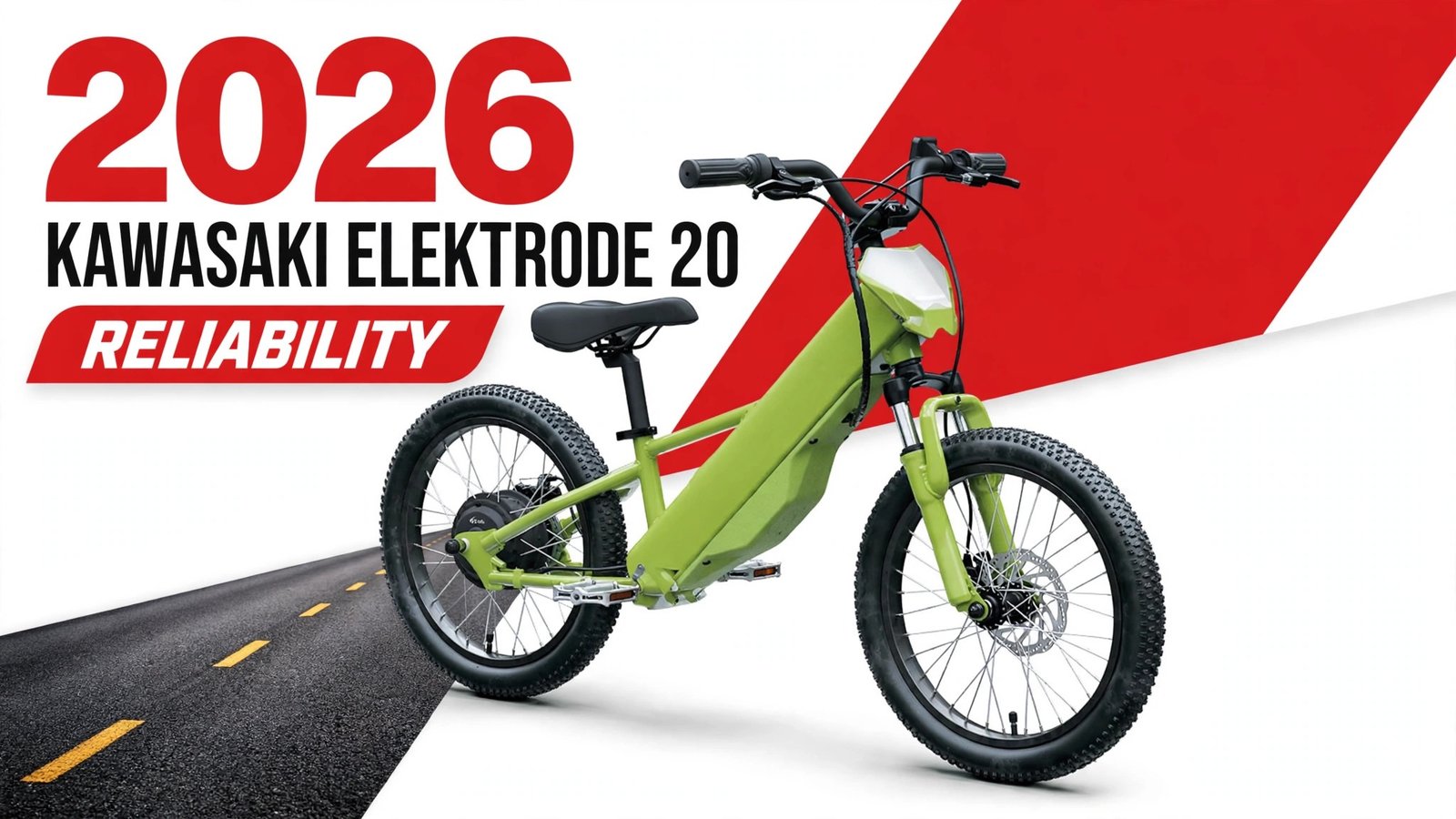
The Kawasaki Elektrode 20 is a kids’ electric balance bike with almost nothing to service. There is no engine oil, no petrol, no spark plug, no air filter, no chain and no exhaust. This Kawasaki Elektrode 20 reliability guide looks at what that means for owners: a bike whose routine is charging and checking the tyres and brakes. The 20 is the step-up from the Elektrode 16, and it costs $2,199 for both trims on Kawasaki’s own model page — the base 20 and the 20FS — with only one US model year so far, 2025.
Kawasaki Elektrode 20 reliability comes down to three things: a battery built into the frame, a motor in the rear wheel, and a warranty that treats the electrics differently from the frame. The battery and motor are covered for 90 days, the frame for 12 months, and wear items for 30 days. The Cycle News review called the bike “about as close to a zero-maintenance motorcycle as you can get.”
Kawasaki Elektrode 20 Reliability Overview
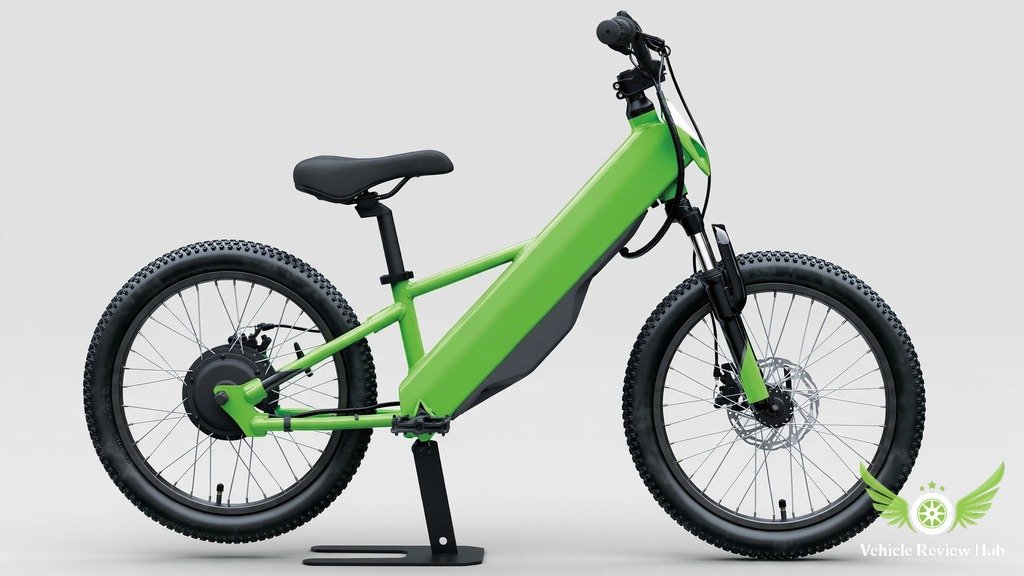
The short version of Kawasaki Elektrode 20 reliability is simple: nothing has been recalled, nothing broke in testing, and the bike asks for very little. Kawasaki Elektrode 20 reliability is a battery story first and a bicycle story second. The battery is a 50.4V 10.2Ah pack (514Wh) built into the frame, not swappable, and the one part whose replacement cost Kawasaki does not publish.
No Recall on CPSC Record
No recall has ever named the Kawasaki Elektrode 20, the 20FS, or any Elektrode. A check of the full US CPSC recall database — the federal database for children’s products — returns zero occurrences of the word “elektrode” in recalls through November 19, 2026. No injuries, no complaints and no defect reports turned up in any source searched either. For Kawasaki Elektrode 20 reliability, a clean recall record is the first thing a buyer should want to see, and this bike has it.
How Mileage, Storage and Previous Care Affect Reliability
How far and how fast the 20 goes depends on the battery’s treatment. Kawasaki’s own footnote says battery age, charge and charge cycles affect run time and top speed, so a used bike left flat in a garage will not run as long as one stored charged. That is how Kawasaki Elektrode 20 reliability changes with mileage and previous care: the battery’s health is set by how the last owner charged and stored it.
Storage is straightforward: store the bike charged, keep the charger with it, and let the bike do the rest — it powers off by itself after 10 minutes of inactivity to save the battery. The battery sits inside the frame, protected from dirt, mud, rocks and falls by design. Ultimate Motorcycling rode the 20 aggressively off-road and over street curbs, and reported that nothing broke or bent, even when adults over the 132 lb weight limit took it for spins.
Kawasaki Elektrode 20 Common Problems and Wear Items
The weak point in Kawasaki Elektrode 20 reliability is not the frame or the fork. It is the warranty on the parts that do the work. The frame is covered for 12 months, but the battery, motor and other electrics for only 90 days, and wear items for 30 days.
Battery Covered Just 90 Days
Ninety days is a short warranty for the most expensive part on the bike. The electrics tier covers the battery, the rear in-wheel motor, the control housing, the charging harness, the throttle assembly, the battery charger and the controller, and if any of those fails after three months, the owner pays. For Kawasaki Elektrode 20 reliability, the 90-day figure is the number that matters most, because the battery is a 514Wh pack built into the frame and it cannot be swapped for a spare the way a rival’s battery can.
Kawasaki’s electrics tier is the same 90 days the Elektrode 16 gets, so the 20 does not improve on the smaller bike here. The battery itself is rated for 500 charge cycles before it drops to 80% of its original capacity. For Kawasaki Elektrode 20 reliability, the battery’s life is generous and its warranty is not.
Replacement Battery Price Unknown
There is no published price for a replacement Elektrode 20 battery anywhere: Kawasaki does not list one, no dealer lists one, and no parts site lists one. The battery is built into the frame and is dealer-replaced, so an owner who needs one has to ask a Kawasaki dealer for a quote. For Kawasaki Elektrode 20 reliability, the unknown price is a real ownership risk: the bike’s most expensive part is also its least transparent one.
The STACYC 20eDRIVE’s spare battery costs $325, and it swaps in by hand because the pack is removable. The Elektrode 20’s battery does not come out at all, so there is no spare-pack option and no do-it-yourself swap. An owner should treat the battery well — store it charged and keep the charge cycles down.
| Coverage | Period | What is covered |
|---|---|---|
| Frame and listed parts | 12 months | Frame, fork, handlebar, front wheel, number plate, brake lever, seat post, seat clamp, frame under cover |
| Electrics | 90 days | Battery, rear in-wheel motor, control housing, charging harness, throttle assembly, battery charger, controller |
| Wear items | 30 days | Seat, footrests, brake cable, brake pad, brake rotor/caliper, paint/decals, tyres and inner tubes |
Note: The 90-day electrics tier is the short one in this Kawasaki Elektrode 20 reliability picture: the battery, motor and controller get three months while the frame gets a year. STACYC covers its frame for five years against Kawasaki’s 12 months, and Orion covers its battery for six months against Kawasaki’s 90 days.
Kawasaki Elektrode 20 Maintenance Schedule and Servicing
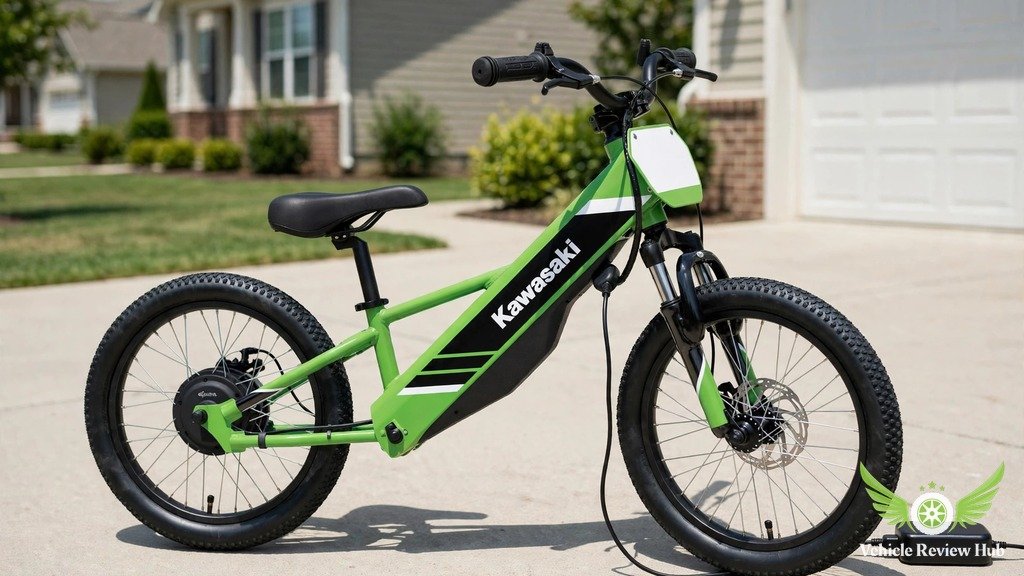
There is no service schedule in the motorcycle sense for this bike, because there is no engine to service. The routine is Kawasaki’s charge-and-inspect routine: charge the battery, check the tyres and brakes, and look the bike over. That is the whole schedule, and it is the reason Kawasaki Elektrode 20 reliability costs its owners so little time. The one gap is that there is no public owner’s manual to check it against.
Charge Time Is About 4 Hours
A full charge takes about 4 hours from flat on a standard 110-V home outlet, using the included charger. The charging connector sits at the front of the bike, not under the frame as on the Elektrode 16, so it is easy to reach. Cycle News notes that about 20 minutes from flat is enough for “a decent ride”, so a short top-up between sessions is genuinely useful. For Kawasaki Elektrode 20 reliability, the charging habit matters more than the charging time: store the bike charged, and do not leave the battery flat for weeks.
The bike helps: it powers off by itself after 10 minutes of inactivity, which saves the battery when a child walks away mid-ride, and it can also be charged from a car, camper or side-by-side. The battery holds 80% of its original capacity after 500 charge cycles. For Kawasaki Elektrode 20 reliability, that 500-cycle figure is the number to remember: it sets how long the battery stays strong.
No Public Manual to Check
There is no public owner’s manual for the Elektrode 20, so this guide never cites a figure “from the manual” — there is no public manual to cite. For Kawasaki Elektrode 20 reliability, the practical effect is simple: owners should use the printed manual supplied with the bike, and ask their dealer when it does not answer the question.
Tyre pressure is the place this matters most: the tyres are happiest around 30 psi for mixed dirt and hardpack, and the safe check is the pressure printed on the tyre sidewall itself. The same rule applies to any other figure: if it is not on the bike, on the printed manual or on Kawasaki’s own 2025 spec sheet, treat it as unverified and ask a dealer.
| Check | When | What to do |
|---|---|---|
| Charge the battery | After every ride, or when low | Included charger at the front; about 4 hours from flat, 20 minutes for a decent ride |
| Tyre pressure | Before every ride | Around 30 psi, per the sidewall |
| Brakes | Before every ride | Cable, pads and rotors, both 160 mm discs |
| Battery storage | Between rides | Store charged; bike sleeps after 10 minutes idle |
| Full inspection | Regularly | Fork, pedals, bolts and number plate; keep a record |
Note: This is the whole maintenance schedule for Kawasaki Elektrode 20 reliability: charge, check the tyres and brakes, and look the bike over. There is no oil, filter, valve or chain schedule to print, because the bike has none of those.
Kawasaki Elektrode 20 Tires, Brakes and Suspension Maintenance

The tyres, brakes and suspension on the 20 are bicycle parts. The tyres are IRC knobby tyres with tubes, the brakes are mechanical discs front and rear, and the base 20 has a 28 mm telescopic fork with 50 mm of travel while the 20FS has a rigid fork. The one job that is harder than it looks is a flat on the rear tyre, and that is where Kawasaki Elektrode 20 reliability asks its owners for patience.
Rear Flats Are Harder Work
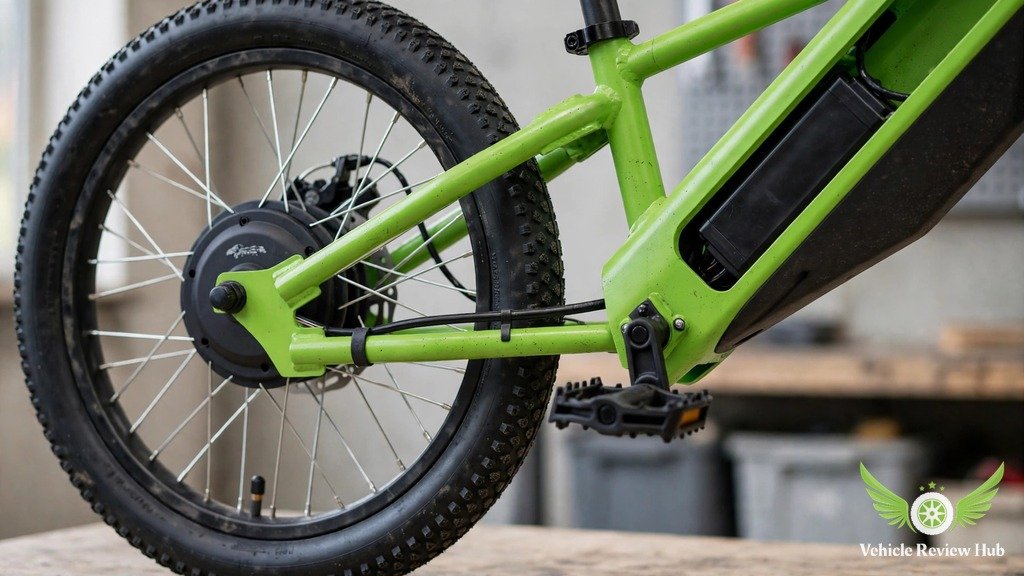
A flat on the rear tyre is harder to fix on the 20 than on a chain bike, because the motor is built into the rear wheel. Cycle News puts it plainly: “There’s no chain to lube or adjust thanks to the hub-mounted rear motor; however, this means it can be a pain to fix flats, as removing the rear wheel requires some effort.” The motor, the wiring and the hub’s weight all sit in the wheel that has to come off, so a rear puncture is a longer job than the same puncture on a bicycle. For Kawasaki Elektrode 20 reliability, this is the most likely repair an owner will actually face, and it is worth knowing before the first flat happens.
The front wheel is the opposite story: a normal bicycle-style wheel with no motor in it, so a front flat is a standard bicycle job. Carry a spare tube and a pump, and fix a rear flat at home rather than on the trail. The tyres themselves are IRC 20×2.125 on the base 20 and 20×1.95 on the 20FS, both with tubes, and both are happiest around 30 psi for mixed dirt and hardpack.
Tire, Brake and Suspension Checks That Matter
The checks that matter are the short ones before every ride. Check the tyre pressure against the sidewall, and look for cuts, embedded stones and worn knobs. Check both brakes: squeeze each lever, look at the cable, and check the pads and the 160 mm rotors for wear. The mechanical setup is a genuine advantage: no hydraulic fluid to bleed and nothing to spill in a crash, as Cycle News notes. For Kawasaki Elektrode 20 reliability, a two-minute check before the ride keeps a small problem from becoming a ride-ending one.
The suspension needs less attention: the base 20’s fork is non-adjustable, so just check it moves freely and the brace and bolts are tight. The 20FS fork is rigid and the rear is a hardtail on both, so there is nothing else to service. Check the foldable pedals too: they fold inward on ground contact and spring back, and they should move freely without sticking.
Kawasaki Elektrode 20 Maintenance and Ownership Costs
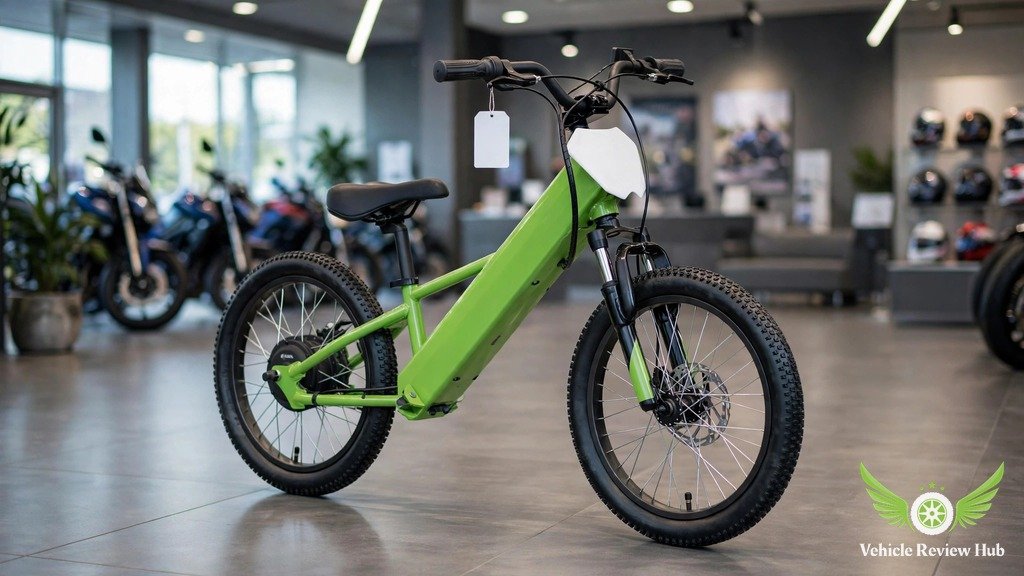
Owning the 20 costs very little after the purchase: no fuel, no oil and no routine servicing bill, so the running costs are electricity, tyres and tubes. The real ownership story is the purchase price: the $2,199 MSRP is the same for both trims, and dealers are selling well under that. For Kawasaki Elektrode 20 reliability, the costs are low — but the one cost nobody can quote is the battery, and that is the gap to keep in mind.
Fuel, Routine Servicing, Tires and Replacement Parts
There is no fuel to buy: a full charge takes about 0.5 kWh of electricity — the 514Wh battery, filled from a home outlet — and there is no petrol, no oil and no routine servicing beyond tyre and brake checks and charging. The parts that wear are the tyres and inner tubes, the brake pads and cables, and the brake rotors — all 30-day warranty items and simple bicycle parts. For Kawasaki Elektrode 20 reliability, the servicing story is the absence of servicing: nothing on this bike has an oil change, a valve check or a chain adjustment, because it has no oil, no valves and no chain.
Replacement parts come through Kawasaki dealers — and the 20 and the 16 are different platforms, so their parts are not interchangeable, as the HS Motorsports fit guide confirms. Confirm 16 or 20 before ordering any model-specific part.
Street Prices Run Below MSRP
Dealers are selling the Elektrode 20 well below its $2,199 MSRP. Street prices run $1,099 to $1,799 as dealer sale prices — $400 to $1,100 under MSRP — including $1,295 at R/T Powersports and $1,099 on Cycle Trader. For Kawasaki Elektrode 20 reliability, the street price changes the value of the warranty: a bike bought for $1,099 with a 90-day battery warranty is a different proposition from the same bike at $2,199.
No destination or freight figure is published for the Elektrode 20 — the spec-sheet footnote only says the MSRP excludes destination, options, taxes, title and license, and dealer fees, without giving a number, and the 16’s $50 freight surcharge does not carry over to the 20. The rival prices put the discount in context in our Elektrode 20 comparison: the Orion e20x-FS lists at $1,549 and the STACYC 20eDRIVE at $2,599, so a discounted 20 at $1,099 to $1,799 sits in the middle of the field rather than at the top of it.
| Cost | Amount | Notes |
|---|---|---|
| MSRP, both trims | $2,199 | Both trims the same; no destination figure |
| Dealer sale prices | $1,099–$1,799 | Dealer sale prices, Nov 2026; $400–$1,100 under MSRP |
| Electricity per full charge | About 0.5 kWh | 514Wh battery; no fuel, no oil |
| Replacement battery | Price not published | In-frame, dealer-replaced; ask a dealer for a quote |
| Tyres, tubes and brake pads | Wear items | 30-day warranty; IRC 20×2.125 (20) / 20×1.95 (20FS), 160 mm discs |
Note: The running costs in this Kawasaki Elektrode 20 reliability guide are electricity and wear items only: no fuel, no oil and no routine servicing bill. The one cost with no number attached is the replacement battery, which Kawasaki does not price anywhere.
How to Keep a Kawasaki Elektrode 20 Reliable
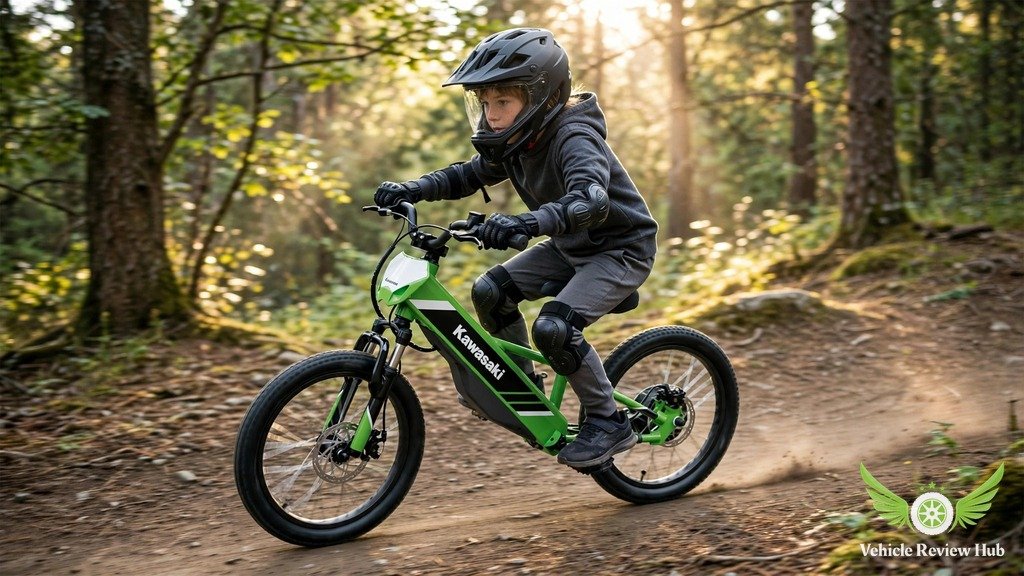
Keeping the 20 reliable takes less work than almost any other bike, because there is so little to go wrong. One more thing to know: unlike the Elektrode 16, the 20 has no passcode lock on its speed modes, so the rider changes modes with a button on the handlebar dash — parents should know that before they hand the bike over. For Kawasaki Elektrode 20 reliability, the ownership routine is short enough to do every time, and that is exactly why it works.
Preventive Maintenance, Records and Regular Inspections
Preventive maintenance on the 20 is three habits. First, keep the battery charged and store the bike charged — battery age, charge and charge cycles set the run time and top speed, so the battery’s health is the bike’s health. Second, check the tyres and brakes before every ride: pressure around 30 psi for mixed dirt and hardpack, pads and rotors in good shape, cables moving freely. Third, look the bike over regularly and write down what was checked and when. For Kawasaki Elektrode 20 reliability, the record matters because the battery’s history is invisible: a bike with a log of regular charging is worth more than the same bike without one.
The run-time figures in our Elektrode 20 performance guide are the benchmark: Cycle News measured about 45 hard minutes and an hour and a half or more of gentle riding. If a bike that used to run that long now fades much sooner, the battery is the first suspect, not the motor — have it checked by a dealer.
Genuine Parts via Dealers
Genuine parts for the Elektrode 20 come through Kawasaki dealers. That matters because the 20 and the 16 are different platforms and their parts are not interchangeable — ordering a 16 part for a 20, or the other way round, wastes time and money. Confirm whether the bike is a 16 or a 20 before ordering any model-specific part, and confirm the trim too. For Kawasaki Elektrode 20 reliability, the dealer is also the only route to the parts that cannot be bought off the shelf: the in-frame battery is dealer-replaced, and a dealer is the only source of a quote for it.
Owners who run both bikes can check our Elektrode 16 reliability guide for the smaller bike’s own parts story. Families who buy the 16 first and the 20 later should keep the two bikes’ parts separate — nothing from the 16 carries over.
Kawasaki Elektrode 20 Reliability: Frequently Asked Questions
The questions below cover what owners and buyers ask most: recalls, warranty, the battery, charging, maintenance, flat tyres and parts. The answers use the verified figures from this Kawasaki Elektrode 20 reliability guide — no guesses, and no number printed where none exists.
Has the Kawasaki Elektrode 20 been recalled?
No. A check of the full US Consumer Product Safety Commission recall database found no recall naming any Elektrode. Balance bikes are not motor vehicles, so the NHTSA recall database does not cover them. For Kawasaki Elektrode 20 reliability, the recall record is clean from the start.
What warranty does the Elektrode 20 have?
12 months on the frame, fork, handlebar, front wheel, number plate, brake lever, seat post, seat clamp and frame under cover; 90 days on the battery, rear in-wheel motor, controller, charging harness, throttle, charger and control housing; 30 days on wear items such as the seat, footrests, brake pads, brake cables, tyres and tubes. For Kawasaki Elektrode 20 reliability, the warranty split is the whole story: a year on the frame, a quarter on the parts that do the work.
How much does a replacement battery cost for the Elektrode 20?
Kawasaki publishes no replacement battery price, and no dealer or parts site lists one. The battery is built into the frame and is dealer-replaced — ask a Kawasaki dealer for a quote. By comparison, the STACYC 20eDRIVE’s spare battery costs $325 and swaps in by hand. For Kawasaki Elektrode 20 reliability, the unknown battery price is the one cost an owner cannot plan for.
How long does the Elektrode 20 take to charge?
About 4 hours from flat on a standard 110-V home outlet, using the included charger. Cycle News notes that about 20 minutes from flat is enough for “a decent ride”, and the bike powers off by itself after 10 minutes of inactivity to save the battery. For Kawasaki Elektrode 20 reliability, the charging habit is the whole maintenance habit: keep it charged and top it up after every ride.
Does the Elektrode 20 need any maintenance?
Almost none: there is no engine oil, petrol, spark plug, air filter, chain, clutch or exhaust. The routine is charging, tyre-pressure checks (around 30 psi for mixed dirt and hardpack), brake-cable and pad checks, and keeping the battery charged. Cycle News calls it “about as close to a zero-maintenance motorcycle as you can get.” For Kawasaki Elektrode 20 reliability, the maintenance list is the absence of one.
Are rear tyre punctures hard to fix on the Elektrode 20?
Yes, harder than on a chain bike: the motor is built into the rear wheel, so removing the rear wheel to fix a flat takes more effort. The front wheel is a normal bicycle-style wheel, so a front flat is a standard bicycle job. For Kawasaki Elektrode 20 reliability, the rear flat is the one repair to plan for: carry a spare tube and a pump.
Can I use Elektrode 16 parts on the Elektrode 20?
No. The 16 and 20 are different platforms and their parts are not interchangeable — confirm whether you own a 16 or a 20 before ordering any model-specific part, and buy genuine parts through Kawasaki dealers. For Kawasaki Elektrode 20 reliability, the parts rule is simple: order for the 20, not for the 16.