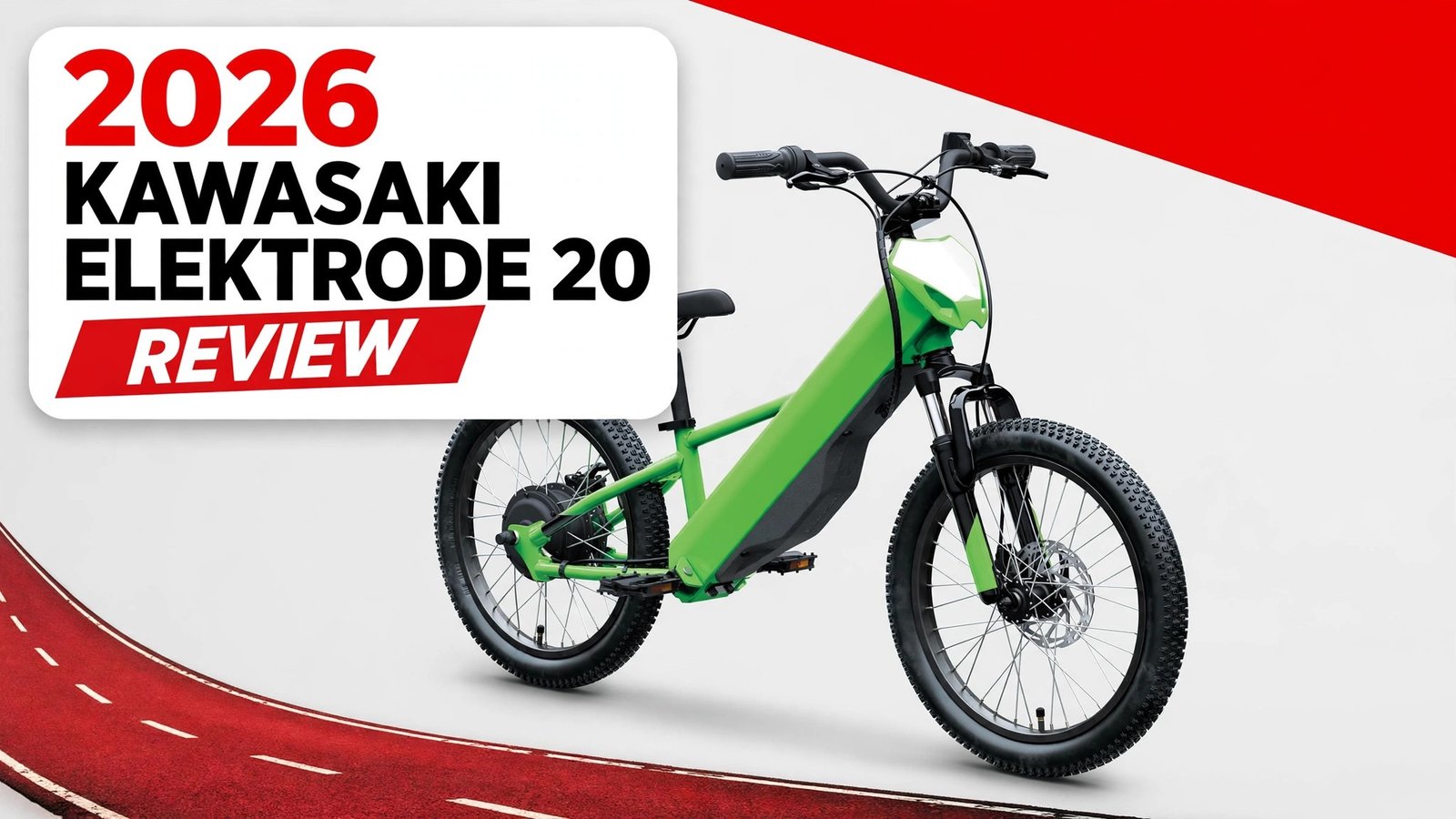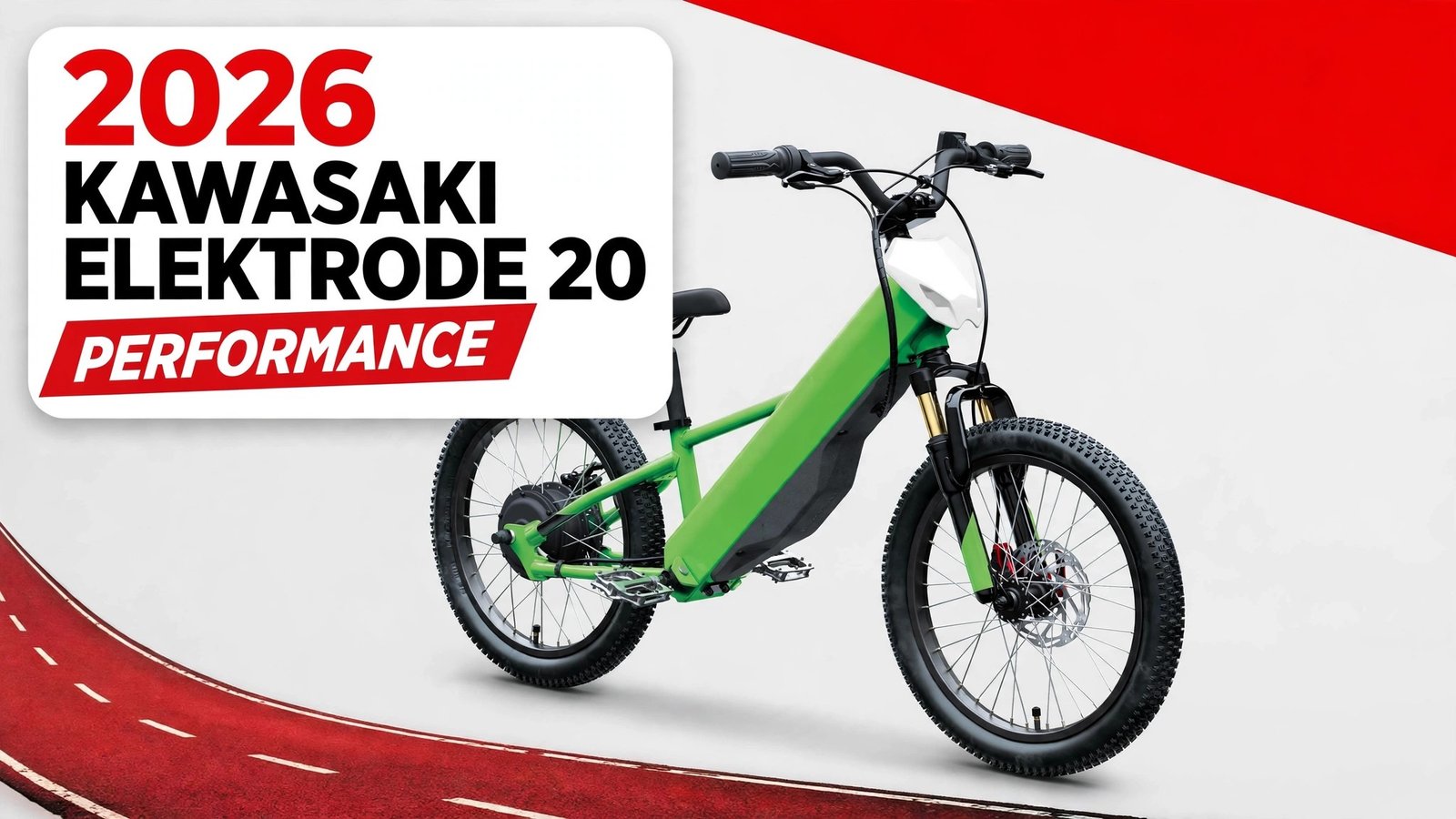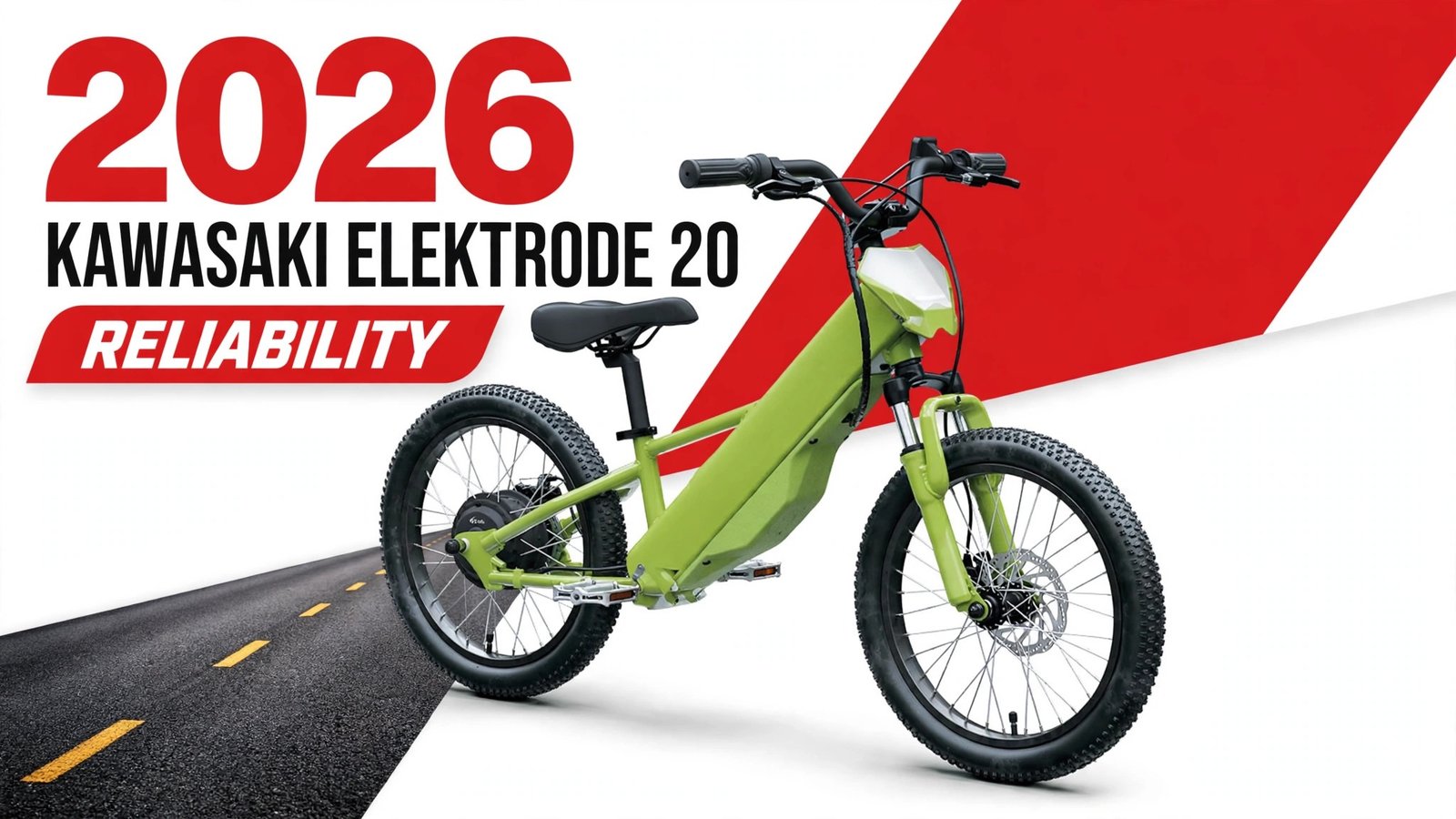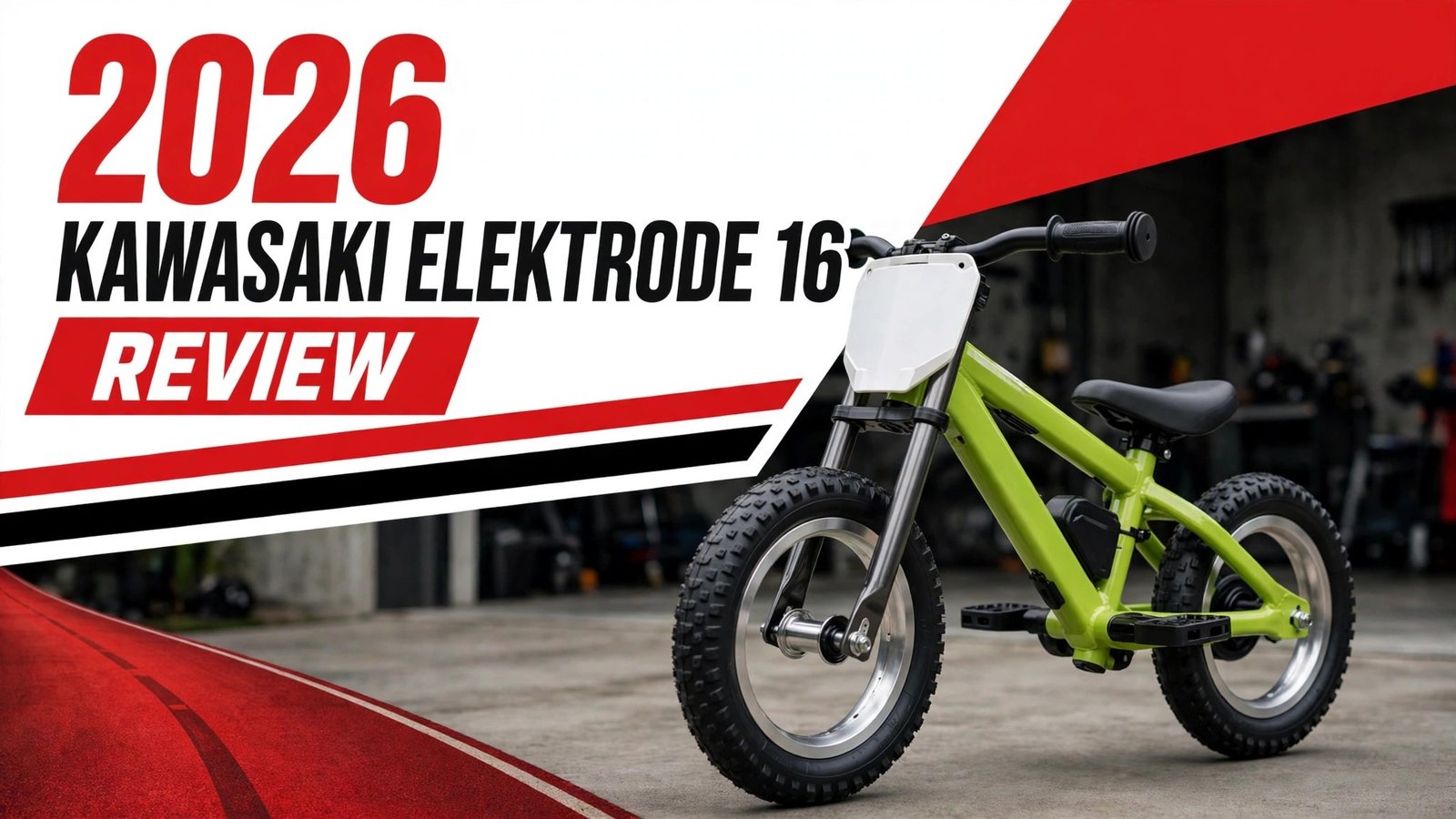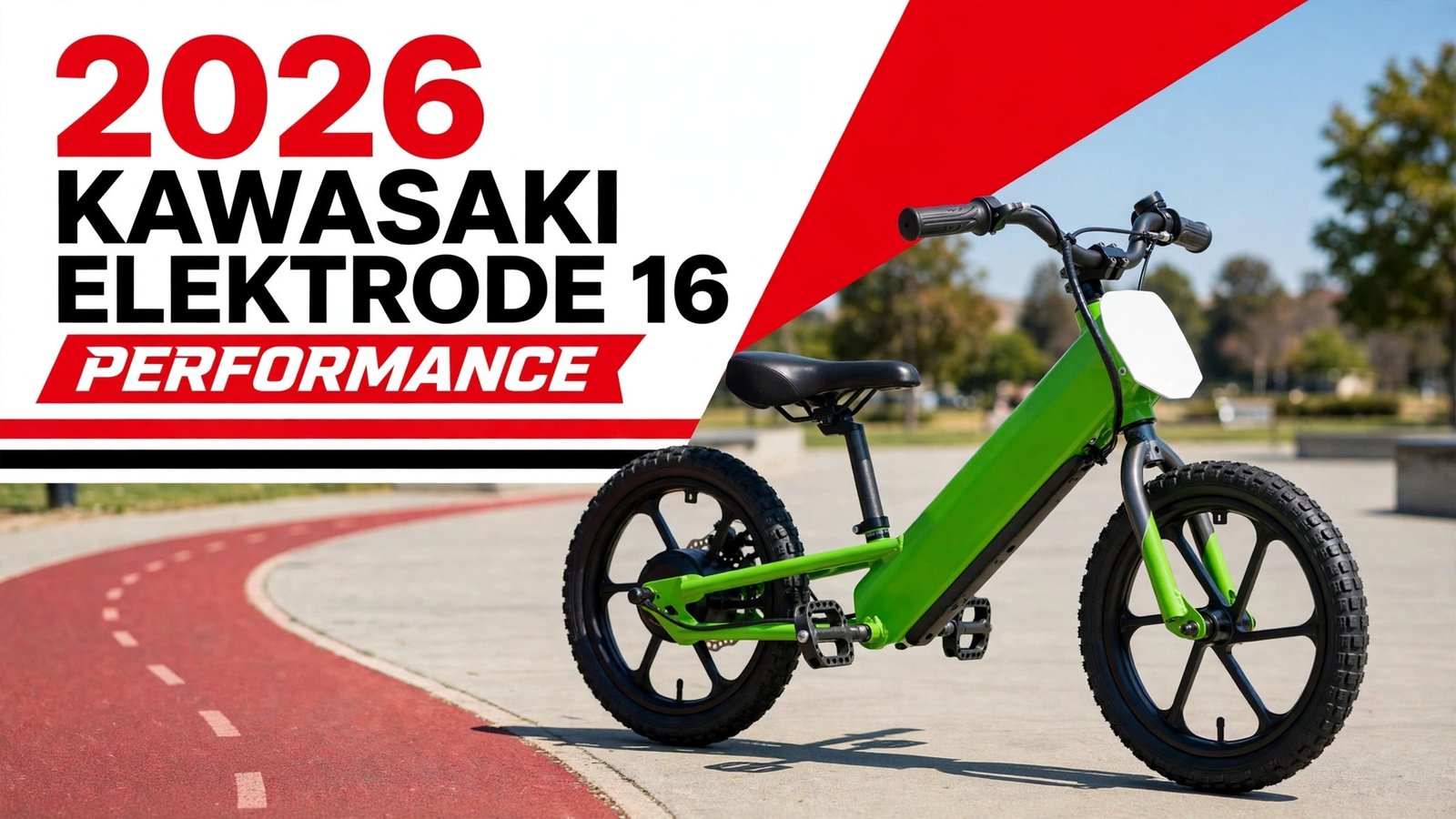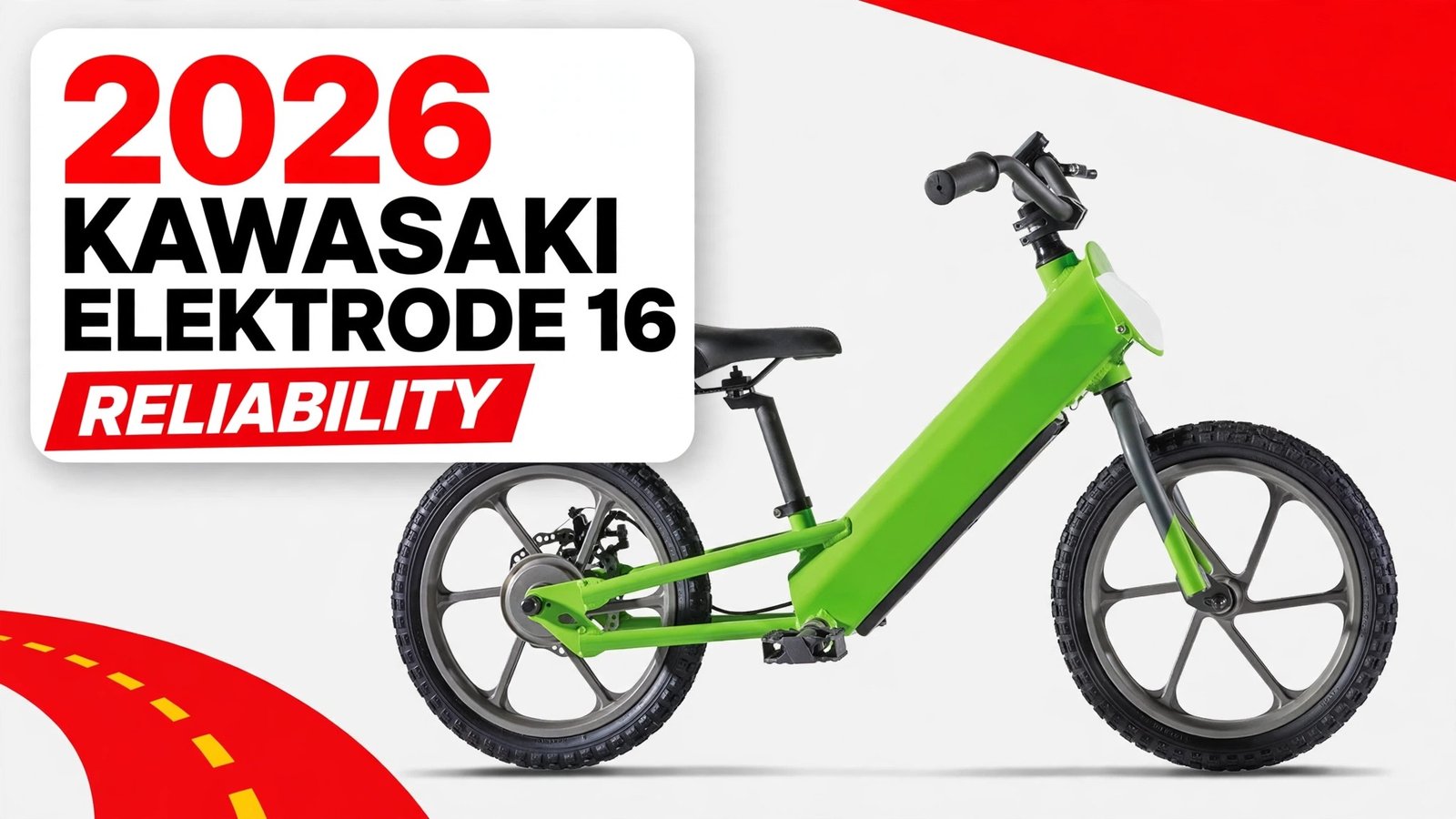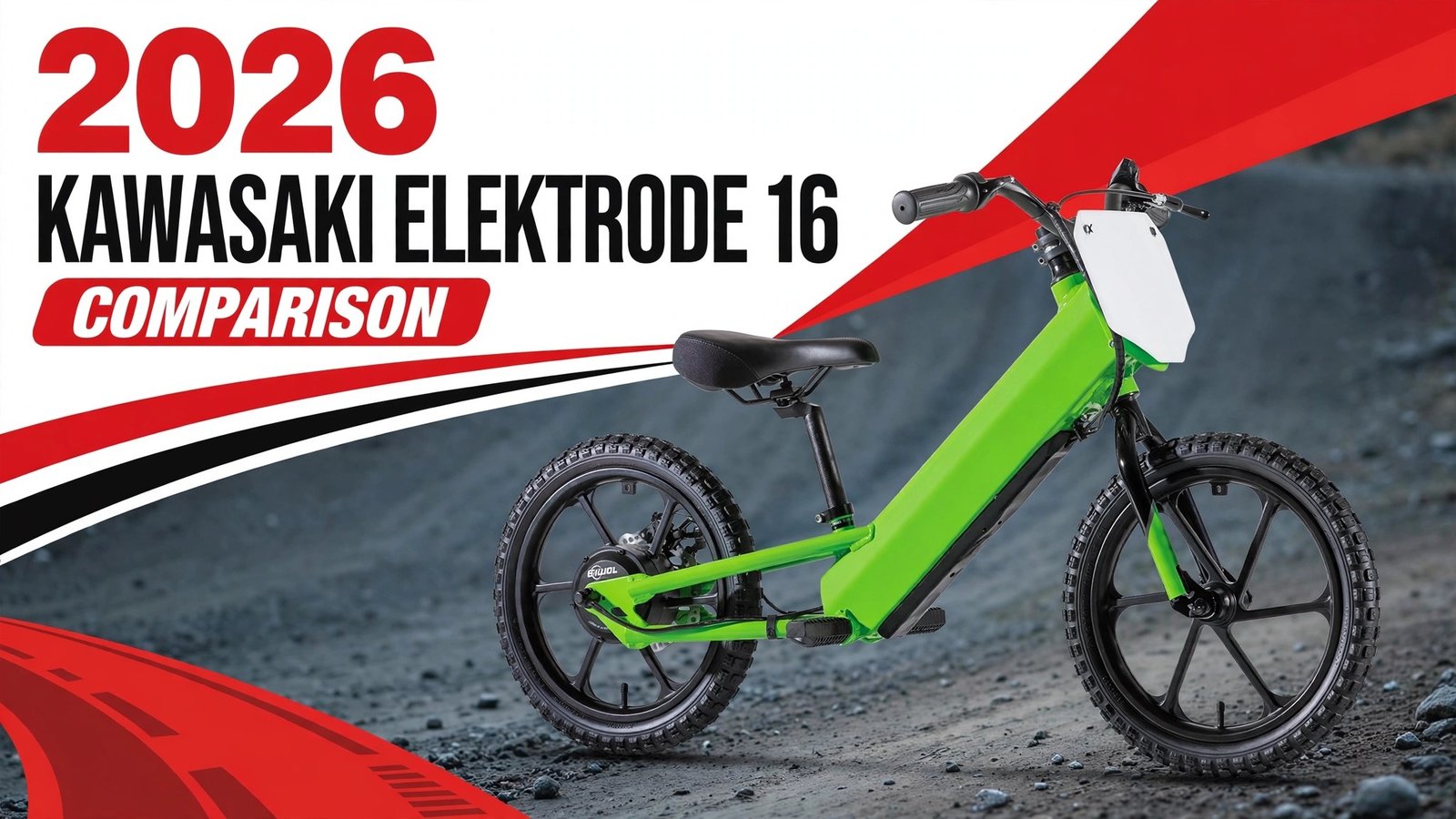
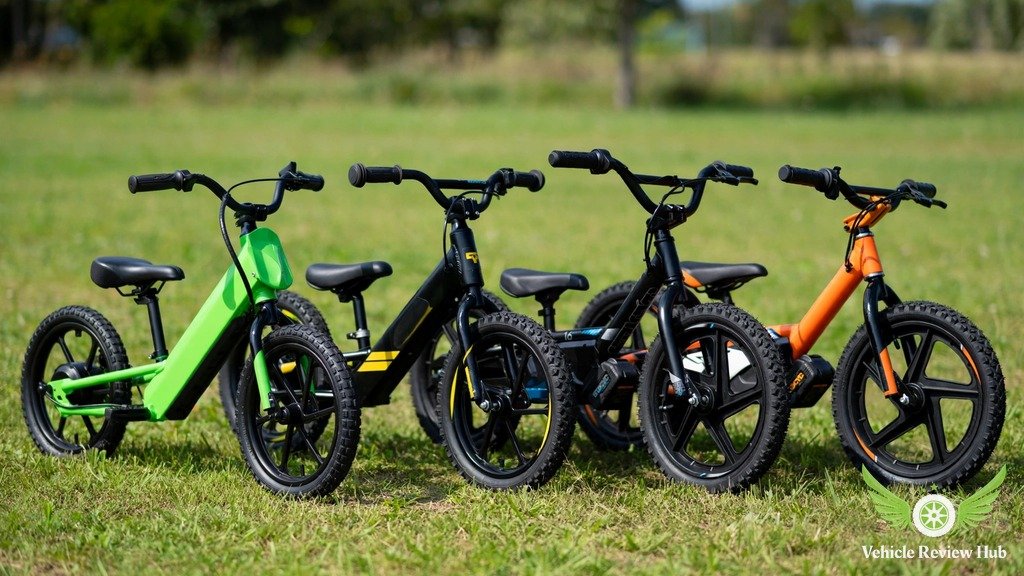
Four small electric balance bikes chase the same buyer, and the dearest is the Kawasaki. The Elektrode 16 costs $1,099, against $999 for the Orion e16X, $1,049 for the STACYC 16eDRIVE Brushless and $1,080 for the KTM Factory Replica 16eDRIVE. This Kawasaki Elektrode 16 comparison puts the four side by side on price, battery and run time, weight, fit and which child each bike suits.
The Elektrode is not the cheapest, the lightest or the fastest of the four — but this Kawasaki Elektrode 16 comparison gives each rival its fair win, and says plainly where the Kawasaki loses.
Kawasaki Elektrode 16 Overview and Its Closest Rivals
The four bikes in this Kawasaki Elektrode 16 comparison are all 16-inch electric balance bikes for children: a powered first bike with no pedals, no chain, no clutch, where a parent controls the speed. Beyond that they differ sharply: the Elektrode and the Orion offer longer run times, while the STACYC and its KTM twin trade run time for a quick battery change.
Kawasaki’s own product walk-around shows the Elektrode 16 on its own — frame, in-wheel motor, handlebar dash and passcode lock. No head-to-head video against the STACYC, the Orion or the KTM exists, so the comparisons here come from the spec sheets and tester reports.
Wins on Run Time, Loses on Swap
The Elektrode’s single biggest advantage in this Kawasaki Elektrode 16 comparison is how long it runs: Kawasaki claims 150-plus minutes and about nine miles per charge, and Ultimate Motorcycling’s tester never depleted the battery in a day, even sharing it with his son’s big sister Avery. The STACYC and the KTM manage 30 to 60 minutes, so the Elektrode runs roughly three times as long. The Orion claims four hours, which is longer still — but no independent tester has verified that claim the way Ultimate Motorcycling verified the Elektrode’s day-long run time.
The trade is the battery itself. The Elektrode’s 36V 5.1Ah pack is built into the frame and cannot be swapped, so when it is flat the riding stops for about two and a half hours while it charges. The STACYC, the Orion and the KTM all use packs that come off the bike, so a second pack is an instant refuel — the one clear loss in this Kawasaki Elektrode 16 comparison.
How the Four Bikes Differ at a Glance
The table below sets the four bikes against each other, all figures from the manufacturers’ own spec sheets and brochures. Two figures carry conflicts that this Kawasaki Elektrode 16 comparison labels: the Orion’s weight (29 lb from Orion, 33 lb from dealers) and the KTM’s price ($1,080 today against $1,069.99 at launch).
| Bike | MSRP | Motor | Battery | Run time | Top speed | Weight | Seat | Ages |
|---|---|---|---|---|---|---|---|---|
| Orion e16X | $999 | 500W brushless hub | 36V 8Ah removable | 4 h claimed | 20 mph (26 Race) | 29 lb (dealers: 33 lb) | 19–23.5 in | 4–8 |
| STACYC 16eDRIVE Brushless | $1,049 | Brushless (no W published) | 20V 4Ah swappable | 30–60 min | ~13.5 mph | 19 lb | 17 in | 5–7 |
| KTM Replica 16eDRIVE | $1,080 | Brushless (STACYC) | 20V 4Ah swappable | 30–60 min | 13 mph | ~20 lb | 17 in | 4–8 |
| Kawasaki Elektrode 16 | $1,099 (+ $50 freight) | 250W brushless in-wheel | 36V 5.1Ah in-frame | 150+ min claimed | 13 mph | 31.97 lb | 16.1–20.5 in | 3–8 |
Note: Prices in this Kawasaki Elektrode 16 comparison are manufacturers’ list prices; none of the four rivals publishes a destination figure, and the Elektrode’s $50 is a Freight and Materials surcharge — not a destination charge. The Orion’s 26 mph Race Mode is adult-only — never a kids’ mode. The STACYC’s 2025 brochure lists modes of about 6, 8 and 13.5 mph; the 2024 brochure listed about 5, 7.5 and 13 mph.
Kawasaki Elektrode 16 vs STACYC 16eDRIVE Brushless
The STACYC 16eDRIVE Brushless is the market default and the bike the Elektrode was built to answer — Ultimate Motorcycling’s verdict calls the Elektrode “a legitimate alternative to the Stacyc”, the right frame for this Kawasaki Elektrode 16 comparison.
Engine, Specs and Performance Side by Side
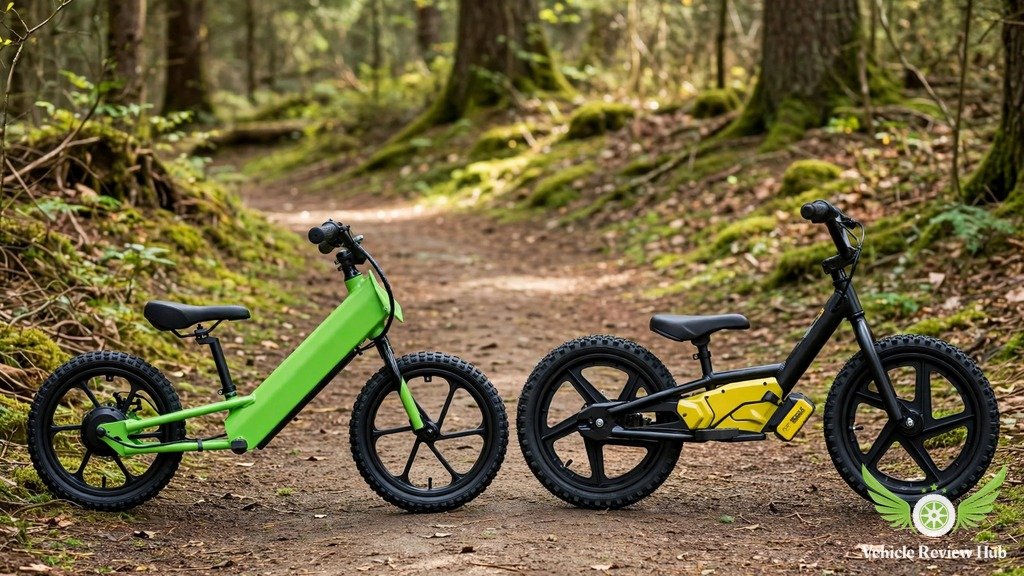
Both bikes use a brushless drive, but STACYC publishes no watt figure — the Elektrode’s 250W is the only published figure. The battery is the real contrast in this Kawasaki Elektrode 16 comparison: the Elektrode’s 36V 5.1Ah pack is built into the frame and holds 187.2 watt-hours, while the STACYC’s 20V 4Ah pack slides off like a power-tool battery. The Elektrode claims 150-plus minutes and about nine miles per charge; the STACYC claims 30 to 60 minutes, and a 2020 MXA test found its 4Ah pack lasted longer than an hour when ridden gently.
Top speed is effectively a tie: the Elektrode caps at 13 mph in High mode, the STACYC’s 2025 brochure lists about 13.5 mph. Ultimate Motorcycling measured the Elektrode at 12.6 mph on GPS. The weight gap is the real one: the STACYC is 19 lb with its battery, and the Elektrode is 31.97 lb — nearly 13 lb heavier, which a parent feels every time the bike is lifted into a car. The Elektrode answers with a rear 160 mm disc brake against the STACYC’s rear drum, and cast wheels against composite rims.
Price, Equipment and Which Suits Which Rider
The STACYC costs $1,049 — $50 less than the Elektrode’s $1,099, $100 less once the Elektrode’s $50 Freight and Materials surcharge is added. The STACYC also starts later: ages five to seven, a 17-inch seat, a rider limit under 75 lb, while the Elektrode starts at age three, drops its seat to 16.1 inches and carries riders up to 99.5 lb. A three- or four-year-old fits the Elektrode better, and a bigger child near the STACYC’s 75 lb limit fits the Kawasaki better too.
For a five- to seven-year-old who rides in long sessions, this Kawasaki Elektrode 16 comparison finds the STACYC’s swappable battery the stronger argument: a spare pack ends the wait, and the bike is light enough to handle alone. For a younger rider, or a family buying a first powered bike, the Elektrode’s passcode lock, longer single run and lower seat are stronger. The review covers the Elektrode’s price and equipment, and the performance guide covers its measured speeds.
Kawasaki Elektrode 16 vs Orion e16X
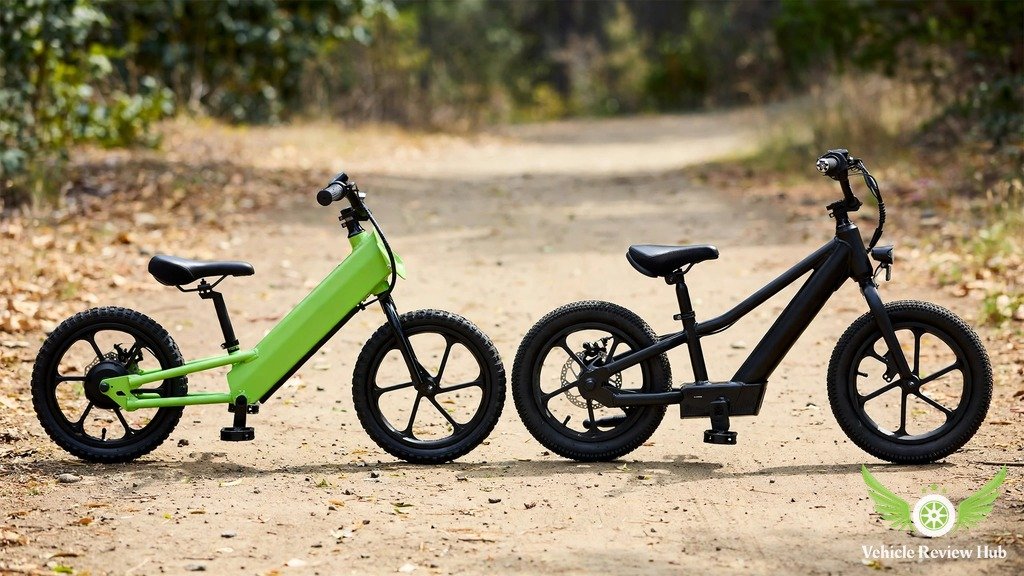
The Orion e16X is the price leader and the power leader of this Kawasaki Elektrode 16 comparison — the rival the Elektrode looks weakest against on paper. It costs $999 — $100 less than the Elektrode before freight, $150 less after it — and its 500W brushless hub motor is double the Elektrode’s 250W. Its removable 36V 8Ah LiFePO4 battery claims four hours and more than 20 miles, against the Elektrode’s 150-plus minutes and about nine miles.
Engine, Specs and Performance Side by Side
The Orion’s motor figure carries a conflict worth naming: Orion’s own site lists 500W, while one dealer listing says 350W. This Kawasaki Elektrode 16 comparison uses Orion’s 500W, since it is the manufacturer’s own figure. Even at 350W the Orion would out-power the Elektrode’s 250W. The Orion’s top speed is 20 mph in High mode, with a 26 mph Race Mode that is adult-only — never a kids’ mode. The Elektrode caps at 13 mph, the safer ceiling for the youngest riders in this group.
Weight is closer than the motor gap suggests in this Kawasaki Elektrode 16 comparison: Orion lists 29 lb, while dealers and BikeRide say 33 lb, so the Orion is either slightly lighter than the Elektrode or slightly heavier. Its seat runs 19 to 23.5 inches — far taller than the Elektrode’s 16.1 to 20.5 inches — and it is aimed at ages four to eight with a 100 lb limit, almost identical to the Elektrode’s 99.5 lb. The Orion’s warranty is one year on the bike and six months on the battery, against the Elektrode’s 12 months on the frame and 90 days on electrics.
Price, Equipment and Which Suits Which Rider
On price alone the Orion wins this Kawasaki Elektrode 16 comparison by $100 on list price and $150 with the Elektrode’s freight added — and it also wins on power, top speed, claimed run time and its removable battery. What the Elektrode keeps is the safety story: a passcode parental lock on the speed modes, which no Orion listing mentions, and a 13 mph cap that suits a three- or four-year-old far better than a 20 mph bike with a 26 mph Race Mode hiding in its settings.
The choice turns on the child’s age and the parent’s comfort with speed. A bigger, older child who has already ridden a balance bike and wants more speed and range will get more from the Orion, with adult supervision. A first powered bike for a three- to five-year-old belongs to the Elektrode, where the passcode keeps the speed at five mph until a parent decides. The Orion’s four-hour run time and 20-plus-mile range are manufacturer claims, not tester-verified figures.
Kawasaki Elektrode 16 vs KTM Replica 16eDRIVE
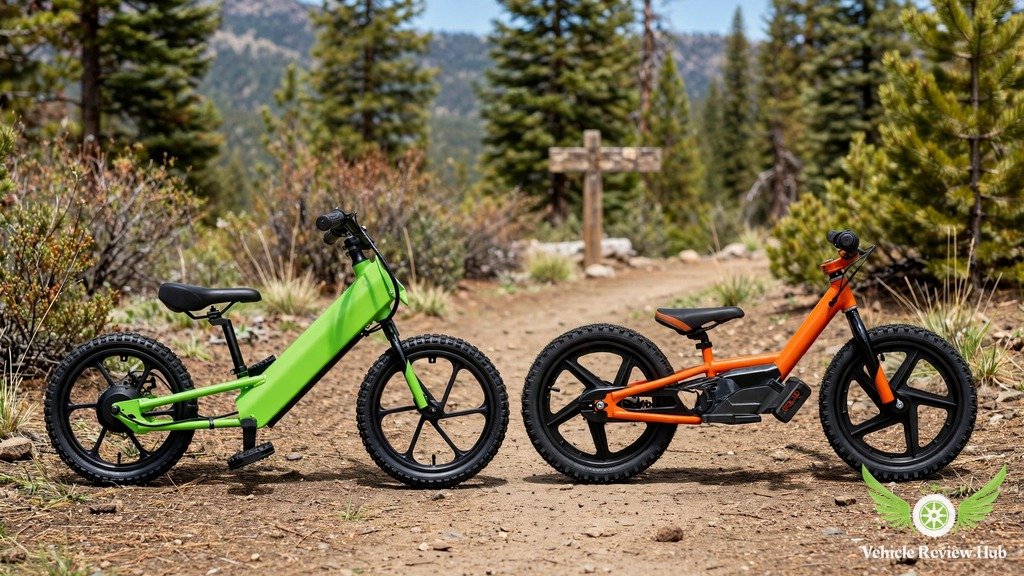
The KTM Factory Replica 16eDRIVE is a STACYC 16eDRIVE Brushless in KTM Factory Replica livery — the same bike, orange plastics, KTM branding. This Kawasaki Elektrode 16 comparison therefore measures the Elektrode against the STACYC’s hardware a second time, with a different badge and a $1,080 dealer price.
Engine, Specs and Performance Side by Side
The KTM Replica carries the same specs as the STACYC it is based on: a brushless drive, a swappable 20V 4Ah battery, 30 to 60 minutes of run time, a 13 mph top speed and a 17-inch seat, at about 20 lb, for ages four to eight, inseam 18 to 24 inches. Against that the Elektrode offers 150-plus minutes per charge, a rear disc brake instead of a drum, cast wheels instead of composite rims, a seat that drops to 16.1 inches, ages from three, and a 99.5 lb limit against the STACYC family’s roughly 75 lb.
The KTM’s price carries a small conflict: it launched in February 2021 at $1,069.99, and current dealers list it at $1,080, while one Cycle Trader listing shows a “2026 KTM Replica 16eDrive” at $1,099. This Kawasaki Elektrode 16 comparison prints $1,080 as the current dealer price. At $1,080 the KTM is $19 cheaper than the Elektrode on list price in this Kawasaki Elektrode 16 comparison — and $69 cheaper once the Elektrode’s $50 freight surcharge is counted.
Price, Equipment and Which Suits Which Rider
The KTM’s real advantage over the Elektrode in this Kawasaki Elektrode 16 comparison is not its $19 price edge but its weight and swappable battery: at about 20 lb it is roughly 12 lb lighter, and a second pack ends a riding session’s wait. Its other advantage is the KTM name — a family already riding KTMs, or a child who wants the orange factory look, will find the Replica an easy choice. The Elektrode’s advantages are the longer single run, the disc brake, the lower seat, the age-three start and the fact that Kawasaki designed and built it in-house, not rebadged.
For a child aged three or four, the Elektrode is the only choice, since the KTM starts at four with a 17-inch seat. For a five- to eight-year-old in a KTM household, the Replica is a fair pick — but buyers should know they are buying a STACYC with orange plastics, and the Elektrode’s longer run time and passcode lock are the two things the Replica cannot match. The reliability guide covers the Elektrode’s warranty and maintenance: 12 months on the frame, 90 days on the electrics and 30 days on wear items.
Kawasaki Elektrode 16 Price and Value Compared
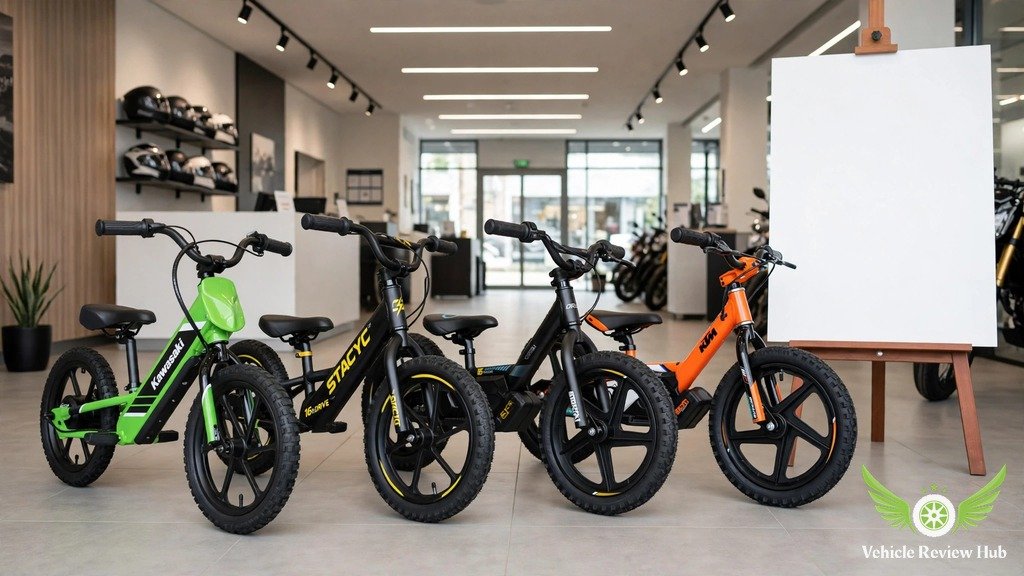
Price is where the Elektrode loses this Kawasaki Elektrode 16 comparison outright. It is the most expensive of the four on list price, and the gap widens once freight is counted, because it is the only one with a published freight figure at all. The rivals publish no destination figure, so their list prices are the only numbers to compare.
| Bike | MSRP | Freight / destination | Before tax and fees | Notes |
|---|---|---|---|---|
| Orion e16X | $999 | None published | $999 | Price leader; was $1,099 |
| STACYC 16eDRIVE Brushless | $1,049 | None published | $1,049 | H-D branded version $899 |
| KTM Replica 16eDRIVE | $1,080 | None published | $1,080 | Launch $1,069.99 (Feb 2021) |
| Kawasaki Elektrode 16 | $1,099 | $50 Freight and Materials surcharge | $1,149 | Price frozen since 2023 launch |
Note: In this Kawasaki Elektrode 16 comparison, the Elektrode’s $1,099 has not changed since its 2023 launch. The $50 is a Freight and Materials surcharge, not a destination charge; Kawasaki publishes no destination figure for the Elektrode. Dealers were discounting the Elektrode to $699–$999 in late 2026 — dealer sale prices, not a price cut from Kawasaki.
Spare STACYC Pack Is $195
The spare battery is the STACYC family’s best counter-argument in this Kawasaki Elektrode 16 comparison. A spare 5Ah 20V MAX pack costs $195, and it turns a 30-to-60-minute bike into a 60-to-120-minute bike with a ten-second battery change. But it is not a cheap answer: a STACYC at $1,049 plus a $195 spare pack costs $1,244 — $95 more than the Elektrode’s $1,149 before tax and fees. The STACYC only stays cheaper if the family accepts the shorter single run and buys no spare.
The same arithmetic applies to the KTM Replica, which uses the same pack. The Orion needs no spare to beat the Elektrode on run time, since its removable 36V 8Ah pack claims four hours — though that claim is the manufacturer’s, not a tester’s. The Elektrode’s answer is that its single charge already covers a full day of riding: Ultimate Motorcycling’s tester never depleted it in a day, even sharing the bike between two children.
Running Costs and Resale Value Compared
Running costs are nearly identical across the four bikes in this Kawasaki Elektrode 16 comparison, because all four are electric: a full charge is a fraction of a kilowatt-hour from a home outlet, with no fuel, oil, spark plug or chain to buy. The Elektrode’s 2.5-hour charge is the slowest of the group against the STACYC’s 30-to-60-minute charge, but it is also the least frequent, since the Elektrode runs three times as long per charge. The STACYC’s rear-wheel change is difficult without the maker’s how-to video, according to MXA, while the Elektrode’s tyres and tubes are standard items a parent can fit at home.
No resale figure is published for any of the four, so this Kawasaki Elektrode 16 comparison gives judgement, not data. A Kawasaki badge and a dealer network should help the Elektrode hold value, and a documented battery history — purchase date, charge cycles, storage — matters more than the badge, since battery age and cycles set its used value. The STACYC’s parts ecosystem should help it too, and the Orion’s lower starting price leaves less value to lose — but none of that is a measured resale figure.
Kawasaki Elektrode 16 Comparison Verdict and US Alternatives
The verdict of this Kawasaki Elektrode 16 comparison: the most expensive bike of the four is also the best first bike of the four — for the youngest riders. For an older child the answer changes.

| Rider | Best pick | Why |
|---|---|---|
| Age 3–4, first bike | Kawasaki Elektrode 16 | Only bike starting at age 3; seat 16.1 in; 5 mph low mode, passcode |
| Age 5–7, long sessions | STACYC 16eDRIVE Brushless (+ $195 spare pack) | Lightest, 19 lb; swappable battery ends the wait; huge parts ecosystem |
| Age 6–8, wants speed | Orion e16X | Cheapest, $999; 500W, 20 mph; 4 h claimed — adult supervision of modes |
| KTM household, age 4–8 | KTM Replica 16eDRIVE | STACYC hardware in KTM livery; $1,080; light, swappable, no passcode lock |
Note: Every pick in this Kawasaki Elektrode 16 comparison assumes a helmet, protective gear and adult supervision. The Orion’s 26 mph Race Mode is adult-only, and the Elektrode’s passcode lock is the only parental control in this group that stops a child raising the speed alone.
Verdict: Longest Legs, Youngest Start
The Elektrode wins this Kawasaki Elektrode 16 comparison on two counts that matter most for a first bike. It has the longest legs of the group in tester-verified terms — 150-plus minutes claimed and a full day of riding without depletion in Ultimate Motorcycling’s hands, against 30 to 60 minutes for the STACYC and the KTM. The Orion claims four hours, which is longer on paper, but no independent tester has confirmed it. And it has the youngest start: age three, the widest range at three to eight, and the highest limit at 99.5 lb against under 75 lb for the STACYC.
It loses on price, weight and the battery swap in this Kawasaki Elektrode 16 comparison. At $1,099 plus $50 freight it is the dearest of the four, at 31.97 lb the heaviest by nearly 13 lb over the STACYC, and its in-frame battery cannot be swapped while all three rivals’ packs can. Those are real losses, and a family buying for a five- to seven-year-old who rides all day should weigh them seriously. But for the buyer this bike was designed for — a parent buying a first powered bike for a three- to five-year-old — the passcode lock, the 13 mph cap, the low seat and the day-long battery outweigh a $100 price gap.
Elektrode 20 Is the Step Up
When the 16 is outgrown, the step up in this Kawasaki Elektrode 16 comparison is Kawasaki’s own Elektrode 20 and its bigger 20FS twin, both at $2,199 — exactly double the 16’s price. The 20 carries a 750W brushless in-wheel motor, three times the 16’s 250W, modes of 13, 24 and 24 mph, a 50.4V 10.2Ah battery, front and rear 160 mm disc brakes — the front brake the 16 lacks — and a 28 mm braced fork with two inches of travel, for ages eight and up, 132 lb limit.
The step up carries a safety trade-off that parents must know before buying: the Elektrode 20 has no passcode safeguard. Cycle News reports that, unlike the 16-incher, there is no safeguard that can stop the kid from changing modes themselves, so a child on the 20 can switch to 24 mph alone. The progression is real — Cycle News tester Harvey went from STACYC 16- and 18-inch bikes to the first Elektrode 16, then the 20 — but the 20 hands the speed decision to the child. The Elektrode 20 review covers the bigger bike in full when the time comes.
Kawasaki Elektrode 16 Comparison: Frequently Asked Questions
The questions below cover the price, battery and run-time points parents ask most in this Kawasaki Elektrode 16 comparison.
Which is cheapest: Elektrode 16, STACYC, Orion or KTM Replica?
In this Kawasaki Elektrode 16 comparison, the Orion e16X is cheapest at $999, then the STACYC at $1,049, the KTM Replica at $1,080, and the Elektrode 16 at $1,099 — plus a $50 Freight and Materials surcharge, making the Elektrode $1,149 before tax and fees. The Orion undercuts the Elektrode by $100 on list price and $150 with freight counted.
Which runs longest per charge?
In this Kawasaki Elektrode 16 comparison, the Orion claims four hours and the Elektrode claims 150-plus minutes; the STACYC and the KTM manage 30 to 60 minutes. But the STACYC and Orion batteries swap, so a spare pack extends them — a $195 spare STACYC pack turns 30 to 60 minutes into 60 to 120. The Elektrode’s run time is the longest single charge testers have verified — Ultimate Motorcycling’s tester never depleted it in a day.
Which is the lightest?
The STACYC 16eDRIVE Brushless at 19 lb with its battery — the lightest bike in this Kawasaki Elektrode 16 comparison. The KTM Replica is about 20 lb, the Orion is 29 lb on its own site — dealers say 33 lb — and the Elektrode is the heaviest at 31.97 lb, nearly 13 lb more than the STACYC.
Can I swap the battery on the Elektrode 16?
No — the Elektrode’s battery is built into the frame, the one fixed pack in this Kawasaki Elektrode 16 comparison. The STACYC, Orion and KTM packs are all swappable or removable, and a spare STACYC 5Ah pack costs $195. When it is flat, riding stops for about two and a half hours while it charges.
Which is best for a 3-year-old?
The Elektrode 16 — the only one of the four in this Kawasaki Elektrode 16 comparison that starts at age three, with a 5 mph low mode behind a parental passcode and a seat that drops to 16.1 inches. The Orion and the KTM start at four, and the STACYC 16eDRIVE at five.
Is the KTM Replica just a rebadged STACYC?
Yes. The KTM Replica is a STACYC 16eDRIVE Brushless in KTM Factory Replica livery — the rebadged rival in this Kawasaki Elektrode 16 comparison — with the same specs: swappable 20V 4Ah battery, 13 mph, 17-inch seat, $1,080 dealer price. What buyers get for the extra $31 over the STACYC is the orange KTM look and dealer network.
What is the step up from the Elektrode 16?
The Elektrode 20 (and 20FS) at $2,199, the step up named in this Kawasaki Elektrode 16 comparison: 750W, 24 mph, ages eight and up, with front and rear disc brakes — but no passcode lock, so kids can change modes themselves. That missing lock is the safety trade-off to weigh before stepping up.