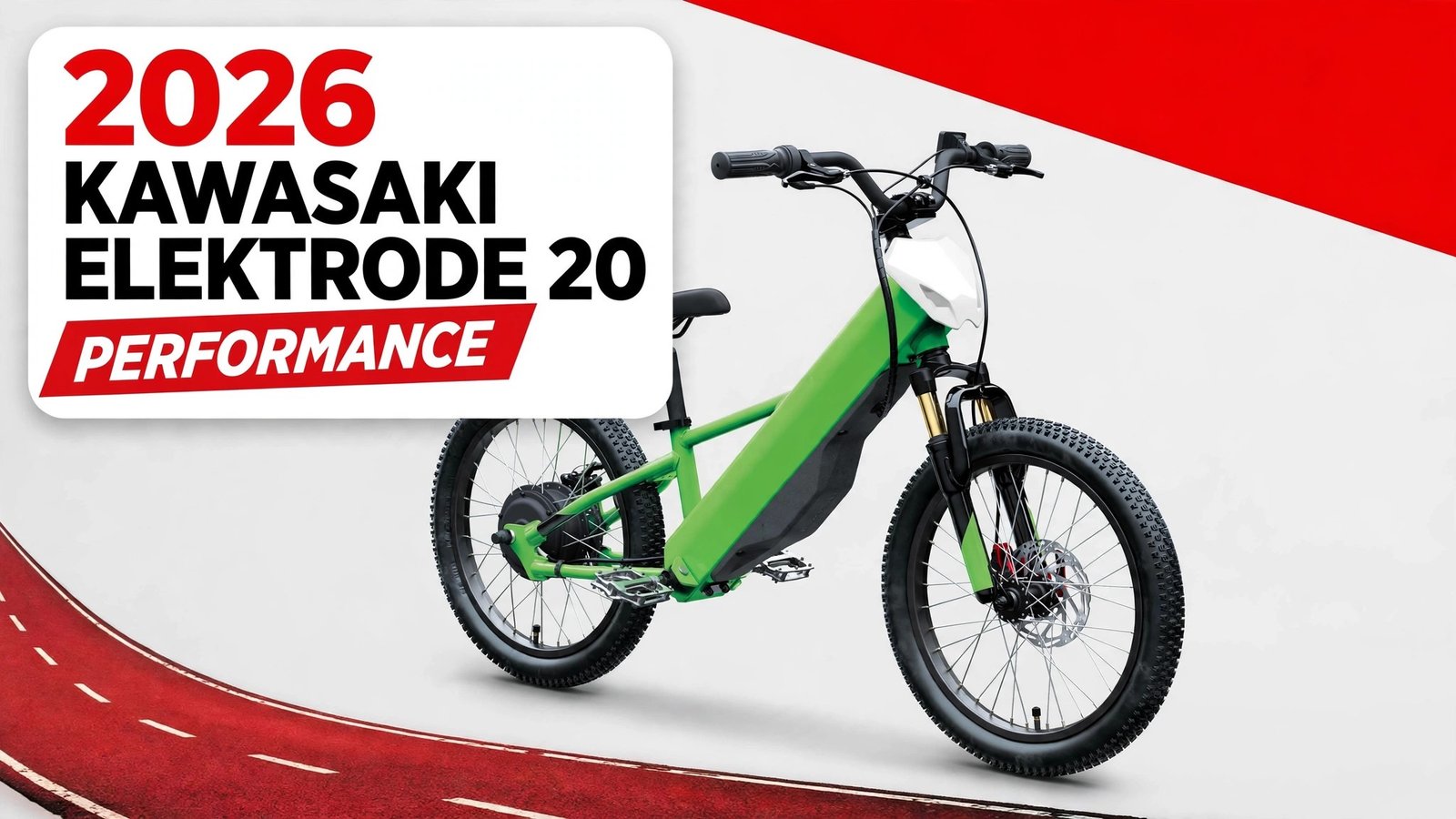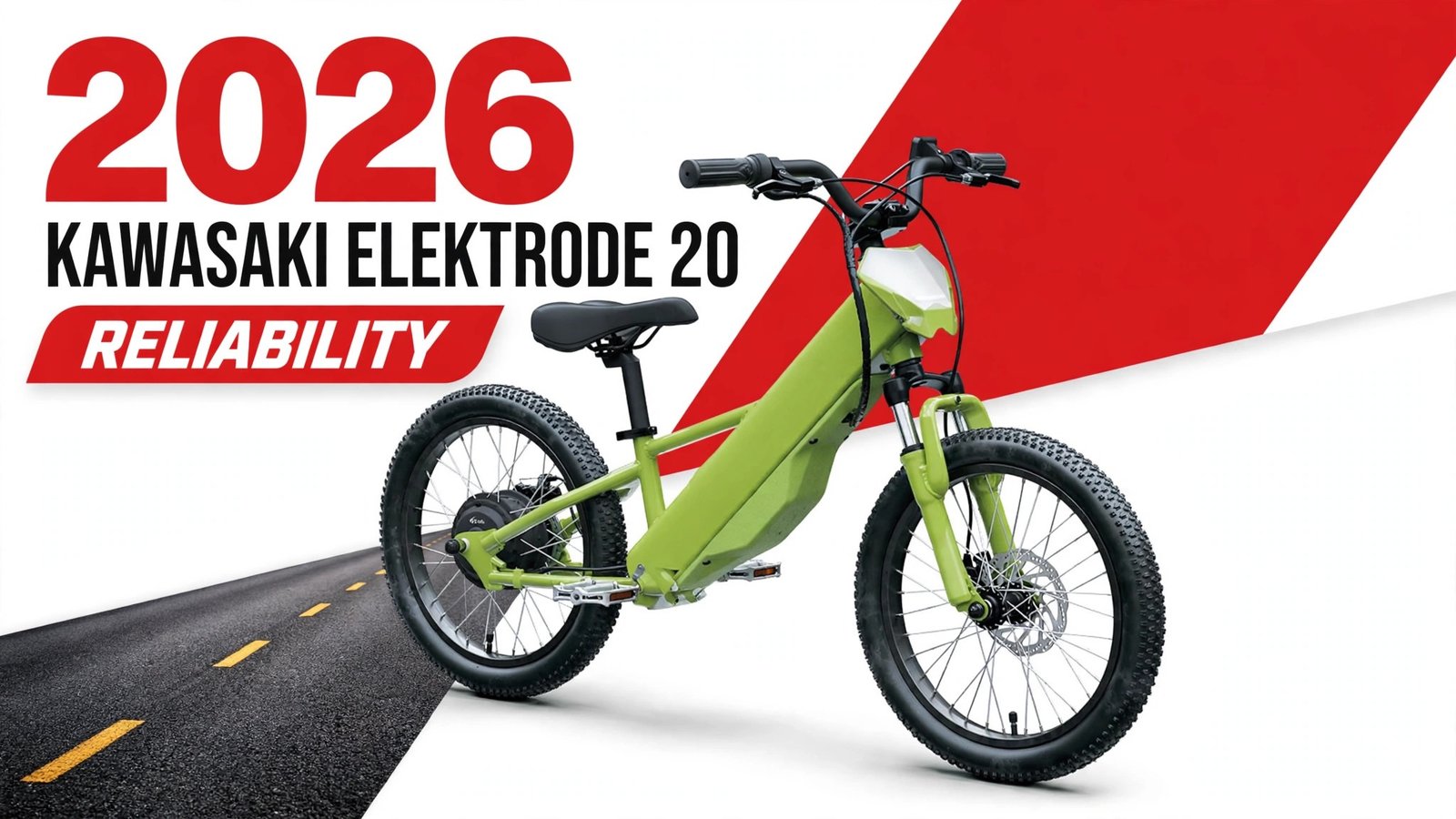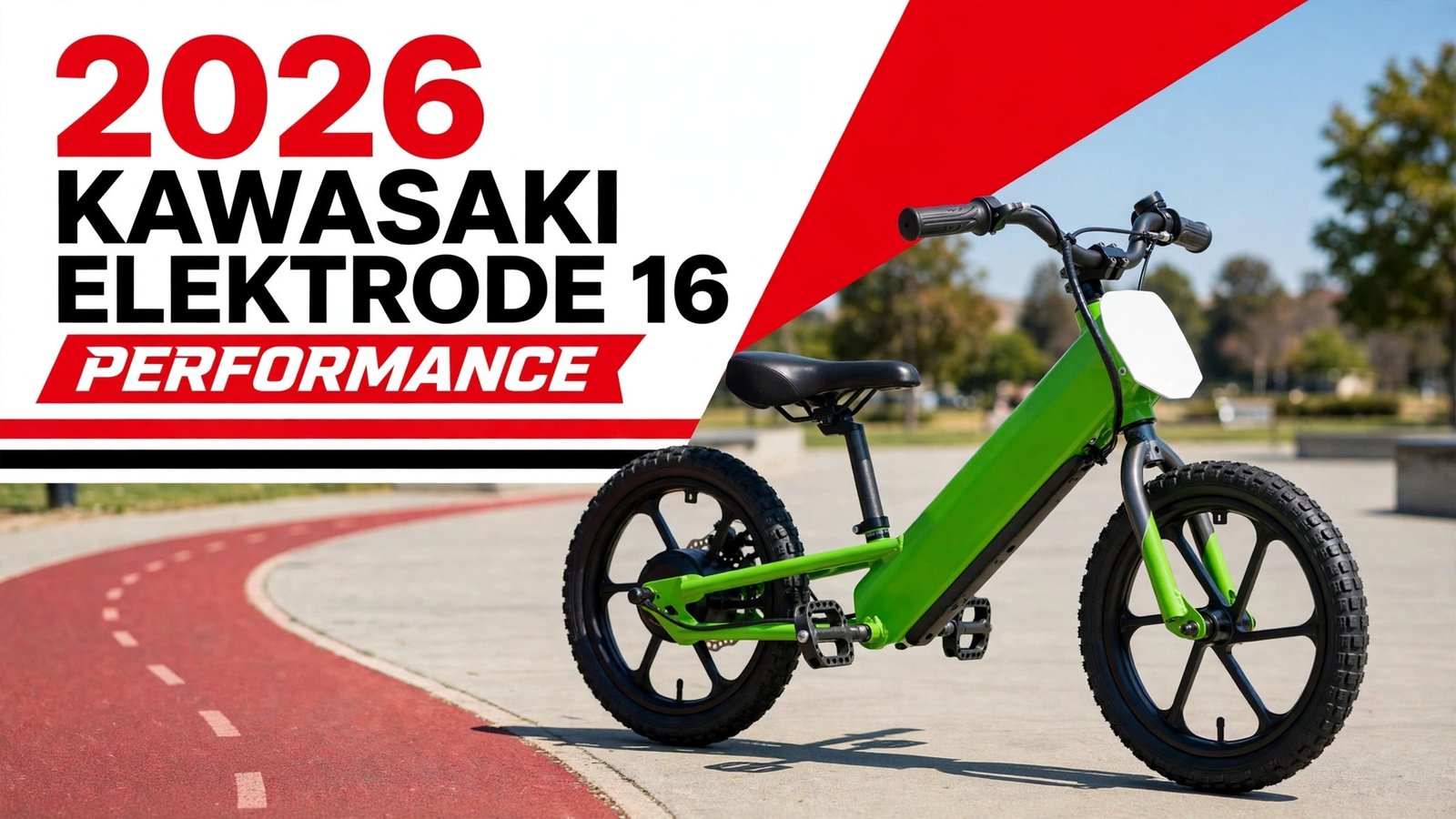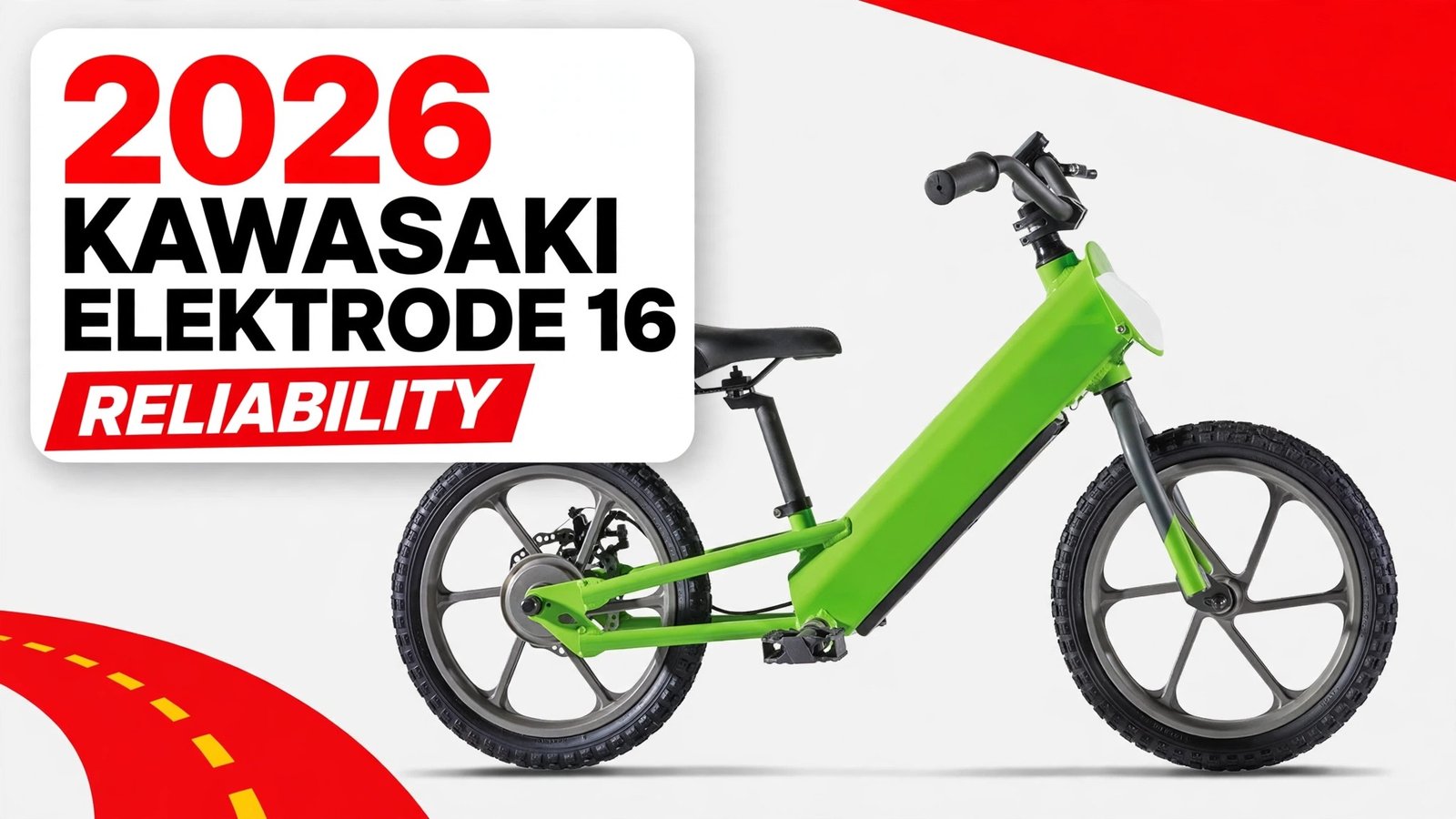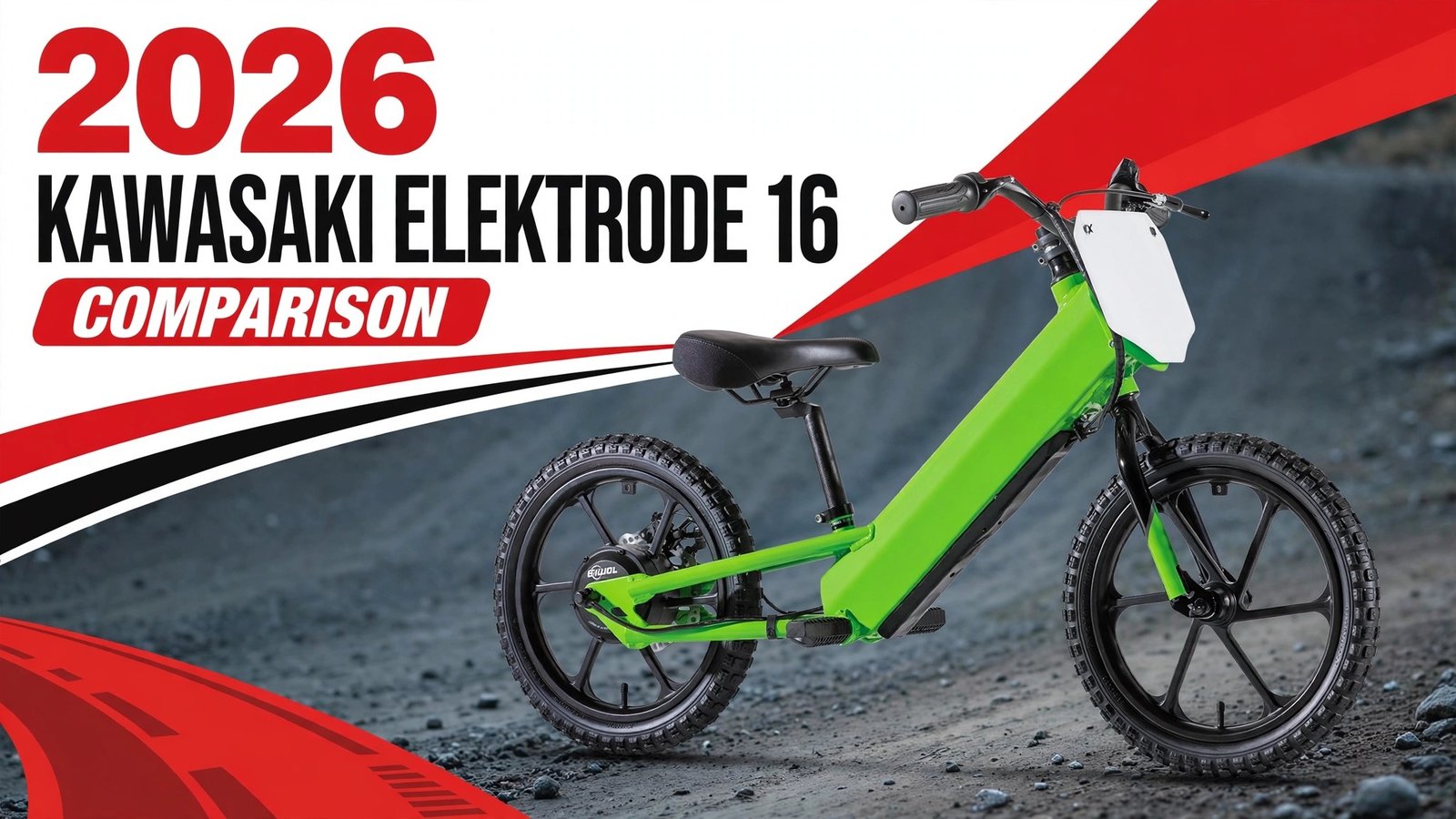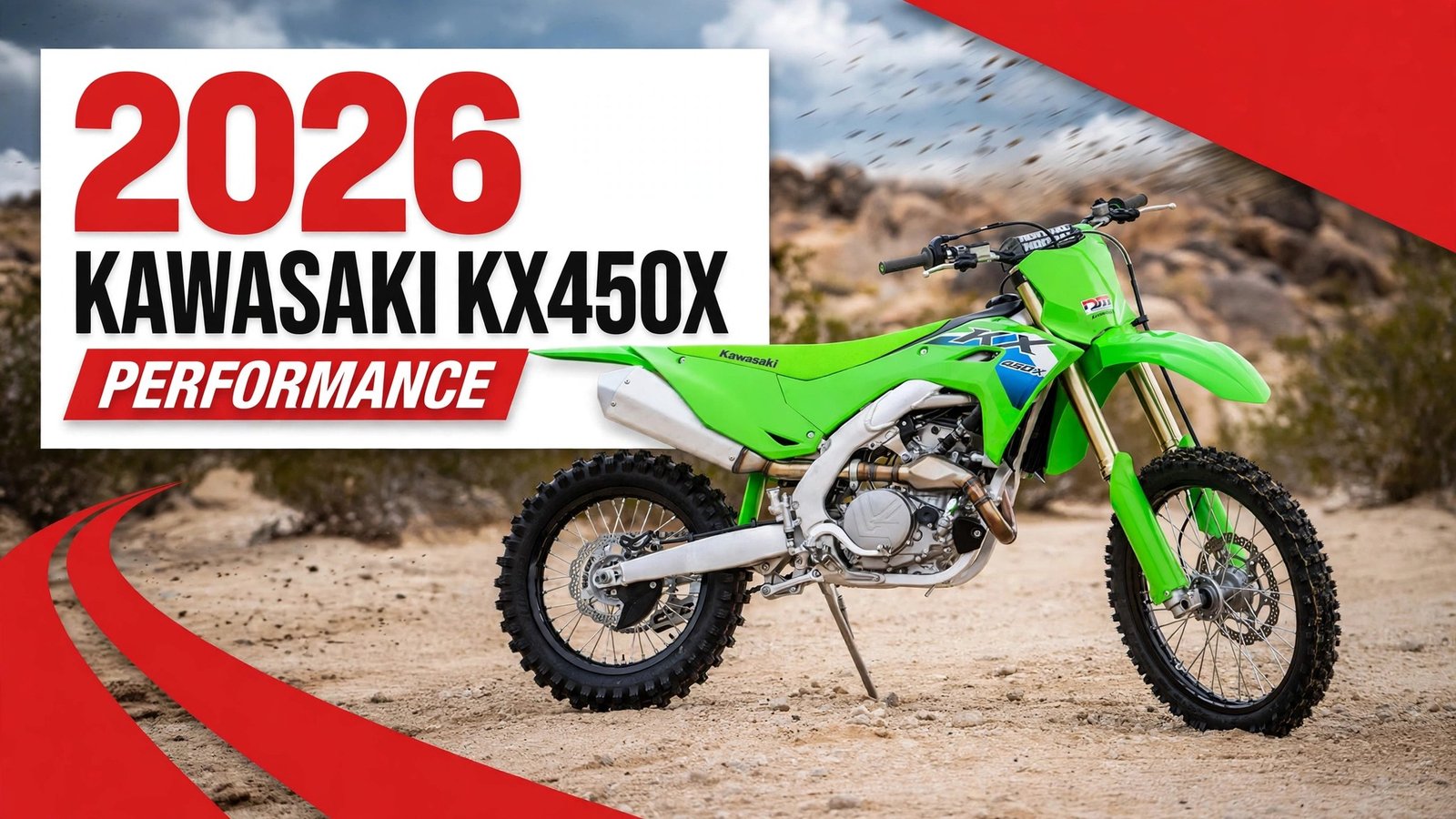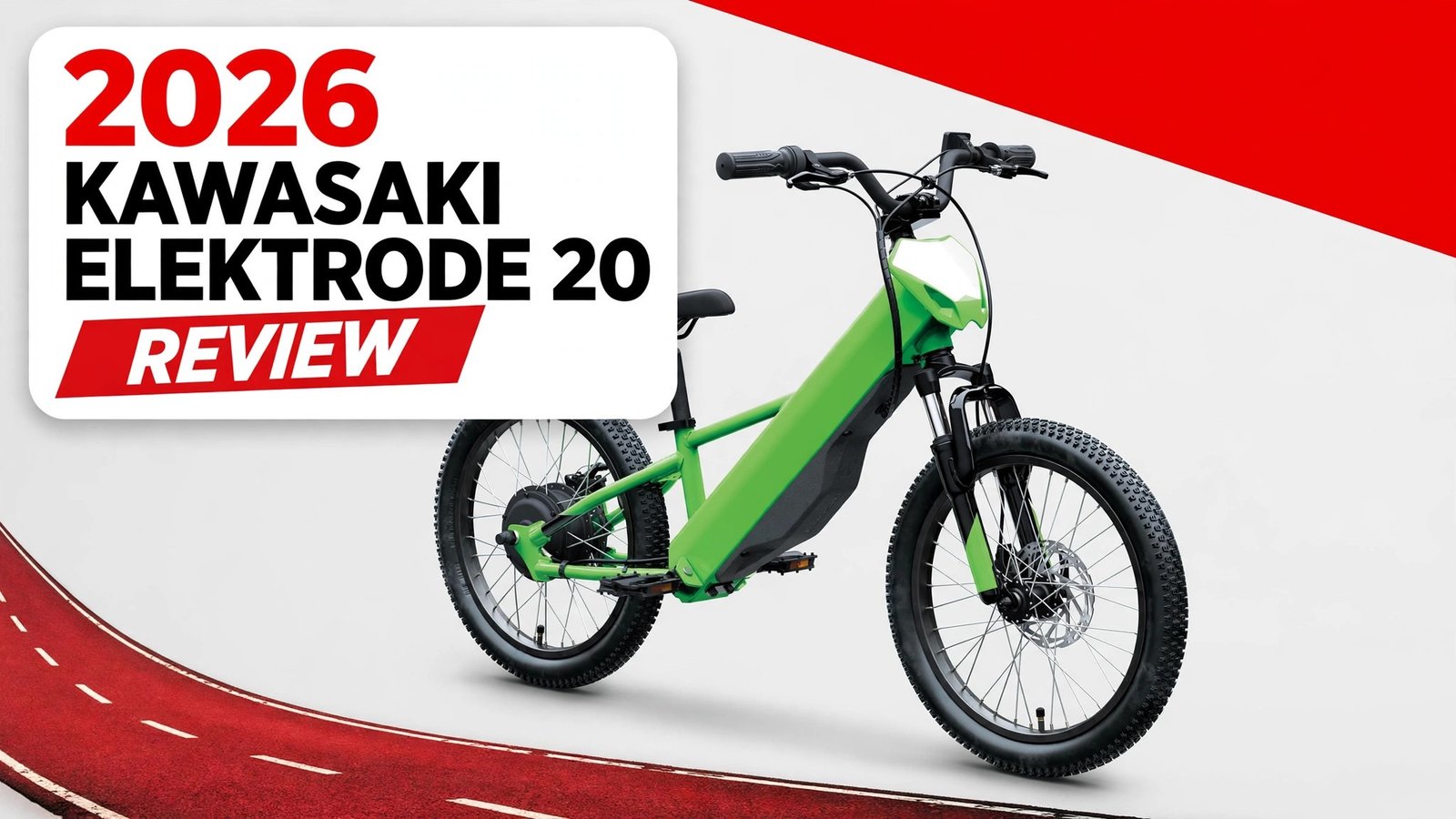
The bigger bike has arrived — and this Kawasaki Elektrode 20 review starts with the number that frames everything else: $2,199, exactly double the 16’s $1,099. The 20 is not a stretched 16. It is a step-up machine with three times the motor, nearly double the top speed, a front brake the 16 never had and a suspension fork the 16 never offered. It also drops the 16’s signature safety feature, the parental passcode lock — and that trade is the story of this review.
Only one US model year exists so far — 2025 — and this Kawasaki Elektrode 20 review covers both trims, the base 20 and the BMX-styled 20FS, at the same $2,199 price. The spec sheets, the May 31, 2024 launch announcement and the two tester reviews — Cycle News and Ultimate Motorcycling — agree on the headline figures, naming the source where they disagree.
Kawasaki Elektrode 20 Overview and Model-Year Updates

The short version of this Kawasaki Elektrode 20 review is that Kawasaki built the bike the 16’s graduates asked for: bigger wheels, more speed, a front brake and a fork that moves. The longer version is about the two trims, the single model year and the one missing feature.
Only One US Year So Far
Kawasaki announced the Elektrode 20 and the 20FS on May 31, 2024, as 2025 models — the starting point for this Kawasaki Elektrode 20 review. The base 20 reached dealers in the summer of 2025, and the 20FS followed in the fall. Kawasaki’s US Elektrode 20 model page still shows 2025 as current, and no 2026 US model year had been announced as of November 2026. A Kawasaki global page lists the 20FS as “NEW 2026” for non-US markets — not a US model year.
That single-year history has two practical consequences for buyers reading this Kawasaki Elektrode 20 review: there are no year-to-year changes to track — every 20 and 20FS on sale in the US is a 2025 bike — and any listing that says “2024 Elektrode 20” is a dealer mislabel, as the May 31, 2024 launch announcement names both bikes as 2025 models.
Double the 16’s Price
The price is the cleanest fact in this Kawasaki Elektrode 20 review: $2,199 for the base 20 and $2,199 for the 20FS, which is exactly twice the Elektrode 16’s $1,099. Both trims cost the same despite the fork difference — Cycle News calls it “curious” that they share a retail price. A family buying the 16 first and the 20 later spends $3,298 at list price; the Elektrode 16 review covers the starter bike.
Dealer sale prices in November 2026 ran from $1,099 to $1,799 — $400 to $1,100 under MSRP — including R/T Powersports at $1,295, Tri County at $1,799 and Holzhauers at $1,499. One Holzhauers graphic wrongly prints the MSRP as $1,699; the sale price is real. Kawasaki.com also runs a free-shipping promotion through December 31, 2026.
Kawasaki’s own launch film, embedded below in this Kawasaki Elektrode 20 review, shows both bikes — the lime-green base 20 on dirt trails and the grey 20FS at a concrete skatepark — in just over a minute. It is a short brand film with music and on-screen text, not a test, naming a 24 mph top speed and three hours of run time.
Kawasaki Elektrode 20 Engine and Specifications
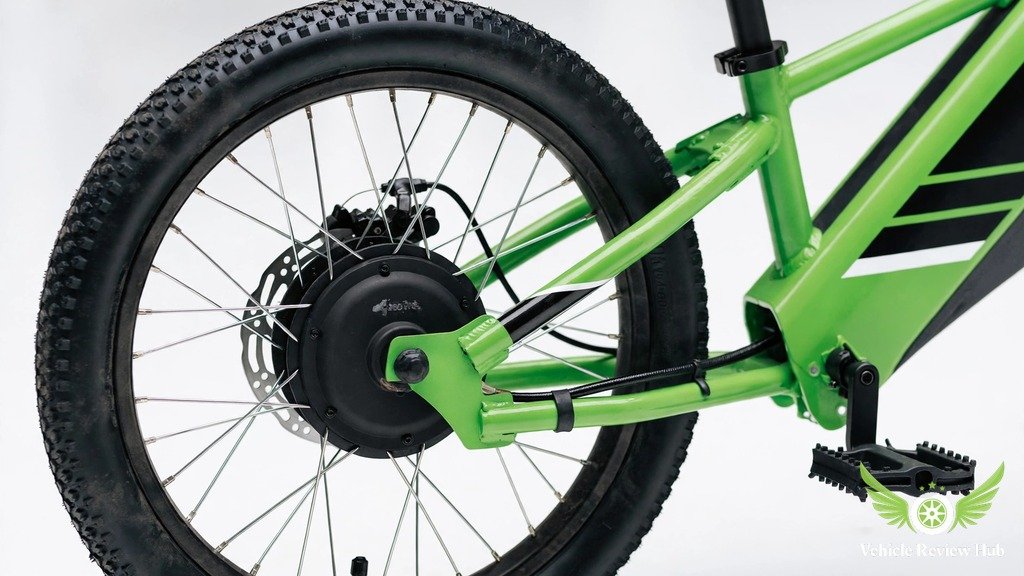
There is no engine in the petrol sense — the “engine” here is a 750W brushless motor built into the rear wheel, driving it directly with no chain — and this Kawasaki Elektrode 20 review treats the electric drive as the heart of the bike. Three times the 16’s 250W, it is the single biggest change from the smaller bike, and the table below puts the two trims side by side.
| Item | Elektrode 20 (base) | Elektrode 20FS |
|---|---|---|
| Motor | 750W (1 hp) brushless, in-wheel | Same — 750W |
| Battery | 50.4V 10.2Ah (514.1Wh), in-frame, not swappable | Same — 50.4V 10.2Ah (514.1Wh) |
| Charge time | About 4 hours, 110-V home outlet | Same — about 4 hours |
| Run time (claimed) | Low 180 min / High 60 min | Same — Low 180 / High 60 min |
| Speed modes | Low 13 / Mid 24 / High 24 mph | Same — 13 / 24 / 24 mph |
| Brakes | Front + rear 160 mm mechanical discs | Same — 160 mm front + rear |
| Front fork | 28 mm telescopic, 50 mm travel | Steel fork, RIGID — zero travel |
| Wheels / tyres | 20-in spoked / 20 x 2.125 IRC | 20-in spoked / 20 x 1.95 BMX |
| Seat height | 21.6–27.3 in | 23.3–29.6 in |
| Max rider weight | 132 lb | 176 lb |
| Curb weight | 46.1 lb | 46.1 lb |
| Colours | Lime Green, Black | Flat Metallic Gray only |
Note: Every figure in this Kawasaki Elektrode 20 review comes from Kawasaki’s own 2025 spec sheets for the two trims, and where the spec sheet and another source disagree on seat height, the spec sheet wins: the press release says 21.7–27.3 in for the base 20, and this review prints the sheet’s 21.6–27.3 in.
Battery Stays in the Frame
The 50.4V 10.2Ah lithium-ion battery at the heart of this Kawasaki Elektrode 20 review — 514.1Wh — is built into the aluminium frame, and it does not come out. There is no swappable pack and no quick-change “refuel” the way the STACYC offers with its $325 spare. When the battery is flat, riding stops for about four hours while it charges, though Cycle News notes twenty minutes from flat is enough for “a decent ride”. The charger is included and the connector sits at the front of the bike.
Kawasaki rates the battery for 500 charge cycles before it drops to 80% of its original capacity. What Kawasaki does not publish is a replacement battery price: no figure appears in the parts store, on Partzilla or at any dealer, so this Kawasaki Elektrode 20 review prints none and the owner should ask a dealer for a quote.
Mechanical Discs at Both Ends
The front brake is the upgrade that matters most over the 16 in this Kawasaki Elektrode 20 review. The 20 carries a 160 mm mechanical disc at the front and another at the rear, both cable-operated with single-piston calipers, where the 16 has a rear disc only. A child moving up from the 16 learns front-brake use here. Both testers agree the 20 will pull a stoppie if the front lever is pulled hard enough.
Kawasaki Elektrode 20 Price and Market Availability
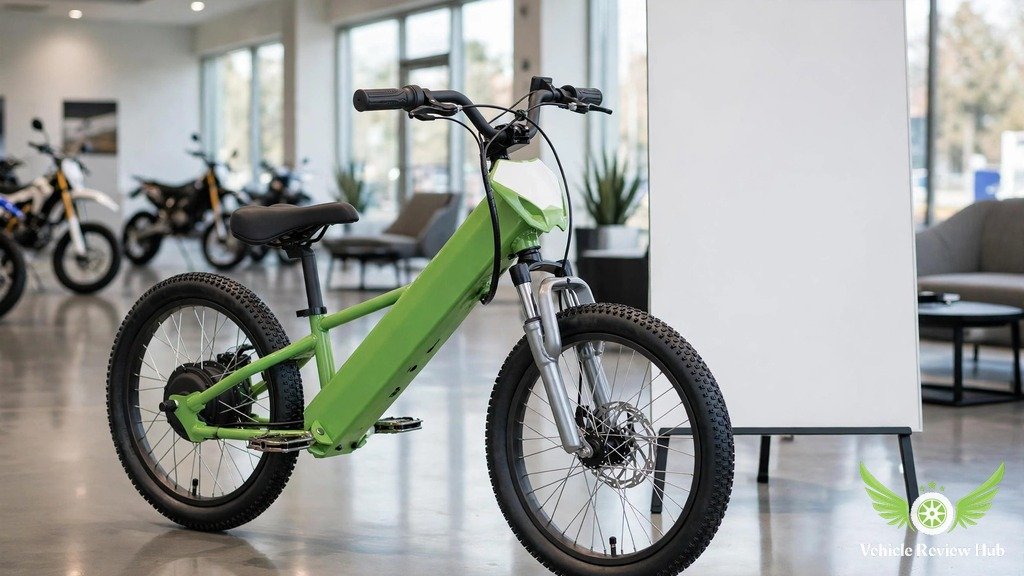
At $2,199 the Elektrode 20 sits in the middle of the 20-inch class at list price — cheaper than the STACYC’s $2,599 list and the KTM’s $3,200 launch price, dearer than the Orion at $1,549 — and this Kawasaki Elektrode 20 review prints both the list price and the street price, because the gap between them is the real buying story.
| Price point | Figure | Source |
|---|---|---|
| MSRP, base 20 (2025) | $2,199 | Kawasaki 2025 spec sheet |
| MSRP, 20FS (2025) | $2,199 | Kawasaki 2025 spec sheet |
| Dealer sale, R/T Powersports | $1,295 | Black Friday sale, Nov 2026 |
| Dealer sale, Tri County | $1,799 | July 2026, $400 off MSRP |
| Dealer sale, Holzhauers | $1,499 | May 2026 sale price |
| Cycle Trader listings | $1,099–$1,799 | Dealer listings, Nov 2026 |
Note: The dealer figures in this Kawasaki Elektrode 20 review are sale prices, not MSRP, and they move with the season — the $1,099 low end is a single dealer listing, not a second list price. The MSRP is $2,199 for both trims, and it has not changed since launch.
Kawasaki Elektrode 20 Price in the USA: $2,199 (2025)
The $2,199 figure at the centre of this Kawasaki Elektrode 20 review comes straight from Kawasaki’s own 2025 spec sheets — the 2025 Elektrode 20 spec sheet and the 2025 Elektrode 20FS spec sheet agree on it. The bike went on sale through dealers and direct from Kawasaki.com in the summer of 2025 for the base 20 and the fall of 2025 for the 20FS, and the price has held since. No trim premium applies: the 20FS costs exactly the same as the base bike.
Dealers were discounting the 20 by $400 to $1,100 in November 2026, and the lowest listing found — $1,099 at All Trails Powersports — is half the list price. That is one dealer clearing stock, not a new MSRP. Start from $2,199, then check the current dealer price before deciding — the advice this Kawasaki Elektrode 20 review gives every buyer — and compare the rivals in the Elektrode 20 comparison, where the STACYC’s holiday sale changes the ladder entirely.
No Destination Figure Published
No destination charge is published for the Elektrode 20 anywhere, as this Kawasaki Elektrode 20 review verified — not on either spec sheet, not on the model page and not on any dealer listing. The spec-sheet footnote says the base MSRP “excludes destination, options, taxes, title and license, and dealer fees and charges”, but it gives no dollar figure to exclude. This review prints no destination figure, and it does not carry the 16’s $50 Freight and Materials surcharge over to the 20.
Kawasaki Elektrode 20 Design, Features and Technology

The 20 looks like a small KX, with lime-green plastics, a white front number plate and an aluminium frame scaled up to 20-inch wheels. But this Kawasaki Elektrode 20 review is about the parts that change how the bike rides — fork, brakes, spoked wheels and dash — and the two trims split on those parts.
A Fork with 50mm of Travel
The 50 mm of travel belongs to the BASE 20 only. The base bike carries a 28 mm telescopic fork with 50 mm of travel — just under two inches. The 20FS has a rigid steel fork with zero travel. The “FS” does not mean front suspension: the FS is the BMX-styled variant, with a tall BMX handlebar, BMX-type tyres, a square number plate and Flat Metallic Gray paint, trading the fork for a higher 176 lb limit against the base bike’s 132 lb.
Two inches of travel is not much, and neither tester in this Kawasaki Elektrode 20 review pretends otherwise. Ultimate Motorcycling calls the fork “not sophisticated, but better than a rigid front end, especially when wheelies are aborted or when riding on washboard terrain”, and the rear is a hardtail on both trims. The spec sheet’s 50 mm is the figure this review prints.
How the Design Balances Style, Comfort and Practicality
The rest of the design in this Kawasaki Elektrode 20 review is bicycle hardware. The wheels are 20-inch spoked — not cast, as one review’s spec box wrongly prints — with an aluminium front hub, and the tyres are IRC knobby bicycle tyres, 20 x 2.125 on the base 20 and 20 x 1.95 on the 20FS. The footrests are rotating bicycle pedals that fold inward on ground contact and spring back. The handlebar height is adjustable as the rider grows: change the bar height and, as Cycle News puts it, “you won’t be (hopefully) buying a new bike every other year”.
Kawasaki Elektrode 20 Riding Experience and Comfort
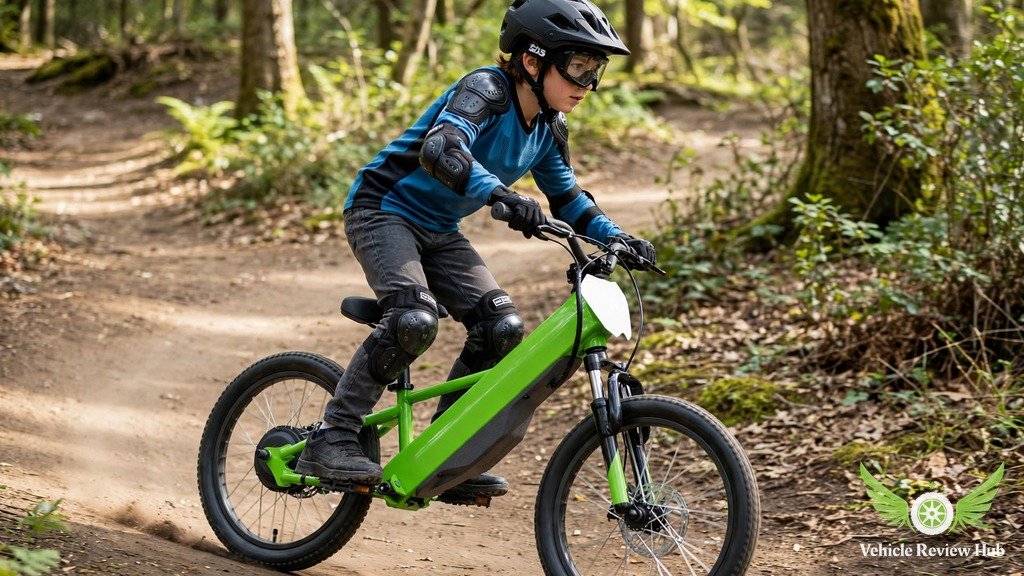
Everything here comes from the two testers who actually rode the bike, because this Kawasaki Elektrode 20 review invents no riding experience of its own. Cycle News put Harvey Scaysbrook — seven, experienced, 47 inches tall when he first got the bike — on it, and Ultimate Motorcycling put Avery Bart — ten, four feet seven, 67 lb — on it. They agree on the essentials: the 20 is fast for a kids’ bike, and it is big.
Seat Spans 21.6 to 27.3 Inches
That span is the base 20’s range, and the 20FS sits taller at 23.3–29.6 in — this Kawasaki Elektrode 20 review gives both figures labelled, because a buyer choosing between trims is choosing between seat heights as much as forks. The range covers several years of growth, stretched further by the adjustable handlebar. Harvey found the bike “a tad big” at 47 inches when he first got it, then grew “a couple of inches” and fitted right into it; Avery, at four feet seven, “fits the 2025 Kawasaki Elektrode 20 perfectly”.
What no source publishes is a rider-height range for the 20: one review’s spec box prints “37 to 55 inches”, but that is the 16’s figure copied over, and this review does not print it. The honest advice is to sit the child on the bike before buying, because 21.6 inches at the lowest setting is still a tall saddle for a small eight-year-old.
Riding Position and Comfort Over Longer Distances
The riding position in this Kawasaki Elektrode 20 review is upright and bicycle-like. On the move, the 20’s size jump from the 16 is what testers keep coming back to — Cycle News frames it as “scale the difference between an 85cc and a 125cc dirt bike, and you’ll get the idea” — and 24 mph makes that size feel bigger still. Cycle News restricted Harvey to the middle range of the throttle, and advised parents to wait until eight or stick with the slowest mode, “because the high/full power mode is seriously quick for a kid’s bike”.
Comfort over longer distances, in this Kawasaki Elektrode 20 review’s reading, is really a run-time question. Kawasaki claims 180 minutes in Low and 60 in High, and Cycle News measured about 45 minutes flat-out in Medium, rising to an hour and a half or more of cruisey trail riding. The full Cycle News review and the Ultimate Motorcycling review both describe the same bike: quick, quiet, bigger than it looks in photos, and best ridden in Low or Mid until the rider earns High.
Kawasaki Elektrode 20 Review: Pros, Cons and Verdict

The verdict in this Kawasaki Elektrode 20 review is that the 20 does exactly what a step-up bike should do — more speed, more size and a front brake for a rider who outgrew the 16 — and it charges exactly one price for it: the parental control the 16 had. The table below puts both sides in one place.
| Pros | Cons |
|---|---|
| 24 mph top speed — fastest in the 20-inch class in normal modes | No passcode lock — kids change modes themselves |
| 750W motor, three times the 16’s power | 46.1 lb — heaviest in its class |
| Front + rear 160 mm mechanical discs | Battery is in-frame and cannot be swapped |
| Biggest battery in the class: 514Wh, 180 min Low / 60 min High claimed | No replacement battery price published |
| Suspension fork (base 20) and 20-in spoked wheels | Mechanical brakes feel basic next to hydraulic rivals |
| Zero recalls on record; 12-month frame warranty | Street prices vary widely — shop around |
Note: The pros and cons in this Kawasaki Elektrode 20 review are the testers’ and the spec sheets’, not this review’s inventions: the speed, the battery and the weight are Kawasaki’s figures, the 45-minute hard-riding run time is Cycle News’s measurement, and the missing lock is Cycle News’s reporting.
Main Advantages and Limitations of the Kawasaki Elektrode 20
The advantages in this Kawasaki Elektrode 20 review start with speed and size: at 24 mph in Mid and High the 20 is the fastest bike in the 20-inch class in normal modes, and its 514Wh battery is the biggest, with 180 minutes claimed in Low and 60 in High. The front brake teaches front-brake use and the 20-inch spoked wheels roll over ground the 16’s cannot.
The limitations this Kawasaki Elektrode 20 review found are just as concrete: at 46.1 lb the 20 is the heaviest bike in its class, 13 lb heavier than the STACYC, and a flat pack ends riding for about four hours while every rival swaps in a fresh one. The mechanical discs feel basic, the rear is a hardtail, and the warranty is short where it matters: 12 months on the frame against the STACYC’s five, and 90 days on the electrics against the Orion battery’s six months. The Elektrode 20 reliability guide covers the warranty and the maintenance in full.
No Lock on the Speed Modes
This is the section this Kawasaki Elektrode 20 review will not soften. The 20 has no passcode safeguard: a child changes modes with a push of a button on the left-handlebar dash, and the bike must be fully stopped to do it. Cycle News states it without hedging: “unlike the 16-incher, there’s no safeguard that can stop the kid from changing it themselves, so you’ll have to trust that they will keep it in the mode you, as the parent, choose.” The 16’s passcode lock — set 5 mph and know it stays 5 mph — is gone, and nothing replaces it.
That absence decides who should buy the 20 — the judgement at the heart of this Kawasaki Elektrode 20 review. For an eight-year-old or older rider with balance-bike or 16 experience, starting in Low mode at 13 mph, it is the right step up. For a younger child, or a first powered bike, it is not — that job belongs to the 16, with its 5 mph low mode and its lock. Parents who buy the 20 hand the speed decision to the child — the single most important fact about the bike.
Kawasaki Elektrode 20 Review: Frequently Asked Questions
The questions below cover the price, the two trims, the battery and the missing lock — the points parents ask about most in this Kawasaki Elektrode 20 review.
What is the Kawasaki Elektrode 20?
A kids’ electric balance bike with 20-inch spoked wheels, a 750W in-wheel motor and a 24 mph top speed, built for riders aged 8 and up — the bike this Kawasaki Elektrode 20 review covers. It is the step-up from the Elektrode 16, which tops out at 13 mph and suits ages 3–8. The 20 adds a front disc brake, a suspension fork on the base bike and a battery more than twice the 16’s size — and it drops the 16’s parental passcode lock.
How much does the Kawasaki Elektrode 20 cost?
$2,199 for both the base 20 and the 20FS (2025), which is exactly double the Elektrode 16’s $1,099. Dealer sale prices in November 2026 ran from $1,099 to $1,799, so shop around before paying list price. No destination figure is published for the 20, so the out-the-door total is $2,199 plus tax and the dealer’s own fees.
What model years does the Elektrode 20 come in?
Only 2025 so far in the USA. Announced May 31, 2024 as a 2025 model, the base 20 went on sale in the summer of 2025 and the 20FS followed in the fall; no 2026 US model year has been announced as of November 2026. Dealer listings that say “2024 Elektrode 20” are mislabels.
Does the Elektrode 20 have a front brake?
Yes — 160 mm mechanical disc brakes at both ends, which this Kawasaki Elektrode 20 review calls the big upgrade over the Elektrode 16, which has a rear disc only. Both discs are cable-operated with single-piston calipers, so there is no hydraulic fluid to bleed or spill, and both testers found them strong enough to pull a stoppie.
Can parents lock the Elektrode 20’s speed modes?
No. Unlike the Elektrode 16, the 20 has no passcode safeguard — the fact this Kawasaki Elektrode 20 review keeps coming back to — and a child can change modes with a button on the left-handlebar dash, though only while the bike is fully stopped. Parents must trust the rider to stay in the mode they choose.
What is the difference between the Elektrode 20 and the 20FS?
Both cost $2,199 and share the motor, battery and brakes, as this Kawasaki Elektrode 20 review’s trim table shows. The base 20 has a 28 mm telescopic fork with 50 mm travel, 20 x 2.125 tyres, a 21.6–27.3 in seat and a 132 lb weight limit. The 20FS is the BMX-styled version: rigid steel fork, 20 x 1.95 tyres, 23.3–29.6 in seat, 176 lb limit, Flat Metallic Gray only. The “FS” does not mean front suspension.
How long does the Elektrode 20 battery last?
Kawasaki claims 180 minutes in Low mode and 60 minutes in High mode, charging in about 4 hours on a home outlet — the figures this Kawasaki Elektrode 20 review uses throughout. The battery is built into the frame and is not swappable, and it holds 80% of its capacity after 500 charge cycles.