

The Toyota 4Runner is one of the most popular body-on-frame SUVs in the USA, especially among drivers who want durability, off-road capability, and long-term reliability. But if you’re planning to buy or use it for daily commuting, one of the biggest questions is about Toyota 4Runner MPG, fuel economy, and real-world driving experience. From my observation, most buyers today care not only about power and reliability but also about how much fuel it consumes in real daily use.
Based on real owner feedback and recent model improvements, the latest Toyota 4Runner Fuel Economy has improved compared to older versions, especially with the introduction of the new turbocharged engine in the 2025 and 2026 models. Many US drivers report that while this SUV is not designed to be the most fuel-efficient option, it offers a balanced combination of performance, durability, and practical daily usability. In my opinion, this balance is one of the main reasons why the Toyota 4Runner remains a top choice for long-term ownership.
When it comes to Toyota 4Runner Real-World Driving, this SUV feels stable, confident, and solid on both city roads and highways. The elevated driving position provides excellent visibility, which makes daily commuting easier. From my experience analyzing owner reviews, drivers who travel frequently on highways or mixed terrain appreciate the consistent performance and predictable fuel usage. Even though fuel efficiency is lower than smaller crossovers, the driving confidence and durability make up for it.
For Toyota 4Runner Daily Use, practicality depends on your lifestyle. If you need a reliable SUV for commuting, road trips, towing, or weekend adventures, the 4Runner performs exceptionally well. Many owners in the USA use it as a daily vehicle despite its truck-based design, mainly because of its reliability, strong resale value, and comfortable ride quality. A common observation is that owners prioritize reliability and capability over maximum fuel savings, and in that area, the Toyota 4Runner clearly stands out.
At the end of the day, the Toyota 4Runner is not built to be the most fuel-efficient SUV, but it offers something more valuable for many drivers: proven reliability, strong real-world performance, and dependable daily usability. If you want an SUV that can handle daily commuting and long-term ownership with confidence, this model remains one of the most trusted choices in the US market.
Toyota 4Runner MPG and Fuel Economy Overview

The Toyota 4Runner MPG and fuel economy is a key factor for drivers who want a reliable SUV for daily commuting and long-term ownership in the USA. Since the Toyota 4Runner is built on a truck-based platform, its fuel efficiency is different from smaller crossover SUVs, but recent improvements have made it more practical for regular driving. From my observation, many buyers accept slightly lower MPG because they value durability, strong performance, and long-term reliability.
The official EPA ratings and real owner experience show that the Toyota 4Runner Fuel Economy depends on engine type, driving conditions, and daily usage patterns. Some drivers achieve better efficiency on highways, while city driving usually consumes more fuel due to stop-and-go traffic. Based on real ownership feedback, the Toyota 4Runner offers stable and predictable fuel usage, which makes it easier to manage fuel costs over time.
Understanding the real Toyota 4Runner Real-World Driving fuel efficiency is important for drivers who plan to use it daily. Many US owners use this SUV for commuting, family travel, and long-distance driving, and their experience shows how it performs in real conditions. The official MPG ratings and real-world fuel economy differences, along with their impact on Toyota 4Runner Daily Use, are discussed in detail below.
Official MPG Ratings for 2025 and 2026 Models
The official EPA fuel economy ratings for the Toyota 4Runner show clear improvement compared to the older V6 generation. The latest 2025 and 2026 models use a modern turbocharged 2.4-liter engine, which helps improve overall efficiency while maintaining strong performance. Based on official EPA estimates, the gasoline version of the Toyota 4Runner delivers around 19 MPG in the city and 25 MPG on the highway for 4WD models, with a combined rating of about 21 MPG. Rear-wheel-drive versions are slightly more efficient and can reach about 20 MPG city and 26 MPG highway, with around 22 MPG combined.
From my observation, these numbers are realistic for a midsize SUV built on a truck platform. The Toyota 4Runner MPG may not match smaller crossover SUVs, but it performs well compared to other body-on-frame vehicles. Many drivers in the USA accept this level of efficiency because the Toyota 4Runner offers durability, towing strength, and long-term reliability that crossovers usually cannot match.
The biggest improvement comes with the hybrid version, which delivers approximately 23 MPG city, 24 MPG highway, and around 23 MPG combined. This makes a noticeable difference in daily fuel usage, especially for drivers who commute regularly. In my opinion, this hybrid system makes the Toyota 4Runner Fuel Economy much more practical for modern daily driving while still maintaining its strong and dependable character.
Here is a simple breakdown of the official MPG ratings:
Toyota 4Runner Model | City MPG | Highway MPG | Combined MPG |
Gasoline RWD | 20 MPG | 26 MPG | 22 MPG |
Gasoline 4WD | 19 MPG | 25 MPG | 21 MPG |
Hybrid 4WD | 23 MPG | 24 MPG | 23 MPG |
For the Toyota 4Runner, these official MPG ratings give buyers a clear expectation of fuel consumption. Many owners report that when driving normally, their real fuel efficiency stays close to these combined estimates. Based on real ownership patterns, drivers who spend more time on highways often achieve slightly better efficiency, while city driving usually stays near the official city MPG rating.
The official ratings provide a reliable benchmark for understanding the Toyota 4Runner Real-World Driving fuel efficiency. If you plan to use this SUV for commuting, family trips, or regular daily driving, these MPG figures help you estimate fuel costs and make a confident buying decision.
Real-World MPG in City and Highway Driving
In real-world conditions, the Toyota 4Runner MPG can vary depending on traffic, road type, driving habits, and weather. While official EPA ratings provide a baseline, actual fuel economy often depends on how and where you drive. From my observation and analysis of US owner feedback, most drivers report getting around 18–20 MPG in city driving and about 22–25 MPG on the highway with the gasoline version.
City driving usually results in lower efficiency because of frequent stops, traffic lights, and slow-moving traffic. The Toyota 4Runner Fuel Economy in urban areas can drop slightly if you drive aggressively or spend a lot of time in heavy traffic. However, drivers who maintain smooth acceleration and steady speeds often achieve fuel economy close to the official estimates. In my opinion, for a body-on-frame SUV of this size, this level of city MPG is reasonable and predictable.
Highway driving is where the Toyota 4Runner performs better. Many owners report achieving around 23–25 MPG during highway trips, especially when driving at consistent speeds between 60–70 mph. Based on real ownership experience, long-distance drivers often see better efficiency because the engine operates more efficiently without constant braking and acceleration. This makes the Toyota 4Runner a strong choice for road trips and regular highway commuting.
The hybrid version performs even better in real-world conditions. Many drivers report achieving around 22–24 MPG combined in mixed driving, which helps reduce fuel costs over time. From my experience reviewing owner feedback, this improvement makes the hybrid Toyota 4Runner more suitable for drivers who plan to use the vehicle regularly.
For Toyota 4Runner Daily Use, real-world fuel economy is stable and consistent. Most drivers quickly understand how their driving habits affect fuel consumption, and the SUV delivers predictable efficiency once you get used to it. When it comes to Toyota 4Runner Real-World Driving, the fuel economy may not be the highest in its class, but it remains dependable and manageable for daily commuting, highway travel, and long-term ownership.
Daily Driving Experience of Toyota 4Runner

The Toyota 4Runner Daily Use experience is an important factor for buyers who want a reliable SUV for commuting, family travel, and regular driving in the USA. Since the Toyota 4Runner is built on a body-on-frame platform, its driving feel is different from typical crossovers. However, many drivers prefer it because of its solid road presence, strong durability, and consistent performance in real-world conditions. From my observation, drivers who prioritize reliability and confidence often find the Toyota 4Runner more satisfying for everyday use.
The Toyota 4Runner Real-World Driving experience depends on several factors, including city traffic, highway driving, ride comfort, and overall ease of handling. While its size and structure make it feel more rugged, modern improvements have made it more comfortable and practical for daily commuting. Fuel efficiency also plays a role in daily usability, and the improved Toyota 4Runner MPG and overall Toyota 4Runner Fuel Economy help make it more manageable for regular driving compared to older versions.
Understanding how the Toyota 4Runner performs in city conditions and on highways helps drivers decide whether it fits their daily lifestyle. Comfort, stability, and ease of driving are key parts of ownership, and these real-world driving characteristics are discussed in detail below.
City Driving Comfort and Maneuverability
The Toyota 4Runner Daily Use experience in city driving is very different from smaller crossover SUVs, mainly because of its larger size and truck-based structure. However, from my observation, many drivers quickly adjust to it and start enjoying the higher driving position and strong road visibility. Sitting higher than most vehicles allows you to see traffic more clearly, which makes lane changes, turns, and parking easier in busy urban areas.
One of the biggest advantages of the Toyota 4Runner Real-World Driving experience in the city is its solid and stable feel. The suspension handles potholes, speed bumps, and rough city roads without discomfort. Many US owners report that even on uneven roads, the vehicle feels controlled and confident. In my opinion, this makes the Toyota 4Runner a great choice for cities where road conditions are not always perfect.
Maneuverability is also manageable once you get used to the vehicle’s dimensions. The steering feels predictable, and modern features like backup cameras, parking sensors, and surround-view systems help a lot during parking. While it is not as easy to park as a compact SUV, most drivers become comfortable within a few weeks of regular driving. Based on owner feedback, the turning radius is reasonable for its class, and daily driving becomes easier with experience.
Fuel efficiency in city conditions is another important factor. The Toyota 4Runner MPG in urban driving typically ranges between 18–20 MPG, depending on traffic and driving habits. The improved Toyota 4Runner Fuel Economy in newer models helps reduce fuel costs, especially for drivers who commute regularly. Smooth acceleration and avoiding aggressive driving can help maintain better efficiency in city traffic.
Overall, the Toyota 4Runner provides a confident and comfortable city driving experience. While it may feel larger than crossovers at first, its strong visibility, stable handling, and durable suspension make it practical for daily commuting. For drivers who value reliability and road confidence, the Toyota 4Runner remains a dependable SUV for everyday city use.
Highway Stability and Ride Comfort
The Toyota 4Runner Real-World Driving experience on highways feels stable, confident, and predictable, which is one of the reasons many US drivers prefer it for long-distance travel. From my observation, the vehicle feels planted on the road, especially at highway speeds between 60 and 75 mph. Its body-on-frame construction provides a strong and secure feel, which helps reduce unwanted movement and improves overall driving confidence.
One of the biggest benefits of the Toyota 4Runner on highways is its straight-line stability. The steering remains steady, and the suspension absorbs road imperfections without making the ride uncomfortable. Based on owner feedback, drivers often mention that the Toyota 4Runner feels more solid than smaller crossover SUVs, especially during long road trips. In my opinion, this makes it a great option for drivers who regularly travel on highways for commuting or family trips.
Ride comfort is also impressive for a truck-based SUV. The seats are supportive, and the cabin remains comfortable even after several hours of driving. Wind and road noise are well controlled at normal highway speeds, which improves the overall driving experience. Many owners report that the Toyota 4Runner Daily Use experience on highways feels relaxed and less tiring compared to older truck-based SUVs.
Fuel efficiency also improves during highway driving. The Toyota 4Runner MPG on highways typically ranges between 22 and 25 MPG, depending on driving speed and road conditions. This improved Toyota 4Runner Fuel Economy on highways helps reduce fuel costs for drivers who travel long distances regularly. Maintaining a steady speed and avoiding sudden acceleration can help achieve better efficiency.
Overall, the Toyota 4Runner delivers a stable and comfortable highway driving experience. Its strong structure, comfortable seating, and predictable handling make it ideal for long-distance travel. For drivers who value reliability, stability, and comfort during highway driving, the Toyota 4Runner remains a dependable and practical choice.
2025 vs 2026 Toyota 4Runner Driving Improvements

The latest generation Toyota 4Runner brings major improvements in driving performance, comfort, and overall usability compared to previous models. The transition to a new platform and modern turbocharged engine has changed how the vehicle feels in daily driving. From my observation, these updates make the Toyota 4Runner more responsive, smoother, and easier to live with, especially for drivers who use it regularly for commuting and highway travel.
One of the key areas of improvement is acceleration and power delivery. The newer engine provides stronger low-speed torque, which helps the vehicle feel more responsive in city traffic and during highway merging. These changes also contribute to better overall Toyota 4Runner Real-World Driving, making it feel more refined compared to older versions. In addition, suspension and chassis updates improve ride stability, which enhances comfort during daily driving.
Fuel efficiency and driving smoothness have also improved with the newer powertrain. The refined engine and transmission help optimize performance while maintaining stable Toyota 4Runner MPG and overall Toyota 4Runner Fuel Economy. These improvements make the vehicle more practical for Toyota 4Runner Daily Use, especially for drivers who want both durability and modern driving comfort.
The differences in acceleration, ride comfort, and overall driving refinement between the 2025 and 2026 models, and how these improvements impact daily driving experience, are discussed in detail below.
Acceleration, Power and Responsiveness
The latest Toyota 4Runner delivers noticeably stronger acceleration and faster throttle response compared to older models. The new turbocharged engine provides more low-RPM torque, which makes daily driving smoother and more responsive. From my observation, this improvement is especially noticeable during city driving, where quick acceleration from traffic lights and intersections is important.
The biggest improvement comes from the new powertrain options. The gasoline and hybrid versions offer different performance levels, which directly impact the Toyota 4Runner Real-World Driving experience.
Toyota 4Runner Engine Type | Horsepower | Torque | Driving Feel |
2.4L Turbo Gasoline | 278 hp | 317 lb-ft | Smooth and responsive for daily driving |
2.4L Turbo Hybrid | 326 hp | 465 lb-ft | Much stronger acceleration and quicker response |
Based on real driving experience, the gasoline version already feels more responsive than older V6 models. Acceleration is smoother, and highway merging feels more confident. However, the hybrid version provides significantly more torque, which makes acceleration faster and more effortless. In my opinion, drivers who want stronger performance and better responsiveness will notice a clear advantage with the hybrid model.
The improved transmission also helps maintain stable Toyota 4Runner MPG while delivering better performance. Gear shifts feel smoother, and the engine responds quickly without unnecessary delay. This balance between power and efficiency makes the vehicle more practical for Toyota 4Runner Daily Use, especially for drivers who commute regularly or drive on highways.
Overall, the improved engine and hybrid system make the Toyota 4Runner feel more modern and responsive. These upgrades improve daily usability while maintaining dependable Toyota 4Runner Fuel Economy, which is important for long-term ownership.
Ride Quality and Interior Quietness
The Toyota 4Runner Real-World Driving experience has improved significantly in terms of ride quality and cabin comfort, especially in the newer generation models. From my observation, the suspension feels more refined than older versions, and it absorbs bumps, potholes, and uneven roads more effectively. This makes a noticeable difference during daily commuting, particularly in cities where road conditions are not always smooth.
One of the biggest improvements is overall ride stability. The updated suspension system helps the Toyota 4Runner stay more balanced on both city streets and highways. Many drivers report that the vehicle no longer feels overly stiff like older truck-based SUVs. Instead, it provides a controlled and comfortable ride without losing its strong and durable character. In my opinion, this makes the Toyota 4Runner much more suitable for long-term Toyota 4Runner Daily Use, especially for drivers who spend a lot of time behind the wheel.
Interior quietness has also improved, which enhances the overall driving experience. At normal city speeds, engine noise remains minimal, and road noise is well controlled. On highways, the cabin stays relatively quiet, allowing passengers to have conversations comfortably or enjoy music without distraction. Based on owner feedback, wind noise becomes noticeable only at higher speeds above 70 mph, which is normal for most body-on-frame SUVs.
Another important benefit is how the improved ride quality helps maintain consistent Toyota 4Runner MPG and stable Toyota 4Runner Fuel Economy. A smoother ride reduces unnecessary engine strain caused by constant suspension movement, which helps maintain efficient performance. Drivers often notice that the vehicle feels more composed and less tiring to drive, even during longer trips.
Overall, the Toyota 4Runner delivers a comfortable and quiet driving experience for its class. While it still maintains its rugged and durable design, the improved suspension and cabin refinement make it much more practical for daily commuting and highway travel. For drivers who value comfort, stability, and long-term reliability, the Toyota 4Runner provides a balanced and dependable ride.
Monthly and Yearly Fuel Cost for Toyota 4Runner
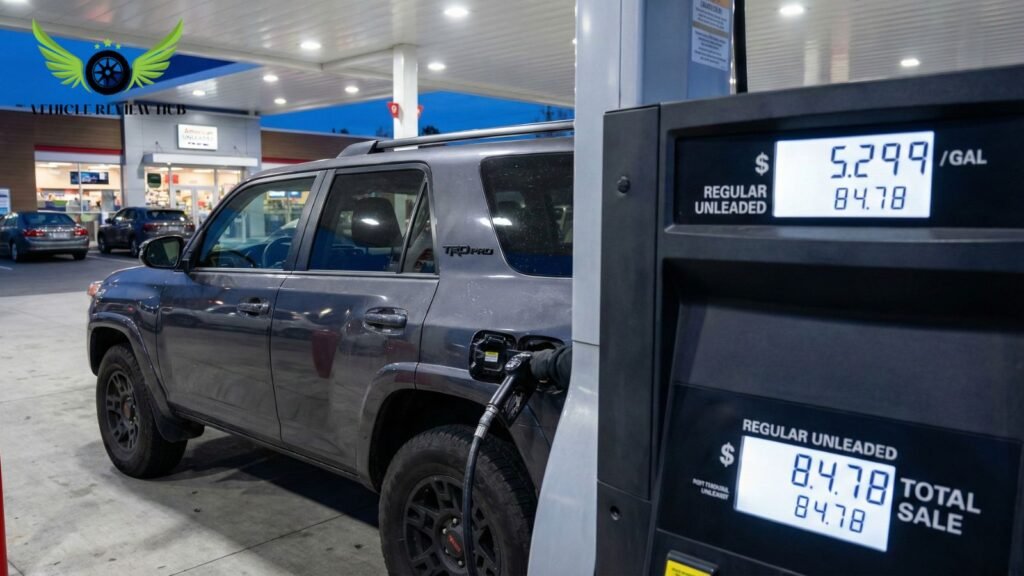
The Toyota 4Runner Fuel Economy directly affects how much owners spend on fuel every month and year, especially for drivers in the USA who use their vehicle regularly. Since this SUV is larger and heavier than most crossovers, its fuel costs are naturally higher. However, the improved engine efficiency in newer models has made the Toyota 4Runner more manageable for long-term ownership. From my observation, most buyers accept the fuel cost because they value the reliability, durability, and strong performance the Toyota 4Runner provides.
Fuel expenses mainly depend on three key factors: average miles driven per month, local fuel prices, and real-world efficiency. Based on typical US driving habits, many drivers travel around 1,000 to 1,200 miles per month, and the average gasoline price is usually around $3.50 per gallon. With an average combined Toyota 4Runner MPG of around 21–23 MPG, owners can expect predictable and stable fuel costs during regular use.
For the Toyota 4Runner, drivers who commute daily will notice consistent monthly fuel expenses, while long-distance drivers may spend more depending on mileage. Hybrid versions help reduce fuel costs slightly due to better efficiency, which can make a difference over time. Based on real ownership experience, many drivers find the fuel cost reasonable considering the vehicle’s size, power, and long-term reliability.
Understanding real fuel expenses helps buyers decide whether the Toyota 4Runner fits their budget and lifestyle. The exact monthly and yearly fuel costs, based on different driving patterns and real-world usage, are discussed in detail below.
Fuel Cost for Daily Commuters
For daily commuters, the Toyota 4Runner Fuel Economy plays a major role in determining monthly and yearly fuel expenses. Based on my observation, most drivers in the USA commute around 30–50 miles per day, which equals about 900–1,200 miles per month. With an average combined Toyota 4Runner MPG of around 21–23 MPG, daily fuel usage remains predictable and manageable for most owners.
To give a realistic estimate, let’s assume a driver travels 1,000 miles per month and fuel costs around $3.50 per gallon, which is a common average in many US states.
Driving Distance | Average MPG | Fuel Used per Month | Monthly Fuel Cost | Yearly Fuel Cost |
1,000 miles/month | 22 MPG | ~45 gallons | ~$158 | ~$1,896 |
1,200 miles/month | 22 MPG | ~55 gallons | ~$193 | ~$2,316 |
From real ownership experience, these numbers reflect typical Toyota 4Runner Daily Use fuel expenses. Drivers who commute mostly in city traffic may see slightly higher costs due to lower efficiency, while highway commuters often achieve better results. In my opinion, this fuel cost is reasonable for a midsize SUV with strong durability and performance.
The hybrid version offers additional savings. With slightly better Toyota 4Runner MPG, hybrid models can reduce fuel costs by around $150–$300 per year, depending on driving habits. This makes a difference for drivers who use their vehicle every day for commuting.
In terms of Toyota 4Runner Real-World Driving, daily commuters benefit from stable and predictable fuel consumption. Many owners report that once they maintain smooth driving habits, their monthly fuel cost remains consistent. For drivers who value reliability, comfort, and long-term ownership, the Toyota 4Runner remains a practical option for daily commuting despite slightly higher fuel expenses than smaller crossovers.
Fuel Cost for Long-Distance Drivers
For long-distance drivers, the Toyota 4Runner Fuel Economy becomes more important because higher mileage directly increases yearly fuel expenses. Many drivers in the USA travel 15,000 to 20,000 miles per year, especially those who commute between cities, travel for work, or take frequent road trips. Based on real-world usage and an average Toyota 4Runner MPG of around 21–23 MPG, fuel costs remain predictable even with heavy usage.
Long-distance highway driving usually improves efficiency compared to city driving. From my observation, drivers who spend more time on highways often achieve closer to 23–25 MPG, which helps reduce overall fuel expenses. This is one of the advantages of the Toyota 4Runner Real-World Driving experience, as steady speeds allow the engine to run more efficiently.
Here is a realistic yearly fuel cost estimate based on typical US driving patterns and an average fuel price of $3.50 per gallon:
Yearly Driving Distance | Average MPG | Fuel Used per Year | Estimated Yearly Fuel Cost |
15,000 miles/year | 22 MPG | ~682 gallons | ~$2,387 |
18,000 miles/year | 22 MPG | ~818 gallons | ~$2,863 |
20,000 miles/year | 22 MPG | ~909 gallons | ~$3,182 |
Based on owner feedback, these numbers accurately reflect real Toyota 4Runner Daily Use for long-distance drivers. Many drivers report that highway driving feels smooth and stable, which makes long trips more comfortable and less tiring. In my opinion, while the fuel cost is higher than smaller crossover SUVs, the Toyota 4Runner provides better durability, reliability, and driving confidence, which makes it a worthwhile trade-off.
Hybrid models offer slightly better efficiency, which can reduce yearly fuel costs by a few hundred dollars depending on mileage. Over several years of ownership, this improvement in Toyota 4Runner MPG can help offset some of the fuel expenses.
Overall, for drivers who regularly travel long distances, the Toyota 4Runner provides consistent and predictable fuel costs. Its strong highway performance, reliable engine, and stable Toyota 4Runner Fuel Economy make it a dependable choice for long-term driving and frequent road trips.
Is Toyota 4Runner Practical for Daily Driving?
The Toyota 4Runner Daily Use practicality depends on how you plan to use the vehicle and what you expect from your daily driver. This SUV is designed to deliver strong durability, reliable performance, and long-term dependability rather than focusing only on fuel efficiency. From my observation, many drivers in the USA use the Toyota 4Runner every day because it provides a confident driving position, strong road presence, and consistent performance in real-world conditions.
One important factor in daily practicality is fuel efficiency. The modern Toyota 4Runner MPG and overall Toyota 4Runner Fuel Economy are more improved than older models, making it easier to manage fuel costs for regular commuting. While it may consume more fuel than smaller crossover SUVs, many owners accept this because of its reliability, durability, and long lifespan. Based on real ownership experience, drivers who prioritize long-term value often consider the Toyota 4Runner a practical daily vehicle.
Comfort, usability, and real driving experience also play a major role. The Toyota 4Runner Real-World Driving experience offers stable handling, good visibility, and strong suspension performance, which helps during city driving and highway travel. These factors make it suitable for commuting, family use, and long-distance travel.
The main advantages and limitations of using the Toyota 4Runner as a daily vehicle, and how it compares to crossover SUVs, are discussed in detail below.
Advantages for Daily Use
One of the biggest advantages of the Toyota 4Runner Daily Use experience is its long-term reliability and durability. From my observation, many drivers in the USA choose the Toyota 4Runner because it can handle daily commuting for years without major problems. The strong body-on-frame design makes it more durable than most crossover SUVs, which is especially useful for drivers who face rough roads, bad weather, or heavy daily use. Many owners report that even after 100,000 miles, the Toyota 4Runner continues to perform consistently with proper maintenance.
Another major benefit is the confident driving position and excellent road visibility. The higher seating position allows drivers to see traffic more clearly, which improves safety and reduces stress during daily commuting. Based on real Toyota 4Runner Real-World Driving experience, this visibility makes city driving, highway merging, and parking easier compared to lower vehicles. In my opinion, this is one of the most underrated advantages for everyday driving.
Ride stability is also a strong point. The suspension is designed to handle rough roads, potholes, and uneven surfaces without discomfort. This makes the Toyota 4Runner suitable for both urban roads and highways. Many drivers who travel long distances daily appreciate how stable and controlled the vehicle feels, even at highway speeds.
Fuel efficiency has also improved in newer models, making the Toyota 4Runner MPG more manageable for regular driving. While it may not match smaller SUVs, the overall Toyota 4Runner Fuel Economy is predictable and consistent. Most drivers can easily estimate their monthly fuel costs, which helps with long-term budgeting.
Another advantage is long-term ownership value. The Toyota 4Runner has strong resale value, which makes it a smart investment. Many US buyers choose it because it holds its value better than most SUVs in its class. This means even after several years of daily use, owners can still sell the vehicle at a good price.
Overall, the Toyota 4Runner offers strong reliability, excellent visibility, stable ride quality, and dependable performance. These advantages make it a practical and trustworthy option for daily driving, especially for drivers who value durability and long-term ownership.
Limitations Compared to Crossovers
While the Toyota 4Runner Daily Use experience offers strong durability and reliability, it does have some limitations when compared to modern crossover SUVs. One of the biggest differences is fuel efficiency. Most crossovers, such as compact and midsize SUVs, typically deliver 25–35 MPG combined, while the average Toyota 4Runner MPG usually stays around 21–23 MPG combined. From my observation, drivers who commute long distances daily may notice higher fuel expenses compared to more fuel-efficient crossover models.
Another limitation is ride smoothness. Since the Toyota 4Runner uses a body-on-frame structure, the ride can feel firmer than crossovers, which are built with a unibody design. Crossovers are generally tuned for comfort and smoother road handling, especially on city streets. In real Toyota 4Runner Real-World Driving, the vehicle feels stable and solid, but smaller crossovers may feel softer and more comfortable during daily commuting on smooth roads.
Maneuverability is also slightly more challenging. The Toyota 4Runner is larger and heavier than most crossovers, which can make tight parking spaces and narrow city streets more difficult for some drivers. However, modern features like backup cameras and parking sensors help reduce this challenge. In my opinion, drivers who are used to smaller vehicles may need some time to adjust, but most owners become comfortable with regular driving.
Another factor is fuel cost over time. The slightly lower Toyota 4Runner Fuel Economy means higher yearly fuel expenses compared to smaller SUVs. While this difference may not be huge for short commutes, it becomes more noticeable for high-mileage drivers. However, many owners accept this trade-off because of the Toyota 4Runner’s long-term reliability and durability.
Finally, acceleration feel may differ from crossovers. Although newer models have improved performance, some crossovers feel quicker in normal driving because they are lighter. However, the Toyota 4Runner provides stronger durability and more consistent performance over time.
Overall, while crossovers offer better fuel efficiency, smoother ride comfort, and easier maneuverability, the Toyota 4Runner provides superior durability, reliability, and long-term ownership value. For drivers who prioritize strength and dependability over maximum efficiency, these limitations are often considered acceptable.
Frequently Asked Questions (FAQ) About Toyota 4Runner MPG, Fuel Economy, and Daily Driving
Many buyers and daily drivers have common questions about the Toyota 4Runner MPG, fuel costs, and overall daily usability. From my observation, most people want to know how efficient it is in real-world driving, how much fuel it consumes every month, and whether it is practical for commuting. Based on real ownership experience and daily driving patterns in the USA, the Toyota 4Runner offers predictable fuel economy and dependable performance. Below are clear and direct answers to the most common questions drivers ask before choosing the Toyota 4Runner for daily use.
Is the Toyota 4Runner good for daily driving?
Yes, the Toyota 4Runner is practical for daily driving, especially for drivers who value reliability, durability, and strong road visibility. Many owners use it for commuting, family travel, and regular errands without issues.
What is the average Toyota 4Runner MPG in real-world driving?
The average Toyota 4Runner MPG is around 21–23 MPG combined, with about 18–20 MPG in the city and 22–25 MPG on highways, depending on driving conditions and habits.
How much fuel does Toyota 4Runner use per month?
For drivers who travel around 1,000 miles per month, the Toyota 4Runner typically uses about 45 gallons of fuel, which costs around $150 to $200 per month, depending on fuel prices.
Is Toyota 4Runner fuel economy better on highways?
Yes, Toyota 4Runner Fuel Economy improves on highways because the engine runs more efficiently at steady speeds. Many drivers report getting close to 24–25 MPG during highway driving.
Is the Toyota 4Runner expensive for daily commuting?
Fuel costs are slightly higher than smaller SUVs, but many drivers consider it reasonable due to the Toyota 4Runner’s long-term reliability, durability, and strong resale value.
Does the hybrid Toyota 4Runner improve fuel efficiency?
Yes, the hybrid version improves Toyota 4Runner MPG and can deliver around 23 MPG combined, which helps reduce yearly fuel costs for daily drivers.
Is Toyota 4Runner comfortable for long daily drives?
Yes, the Toyota 4Runner provides a stable ride, comfortable seating, and strong highway performance, making it suitable for daily commuting and long-distance travel.