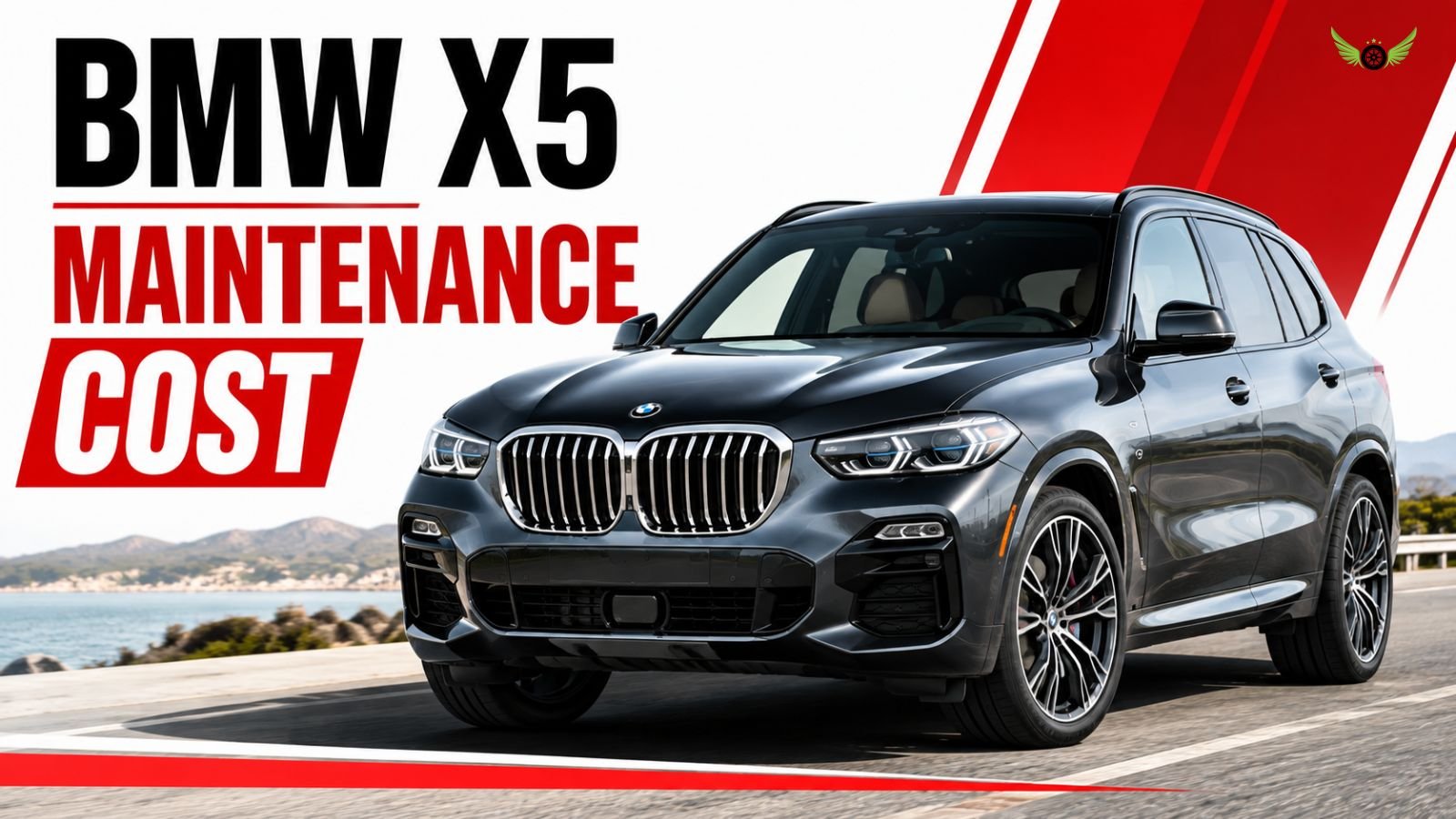
The 2026 BMW X5 is a premium luxury SUV with maintenance and ownership costs that buyers should consider before purchasing. In the USA, BMW includes Ultimate Care scheduled maintenance for 3 years or 36,000 miles, covering eligible factory-recommended services during that period. The new-vehicle limited warranty provides coverage for 4 years or 50,000 miles, whichever comes first.
For BMW X5 Reliability, Consumer Reports predicts that the 2026 model will be more reliable than the average new vehicle, based on reliability data from the 2023–2025 X5 model years. However, ownership costs can increase once the included maintenance and warranty coverage ends, making long-term maintenance an important consideration for buyers.
Current BMW X5 Common Problems information also includes two NHTSA safety recalls for the 2026 model. One recall involves a potentially improperly sealed windshield that could allow water into electrical components, while another involves an instrument panel issue that could affect passenger-side airbag deployment. BMW dealers provide recall repairs at no cost for affected vehicles.
This guide covers the BMW X5 Maintenance Cost, maintenance requirements, reliability, common problems, warranty coverage, and long-term ownership considerations to help U.S. buyers understand what to expect.
BMW X5 Maintenance Schedule
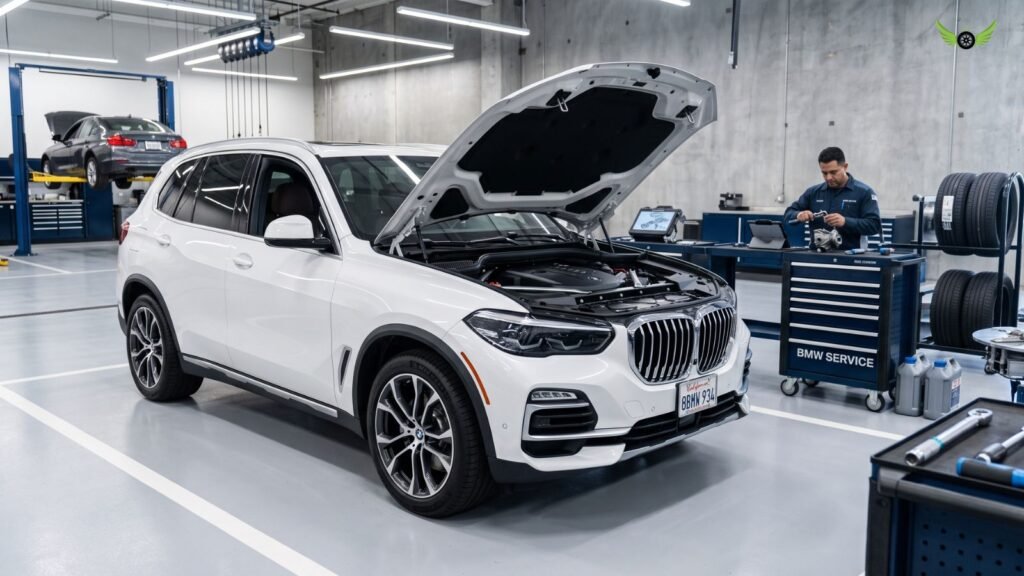
The 2026 BMW X5 maintenance schedule uses BMW’s Condition Based Service (CBS) system. Service intervals are based on time, mileage, and driving conditions rather than one fixed schedule. The vehicle monitors key maintenance items and shows when service is due through the maintenance display.
BMW’s official maintenance information also shows that some service requirements follow specific engine-oil service intervals. This makes it important to follow the vehicle’s CBS notifications instead of using a generic maintenance schedule.
Routine Service Intervals
The maintenance system monitors engine oil, vehicle inspections, front and rear brake service, and brake fluid. BMW also recommends regular owner checks of tire condition and pressure, coolant, brake fluid, and washer fluid.
For the 2026 model, the official maintenance schedule lists the cabin microfilter for replacement at approximately every second engine oil service, or around 20,000 miles. Brake pads are replaced based on their condition, while brake discs are inspected and replaced when necessary.
Major Maintenance Requirements
For the non-M 2026 X5, BMW’s maintenance summary schedules the engine air filter and spark plugs according to specific engine-oil service intervals. The exact interval depends on the vehicle’s maintenance schedule, with air-filter replacement occurring more frequently in dusty conditions.
A full vehicle check also includes inspections of components such as the tires, steering, suspension-related parts, underbody, lighting, safety belts, and brake system. The xDrive50e plug-in hybrid has additional checks for its charging equipment and cooling systems.
For the first 3 years or 36,000 miles, eligible factory-recommended maintenance is covered under BMW Ultimate Care when the service is due according to the BMW Maintenance System.
BMW X5 Maintenance & Repair Costs
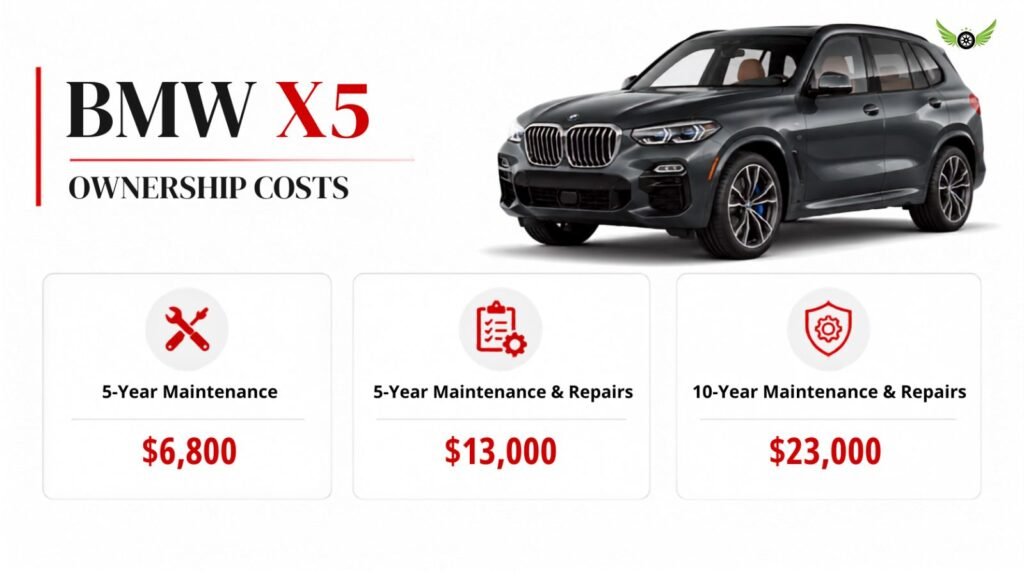
Maintenance and repair costs are an important part of owning a luxury SUV. For a new 2026 model, BMW Ultimate Care covers eligible factory-recommended scheduled maintenance for the first 3 years or 36,000 miles, which helps reduce early ownership expenses. After that coverage ends, routine service, wear items, and unexpected repairs become the owner’s responsibility.
Average Annual Maintenance Cost
Current estimates provide a useful range for planning. Kelley Blue Book estimates $5,010 in maintenance costs over five years for the 2026 model, or about $1,002 per year. CarEdge estimates $6,116 in combined maintenance and repair costs over the first five years, averaging approximately $1,223 annually. Because these estimates use different methodologies, they should be treated as planning benchmarks rather than a fixed ownership cost.
Cost Estimate | Estimated Cost | Coverage |
KBB 5-year maintenance | $5,010 | Scheduled maintenance estimate |
CarEdge 5-year maintenance & repairs | $6,116 | Maintenance, wear items, and expected repairs |
RepairPal annual average* | $1,166 | Historical repair and maintenance data |
*RepairPal’s figure is based on broader BMW X5 ownership data rather than the 2026 model specifically.
5-Year & 10-Year Ownership Costs
Long-term costs become more important after the included maintenance coverage ends. The estimates below provide a practical view of expected maintenance and repair expenses, but actual ownership costs can vary.
Ownership Period | Estimated Cost | What It Includes | Source |
5 Years | $5,010 | Maintenance | Kelley Blue Book |
5 Years | $6,116 | Maintenance and repairs | CarEdge |
10 Years | $19,459 | Maintenance and repairs | CarEdge |
For comparison, Edmunds estimates $9,836 in maintenance and $2,177 in repairs over five years for the 2026 X5 xDrive40i, based on its True Cost to Own assumptions, including 15,000 miles of driving per year. Trim, driving mileage, and local service costs can therefore make a significant difference.
BMW X5 Reliability & Common Problems
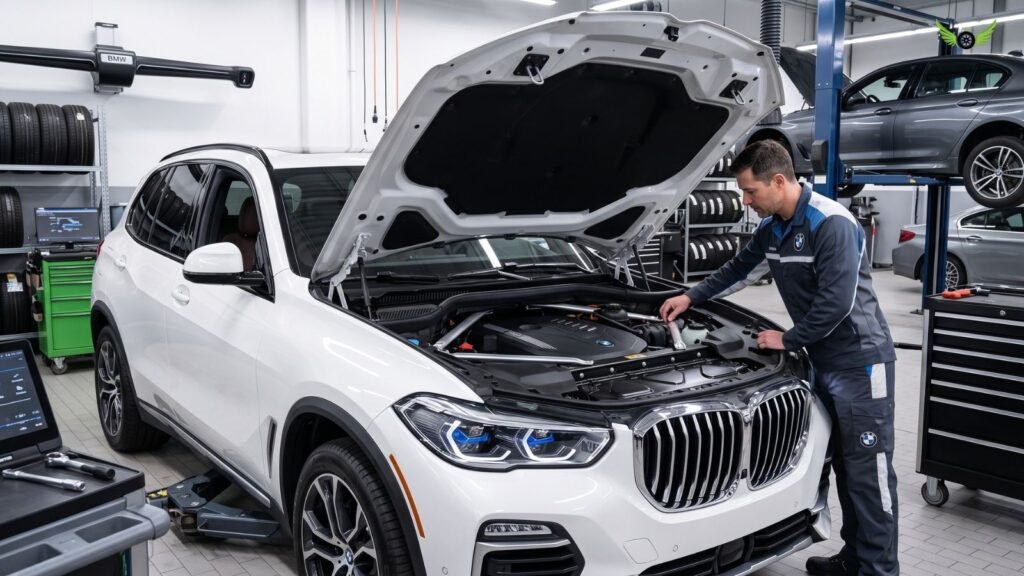
The BMW X5 Reliability outlook is generally strong for recent models, with Consumer Reports rating the 2025 X5 as more reliable than other vehicles from the same model year. For the 2026 X5 Plug-in Hybrid, Consumer Reports predicts average reliability based on data from the 2023–2025 models. Owner reports and recall data also show that electronics and software-related issues are areas worth watching.
Engine, Hybrid System & Transmission Reliability
The conventional X5’s recent reliability record is encouraging, but engine, cooling, and transmission systems remain important areas to monitor on any complex luxury SUV. Consumer Reports tracks issues such as oil or coolant leaks, engine electrical faults, and transmission shifting problems among its potential trouble spots for the X5.
The xDrive50e plug-in hybrid adds electric-drive, battery, and charging components, increasing overall system complexity. Some early 2026 owner reports describe drivetrain warnings and software-related faults, but individual owner reports do not establish a widespread defect. Consumer Reports’ prediction of average reliability for the 2026 plug-in hybrid is a more useful overall indicator for buyers.
Electrical, Air Suspension & Infotainment Issues
Electrical and infotainment problems have appeared in owner feedback from recent model years. Consumer Reports documented reports of blank display screens and inconsistent phone connectivity in the 2024 X5, with some issues resolved through software updates or display replacement under warranty.
Suspension and steering systems—including electronic or air suspension on applicable configurations—can be expensive to repair if components fail. However, current reliability data does not support describing air-suspension failure as a common problem across all 2026 models.
Buyers should also check their vehicle’s VIN for open recalls. NHTSA recalled certain 2026 X5 vehicles because an improperly sealed windshield could allow water to enter electrical components, potentially causing electronic failures. Recall repairs are performed free of charge for affected vehicles.
BMW X5 Warranty & Service Coverage
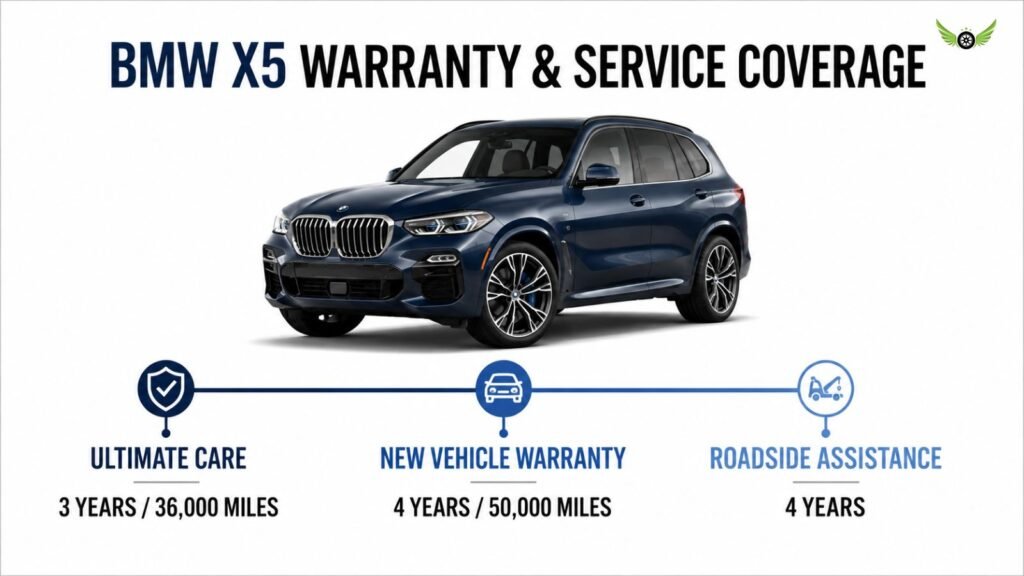
The 2026 BMW X5 comes with a 4-year/50,000-mile New Vehicle Limited Warranty and BMW Ultimate Care scheduled maintenance for 3 years or 36,000 miles, whichever comes first. The warranty protects against covered defects in materials or workmanship, while Ultimate Care covers eligible factory-recommended scheduled maintenance performed at an authorized BMW center. BMW also provides roadside assistance for four years with no mileage limit.
Factory Warranty & BMW Ultimate Care
These two programs cover different parts of ownership. The factory warranty is designed for covered vehicle defects, while Ultimate Care helps with scheduled maintenance. Ultimate Care does not cover items such as tires, wheel alignment, tire balancing, or maintenance performed more frequently than BMW recommends.
Coverage | Term | Primary Purpose |
New Vehicle Limited Warranty | 4 years / 50,000 miles | Covered defects in materials or workmanship |
BMW Ultimate Care | 3 years / 36,000 miles | Eligible scheduled maintenance |
Roadside Assistance | 4 years / unlimited miles | Emergency roadside support |
BMW’s new-vehicle limited warranty is transferable to subsequent owners for the remaining coverage period.
Is an Extended Warranty Worth It?
A BMW extended protection plan can be worth considering if you plan to keep the vehicle beyond the original warranty period and want protection from potentially expensive covered repairs. BMW does not simply extend the original factory warranty; it offers Vehicle Service Contracts (VSCs) that can provide coverage for up to 7 years or 100,000 miles, depending on the plan. BMW offers Platinum and Powertrain coverage levels.
For buyers who expect to sell or trade in the vehicle before the factory warranty expires, an additional service contract may provide limited value. The decision should mainly depend on how long you plan to keep the SUV, expected mileage, the coverage offered, and the price of the contract.
BMW X5 Long-Term Reliability
The BMW X5 has a solid long-term reliability outlook for a luxury SUV, but maintenance quality plays a major role in how well it ages. Consumer Reports predicts the 2026 model will be more reliable than the average new vehicle, based on reliability data from recent model years. However, maintenance and repair costs generally increase as the vehicle gets older.
Expected Lifespan
Based on iSeeCars’ analysis of more than 300 million vehicles, the X5 has an estimated average lifespan of approximately 133,000 miles, or 11.4 years. The same analysis estimates a 7.9% chance of reaching 200,000 miles or more. These figures are statistical estimates based on historical vehicle data, not a guaranteed lifespan for every vehicle.
For long-term owners, consistent maintenance is especially important. The current X5 generation (2019–2026) received an 8.1/10 reliability score from iSeeCars’ generation analysis, providing a positive data-based indicator for the platform’s overall durability.
Tips to Reduce Maintenance Costs
The most effective way to control ownership costs is to follow BMW’s Condition Based Service system and factory maintenance schedule. BMW’s Maintenance Service Display helps owners track when specific services are due, reducing the risk of missing recommended maintenance.
Addressing warning messages early and keeping up with scheduled service can also help prevent smaller issues from becoming more expensive repairs. During the first 3 years or 36,000 miles, eligible factory-recommended maintenance is included under BMW Ultimate Care, which can reduce early maintenance expenses.
BMW X5 Maintenance Cost, Reliability & Common Problems FAQs
The following FAQs cover the key ownership questions buyers ask about the 2026 BMW X5, including maintenance costs, service requirements, reliability, common issues, warranty protection, and long-term ownership in the USA.
How much does it cost to maintain a BMW X5?
Maintenance costs vary by mileage, vehicle condition, and where the SUV is serviced. New 2026 models include BMW Ultimate Care for 3 years or 36,000 miles, covering eligible factory-recommended scheduled maintenance and reducing early ownership costs.
Is the 2026 BMW X5 reliable?
Consumer Reports predicts the 2026 X5 will be more reliable than the average new vehicle, based on reliability data from the 2023–2025 model years.
What are common problems with the BMW X5?
Potential problem areas reported across recent model years include engine cooling, electrical systems, transmission components, suspension, and in-car electronics. These issues do not affect every vehicle, and problems can vary by model year and configuration.
How often does a BMW X5 need maintenance?
BMW uses its Condition Based Service system and Maintenance Service Display to determine when specific services are due. Owners should follow the vehicle’s maintenance notifications and official maintenance booklet rather than relying on one universal mileage interval.
What does BMW Ultimate Care cover?
BMW Ultimate Care covers eligible factory-recommended scheduled maintenance during the coverage period. The exact services are performed according to BMW’s maintenance requirements for the vehicle.
How long is the BMW X5 factory warranty?
The 2026 model comes with a 4-year or 50,000-mile New Vehicle Limited Warranty, whichever comes first. BMW also provides roadside assistance for four years with no mileage restriction.
Does the BMW X5 plug-in hybrid require special maintenance?
No. BMW states that its plug-in hybrid vehicles do not require special scheduled maintenance beyond the factory-recommended maintenance program. The high-voltage battery is covered against defects for 8 years or 100,000 miles, whichever comes first.
Should I buy an extended warranty for a BMW X5?
An extended service contract may be worth considering if you plan to keep the vehicle beyond the factory warranty. BMW Vehicle Service Contracts offer extended coverage for up to 7 years or 100,000 miles, depending on the selected plan.
How can I reduce long-term maintenance and repair costs?
Follow BMW’s recommended maintenance schedule, address warning messages promptly, and keep up with scheduled inspections. Regular maintenance can help identify issues before they develop into more costly repairs. BMW Ultimate Care can also reduce eligible scheduled maintenance costs during the first three years or 36,000 miles.