Short answer: Honda CB500F performance is honest middleweight performance — no superbike numbers, no marketing exaggeration, just a friendly 471cc twin that pulls cleanly from low revs, cruises happily at highway speed, and returns genuinely good fuel economy while doing it. This Honda CB500F performance guide reports only figures that belong to the F itself: Cycle World’s dyno and instrumented tests, Rider’s separate dyno and fuel-economy runs, and aggregator data clearly labelled as aggregator data. The faired CBR500R’s numbers are never borrowed here, because the CB500F and the CB500 Hornet are the same motorcycle (CB500FA throughout; Europe renamed it for 2024, the United States for 2026) — so this Honda CB500F performance guide is also the performance story of the bike now sold as the Hornet.
That identity point shapes every number below. The F ran in the United States from 2013 to 2025 with no 2020 model year, and its final year was 2025 at $6,899 plus $600 destination in Matte Black Metallic only. The 2026 Hornet at $5,899 plus $600 is the same bike $1,000 cheaper, not a redesign — a fact that matters when comparing used F values against new Hornet prices. For the F’s full story, see our Honda CB500F review.
Honda CB500F Engine Performance and Power Delivery
Power delivery is the F’s best argument, and this Honda CB500F performance section starts there because it is where the bike earns its keep. The 471cc liquid-cooled DOHC parallel twin — 67.0 by 66.8mm bore and stroke, 10.7:1 compression, PGM-FI through 34mm throttle bodies, six-speed gearbox, assist and slipper clutch from 2019 — makes its power low and wide rather than high and peaky. Twist the throttle in any gear and the F surges forward without drama — exactly what a commuter and a newer rider need.

Cycle World Dyno: 43.14 HP at 8,270 RPM and 29.43 lb-ft
Cycle World’s 2022 twin test is the dyno figure this Honda CB500F performance guide trusts most, because it was measured on the same day, on the same dyno, as its faired sibling — and the two results were kept separate. The F produced 43.14 horsepower at 8,270 rpm and 29.43 lb-ft of torque at 6,610 rpm at the rear wheel. That is the F’s number. The faired R’s 43.20 horsepower at 8,280 rpm in the same test belongs to a different motorcycle, and this Honda CB500F performance guide never averages the two — a 0.06-horsepower gap is a rounding error, not a reason to merge tests. Honda USA itself publishes no horsepower figure for the F at all, so any page quoting a “Honda official” horsepower number for this bike is inventing one. The 47-horsepower figure on European spec sheets is the EU A2 licence cap, a regulatory ceiling, not an American measurement, and “48 hp” aggregator figures are EU rounded crank claims — neither belongs in a US Honda CB500F performance discussion as a test result.
Rider’s Jett Dyno Read 46.1 HP: Why Dynos Differ by Outlet
Rider magazine’s Jett Tuning dyno read 46.1 horsepower for the F — noticeably higher than Cycle World’s 43.14 — and this Honda CB500F performance guide reports both, because the gap itself teaches something useful. Dynos differ by outlet for honest reasons: correction factors (SAE versus uncorrected), the individual bike’s condition and mileage, tyre choice and pressure, ambient temperature, and even how tightly the bike is strapped down. Neither outlet is “lying”; they measured different bikes on different days on different equipment. What a buyer should take from Honda CB500F performance dyno data is the shape, not a single number: a flat, friendly torque curve peaking in the midrange. Treat any outlet-less dyno figure as incomplete.
| Measured figure (rear wheel) | Honda CB500F (naked) | Honda CBR500R (faired, for contrast only) |
|---|---|---|
| Cycle World dyno, horsepower | 43.14 hp @ 8,270 rpm | 43.20 hp @ 8,280 rpm |
| Cycle World dyno, torque | 29.43 lb-ft @ 6,610 rpm | 29.77 lb-ft @ 6,450 rpm |
| Rider/Jett dyno | 46.1 hp (different dyno, different day) | Not quoted here |
| Summary | Flat midrange torque, friendly delivery | Near-identical output, different bike |
Honda CB500F Top Speed and Acceleration
Top speed and acceleration are where this Honda CB500F performance guide must be most careful, because the numbers floating around under the F’s name come from three different kinds of data — instrumented tests, aggregator estimates, and European press figures — and mixing them misleads buyers. Keep the kinds separate and the Honda CB500F performance picture is clear: the F is quick enough for any legal road use, and its limits are aerodynamic.
Cycle World Measured: 0-60 in 5.44 Seconds, Quarter in 14.30
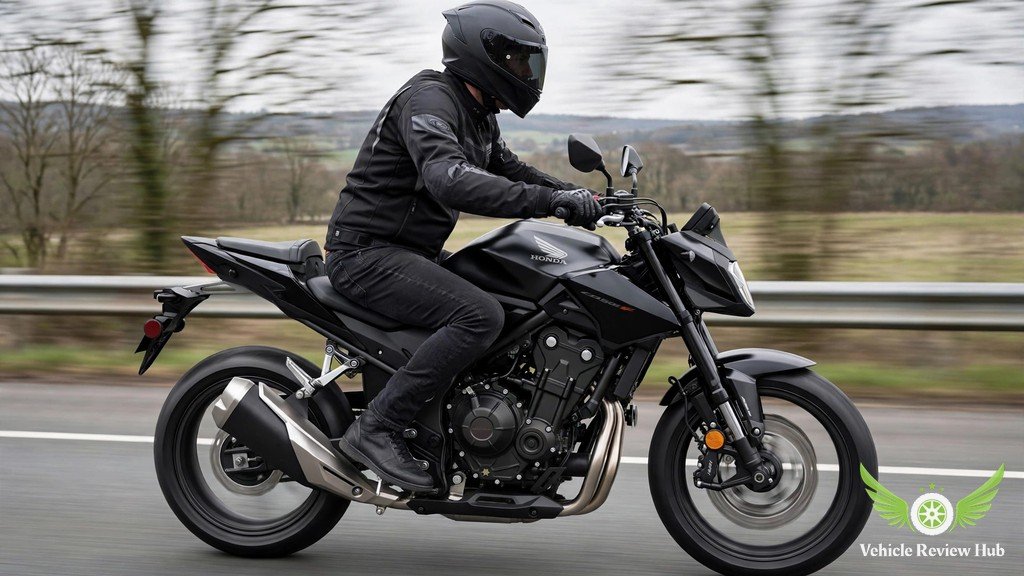
Cycle World’s instrumented F figures are the acceleration backbone of this Honda CB500F performance guide: 0–60 mph in 5.44 seconds and a quarter mile in 14.30 seconds at 94.19 mph. Those are real measured runs, and they tell a buyer more than any top-speed claim — the F gets off the line briskly and pulls cleanly through the gears. Do not confuse them with the faired R’s instrumented figures (0–60 in 4.72 seconds, quarter in 13.51 seconds), earned by its fairing and crouch — pasting R acceleration onto F copy is exactly the error this Honda CB500F performance guide exists to prevent. The video below is a top-speed test of the real 2019 F, honestly labelled as such, and worth watching precisely because it shows what the naked bike actually does at full throttle rather than what a spec table claims.
Braking 60-0 in 132.07 Feet and No US Top-Speed Test Exists
Cycle World also measured the F’s braking at 60–0 mph in 132.07 feet — a solid middleweight result reflecting the 2022-on dual 296mm front discs and ABS, and one more reason Honda CB500F performance should be judged on the whole test sheet. And here is the heading’s literal truth: no US instrumented top-speed test exists for the F. MotoStatz’s CB500F page lists 112 mph top speed, 0–60 in 4.34 seconds, and a quarter mile in 13.36 seconds at 98 mph — but those are aggregator figures with MotoStatz’s own lightweight-rider, perfect-launch caveat, and they disagree with Cycle World’s instrumented quarter mile precisely because they are different kinds of data. This Honda CB500F performance guide cites the 112-mph figure only as an aggregator estimate, never as a test result, and notes that real-world top speed for most riders will be more like 100–105 mph once wind blast on a naked bike is factored in. For the faired bike’s own acceleration story, see our Honda CBR500R performance guide.
Honda CB500F Mileage and Fuel Economy
Fuel economy is where Honda CB500F performance quietly beats most of its class. A 471cc twin that sips fuel at commuter pace and still cruises at highway speed is the whole point of the bike, and the tested figures — from two different American outlets — agree closely enough to trust. Every number below is labelled with its test.

Cycle World Average 59.0 MPG and Rider Tested 62.4 MPG
Cycle World’s F test average was 59.0 miles per gallon, and Rider’s 2017 F test recorded 62.4 mpg — two independent American tests landing within a few mpg of each other, which is about as good as Honda CB500F performance evidence gets for economy. The gap is test riding, not contradiction: Rider’s loop was gentler, and a separate Cycle World canyon sample of 65 mpg shows how much riding style moves the number. Honda’s own 72-mpg figure for the faired R sometimes gets pasted onto F copy; it is a comparison-only number, not a test result, and this Honda CB500F performance guide does not use it for the F. What matters for a Honda CB500F performance buyer is the band: ride normally and expect high-50s mpg, ride gently and you will see low-60s, ride hard and you will still beat most middleweights.
Range up to 274 Miles Recorded by Rider From 4.4 Gallons
Rider’s 62.4-mpg test covered 274 miles, and this Honda CB500F performance guide reports Rider’s printed 4.4-gallon tank figure exactly as printed rather than silently “correcting” it — tank history runs 4.1 gallons (2013–2015, 15.5 litres) to 4.4 gallons to the current 4.5 gallons (17.1 litres), so Rider’s figure matches its test bike’s era. At Cycle World’s 59.0-mpg average on the current 4.5-gallon tank, planning range is roughly 265 miles — more than a week’s commuting for most riders. That range, combined with the F’s upright comfort, is why Honda CB500F performance works as everyday transport. For servicing costs behind those miles, see our Honda CB500F reliability guide.
| Economy figure | Result | Label |
|---|---|---|
| Cycle World test average | 59.0 mpg | US test, 2022 F |
| Rider test | 62.4 mpg / 274 miles | US test, 2017 F, 4.4-gal tank as printed |
| Cycle World canyon sample | 65 mpg | Gentler riding, different sample |
| Summary | ~265 miles planning range on 4.5 gal | At 59.0 mpg average |
Honda CB500F Real-World Riding Performance
Paper figures only go so far, and Honda CB500F performance in daily use is where the bike’s character shows. The engine’s flat torque curve means the F rarely needs to be revved hard to make progress, the six-speed gearbox is light and positive, and the assist and slipper clutch (from 2019) keeps downshifts smooth. Testers describe the same thing: a bike that feels faster than its numbers because it never makes you wait for power.

City Riding, Traffic Performance and Everyday Acceleration
In the city, Honda CB500F performance is at its best. The upright bars give a commanding view over traffic, the 31.1-inch seat keeps feet flat at lights for most riders, and the twin pulls cleanly from just above idle — no clutch-slipping, no frantic downshifting, just roll-on-and-go progress through gaps. Low-speed manoeuvrability is a genuine strength: the bike is light enough to paddle around parking lots without strain, and the wide bar gives leverage that the faired R’s clip-ons cannot match. Visordown’s first ride of the original F already caught this character in 2013, noting the smooth, linear delivery that let the bike be hustled without ever feeling frantic. A decade of updates sharpened the Honda CB500F performance package without changing that friendliness.
Highway Riding, Wind Blast and Open-Road Passing
On the highway, Honda CB500F performance is competent with one honest caveat: wind blast. With no fairing, sustained 75–80 mph cruising puts wind on the rider’s chest, and while the engine itself is unstressed at those speeds — the twin sits comfortably in its midrange with passing power in reserve — the rider works harder than on the faired R. Open-road passing is a downshift-and-go affair, but the F never feels out of its depth at legal highway speeds. For longer highway days, the R’s fairing or the NX500’s screen are better tools; for mixed riding, the F is honest transport.
Honda CB500F Handling, Braking and Stability
Handling is the other half of Honda CB500F performance, and it is where the naked bike’s ergonomics pay off most clearly. The chassis is a steel diamond frame shared across the 500 family, but the F’s wide, higher bar and upright position change how that chassis feels — more leverage, more control at low speed, and a position that keeps weight where it helps.
Wider, Higher Bar Preferred by Testers Over R Clip-Ons
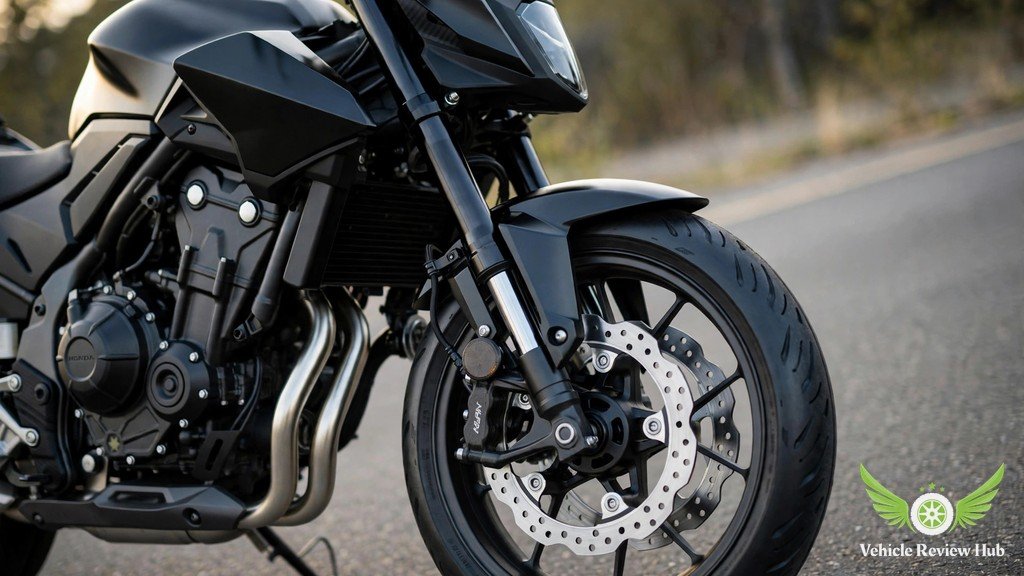
Testers have repeatedly preferred the F’s wider, higher bar over the R’s clip-ons for everyday riding, and this Honda CB500F performance section agrees with them. The bar gives leverage in slow corners and traffic, keeps wrists neutral on longer rides, and makes the bike feel lighter than its 414-pound claimed curb weight (417 pounds on Cycle World’s scales, fully fuelled — both figures reported). Stability at speed is calm rather than razor-sharp: the 55.5-inch wheelbase, 25.5-degree rake, and 4.0 inches of trail deliver a planted, predictable feel. There is no IMU, no cornering ABS, and no lean-sensitive traction control — HSTC (from 2024) is straightforward — and Honda CB500F performance is better understood without them: stability comes from geometry and ergonomics, not electronics.
Single 320mm Disc Before 2022, Dual 296mm Discs After
The brake story splits by year, and this Honda CB500F performance guide keeps the split exact: before 2022 the F used a single 320mm front disc, and from 2022 it uses dual 296mm front discs with the 41mm Showa SFF-BP inverted fork, plus a 240mm rear disc throughout. ABS was optional until 2019 and standard from 2021 — with no 2020 US model year in between, so the “optional until 2019, standard from 2021” wording is a gap year, not a contradiction. The dual-disc setup is the one to buy for braking confidence, and Cycle World’s 132.07-foot 60–0 result belongs to that generation’s hardware. Tyres are 120/70R-17 front and 160/60R-17 rear, sensibly sized with affordable replacements.
Honda CB500F Performance Compared With Other Naked Bikes
Comparison is where Honda CB500F performance has to earn its price, because the naked middleweight class is crowded and every rival has a sharper headline somewhere. The F’s case is not a single winning number — it is the whole package: proven reliability, cheap running costs, friendly ergonomics, and a decade of parts availability. For the buying decision in full, see our Honda CB500F buying guide.

Honda CB500F vs Kawasaki Z500 and CFMOTO 450NK
Against the Kawasaki Z500 ABS — $5,699 plus $650 destination for 2026, a 451cc twin making 51 horsepower — the F gives away outright power but answers with Honda CB500F performance strengths the spec sheet hides: a torquier midrange, a longer model run with deeper used-parts support, and fuel economy the Z500 does not clearly beat. Against the CFMOTO 450NK (2026 MSRP $5,399), the F is the more expensive, more proven, more dealer-supported choice; the 450NK undercuts on price and weight, but its long-term record is a fraction of the F’s decade. Neither rival makes the F obsolete, and neither makes the F the obvious pick on numbers alone — which is why this Honda CB500F performance guide frames the choice as package versus price. The renamed Hornet at $5,899 plus $600 is also the F’s own successor competing with it: a used F asking near new-Hornet money makes no sense.
| 2026 comparison | Honda CB500F (final year 2025) | Kawasaki Z500 ABS (2026) |
|---|---|---|
| Price + destination | $6,899 + $600 (2025, final F year) | $5,699 + $650 |
| Engine | 471cc twin, CW dyno 43.14 hp | 451cc twin, 51 hp claimed |
| Tested economy | 59.0 mpg (Cycle World) | Not directly compared here |
| Summary | Proven package, torquey midrange | Cheaper, more peak power |
Is the Honda CB500F Suitable for Beginner Riders?
Yes — with the usual honest qualifier that “beginner” means a trained new rider, not someone who has never ridden. Honda CB500F performance suits beginners because the power is friendly rather than intimidating: the flat torque curve forgives a wrong gear, the seat is low enough for confidence at stops, the weight is manageable, and ABS has been standard since 2021. MCN’s CB500F review and its owner scores back that up across generations. The F is also a bike a beginner can grow into rather than out of in a season: it commutes, tours lightly, and handles a winding road. That is the strongest version of the Honda CB500F performance case — not the fastest naked middleweight, but the easiest one to live with while learning.
Honda CB500F Performance FAQs
Direct answers to the Honda CB500F performance questions buyers ask most.
How much horsepower does the Honda CB500F make?
On Cycle World’s dyno, the F made 43.14 horsepower at 8,270 rpm at the rear wheel, says this Honda CB500F performance guide. Rider’s Jett dyno read 46.1 horsepower on a different bike and dyno.
What is the top speed of the Honda CB500F?
No US instrumented top-speed test exists, says this Honda CB500F performance guide. MotoStatz’s aggregator figure is 112 mph, with a real-world expectation of 100–105 mph once naked-bike wind blast is factored in.
What is the 0-60 time of the Honda CB500F?
Cycle World measured 0–60 mph in 5.44 seconds for the F, says this Honda CB500F performance guide. MotoStatz’s aggregator figure of 4.34 seconds is a different kind of data and is not presented as a test result.
What is the quarter-mile time of the Honda CB500F?
Cycle World measured the quarter mile in 14.30 seconds at 94.19 mph, says this Honda CB500F performance guide. MotoStatz’s 13.36 seconds at 98 mph is aggregator data, not an instrumented test.
What MPG does the Honda CB500F get?
Cycle World’s test average was 59.0 mpg and Rider’s test recorded 62.4 mpg, says this Honda CB500F performance guide — a high-50s to low-60s band depending on riding style.
How far can the Honda CB500F go on a tank?
Rider covered 274 miles in its test, says this Honda CB500F performance guide. At Cycle World’s 59.0-mpg average on the current 4.5-gallon tank, planning range is roughly 265 miles.
Is the Honda CB500F good for beginners?
Yes, for trained new riders, says this Honda CB500F performance guide: friendly torque, a 31.1-inch seat, manageable weight, and standard ABS from 2021 make it one of the easiest middleweights to learn on.
Does the Honda CB500F have a quickshifter or E-Clutch?
No, says this Honda CB500F performance guide. No US F or Hornet has E-Clutch; Europe gets E-Clutch on the 500 twins for 2026, but that fitment never crossed to American bikes.
How does the CB500F compare to the Z500?
The Z500 is cheaper and more powerful on paper, says this Honda CB500F performance guide, but the F answers with a torquier midrange, better-tested economy, and a decade of parts and dealer support.
Is the CB500F the same as the CB500 Hornet?
Yes, says this Honda CB500F performance guide. The Hornet is the F’s new name (Europe 2024, United States 2026), same CB500FA model code and same motorcycle — the rename changed the badge, not the bike.
What brakes does the Honda CB500F have?
Dual 296mm front discs from 2022 (a single 320mm disc before), says this Honda CB500F performance guide, with a 240mm rear disc and ABS standard from 2021.