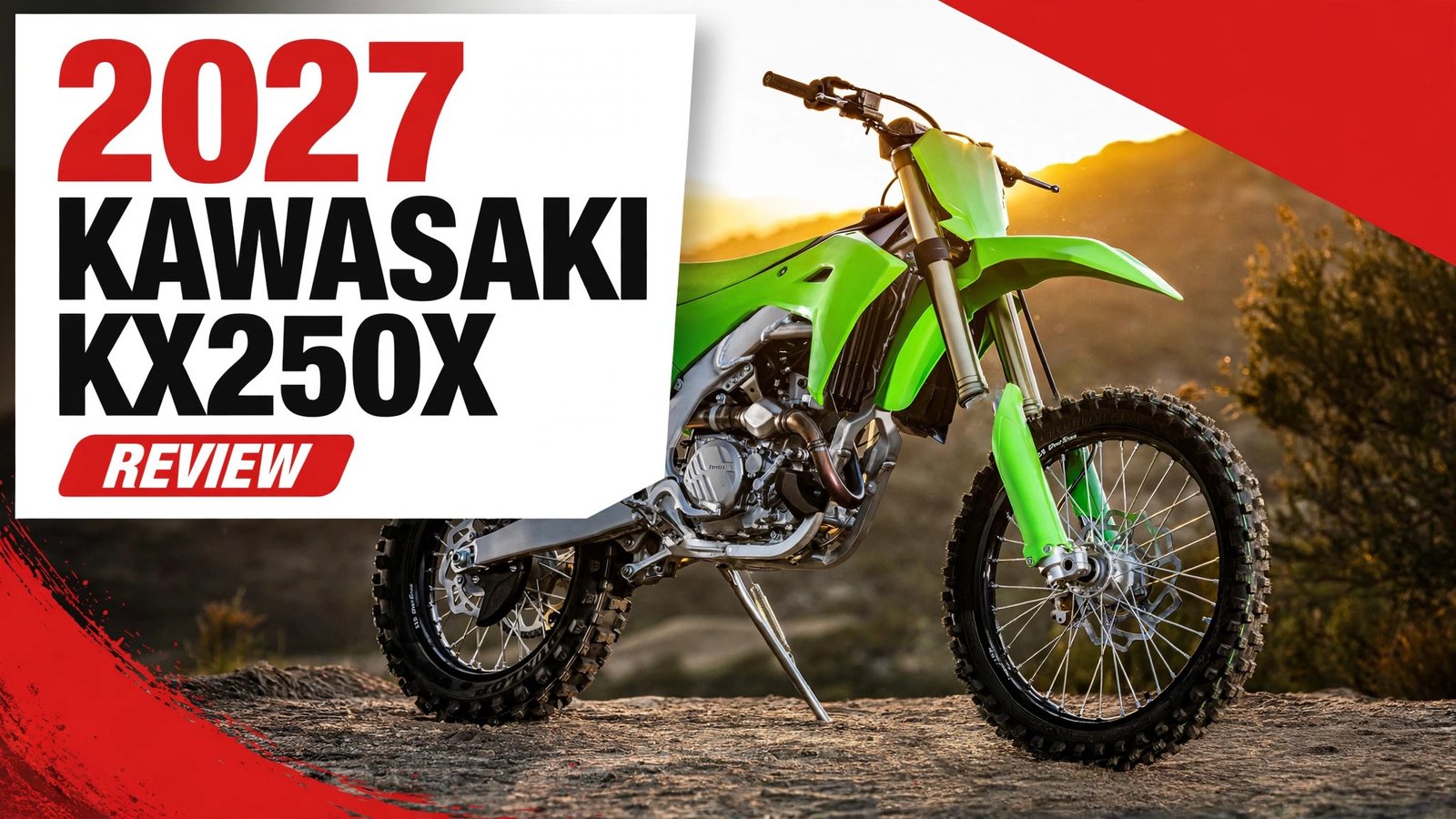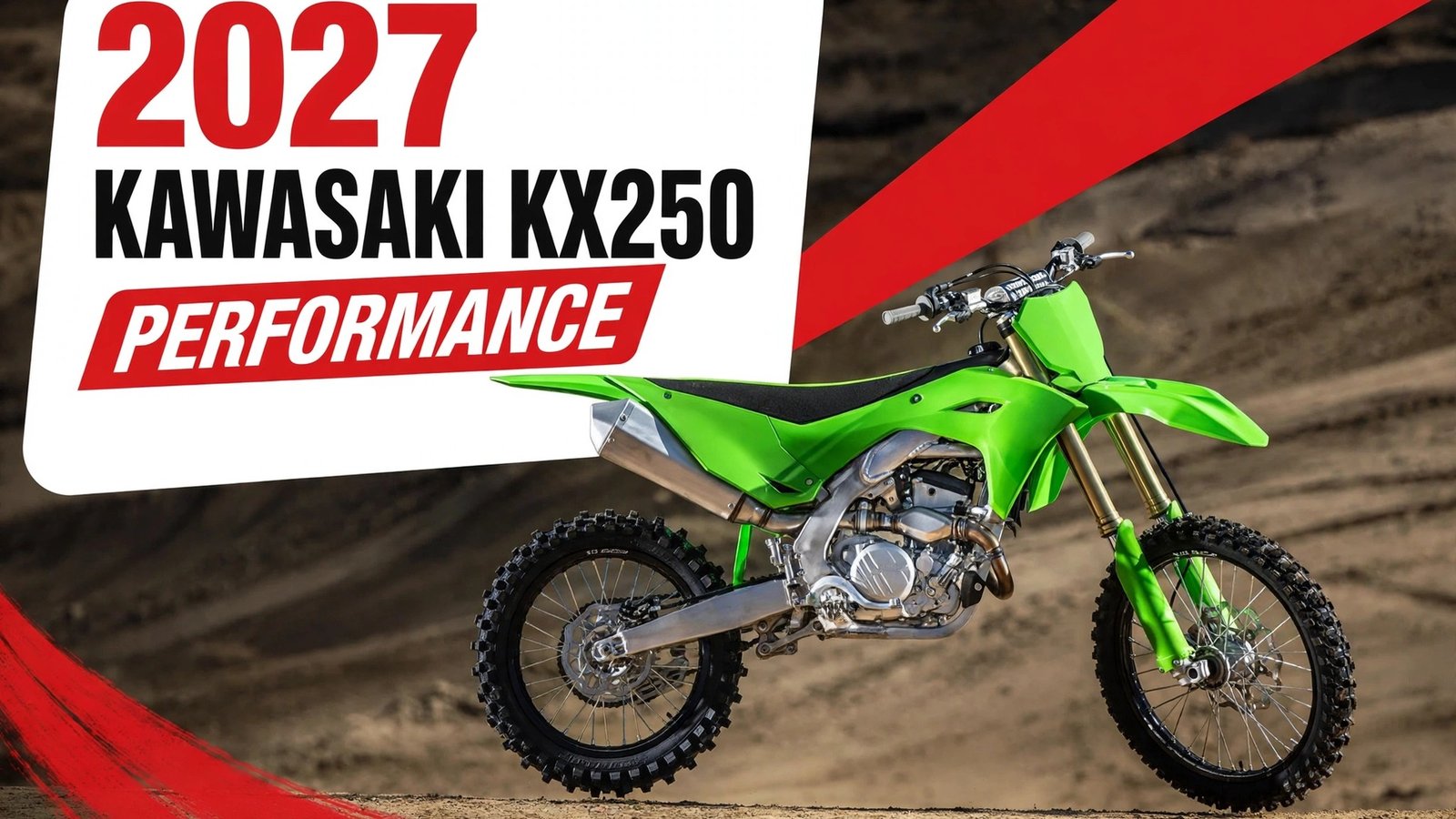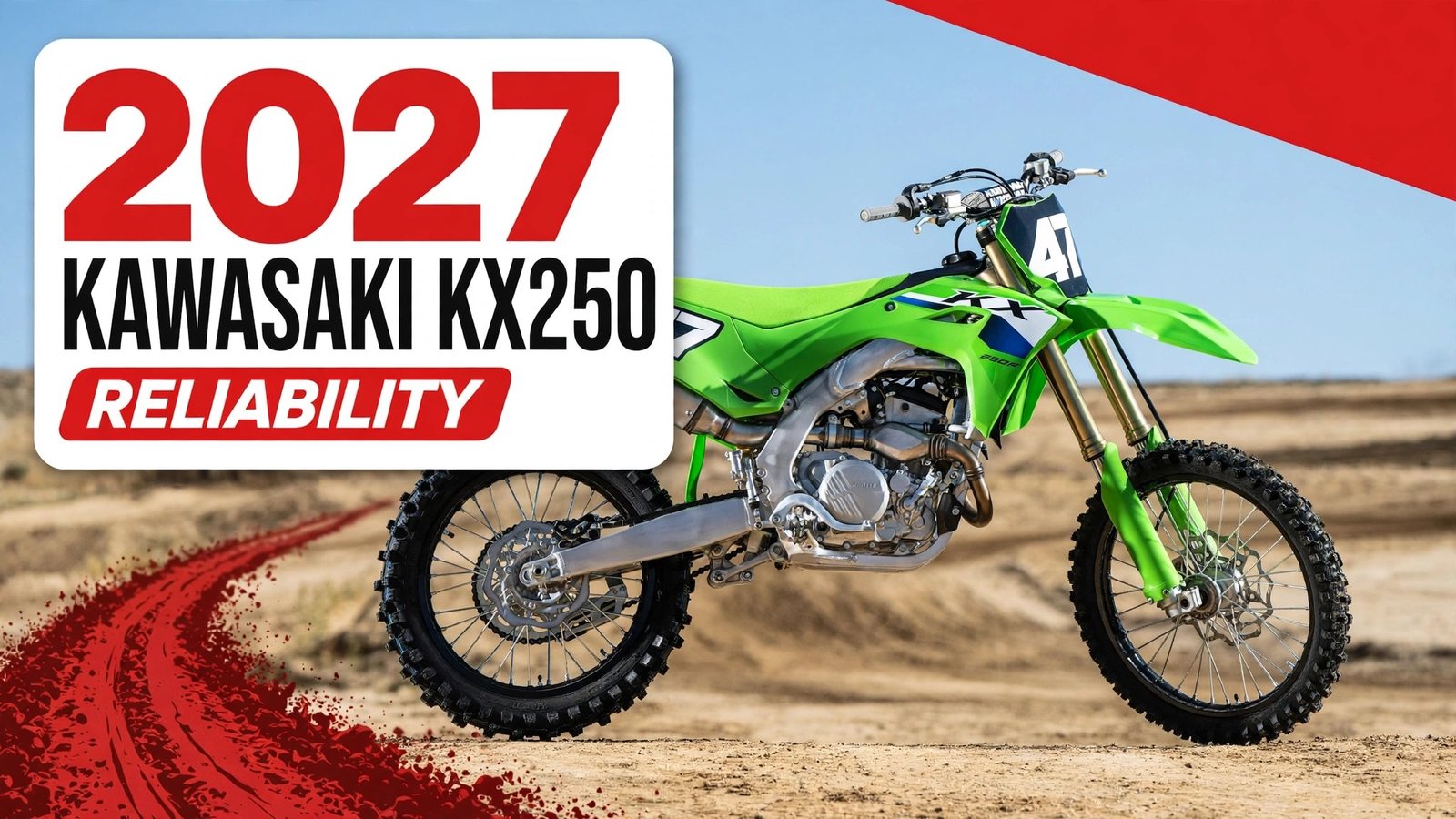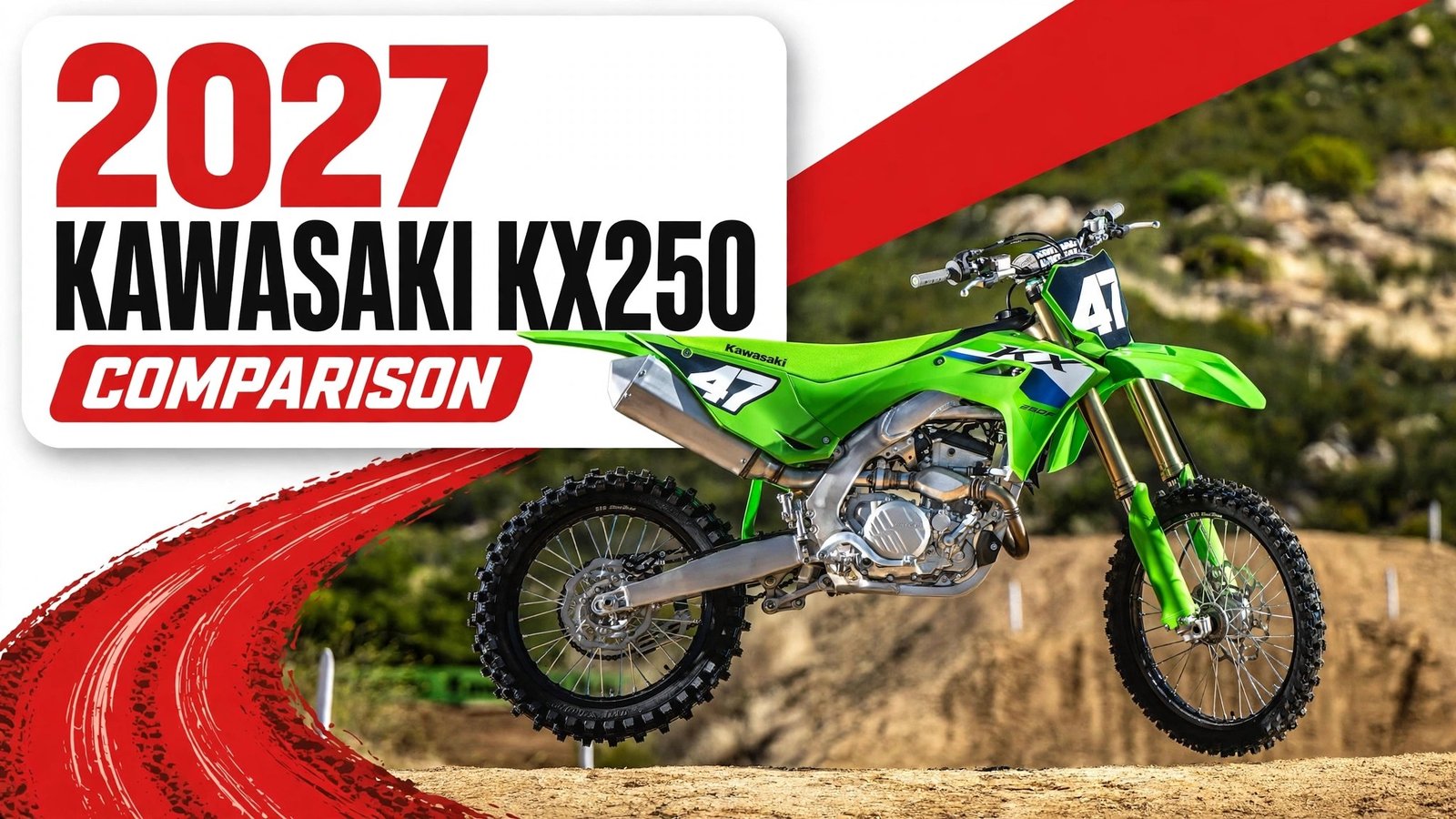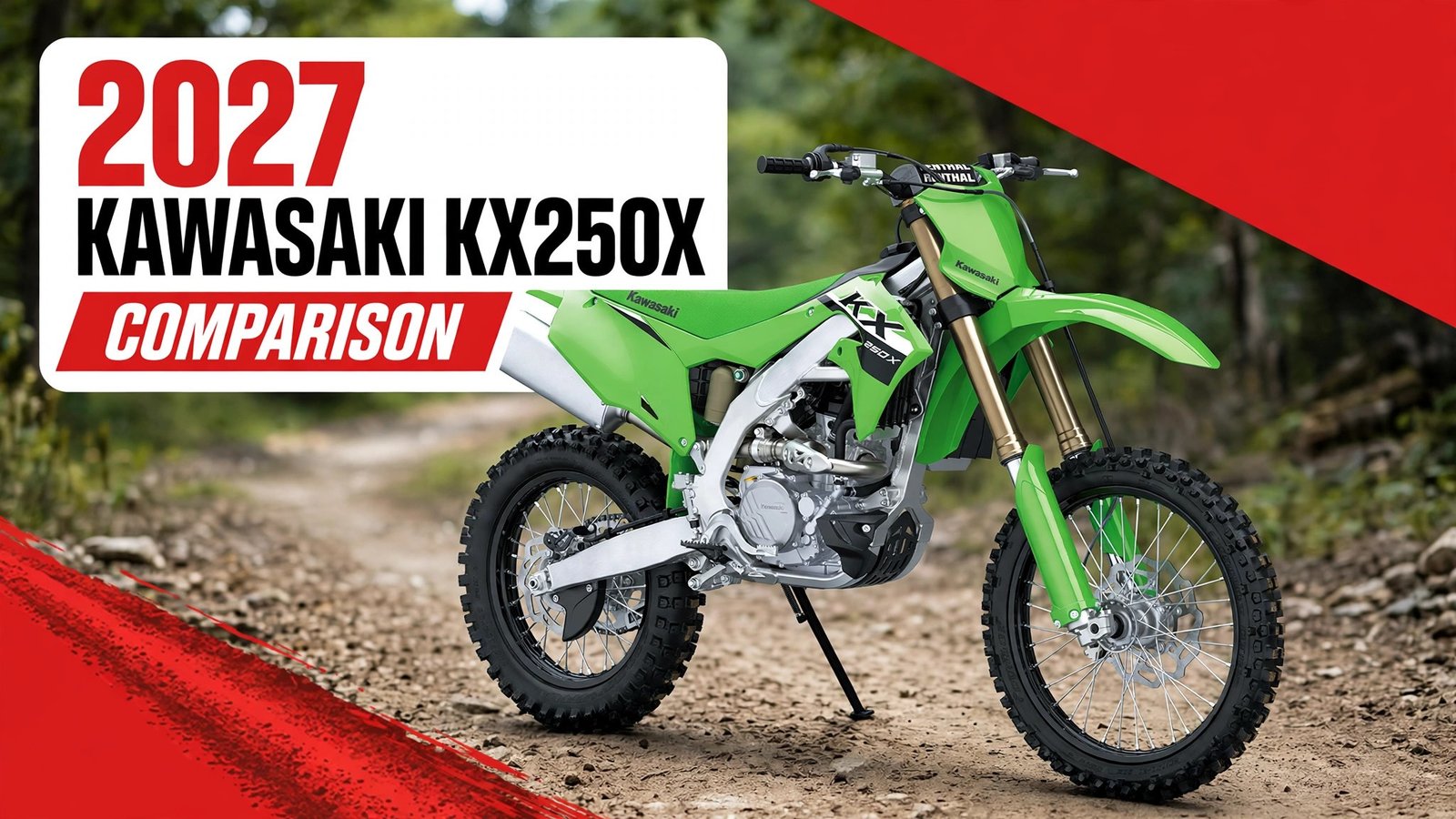
The Kawasaki KX250X became the KX250FX for 2027 — same 249cc cross-country bike, new name, $500 cheaper at $8,699. This Kawasaki KX250X comparison puts the renamed 2027 KX250FX against the three bikes US woods racers actually cross-shop it with: the Yamaha YZ250FX, the Honda CRF250RX and the KTM 250 XC-F. All four are 250cc four-stroke closed-course cross-country racers priced on 2027 models, and the Kawasaki is cheapest on MSRP and delivered price. Our KX250X review covers the full model-year story behind the rename.
The headline is simple. The Kawasaki wins on price and loses on tank: at $8,699 it undercuts the Honda by $200, the Yamaha by $400 and the KTM by $2,450, but its 1.64-gallon tank is the smallest of the four by a clear margin. This Kawasaki KX250X comparison works through each rival head to head — engine, gearbox, tank, equipment and delivered price — so a buyer can see what the cheapest bike gives up and what it keeps.
Kawasaki KX250X Overview and Its Closest Rivals
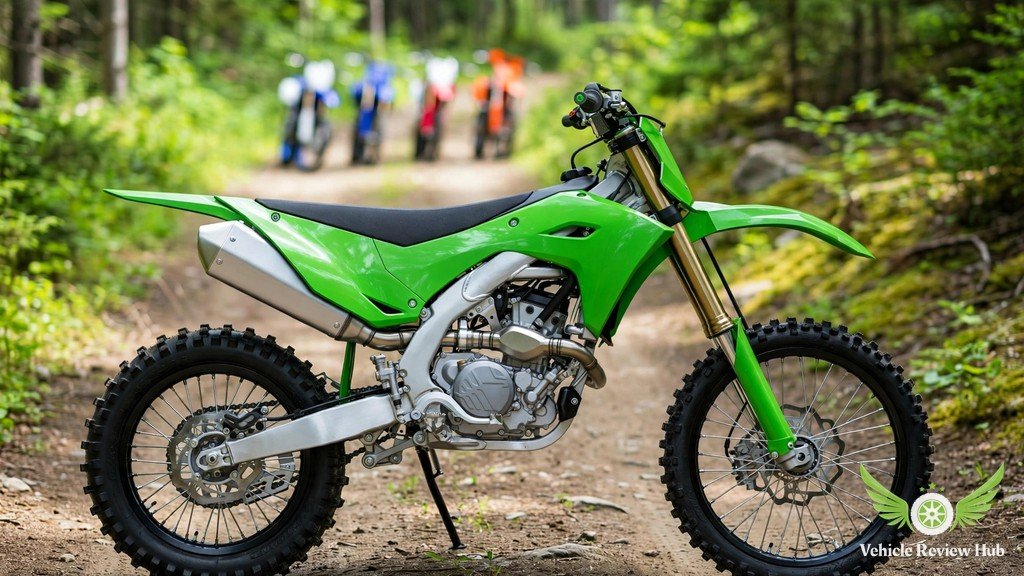
Four bikes, one class: the 250cc cross-country class is woods racing’s closest thing to a spec formula, with every bike a 249–250cc four-stroke single with an 18-inch rear wheel, a kickstand and softer suspension than its motocross sibling. What separates them is price, gearbox, tank size and mapping — and that is what this Kawasaki KX250X comparison measures. Ultimate Motorcycling called the 2021 X “an instant winner” at launch; the motocrosser’s own rivals are covered in our KX250 comparison.
Wins on Price, Loses on Tank
On MSRP the Kawasaki is the cheapest bike in this Kawasaki KX250X comparison at $8,699, and on delivered price it stays cheapest at $9,349 with the $650 destination charge. Next is the Honda CRF250RX at $8,899 plus $600 destination, $9,499 delivered, then the Yamaha YZ250FX at $9,099, destination not verified, then the KTM 250 XC-F at $11,149 plus $690 destination, $11,839 delivered. The tank tells the opposite story: the Kawasaki carries 1.64 gallons against 2.1 for the Honda and Yamaha and 2.2 for the KTM, so the cheapest bike also stops for fuel first — about 50 minutes at race pace, per Dirt Bike Test’s 2025 first impression of the X.
The price gap is not small change: the $2,450 between the Kawasaki and the KTM buys a lot of fuel, tyres and service, and the $400 between the Kawasaki and the Yamaha is less than one set of tyres. What the Kawasaki gives up is fuel range and, against the Yamaha and KTM, a sixth gear. What it keeps is the same 249cc engine family, the same 5-speed close-ratio gearbox as the Honda, and the lowest delivered price in the class. That is the value question at the heart of this Kawasaki KX250X comparison.
How the Four Bikes Differ at a Glance
The table below puts the four 2027 bikes side by side on the numbers that decide this Kawasaki KX250X comparison: price, gearbox, tank and mapping. Every figure is a 2027 number from the makers or from Dirt Bike Magazine’s 2026 off-road dyno wrap, and unverified figures are marked as such rather than guessed.
| Bike | 2027 MSRP | Destination | Delivered | Gearbox | Fuel tank | Mapping | Skid plate |
|---|---|---|---|---|---|---|---|
| Kawasaki KX250FX | $8,699 | $650 | $9,349 | 5-speed close-ratio | 1.64 gal | MX mapping | Accessory (gen 2) |
| Yamaha YZ250FX | $9,099 | Not verified | — | 6-speed wide-ratio | 2.1 gal | Off-road mapping | Standard (plastic) |
| Honda CRF250RX | $8,899 | $600 | $9,499 | 5-speed | 2.1 gal | Off-road mapping | Standard |
| KTM 250 XC-F | $11,149 | $690 | $11,839 | 6-speed wide-ratio | 2.2 gal | MX mapping | Standard |
Note: 2027 prices from Kawasaki USA, Yamaha USA and dealers (YZ250FX $9,099), Honda dealers (CRF250RX $8,899) and Motorcycle.com (KTM 250 XC-F $11,149 + $690 destination). Gearboxes, tanks and mapping from Dirt Bike Magazine’s 2026 dyno wrap. The Yamaha’s destination charge was not verified, so no delivered price is printed for it in this Kawasaki KX250X comparison.
Kawasaki KX250X vs Yamaha YZ250FX
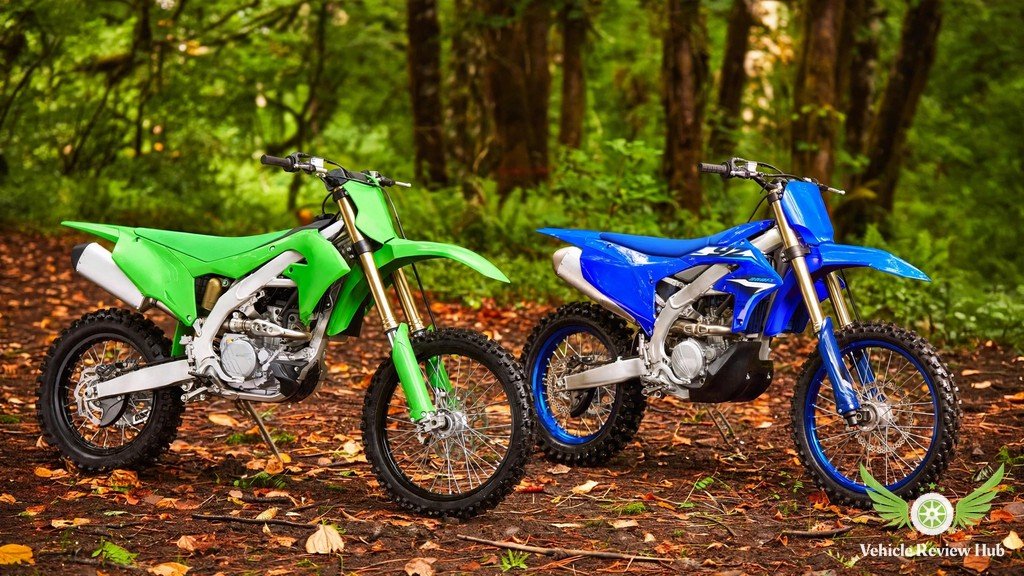
The Yamaha is the Kawasaki’s closest rival on paper and the hardest to beat on the trail: the YZ250FX costs $400 more than the Kawasaki for 2027, carries half a gallon more fuel, and runs a wide-ratio six-speed where the Kawasaki runs a five-speed. This part of the Kawasaki KX250X comparison tests whether that $400 buys a better woods bike.
Engine, Specs and Performance Side by Side
Both bikes are 250cc four-stroke singles, but they are tuned differently. The Yamaha’s 250cc engine (77.0 × 53.6 mm, 13.8:1 compression) is the class benchmark for low-end torque — Dirt Bike Test’s 2022 woods comparison called the Yamaha motor “one of, if not the best in its class” with “low-end torque … unmatched”. The Kawasaki’s 249cc engine (78.0 × 52.2 mm, 14.0:1) is the motocross engine with woods equipment: quick-revving, strong on top, and “the least off-road oriented of the bunch” in Dirt Bike Test’s words — though the same testers said its aggressive power “was favored by quite a few of our testers, from Pro to Novice/Intermediate”. That mapping split is the first thing this Kawasaki KX250X comparison measures: the Yamaha runs off-road mapping, the Kawasaki runs motocross mapping.
| Spec | Kawasaki KX250FX | Yamaha YZ250FX |
|---|---|---|
| Engine | 249cc DOHC single, 4-stroke | 250cc DOHC single, 4-stroke (77.0 × 53.6 mm) |
| Compression | 14.0:1 | 13.8:1 |
| Gearbox | 5-speed, close-ratio | 6-speed, wide-ratio |
| Fuel tank | 1.64 gal | 2.1 gal |
| Weight w/o fuel | 233.3 lb (sheet) / 236 lb (scale) | 234 lb (scale) |
| Seat height | 37.2 in | 37.6 in (dealer video — not Yamaha’s page) |
| Rear wheel | 18-in, 110/100-18 Dunlop Geomax AT81 | 18-in, Dunlop MX33 |
| Skid plate | Accessory (gen 2) | Standard (plastic) |
| Mapping | MX mapping | Off-road mapping |
| Clutch | Hydraulic | Cable |
| 2027 MSRP | $8,699 | $9,099 |
Note: Kawasaki figures from the 2027 FX page and spec sheets; Yamaha figures from Yamaha USA’s YZ250FX page and Dirt Bike Magazine’s 2026 off-road dyno wrap. The Yamaha’s 37.6-inch seat height comes from a dealer video, not Yamaha’s own page, and is labelled as such in this Kawasaki KX250X comparison. Weights are scale figures unless marked as sheet figures.
Price, Equipment and Which Suits Which Rider
The Yamaha costs $400 more than the Kawasaki on MSRP, and it spends that money on equipment: a standard plastic skid plate where the gen-2 Kawasaki’s is an accessory, a 2.1-gallon tank where the Kawasaki carries 1.64 gallons, and a wide-ratio six-speed where the Kawasaki runs five speeds. The Kawasaki answers with a hydraulic clutch against the Yamaha’s cable clutch and a $400 saving that covers a skid plate and most of a tyre. For tight woods, the Yamaha’s low-end torque and off-road mapping are stronger; for faster, more open courses, the Kawasaki’s quick-revving top-end and lower price are better — and that is the honest split in this Kawasaki KX250X comparison.
Kawasaki KX250X vs Honda CRF250RX
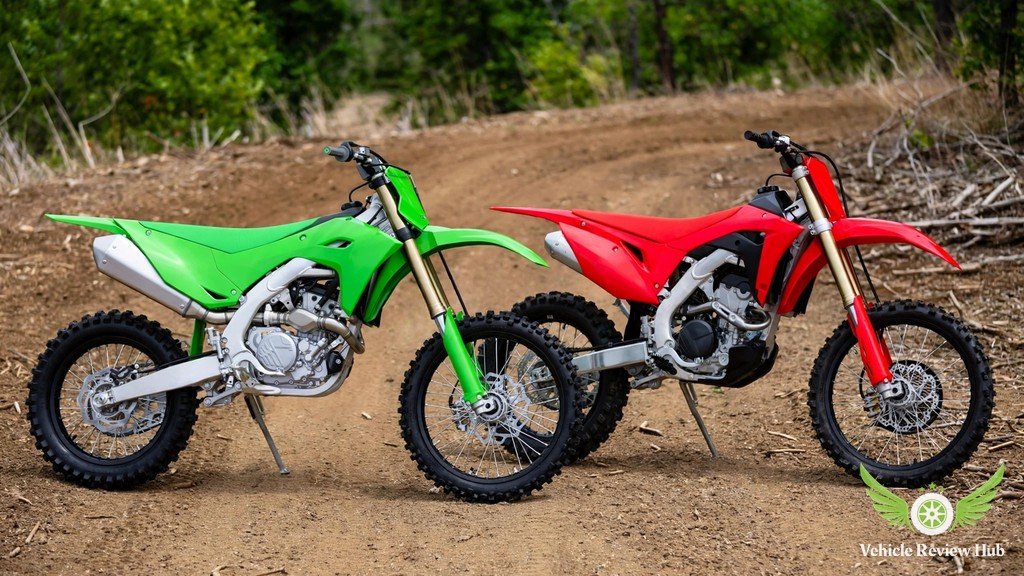
The Honda is the closest rival of all on price — $200 separates the two on MSRP, $150 on delivered price — and the closest on philosophy, because the CRF250RX is also a five-speed. This section of the Kawasaki KX250X comparison is the tightest call in the class.
Engine, Specs and Performance Side by Side
Both bikes run 249cc four-stroke singles with five-speed gearboxes — motocross engines dressed for the woods. The difference is mapping: the Honda runs off-road mapping, the Kawasaki motocross mapping, and Dirt Bike Test’s 2022 woods comparison ranked the Honda’s motor the “second-best all-around motor” in the class, behind only the Yamaha, while the Kawasaki’s was “the least off-road oriented of the bunch”. That mapping difference is the central split in this Kawasaki KX250X comparison. The Honda’s measured output is the one hard number in the class: our CRF250RX performance guide‘s 37.7 hp dyno figure (2025) is the RX’s own figure, and no comparable peak figure exists in text for the Kawasaki — its Pro Circuit dyno peaks were published as chart images only. The 39.2 hp figure sometimes quoted for the Kawasaki is the KX250 motocrosser’s Dirt Rider dyno figure, not the X’s.
| Spec | Kawasaki KX250FX | Honda CRF250RX |
|---|---|---|
| Engine | 249cc DOHC single, 4-stroke | 249cc DOHC single, 4-stroke |
| Compression | 14.0:1 | Not verified |
| Gearbox | 5-speed, close-ratio | 5-speed |
| Fuel tank | 1.64 gal | 2.1 gal |
| Weight w/o fuel | 233.3 lb (sheet) / 236 lb (scale) | 229 lb (scale) |
| Seat height | 37.2 in | Not verified |
| Rear wheel | 18-in, 110/100-18 Dunlop Geomax AT81 | 18-in |
| Skid plate | Accessory (gen 2) | Standard |
| Mapping | MX mapping | Off-road mapping |
| Clutch | Hydraulic | Cable (per 2022 Dirt Bike Test comparison) |
| 2027 MSRP | $8,699 | $8,899 |
Note: Kawasaki figures from the 2027 FX page and spec sheets; Honda figures from Honda dealers and Dirt Bike Magazine’s 2026 dyno wrap. The Honda’s compression ratio and seat height were not verified from a maker page and are marked as such in this Kawasaki KX250X comparison. The Honda’s 37.7 hp dyno figure (2025) comes from our own CRF250RX performance guide and is the RX’s figure, not the Kawasaki’s.
Price, Equipment and Which Suits Which Rider
The Honda costs $200 more on MSRP and $150 more delivered, and for that it gives the buyer a 2.1-gallon tank, a standard skid plate and off-road mapping — the three things the Kawasaki makes the buyer add or accept. The Kawasaki answers with a hydraulic clutch, a $150 saving and the same five-speed gearbox, so the choice is fuel range and mapping against price. On a 50-minute race the Honda’s extra half gallon is the difference between finishing on one tank and stopping for fuel; on a shorter sprint the Kawasaki’s saving and stronger top-end are worth more. There is no wrong answer here, only a course that suits one bike better — and that is why this Kawasaki KX250X comparison calls it the tightest call in the class.
On calculated speed the two are inseparable: Dirt Bike Magazine’s gear-ratio table puts the Kawasaki at 73.0 mph in 5th gear at 12,500 rpm and the Honda at 72.7 mph in 5th — both calculated figures, explicitly not observed speeds, and both limited by the same five-speed gearing. The six-speed rivals are the ones that stretch away on paper, and they do it in top gear only.
Kawasaki KX250X vs KTM 250 XC-F
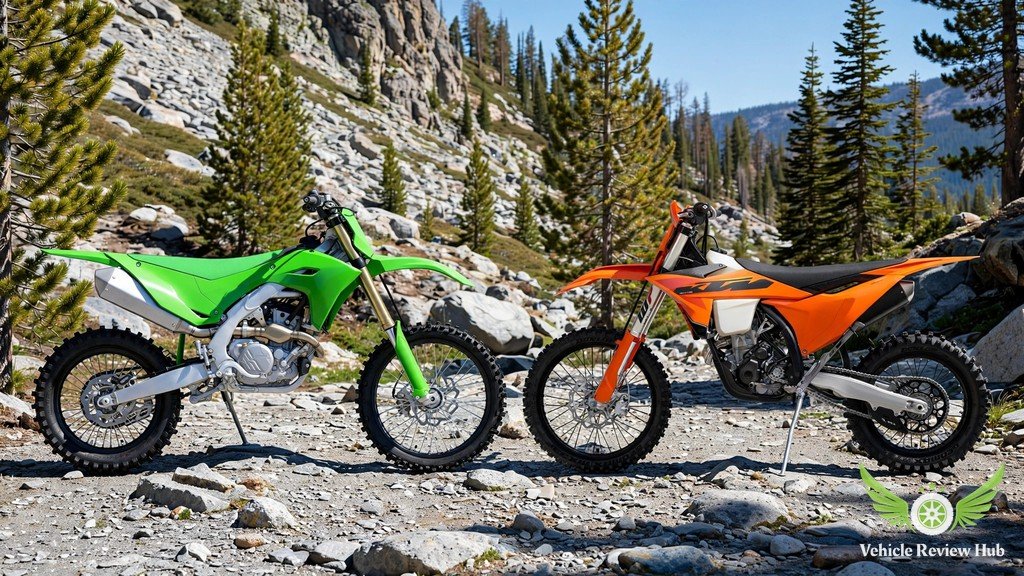
The KTM is the outlier in this Kawasaki KX250X comparison: $2,450 more than the Kawasaki on MSRP, the biggest tank in the class, a wide-ratio six-speed, and a Brembo hydraulic clutch. It is the only rival that costs thousands more — and the question is whether it is thousands better.
Engine, Specs and Performance Side by Side
The KTM’s 249.9cc engine runs the highest compression in the class at 14.5:1, and its wide-ratio six-speed gives it the longest legs: Dirt Bike Magazine’s calculated gear speeds put the KTM at 94.0 mph in 6th gear at 12,500 rpm against the Kawasaki’s 73.0 mph in 5th — both calculated, not observed. The KTM shares the Kawasaki’s motocross mapping rather than the off-road mapping of the Yamaha and Honda, so both feel aggressive where the Yamaha and Honda feel tractable. The KTM’s 2.2-gallon tank (2.24 gallons, 8.5 litres, per KTM) is the biggest in the class, 0.56 gallons more than the Kawasaki’s 1.64. The tank and the gearbox are the two numbers that define the KTM in this Kawasaki KX250X comparison.
| Spec | Kawasaki KX250FX | KTM 250 XC-F |
|---|---|---|
| Engine | 249cc DOHC single, 4-stroke | 249.9cc DOHC single, 4-stroke |
| Compression | 14.0:1 | 14.5:1 |
| Gearbox | 5-speed, close-ratio | 6-speed, wide-ratio |
| Fuel tank | 1.64 gal | 2.2 gal (2.24 gal / 8.5 L per KTM) |
| Weight w/o fuel | 233.3 lb (sheet) / 236 lb (scale) | 233 lb (scale) |
| Seat height | 37.2 in | Not verified |
| Rear wheel | 18-in, 110/100-18 Dunlop Geomax AT81 | 18-in, Dunlop AT82 |
| Skid plate | Accessory (gen 2) | Standard |
| Mapping | MX mapping | MX mapping |
| Clutch | Hydraulic | Hydraulic (Brembo) |
| 2027 MSRP | $8,699 | $11,149 |
Note: Kawasaki figures from the 2027 FX page and spec sheets; KTM figures from Motorcycle.com’s 2027 compare and Dirt Bike Magazine’s 2026 dyno wrap. The KTM’s seat height was not verified from a maker page and is not printed in this Kawasaki KX250X comparison. Gear speeds are calculated from Dirt Bike Magazine’s gear-ratio table at 12,500 rpm, not observed speeds.
Price, Equipment and Which Suits Which Rider
The KTM costs $2,450 more on MSRP and $2,490 more delivered than the Kawasaki, and it is the only bike in this Kawasaki KX250X comparison where the price gap is measured in thousands. For that money the buyer gets a sixth gear, the biggest tank, the highest compression and a Brembo clutch — but Dirt Bike Magazine’s own caveat applies to the extra gear: on the tight off-road loop of its 2026 shootout, the two six-speeds “were at a disadvantage”, with first gear too low and sixth “just an overdrive for dirt roads”, so that “they were both effectively four-speeds”. A sixth gear never used on a tight woods loop is not worth $2,450 there; on faster, more open terrain it is. The KTM is the most capable bike in this Kawasaki KX250X comparison and the most expensive by thousands, suiting the rider who races open country and values the tank and the top gear; the Kawasaki suits the rider who races the same courses for $2,490 less.
Kawasaki KX250X Price and Value Compared
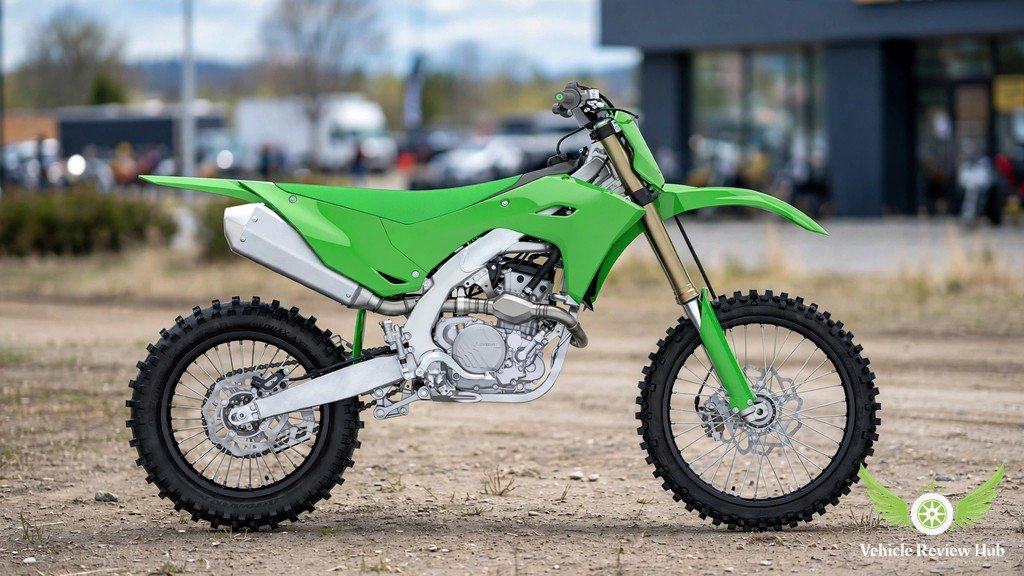
Price is where this Kawasaki KX250X comparison is decided, because the four bikes are closer on the trail than on the price list. The table below is the whole value argument: MSRP, destination, delivered price and the gap to the Kawasaki, all on 2027 models.
The Six-Speed KTM Costs Thousands More
A correction belongs here: the document outline gave this section the heading “Six-Speeds Cost Thousands More”, and that heading is only half true. The six-speed KTM does cost thousands more than the Kawasaki — $2,450 more on MSRP, $11,149 against $8,699 — but the six-speed Yamaha costs only $400 more, $9,099 against $8,699, which is not thousands, and the Honda is a five-speed, so it does not belong in the claim. The heading has been corrected to “The Six-Speed KTM Costs Thousands More” and the blanket claim is not printed as fact in this Kawasaki KX250X comparison. The honest sentence is the one the figures support: the six-speed KTM costs $2,450 more than the Kawasaki, the six-speed Yamaha only $400 more — and on Dirt Bike Magazine’s tight off-road loop both six-speeds were “effectively four-speeds”, with first gear too low and sixth just an overdrive for dirt roads.
| Bike | 2027 MSRP | Destination | Delivered | Gap vs Kawasaki |
|---|---|---|---|---|
| Kawasaki KX250FX | $8,699 | $650 | $9,349 | — (cheapest) |
| Honda CRF250RX | $8,899 | $600 | $9,499 | +$200 MSRP / +$150 delivered |
| Yamaha YZ250FX | $9,099 | Not verified | — | +$400 MSRP |
| KTM 250 XC-F | $11,149 | $690 | $11,839 | +$2,450 MSRP / +$2,490 delivered |
Note: 2027 MSRPs from Kawasaki USA, Yamaha USA and dealers, Honda dealers and Motorcycle.com. Destination charges are verified per model year and never carried across years: $650 for the Kawasaki, $600 for the Honda and $690 for the KTM. The Yamaha’s destination charge was not verified, so no delivered price is printed for it in this Kawasaki KX250X comparison.
Running Costs and Resale Value Compared
Delivered price is the running-cost headline, because all four bikes share the same race-bike service rhythm: air filter after every race, oil every three races, piston and valve check every 15 hours on the KX250 family’s published chart — the family figure, not the X’s own. No verified comparative service-cost dataset exists for the four bikes, so this Kawasaki KX250X comparison does not invent one: the honest statement is that the $2,490 saved against the KTM covers years of filters, oil and tyres. Our KX250X reliability guide covers the full service schedule and what it costs.
Resale is the one cost area where no claim is made at all. No verified used-price dataset exists for any of the four 2027 bikes, so no resale percentage and no “holds value best” claim is printed here. The only hard resale datapoint is the leftover-2026 Kawasaki discount: new 2026 X bikes advertised at $7,149 to $7,424 against the $9,199 MSRP, a discount snapshot on new leftovers, not a used value. A used bike in this class is priced on its hours and its service records, not on a table — that discipline, print no resale claim without a dataset, is the rule this Kawasaki KX250X comparison follows throughout.
Kawasaki KX250X Comparison Verdict and US Alternatives
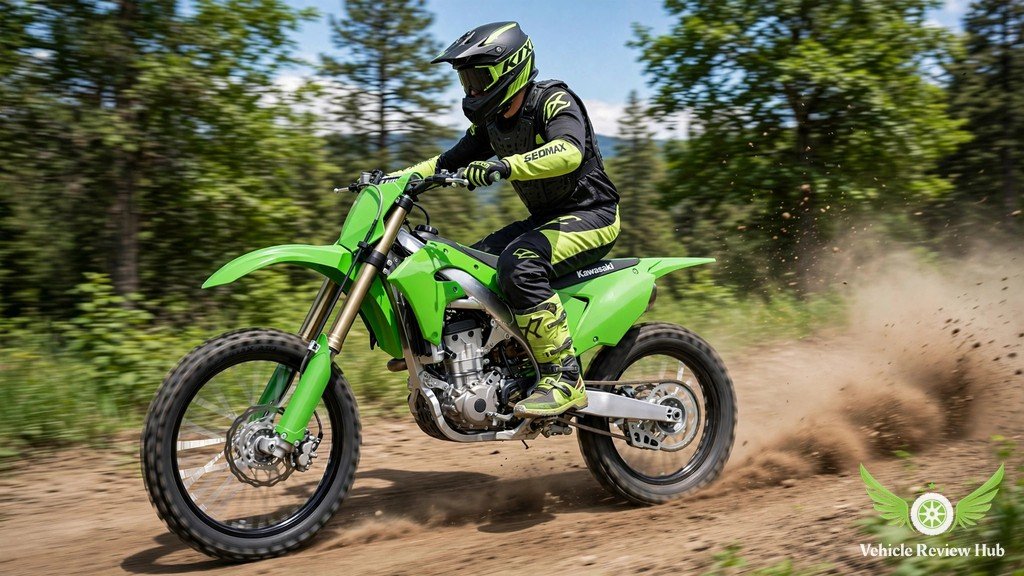
Four bikes, four honest answers: the Kawasaki is the cheapest and the thirstiest; the Yamaha is the best woods motor for $400 more; the Honda is the closest match for $200 more; the KTM is the most capable and the most expensive by thousands. This Kawasaki KX250X comparison ends with the verdict and the one alternative that is not a race bike at all.
Verdict: Woods Racer, MX Heart
The verdict is the bike’s own description: a woods racer with an MX heart. The Kawasaki KX250X is a motocross bike with woods equipment — an 18-inch rear wheel, a kickstand, softer suspension, shorter gearing and the mildest mapping coupler fitted — and it races like one: quick-revving, strong on top, least off-road oriented in Dirt Bike Test’s 2022 woods comparison, and competitive when ridden hard. It wins this Kawasaki KX250X comparison on price by $200 over the Honda, $400 over the Yamaha and $2,450 over the KTM, and loses it on tank size to all three. Buy it if price matters more than fuel range, if the courses are fast enough for its five-speed legs, and if the $2,490 saved against the KTM is worth more than a sixth gear that Dirt Bike Magazine found was effectively an overdrive on a tight loop. Our KX250X performance guide covers what the engine delivers when it is healthy.
Buy the Yamaha for tight woods, where low-end torque is the priority. Buy the Honda if the $200 gap is worth a bigger tank, off-road mapping and a standard skid plate. Buy the KTM if the courses are open, the tank matters and the budget stretches to $11,839 delivered. Buy none of the four if the riding is trails rather than racing — that buyer has a cheaper Kawasaki waiting below. That is the full verdict of this Kawasaki KX250X comparison.
KLX300R Is the Trail Option
The trail alternative is Kawasaki’s own KLX300R: $5,799 plus a $650 destination charge, $6,449 delivered for 2027 — $2,900 cheaper than the FX on MSRP and delivered. It is a 292cc fuel-injected trail bike with a six-speed gearbox, electric start only, a 35.4-inch seat and 282.2 pounds of curb weight, built for trails rather than racing — no dash, no headlight, no mirrors. It has no spark arrestor problem to solve and no race-bike service rhythm to keep, and for a rider who wants to ride trails rather than race them it is the better Kawasaki — which is why this Kawasaki KX250X comparison ends here, not with a fourth race bike.
The X racing, rather than being compared: Trevor Hunter rides the 2021 KX250X at the New Years Grand Prix at Glen Helen. Watch it below at race pace.
Kawasaki KX250X Comparison: Frequently Asked Questions
The questions below are the ones buyers ask when they compare the KX250X against its rivals, answered from the verified facts in this Kawasaki KX250X comparison.
Which is cheaper, the Kawasaki KX250FX or the Yamaha YZ250FX?
The Kawasaki. For 2027 the KX250FX is $8,699 against the YZ250FX’s $9,099 — $400 less before destination, the cheapest bike in this Kawasaki KX250X comparison.
Which is cheaper, the Kawasaki KX250FX or the Honda CRF250RX?
The Kawasaki, by $200: $8,699 against the Honda’s $8,899 for 2027 ($9,349 vs $9,499 delivered), and the closest gap in this Kawasaki KX250X comparison.
How much more is the KTM 250 XC-F than the Kawasaki?
$2,450 more on MSRP for 2027 ($11,149 vs $8,699) — the only rival in this Kawasaki KX250X comparison that costs thousands more.
Which of the four has the biggest fuel tank?
The KTM 250 XC-F at 2.2 gallons, then the Honda CRF250RX and Yamaha YZ250FX at 2.1 gallons. The Kawasaki is smallest at 1.64 gallons. The tank is the Kawasaki’s one clear loss in this Kawasaki KX250X comparison.
Which of the four has a six-speed gearbox?
The Yamaha YZ250FX and the KTM 250 XC-F (wide-ratio six-speeds). The Kawasaki KX250FX and the Honda CRF250RX both use five-speed close-ratio gearboxes — and on Dirt Bike Magazine’s tight off-road loop the six-speeds were “effectively four-speeds”.
What is the best trail alternative to the KX250X?
Kawasaki’s own KLX300R: $5,799 plus $650 destination ($6,449 delivered) for 2027, a 292cc six-speed trail bike with a 35.4-inch seat — $2,900 cheaper than the FX, built for trails rather than racing, which is why this Kawasaki KX250X comparison ends with it.