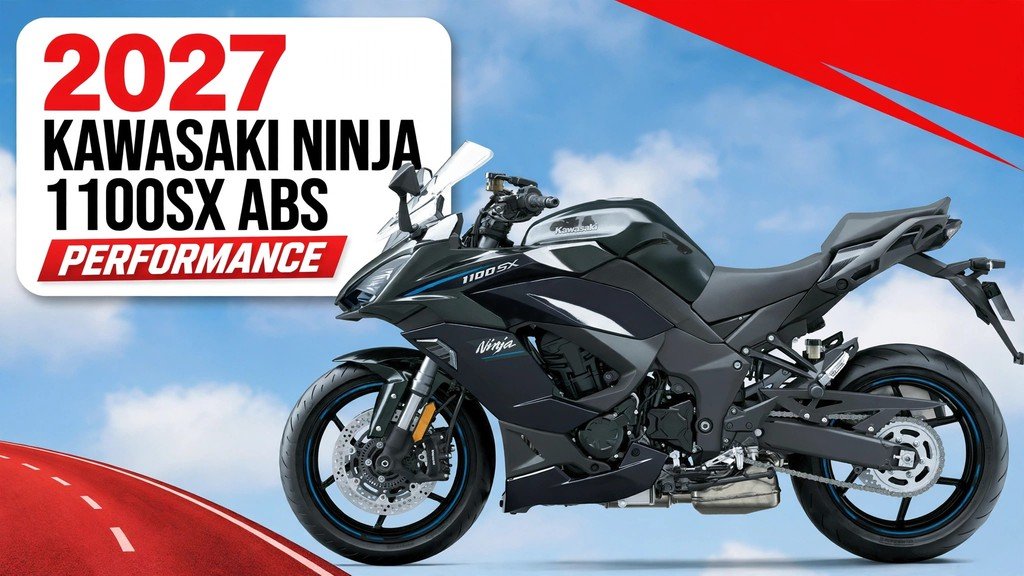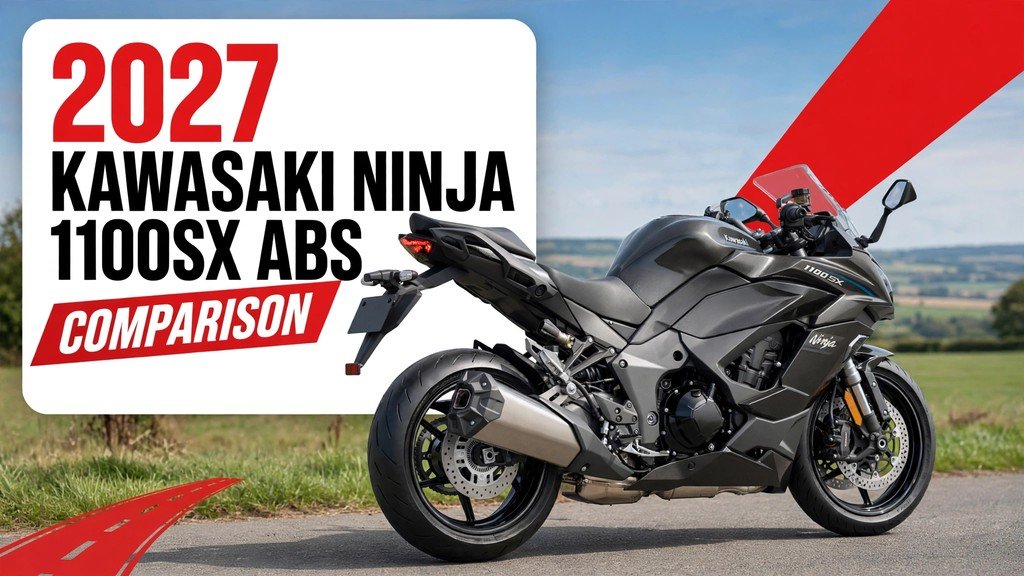
The short answer is that the Kawasaki Ninja 1100SX ABS sits in the middle of the sport-touring market on price and at the top of it on cornering electronics. At $14,839 delivered for 2026, it costs $260 less than the Suzuki GSX-S1000GT+ and $1,540 more than the Yamaha Tracer 9 before luggage, and it is the only one of the three with a six-axis IMU and cornering electronics as standard. This Kawasaki Ninja 1100SX ABS comparison puts the standard bike against the Suzuki, the Yamaha and its own SE trim, with every price delivered and every pannier cost shown separately.
Kawasaki Ninja 1100SX ABS Overview and Its Closest Rivals
The sport-touring class in 2026 is a small one. The Suzuki GSX-S1000GT+ is the power pick, the Yamaha Tracer 9 is the budget pick, and the Kawasaki’s own SE is the same bike with better brakes and suspension. This Kawasaki Ninja 1100SX ABS comparison starts with those three because each one tests a different part of the Kawasaki’s case.

Why These Three Rivals: GT, Tracer, Its Own SE
The GT+ is the closest rival on paper: a litre-class four with more peak power, factory panniers and a lower seat, for $260 more. The Tracer 9 is the cheapest way into the class at $13,299 delivered, with a lighter triple and a taller, more upright riding position. The SE matters because it is the same 1,099cc engine and chassis for $1,800 more. This Kawasaki Ninja 1100SX ABS comparison keeps the three separate because they answer three different questions.
How the Four Bikes Differ at a Glance
Four numbers decide most of this comparison: power, torque, weight and seat height. The Suzuki makes the most power and weighs the least, the Yamaha makes the least power and costs the least, and the Kawasaki makes the most torque at the lowest revs while carrying the most weight. This Kawasaki Ninja 1100SX ABS comparison table puts those numbers side by side with the delivered prices.
| Bike | Engine | Power | Torque | Curb weight | Seat | 2026 delivered |
|---|---|---|---|---|---|---|
| Kawasaki Ninja 1100SX ABS | 1,099cc four | 134 hp @ 9,000 rpm | 83.2 lb-ft @ 7,600 rpm | 518.2 lb | 32.3 in | $14,839 |
| Suzuki GSX-S1000GT+ | 999cc four | 150 hp @ 11,000 rpm | 79.6 lb-ft @ 9,250 rpm | 498 lb | 31.9 in | $15,099 |
| Yamaha Tracer 9 | 890cc triple | 117 hp @ 10,000 rpm | 68.6 lb-ft @ 7,000 rpm | 483 lb | 33.3 in | $13,299 |
| Kawasaki Ninja 1100SX SE | 1,099cc four | 134 hp @ 9,000 rpm | 83.2 lb-ft @ 7,600 rpm | 516.0 lb | 32.3 in | $16,639 |
Notes for this Kawasaki Ninja 1100SX ABS comparison table: the GT+ price includes its panniers, while the 1100SX panniers cost $1,128.96 extra; the Tracer 9 seat is 33.3 to 33.9 inches for the 2025 and later generation.
The video below is not a test of the three rivals in this guide. It is Adventure Bike Rider’s 1,500-mile NC500 ride in four days, pitching the Ninja 1100SX SE against its stablemate the Versys 1100 SE, a taller adventure-tourer with the same 1,099cc engine and a different mission. This Kawasaki Ninja 1100SX ABS comparison treats the film as a long-distance touring record for the SE, not as evidence about the Suzuki or the Yamaha.
Kawasaki Ninja 1100SX ABS vs Suzuki GSX-S1000GT+
The Suzuki is the rival the Kawasaki has to beat on the road: faster on paper and cheaper with luggage. The GT+ makes 150 hp, weighs 498 lb and arrives with panniers fitted for $15,099 delivered. The Kawasaki answers with more torque lower down, a six-axis IMU the Suzuki does not have at all, and a $260 lower sticker price before bags. This Kawasaki Ninja 1100SX ABS comparison section weighs those two cases honestly.

Engine, Specs and Performance Side by Side
On peak power the Suzuki leads by 16 hp: 150 hp at 11,000 rpm from its 999cc four against the Kawasaki’s 134 hp at 9,000 rpm, published to the ISO 4106 standard. On torque the Kawasaki leads by 3.6 lb-ft and peaks 1,650 rpm lower, 83.2 lb-ft at 7,600 rpm against 79.6 lb-ft at 9,250 rpm, so the midrange belongs to the Kawasaki. The Suzuki is also 20.2 lb lighter and its seat is 0.4 inches lower. The only dyno run found is Motorcycle.com’s test of an SE at 124.6 hp at the rear wheel, and this Kawasaki Ninja 1100SX ABS comparison labels that run SE-only because no standard-bike dyno exists. MCN’s long-term dyno found the new engine makes 6 to 8 bhp more than the old 1000SX between 4,000 and 7,000 rpm.
Price, Equipment and Which Suits Which Rider
The Suzuki costs $15,099 delivered with panniers included, while the Kawasaki costs $14,839 delivered with panniers at $1,128.96 extra, so the Kawasaki with bags fitted costs $15,967.96, $868.96 more than the Suzuki. The equipment gap runs the other way: the Kawasaki has a six-axis IMU with cornering ABS and traction control as standard, and the Suzuki has none of them, with a five-stage traction control system and ABS that are not angle-responsive. MCN called the Suzuki decidedly more vibey and raw while the Kawasaki is ultra-smooth, and named the Ninja 1100SX SE its Sports Tourer of the Year for 2025. This Kawasaki Ninja 1100SX ABS comparison puts the Suzuki ahead for peak power and included luggage, and the Kawasaki ahead for cornering electronics and a calmer engine. The Motorcycle.com SE review covers the dyno run and the road-test detail behind those figures.
Kawasaki Ninja 1100SX ABS vs Yamaha Tracer 9
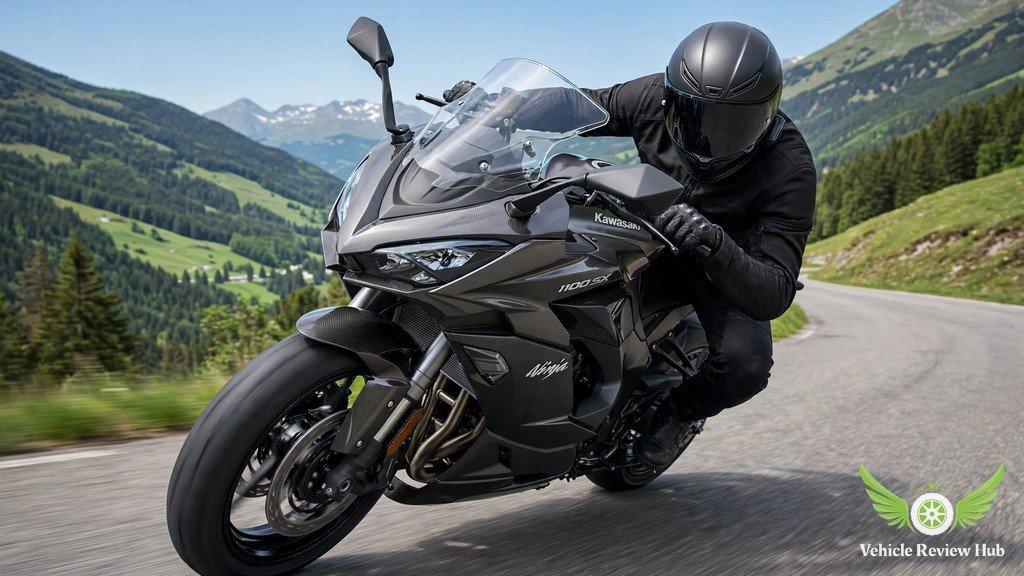
The Yamaha is the cheapest bike in this comparison and the most different in character. The Tracer 9 costs $13,299 delivered for 2026, which is $1,540 less than the Kawasaki, and it weighs 483 lb, which is 35.2 lb less. It is a taller, more upright crossover-style tourer with a 890cc triple, against the Kawasaki’s low-slung faired sport-tourer. This Kawasaki Ninja 1100SX ABS comparison section asks whether the Yamaha’s price and agility outweigh the Kawasaki’s power, torque and equipment.
Engine, Specs and Performance Side by Side
The Kawasaki has 17 hp more and much more torque: 134 hp at 9,000 rpm and 83.2 lb-ft at 7,600 rpm against the Yamaha’s 117 hp at 10,000 rpm and 68.6 lb-ft at 7,000 rpm. The Yamaha answers with weight and agility: at 483 lb it is 35.2 lb lighter than the Kawasaki, and Cycle News found the Kawasaki is not as nimble as a Tracer 9. The Tracer 9 seat is 33.3 to 33.9 inches for the 2025 and later generation, a full inch higher than the Kawasaki’s 32.3 inches at the low end of its range. This Kawasaki Ninja 1100SX ABS comparison gives the Yamaha the agility and the Kawasaki the power.
Price, Equipment and Which Suits Which Rider
The Yamaha is $1,540 cheaper delivered at $13,299 against $14,839, but the US Tracer 9 is the base bike only, with no GT or GT+ equipment, no radar and no Y-AMT automatic gearbox. The Kawasaki brings a full fairing, a six-axis IMU, cruise control and a quickshifter that works from 1,500 rpm, all as standard. The Yamaha’s panniers are not included at this price and no US pannier price was found, so the bags comparison stays qualitative: the Yamaha’s panniers would need to cost over $2,669 to erase the gap, which is implausible. This Kawasaki Ninja 1100SX ABS comparison calls the Tracer 9 the budget pick and the 1100SX the more powerful, better-equipped pick for $1,540 more.
Kawasaki Ninja 1100SX ABS vs Kawasaki Ninja 1100SX SE
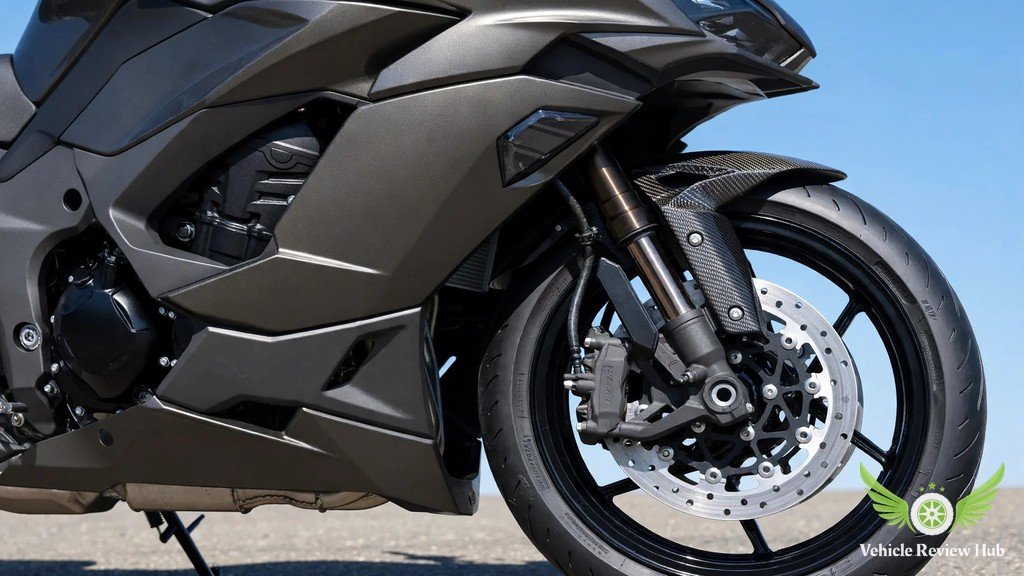
The SE is the same bike with better equipment, and the question is whether $1,800 is a fair price for it. The SE shares the standard bike’s 1,099cc engine, 134 hp claim, 56.7-inch wheelbase, 5.0-gallon tank and electronics, and it adds Brembo M4.32 calipers with a Brembo master cylinder and steel-braided lines, an Öhlins S46 rear shock and heated grips. It is also 2.2 lb lighter at 516.0 lb against 518.2 lb. This Kawasaki Ninja 1100SX ABS comparison section works out what the $1,800 buys and who should pay it.
Engine, Specs and Performance Side by Side
There is no performance difference to measure between the two trims. Both use the same stroked 1,099cc four with the same 134 hp and 83.2 lb-ft claims, the same 32.3-inch seat and the same 5.0-gallon tank, and the only dyno run found covers an SE. The SE is 2.2 lb lighter, which no rider will feel on a 518 lb bike. This Kawasaki Ninja 1100SX ABS comparison treats the two trims as the same bike mechanically, and the choice between them is a chassis and comfort choice, not a power choice. The RevZilla first look records the SE equipment and the 70 mph at 4,200 rpm gearing figure from the TFT tach.
Price, Equipment and Which Suits Which Rider
The SE costs $1,700 more than the base for 2025 and $1,800 more for 2026 and 2027: $15,399 against $13,699 for 2025, $15,799 against $13,999 for 2026, and $15,999 against $14,199 for 2027. Delivered, the 2026 figures are $16,639 against $14,839. With destination added, the 2025 pair comes to $14,514 and $16,214, and the 2027 pair to $15,039 and $16,839. RevZilla’s answer on the brakes is mixed: the Brembos should improve the brakes, but they do not, because the non-adjustable ABS throws its hands up well before enough pressure is applied, while the heated grips are a real perk. This Kawasaki Ninja 1100SX ABS comparison recommends the standard bike for the buyer who will fit their own suspension or brakes or rides mostly solo in fair weather, and the SE for the buyer who wants the best factory chassis with heated grips and tours two-up.
| Feature | Standard bike | SE |
|---|---|---|
| Front calipers | Radial-mount four-piston monobloc, brand not stated | Brembo M4.32 |
| Master cylinder | Standard | Brembo |
| Brake lines | Standard lines | Steel-braided lines |
| Rear shock | Showa, rebound and remote preload | Öhlins S46, yellow spring |
| Heated grips | Paid accessory | Standard |
| 2026 MSRP | $13,999 | $15,799 |
| 2026 delivered | $14,839 | $16,639 |
| Curb weight | 518.2 lb | 516.0 lb |
Notes for this Kawasaki Ninja 1100SX ABS comparison table: the SE costs $1,700 more than the base for 2025 and $1,800 more for 2026 and 2027; the engine, power and electronics are identical on both trims, and the panniers cost $1,128.96 extra on either trim.
Kawasaki Ninja 1100SX ABS Price and Value Compared
Sticker prices hide the real cost of a sport-tourer, because the panniers are the difference between a bike and a tourer. The Kawasaki charges $1,128.96 for its 28-litre panniers on either trim, the Suzuki includes them, and the Yamaha sells the base bike without them. This Kawasaki Ninja 1100SX ABS comparison section adds the luggage to every price, then looks at fuel, servicing and resale.
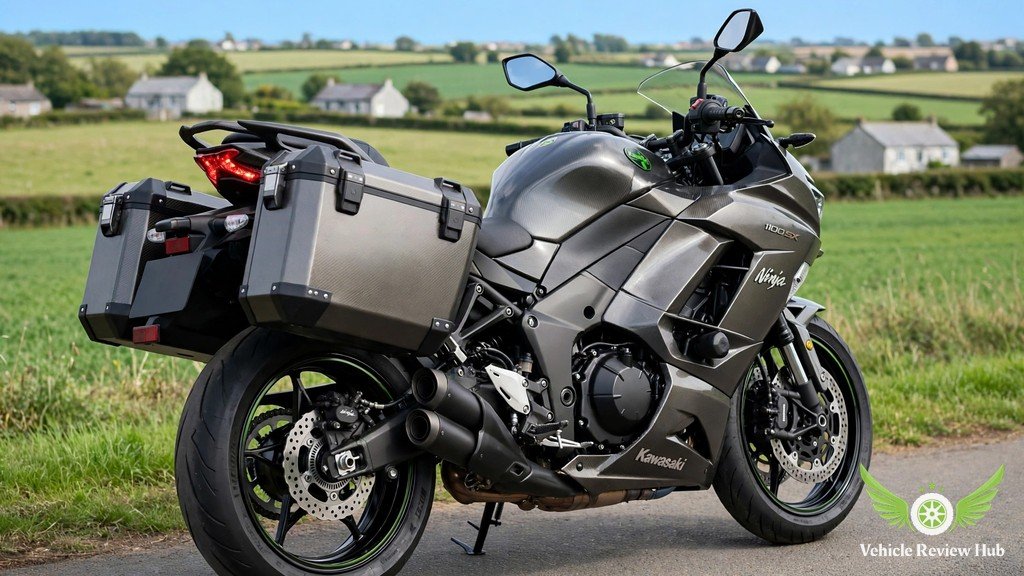
With Bags Fitted, Both Rivals Cost Less
The arithmetic is blunt. The 1100SX at $14,839 delivered plus $1,128.96 for panniers costs $15,967.96 with bags fitted, against the GT+ at $15,099 delivered with panniers included, so the Suzuki is $868.96 less. The Tracer 9 at $13,299 delivered stays cheaper too, since its panniers would need to cost over $2,669 to erase the gap, which is implausible even without a published US pannier price. This Kawasaki Ninja 1100SX ABS comparison keeps the point simple: on sticker price the Kawasaki is the middle bike, and with bags fitted it is the most expensive of the three rivals, which is the price of its cornering electronics.
| Bike | 2026 delivered | Panniers | With bags fitted |
|---|---|---|---|
| Kawasaki Ninja 1100SX ABS | $14,839 | $1,128.96 extra | $15,967.96 |
| Suzuki GSX-S1000GT+ | $15,099 | Included | $15,099 |
| Yamaha Tracer 9 | $13,299 | Not included, price unverified | $13,299 plus panniers |
| Kawasaki Ninja 1100SX SE | $16,639 | $1,128.96 extra | $17,767.96 |
Notes for this Kawasaki Ninja 1100SX ABS comparison table: all prices are 2026 delivered figures; the Kawasaki panniers are 28-litre key-and-color-matched pairs at $1,128.96, and no US Yamaha pannier price was found.
Running Costs and Resale Value Compared
Fuel is the biggest running cost, and the Kawasaki’s numbers are SE tester figures: RevZilla 38.5 mpg over three tanks, Ultimate Motorcycling 39 mpg, and Motorcycle.com over 40 mpg on long hauls, roughly 190 to 200 miles from the 5.0-gallon tank. Kawasaki claims 50 mpg, but that is the manufacturer’s claim, not a test result. Servicing has no US dealer price published, and the only servicing price found anywhere is MCN’s UK figure of £250 a year. The service intervals are the 1000SX platform figures, labelled as carry-over: oil and filter and spark plugs every 7,600 miles, first service at 600 miles, chain about every 400 miles. This Kawasaki Ninja 1100SX ABS comparison cannot price resale yet: one used 2025 base with 3,226 miles was listed at $10,899 asking, a single listing and not a market price, while new 2025 bikes have been advertised discounted at $12,499 to $12,508 against the $13,699 MSRP. The 1100SX reliability guide covers the service intervals and the NHTSA record in full.
Kawasaki Ninja 1100SX ABS Comparison Verdict and US Alternatives
The verdict is a short one: buy the Kawasaki for its cornering electronics, buy the Suzuki for its power and included luggage, buy the Yamaha for its price, and buy the SE only if you want the best factory chassis. The alternatives beyond the three rivals run from the Honda NT1100 DCT at $12,774 delivered to the BMW R 1300 RS and Ducati Multistrada V2 at $17,990 each. This Kawasaki Ninja 1100SX ABS comparison section gives the verdict first and the alternatives second.
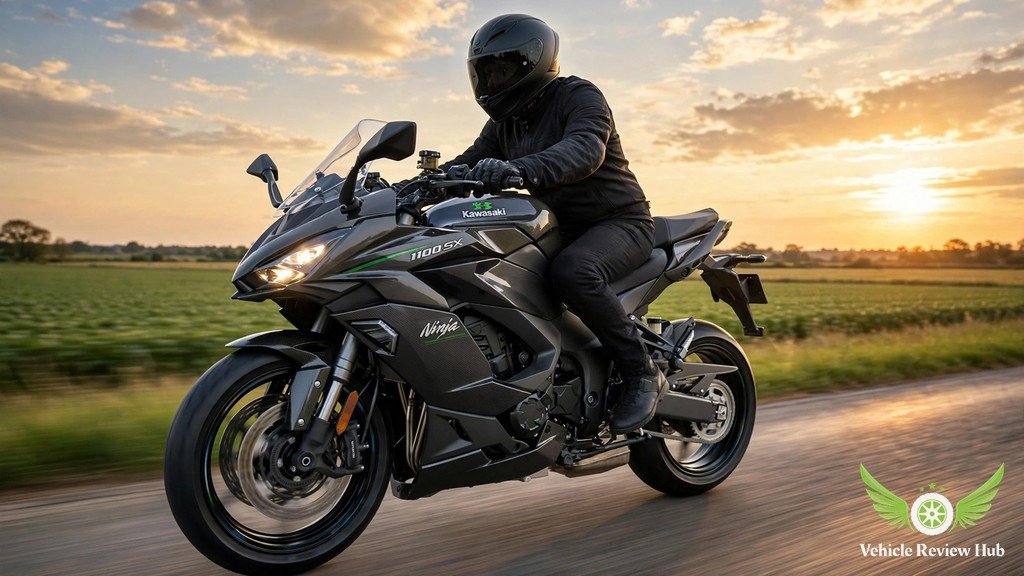
Verdict: the Cornering Tech Is the Case
The 1100SX’s case against the GT+ is its cornering electronics: a six-axis IMU with cornering ABS and traction control, all standard, against a Suzuki with none of them. Against the Tracer 9 its case is power and torque plus a lower seat and a full fairing, 134 hp and 83.2 lb-ft against 117 hp and 68.6 lb-ft. Against its own SE its case is $1,800 less for the same engine. MCN named the Ninja 1100SX SE its Sports Tourer of the Year for 2025, and its group-test verdict was that sports-touring perfection is just about what the new Kawasaki achieves for two grand less in SE Tourer spec. This Kawasaki Ninja 1100SX ABS comparison verdict is that the standard bike suits the rider who wants cornering tech at the middle price, the GT+ suits the rider who wants peak power with bags included, and the Tracer 9 suits the rider who wants the cheapest way into the class. The 1100SX performance guide covers the dyno, the gearing and the fuel economy behind this verdict, the MCN Ninja 1100SX review carries the long-term test behind it, and the 1100SX review covers the standard bike’s prices and riding experience in full.
Used Ninja 1000SX Alternative
A used Ninja 1000SX is the budget way into this platform, but it is not an 1100SX. The final-year 2024 bike cost $13,699 when new, the same launch price as the 2025 1100SX, and it makes 140 hp, which is more peak power than the 1100SX’s 134 hp, with a 250 mm rear disc, petal front discs, S22 tyres and 5.4 inches of rear travel, and no SE trim ever existed for it. Its 154 mph top-speed figure belongs to it alone and must not be carried over to the 1100SX, which has different gearing and a lower rev limit. This Kawasaki Ninja 1100SX ABS comparison ends on the succession fact: the 1100SX is the current new bike, and the 1000SX is now a used buy. The 1000SX comparison covers the old bike against its own rivals.
Kawasaki Ninja 1100SX ABS Comparison: Frequently Asked Questions
Direct answers to the Kawasaki Ninja 1100SX ABS comparison questions buyers ask most.
Which is better, the Kawasaki Ninja 1100SX ABS or the Suzuki GSX-S1000GT+?
It depends what you value. The Suzuki makes more peak power at 150 hp against 134 hp and includes its panniers, while the Kawasaki makes more torque lower down and has a six-axis IMU with cornering electronics that the Suzuki does not have. This Kawasaki Ninja 1100SX ABS comparison gives the Suzuki the power and luggage case and the Kawasaki the electronics and midrange case.
Is the Kawasaki Ninja 1100SX ABS cheaper than the Yamaha Tracer 9?
No. The Tracer 9 costs $13,299 delivered for 2026, $1,540 less than the Kawasaki at $14,839 delivered. This Kawasaki Ninja 1100SX ABS comparison calls the Yamaha the budget pick: it is lighter and cheaper, but it is the base bike only in the USA, with no GT equipment, no radar and no automatic gearbox.
Is the SE trim worth $1,800 more than the standard bike?
Only if you want what it adds. The SE buys Brembo M4.32 calipers with a Brembo master cylinder and steel-braided lines, an Öhlins S46 rear shock and heated grips, for $1,800 more in 2026. This Kawasaki Ninja 1100SX ABS comparison treats the two trims as the same bike mechanically, so the standard bike is the value pick for the buyer who will fit their own suspension. Both trims share the same chassis hardware: dual 300 mm front discs, a 260 mm round rear disc and 5.6 inches of rear travel.
Does the Kawasaki Ninja 1100SX ABS come with panniers?
No. The 28-litre panniers cost $1,128.96 a pair as an accessory on both trims and are never standard. This Kawasaki Ninja 1100SX ABS comparison adds them to every price: the standard bike with bags fitted costs $15,967.96 for 2026, $868.96 more than the Suzuki GT+ with its panniers included.
How much power does the Kawasaki Ninja 1100SX ABS make compared to its rivals?
Kawasaki claims 134 hp at 9,000 rpm and 83.2 lb-ft at 7,600 rpm, measured to the ISO 4106 standard. The Suzuki makes 150 hp at 11,000 rpm and the Yamaha makes 117 hp at 10,000 rpm, so the Kawasaki sits between them on power and ahead of both on torque. This Kawasaki Ninja 1100SX ABS comparison notes the only dyno run found is Motorcycle.com’s SE test at 124.6 hp at the rear wheel.
Which bike has the lowest seat height?
The Suzuki, at 31.9 inches. The Kawasaki seat is 32.3 inches and the Tracer 9 seat is 33.3 to 33.9 inches, so the Kawasaki is second-lowest of the three. This Kawasaki Ninja 1100SX ABS comparison puts the Kawasaki second-lowest: the Suzuki undercuts it by 0.4 inches.
Does the Suzuki GSX-S1000GT+ have cornering ABS?
No. The Suzuki has no IMU, no cornering ABS and no cornering traction control, with a five-stage traction control system and ABS that are not angle-responsive. This Kawasaki Ninja 1100SX ABS comparison counts the cornering electronics as the standard bike’s strongest card.
What is the cheapest litre-class sport-tourer in the USA?
The Honda NT1100 DCT at $12,774 delivered for 2026, which is $11,999 plus $775 destination. It is the only one of the alternatives with an automatic gearbox, using a 1,084cc parallel twin with DCT. This Kawasaki Ninja 1100SX ABS comparison lists it as a US alternative, alongside the BMW F 900 XR at $13,690 delivered.
Is the Kawasaki Ninja 1100SX ABS good for two-up touring?
Yes, with the panniers fitted and the preload set for the load. The 1,099cc four makes 83.2 lb-ft at 7,600 rpm and the seat is 32.3 inches, and the 5.0-gallon tank gives roughly 190 to 200 miles per fill on SE tester figures. This Kawasaki Ninja 1100SX ABS comparison recommends the SE for regular two-up touring, because its Öhlins shock has a remote preload adjuster.
Should I buy a used Ninja 1000SX instead of a new 1100SX?
Only if the price is right and you know what you are giving up. The 1000SX makes 140 hp, which is more peak power than the 1100SX, but it has petal front discs, a 250 mm rear disc, S22 tyres and 5.4 inches of rear travel, with no SE trim. The succession fact stands: the 1100SX is the current new bike, and the 1000SX is now a used buy, and this Kawasaki Ninja 1100SX ABS comparison treats the old bike as a used alternative, not a current rival.
Does the Kawasaki Ninja 1100SX ABS have a quickshifter?
Yes. The up and down quickshifter works from 1,500 rpm on both trims, down from 2,500 rpm on the old bike, and electronic cruise control is standard alongside the 4.3-inch TFT display. This Kawasaki Ninja 1100SX ABS comparison notes the Suzuki also has a quickshifter and cruise control.
Which sport-tourer won MCN’s Sports Tourer of the Year for 2025?
The Ninja 1100SX SE. MCN named it Sports Tourer of the Year for 2025, and its group-test verdict was that sports-touring perfection is just about what the new Kawasaki achieves for two grand less in SE Tourer spec. This Kawasaki Ninja 1100SX ABS comparison treats that verdict as the SE’s case.