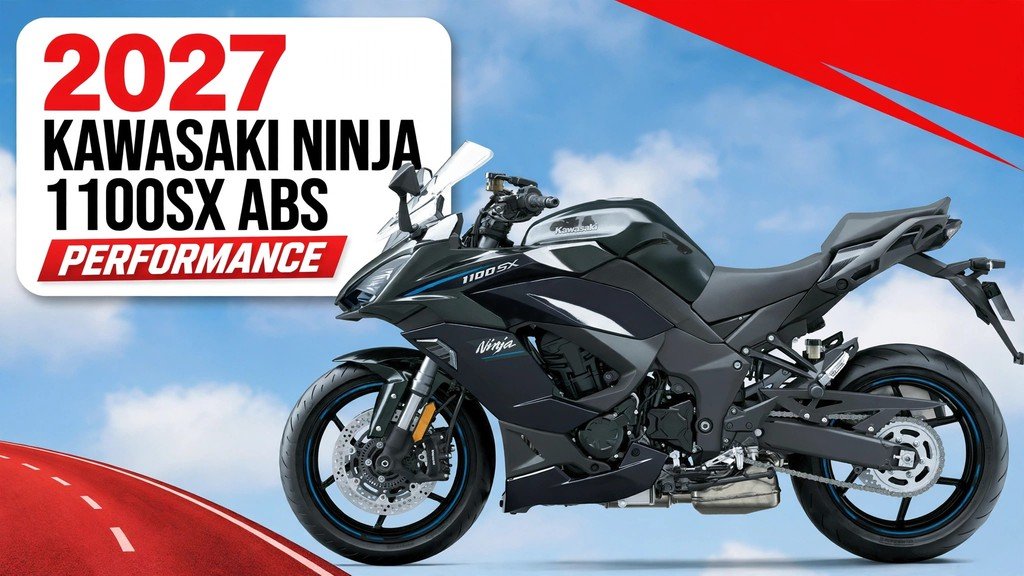
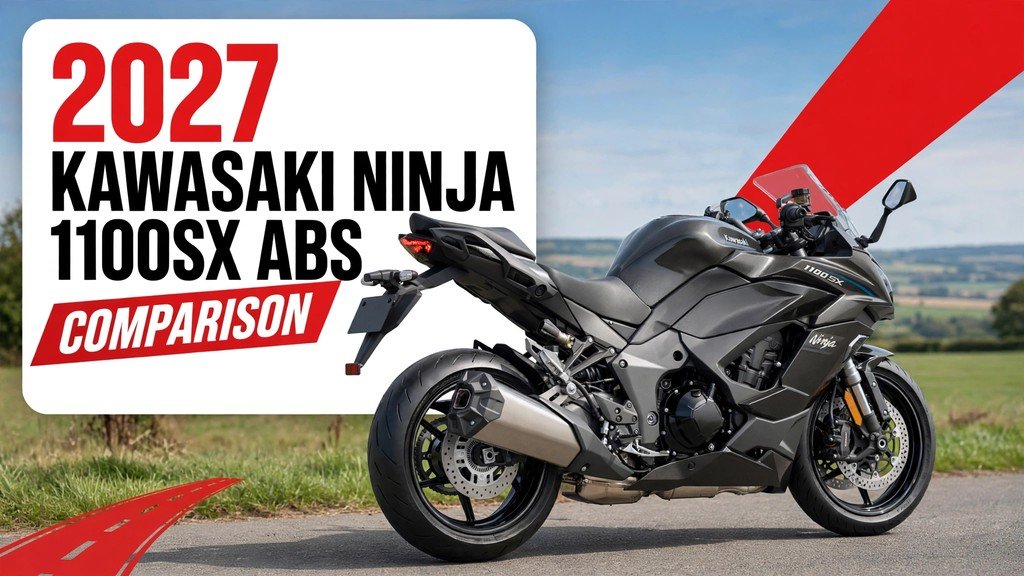
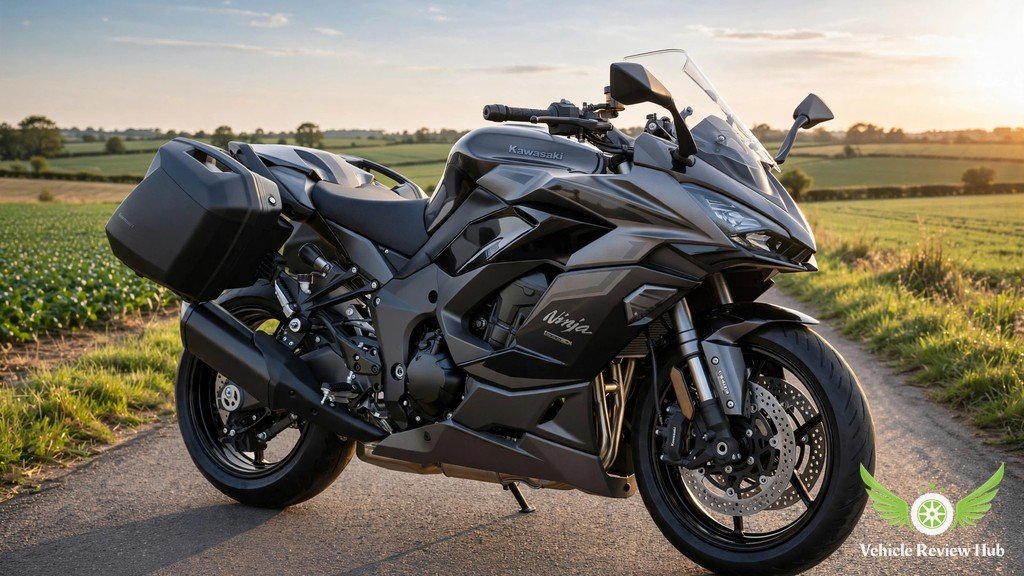
The Kawasaki Ninja 1000SX is the litre-class sport-tourer that Kawasaki sold in the USA from 2011 to 2024, and this Kawasaki Ninja 1000SX review ends with an honest fact: the bike is no longer sold new. The final US model year is 2024, priced at $13,699 MSRP, and for 2025 Kawasaki replaced it with the larger Ninja 1100SX. What the 1000SX leaves behind is a 1,043cc inline-four with a global claim of 140 horsepower, a rear-wheel dyno figure of 124.3 horsepower from Rider magazine, a 32.3-inch seat, and a recall record that NHTSA lists as zero. It is now a used buy, and this Kawasaki Ninja 1000SX review finds its strongest case in that engine and in its clean recall record.
Kawasaki Ninja 1000SX Overview and Model-Year Updates
The Ninja 1000SX is a fully faired sibling of the Z1000 streetfighter, built on the same 1,043cc engine and aluminium twin-tube backbone frame, but with upright ergonomics, a larger 5.0-gallon tank, an adjustable windscreen and touring electronics. This Kawasaki Ninja 1000SX review covers all four generations, from the 2011 original to the final 2024 bike, and explains why the name on the tank changed twice along the way.
Three Names Across Fourteen Years
US buyers met this bike as the Ninja 1000 from 2011 to 2019. The SX suffix arrived with the 2020 generation in the USA, when the bike gained throttle-by-wire, cruise control, a quickshifter and a TFT dash. Europe had used the Z1000SX name earlier. The generations break down as 2011 to 2013, 2014 to 2016, 2017 to 2019, and 2020 to 2024, and this Kawasaki Ninja 1000SX review recommends the gen-4 bikes most.
The 1100SX Took Its Place for 2025
For 2025 Kawasaki replaced the 1000SX with the Ninja 1100SX, a 1,099cc bike that makes 134 horsepower at 9,000 rpm and 83.2 lb-ft of torque at 7,600 rpm. That is 6 horsepower down on the 1000SX peak figure but 1.5 lb-ft more torque, with longer fifth and sixth gears and an improved quickshifter, so the successor gains midrange rather than peak power. The 2026 Ninja 1100SX costs $13,999 plus $840 destination, or $14,839 delivered, and the SE trim with Brembo brakes, an Öhlins shock and heated grips costs $16,639 delivered. There is no 2025 or 2026 Ninja 1000SX in the USA, so anyone shopping for one today is shopping used. This Kawasaki Ninja 1000SX review treats the 1100SX as the successor to compare against, not as a new 1000SX. The Kawasaki Ninja 1100SX page is the place to check the successor’s current price and spec.
Jeff Ware of BikeReview tested the 2020 bike when the SX name and the new electronics first arrived, and his review still describes the gen-4 bike well. Watch his full 2020/2021 review below.
Kawasaki Ninja 1000SX Engine and Specifications
The engine is the heart of this bike and the reason it survived fourteen years in a shrinking class. It is a 1,043cc liquid-cooled inline-four that Kawasaki tuned for midrange pull rather than top-end scream. This Kawasaki Ninja 1000SX review puts the claimed figures and the measured figures side by side, because they tell different stories.
1,043cc Inline-Four, 77 by 56 Millimetres
The gen-4 engine displaces 1,043cc from a 77.0 mm bore and a 56.0 mm stroke, with an 11.8:1 compression ratio and fuel injection through four 38 mm electronic throttle bodies. The global claim is 142 PS, or 104.5 kW, at 10,000 rpm, which converts to 140 horsepower, and the US spec sheet lists torque at 81.7 lb-ft at 7,800 rpm. Earlier generations claimed less: the 2011 bike claimed 125.1 horsepower at 9,900 rpm and 74.4 lb-ft at 8,800 rpm, while the 2017 US bike claimed 138 horsepower and 73 lb-ft. The measured figure matters more than any of these claims. On the Jett Tuning dyno, Rider magazine’s 2020 road test recorded 124.3 horsepower at 9,500 rpm and 75.4 lb-ft of torque at 8,000 rpm at the rear wheel, and Motorcycle.com reported the same figures in its 2020 first ride. A 2022 showdown dyno read slightly lower, at 120.5 horsepower and 70.8 lb-ft.
IMU and Slipper Clutch Arrived in 2017
The 2017 update brought a Bosch 6-axis IMU, and with it three-mode KTRC traction control, cornering-aware KIBS ABS and the KCMF cornering management function. Kawasaki announced a slipper clutch as new for 2017, although Cycle World’s 2017 first ride described it as a carry-over item, so the wording is split and this Kawasaki Ninja 1000SX review flags it rather than settling it. What is not in dispute is the 2020 step: throttle-by-wire enabled electronic cruise control, a four-mode system with Sport, Road, Rain and a customisable Rider mode, and an up and down quickshifter. LED headlights arrived in 2017.
| Specification | 2020–2024 Kawasaki Ninja 1000SX (US) |
|---|---|
| Engine | 1,043cc liquid-cooled DOHC 16-valve inline-four |
| Bore × stroke | 77.0 × 56.0 mm |
| Compression ratio | 11.8:1 |
| Power (global claim) | 142 PS (140 hp) @ 10,000 rpm |
| Torque (US spec) | 81.7 lb-ft @ 7,800 rpm (111 Nm) |
| Dyno (Rider 2020, rear wheel) | 124.3 hp @ 9,500 rpm, 75.4 lb-ft @ 8,000 rpm |
| Curb weight | 513.8 lb (49-state) / 516.0 lb (California) |
| Seat height | 32.3 in (820 mm) |
| Fuel tank | 5.0 gal (19 L) |
| Tyres | 120/70 ZR17 front, 190/50 ZR17 rear (Bridgestone Battlax S22 from 2020) |
| Brakes | Dual 300 mm front discs, Tokico radial-mount 4-piston calipers; 250 mm rear disc; KIBS cornering ABS |
| Electronics | Bosch 6-axis IMU, KTRC 3-mode, KIBS, KCMF, KQS quickshifter, cruise control (85 mph limit), 4.3-in TFT |
| Warranty | 12-month limited |
Notes for this Kawasaki Ninja 1000SX review table: power is the global claim, because Kawasaki USA publishes no US horsepower figure for the gen-4 bike; the 124.3 horsepower dyno figure is the measured rear-wheel number from Rider magazine’s 2020 test. Weight is the Kawasaki USA curb figure, with the 49-state and California numbers listed separately. The torque-rpm figure is split across sources — the US spec sheet says 81.7 lb-ft at 7,800 rpm, while some global listings quote 111 Nm at 7,300 rpm or 8,000 rpm — so this table prints the US figure only.

Kawasaki Ninja 1000SX Price and Market Availability
The price story of this bike is a slow climb from just under $11,000 to just under $14,000 over thirteen years, before stopping entirely. This Kawasaki Ninja 1000SX review lists every verified US price with its year, and says plainly where the destination charge could not be verified.
Kawasaki Ninja 1000SX Price in the USA: Final $13,699
The final US price is the 2024 model at $13,699 MSRP. The destination charge for 2024 was not found in any source, so this Kawasaki Ninja 1000SX review prints the MSRP only and never a delivered total for that year. The 2023 bike cost $13,199 plus $460 destination, or $13,659 delivered, and the 2020 bike cost $12,399 plus $410 destination, or $12,809 delivered, with Rider’s price-as-tested at $13,529 once the 28-litre saddlebags were added. One trap to avoid: a 2011 Canadian price of $13,699 circulates online, and it is not the US price — the US 2011 bike cost $10,999.
The 2022 Figure Is Dealer-Inferred Only
The 2022 price of $12,899 is dealer-inferred only, and its destination charge is unverified, so no delivered total exists for that year either. The 2021 price of $12,599 and the 2014 price of $11,999 are in the same position: MSRP only, destination unverified. The cleanest delivered figures are 2011, 2017, 2020 and 2023. This Kawasaki Ninja 1000SX review prints no delivered total for the other years.
| Year | MSRP | Destination | Delivered |
|---|---|---|---|
| 2011 | $10,999 | $275 | $11,274 |
| 2014 | $11,999 | Unverified | — |
| 2017 | $12,199 | $360 | $12,559 |
| 2020 | $12,399 | $410 | $12,809 |
| 2021 | $12,599 | Unverified | — |
| 2022 | $12,899 | Unverified | — |
| 2023 | $13,199 | $460 | $13,659 |
| 2024 | $13,699 | Unverified | — |
| 2025–2026 | Not sold in USA | — | — |
Notes for this Kawasaki Ninja 1000SX review table: delivered totals are shown only where MSRP and destination are both verified. The 2022 MSRP of $12,899 is dealer-inferred only. The 2011 Canadian price of $13,699 is not the US price and is not in this table. Kawasaki’s 2024 spec sheet prints “BASE MSRP NON-ABS $13,699”, which is a template artefact — the US bike is ABS-only, and there is no non-ABS US 1000SX.

Kawasaki Ninja 1000SX Design, Features and Technology
The gen-4 bike looks like a Ninja and works like a tourer. The full fairing, the adjustable windscreen and the upright bars give it long-distance comfort. This Kawasaki Ninja 1000SX review separates what came standard from what cost extra, because the accessories list is where buyers get surprised.
TFT, Cruise and Quickshifter From 2020
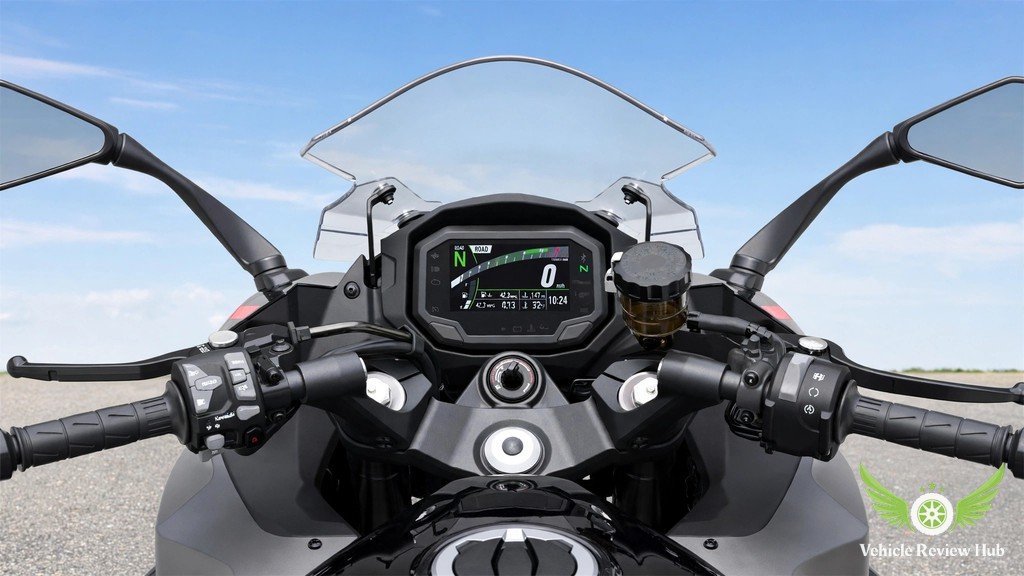
The 2020 update is the dividing line. From 2020 the bike has a 4.3-inch full-colour TFT dash, electronic cruise control, an up and down quickshifter, and four ride modes that link the KTRC traction control and the two power modes — Full and Low, with Low cutting output to roughly 70 percent. The cruise control works well but tops out at 85 mph, which RevZilla found frustrating on a bike with a tester-indicated top speed of 154 mph. The windscreen adjusts through four positions, but the tab sits behind the brake reservoir and needs both hands, so it is not a while-riding adjustment. The final-year 2024 colours are Metallic Matte Graphite Gray and Metallic Diablo Black, while the 2023 Emerald Blazed Green is the most distinctive gen-4 colour. Heated grips cost $298.95 in 2020 and the 28-litre saddlebags cost $1,129.95, each holding a full-face helmet, and both are accessories rather than standard kit. The SE trim with heated grips, Brembo brakes and an Öhlins shock exists only on the 1100SX from 2025, never on the 1000SX. Every one of those features is standard on the gen-4 bike, which is why this Kawasaki Ninja 1000SX review points used buyers at 2020 and later.
No Cornering Lights on Any Generation
No generation of the 1000SX has cornering lights, which is worth stating plainly because some buyers assume a bike with a 6-axis IMU must have them. The Versys 1000 SE LT has them; the Ninja 1000SX does not. There is also no keyless ignition on any generation, and no centre stand on any generation, so chain maintenance means a paddock stand or a careful side-stand routine. Suspension is a 41 mm inverted Showa fork with 4.7 inches of travel up front and 5.4 inches at the rear. Buyers who want cornering lights need a different bike, and this Kawasaki Ninja 1000SX review says so plainly rather than hiding the gap. LED headlights arrived in 2017, and the 2020 switch to a single right-side muffler cut a claimed 4.5 pounds.
Kawasaki Ninja 1000SX Riding Experience and Comfort
Testers keep coming back to the same word for this bike: sweet spot. The gen-4 bike is the one to buy used, and this Kawasaki Ninja 1000SX review says the 2020 updates are the reason. This Kawasaki Ninja 1000SX review gathers what named testers actually measured and said, rather than repeating the brochure.
The Sport-Touring Sweet Spot, Say Testers
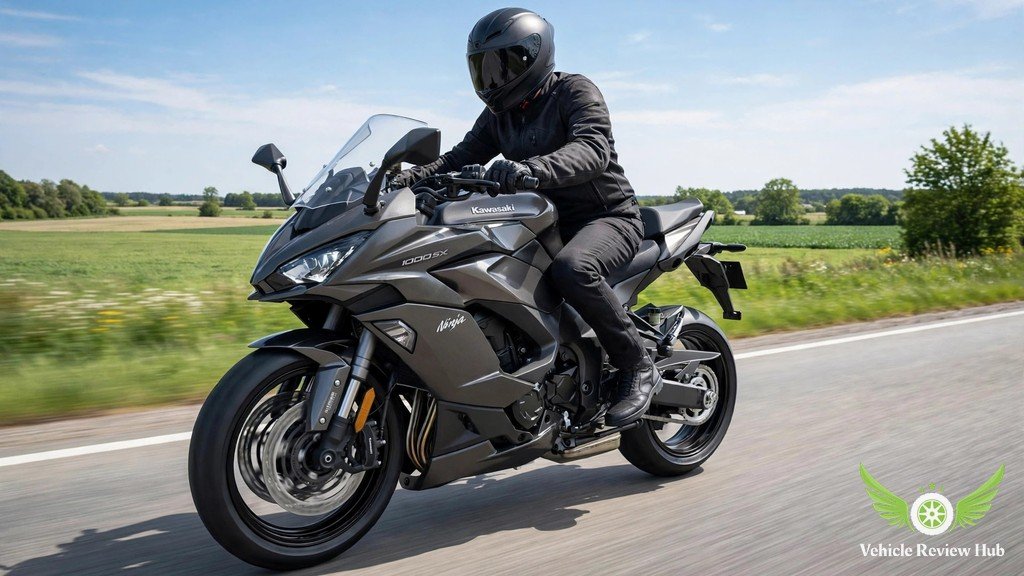
Rider magazine called the 2020 bike’s engine lovely and torque-rich, and measured 37.6 mpg on average, which gives roughly 185 miles from the 5.0-gallon tank. RevZilla averaged 40 mpg on the highway for a 200-mile range, and found the engine relaxed at 80 mph, turning over at 5,800 rpm with vibration nearly non-existent. The 2020 engine work — revised cam profiles, shorter intake funnels on cylinders one and four, and a secondary balancer — cut the pre-2020 highway buzz that owners used to complain about, and Rider described the result as serene. That is a qualitative judgement, and this Kawasaki Ninja 1000SX review does not turn it into a number. Motorcycle.com’s 2022 showdown found the Ninja sportier in the tight stuff, though the Suzuki ultimately won on its engine, quickshifter and saddlebags. The Ninja’s rear shock has only three turns of rebound adjustment and no compression adjustment, and both showdown testers advised fitting a 190/55 rear tyre in place of the flat-feeling 190/50.
513.8 Pounds and a 32.3-Inch Seat
At 513.8 pounds curb for the 49-state bike and 516.0 pounds for the California bike, the Ninja is no lightweight, but the weight sits low and the 32.3-inch seat is reachable for most riders. The bars are closer and the pegs higher than on the Suzuki GT+, so taller riders may find it slightly more cramped. For most riders the reach is easy, and this Kawasaki Ninja 1000SX review calls the 32.3-inch seat a genuine strength. The fairing and the adjustable screen give real wind protection. The Motorcycle.com showdown against the Suzuki GSX-S1000GT+ is the best single read on how the Ninja compares, and our own Suzuki GSX-S1000GT review covers the rival in the same depth. For the numbers behind the ride, the Kawasaki Ninja 1000SX performance guide carries the dyno runs, the tester top speed and the measured fuel economy.
Kawasaki Ninja 1000SX Review: Pros, Cons and Verdict
Fourteen years of production, four generations and a clean recall record add up to a simple verdict: the Ninja 1000SX is a genuinely good motorcycle that Kawasaki replaced rather than retired in disgrace. This Kawasaki Ninja 1000SX review weighs what it does well against what it never offered, and the balance favours the buyer who shops used.
Main Advantages and Limitations of the Kawasaki Ninja 1000SX
The engine is the biggest advantage. A 1,043cc inline-four with 81.7 lb-ft of torque at 7,800 rpm pulls hard from low revs, and the measured 124.3 rear-wheel horsepower is more than enough for two-up touring. The electronics are the second advantage: a 6-axis IMU, three-mode traction control, cornering ABS, a quickshifter and cruise control, all standard from 2020, with a TFT dash and four ride modes. The third advantage is the record: NHTSA lists zero recalls and zero complaints for the Ninja 1000SX across the 2011, 2014, 2017, 2020 and 2024 model years, which is cleaner than aggregator sites claim, because several of them wrongly attach ZX-10R recalls to this bike. The limitations are honest ones. There is no keyless ignition, no cornering lights and no centre stand on any generation. The saddlebags and heated grips that make it a proper tourer are paid accessories, at $1,129.95 and $298.95 in 2020 money. The cruise control stops at 85 mph. The rear shock has almost no adjustment. And the bike is discontinued, so every purchase now is a used purchase, with the checks that implies — the Kawasaki Ninja 1000SX reliability guide covers the service schedule and the ownership checks in full.
| Pros | Cons |
|---|---|
| 1,043cc inline-four with strong midrange torque | No keyless ignition on any generation |
| Full electronics from 2020: IMU, KTRC, KIBS, quickshifter, cruise, TFT | No cornering lights on any generation |
| NHTSA recall and complaint counts are zero | No centre stand on any generation |
| Comfortable upright ergonomics and real wind protection | Saddlebags and heated grips are paid accessories, never standard |
| 124.3 hp measured at the rear wheel by Rider in 2020 | Cruise control limited to 85 mph |
| Strong used value after a $13,699 final MSRP | Discontinued — no new bike, 12-month warranty only |
Notes for this Kawasaki Ninja 1000SX review table: the recall and complaint counts are NHTSA figures for the Ninja 1000SX nameplate, and aggregators that list ZX-10R recalls against this bike are wrong. The accessory prices are the verified 2020 figures; prices for 2021 to 2024 were not separately verified. The warranty line is the factory 12-month limited warranty, not the optional Kawasaki Protection Plus cover.
12 Month Limited Warranty
The factory warranty is a 12-month limited warranty, with unlimited miles according to Rider’s 2020 test. Kawasaki Protection Plus extends cover to 12, 24, 36 or 48 months for buyers who want it, and on a used bike the remaining factory cover is the first thing to check. The short factory term is the weakest part of the package, though the zero-recall record softens the blow. Buy a gen-4 bike with records, check the chain, the dash and the service book, and this Kawasaki Ninja 1000SX review calls it the class value pick — the full head-to-head is in the Kawasaki Ninja 1000SX comparison.
Kawasaki Ninja 1000SX Review: Frequently Asked Questions
Direct answers to the Kawasaki Ninja 1000SX review questions buyers ask most.
Is the Kawasaki Ninja 1000SX still made?
No. The final US model year is 2024, and Kawasaki replaced it with the Ninja 1100SX for 2025. There is no 2025 or 2026 Ninja 1000SX in the USA, so this Kawasaki Ninja 1000SX review treats it as a used buy from here on.
How much does a 2024 Kawasaki Ninja 1000SX cost?
The 2024 bike cost $13,699 MSRP. The destination charge for 2024 was not verified in any source, so this Kawasaki Ninja 1000SX review prints the MSRP only and never a delivered total for that year.
How much horsepower does the Ninja 1000SX make?
The global claim is 140 horsepower at 10,000 rpm, and the US torque figure is 81.7 lb-ft at 7,800 rpm. Measured at the rear wheel, Rider magazine’s 2020 dyno test recorded 124.3 horsepower at 9,500 rpm, and this Kawasaki Ninja 1000SX review uses that measured figure wherever power is compared.
What is the top speed of the Ninja 1000SX?
There is no official top speed figure. Testers indicate 152 to 154 mph: RevZilla recorded 152 mph on GPS during a closed-highway run, and a RevZilla tester indicated 154 mph in its first ride. This Kawasaki Ninja 1000SX review labels both numbers as tester figures, not factory claims.
Is the Ninja 1000SX good for two-up touring?
Yes, with the right accessories. The 435-pound load capacity covers a pillion and luggage, the 5.0-gallon tank gives roughly 185 miles of range at Rider’s measured 37.6 mpg, and the upright seating and adjustable screen keep both riders comfortable. The 28-litre saddlebags are a paid accessory, so this Kawasaki Ninja 1000SX review advises buyers to check whether they are included in the used price.
Does the Ninja 1000SX have cruise control?
Yes, from the 2020 generation onward, as part of the throttle-by-wire update. The system works well but is limited to 85 mph, which is well below the bike’s top speed. This Kawasaki Ninja 1000SX review lists the limit as a genuine limitation, not a footnote.
Does the Ninja 1000SX have a quickshifter?
Yes. The KQS up and down quickshifter arrived with the 2020 update and works with the four ride modes. Owners report it can lurch at low rpm on the auto-blip downshift, so this Kawasaki Ninja 1000SX review suggests testing it below 3,500 rpm on any used bike before buying.
How often does the Ninja 1000SX need valve checks?
Valve clearance inspection is every 15,000 miles, which is the US figure confirmed by Rider’s spec table. Oil and filter changes are every 7,600 miles, as are spark plug changes, and the first service is at 600 miles. This Kawasaki Ninja 1000SX review notes that a 6,000-mile oil interval printed by one aggregator is wrong.
Does the Ninja 1000SX have any recalls?
No. NHTSA lists zero recalls and zero complaints for the Ninja 1000SX across the 2011, 2014, 2017, 2020 and 2024 model years. This Kawasaki Ninja 1000SX review checked the NHTSA record directly, and aggregators that list ZX-10R recalls against this bike are wrong.
Is the Ninja 1000SX good for beginners?
No. It makes a claimed 140 horsepower, weighs 513.8 pounds and carries a 32.3-inch seat, which is too much bike for a new rider. This Kawasaki Ninja 1000SX review recommends it for riders stepping up from a middleweight, not for a first bike.
Which is better, the Ninja 1000SX or the Suzuki GSX-S1000GT+?
Motorcycle.com’s 2022 showdown picked the Suzuki, praising its livelier engine, its quickshifter and its saddlebags, with an overall score of 89.5 percent against the Kawasaki’s 85.4 percent. The Ninja counters with a 6-axis IMU, cornering ABS and a lower used price, so this Kawasaki Ninja 1000SX review calls the Suzuki the better new buy and the Kawasaki the better used value.
Should I buy a used Ninja 1000SX or a new Ninja 1100SX?
Buy the used 1000SX if the budget matters and buy the new 1100SX if the warranty and the extra midrange matter. A gen-4 1000SX with records gives you the same touring kit for thousands less, while the 1100SX costs $14,839 delivered with a fresh 12-month warranty and 1.5 lb-ft more torque. This Kawasaki Ninja 1000SX review ends where it began: the 1000SX is gone from showrooms, but as a used sport-tourer it is still the class value pick.