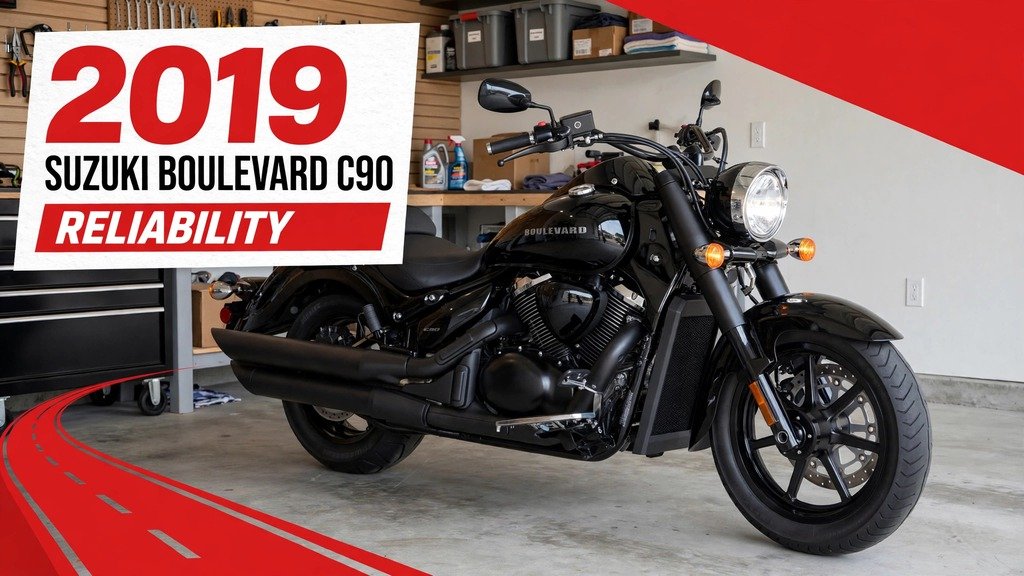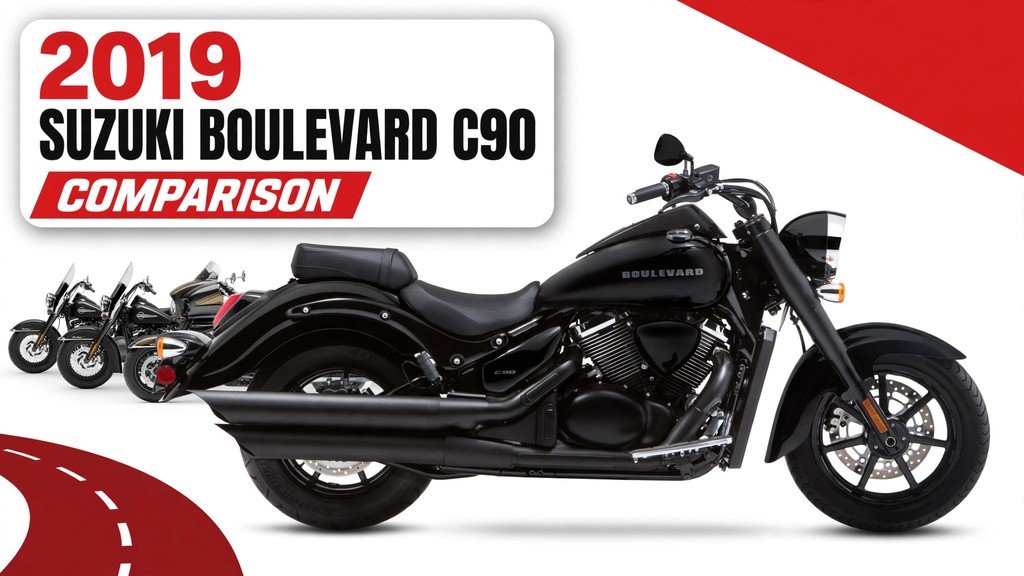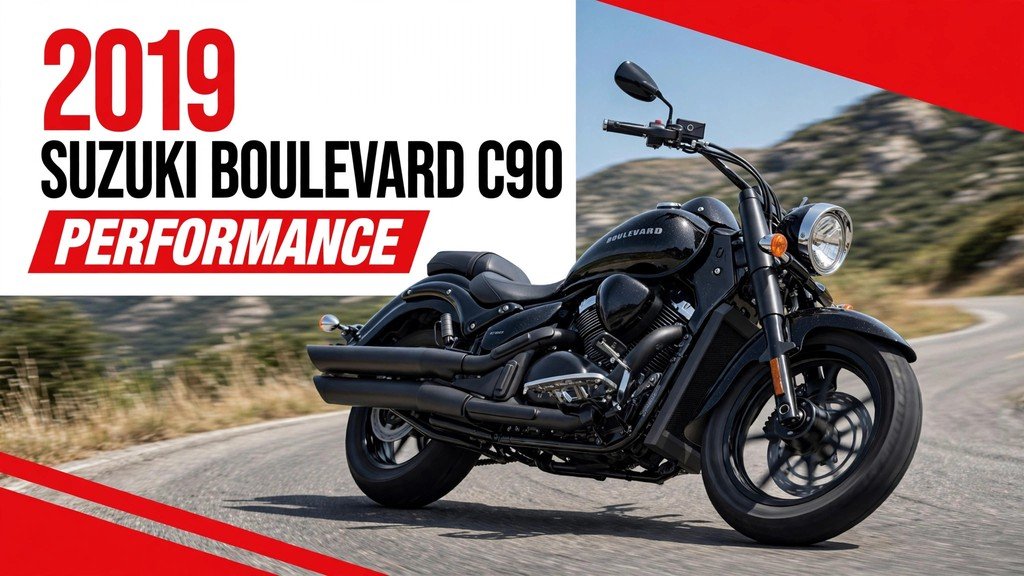
The Suzuki Boulevard C90’s performance is built around torque, not horsepower. Both generations of the 1,462cc V-twin make their best pull barely above idle, and neither one was ever built to win a speed contest. This Suzuki Boulevard C90 performance guide puts every number in its place: the claimed-power figures genuinely conflict, the only measured dyno figures come from the same engine in the M90 and a 34-second Motorcycle Cruiser clip, no instrumented top-speed test exists for either generation, and the only named fuel-economy figure is Australian. The full two-generation story is in the Suzuki Boulevard C90 review.
Suzuki Boulevard C90 Engine Performance and Power Delivery
The 1,462cc V-twin is the one thing both C90 generations share, and it defines this Suzuki Boulevard C90 performance guide. The gen-1 bike (2005–2009) runs an air/oil-cooled 45-degree twin with three valves per cylinder and hydraulic lifters; the gen-2 bike (2013–2019) runs the M90’s liquid-cooled 54-degree twin with four valves per cylinder and dual spark plugs. Same displacement, gearbox and shaft drive — but the gen-2 engine revs freer and carries Suzuki’s Clutch Assist System. It is not a retuned M109R unit — the Boulevard M109R review covers the bigger 1,783cc bike. Neither C90 engine chases peak horsepower: both are long-stroke twins tuned to pull from barely above idle.
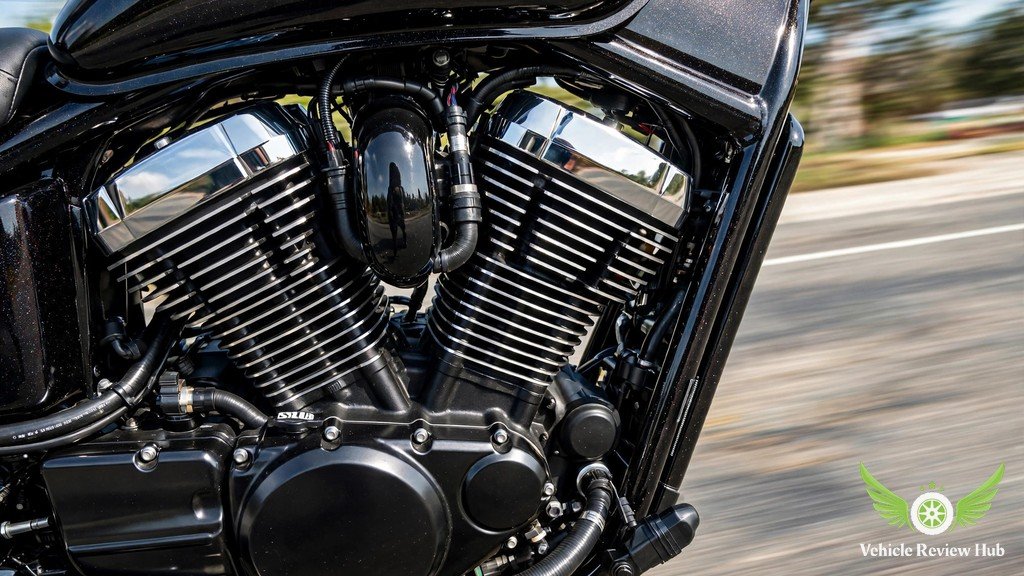
Gen 2 Dyno: 68.7 HP and 85.3 lb-ft, Cruiser 2017
Motorcycle Cruiser ran a 2017 Suzuki Boulevard C90T on its rear-wheel dyno and published the run as a 34-second clip, “How Much Power Does The 2017 Suzuki Boulevard C90T Make?” The clip’s description says the magazine ran the bike “on our rear-wheel dyno to find out how much horsepower and torque it makes”. The figures printed in this heading — 68.7 hp and 85.3 lb-ft — are confirmed from the video itself, as this Suzuki Boulevard C90 performance guide verified by watching the clip: its on-screen results card reads “2017 SUZUKI BOULEVARD C90T 68.7HP 85.3 TQ”. The video shows no rpm values and no plotted dyno curve, and the on-screen label is “TQ” rather than lb-ft spelled out. What can be verified is the closest measured figure for the same engine: Motorcycle.com’s 2009 Muscle Cruiser Shootout dyno-recorded the M90 at 69.6 hp at 5,100 rpm and 82.7 lb-ft at 2,900 rpm. The two sets of numbers sit close together, and they are never ranked against each other.
The video below is that Motorcycle Cruiser clip: 34 seconds of a 2017 C90T on the rear-wheel dyno, not a full performance test.
Claimed Figures Conflict: 77.8 HP vs 81.8 HP
The claimed-power picture for the gen-2 engine is a genuine four-way conflict, and this Suzuki Boulevard C90 performance guide names all four numbers rather than picking one. Suzuki’s 2013 C90T brochure prints 59.6 kW (79.9 hp) at 4,800 rpm and 131.4 Nm at 2,600 rpm. The spec databases print 50 kW (67 hp) at 4,800 rpm and 114 Nm at 2,300 rpm. Women Riders Now, reporting Suzuki’s claim in 2013, prints 77.8 hp at 4,800 rpm and 96.6 lb-ft at 2,600 rpm — 96.6 lb-ft is 131.0 Nm, the brochure’s torque in imperial dress. Rider Magazine, reporting Suzuki’s claim in its month-long road test, prints 81.8 hp at 4,800 rpm and 93.3 lb-ft at 2,800 rpm, noting Suzuki claims the B.O.S.S. “squeezes out a skosh more power than the M90, with an earlier and higher torque peak”. Suzuki’s US spec tables print no power figure at all. The table below lines them up, plus the two measured figures and one editorial estimate.
| Source | Horsepower | Torque | What it is |
|---|---|---|---|
| Suzuki 2013 C90T brochure | 79.9 hp @ 4,800 rpm | 131.4 Nm @ 2,600 rpm | Suzuki’s own brochure claim |
| Spec databases | 67 hp @ 4,800 rpm | 114 Nm @ 2,300 rpm | Database claim, same engine |
| Women Riders Now (Suzuki’s claim) | 77.8 hp @ 4,800 rpm | 96.6 lb-ft @ 2,600 rpm | Magazine reporting Suzuki’s claim |
| Rider Magazine (Suzuki’s claim) | 81.8 hp @ 4,800 rpm | 93.3 lb-ft @ 2,800 rpm | Magazine reporting Suzuki’s claim |
| Motorcycle.com, 2009 (M90 dyno) | 69.6 hp @ 5,100 rpm | 82.7 lb-ft @ 2,900 rpm | Measured — same engine, M90 |
| Motorcycle Cruiser, 2017 video | 68.7 hp | 85.3 lb-ft | Motorcycle Cruiser video, on-screen results card |
| MotorcycleDB editorial | 58.0 hp @ 4,800 rpm | 131.0 Nm @ 2,600 rpm | Editorial estimate — internally inconsistent (42.3 kW = 56.7 hp, not 58.0) |
Suzuki Boulevard C90 Top Speed and Acceleration
Top speed is the thinnest chapter of this Suzuki Boulevard C90 performance guide: no instrumented top-speed test was ever published for either generation, and the acceleration evidence is a sourced gen-1 quarter-mile figure, an aggregator’s gen-2 estimate and two doc figures that could not be verified.

Gen 1 Quarter Mile: 14.61 in the Table, 14.53 in Text
The doc carries two different gen-1 quarter-mile figures — 14.61 seconds in the table and 14.53 seconds in the text — and neither could be found in any source. Repeated searches found neither number, so this Suzuki Boulevard C90 performance guide does not present either as verified. The sourced gen-1 figure is different: motorcyclespecifications.com prints a standing quarter mile of 15.0 seconds at a 138 km/h (85.7 mph) trap speed. That same table also lists “top speed 138 km/h” — really the quarter-mile trap speed, not a top speed. The two doc figures differ by eight hundredths of a second — likely a transcription difference, but the guide does not merge them into one invented number. The 15.0-second figure is the only sourced gen-1 quarter-mile time — a database figure, not a magazine test.
No US Instrumented Test Exists for Gen 2
For the gen-2 bike there is no instrumented test at all — no GPS top-speed run, no instrumented 0–60, no magazine quarter-mile pass. The only acceleration numbers attached to the gen-2 C90 come from zeroto60times, an aggregator listing the 2013 C90T B.O.S.S. at 0–60 mph in 4.5 seconds and the quarter mile in 13.5 seconds, with no named test behind either figure. This Suzuki Boulevard C90 performance guide prints those numbers only with the aggregator label, never as a magazine test. One 2005 C90 owner says the bike is smooth between 120 and 150 km/h and will “probably top out between 170 kph to 180 kph” — but an owner’s guess is not a test. The practical read: the gen-2 C90 is geared for relaxed highway cruising, and its story is torque and comfort, not measured speed.
Suzuki Boulevard C90 Mileage and Fuel Economy
Fuel economy is the second thin chapter in this Suzuki Boulevard C90 performance guide: Suzuki publishes no MPG figure for either generation, no US magazine ever tested the gen-2 bike’s mileage, and the gen-1 evidence is owner-reported — one Australian review figure, a handful of owner reports and simple tank arithmetic.
No US MPG Test for Gen 2: Australian Figure Only
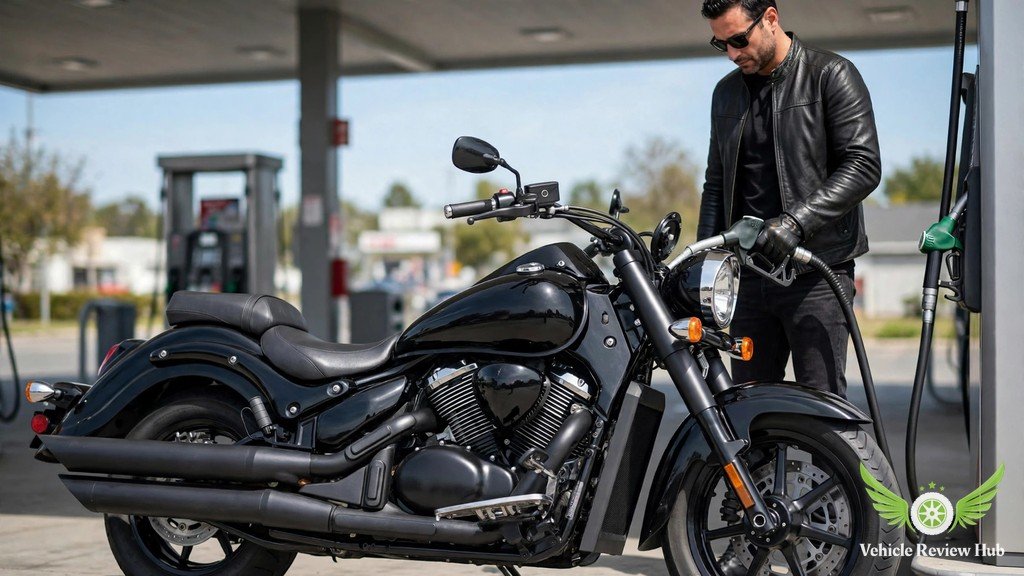
The only named MPG figure for the gen-2 C90 comes from Australia: webBikeWorld’s 2013 C90T review records fuel economy of about 6.5 litres per 100 km — about 36 mpg in US gallons — and says that should give “about 250+ km” of range from the 18-litre tank. This Suzuki Boulevard C90 performance guide labels that figure exactly as it is: an Australian review’s figure, converted, never a US test. The gen-2 tank holds 4.8 US gallons, so at about 36 mpg it implies roughly 173 miles of range — an implication, not a tested range. No US magazine MPG test for the gen-2 C90 was found, and Suzuki’s own spec tables print no fuel-economy figure for either generation. Owner reports point a little higher — one 2013 C90T B.O.S.S. owner reports about 42 mpg, another says the bike “gets over 50 miles to the gallon” — both owner-reported.
Gen 1 Range Was 142 Miles on 3.7 Gallons
The doc’s gen-1 range heading promises 142 miles on the 3.7-gallon tank: 142 miles on 3.7 gallons implies 38.4 mpg. But no test source for the 142-mile range was found, so this Suzuki Boulevard C90 performance guide does not print 142 miles as a tested range. What the owner record supports is a band: a 2005 C90T owner reports about 50 mpg, a 2008 C90T owner 36 mpg in the city and 41 on the highway, and a 2006 C90 owner 50 to 54 mpg on the highway and 43 to 47 commuting. At the owner-reported 36 to 41 mpg, the 3.7-gallon gen-1 tank gives roughly 133 to 152 miles — and the doc’s 142 miles falls inside that band. The gen-1 tank is the small one in this story — 3.7 gallons against the gen-2 bike’s 4.8 — and owners call it the bike’s weak point on long runs: one 2006 owner calls it “a bit of a joke for a bike of this size”. The honest gen-1 range answer in this Suzuki Boulevard C90 performance guide is a band, not a number: roughly 135 to 150 miles.
Suzuki Boulevard C90 Real-World Riding Experience
Two named road tests carry this Suzuki Boulevard C90 performance guide’s real-world chapter: Rider Magazine spent a month with a 2013 C90T B.O.S.S. in California, and webBikeWorld rode the Australian C90T the same year. They agree on the engine and the comfort — and they disagree on the rear suspension.

Rider: Great Engine, Weak Bouncy Suspension
Rider Magazine’s verdict on the 2013 C90T B.O.S.S.: a great engine held back by a weak, bouncy rear end. After a month with the bike, Rider’s tester wrote that “the big vee makes a nice chudda-chudda-chudda at low rpm, but as the revs climb it launches into a satisfying rush of power” and called the engine “a barrel of fun”. The suspension got the opposite treatment: “The 45mm fork does a decent job up front, and though the rear soaks up small hits, it’s just plain bouncy over larger bumps.” webBikeWorld, riding the Australian C90T the same year, splits from Rider: “the forks are compliant without a squashy feel under hard braking and the rear squats nicely and doesn’t bounce around”. Two named reviewers, two different rear ends on the same bike — this Suzuki Boulevard C90 performance guide names the split instead of picking a winner.
Last in Speed Contests, Smoothest in Its Class
The C90 never entered a speed contest, and this Suzuki Boulevard C90 performance guide does not pretend it did: there is no instrumented top-speed test for either generation, the only measured power figures are mid-pack dyno numbers in the high 60s, and the one aggregator figure — 0–60 mph in 4.5 seconds — is not a magazine test. No named source ranks it as the smoothest in its class — the heading’s “smoothest” claim is the doc’s characterisation, not a sourced verdict. What the named sources do say about smoothness is narrower: Rider’s tester found the big V-twin’s vibrations vanish as the revs climb, and webBikeWorld’s tester called the induction note “a glorious and entertaining sound” with “almost no mechanical noise”. The smoothness the C90 offers is the long-stroke V-twin kind — low revs, big torque, little mechanical noise.
Suzuki Boulevard C90 Handling, Braking and Stability
Handling on the C90 is a low-speed story more than a cornering story: the 28.3-inch seat and the weight carried low make an 800-pound bike manageable at walking pace, but the braking hardware is the thinnest part of this Suzuki Boulevard C90 performance guide — one front disc, two-piston calipers, no ABS, no suspension adjustment.

One Disc and Two-Pot Calipers on an 800-Pound Bike
The gen-2 C90 stops with a single 330 mm front disc and a 275 mm rear disc, each squeezed by a two-piston caliper, and no ABS in any year. Rider Magazine’s month-long test put it plainly: “The single discs and two-pot calipers front and rear take plenty of pressure at the controls to stop the 800-pound bike quickly, though it can be done.” The gen-1 bike had more disc area — dual front discs and a single rear disc — but no ABS either. One trap: motorcyclespecifications.com prints “dual 300 mm discs, four-piston caliper” at the front and a “single 180 mm disc” at the rear for the gen-2 C90 — copy-pasted M50 and C50 figures, not the C90’s brakes, and this Suzuki Boulevard C90 performance guide does not use them. The honest verdict: adequate when both brakes are used together and the rider plans ahead, modest against 800 pounds.
Tire, Brake and Suspension Checks That Matter
The checks that matter on a C90 are the ones the service manual schedules. Tyre pressures for the gen-2 bike are 33 psi front and 36 psi solo or 41 psi two-up at the rear, on a 130/80-17 front and a 200/60-16 rear. Brake fluid is DOT 4, replaced every two years; the brake hoses go every four years; the pads and braking system are inspected at every service column. Forks and rear suspension are inspected at 7,500 and 14,500 miles, and the steering head at 600, 7,500 and 14,500 — a worn rear shock shows up as the bouncy ride Rider described, and the only fix is replacement. The full service schedule is in the Suzuki Boulevard C90 reliability guide; the manual chart itself is on maintenanceschedule.com. Gen-1 owners should check the front tyre size moulded into the tyre fitted before ordering: sources split between 130/70-16 and 150/80-16. And the shared Boulevard rule: the oil filter is replaced only at 600 and 11,000 miles, never with every oil change, as the C50 reliability guide explains for the same manual family.
Suzuki Boulevard C90 Performance Compared With Other Big Cruisers
The comparison chapter of this Suzuki Boulevard C90 performance guide is short by design: the C90 is discontinued, so the comparison is its last-new price against the one Japanese big twin still sold new in 2026 — the Kawasaki Vulcan 1700 Vaquero — and the answer is about what $7,910 buys.

Suzuki Boulevard C90 vs Kawasaki Vulcan 1700 Vaquero
On paper the Vaquero is the stronger bike: Kawasaki’s own 2026 page lists the Vulcan 1700 Vaquero ABS at $19,999 plus $840 destination — $20,839 — for a 1,700cc liquid-cooled 52-degree V-twin making 82 hp at 5,000 rpm and 107.6 lb-ft at 2,750 rpm, through a six-speed gearbox with overdrive and a Kevlar-reinforced belt, with K-ACT linked ABS, cruise control, a fairing and hard saddlebags, at 844.5 pounds and a 28.7-inch seat. The C90’s last-new price was $12,549 plus $380 destination — $12,929 in total — a $7,910 gap before either bike turns a wheel. Against the Vaquero’s published 82 hp and 107.6 lb-ft, the C90 offers a brochure claim of 79.9 hp and 131.4 Nm — or a database claim of 67 hp and 114 Nm — and the closest measured figure, the M90’s 69.6 hp and 82.7 lb-ft. The Vaquero wins on power on every version of the numbers, and on equipment too: six speeds against five, ABS against none, cruise control and a fairing against neither. The Vaquero is the only Japanese big twin still sold new in 2026 — the point of this Suzuki Boulevard C90 performance comparison: the C90’s class has shrunk to one new Japanese bike. The full four-bike comparison is in the Suzuki Boulevard C90 comparison guide.
| Item | Suzuki Boulevard C90 (2019, last new) | Kawasaki Vulcan 1700 Vaquero ABS (2026) |
|---|---|---|
| Price (MSRP + destination) | $12,549 + $380 = $12,929 | $19,999 + $840 = $20,839 |
| Engine | 1,462cc liquid-cooled 54° V-twin, SOHC | 1,700cc liquid-cooled 52° V-twin, SOHC |
| Claimed power | 79.9 hp @ 4,800 rpm (Suzuki brochure); 67 hp (database) | 82 hp @ 5,000 rpm (ISO 4106, Kawasaki publishes) |
| Claimed torque | 131.4 Nm @ 2,600 rpm (Suzuki brochure) | 107.6 lb-ft @ 2,750 rpm (Kawasaki publishes) |
| Measured dyno | 69.6 hp @ 5,100 / 82.7 lb-ft @ 2,900 (M90, same engine) | No published dyno figure |
| Transmission / final drive | 5-speed / shaft | 6-speed with overdrive / Kevlar belt |
| Curb weight | 800 lb (C90T) | 844.5 lb |
| Seat height | 28.3 in | 28.7 in |
| Brakes / ABS | Single 330 mm front disc, two-piston; no ABS | Dual 300 mm front discs; K-ACT ABS standard |
Is the Suzuki Boulevard C90 Suitable for Beginner Riders? No
No — and this Suzuki Boulevard C90 performance guide is blunt about it. At 800 pounds in touring trim with 1,462cc, no ABS and a single front disc, the C90 is a big, heavy full-size cruiser, and a new rider’s first emergency stop is exactly when its thin brakes matter most. The low 28.3-inch seat tempts beginners, but a low seat does not make an 800-pound bike light, and the long wheelbase asks for experience at walking pace. The power delivery itself is forgiving — torque barely above idle, no sudden hit, fifth gear a long overdrive — but forgiving delivery does not cancel heavy weight and weak brakes. A beginner is better served by a smaller Boulevard: the Boulevard S40 review covers the 652cc single-cylinder bike at 381 pounds — less than half the C90T.
Suzuki Boulevard C90 Performance: Frequently Asked Questions
Direct answers to the performance questions riders ask about this Suzuki Boulevard C90 performance guide.
How much horsepower does the Suzuki Boulevard C90 make?
It depends which claim you read: Suzuki’s 2013 brochure prints 79.9 hp and 131.4 Nm; the spec databases print 67 hp and 114 Nm; Women Riders Now reports 77.8 hp and Rider Magazine 81.8 hp as Suzuki’s claim. The closest measured figure is the M90’s: 69.6 hp at 5,100 rpm.
What is the top speed of the Suzuki Boulevard C90?
No instrumented or GPS top-speed test was ever published for either generation, so this Suzuki Boulevard C90 performance guide prints no top-speed figure as a fact. The 138 km/h figure in one spec table is a quarter-mile trap speed, and owner guesses of 170–180 km/h are owner reports, not tests.
How fast is the Suzuki Boulevard C90 0–60?
No instrumented 0–60 test exists for either generation. The only gen-2 figure is an aggregator’s: zeroto60times lists the 2013 C90T B.O.S.S. at 0–60 mph in 4.5 seconds.
What is the quarter-mile time of the Suzuki Boulevard C90?
The sourced gen-1 figure is 15.0 seconds at a 138 km/h (85.7 mph) trap speed, from motorcyclespecifications.com. The doc’s 14.61- and 14.53-second figures could not be found in any source. The gen-2 aggregator figure is 13.5 seconds.
What MPG does the Suzuki Boulevard C90 get?
The only named figure is Australian: webBikeWorld’s 2013 C90T review records about 6.5 litres per 100 km, about 36 mpg in US gallons. No US magazine MPG test exists.
How far can a Suzuki Boulevard C90 go on a tank?
On the Australian figure, the gen-2 bike’s 4.8-gallon tank implies roughly 173 miles — an implication, not a tested range. For the gen-1 bike’s 3.7-gallon tank, 36 to 41 mpg implies 133–152 miles.
Does the Suzuki Boulevard C90 have ABS?
No. ABS was never offered on any US C90 in either generation; the gen-2 bike stops with a single 330 mm front disc and a 275 mm rear disc, both two-piston calipers.
Is the Suzuki Boulevard C90 faster than the Vulcan 1700 Vaquero?
No, on the published numbers: the Vaquero’s figures are 82 hp at 5,000 rpm and 107.6 lb-ft at 2,750 rpm, against the C90’s closest measured figure of 69.6 hp and 82.7 lb-ft from the M90. The C90 is 44.5 pounds lighter, but it does not outrun the Vaquero.
Which generation C90 is quicker?
The gen-2 bike: its brochure claim is 79.9 hp against the gen-1 database claim of 66 hp, and its measured cousin — the M90 dyno at 69.6 hp — sits above any measured gen-1 figure,
Is the C90’s engine the same as the M109R’s?
No. The gen-2 C90’s engine comes from the M90 (VZ1500): a 1,462cc SOHC 54-degree V-twin. The M109R runs a completely different 1,783cc DOHC 54-degree V-twin, the VZR1800 — same 54-degree angle, 321cc apart
What size are the C90’s brakes?
Gen 2: a single 330 mm front disc and a 275 mm rear disc, both two-piston calipers, and no ABS. Gen 1: dual front discs and a single rear disc, also without ABS.
Is the Suzuki Boulevard C90 good for highway cruising?
Yes — highway cruising is what the bike is built for: fifth gear is a long overdrive, the torque arrives barely above idle, and both named road tests praise the engine and the comfort.