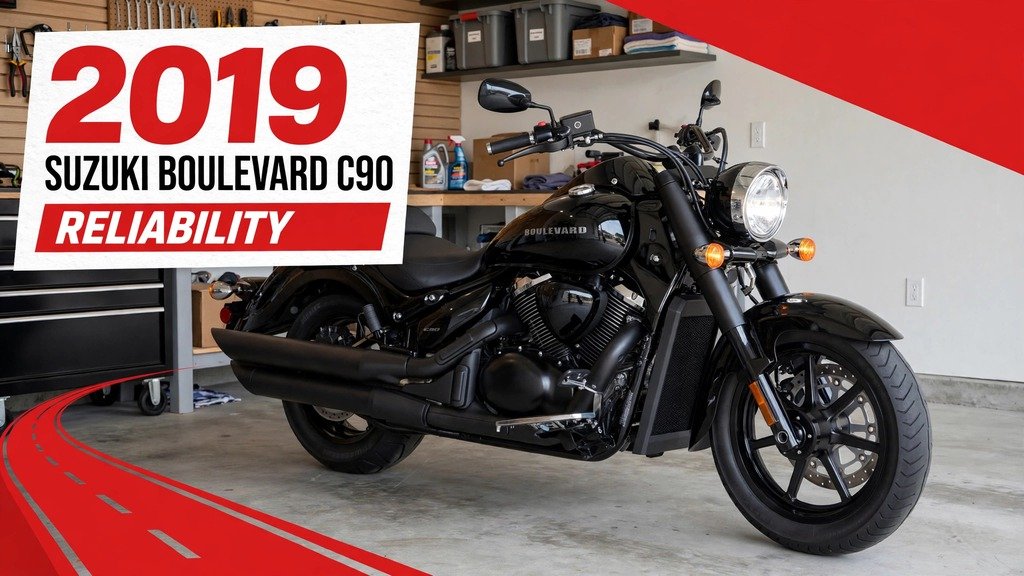
The Suzuki Boulevard C90 is a reliable big cruiser by the owner record, with one clear weakness to watch. Owners rate the Intruder 4.3 out of 5 for reliability, the bike has exactly one recall in published notices — the 2006 fuel-tank recall 06V-025 — and its maintenance is simple, with the same service columns in both generations. The watch item is the charging system: stator and regulator failures are owner-documented, even though the C90 is not part of the regulator-rectifier recall that covered its M90 sibling. This Suzuki Boulevard C90 reliability guide covers both generations, the service chart, the one recall and used C90 running costs. The full two-generation story is in the Suzuki Boulevard C90 review.
Suzuki Boulevard C90 Reliability Overview
Two generations share the C90 name, and both are simple, understressed big twins: the gen-1 bike (2005–2009) runs an air/oil-cooled 45-degree V-twin with hydraulic lifters and no valve service, and the gen-2 bike (2013–2019) runs the M90’s liquid-cooled 54-degree V-twin with shim-adjusted valves. Same 1,462cc displacement, five-speed gearbox, shaft drive and service columns in both manuals — and no ABS in either generation. That simplicity is the foundation of this Suzuki Boulevard C90 reliability guide: little here goes wrong, and what does is well documented by owners.

MCN Owners Rate the Intruder 4.3, From 11 Owners
The strongest owner evidence for this Suzuki Boulevard C90 reliability guide comes from MCN’s own owner-reviews page for the Suzuki VL1500 Intruder (1998–2002) — the C90’s direct ancestor. Owners there rate the bike’s reliability 4.3 out of 5, from 11 owners, with an overall rating of 4.1 out of 5. That is a small sample, but it is the only named owner rating for this engine family. Do not confuse it with MCN’s separate C1500T Intruder page, which has only one owner; this guide uses the VL1500 page. Owner ratings are self-selected — people post problems more often than trouble-free miles — so a 4.3 from 11 owners is encouraging, not a guarantee.
How Mileage, Storage and Previous Care Affect Reliability
Mileage alone does not decide a used C90’s reliability — storage and previous care matter more. A low-mileage bike that sat for years can need more work than a high-mileage bike ridden and serviced on schedule: stale fuel, a dead battery, dried seals and corroded brake fluid are storage problems, not wear problems. Previous care shows in the service record — oil on the manual’s columns, the filter only at 600 and 11,000 miles, brake fluid every two years. Before buying, check the charging system and the fuel tank mounting area, and ask whether the recall work was done. A C90 with records and regular use is the reliable one.
Suzuki Boulevard C90 Common Problems and Wear Items
The C90’s problem list in this Suzuki Boulevard C90 reliability guide is short, and every item on it is owner-documented rather than a factory bulletin. The charging system leads it, followed by the normal wear items of any heavy cruiser. What the C90 does not suffer from matters too: no second-gear pop-out, no clutch shudder, no petcock failures and no cam-chain tensioner pattern. The Suzuki Boulevard C90 performance guide covers what the engine does; this section covers what goes wrong with it.
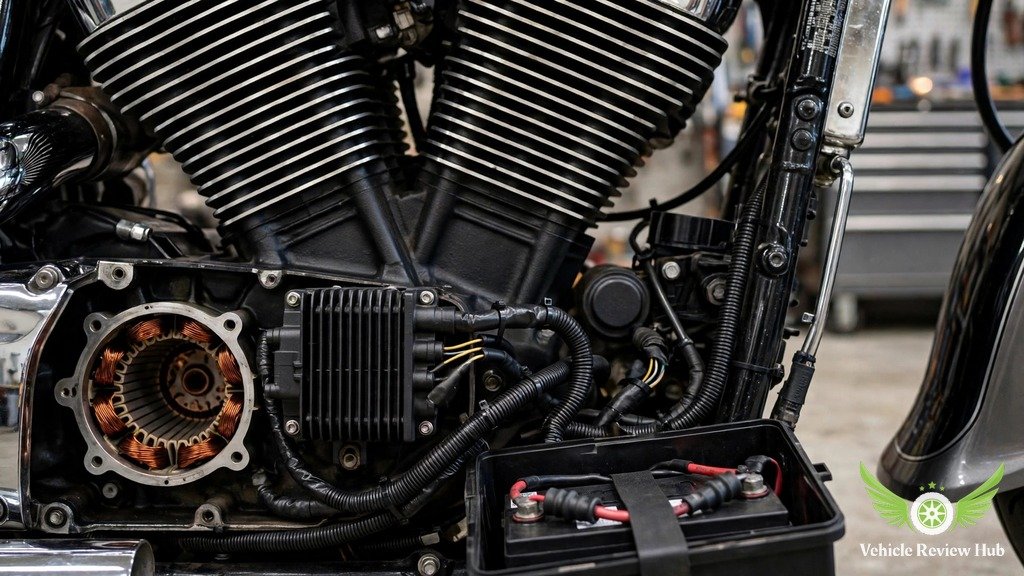
Stator and Regulator Failures Are Owner-Documented
Stator and regulator/rectifier failures on the C90 are owner-documented — owner forums describe charging failures on high-mileage bikes. They are NOT a Suzuki bulletin and NOT a recall, and this Suzuki Boulevard C90 reliability guide does not upgrade owner reports into a “known defect” claim. What the C90 does not suffer from: no second-gear pop-out or clutch shudder (the M109R’s stories), no petcock failures (the S40’s) and no cam-chain tensioner pattern (the S40’s).
The Recalled Part Number Irony, Explained
The irony this heading promises is real as far as the verified facts go, but the part-number connection behind it could not be confirmed from published sources. Here are the verified facts this Suzuki Boulevard C90 reliability guide can stand behind: the C90 is NOT in the 11V-108 regulator-rectifier campaign — Suzuki’s own February 2011 notice lists VLR1800 and VZ1500 (the M90) and no VL1500 anywhere in it — yet C90 owners report stator and regulator failures of the same class. So the bike that owners say suffers the failure was left out of the campaign that fixed it on its sibling — that is the irony, and it is as far as the verified record goes. Whether the C90 and the M90 share the same regulator part number could not be confirmed from any named source, so this Suzuki Boulevard C90 reliability guide does not print a part-number explanation as fact.
Suzuki Boulevard C90 Maintenance Schedule and Servicing
Both C90 generations in this Suzuki Boulevard C90 reliability guide use the same service columns — 600, 4,000, 7,500, 11,000 and 14,500 miles — and the same basic interval of every 3,500 miles or yearly. The charts differ in one big way: the gen-1 engine has no valve service at all, while the gen-2 engine needs its valves inspected every 7,500 miles. The full chart is on maintenanceschedule.com’s C90 page, and the table below condenses it.
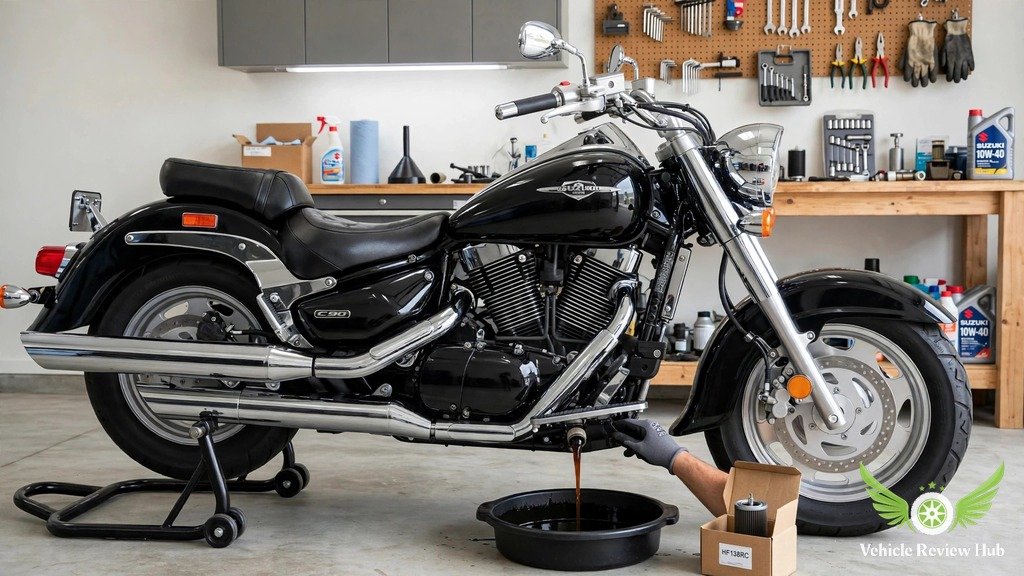
The video below is Rick Mammana’s 19-minute how-to showing the oil, filter and final-gear oil change on a 2005 C90 — a gen-1 bike.
| Item | Gen 1 (2005–09) | Gen 2 (2013–19) | Interval |
|---|---|---|---|
| Engine oil (10W-40) | Replace | Replace | Every column: 600/4,000/7,500/11,000/14,500 mi |
| Oil filter (HF138RC) | Replace | Replace | ONLY at 600 and 11,000 mi — never with every oil change |
| Spark plugs (×4, dual spark) | I 4,000/11,000; R 7,500/14,500 | I 4,000/11,000; R 7,500/14,500 | DPR7EA-9 (chart) vs CPR6EA-9 (brochure) — print both |
| Valve clearance | No valve service — hydraulic lifters | Inspect | Gen 2 only: 600/7,500/14,500 (every 7,500 mi) |
| Air cleaner element | I 4,000/7,500/14,500; R 11,000 | I at 11,000 | R every 22,000 mi (gen 2) |
| Final-gear oil | R at 600, then I | R at 600, then I | I at 7,500/14,500 |
| Brake fluid (DOT 4) | Inspect | Inspect | Replace every 2 years |
| Brake hose | Inspect | Inspect | Replace every 4 years |
| Engine coolant | N/A — air/oil-cooled | Replace | Gen 2 only: every 4 yrs or 29,000 mi |
| Tires, steering, forks, rear suspension | Inspect | Inspect | Steering 600/7,500/14,500; forks + rear 7,500/14,500 |
Oil at 600, 4,000, 7,500, 11,000 and 14,500 Miles
Engine oil is replaced at every service column in both generations — 600, 4,000, 7,500, 11,000 and 14,500 miles — with 10W-40. Gen-1 capacities: 3,700 ml (3.9 US quarts) without the filter, 4,300 ml (4.5 US quarts) with it. The oil filter is where buyers get caught out: replaced ONLY at 600 and 11,000 miles in both generations — the same rule as the C50, M109R and M50, the opposite of the S40. The C50 reliability guide explains the same manual-family rule, and the S40 reliability guide shows the opposite rule. One online guide says to replace the filter at every oil change; that contradicts both Suzuki manual charts.
Gen 1 Has No Valve Service: Hydraulic Lifters
The gen-1 C90 has no valve service at all, because its engine runs hydraulic lifters. Total Motorcycle’s 2005 C90 specs put it plainly: “Hydraulic valve lash adjusters eliminate valve adjustment maintenance” — and Suzuki’s own VL1500K5 manual chart has NO valve-clearance row at all. The gen-2 bike is different — its liquid-cooled engine uses shim-adjusted valves, inspected at 600, 7,500 and 14,500 miles. The gen-2 engine is the M90’s 1,462cc SOHC unit, not a retuned M109R engine.
Suzuki Boulevard C90 Tires, Brakes and Suspension Maintenance
Tires, brakes and suspension on the C90 are straightforward, but the details split by generation — and this Suzuki Boulevard C90 reliability guide keeps them separate. The gen-2 bike runs a 130/80-17 front and a 200/60-16 rear; the gen-1 bike runs a 180/70-15 rear and a front tyre whose size sources disagree on. Brakes are thin for an 800-pound bike: a single 330 mm front disc on the gen-2 bike, dual front discs on the gen-1 bike, and no ABS in any year. Suspension is inspected at 7,500 and 14,500 miles.

Gen 2 Valves Inspected at 600, 7,500 and 14,500
Gen-2 valve clearance is inspected at 600, 7,500 and 14,500 miles — every 7,500 miles. One online FAQ claims a valve check “every 14,500 miles”; that misreads the chart — 14,500 is the LAST column, not the interval. The gen-2 plugs follow the same pattern — inspected at 4,000 and 11,000 miles, replaced at 7,500 and 14,500 — four plugs, because the engine runs dual spark plugs per cylinder. The plugs carry their own conflict: the manual chart lists NGK DPR7EA-9, while Suzuki’s 2019 dealer brochure lists NGK CPR6EA-9 or DENSO U20EPR9. This guide prints both, names the conflict, and tells the buyer to check the plug actually fitted to their year. The M90’s chart lists yet another plug (NGK CR6E); that is the M90’s plug, not the C90’s.
Final-Gear Oil Replaced at 600, Then Inspected
Final-gear oil is replaced at 600 miles and then inspected at 7,500 and 14,500 miles in both generations — the shaft drive’s one fluid job, and a small one at 200–220 ml on the gen-1 bike. There is no chain to adjust and no belt to tension — the C90 is shaft drive in both generations. Tyre pressures for the gen-2 bike are 33 psi front and 36 psi solo or 41 psi two-up at the rear. One figure stays unresolved: the gen-1 front tyre. Maintenanceschedule.com says the earlier C90 (up to 2009) ran 130/70-16, while several spec databases print 150/80-16. This Suzuki Boulevard C90 reliability guide does not pick one: gen-1 owners should check the size moulded into the tyre actually fitted before ordering. The gen-1 rear (180/70-15) and the gen-2 pair (130/80-17 front, 200/60-16 rear) are consistent across sources.
Suzuki Boulevard C90 Maintenance and Ownership Costs
Running a C90 costs little beyond fuel, tires and the scheduled services — and the biggest cost difference between the generations is the gen-2 valve check. The bike’s last-new prices were $12,549 for the 2019 C90 B.O.S.S. and $13,049 for the 2019 C90T, each plus $380 destination — database-sourced, since Suzuki’s own 2019 C90 page could not be reached — and on the used market a C90 B.O.S.S. is framed as “an ABSOLUTE steal at under $7,000” in a 2024 Srkcycles video title. That used framing is a video title, not a verified market figure — but it sets the scale. The Suzuki Boulevard C90 comparison guide sets the last-new price against the three rivals still sold new.

Fuel, Routine Servicing, Tires and Replacement Parts
Fuel is the C90’s biggest running cost, and the only named economy figure is Australian: webBikeWorld’s 2013 C90T review records about 6.5 litres per 100 km, about 36 mpg in US gallons — roughly 173 miles from the gen-2 bike’s 4.8-gallon tank, an implication, not a tested range. Gen-1 economy is owner-reported only: about 50 mpg from one 2005 owner, 36 city and 41 highway from a 2008 owner. Routine servicing is cheap to do yourself — oil, a filter every 11,000 miles, four spark plugs, a small bottle of final-gear oil — and the gen-2 valve inspection every 7,500 miles is the one service most owners leave to a dealer. Tires are the other real cost: the gen-2 rear is a wide 200/60-16, and a pair of cruiser tires fitted costs noticeably more than a pair for a middleweight. Replacement parts are ordinary Suzuki cruiser parts — the HF138RC filter, DPR7EA-9 or CPR6EA-9 plugs (check which is fitted), DOT 4 fluid every two years, brake hoses every four years, coolant every four years or 29,000 miles on the gen-2 bike. None of it is exotic.
Recall 06V-025: Fuel Tank Crack, 37,911 Bikes
The heading carries the doc’s 37,911 figure, but the only sourced population is the NHTSA investigation’s 37,511, and the campaign total could not be confirmed — so this Suzuki Boulevard C90 reliability guide uses 37,511 and does not print 37,911 as a verified campaign figure. Suzuki’s own recall letter of February 3, 2006 covers ALL 1998–2005 and certain 2006 VL1500 and C90/T Boulevard models: repeated stress around the right front fuel tank mounting point can cause a hairline crack from metal fatigue, and a fuel leak brings a fire risk. The remedy is an inspection plus improved cushions, with cracked tanks replaced free in about two hours — and Suzuki’s letter carries a DO NOT RIDE warning for affected bikes. The NHTSA investigation behind it, PE05-031, closed on January 31, 2006, covered model years 1998–2006 Intruder 1500 and C90/T — population 37,511, 8 owner fuel-leak allegations. That is the C90’s only recall in published notices — exactly one — and the NHTSA recall search is the place to check whether a specific bike had the work done.
| Recall | Covers the C90? | What it is |
|---|---|---|
| 06V-025 (2006) | Yes — the C90’s only recall | Fuel-tank crack at the right front mounting point; inspect + cushions, cracked tanks replaced free; DO NOT RIDE warning |
| 11V-108 (2011) | No — does not name the C90 | Regulator-rectifier campaign for VLR1800/VZ1500 (M90); no VL1500 in Suzuki’s letter |
| 05V-566 (2005) | No — does not touch the C90 | Ignition-switch recall for VL800/VZ800 (C50/M50) only |
How to Keep a Suzuki Boulevard C90 Reliable
Keeping a C90 reliable — the whole point of this Suzuki Boulevard C90 reliability guide — is mostly a matter of following the manual and watching the two known weak points: change the oil on the columns, replace the filter only at 600 and 11,000 miles, keep the final-gear oil fresh, replace brake fluid every two years and brake hoses every four. Check the charging system at every service and the fuel tank mounting area — the stator and regulator are the weak point, and 06V-025 is the one recall this bike has. Against its rivals the C90 is the old bike in the room — the 2026 Kawasaki Vulcan 1700 Vaquero carries K-ACT ABS, cruise control and a fairing the C90 never had.

Preventive Maintenance, Records and Regular Inspections
Preventive maintenance on the C90 means the chart, not guesswork: oil at every column, filter only at 600 and 11,000, plugs inspected at 4,000 and 11,000 and replaced at 7,500 and 14,500, valves every 7,500 miles on the gen-2 bike only, final-gear oil replaced at 600 and then inspected, brake fluid every two years, brake hoses every four, coolant every four years on the gen-2 bike. Records matter because the next buyer will ask for them — and the charging system and fuel tank are both checkable in minutes. Inspect the tires for age as well as tread, and catch the small things — a weeping seal, a soft brake lever, a fading battery — before they become the big things.
Recall 11V-108 Does Not Name the C90
Recall 11V-108 does not name the C90, and Suzuki’s own letter is the proof: the February 11, 2011 overseas notice lists the regulator-rectifier campaign’s parts as covering VLR1800 and VZ1500 — the M109R and the M90 — with no VL1500 in it. Suzuki’s own 2016 customer letter lists “2009-2010 VZ1500”, and Transport Canada’s 2011071 lists the 2009–2010 Boulevard M90 only. The confusion comes from Cycle World’s May 2011 “Recall Roster”, which groups “C90/M90 Boulevard” for 11V-108 — that roster grouping is the roster’s error, the same loose pattern as its “C50/M50” grouping — the M50 reliability guide shows the same error. A C90 owner with a failed regulator should not expect a free 11V-108 remedy — but should still get the charging system checked.
Suzuki Boulevard C90 Reliability: Frequently Asked Questions
Direct answers to the reliability questions riders ask about this Suzuki Boulevard C90 reliability guide.
Is the Suzuki Boulevard C90 reliable?
Yes, by the owner record — the short answer this Suzuki Boulevard C90 reliability guide gives. MCN’s VL1500 Intruder page rates reliability 4.3 out of 5 from 11 owners, the bike has exactly one recall in published notices, and its maintenance is simple. The weak point is the charging system, which owners report failing on high-mileage bikes.
What is the most common problem with the Suzuki Boulevard C90?
Stator and regulator/rectifier failures are the most commonly owner-reported problem for Suzuki Boulevard C90 reliability. They are owner-documented, not a Suzuki bulletin and not a recall — and the C90 is not part of the 11V-108 campaign, which covered the M90 instead. Check the charging system before buying any used C90.
Does the Suzuki Boulevard C90 have stator problems?
Owner forums document stator and regulator/rectifier failures on the C90, usually on high-mileage bikes. The symptoms are a battery that will not stay charged and a bike that dies after a short ride. It is an owner-documented pattern, not a factory defect claim.
Was the Suzuki Boulevard C90 recalled?
Yes, once — the single recall this Suzuki Boulevard C90 reliability guide records: 06V-025 in 2006, for a fuel-tank crack at the right front mounting point on 1998–2005 and certain 2006 VL1500 and C90/T models. Suzuki inspected the tank, fitted improved cushions and replaced cracked tanks free, with a DO NOT RIDE warning. The NHTSA investigation population was 37,511; the campaign total could not be confirmed.
How many miles will a Suzuki Boulevard C90 last?
No published lifespan figure exists for the C90, so this Suzuki Boulevard C90 reliability guide prints none. Longevity depends on maintenance and previous care: a bike serviced on the manual’s columns lasts far longer than one with gaps in its history. The engine is a simple, understressed 1,462cc twin.
How often should I change the oil on a Suzuki Boulevard C90?
At every service column — 600, 4,000, 7,500, 11,000 and 14,500 miles — with 10W-40 oil. The basic interval is every 3,500 miles or yearly. The filter is a different job: replaced only at 600 and 11,000 miles, never with every oil change.
Does the gen-1 C90 need valve adjustments?
No — and this is one of the clearest findings in this Suzuki Boulevard C90 reliability guide. The 2005–2009 C90 runs hydraulic lifters, and Suzuki’s own VL1500K5 manual chart has no valve-clearance row at all — Total Motorcycle’s 2005 specs say the hydraulic valve lash adjusters “eliminate valve adjustment maintenance”. The gen-2 bike is different: its shim-adjusted valves are inspected at 600, 7,500 and 14,500 miles.
What spark plugs does the Suzuki Boulevard C90 use?
Both part numbers appear in Suzuki sources, and they conflict: the manual chart lists NGK DPR7EA-9 (four plugs, dual spark plugs per cylinder), while the 2019 dealer brochure lists NGK CPR6EA-9 or DENSO U20EPR9. Check the plug actually fitted to your year before ordering — this Suzuki Boulevard C90 reliability guide does not print one as “the” spec.
How often should the final-gear oil be changed?
For Suzuki Boulevard C90 reliability, the manual replaces final-gear oil at 600 miles and then inspects it at 7,500 and 14,500 miles in both generations. Many owners change it every year or every 7,500 miles instead — cheap insurance on a shaft-drive bike. The gen-1 capacity is 200–220 ml.
Does the Suzuki Boulevard C90 have ABS?
No. ABS was never offered on any US C90 in either generation. The gen-2 bike stops with a single 330 mm front disc and a 275 mm rear disc, both two-piston calipers; the gen-1 bike has dual front discs and a single rear disc. All three rivals carry ABS as standard.
Which C90 generation is more reliable?
No head-to-head reliability data exists between the generations, so this Suzuki Boulevard C90 reliability guide does not pick a winner. The gen-1 bike is simpler — no valve service, hydraulic lifters, air/oil cooling — but every gen-1 bike is at least 16 years old now. The gen-2 bike is newer, but it adds valve inspections every 7,500 miles and a coolant change every four years.
What should I check before buying a used Suzuki Boulevard C90?
For Suzuki Boulevard C90 reliability, check the charging system first — battery voltage at rest and at revs — then the fuel tank mounting area for the 06V-025 recall and whether the recall work was done. Ask for service records, check the oil and filter history, look at the final-gear oil, check tire age as well as tread, and on a gen-1 bike check the front tire size moulded into the tyre fitted — sources split between 130/70-16 and 150/80-16. A bike with records and regular use is the reliable one.