The short answer first: the 2026 Suzuki DR-Z125L is the simplest and cheapest bike to own in its class, but it is not the cheapest to buy. The Yamaha TT-R125LE undercuts it by $10 on the published total, and every one of its three rivals has electric start while the DR-Z has a kick starter only. What the DR-Z wins on is everything that follows the sale: a six-month warranty that matches Honda and Kawasaki and doubles Yamaha’s 90 days, the lightest weight of the four, and a 124cc air-cooled carburetted single with no battery, no fuel injection and nothing expensive to break. This Suzuki DR-Z125L comparison puts the DR-Z against the Kawasaki KLX140R L, the Honda CRF125F Big Wheel and the Yamaha TT-R125LE on price, specs, equipment and value.
Suzuki DR-Z125L Overview and Its Closest Rivals
The DR-Z125L’s rivals are the three bikes that match it where it matters: big 19-inch front and 16-inch rear wheels, a true manual clutch, and a size that fits teens and smaller adults. The standard KLX140R and the standard CRF125F run smaller 17/14 wheels and lower seats, so they sit in the alternatives section at the end of this Suzuki DR-Z125L comparison instead of the head-to-head sections. The three named rivals are the Kawasaki KLX140R L, the Honda CRF125F Big Wheel and the Yamaha TT-R125LE.

Why These Three Rivals: The Only 19/16 Clutch Bikes
All four bikes in this Suzuki DR-Z125L comparison share the same formula: 19-inch front and 16-inch rear wheels, a manual clutch, a five-speed gearbox on three of them, and seats between 30.9 and 32.0 inches. The DR-Z125L is the only one of the four with a kick starter and no electric start, and the only one whose engine has been unchanged since 2003. The Dirt Rider 2008 midsize playbike comparison tested the DR-Z125L against the TT-R125, the CRF100F, the CRF150F and the KLX140L, and called the DR-Z “a very middle-of-the road machine in nearly every aspect” — average power, sufficient suspension, handling that was nothing to write home about. That verdict still frames this Suzuki DR-Z125L comparison: the DR-Z does not win shootouts, it wins on simplicity.
How the Four Bikes Differ at a Glance
The table below is the whole comparison. The DR-Z125L is the lightest bike here at 196 lb with the tallest seat at 32.0 inches. The Kawasaki has the biggest engine at 144cc and the only rear disc brake. The Honda is the only fuel-injected bike and the only four-speed, with the lowest seat at 30.9 inches and the smallest tank at 1.0 gallon. The Yamaha has the biggest tank at 1.6 gallons and the lowest published total at $3,939. Prices are 2026 MSRP plus destination.
| Bike | 2026 published total | Engine and start | Seat height | Tank |
|---|---|---|---|---|
| Suzuki DR-Z125L | $3,949 | 124cc carb, kick-only | 32.0 in | 1.3 gal |
| Kawasaki KLX140R L | $4,414 | 144cc carb, electric | 31.5 in | 1.5 gal |
| Honda CRF125F Big Wheel | $4,299 | 124cc fuel-injected, electric + kick | 30.9 in | 1.0 gal |
| Yamaha TT-R125LE | $3,939 | 124cc carb, electric + kick | 31.7 in | 1.6 gal |
Suzuki DR-Z125L vs Kawasaki KLX140R L
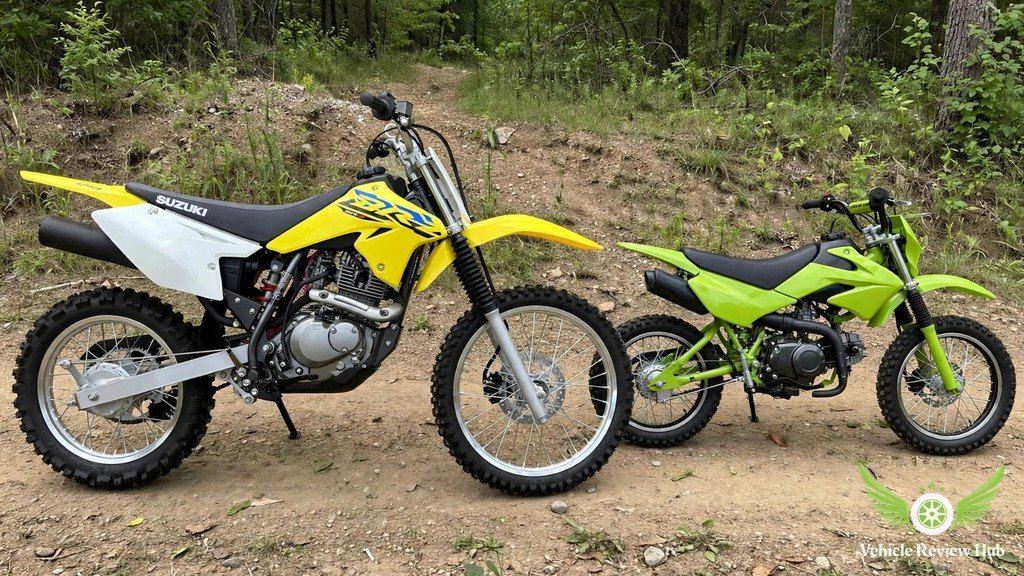
The Kawasaki KLX140R L is the DR-Z125L’s biggest rival in every sense: the biggest engine of the four at 144cc, the heaviest curb weight at 209 lb, and the highest published total at $4,414. It is also the only one of the four with a rear disc brake, and the only one with a Keihin carburettor. The KLX140R L was renamed from the KLX140L in 2021 — the same bike, a new badge.
Engine, Specs and Performance Side by Side
Neither manufacturer publishes a horsepower figure, so there is no factory number to settle the engine argument — and this Suzuki DR-Z125L comparison does not invent one. The Kawasaki’s 144cc air-cooled single is 20cc bigger than the DR-Z’s 124cc, with a Keihin PB20 carburettor against the DR-Z’s Mikuni VM20SS, and electric start against the DR-Z’s kick-only setup. The DR-Z’s own power figures are a database conflict — 10 HP at 7,500 rpm from 1000PS, 12 HP at 9,500 rpm from CycleChaos and autoevolution, 15 HP from MotorcycleDB labelled as an editorial estimate, and 7 HP from Motocross Hideout — with 12 HP at 9,500 rpm the most widely repeated. The CycleChaos DR-Z125 page is the source for the 12 HP figure. Both bikes run 19/16 wheels with knobby tyres, both have a 30 mm-class conventional fork, and the Kawasaki’s suspension travel is 180 mm front and rear against the DR-Z’s 180 mm front and 170 mm rear from the 1000PS database. The Kawasaki’s rear disc brake is the one clear equipment win: the DR-Z’s rear drum works, but the Kawasaki stops harder from the back wheel.
Price, Equipment and Which Suits Which Rider
The Kawasaki costs $4,099 plus $315 destination, $4,414 in total — $450 more than the DR-Z’s $3,649 MSRP and $465 more on the published total. That $465 buys the bigger engine, the electric start, the rear disc brake and 0.2 gallons more fuel. It does not buy a longer warranty: the KLX140R L carries a six-month limited warranty, the same as the DR-Z’s, per the motorcycle.com spec comparison. The motorcycle.com KLX140R L comparison lists the $4,099 MSRP, the $315 destination charge and the six-month limited warranty. The DR-Z suits the rider who wants the lightest, simplest bike and does not mind kicking it to life; the Kawasaki suits the rider who wants more engine, a button to start it and a rear disc for $465. A note on the numbers: the KLX140R L’s MSRP is $4,099 — the same figure as the DR-Z’s unconfirmed surcharge total, which this guide never prints as a confirmed DR-Z price. The two $4,099 figures must never be confused: one is the Kawasaki’s published MSRP, the other is a DR-Z total that no named source confirms.
Suzuki DR-Z125L vs Honda CRF125F Big Wheel
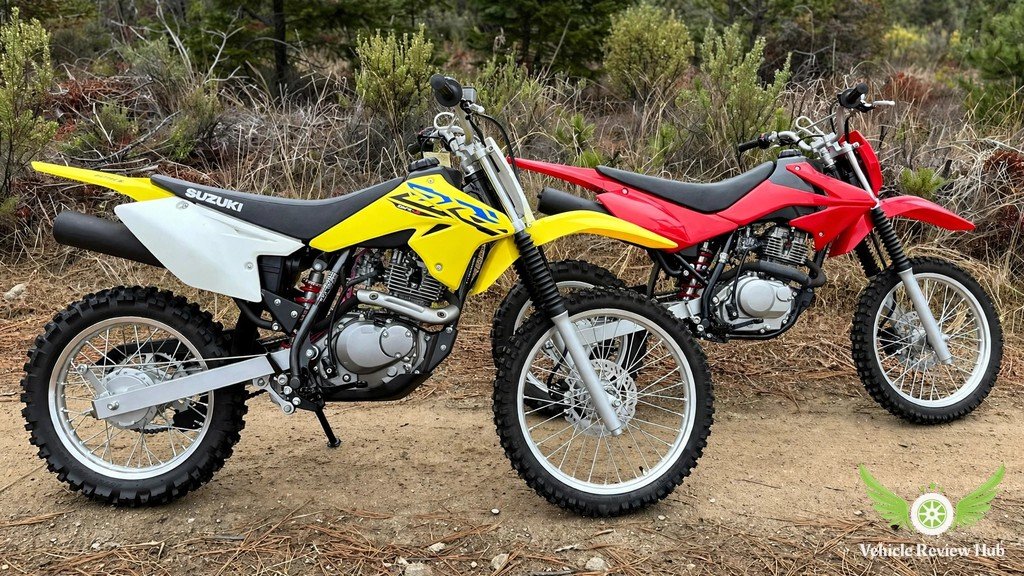
The Honda CRF125F Big Wheel is the DR-Z125L’s most modern rival: it is fuel-injected, it has electric start with a kick backup, and it costs $350 more. It is also the only four-speed, the only bike with a 1.0-gallon tank, and the one with the lowest seat at 30.9 inches. The Honda’s case is convenience — no choke, no kick, no carburettor to drain before storage. The DR-Z’s case is price and weight: $350 less, 3 lb lighter, and a five-speed against the Honda’s four.
Engine, Specs and Performance Side by Side
Both bikes are 124cc air-cooled singles, but they breathe differently: the Honda runs PGM-FI fuel injection through a 22 mm throttle body, the only fuel-injected bike here, while the DR-Z runs its Mikuni VM20SS carburettor. Honda publishes no horsepower figure for the CRF125F Big Wheel, just as Suzuki publishes none for the DR-Z, so the engine argument rests on delivery rather than numbers — the Honda’s fuel injection starts cleanly in the cold with no choke routine, while the DR-Z’s carburettor needs the choke-on, firm-kick, choke-off routine that Ultimate Motorcycling called “a bit on the cold-blooded side”. The Honda’s four-speed is the only four-speed here; the DR-Z’s five-speed gives it a taller top gear and shorter first and second gears for learning. The Honda’s seat is 30.9 inches against the DR-Z’s 32.0, its curb weight is 199 lb against the DR-Z’s 196 lb, and its tank is 1.0 gallon against the DR-Z’s 1.3 — the smallest tank of the four. Both bikes have a front disc and a rear drum, and the Honda’s suspension is 170 mm front and 168 mm rear against the DR-Z’s 180 mm and 170 mm from the database figures.
Price, Equipment and Which Suits Which Rider
The Honda costs $3,999 plus $300 destination, $4,299 in total — $350 more than the DR-Z on both measures. Honda’s own 2026 CRF125F Big Wheel page lists the $3,999 price, the $300 destination charge, the push-button electric starter and a transferable six-month limited warranty — the same six months as the DR-Z, so the Suzuki holds no warranty edge here. The Honda 2026 CRF125F Big Wheel page is the source for the price, destination, electric starter and warranty. The DR-Z suits the buyer who wants the cheapest bike with a five-speed gearbox and the lightest weight in the class, and who is happy to kick-start and drain a carburettor before storage. The Honda suits the buyer who wants to press a button and ride, never touch a choke, and sit 1.1 inches lower — and who will pay $350 for that convenience and accept a smaller tank and one fewer gear.
Suzuki DR-Z125L vs Yamaha TT-R125LE
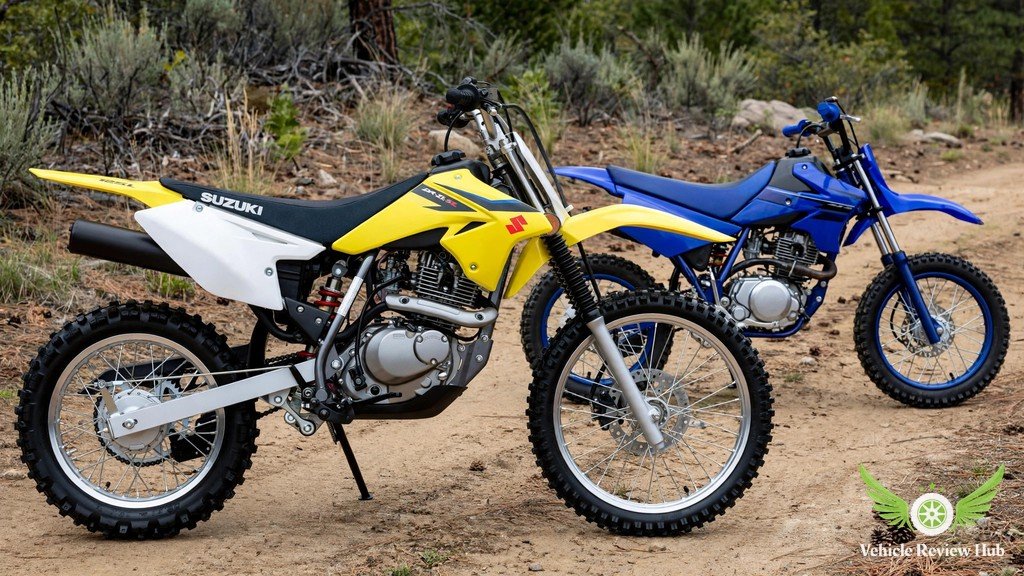
The Yamaha TT-R125LE is the rival this Suzuki DR-Z125L comparison cannot dodge: the cheapest bike of the four, by $10, with electric start and a kick backup while the DR-Z has a kick starter only. The Yamaha’s case is simple: it costs less and starts with a button.
The video below is Babbitt’s Online’s dealer comparison of the 2021 Suzuki DR-Z125 and the 2021 Yamaha TT-R125 — a walkaround and feature comparison from a dealer, not an instrumented test and not a ride review.
Engine, Specs and Performance Side by Side
Both bikes are 124cc air-cooled carburetted singles with a five-speed manual clutch and 19/16 wheels — the closest pairing in this Suzuki DR-Z125L comparison. The Yamaha runs a Mikuni VM20 carburettor, the same family as the DR-Z’s VM20SS, with a 54.0 x 54.0 mm bore and stroke against the DR-Z’s 57.0 x 48.8 mm, and a 10.0:1 compression ratio against the DR-Z’s 9.5:1. Yamaha publishes no horsepower figure for the TT-R125LE, just as Suzuki publishes none for the DR-Z. The Yamaha’s seat is 31.7 inches against the DR-Z’s 32.0, its curb weight is 198 lb against the DR-Z’s 196 lb, and its tank is 6.0 litres (1.6 gallons) against the DR-Z’s 4.8 litres (1.3 gallons) — the biggest tank of the four. Both bikes have a front disc and a rear drum, and the Yamaha’s suspension is 180 mm front and 168 mm rear against the DR-Z’s 180 mm and 170 mm from the database figures. The difference that matters most is the starter: the Yamaha has electric start with a kick backup, the DR-Z has a kick starter only, and for a lighter rider restarting after a stall that is the difference between pressing a button and kicking a 124cc single back to life. The Motocross Hideout DRZ125 review puts it plainly: “One downfall of the Suzuki DRZ 125 and 125L is that they only have a kick-start — all of the 125-140cc competition has electric start.”
Price, Equipment and Which Suits Which Rider
The Yamaha costs $3,599 plus $340 destination, $3,939 in total — $50 less than the DR-Z’s $3,649 MSRP and $10 less on the published total. Yamaha’s own June 2025 announcement set the 2026 TT-R125LE at $3,599 MSRP, and the $340 destination comes from the motorcycle.com spec database and dealer listings. The Racer X report of Yamaha’s 2026 announcement confirms the $3,599 MSRP. The Yamaha is the only rival that costs less than the DR-Z on both measures, and this Suzuki DR-Z125L comparison says so directly. The DR-Z’s answer is the warranty and the weight: six months limited against the Yamaha’s 90-day limited factory warranty, and 196 lb against 198 lb. The $10 gap is within dealer-setup noise — a single setup fee wipes it out — but the electric start is not noise, and it is the Yamaha’s real advantage. The Yamaha suits the buyer who wants the cheapest published total and a button to start the bike. The DR-Z suits the buyer who wants the lightest bike, the longer warranty, and the simplest machine of the four — and who is willing to kick it.
Suzuki DR-Z125L Price and Value Compared
Price is where this Suzuki DR-Z125L comparison gets honest: the DR-Z is second-cheapest, not cheapest, and the gap to the cheapest bike is $10. The value argument has to be made on what the $10 buys elsewhere — warranty, weight, simplicity — and on the running costs that follow, where the DR-Z’s appetite for oil and parts is the smallest in the class.
Second-Cheapest Published Total of the Four Bikes
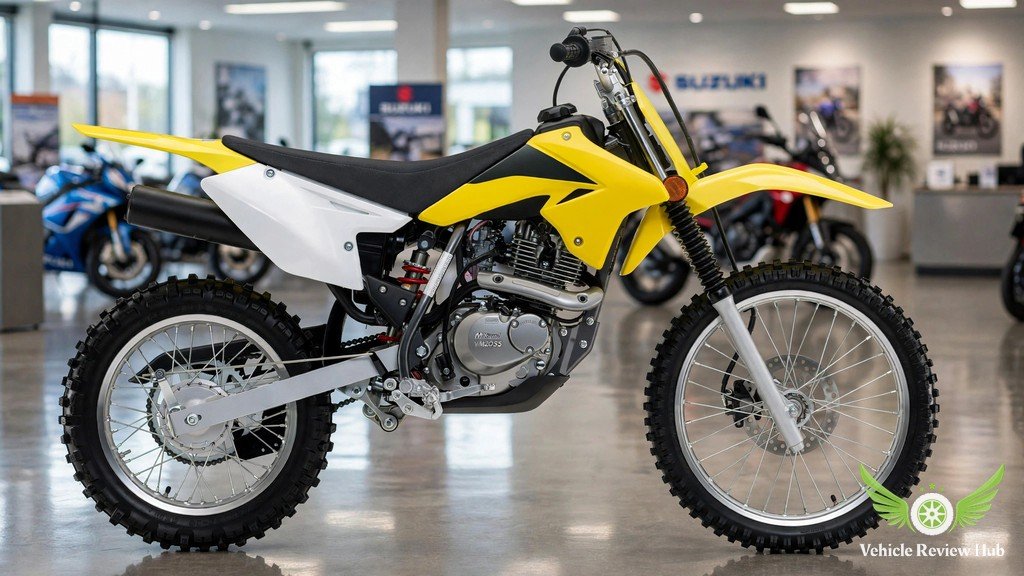
The ranking below uses 2026 MSRP plus destination, the totals a buyer pays before tax and dealer fees. The Yamaha TT-R125LE leads at $3,939, the DR-Z125L follows at $3,949, the Honda CRF125F Big Wheel is third at $4,299, and the Kawasaki KLX140R L is last at $4,414. The DR-Z is second-cheapest on MSRP too, so the ranking holds on either reading. One question buyers always ask is the freight surcharge: Suzuki’s own footnote says a surcharge applies to certain MY25 and MY26 models shipped after September 17, 2025, but no amount is published for the DR-Z125L, so this Suzuki DR-Z125L comparison prints the confirmed $3,949 total and adds nothing. The correction holds even if a surcharge did apply: adding $150 would put the DR-Z at $4,099, still second-cheapest. The Total Motorcycle 2026 TT-R125LE review confirms the Yamaha’s $3,599 US MSRP.
| Bike | MSRP | Destination | Published total |
|---|---|---|---|
| Yamaha TT-R125LE | $3,599 | $340 | $3,939 |
| Suzuki DR-Z125L | $3,649 | $300 | $3,949 |
| Honda CRF125F Big Wheel | $3,999 | $300 | $4,299 |
| Kawasaki KLX140R L | $4,099 | $315 | $4,414 |
Running Costs and Resale Value Compared
Running costs are where the DR-Z125L pulls ahead of its rivals, even where it loses on the showroom price. The DR-Z uses about 1.1 litres of SAE 10W-40 at every service, a spark plug that costs a few dollars, and a chain that needs cleaning and oil after every ride — the same cheap consumables as its rivals, but with two advantages they cannot match. First, there is no battery to replace, because the kick-only DR-Z has none; every rival with electric start carries one that will need replacing. Second, there is no fuel-injection system to diagnose, because the DR-Z’s carburettor can be cleaned by hand; the Honda’s PGM-FI needs a dealer when it faults. The DR-Z’s service chart is calendar-based, and the Suzuki DR-Z125L reliability guide sets out the full chart. On resale, clean used DR-Z125Ls typically list at $1,500 to $3,000 depending on year and condition, at drafting time, and parts and used examples are plentiful. The rivals hold their value the same way a clean trail bike does, but none of them has been in production unchanged for over twenty years.
Suzuki DR-Z125L Comparison Verdict and US Alternatives
The verdict of this Suzuki DR-Z125L comparison is that the DR-Z125L is the best value in the class for the buyer who values simplicity over convenience — and the second-best value for everyone else. The Yamaha is cheaper by $10 and starts with a button, the Honda is more modern and easier to live with, and the Kawasaki is bigger and stronger. The DR-Z wins on weight, on warranty against the Yamaha, and on the fact that there is almost nothing on it to break.

Every Rival Has Electric Start, but Only Two Cost More
Every rival has electric start — the Kawasaki, the Honda and the Yamaha all start with a button, and the Honda and the Yamaha also carry a kick backup. The DR-Z125L is the only kick-only bike of the four, the single biggest equipment gap in this Suzuki DR-Z125L comparison. But only two rivals cost more: the Honda at $4,299 and the Kawasaki at $4,414. The Yamaha costs less at $3,939, by $10 on the total and $50 on the MSRP. So the DR-Z’s pitch is not “cheapest” and it is not “easiest to start” — it is lightest at 196 lb, longest-warrantied against the Yamaha, and simplest to own, with no battery and no fuel injection. The Suzuki DR-Z125L performance guide covers the engine figures, and the Suzuki DR-Z125L review covers the riding experience. Buy the DR-Z for the lightest, simplest bike. Buy the Yamaha for the cheapest total and a button. Buy the Honda for fuel injection and the lowest seat. Buy the Kawasaki for the biggest engine and a rear disc. The DR-Z400S is a different class of bike entirely — the Suzuki DR-Z400S review covers its 398cc liquid-cooled engine and $7,659 total, nearly twice the DR-Z125L’s price.
KLX140R and Standard CRF125F Alternatives
Two more bikes sit just outside this Suzuki DR-Z125L comparison, for riders the big-wheel four do not fit. The standard Kawasaki KLX140R costs $3,799 plus $315 destination, $4,114 in total, on smaller 17/14 wheels with a 30.7-inch seat — the same 144cc engine and electric start as the L. The standard Honda CRF125F costs $3,599 plus $300 destination, $3,899 in total, on 17/14 wheels with a 28.9-inch seat — the lowest seat of all five bikes, and the cheapest published total of the five, $40 less than the Yamaha TT-R125LE. Both are worth a look for a rider under five foot. The small-wheel DR-Z125 itself ended in the USA around 2014, so there is no small-wheel Suzuki to match them — the DR-Z125L is the only DR-Z125 on sale.
Suzuki DR-Z125L Comparison: Frequently Asked Questions
Direct answers to the questions riders ask when comparing the DR-Z125L with its rivals.
Which is cheapest, the DR-Z125L or the TT-R125LE?
The Yamaha TT-R125LE is cheapest, by $10 on the published total: $3,599 plus $340 destination is $3,939, against the DR-Z125L’s $3,649 plus $300 destination, $3,949. The DR-Z is second-cheapest in this Suzuki DR-Z125L comparison, not cheapest.
Is the DR-Z125L the best value of the four?
For the buyer who values simplicity, yes: it is the lightest bike at 196 lb, its six-month warranty matches Honda and Kawasaki and doubles Yamaha’s 90 days, and it has no battery or fuel injection to maintain. For the buyer who values convenience, the Yamaha’s electric start and lower price make it the better value.
Which rival has the most power?
No manufacturer publishes a horsepower figure for any of the four bikes, so there is no factory number to rank them by. The Kawasaki has the biggest engine at 144cc against the other three at 124cc, and the DR-Z’s database figures conflict — 10, 12, 15 and 7 HP from different sources, with 12 HP at 9,500 rpm the most widely repeated.
Which bike is best for a beginner?
All four are beginner bikes, and the choice turns on fit and starting. The Honda’s 30.9-inch seat is the lowest of the big-wheel four, the Yamaha’s electric start is the easiest, and the DR-Z’s kick-only starting is the hardest for a lighter rider to work after a stall.
Does any rival have a rear disc brake?
Yes, one: in this Suzuki DR-Z125L comparison, only the Kawasaki KLX140R L has front and rear disc brakes. The other three all have a front disc and a rear drum.
Which bike has the biggest fuel tank?
The Yamaha TT-R125LE, at 6.0 litres (1.6 gallons). The Kawasaki follows at 1.5 gallons, the DR-Z125L at 4.8 litres (1.3 gallons), and the Honda is smallest at 1.0 gallon.
Which bike has the lowest seat height?
Of the four big-wheel bikes, the Honda CRF125F Big Wheel at 30.9 inches. The standard CRF125F is lower still at 28.9 inches. The DR-Z125L has the tallest seat of the four at 32.0 inches.
Does the DR-Z125L have electric start?
No. The DR-Z125L is kick-start only, with no battery and no electric start — the only kick-only bike of the four. Every rival has electric start, and the Honda and Yamaha also carry a kick backup.
Which rival is fuel-injected?
Only the Honda CRF125F Big Wheel, with PGM-FI fuel injection through a 22 mm throttle body. The DR-Z125L, the KLX140R L and the TT-R125LE all run carburettors.
How much more does the KLX140R L cost than the DR-Z125L?
The Kawasaki costs $465 more on the published total: $4,099 plus $315 destination is $4,414, against the DR-Z125L’s $3,949. The MSRP gap is $450.
Is the DR-Z125L a good buy used?
Yes. Clean used DR-Z125Ls typically list at $1,500 to $3,000 depending on year and condition, at drafting time, and parts and used examples are plentiful after over twenty years in production. Check the carburettor first — a clogged pilot jet from storage is the most common reason a used DR-Z125L will not start.
Should I buy the standard KLX140R or standard CRF125F instead?
If the rider is under five foot, yes — look at them first. The standard KLX140R is $4,114 in total with a 30.7-inch seat, and the standard CRF125F is $3,899 in total with a 28.9-inch seat.