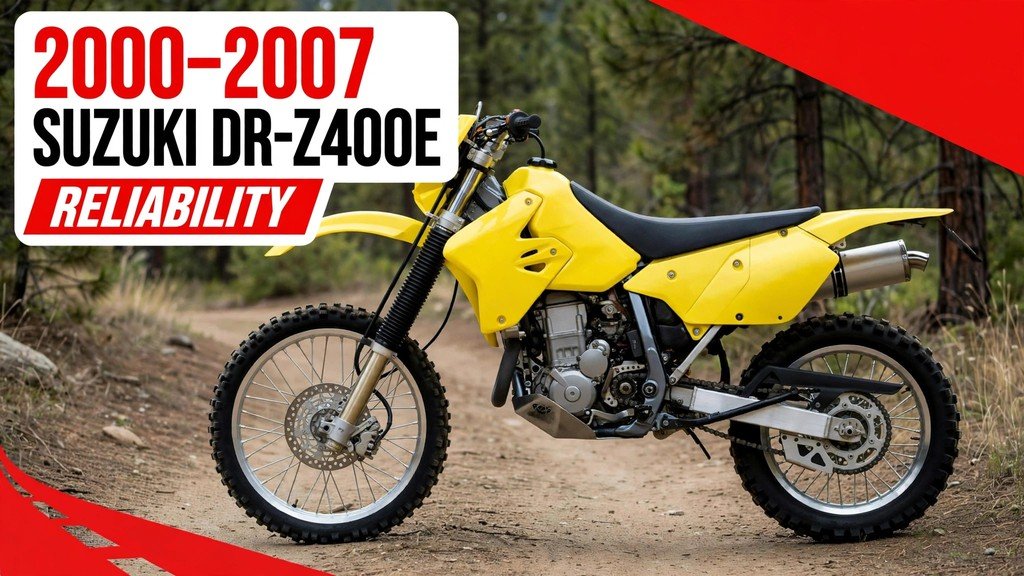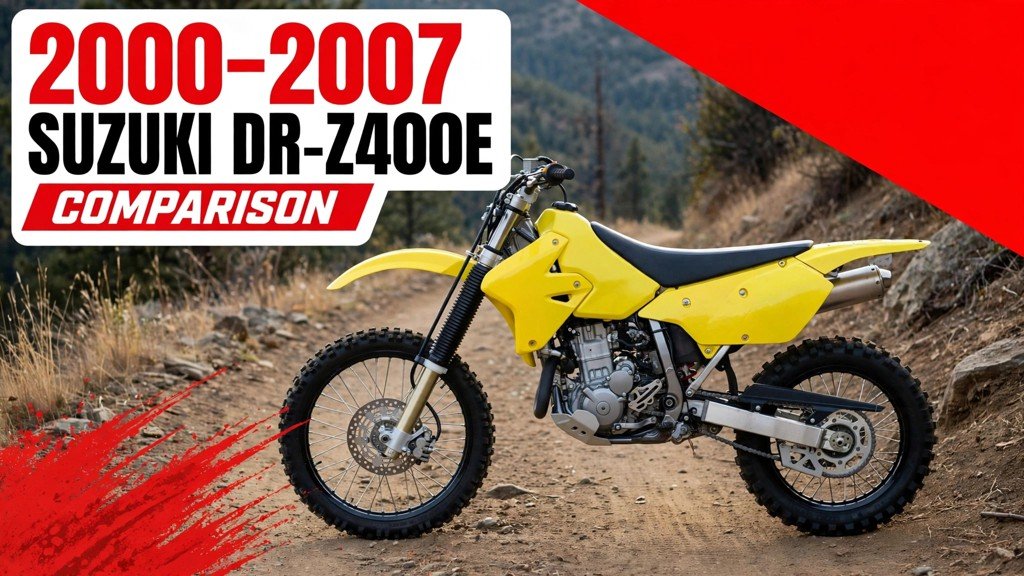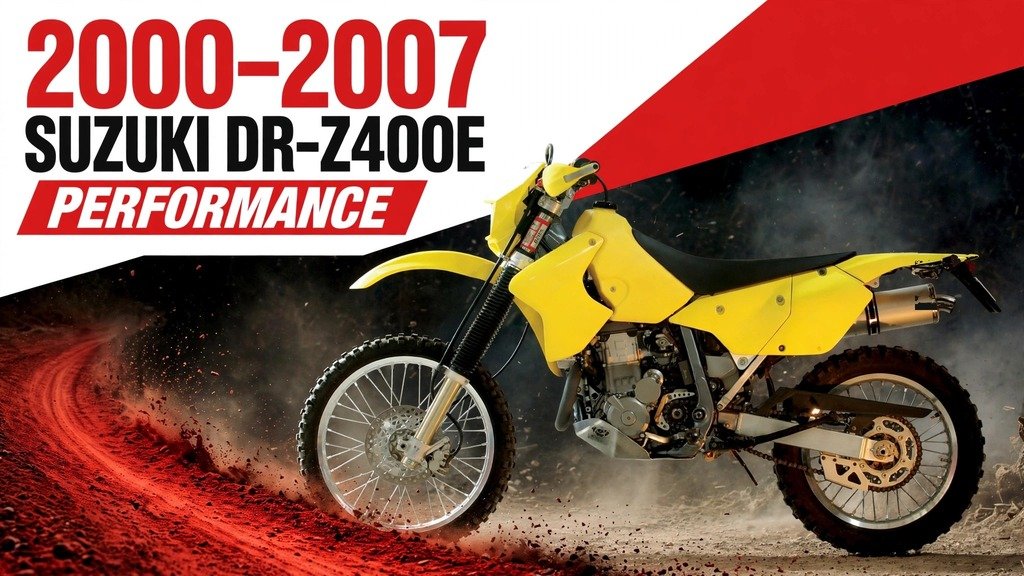
The short answer first: the Suzuki DR-Z400E is quick for a 400cc trail bike, but almost none of its performance was ever measured in the USA. Suzuki claimed 48 hp at 9,000 rpm, no American magazine ever put the E itself on a dyno, no outlet ever instrument-tested its top speed, and no EPA fuel-economy figure exists. What the period tests did prove is that the E was the torque-rich, plush-riding enduro of Dirt Bike Magazine’s June 2000 shootout. This Suzuki DR-Z400E performance guide separates the claimed figures from the measured ones.
Suzuki DR-Z400E Engine Performance and Power Delivery
The E’s engine is a 398cc liquid-cooled single with double overhead cams, four valves and a dry sump, and Suzuki claimed 48 hp at 9,000 rpm and 41 Nm (30 lb-ft) of torque at 7,500 rpm for the E and the kick-start DR-Z400 together, per Suzuki’s 2000 specification. The compression ratio is 12.2:1 against the S bike’s 11.3:1, made with a thinner base gasket and higher-lift cams, and the carburettor is a Keihin FCR39 pumper with an accelerator pump and a throttle-position sensor tied to the digital ignition. The power delivery is the point of the bike: the FCR39 gives instant throttle response and the short 14/47 gearing puts the torque where a trail rider uses it. The DR-Z400E review covers the engine in full.

| Power figure | Value | Source and label |
|---|---|---|
| Suzuki claimed power | 48 hp @ 9,000 rpm / 41 Nm @ 7,500 rpm | Suzuki 2000 spec, E and kick-start bike together |
| Dirt Bike 2000 shootout dyno | 38.4 hp @ 9,800 rpm | Dirt Bike Magazine, June 2000 — version not named (see text) |
| Australian dyno, de-restricted | ~40 hp at the rear wheel | MCNews, Nov 15, 2000 — Australian bike, labelled as such |
| SM sibling dyno | 34.65 hp / 25.91 lb-ft | Motorcycle.com 2005 DR-Z400SM — sibling data only, not the E |
| Database claimed figure | 49 hp (2005 E) | 1000ps database — conflicts with Suzuki’s 48 hp claim |
No US Dyno Test of the E Was Ever Published
No American magazine ever published a dyno test of the E with the E named. That is the honest starting point for any Suzuki DR-Z400E performance discussion, and it is why this guide never prints a single rear-wheel number as “the E’s dyno figure”. The closest thing to a US dyno is Dirt Bike Magazine’s June 2000 shootout, which lists “2000 SUZUKI DRZ400 — PEAK HORSEPOWER: 38.4 @ 9800 rpm” on its quick-bike-reviews page, with test-bike weights for both versions (E 277 lb, kick-start bike 268 lb) and a single peak-horsepower figure. The shootout text says the bikes were stock for the dyno, but the published figure is attributed to “the DRZ400” without saying whether the E or the kick-start bike was on the dyno — and that ambiguity has to be named in the same sentence, every time the number appears.
There is also a claimed-power split worth naming once: Suzuki’s 2000 specification says 48 hp, while the 1000ps database prints 49 hp for the 2005 E. The two figures are never merged or averaged here; the table above carries both, labelled.
The Only Dyno Is Australian, on a Restricted Bike
The only dyno ever published with the E named is Australian. MCNews ran a November 15, 2000 test of the Australian DR400 — the ADR-approved E, which carried road gear but the same engine — and dyno’d the standard restricted bike against a piped WR400 and a de-restricted DR with the muffler baffle removed, a .178 main jet and the airbox cover off. The de-restricted DR and the piped WR made similar peaks of around 40 hp at the rear wheel, and MCNews wrote that the de-restricted bike had “around 40 horsepower at the rear wheel. Some 5 more horsepower than the current model DR650!” The restricted standard bike’s peak exists only on the dyno-chart image in the article, not as readable text, so this guide prints no restricted peak number. The ~40 hp figure is the de-restricted Australian bike’s number, labelled as such, and it is the closest measured figure the E has — never quoted as the stock bike’s output.
Suzuki DR-Z400E Top Speed and Acceleration
There is no tested top speed for the DR-Z400E, and no tested acceleration time either. That sounds like a gap in this Suzuki DR-Z400E performance guide, but it is the verified truth: no named outlet ever GPS- or instrument-tested the E’s top speed, and no outlet ever ran it through a timed 0–60 mph or quarter-mile test. The only top-speed figure in circulation is a database number — 1000ps lists 150 km/h (93 mph) for the 2005 E — and a database number is not a test.

No Instrumented Top-Speed Test Exists
The 93 mph figure needs its label every time it appears: it is 1000ps’s database figure for the 2005 E, 150 km/h, and no test stands behind it. The S bike’s database figure is 152 km/h (94 mph), which is also a database number and also not a test — and it is not the E’s figure anyway. This Suzuki DR-Z400E performance guide never writes “the E tops out at 93 mph” as a tested fact, because no one tested it. The gearing explains why a high top speed was never the point: first gear is 2.285, fifth is 0.863, and the primary ratio is 2.96, so the engine spins fast for a given road speed and the bike runs out of gearing before it runs out of power. A rider who wants a faster top speed can fit a larger front sprocket or a smaller rear one, but that trades away the low-end pull the E was built for. The honest statement is short: 93 mph as a database figure, untested.
Acceleration is the same story: no 0–60 mph time and no quarter-mile time was ever published for the E. The S bike’s database quarter-mile is 13.9 seconds, but that is a database number for the S, not the E, and not a test. What the period tests did measure was the E’s low-end pull — Dirt Bike’s shootout ranked the Suzuki second for low-end power, behind only the Honda XR400R — but the stopwatch numbers do not exist, and this guide does not invent them.
S-Model Dynos Are Sibling Data Only
The only measured DR-Z400-family dyno from a named outlet belongs to the supermoto sibling, not the E. Motorcycle.com’s 2005 DR-Z400SM dyno made 34.65 hp and 25.91 lb-ft at the rear wheel — the SM’s figure, from the street-legal supermoto with the Mikuni BSR36 carburettor, 11.3:1 compression and 17-inch wheels. The DR-Z400SM performance guide covers that run in full. It is useful here only as sibling data, labelled as such: the SM’s detuned engine reads lower than the E’s claimed output, as the E’s hotter cams, higher compression and pumper carb should prevent. The DR-Z400S performance guide carries the same warning for the S bike’s figures — the S shares the E’s engine block but not its tune, and no S dyno number becomes an E number by association.
Suzuki DR-Z400E Mileage and Fuel Economy
The DR-Z400E has no official fuel-economy figure, because no official figure exists for it. Off-road bikes get no EPA fuel-economy rating — the EPA certifies street-legal motorcycles, and the E was never street-legal — so there is no window-sticker MPG to quote and no government test to cite. Any Suzuki DR-Z400E performance article that prints a single MPG number as the E’s official economy is inventing it.

No Official MPG: an Off-Road Bike Has No EPA Figure
The owner evidence is thin but consistent: a DR-Z400SM owner on PistonHeads reported 68 mpg “trundling at 60 mph” and 45–50 mpg “flat out” — and the poster is in the UK, so those are UK gallons, not US gallons. Converted silently they would read about 57 US mpg and 37–42 US mpg, which is why this guide quotes the poster’s own words with “UK gallons” rather than converting without saying so. The E’s own economy should sit in the same band — same engine family, similar weight — but the E’s pumper carb and shorter gearing work against it at steady speed, and the FCR39 is altitude-sensitive. The aggregator band of “50–65 MPG” that some sites print for the DR-Z400 is low-authority and unsourced, and it is not cited here.
Range Talk Must Carry Its Source Label
Range is arithmetic, not a test, and it has to be labelled that way. The E’s tank holds 2.6 US gallons with a 0.6-gallon reserve, so about 2.0 gallons is usable before the reserve. At the owner-reported 45–50 mpg (UK gal) flat-out band, 2.6 gallons gives roughly 100–130 miles; at the gentle 68 mpg (UK gal) cruising figure, the same tank stretches toward 150 miles — but that is labelled arithmetic from an owner-reported SM figure in UK gallons, not a tested E range. There is no fuel gauge and no odometer on the E, so a rider judges range by feel and by the reserve tap.
Suzuki DR-Z400E Real-World Riding Experience
On the trail, the E rides like a trail bike that happens to have a 400cc engine, not like a race bike with its lights taken off. The seat is 37.2 inches high, the bars are upright, the waist is slim, and the short 14/47 gearing means the bike pulls hard from low revs and will stand on its back wheel in as high as third gear, as the Australian MCNews test put it. The riding experience in this Suzuki DR-Z400E performance guide comes from the period tests, because no new E has been sold in the USA since 2007.

The video below shows a DR-Z400 in an Irish hare-and-hound enduro race in 2021 — the video does not say whether the bike is an E or a kick-start model, and it is a race, not a dyno or top-speed test.
Aimed Squarely at the Yamaha WR400F, Say Period Tests
The E was built to chase the Yamaha WR400F, and the period tests say so plainly. Cycle World’s March 2000 preview frames the E against the WR/YZ Yamaha thumpers, noting that “the Keihin 39mm pumper carb is the same one that works so well on the WR/YZ Yama-Thumpers”, and Dirt Bike Magazine’s June 2000 eight-bike shootout tested the DR-Z400 directly against the WR400F and the KTM 400 EXC, which won the test. The WR400F cost $5,899 against the E’s $5,349, weighed 265 lb dry against the E’s 262 lb, and made 43.5 hp at 8,900 rpm on the shootout dyno against the Suzuki’s 38.4 hp at 9,800 rpm — remembering that the Suzuki figure does not say which version was on the dyno. The Yamaha won the peak-power ranking and the Suzuki came third, but the Suzuki beat the Yamaha where a trail rider feels it: the low-end power ranking put the Honda first, the Suzuki second and the KTM third.
Plush and Torquey, Bottoming at Race Pace
The shootout’s verdict on the E’s ride is blunt and worth quoting in full. Dirt Bike ranked the Suzuki fifth for slow-speed suspension and seventh — last — for high-speed suspension, calling it “truly bad in high-speed whoops”, and sixth for stability, then concluded that the DR-Z is “more like an updated and modern Honda XR400R” — a bike that could do almost anything with work. Dirt Rider’s 2003 test of the kick-start bike, the same engine and chassis as the E, called it a “truly great trailbike” with “ultra-plush suspension and smooth, linear power”, and warned that “at 90 percent, life isn’t nearly so happy”.
Suzuki DR-Z400E Handling, Braking and Stability
The E handles like a tall, light enduro: quick to turn, easy to manage at low speed, and less settled than the KTM or the Yamaha when the pace rises.

250mm Front and 220mm Rear Discs
The E stops with a 250 mm front disc and a 2-piston caliper, and a 220 mm rear disc with a 1-piston caliper, and there is no ABS on any year — the E predates Suzuki’s ABS era and no source lists ABS for it. The tyres are 80/100-21 front and 110/100-18 rear, and the rear size is a trap for anyone coming from the S: the street-legal S takes a 120/90-18 rear, while the E takes the narrower 110/100-18.
Tire, Brake and Suspension Checks That Matter
Performance on a 2000–2007 bike depends on condition, and the checks that matter most are the ones the manual calls for. The drive chain is an RK520KZO with 112 links, and the slack must be 40–50 mm — a tight chain wears the countershaft and the sprockets, and a loose chain whips and jumps. The fork oil is 720 ml of Suzuki SS-05 per leg, and the fork is a 49 mm conventional cartridge unit with preload, 14-way compression and 18-way rebound adjustment; the rear shock has preload, 26-way compression and 21-way rebound. The service manual calls for a fork and rear-suspension inspection at 5 hours and every 60 hours, and for the steering, brakes and chassis nuts and bolts to be checked on the same cycle. Brake fluid is replaced every two years, brake hoses every four years, and the pads are judged by their grooved wear-limit line. The tyres are checked for pressure and damage on every ride, and the spoke nipples are inspected on every ride too.
Suzuki DR-Z400E Performance Compared With Other Enduros
Against its 2000 rivals, the E was the cheapest bike in the shootout that could still run with the best of them. The KTM 400 EXC won Dirt Bike’s June 2000 test at $6,995, the Yamaha WR400F was the peak-power bike at $5,899, and the E was $5,349 — $550 under the Yamaha and $1,646 under the KTM. The E’s performance case was never about winning a dyno chart; it was about torque where a trail rider uses it, a plush ride at trail pace, electric start, and a price that undercut both of its direct rivals — the full Suzuki DR-Z400E performance comparison follows.
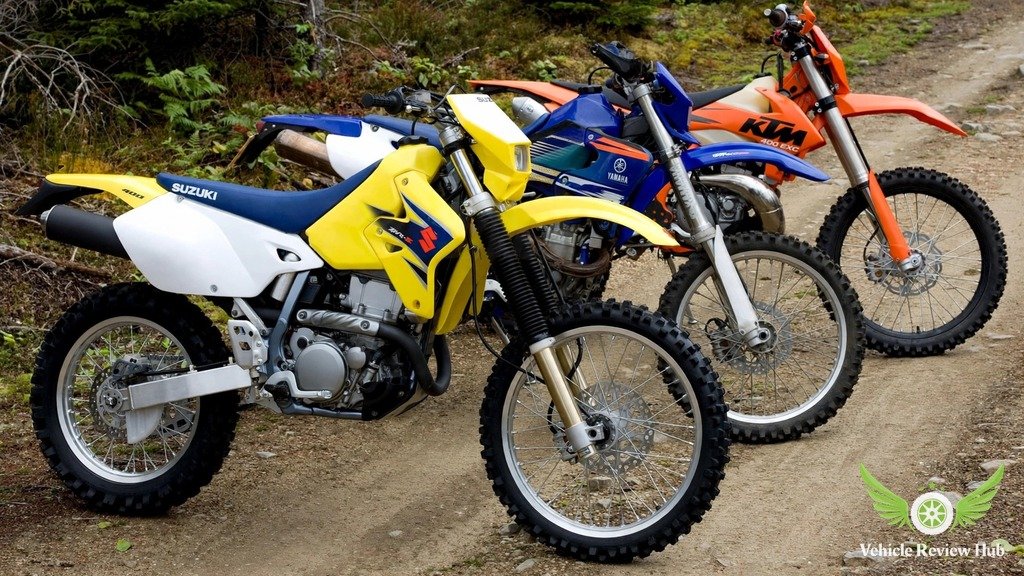
| Bike (2000) | Price | Dry weight | Shootout dyno |
|---|---|---|---|
| Suzuki DR-Z400E | $5,349 | 262 lb | 38.4 hp @ 9,800 rpm* |
| Yamaha WR400F | $5,899 | 265 lb | 43.5 hp @ 8,900 rpm |
| KTM 400 EXC | $6,995 | 257 lb | 39.1 hp @ 7,200 rpm |
| Suzuki DR-Z400 (kick-start) | $5,249 | 249 lb | 38.4 hp @ 9,800 rpm* |
*The 38.4 hp figure is Dirt Bike Magazine’s June 2000 dyno of a US DR-Z400 — the published figure does not say whether the E or the kick-start bike was on the dyno, so it is listed for both versions with the ambiguity named.
Suzuki DR-Z400E vs Yamaha WR400F and KTM 400 EXC
The Yamaha was the faster bike on paper and the KTM was the better bike on the day, and the E was the cheaper bike with the better low-end pull. The WR400F made 43.5 hp at 8,900 rpm against the Suzuki’s 38.4 hp at 9,800 rpm, and it won the peak-power ranking while the Suzuki came third; the KTM made 39.1 hp at 7,200 rpm and won the test outright on handling and suspension. The E’s answer was torque: second for low-end power, behind only the Honda XR400R, and a 14/47 final drive that put the power down from walking speed. The KTM was 5 lb lighter than the E dry (257 lb against 262 lb) and the Yamaha was 3 lb heavier dry than the E. The price gap was the E’s real weapon: $550 under the Yamaha and $1,646 under the KTM, with electric start included — the KTM and the Yamaha both needed a kick. The DR-Z400 history on motocrosshideout records the E’s place in the family, and the shootout’s own conclusion was that the DR-Z is “more like an updated and modern Honda XR400R” — a bike that could do almost anything with work.
Is the Suzuki DR-Z400E Suitable for Beginner Riders?
The E is a good trail bike for a beginner with caveats, and the caveats matter. The power is smooth and linear, the weight is light at 262 lb dry, and the electric start is easy — three things a new rider wants. The seat is 37.2 inches high with 12.8 inches of ground clearance, which is tall for a shorter rider, and there is no factory lowering option. The gearing is short, so the bike is busy at speed, and the FCR39 carburettor is altitude-sensitive, which means a beginner riding in the mountains has to learn jetting or live with a bog. The bike is also not street-legal, so it needs a truck or a trailer to reach the trail. For a tall beginner who rides trails and has transport, the E is a forgiving first enduro; for a short beginner, or one who needs to ride to the trail, the little off-road-only sibling in the DR-Z125L review is the easier start, and a used E is still the cheapest way into a serious 400cc enduro.
Suzuki DR-Z400E Performance: Frequently Asked Questions
Direct answers to the performance questions riders ask in this Suzuki DR-Z400E performance guide.
How much horsepower does the DR-Z400E make?
Suzuki claimed 48 hp at 9,000 rpm and 41 Nm at 7,500 rpm. No US dyno test of the E was ever published with the E named; the closest measured figures are Dirt Bike’s 38.4 hp at 9,800 rpm for a US DR-Z400 of unspecified version, and about 40 hp at the rear wheel for a de-restricted Australian bike.
Was the DR-Z400E ever dyno tested?
Only in Australia — MCNews dyno’d an Australian DR400 in November 2000 and recorded about 40 hp at the rear wheel for the de-restricted bike. No American magazine published a dyno test of the E with the E named.
What is the DR-Z400E’s top speed?
No instrumented top-speed test exists. The only figure in circulation is a database number — 150 km/h (93 mph) from 1000ps — which is not a test result.
How fast is the DR-Z400E 0-60?
No 0–60 mph or quarter-mile time was ever published for the E; the S bike’s database quarter-mile of 13.9 seconds is a database number for the S, not the E, and not a test.
What MPG does the DR-Z400E get?
There is no official MPG figure — off-road bikes get no EPA rating. Owners of DR-Z400-family bikes report roughly 45–68 mpg depending on speed, in UK gallons; the S bike’s EPA figure of 74.7 mpg belongs to the S, not the E.
How far can a DR-Z400E go on a tank?
The tank holds 2.6 US gallons with a 0.6-gallon reserve. At owner-reported economy of 45–50 mpg, that is roughly 100–130 miles — labelled arithmetic, not a tested range.
Is the DR-Z400E faster than the DR-Z400S?
On paper, yes — per motorcycle.com’s E-vs-S compare, the E has a Keihin FCR39 pumper carb and 12.2:1 compression against the S’s Mikuni BSR36 and 11.3:1. No head-to-head dyno of the two was ever published, so the gap is a claimed-tune difference, not a measured one.
What carburettor does the DR-Z400E use?
A Keihin FCR39 pumper carburettor with an accelerator pump and a throttle-position sensor, outside California. California E models got the Mikuni BSR36 instead. The FCR39 is altitude-sensitive and its accelerator-pump diaphragm wears with age, showing up as an off-idle bog.
Is the DR-Z400E good for beginners?
It is a good trail bike with caveats. The power is smooth and linear, the weight is light and the electric start is easy, but the 37.2-inch seat is tall, the gearing is short, and the bike has no instruments and is not street-legal.
How does the DR-Z400E compare to the Yamaha WR400F?
The WR400F made more peak power in this Suzuki DR-Z400E performance comparison — 43.5 hp at 8,900 rpm against the Suzuki’s 38.4 hp at 9,800 rpm in Dirt Bike’s June 2000 shootout — and cost $550 more at $5,899. The E beat it for low-end power, ranking second in the shootout, and undercut it on price.
What size are the DR-Z400E’s brakes?
A 250 mm front disc with a 2-piston caliper and a 220 mm rear disc with a 1-piston caliper, and no ABS on any year. Tyres are 80/100-21 front and 110/100-18 rear — the rear is narrower than the S bike’s 120/90-18.
Does the DR-Z400E have ABS?
No. The E has no ABS on any model year, and no source lists ABS for it.