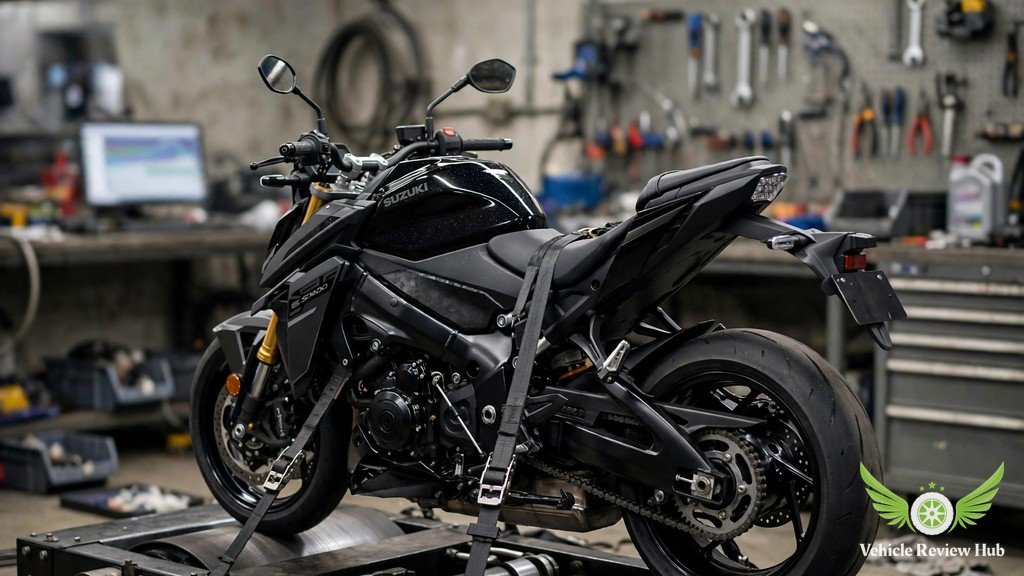
The 2027 Suzuki GSX-S1000 is a litre naked whose performance story is told in rear-wheel numbers, not brochure claims. Suzuki USA publishes no horsepower figure for the bike, but the global claim is 150 hp at 11,000 rpm — and independent dyno runs put 130 to 137 hp at the rear wheel, depending on the bike and the dyno. This Suzuki GSX-S1000 performance guide works through every verified figure: the Rider and Cycle World dyno runs, the famous quarter-mile time that belongs to the faired F rather than the naked bike, tested fuel economy with the gallon labelled every time, and how the bike stacks up against the Yamaha MT-10. The short version: it is fast, thirsty, and honest about both.
Suzuki GSX-S1000 Engine Performance and Power Delivery
The engine is the reason the GSX-S1000 exists. It is a 999cc inline-four derived from the 2005–2008 GSX-R1000 K5, a long-stroke design (73.4 × 59.0 mm, 12.2:1 compression) retuned for street use, with its torque spread wide across the rev range rather than stacked at the top. Suzuki’s global claim is 112 kW — 152 PS, which converts to 150 hp — at 11,000 rpm, with 106 Nm (78 lb-ft) at 9,250 rpm. What matters more than the claim is what the bike actually puts to the rear wheel, and three independent dyno runs agree within a few horsepower of each other.
The video below is Cycle World’s dyno run of the faired 2022 GSX-S1000GT+, not the naked bike. On Cycle World’s in-house Dynojet 250i the retuned GT+ engine made 135.53 hp at 10,360 rpm and 73.15 lb-ft at 9,190 rpm — a useful look at what a GSX-S1000-platform dyno run looks like, but it is the GT+’s retuned engine, not the naked bike’s figure. The naked bike’s own numbers are in the table below.
Rider Dyno: 136 HP From the 2022 Bike
Rider Magazine’s 2022 road test ran the second-generation naked bike on Jett Tuning’s rear-wheel dyno and recorded 136 hp at 10,200 rpm and 73 lb-ft at 9,300 rpm. The shape of the delivery matters as much as the peak: more than 60 lb-ft is available from 4,300 rpm to 11,300 rpm, so the bike pulls hard from the mid-range rather than needing to be wound out. Power climbs in a near-straight line to its peak, which is why the bike feels strong on the road even though its peak number trails the European rivals’ claims. Against the global claimed figure of 150 hp, the roughly 14 hp gap is drivetrain loss — the difference between crankshaft and rear wheel — not a contradiction.
Cycle World’s 2018 Dyno Said 137 HP
Cycle World’s 2018 test of the GSX-S1000Z recorded 137 hp at 10,700 rpm and 74 lb-ft at 9,300 rpm, with 60 lb-ft available from 3,500 rpm to the rev limiter. That is the first-generation bike, before the 2022 ride-by-wire redesign, and it shows how little the engine’s output has changed across the generations: the 2018 bike and the 2022 bike are within 1 hp of each other on the dyno. The most recent independent run comes from Cycle News’s September 2025 comparison, which measured a 2025 naked bike at 130 hp at 10,200 rpm and 70 lb-ft at 9,200 rpm — a little lower, on a different dyno, on a different day. Dyno numbers move with the machine, the conditions and the bike’s state of tune, so the honest reading is a band — 130 to 137 hp at the rear wheel — not a single magic number. For reference, the GT+ figure of 135.53 hp sits inside that same band, which is expected: the GT+ runs a retuned version of the same engine, not a different motor.
| Bike and year | Rear-wheel horsepower | Rear-wheel torque | Dyno / source |
|---|---|---|---|
| 2022 GSX-S1000 (naked) | 136 hp @ 10,200 rpm | 73 lb-ft @ 9,300 rpm | Rider Magazine / Jett Tuning |
| 2018 GSX-S1000Z | 137 hp @ 10,700 rpm | 74 lb-ft @ 9,300 rpm | Cycle World |
| 2025 GSX-S1000 (naked) | 130 hp @ 10,200 rpm | 70 lb-ft @ 9,200 rpm | Cycle News (dyno model not named) |
| 2016 GSX-S1000 (naked) | ~143 hp | Not published | Motorcycle.com shootout |
| 2022 GSX-S1000GT+ (faired) | 135.53 hp @ 10,360 rpm | 73.15 lb-ft @ 9,190 rpm | Cycle World Dynojet 250i — retuned GT+ engine, NOT the naked’s |
Suzuki GSX-S1000 Top Speed and Acceleration
Top speed and acceleration are where the GSX-S1000’s story needs the most care, because the headline numbers belong to a different bike. The faired GSX-S1000F has instrumented test figures. The naked bike does not. Everything below keeps the two separate.

The 10.82-Second Quarter Belongs to the F
The most-quoted quarter-mile figure for this family is 10.82 seconds at 132.8 mph, recorded by Cycle World in its 2016 comparison test — of the faired GSX-S1000F, not the naked bike. MCN’s instrumented test of the F backs it up with 10.77 seconds, along with a 157.55 mph top speed, 0–100 mph in 6.03 seconds and 70–0 mph braking in 53.59 metres. The quarter-mile figure that circulates online for the F appears in no named outlet’s test, and it most likely comes from an aggregator rounding a shorter entry. Suzuki itself once claimed 10.15 seconds for the quarter — a manufacturer claim, not an instrumented test, and it should never be quoted as a test result. The point that matters for a buyer: the naked bike is the same engine in a bike with no fairing and a different riding position, so its own numbers would differ — and nobody has published them.
No Instrumented Test of the Naked Exists
There is no instrumented acceleration, top-speed or braking test of the naked GSX-S1000 anywhere in the named press. MCN’s data table for the naked bike leaves the quarter-mile blank and lists a 145 mph top speed — the only published top-speed figure for the naked bike, and it is a listed figure, not a tested one. Aggregator sites print quarter-mile and 0–60 times for the naked bike, but they cite no test, no outlet and no conditions, so they are unusable. The same goes for braking: no 60–0 mph figure exists for the naked bike at all. What is known is the hardware — Brembo monobloc calipers on dual 310 mm discs, covered in the handling section below — and the weight, 472 lb ready to ride. Until a named outlet straps timing gear to the naked bike, any acceleration figure attached to it is a guess wearing a decimal point.
Suzuki GSX-S1000 Mileage and Fuel Economy
The GSX-S1000 is thirsty for a naked bike, and the spread between the best and worst tested figures is wide — 33.4 to 43.3 mpg US — because riding style moves the number more than anything else. Every figure below carries its gallon, because the US and Imperial gallons differ by 20 percent and mixed-up gallons have produced nonsense comparisons before.

Rider Tested 33.4 MPG on the 2022 Bike
Rider Magazine’s 2022 road test averaged 33.4 mpg US, which gives about 167 miles from the 5.0-gallon tank before reserve. That is the hardest-ridden road-test figure in the set, and it is the honest number for a rider who uses the throttle. The WMTC lab figure is 6.1 L/100 km, which converts to 38.5 mpg US (46.3 mpg Imperial) — a lab number, gentler than real riding. Suzuki’s own “46 mpg” claim is Imperial, which is 38.3 mpg US, so it lines up with the lab figure rather than contradicting it. EPA certification figures sit nearby: 41.9 mpg US for 2018 and 43.2 mpg US for 2017, as recorded by MotorcycleDB from the EPA certificates. Real-world range, then, is roughly 165 to 200 miles on a tank, depending on how the bike is ridden.
2016 Shootout: Best MPG at 41.3
In Motorcycle.com’s 2016 naked sports six-way shootout, the GSX-S1000 won the fuel-economy portion outright, averaging 41.3 mpg US — the best of the six bikes tested, and the highest tested figure the bike has ever recorded. That was a first-generation bike ridden in a mixed test loop, and it shows what the engine can do when it is not being worked hard. The most recent measured figure comes from Cycle News’s September 2025 comparison, which measured 43.3 mpg US for the Suzuki against 38.9 mpg US for the Honda CB1000 Hornet SP — the Suzuki was both quicker on the dyno and easier on fuel in that test. The spread between Rider’s 33.4 and Cycle News’s 43.3 is the whole story: ride it gently and it sips, ride it hard and the 5.0-gallon tank empties fast. The tank itself is the largest in its comparison set, which is what keeps the range usable despite the thirst.
| Figure | Gallon | Source |
|---|---|---|
| 33.4 mpg (2022 road-test average; ~167-mi range) | US | Rider Magazine |
| 41.3 mpg (2016 shootout, best of six) | US | Motorcycle.com |
| 43.3 mpg (2025 measured; Hornet 38.9) | US | Cycle News |
| 38.5 mpg (WMTC 6.1 L/100 km) | US (46.3 Imp) | WMTC lab |
| “46 mpg” claim | Imperial (= 38.3 US) | Suzuki |
| 41.9 mpg (2018) / 43.2 mpg (2017) | US | EPA certification (via MotorcycleDB) |
Suzuki GSX-S1000 Real-World Riding Experience
On the road, the GSX-S1000 is a fast, honest motorcycle with one well-documented flaw. The engine pulls hard from the mid-range, the chassis is stable and the brakes are strong, and the upright bars make it comfortable for a full day. The flaw is the throttle — and whether the 2022 redesign fixed it is still argued about.

Throttle Snatch Defined the First Generation
The first-generation bike was famous for a snatchy, abrupt initial throttle response, documented by Motorcycle.com, MCN and owners alike. The problem was the off-to-on transition: a small twist of the grip delivered a lurch rather than a smooth pick-up, which made low-speed riding and bumpy corners harder than they should have been. Suzuki softened the EFI mapping in 2018, which helped, and owners found their own fixes — a free ECM swap offered by Suzuki New Zealand as a goodwill measure, careful TPS centring, and aftermarket remaps. A FlashTune remap with a Yoshimura slip-on only fixed about 40 percent of the jerkiness, according to Motorcycle.com’s own test, which shows how deep in the fuelling the problem sat. It was never a recall and never a formal service bulletin, just a known character flaw that every reviewer of the first-generation bike mentioned.
2022 Ride-by-Wire Judged Close to Faultless
The 2022 redesign replaced the cable throttle with ride-by-wire, and the question is whether that finished the job. The honest answer is that the testers disagree. MCN’s test of the faired GT said the problem was finally gone. BikeReview’s 2022 test of the naked bike said it was improved a little but not solved, with A mode feeling like a switch — either on or off. RevZilla found A mode too aggressive and B mode the most usable. The three riding modes all deliver full power — C mode does not cap peak output, so full throttle gives 100 percent in any mode — which means the difference between them is delivery, not power. The practical reading is that A mode is too aggressive for most riders, B mode is the sweet spot, and anyone sensitive to throttle response should test-ride before buying. The heading’s “close to faultless” is the generous verdict; the testers’ split is the honest one.
Suzuki GSX-S1000 Handling, Braking and Stability
The chassis is the GSX-S1000’s quiet strength. The 43 mm KYB inverted fork is fully adjustable, the brakes are genuine superbike hardware, and at 472 lb with a 57.5-inch wheelbase the bike is stable at speed and easy to steer at parking speeds. There is no instrumented braking test to quote — no 60–0 figure exists — so this section sticks to the hardware and what the testers said about it.

Brembo Monoblocs on 310mm Discs
The front brakes are Brembo monobloc four-piston radial-mount calipers on dual 310 mm floating discs, with four 32 mm pistons per caliper — the same class of hardware found on superbikes. The rear is a Nissin single-piston caliper on a 240 mm disc on 2022-on bikes; pre-2022 bikes had a 250 mm rear disc, and some articles still print that number for the current bike. The tyres are Dunlop Roadsport 2s, 120/70ZR17 front and 190/50ZR17 rear, run at 36 psi front and 42 psi rear. (The GT runs Roadsmart 2s — a different tyre that MCN’s naked-bike page mislabels onto the naked bike.) The brakes drew praise in the road tests, and the long-term evidence backs them up: Cycle World’s 2016 long-term bike ran 7,850 miles with no mechanical failure, its only brake complaint a low-speed squeal under 20 mph, fixed with aftermarket pads.
Tire, Brake and Suspension Checks That Matter
Before buying — or before a hard ride — the checks that matter are simple. The fork is fully adjustable (preload, compression and rebound), so check the adjusters move freely and the seals are dry; the service chart calls for a fork inspection at 7,500 and 15,000 miles, and there is no fork-oil change interval in the chart. The rear shock is preload and rebound only, with no compression adjustment, and its damping fades with age — one long-term owner replaced it around 35,000 km. Chain slack should be 20–30 mm, with a clean and lube every 600 miles. Brake fluid is DOT 4, replaced every two years, and the brake hoses every four years. Tyre pressures are 36 psi front, 42 psi rear, and the original-equipment Dunlop D214 rear on early bikes was short-lived — one owner wore his out in 3,700 km. None of this is exotic; it is the ordinary care a 150 hp naked bike needs, and the bike rewards it with a reliability record covered in the GSX-S1000 reliability guide.
Suzuki GSX-S1000 Performance Compared With Other Naked Bikes
The GSX-S1000’s performance only makes sense against its rivals. It is the cheapest litre naked in its set and the least electronic — no IMU, no cornering ABS, no cruise control — yet its rear-wheel dyno numbers sit within a few horsepower of bikes costing thousands more. The table below lines up the four rivals on the figures that matter, and the section after it takes the closest performance rival, the Yamaha MT-10, head-on.

| Item | Suzuki GSX-S1000 | Yamaha MT-10 | Honda CB1000 Hornet SP (2026) | Kawasaki Z900 |
|---|---|---|---|---|
| Engine | 999cc inline-four | 998cc crossplane four | 999cc inline-four | 948cc inline-four |
| Claimed power (global) | 150 hp @ 11,000 rpm | 163.6 hp @ 11,500 rpm | 129 hp @ 9,000 rpm (US) | 123 hp @ 9,500 rpm (US) |
| Rear-wheel dyno | 136 hp (Rider / Jett) | None named (base bike) | 116 hp (Cycle News / Rottweiler) | None named |
| Curb weight | 472 lb | 467 lb (wet) | 465 lb | 467.5 lb |
| Seat height | 31.9 in | 32.9 in | 31.9 in | 31.9 in (US) |
| Delivered price (US) | $11,548 | $15,774 | $11,774 | $11,039 |
| IMU / cornering ABS | No | Yes | No | Yes (from 2025) |
| Cruise control | No | Yes | No | Yes |
Suzuki GSX-S1000 vs Yamaha MT-10
The MT-10 is the performance rival that shows what money buys. Its 998cc crossplane-crank four claims 163.6 hp at 11,500 rpm and 82.6 lb-ft at 9,000 rpm — about 14 hp more than the Suzuki’s global claim — and it carries a 6-axis IMU with lean-sensitive traction control, slide control, lift control, engine-brake management and lean-sensitive ABS, plus cruise control and an up/down quickshifter, all standard on the base bike. The Suzuki has none of that: no IMU, no cornering ABS, no cruise. What the Suzuki does have is a $4,226 price advantage — $11,548 delivered against the MT-10’s $15,774 — and the biggest fuel tank in its comparison set at 5.0 gallons. On the dyno the gap narrows further: no named dyno exists for the base MT-10, and the closest figures are previous-generation — the 2017 FZ-10 put down 137.7 hp on Jett Tuning’s dyno, and Cycle World’s MT-10 SP made 134.4 hp. Against the Suzuki’s 136 hp on the same Jett Tuning dyno, the two bikes are effectively equal at the rear wheel. The MT-10 wins on electronics and top-end character; the Suzuki wins on price and on the honesty of a bike that does less, for less. Riders who want the electronics should buy the Yamaha; riders who want the engine should keep the $4,226.
Is the Suzuki GSX-S1000 Suitable for Beginner Riders? No
No. With a global claim of 150 hp, 472 lb of weight and no IMU safety net, the GSX-S1000 is too much bike for a first rider. The throttle is the specific problem for a beginner: even in B mode, the engine’s mid-range surge and the snatchy low-speed pick-up punish clumsy inputs, and there is no lean-sensitive electronics package to catch a mistake in a corner. It suits an experienced rider stepping up to a litre naked, or a returning rider who already knows how a big four behaves — not someone learning to ride. The GSX-8S performance guide covers Suzuki’s lighter middleweight naked for riders who want the same formula in a smaller, more forgiving package.
Suzuki GSX-S1000 Performance: Frequently Asked Questions
Direct answers to the questions riders ask about this Suzuki GSX-S1000 performance guide.
How much horsepower does the GSX-S1000 make?
Suzuki USA publishes no horsepower figure. The global claim is 150 hp at 11,000 rpm and 78 lb-ft at 9,250 rpm. At the rear wheel, Rider Magazine’s dyno run of the 2022 bike made 136 hp, Cycle World’s 2018 test made 137 hp, and Cycle News’s 2025 test made 130 hp.
What is the top speed of the GSX-S1000?
No instrumented top-speed test of the naked bike exists; MCN lists 145 mph for it. The often-quoted 157.55 mph figure belongs to the faired GSX-S1000F, not the naked bike.
What is the GSX-S1000’s quarter-mile time?
There is no instrumented quarter-mile test of the naked bike. The 10.82-second run at 132.8 mph recorded by Cycle World in 2016 belongs to the faired GSX-S1000F, with MCN’s 10.77 seconds as corroboration. Suzuki’s 10.15-second figure is a manufacturer claim, not a test.
What MPG does the GSX-S1000 get?
It depends on how it is ridden. Rider Magazine averaged 33.4 mpg US on the 2022 bike, Motorcycle.com’s 2016 shootout recorded 41.3 mpg US (the best of six bikes), and Cycle News measured 43.3 mpg US in 2025. The WMTC lab figure is 38.5 mpg US, and Suzuki’s “46 mpg” claim is Imperial, which is 38.3 mpg US.
How big is the fuel tank and what is the range?
The tank holds 5.0 US gallons (19.0 litres), the largest in its comparison set. At Rider’s 33.4 mpg US that gives about 167 miles; ridden gently, the range stretches toward 200 miles.
Does the GSX-S1000 have a quickshifter?
Yes. A bi-directional quickshifter is standard from 2022, on the second-generation bike. The first-generation bike had no quickshifter.
Does the GSX-S1000 have cruise control?
No. The naked bike has no cruise control, no IMU and no cornering ABS. The faired GT+ has Smart Cruise; the naked does not.
Does the GSX-S1000 have an IMU?
No. The naked GSX-S1000 has never had an IMU in either generation. Its traction control works from wheel speed only, and its ABS is conventional, not cornering ABS. The Yamaha MT-10 and the 2025-on Kawasaki Z900 both have one.
Is the throttle snatch fixed on the 2022 bike?
Improved, not settled. The 2018 EFI mapping and the 2022 ride-by-wire both helped, but the testers disagree: BikeReview said it was improved a little but not solved, RevZilla found B mode the most usable, and MCN’s GT test said the problem was gone. Test-ride in A and B modes before deciding.
What tyres does the GSX-S1000 use?
Dunlop Roadsport 2 tyres — 120/70ZR17 front and 190/50ZR17 rear — run at 36 psi front and 42 psi rear.
How much does the 2027 GSX-S1000 cost?
The 2027 GSX-S1000 is $10,798 before destination, or $11,548 delivered with the $750 destination charge (dealer-sourced; Suzuki USA lists MSRP before destination). That is $1,191 less than the 2026 MSRP of $11,989. Full pricing detail is in the GSX-S1000 review.
Is the GSX-S1000 faster than the Yamaha MT-10?
At the rear wheel they are effectively equal: the Suzuki made 136 hp on Jett Tuning’s dyno, and no named dyno exists for the base MT-10 (the closest figures are previous-generation — the 2017 FZ-10 made 137.7 hp on the same dyno). The MT-10 claims about 14 hp more and carries a full electronics suite; the Suzuki costs $4,226 less delivered.