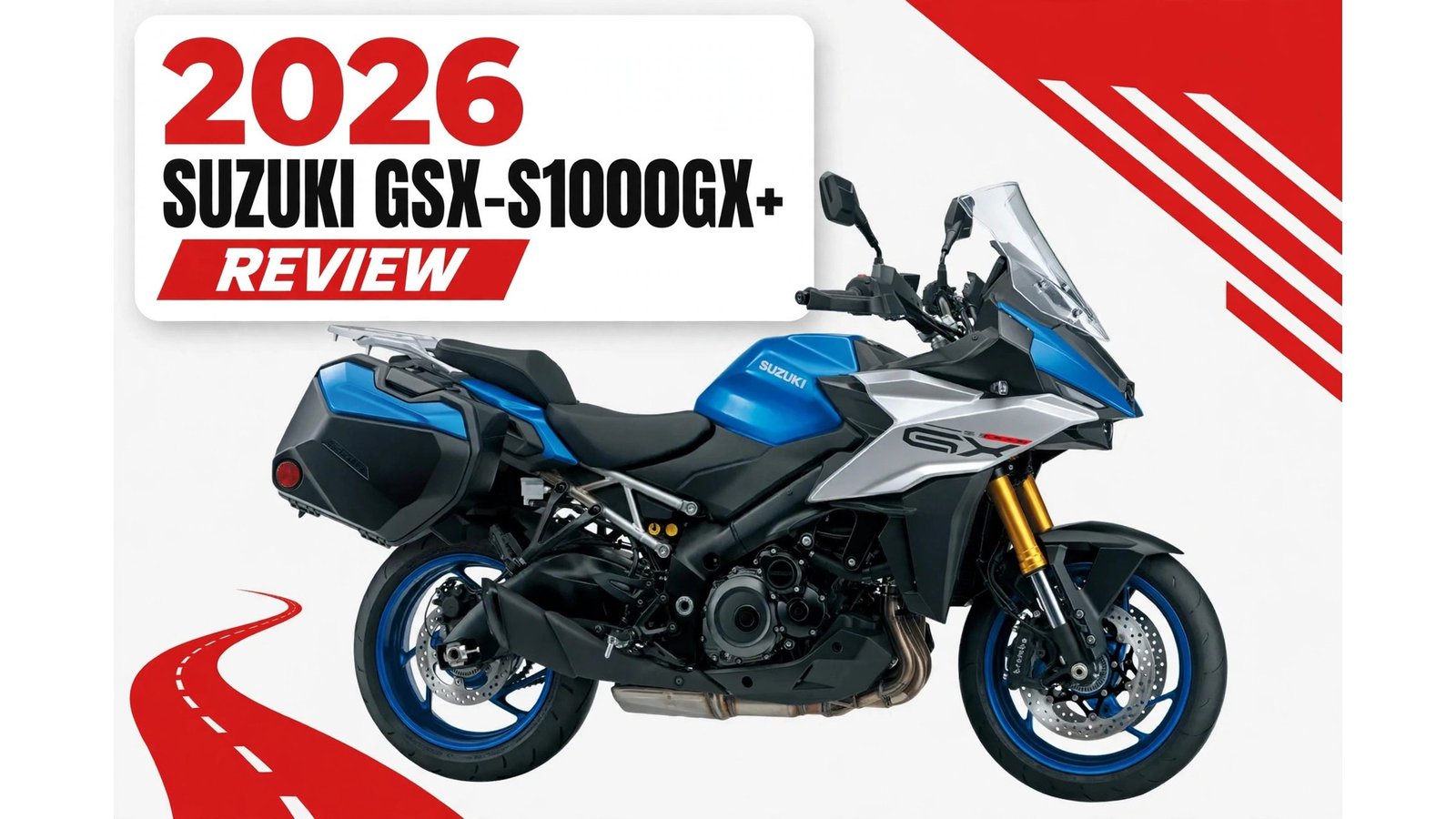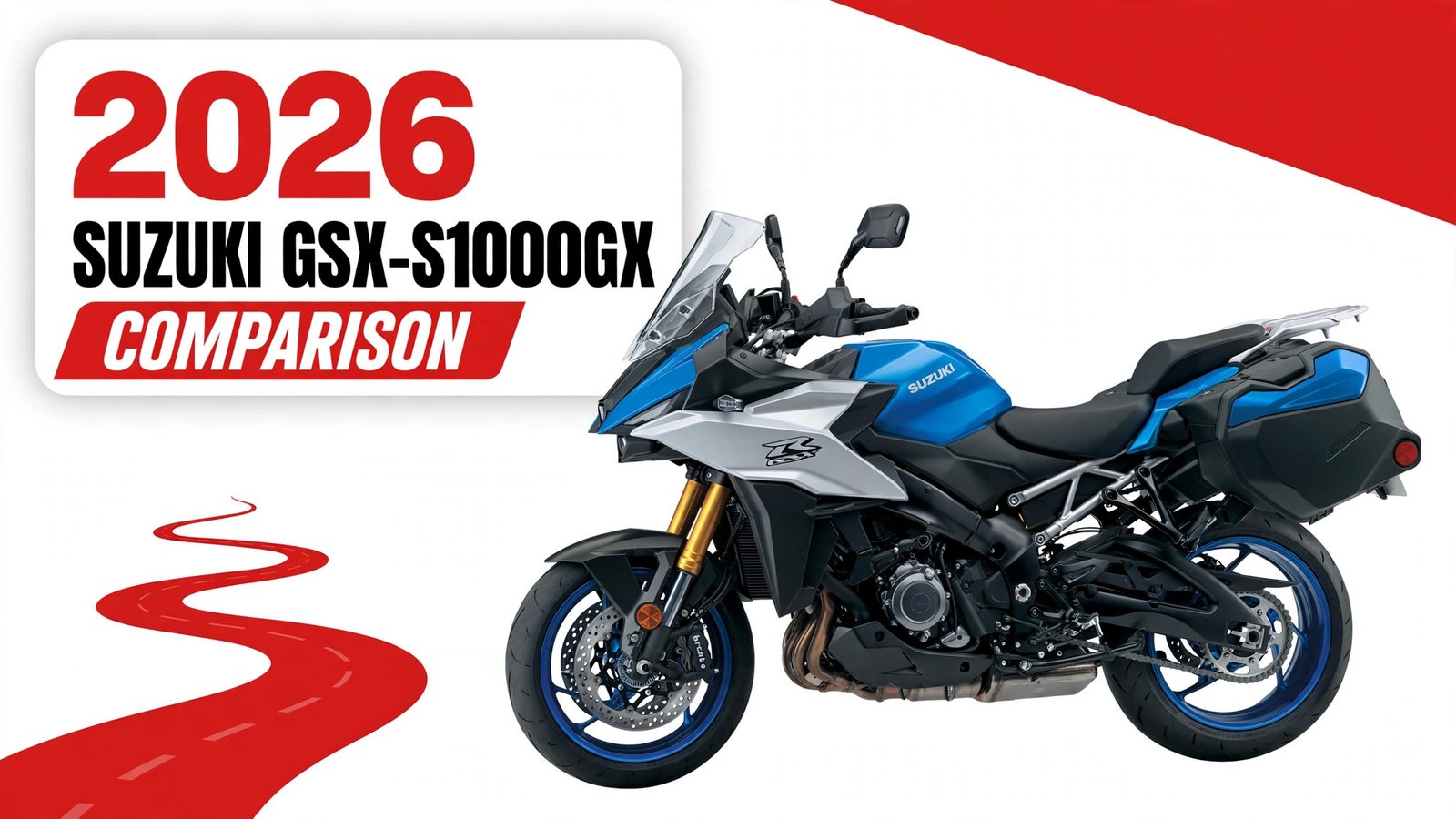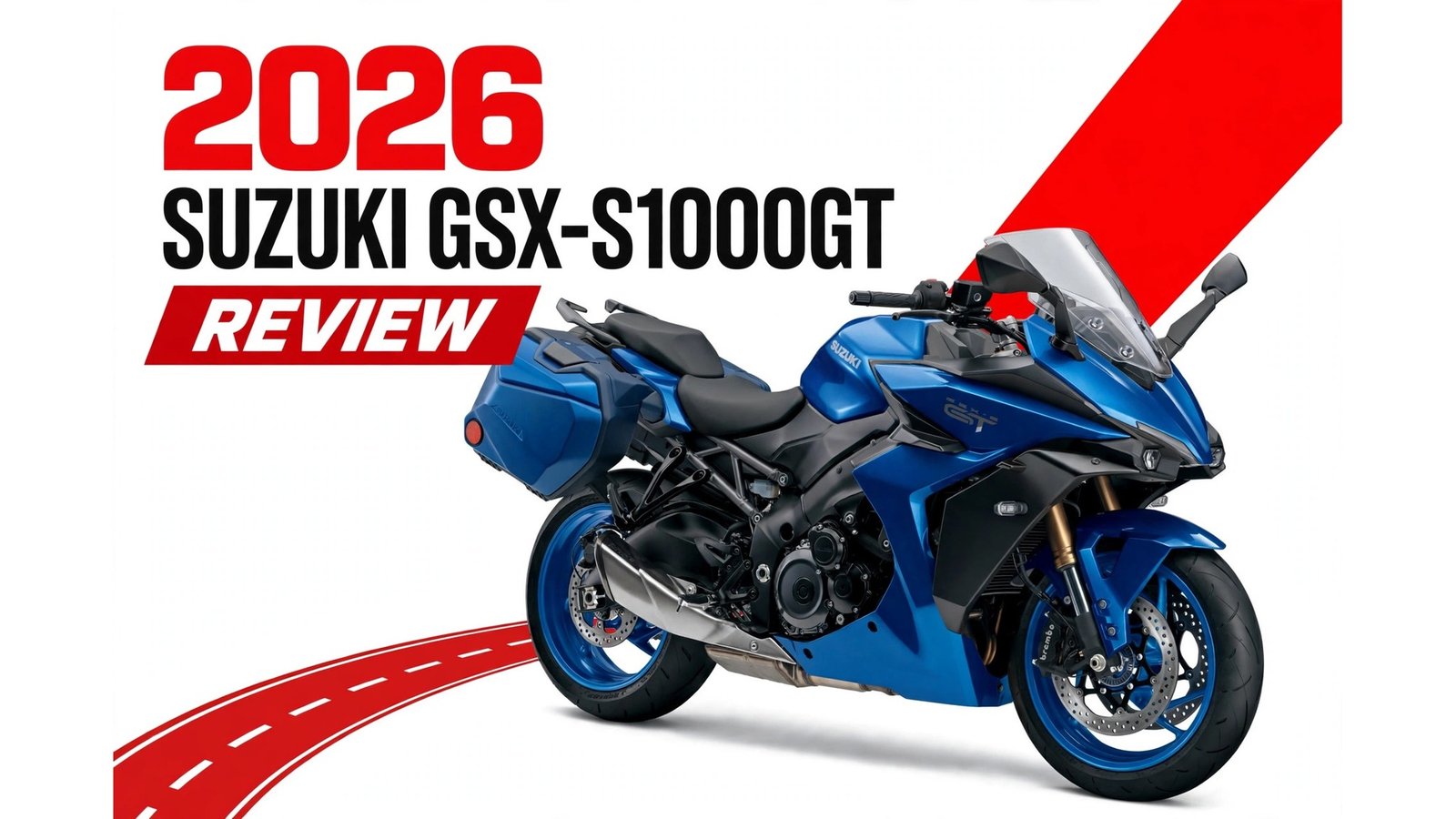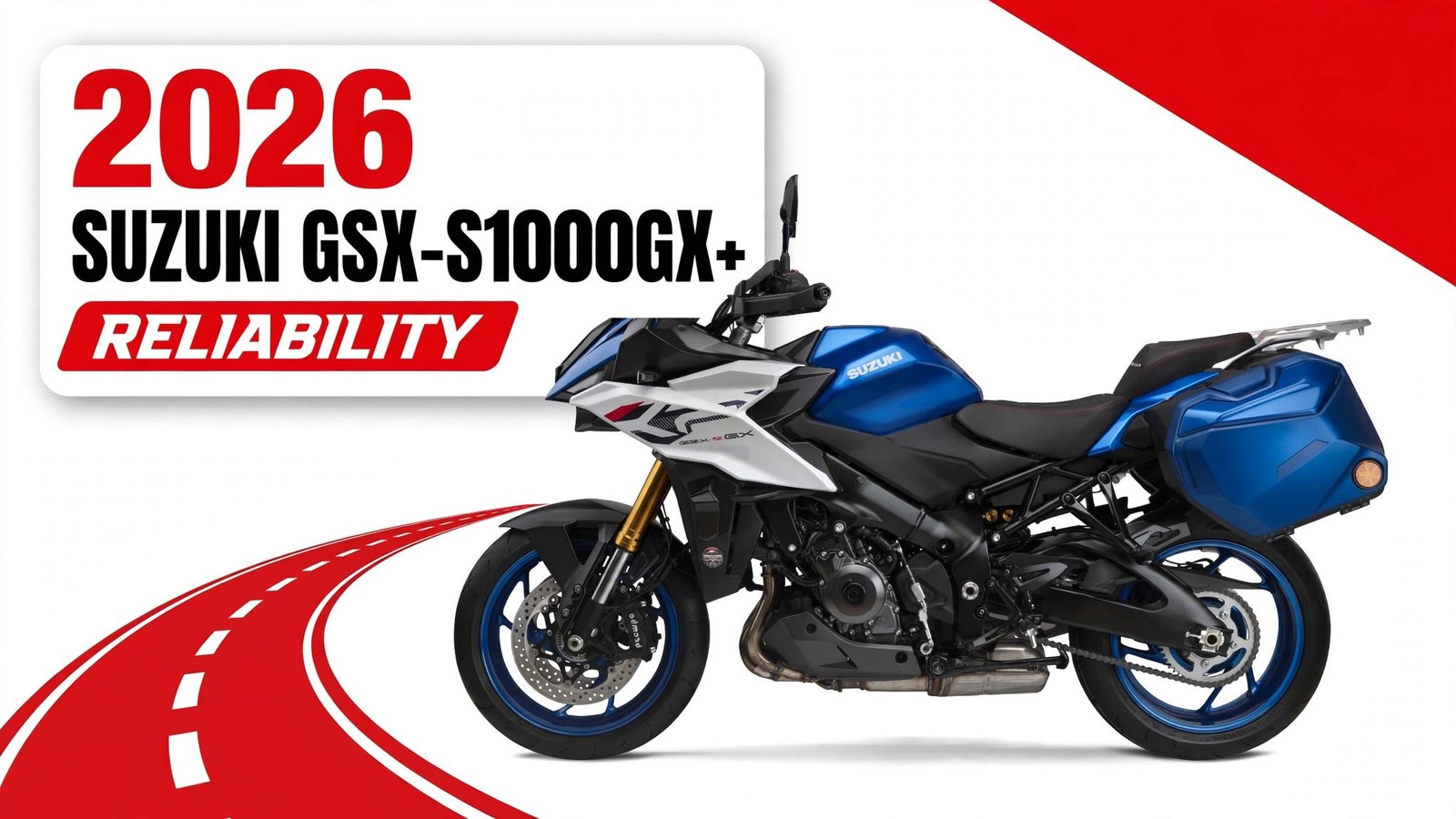
The short answer on Suzuki GSX-S1000GX+ reliability is that the bike has no recurring mechanical or electrical failure pattern after two years: four MCN owners rate reliability and build quality 4.8 out of 5, the only recurring complaints are thin paint and corroding fasteners, and no NHTSA recall names the GX or GX+ at all — the headline Suzuki GSX-S1000GX+ reliability fact. What it does ask for is a strict service routine — oil every 3,750 miles, a valve check at 15,000 miles — and a used-buyer check of the SAES suspension and traction control, both dealer-level electronics with no home repair.
Suzuki GSX-S1000GX+ Reliability Overview
The GX+ is a young bike with a short track record, so Suzuki GSX-S1000GX+ reliability has to be judged on what exists so far: a small owner sample, two long-term tests, and no recall or failure pattern. The picture is consistent — the engine and chassis hold up, and the complaints are cosmetic, not breakdowns.
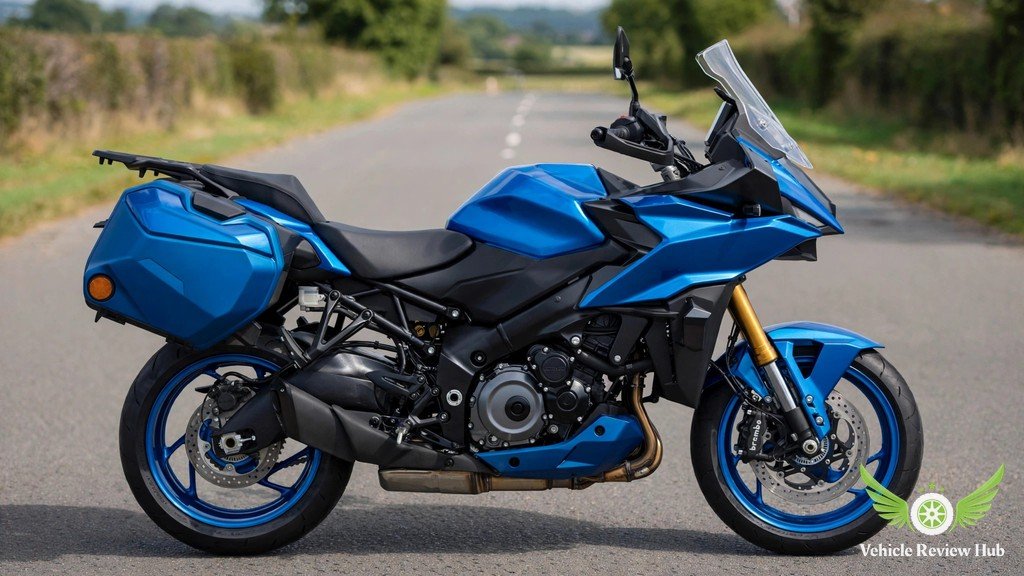
Four MCN Owners Rate Reliability 4.8 of 5
Four owners have reviewed the GX on MCN’s owners’ page: reliability and build quality 4.8 out of 5, engine 5 out of 5, ride quality and brakes 4.8 out of 5, and 4.5 out of 5 overall. The sample is four owners, and this Suzuki GSX-S1000GX+ reliability guide says so every time the 4.8 figure appears — a start, not a survey. The words match the numbers on Suzuki GSX-S1000GX+ reliability: MCN reports “no reports of mechanical or electrical problems” from its owners, “except thin paintwork in places and fasteners corroding during winter riding.” One 2024 GX+ owner called reliability “first class” after a faultless 1,900-mile French tour — while also complaining about the screen fixings. The MCN GX deep-dive test is the source for the owner ratings and the long-term test behind them. MCN’s own long-term GX ran to 9,000 miles, and the 1000PS long-term test covered 9,200 km with a 4.5-out-of-5 verdict.
How Mileage, Storage and Previous Care Affect Reliability
There is no GX-specific study on mileage versus reliability: service history, dry storage and regular use beat a low-mileage bike that sat neglected. The thin-paint and fastener-corrosion reports prove the point — winter riding without cleaning corrodes fasteners, and that is a storage and care issue, not an engine fault. One winter tester rode about 2,000 miles through salt and grime with ACF-50 protection and found the bike “merely dirty — rather than corroded or dulled” — one tester’s winter, not proof the bike is corrosion-proof. On a used GX+, service records matter more than the odometer: the 3,750-mile oil rule and the 15,000-mile valve check show whether the previous owner maintained the bike — the first Suzuki GSX-S1000GX+ reliability check any buyer should make. The GX reliability guide covers the same engine and schedule under the bike’s shorter name.
The video below is BikeRiderTV’s full GX review, as embedded in Bike Rider Magazine New Zealand’s road test — an English, full-length review of the same bike US riders get as the GX+.
Suzuki GSX-S1000GX+ Common Problems and Wear Items
The common-problems list for the GX+ is short, and that is the point: after two years, the only recurring pattern anyone has reported is cosmetic. The rest is wear items and used-bike checks — the things that cost money on any litre bike, not faults unique to this one.
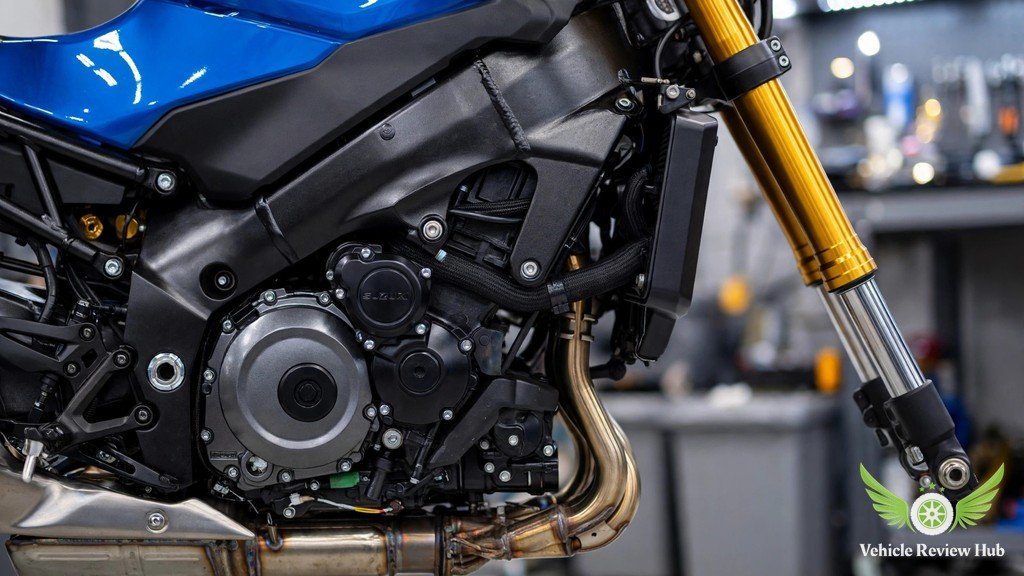
No NHTSA Campaign Names the GX+ at All
No NHTSA recall names the GX or GX+ — the cleanest single fact in Suzuki GSX-S1000GX+ reliability. That is the finding in published notices — not an API-verified zero, since the NHTSA API itself has proven unreliable. The recall buyers most often confuse with this bike is 25V505, and it does not cover the GX+: it covers 2020–2025 V-Strom 1050 models (1,393 bikes) and 2020 and 2024 Katana models (150 bikes), 1,543 in total, for a headlight beam too bright under FMVSS 108, with a free headlamp replacement. The Katana shares the GSX-S1000 platform, but the GX+ is not named in the campaign. A used-GX+ buyer should still run the VIN through NHTSA’s recall lookup before paying — it costs nothing and it is the standard step. The NHTSA Part 573 report for recall 25V505 lists the affected models, and the GX+ is not among them.
Chain, Sprockets, Tires, Fork Seals, Brakes and Electrical Checks
Thin paint on the bodywork and fasteners corroding during winter riding is the only recurring problem pattern reported for the GX+ — MCN’s expert verdict and its owners agree, and nothing else repeats. The stock seat creates hotspots after a few hours, which motorcycle.com reported, but that is a comfort item, not a Suzuki GSX-S1000GX+ reliability fault. The front brake has little initial bite and a vague feel at the lever, with rubber lines — the same complaint as the GT — and sintered pads plus braided hoses are the owner fix. Flies on the Visor alone reports Suzuki improved the 2025 bike’s brake feel with an ABS and IMU software tweak — a single-source report, not a Suzuki announcement. The stock Dunlop Roadsport 2 tyres have average grip, and owners commonly switch to RoadSmart 3, Road 6 or Roadtec 01 rubber — a GT family trait, not a GX-specific failure; the 1000PS test needed new tyres after 9,200 km. Engine buzz at 70 mph and above shows in the mirrors, and the mySPIN app does not work, according to one owner’s two-month verdict on a 2026 GX+ — both comfort and convenience items, not failures. On a used bike, check the chain and sprockets, tyre life, fork seals, brake pads, lines and fluid, the battery, and electrical connectors for winter corrosion. These are standard checks on any used litre bike, and this Suzuki GSX-S1000GX+ reliability guide lists them as such rather than as GX-specific failures.
Suzuki GSX-S1000GX+ Maintenance Schedule and Servicing
The GX+ service schedule comes from the US owner’s manual, and it is stricter than the older GSX-S1000 family’s: oil every 3,750 miles, not 3,500, and valves at 15,000 miles, not 14,500. Do not transfer the 2016–2021 GSX-S1000 and F intervals to this bike.
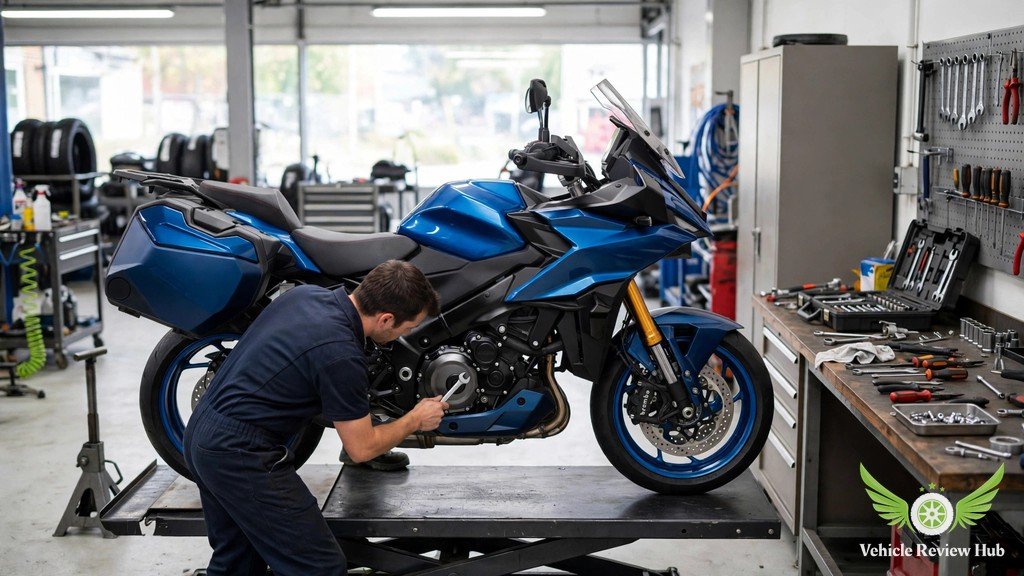
| Service item | Interval (US owner’s manual) |
|---|---|
| First service | 600 mi / 1,000 km or 2 months (oil + filter + chassis inspection) |
| Engine oil (SAE 10W-40) | Replace every 3,750 mi / 6,000 km or 12 months |
| Oil filter (Hiflofiltro HF138RC) | Replace at 600 and 7,500 mi |
| Spark plugs (NGK CR9EIA-9, 4) | Inspect at 3,750 and 11,250 mi; replace at 7,500 and 15,000 mi |
| Valve clearance | Inspect at 15,000 mi / 24,000 km |
| Chain | Clean + lubricate every 600 mi; slack 20–30 mm (0.8–1.2 in) |
| Coolant (super long-life) | Replace every 4 years / 30,000 mi; otherwise every 2 years / 15,000 mi |
| Brake fluid (DOT 4) / hoses | Fluid every 2 years; hoses every 4 years |
Oil Every 3,750 Miles, First Service at 600
The first service lands at 600 miles or two months and covers the oil and filter plus a chassis inspection. After that, engine oil is a 3,750-mile or 12-month job, using SAE 10W-40 meeting JASO MA or API SF/SG/SH/SJ, and the oil filter is replaced at 600 and 7,500 miles. The 3,750-mile figure is the US manual’s number — UK sources for the GT family quote 7,500 miles, a different market’s schedule, and this Suzuki GSX-S1000GX+ reliability guide uses the US figure throughout. The GX maintenance schedule transcribed from the owner’s manual lists every interval in one place.
Valve Clearance Inspection at 15,000 Miles
Valve clearance is inspected at 15,000 miles, or 24,000 km — a dealer-level job on a shim-under-bucket inline-four, and the biggest single service bill a GX+ owner faces, the one Suzuki GSX-S1000GX+ reliability buyers should budget for first. The spark plugs share that visit: NGK CR9EIA-9 iridium, four of them, inspected at 3,750 and 11,250 miles and replaced at 7,500 and 15,000 miles. Do not confuse this with the older GSX-S1000 family’s 14,500-mile valve interval — that belongs to the 2016–2021 bikes. A used GX+ near 15,000 miles without a valve-check record has a bill coming — price that in before paying. The GT reliability guide runs the same 3,750-mile oil and 15,000-mile valve pattern, since the two bikes share the engine and its schedule.
Suzuki GSX-S1000GX+ Tires, Brakes and Suspension Maintenance
Tyres, brakes and suspension are where the GX+ asks for regular attention: the tyres and brakes are owner-serviceable, the SAES suspension is not. Confusing the two is how used buyers get surprised.

Cycle Every SAES Mode When Inspecting a Used Bike
SAES — Suzuki Advanced Electronic Suspension, built by Showa — has no service interval in the owner’s manual: the schedule lists the forks and rear suspension as “inspect for smooth operation, leaks” at 7,500 and 15,000 miles only, with no SAES fluid change, seal service or electronic service interval. That is exactly what this Suzuki GSX-S1000GX+ reliability guide prints — inspection only, never an invented SAES service. What a buyer can do — and what Suzuki GSX-S1000GX+ reliability checks demand — is test it: cycle every SAES mode — Soft, Medium and Hard, plus User — when inspecting a used GX+. A mode that will not change, a warning light or a sagging rear end means a dealer-level diagnosis — no owner-serviceable SAES parts exist. The same goes for traction control: check that it actually cycles through its levels, since a TC fault is a dealer-level electronic diagnosis too. The tyres are 120/70ZR17 front at 36 psi cold and 190/50ZR17 rear at 42 psi cold, Dunlop Roadsport 2 as standard. The brakes are Brembo radial four-piston calipers on dual 310 mm front discs, with a Nissin single-piston caliper at the rear — check pads, lines and fluid at every service, and replace the fluid every two years.
No US Pricing Exists for SAES Repairs
No verified US price exists for a SAES repair, and this guide does not invent one. What is sourced is the shape of the bill: the SAES units are sealed electronic Showa components with no owner-service interval, so a failure means dealer diagnosis and replacement — a big-ticket, dealer-level item. Against that, no SAES failure pattern has been reported by MCN’s four owners or either long-term test. On SAES, Suzuki GSX-S1000GX+ reliability is therefore two-sided: nothing has failed yet in the reported record, and if something does fail, the owner cannot fix it at home and no public price exists. That is also why the used-bike SAES mode check matters — it is the only cheap test a buyer gets before the bike becomes theirs.
Suzuki GSX-S1000GX+ Maintenance and Ownership Costs
Ownership costs for the GX+ are modest for a litre bike on fuel and routine servicing, and the unknowns sit in two places: US dealer service prices, which no source has published, and insurance, where no GX+ dataset exists at all.

| Cost item | What is verified |
|---|---|
| Fuel | 48 mpg imperial (≈40 mpg US, MCN tested); fuel light ~150 mi |
| Annual servicing (UK) | £240 (MCN owners page summary, UK figure) |
| One owner’s 7k service | £340 (one owner’s bill, not the page figure) |
| Tyres | New tyres needed after 9,200 km (1000PS long-term test) |
| Premium seat | $400 (motorcycle.com) |
| US dealer service price | Not verified — get a quote; do not budget from UK figures |
| SAES repair price | Not verified — dealer-level replacement, no public price |
| Insurance | No GX+ dataset found — compare like-for-like quotes |
Fuel, Routine Servicing, Tires and Replacement Parts
MCN measured 48 mpg imperial on test — about 40 mpg in US gallons — with the fuel light at around 150 miles. As an illustration only, 8,000 miles a year at about 40 mpg US uses 200 gallons, about $700 a year at $3.50 a gallon. Routine servicing in the UK runs £240 a year on the MCN owners page summary — a UK figure; one owner reported a £340 bill at the 7,000-mile service. No verified US dealer service price was found, so this Suzuki GSX-S1000GX+ reliability guide does not invent one — US dealer prices vary, so get a quote rather than budgeting from the UK numbers. Tyres are a real cost: the 1000PS long-term test needed new tyres after 9,200 km, and owners commonly move off the standard Dunlop Roadsport 2 to RoadSmart 3, Road 6 or Roadtec 01 rubber. On parts, the GX+ buyer gets the side cases as standard — retrofitting a case set to a base GT costs over $1,000 — and the premium seat is a $400 option. The GX+ performance guide covers the fuel-economy test behind the 48 mpg figure.
The $960 Insurance Figure Belongs to the GT+
The $960-a-year insurance figure that appears in GX+ articles belongs to the GT+, not the GX+. It comes from a Boundless Rider illustration for the GT+ from August 2025, and it does not transfer to the GX+ — a different bike, a different price, a different risk. No GX+ insurance dataset was found, so this Suzuki GSX-S1000GX+ reliability guide prints no insurance figure for the GX+ at all. The 2024 GX+ cost $18,499 plus a $460 destination charge ($18,959 in total), and the 2027 bike is $18,949 plus $750 ($19,699) — a more expensive bike than the GT+, which is why a GT+ insurance quote cannot stand in for a GX+ one. Get like-for-like quotes for the GX+ itself on the same coverage, rider and area — any article that prints a GX+ insurance number without naming its dataset is guessing.
How to Keep a Suzuki GSX-S1000GX+ Reliable
Keeping a GX+ reliable is mostly about doing the scheduled work on time and checking the electronics before they become a bill: the manual’s intervals, clean fasteners in winter, and records that prove the work happened.

Preventive Maintenance, Records and Regular Inspections
Follow the 3,750-mile oil rule without stretching it — the cheapest Suzuki GSX-S1000GX+ reliability habit there is — and keep the chain cleaned and lubricated every 600 miles with the slack at 20–30 mm. Protect fasteners and electrical connectors in winter — ACF-50 or an equivalent, applied before the salt season; the winter tester who used it found his bike merely dirty rather than corroded after about 2,000 miles of salt and grime. Check the rear shock and tyres early, and inspect the forks and suspension at the 7,500 and 15,000-mile services. Keep every service record — it matters for resale and is the first proof a used buyer looks for. Before buying used, run the VIN through NHTSA’s recall lookup — the 25V505 headlight recall does not cover the GX+, but the check is the routine step. The GX+ review covers the prices and specification year by year for buyers weighing a new bike against a used one.
Brochure Says Five TC Modes, Then Seven: Both Printed
Suzuki’s own dealer brochure prints both figures: in one place “the five-mode Suzuki Traction Control System (STCS)”, and in another “compared to the five-mode system on the GSX-S1000GT, this seven-mode version of STCS features a wider selection” — the brochure’s own copy error, printed twice. The correct figure is seven levels plus off: Suzuki’s global, Cyprus and Australia pages say the rider “can choose one of seven selectable level settings… or even opt to turn the system off”, the SDMS-α table lists Smart TLR Control level 7 plus off, and Visordown, Ultimate Motorcycling and Flies on the Visor agree. Rider Magazine is wrong on this point — it repeats the five-mode error in its 2024 first-look and 2026 preview — so this Suzuki GSX-S1000GX+ reliability guide prints seven plus off, notes that the brochure prints both, and does not cite Rider for the traction-control figure. On a used GX+, check that the traction control actually cycles through its levels — a TC fault is a dealer-level electronic diagnosis, the same as SAES. Suzuki GSX-S1000GX+ reliability on the electronics side is therefore a buyer check, not a service item — cycle the modes, watch for a warning light, and walk away from a bike whose electronics will not cycle.
Suzuki GSX-S1000GX+ Reliability: Frequently Asked Questions
Direct answers to the questions riders ask about Suzuki GSX-S1000GX+ reliability.
Is the Suzuki GSX-S1000GX+ reliable?
Yes, on the record so far for Suzuki GSX-S1000GX+ reliability. Four MCN owners rate reliability and build quality 4.8 out of 5, MCN reports no mechanical or electrical problems from its owners, and no NHTSA recall names the GX+. The only recurring complaint is thin paint and fasteners corroding in winter.
What do MCN owners rate the GSX-S1000GX+?
Four owners rate reliability and build quality 4.8 out of 5, the engine 5 out of 5, ride quality and brakes 4.8 out of 5, and the bike 4.5 out of 5 overall — a small sample, as this Suzuki GSX-S1000GX+ reliability guide says every time the figures appear.
Does the GSX-S1000GX+ have any recalls?
No recall found in published notices names the GX or GX+ — the first fact in any Suzuki GSX-S1000GX+ reliability check, and not an API-verified zero, since the NHTSA API has proven unreliable. Run the VIN through NHTSA’s recall lookup before buying used, as a routine check.
Does recall 25V505 affect the GSX-S1000GX+?
No. Recall 25V505 covers 2020–2025 V-Strom 1050 models (1,393 bikes) and 2020 and 2024 Katana models (150 bikes) for a headlight beam that is too bright. The GX+ is not named in the campaign, and the Katana sharing the GSX-S1000 platform does not change that.
How often should I change the oil on a GSX-S1000GX+?
Every 3,750 miles or 12 months, whichever comes first, with SAE 10W-40 oil — the US owner’s manual figure, first service at 600 miles or two months. That 3,750-mile rule is the single most important Suzuki GSX-S1000GX+ reliability habit. Do not use the older GSX-S1000 family’s 3,500-mile interval or the UK GT family’s 7,500-mile figure.
When does the GSX-S1000GX+ need a valve check?
Valve clearance is inspected at 15,000 miles, a dealer-level job and the biggest scheduled Suzuki GSX-S1000GX+ reliability bill, and the spark plugs are replaced at the same visit — NGK CR9EIA-9 iridium, four of them, replaced at 7,500 and 15,000 miles. A used bike near 15,000 miles without a valve-check record has a bill coming.
When should the spark plugs be replaced?
At 7,500 and 15,000 miles — the NGK CR9EIA-9 iridium plugs are inspected at 3,750 and 11,250 miles and replaced at 7,500 and 15,000 miles, replacement, not inspection only.
What are the most common problems on the GSX-S1000GX+?
Thin paint on the bodywork and fasteners corroding during winter riding — the only recurring problem pattern in Suzuki GSX-S1000GX+ reliability reports. Everything else is a wear or comfort item: the stock seat’s hotspots, the front brake’s vague feel and rubber lines, average-grip stock tyres, and mirror-blurring engine buzz at speed.
Does the GSX-S1000GX+ have a SAES service interval?
No — and that is a key Suzuki GSX-S1000GX+ reliability fact: the owner’s manual lists the forks and rear suspension as “inspect for smooth operation, leaks” at 7,500 and 15,000 miles only, with no SAES fluid change, seal service or electronic service interval.
What happens if the SAES suspension fails?
It means dealer diagnosis and replacement, not a home repair — the expensive side of Suzuki GSX-S1000GX+ reliability, since the SAES units are sealed electronic Showa components with no owner-serviceable parts. No SAES failure pattern has been reported by MCN owners or either long-term test, and no verified US repair price exists — budget against a dealer quote.
How much is insurance for a GSX-S1000GX+?
No GX+ insurance dataset was found, so this Suzuki GSX-S1000GX+ reliability guide prints no figure. The $960-a-year number in some articles belongs to the GT+ and does not transfer to the GX+. Get like-for-like quotes for the GX+ itself.
What should I check before buying a used GSX-S1000GX+?
Service records first — the 3,750-mile oil rule and the 15,000-mile valve check are the two Suzuki GSX-S1000GX+ reliability numbers that tell you whether the bike was maintained. Then cycle every SAES mode and traction-control level, check the chain, tyres, fork seals, brake pads and fluid, and look for winter corrosion on fasteners and connectors. Finally, run the VIN through NHTSA’s recall lookup — the 25V505 headlight recall does not cover the GX+, but the check is the routine step.