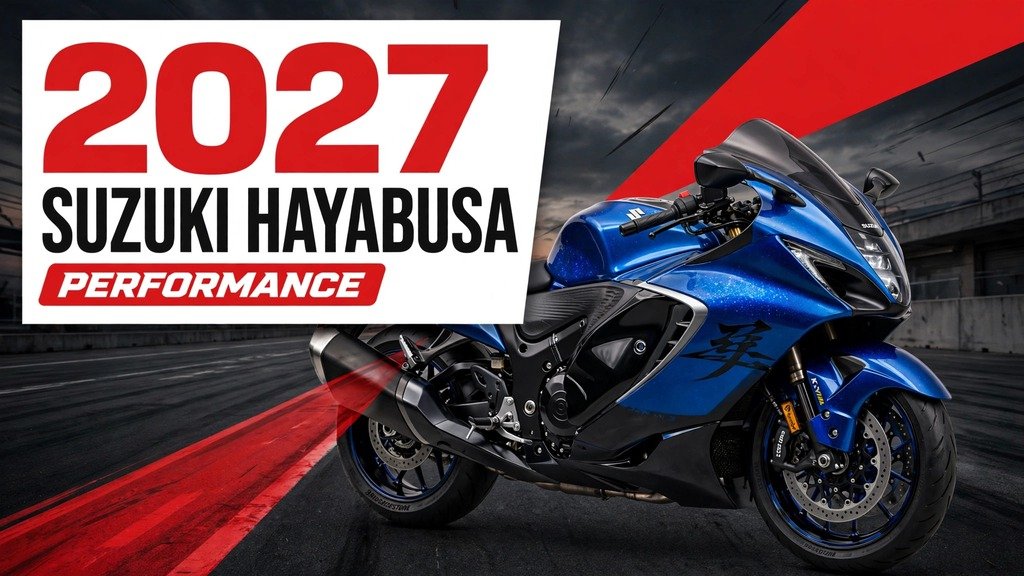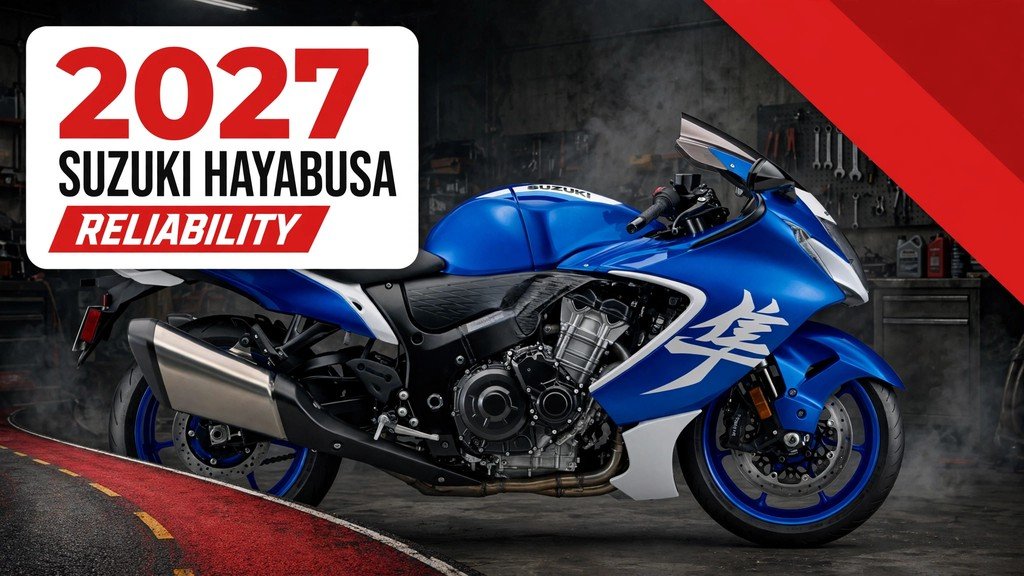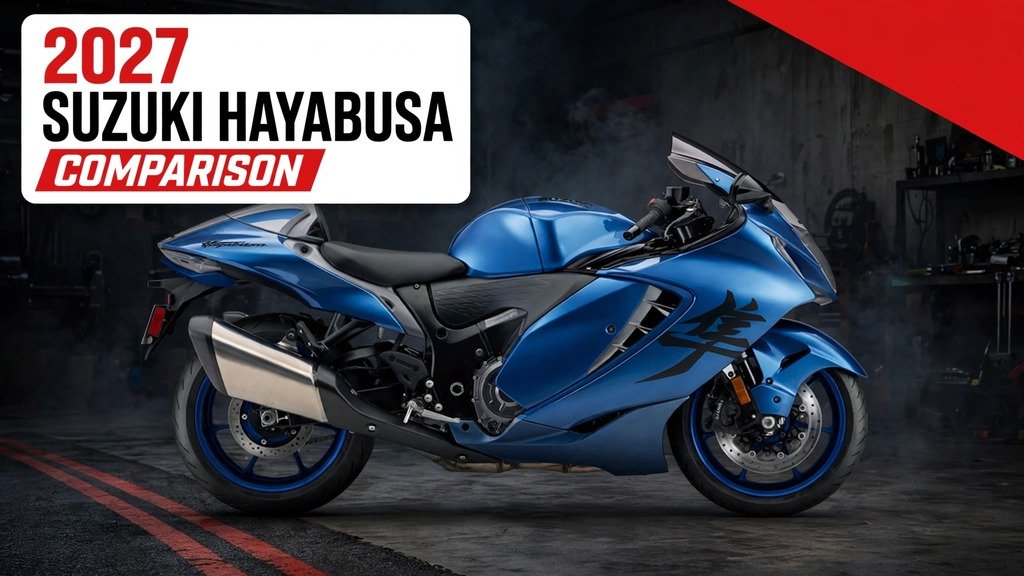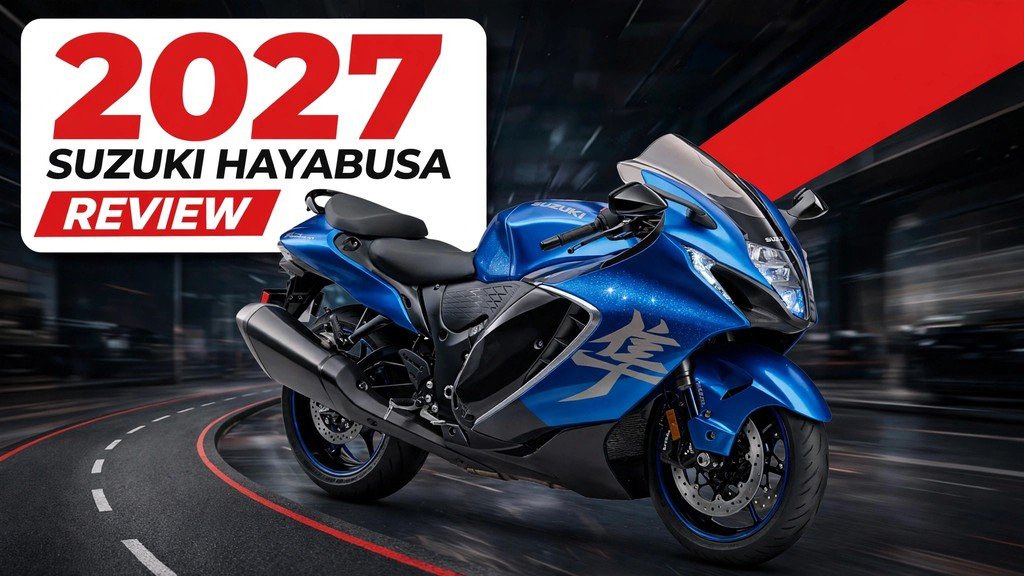
The 2027 Suzuki Hayabusa costs $19,699 plus a $750 destination charge, $20,449 delivered, and, as this Suzuki Hayabusa review shows, it is still the fastest thing Suzuki sells — a 1,340cc hyperbike with 190 PS, a full electronics suite and a 186 mph limiter. Nothing else in Suzuki’s American showroom does what it does, and the 2027 changes are colours only. This Suzuki Hayabusa review covers the price, the specs, the riding experience and the verdict, all with US figures.
Suzuki Hayabusa Overview and Model-Year Updates
Suzuki Hayabusa review starts with a simple fact: this is the third generation of a bike that has been the king of speed since 1999, and the 2027 model is mechanically identical to the 2026 bike — only the paint changed.

Latest Year 2027, Special Edition on Top
The 2027 Hayabusa comes in two versions, and this Suzuki Hayabusa review covers both. The standard bike costs $19,699, in Glass Sparkle Black or Metallic Reflective Blue. The Special Edition costs $20,399, a $700 premium, in Pearl Brilliant White and Metallic Oort Gray with red accents and gold-anodised hardware. With the $750 destination charge, delivered prices are $20,449 and $21,149, before tax, title and fees. The 2027 changes are colours only — the engine, chassis and electronics are unchanged from 2026, when the bike gained new colours, its first Special Edition in Pearl Vigor Blue and an ELIIY lithium-ion battery. The year before that, 2025, brought Smart Cruise Control and revised Launch Control. The price has climbed from $18,599 at the 2022 launch to $19,399 in 2025 and $19,499 in 2026; the last Gen 2 cost $14,799 in 2020. In the UK the 2026 bike lists at £18,199 on the road, with the SE at £18,999 — useful only as context, since this Suzuki Hayabusa review is written for US riders with US prices.
Three Generations, Three Different Motorcycles
The Hayabusa has had three generations, and they are genuinely different motorcycles — the first thing this Suzuki Hayabusa review establishes. The Gen 1 (1999–2007) was a 1,299cc bike making 173 hp, with a rounder fairing, six-piston Tokico calipers and no rider aids beyond fuel injection. It was the world’s fastest production bike at launch, hitting 194 mph unrestricted in 1999 before the gentlemen’s agreement capped it at 186 mph from 2000. The Gen 2 (2008–2020) stroked the engine to 1,340cc, raised compression from 11.2:1 to 12.5:1 and made 194 hp, adding three riding modes and, from 2013, Brembo monoblocs and the bike’s first ABS; it left Europe in 2019 over Euro 4 but kept selling in the US. The Gen 3 (unveiled in February 2021 as a 2022 model — there was no 2021 US model year) is a heavy revision of the Gen 2, not an all-new bike: over 550 new parts, Euro 5 compliance, ride-by-wire and a full electronics suite around a Bosch six-axis IMU. Peak power fell to 190 PS, but the bike is faster where it matters, with a claimed 0–60 mph in 3.2 seconds against the Gen 2’s 3.4.
| Generation | Years | Engine | Claimed power | Top speed |
|---|---|---|---|---|
| Gen 1 | 1999–2007 | 1,299 cc | 173 hp @ 9,800 rpm | 194 mph (1999), then 186 mph |
| Gen 2 | 2008–2020 | 1,340 cc | 194 hp @ 9,500 rpm | 186 mph (limited) |
| Gen 3 | 2021–present | 1,340 cc | 190 PS @ 9,700 rpm | 186 mph (limited) |
The table above is the generation reference this Suzuki Hayabusa review uses.
Suzuki Hayabusa Engine and Specifications
Suzuki Hayabusa review of the engine starts with the numbers Suzuki publishes — and one it does not. The Gen 3 engine is a 1,340cc inline-four, 81.0 mm bore by 65.0 mm stroke, with a 12.5:1 compression ratio, dual overhead cams, 16 valves, liquid cooling, ride-by-wire throttle, dual throttle valves and 10-hole injectors. Suzuki Global rates it at 140 kW, or 190 PS at 9,700 rpm, with 150 Nm of torque at 7,000 rpm. In US units that is 187.7 hp and 111 lb-ft — the same claim in a different unit. Suzuki USA publishes no horsepower figure at all, so any US horsepower number comes from Suzuki Global or the press, converted. Never write “190 hp”: 190 is the metric PS figure.

1340cc Four With a Six-Direction IMU
The Gen 3’s brain is the Suzuki Intelligent Ride System, built around a Bosch six-axis IMU that measures lean angle, pitch and yaw several times a second and feeds every electronic aid on the bike. That IMU is the foundation of every electronic aid this Suzuki Hayabusa review covers in the next section. The transmission is a six-speed constant-mesh gearbox with a bi-directional quickshifter and a slipper/assist clutch — cable-operated on the Gen 3, where the 2008 Gen 2 used a hydraulic clutch. Final drive is a 530 O-ring chain. The chassis is a twin-spar aluminium frame with a fully adjustable 43 mm inverted KYB fork and a fully adjustable KYB rear shock with a remote preload adjuster. Wheelbase is 1,480 mm, or 58.3 inches, with 23 degrees of rake and 90 mm of trail. The bike is assembled in Hamamatsu, Japan.
Ten Modes Each for Traction Control and Anti-Lift
The famous “10 modes” belong to two systems, not one — and this Suzuki Hayabusa review names both. Motion Track Traction Control offers 10 mode settings and can be turned off entirely. Anti-Lift Control also offers 10 modes, from Mode 1 with minimal intervention to Mode 10 where a wheelie is nearly impossible. The rest of the SIRS suite: SDMS-α with three factory presets (A, B, C) and three user presets (U1, U2, U3); a Power Mode Selector with three modes (A full power, B softer, C softest); Engine Brake Control with three modes plus OFF; a Bi-directional Quick Shift with two modes plus OFF; Launch Control with three modes at 4,000, 6,000 and 8,000 rpm; Motion Track ABS with slope-dependent, straight-line and cornering modes; plus Hill Hold Control, an Emergency Stop Signal, Low RPM Assist and the Suzuki Easy Start System. Bennetts’ review names the 10-level traction control and 10 levels of anti-wheelie, and its dyno run at RPM Bikes measured 178.5 bhp at the rear wheel — against 180 bhp for the Gen 2 on the same dyno, with under 5% lost in the transmission.
| Specification | 2027 Suzuki Hayabusa (Gen 3, US spec) |
|---|---|
| Engine | 1,340 cc inline-4, DOHC, 16-valve, liquid-cooled |
| Bore × stroke | 81.0 × 65.0 mm |
| Compression ratio | 12.5:1 |
| Power (Suzuki Global) | 190 PS @ 9,700 rpm (187.7 hp) |
| Torque | 150 Nm / 111 lb-ft @ 7,000 rpm |
| Transmission | 6-speed, bi-directional quickshifter, slipper/assist clutch |
| Curb weight | 264 kg / 582 lb |
| Seat height | 800 mm / 31.5 in |
| Fuel tank | 20.0 L / 5.3 gal |
| Wheelbase | 1,480 mm / 58.3 in |
| Front brakes | Brembo Stylema 4-piston, twin 320 mm discs |
| Rear brake | Nissin single-piston, 260 mm disc |
| Tyres | Bridgestone Battlax Hypersport S22, 120/70ZR17 front, 190/50ZR17 rear |
| Warranty | 12-month unlimited-mileage limited warranty |
The table above gives the US figures this Suzuki Hayabusa review uses.
Suzuki Hayabusa Price and Market Availability
Suzuki Hayabusa review of the price is straightforward: two 2027 prices, one destination charge, and no hidden trim ladder. The bike is sold in the USA continuously, including 2019–2020 when the Gen 2 left Europe, so every price here is a US dollar figure.

Suzuki Hayabusa Price in the USA: $19,699 for 2027
The 2027 Hayabusa standard model lists at $19,699, plus a $750 destination fee, for $20,449 delivered before tax, title and fees — the headline price in this Suzuki Hayabusa review. Cycle News’ report of Suzuki’s July 2026 announcement confirms both the price and the destination charge. For a buyer cross-shopping, the full Hayabusa comparison puts the $19,699 figure against the ZX-14R, the H2 SX SE and the GSX-R1000R.
Special Edition $20,399, Destination $750
The 2027 Special Edition lists at $20,399, a $700 premium, with the same $750 destination charge, for $21,149 delivered. The SE is a cosmetic package: Pearl Brilliant White and Metallic Oort Gray paint with red accents, SE badging, a raised tank emblem, black exhaust end caps, a colour-matched solo seat cowl, red-highlighted wheels and gold-anodised front brake rotors and chain adjusters. It is the second year of the SE treatment — the 2026 SE came in Pearl Vigor Blue. Whether the SE is worth $700 depends on whether you want the white-and-grey paint and the gold hardware, because nothing mechanical changes — and this Suzuki Hayabusa review treats it as a paint choice, not a performance choice. One warning for used-bike shoppers: do not pay 2027 money for a 2025 or 2026 bike in the wrong colours. The 2025 colours were Metallic Mystic Silver with Pearl Vigor Blue, Metallic Matte Steel Green with Metallic Matte Titanium Silver, and Glass Sparkle Black, and the 2026 SE was Pearl Vigor Blue — none of those is a 2027 bike.
| Model year | MSRP | Destination | Delivered |
|---|---|---|---|
| 2027 standard | $19,699 | $750 | $20,449 |
| 2027 Special Edition | $20,399 | $750 | $21,149 |
| 2026 / SE | $19,499 / $20,129 | $750 | $20,249 / $20,879 |
| 2025 | $19,399 | $750 | $20,149 |
| 2022 Gen 3 launch | $18,599 | — | — |
| 2020 Gen 2 last year | $14,799 | — | — |
The prices above are the US figures this Suzuki Hayabusa review uses.
Suzuki Hayabusa Design, Features and Technology
Suzuki Hayabusa review of the design finds a bike that looks fast standing still and carries more technology than any Hayabusa before it — but in one place it deliberately stays old-school. The Gen 3 fairing is sharp and angular, with the “Hayabusa” kanji-style badge and LED lighting throughout, while the twin-spar aluminium frame and the big 1,340cc engine sit low in the chassis.

Analogue Dials With a Central TFT Panel
The dash is the one place the Hayabusa refuses to follow the superbike crowd. It is not a full TFT screen. A large analogue tachometer and an analogue speedometer flank a central TFT LCD panel, with analogue fuel and temperature gauges alongside. A full TFT belongs to the GSX-S1000GX and GT+, not the Hayabusa — and an analogue tach is easier to read at a glance when the bike is doing triple digits. That analogue-first layout is a strength in this Suzuki Hayabusa review, not a weakness.
Brembo Stylema Brakes, 320mm Discs
The brakes are the best the Hayabusa has ever had. Up front, Brembo Stylema four-piston radial-mount calipers grip twin 320 mm discs, with a Nissin single-piston caliper and a 260 mm disc at the rear. The system is linked through the Motion Track Brake System, which ties the front and rear together and runs cornering ABS through the six-axis IMU, with three ABS modes covering slope-dependent, straight-line and cornering braking. Suzuki’s own 2027 page lists the full SIRS electronics alongside the brake hardware. The cast aluminium 17-inch wheels wear Bridgestone Battlax Hypersport S22 tyres — 120/70ZR17 front and 190/50ZR17 rear — at 36 psi front and 42 psi rear. No instrumented braking distance for the Gen 3 has been published by any named outlet, so this Suzuki Hayabusa review prints no feet number; what the reviews agree on is the feel, with Bennetts calling the braking performance very good and Motorcyclist calling the brakes superb, with no fade reported on track.
Suzuki Hayabusa Riding Experience and Comfort
Suzuki Hayabusa review of the riding experience starts with the size. This is a big motorcycle, and it never pretends otherwise — but the Gen 3 is the most agile Hayabusa ever, and the one most at home doing real miles.

582 Pounds and a 31.5-Inch Seat
The Gen 3 weighs 264 kg, or 582 lb, ready to ride — the US curb figure, not the 262 kg European figure for the lithium-battery Euro bike. The seat is 800 mm, or 31.5 inches, high, which is low for a bike this size and lets most riders get both feet down. The riding position is a relaxed sport-touring crouch rather than a racetrack fold: wide, high bars, low pegs, and a fairing and screen that give genuine wind protection at highway speed. Rider Magazine’s road test, run over about 1,700 miles, averaged 38 mpg, with a high of 42 mpg ridden gently and a low of 31 mpg pushed hard in the twisties — a 201.5-mile range from the 5.3-gallon tank. The full Hayabusa performance guide covers the dyno numbers and the fuel economy in detail. That 38 mpg is the figure this Suzuki Hayabusa review uses for fuel economy. Reviewers agree: Bennetts calls it a big, comfortable, stable, fast motorcycle that is very easy to ride fast, and Motorcyclist notes it handles well for its size. Suzuki claims the Gen 3 is the most agile Hayabusa ever, helped by a 2 kg saving over the Gen 2.
Cruise That Stays On Through Gear Changes
Smart Cruise Control is the feature long-distance riders will notice most — but only on 2025 and later bikes, so this Suzuki Hayabusa review is careful with the model year. On 2021–2024 Gen 3 bikes, the cruise cancelled every time you changed gear. The Smart Cruise system introduced for 2025 does not cancel when you change gears using the bi-directional quickshifter, which is exactly the situation that used to kill it on a highway overtake or a hill. The cruise sets from 31 to 200 km/h, in second gear or higher, between 2,000 and 7,000 rpm, with a resume function. If you are shopping used, a 2025 or newer bike is the one with Smart Cruise — a 2022–2024 bike does not have it, and no software update adds it.
The video below is a general third-generation Suzuki Hayabusa review from Duke of Texas, not a 2027-specific one, and it walks through the bike, the electronics and the riding position on the road.
Suzuki Hayabusa Review: Pros, Cons and Verdict
Suzuki Hayabusa review verdict first: the 2027 Hayabusa is the best Hayabusa ever built and the only new bike left in its exact class in the USA — but it is a big, heavy, expensive motorcycle, and the peak-power number went down, not up.

Main Advantages and Limitations of the Suzuki Hayabusa
The table below is the short version of this Suzuki Hayabusa review’s verdict.
The advantages start with the engine and the electronics: a 1,340cc four with more midrange than the Gen 2, a full SIRS suite with 10-mode traction control and anti-lift, Brembo Stylema brakes with cornering ABS, and a chassis reviewers call stable, comfortable and easy to ride fast. The ownership picture is strong too — Gen 3 owners rate reliability 4.6 out of 5 on MCN, Gen 1 owners 4.4 out of 5, and the Gen 3 has no inherent stock-engine pattern. The limitations are the weight, the price and the power headline: 582 lb is a lot of motorcycle, $20,449 delivered is serious money, and the claimed peak fell from 194 hp on the Gen 2 to 190 PS on the Gen 3 because of Euro 5 emissions and a deliberate midrange retune. The dash is analogue-plus-TFT rather than full TFT, there is no factory luggage option in the US, and the 2027 changes are colours only — so a leftover 2026 bike is the same motorcycle for less money. The full Hayabusa reliability guide covers the recalls, the service schedule and the ownership costs in detail.
| Pros | Cons |
|---|---|
| 1,340cc engine with strong midrange and a 3.2-second 0–60 claim | 582 lb curb weight — a big, heavy motorcycle |
| Full SIRS electronics: 10-mode TC and anti-lift, cornering ABS, quickshifter | Claimed peak power fell from 194 hp (Gen 2) to 190 PS (Gen 3) |
| Brembo Stylema brakes with 320 mm discs and no reported fade | $20,449 delivered; 2027 changes are colours only |
| Comfortable sport-touring ergonomics and a 31.5-inch seat | Analogue-plus-TFT dash, not a full TFT |
| Smart Cruise Control (2025+) that stays on through gear changes | No factory luggage option in the US |
| Strong reliability record: Gen 3 owners rate it 4.6/5 | Front-brake recalls dominate Gen 3 — check 2A99 and 3A04 before buying used |
Warranty: 12 Months, Unlimited Mileage
The US warranty is a 12-month unlimited-mileage limited warranty, with longer cover available through Suzuki Extended Protection. That unlimited-mileage wording is the detail this Suzuki Hayabusa review flags most. Other markets have their own terms — the UK, France and Australia all differ. For a used Gen 3, the warranty question is really a recall question: check that the front-brake campaigns are done — the 3A04 campaign must be performed even if the earlier 2A99 fix was already done. The GSX-R1000R review covers Suzuki’s own superbike, and the GSX-S1000GT review covers the sport-tourer alternative.
Suzuki Hayabusa Review: Frequently Asked Questions
Direct answers to the questions riders ask about this Suzuki Hayabusa review.
How much does the 2027 Suzuki Hayabusa cost?
$19,699 for the standard bike and $20,399 for the Special Edition, plus a $750 destination charge — $20,449 and $21,149 delivered, before tax, title and fees. Those are the delivered prices this Suzuki Hayabusa review uses throughout.
How much horsepower does the Hayabusa have?
Suzuki Global rates the Gen 3 at 190 PS at 9,700 rpm, which converts to 187.7 hp — the same claim in a different unit. That is the number this Suzuki Hayabusa review uses for claimed power. Suzuki USA publishes no horsepower figure. Rider Magazine measured 173 hp at the rear wheel on a dyno.
What is the top speed of the Hayabusa?
The Gen 3 is electronically limited to 186 mph under the gentlemen’s agreement. The famous 194 mph figure belongs to the 1999 original only, measured unrestricted by Cycle World with a radar gun.
Is the Hayabusa a good bike for beginners?
No. At 582 lb with 187.7 hp and a 186 mph limiter, it is far too much motorcycle for a new rider, and no riding mode changes that. That is the firm answer in this Suzuki Hayabusa review. A new rider should start on a smaller Suzuki — the GSX-8R review covers the sensible step into the range.
What is the difference between the Hayabusa and the GSX-R1000R?
The Hayabusa is a 1,340cc hyperbike built for speed and distance, at $19,699 and 582 lb with a full touring-capable fairing. The GSX-R1000R is a 999cc track superbike at $17,939, lighter and sharper but far less comfortable over distance. This Suzuki Hayabusa review treats them as different jobs for different riders.
Does the Hayabusa have cruise control?
Yes — on 2025 and later bikes it is Smart Cruise Control, which stays on when you change gears using the quickshifter. On 2021–2024 Gen 3 bikes the cruise cancelled on every gear change. Smart Cruise sets from 31 to 200 km/h in second gear or higher. That 2025 change is the detail this Suzuki Hayabusa review flags for used-bike shoppers.
How heavy is the Hayabusa?
264 kg, or 582 lb, ready to ride — the US curb figure. The 262 kg figure belongs to the European lithium-battery bike. The seat is 800 mm, or 31.5 inches, high, which is low for a bike this size. The 582 lb figure is the US curb weight this Suzuki Hayabusa review uses throughout.
What is the Hayabusa’s fuel economy?
Suzuki USA publishes no MPG figure. Rider Magazine tested 38 mpg over about 1,700 miles — a high of 42 mpg ridden gently, a low of 31 mpg pushed hard — for a 201.5-mile range from the 5.3-gallon tank. Bennetts recorded about 41 mpg Imperial on average. The 38 mpg test is the figure this Suzuki Hayabusa review uses for fuel economy.
Is the Hayabusa reliable?
Yes, by the owner evidence. Gen 3 owners rate reliability 4.6 out of 5 on MCN, and Gen 1 owners rate it 4.4 out of 5. The Gen 3 has no inherent stock-engine pattern; the front-brake recalls dominate its history. That owner evidence is why this Suzuki Hayabusa review calls the Gen 3 reliable.
Has the Hayabusa been recalled?
Yes — seven US NHTSA campaigns plus one UK-only 1999 recall, eight in total. The important one for a used Gen 3 is the front-brake pair: the 2A99 fix must be redone under the later 3A04 campaign. The brake pair is the recall this Suzuki Hayabusa review flags for every used Gen 3.
What is the warranty on a Hayabusa?
A 12-month unlimited-mileage limited warranty in the USA, with longer cover through Suzuki Extended Protection. That is the warranty wording this Suzuki Hayabusa review uses — 12 months, unlimited mileage. The mileage is unlimited — Suzuki’s web spec table shortens it to “12-month limited warranty”, but the press release and brochure state the full wording.
Is the 2027 Hayabusa worth it over a used Gen 3?
Only if you want the 2027 colours and a full warranty, because the 2027 bike is mechanically identical to the 2026 model. A well-kept used Gen 3 — ideally a 2025 or newer bike with Smart Cruise — is the same motorcycle for less money, provided the brake recalls are done. That is the value call this Suzuki Hayabusa review makes.