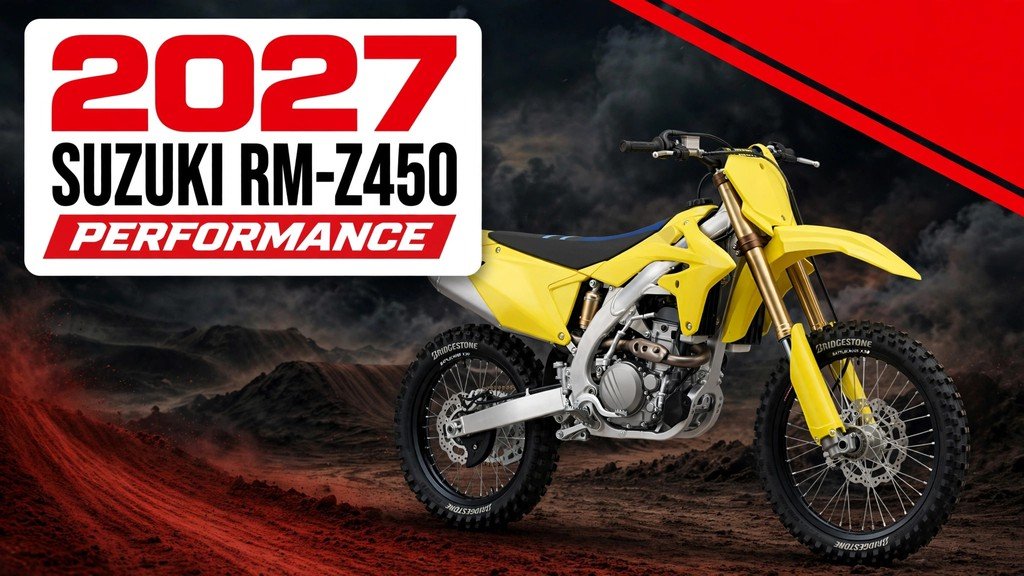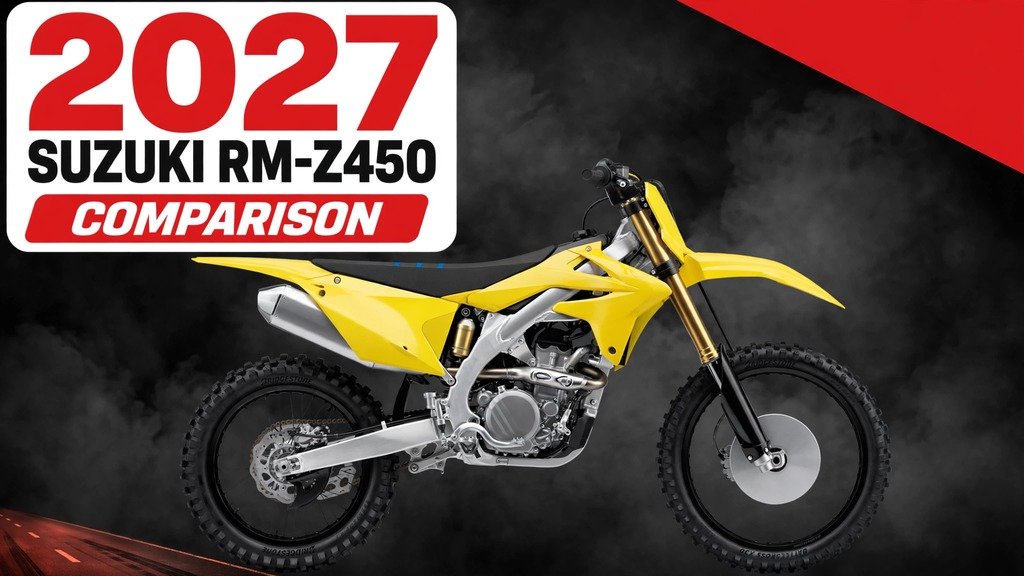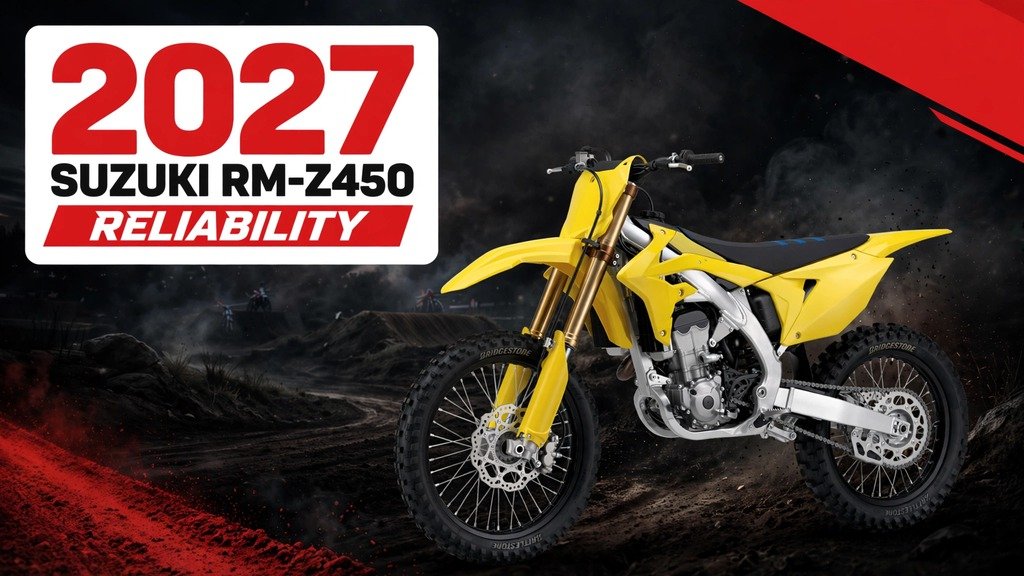
The 2027 Suzuki RM-Z450 is a simple bike to keep alive, and that simplicity is the whole story of Suzuki RM-Z450 reliability. It is a 449cc single with no electric start, no battery, no ride modes and no dashboard, so there is very little to go wrong beyond the parts the manual already tells you to replace. Oil every six hours, a new piston and ring every twelve, the air filter cleaned after every race, and the valve clearances checked every twelve hours. Follow that chart and the bike runs for years. This Suzuki RM-Z450 reliability guide works through the manual schedule, the common problems by model year, the ownership costs, and the clean official recall record, with every figure labelled by its source.
Suzuki RM-Z450 Reliability Overview
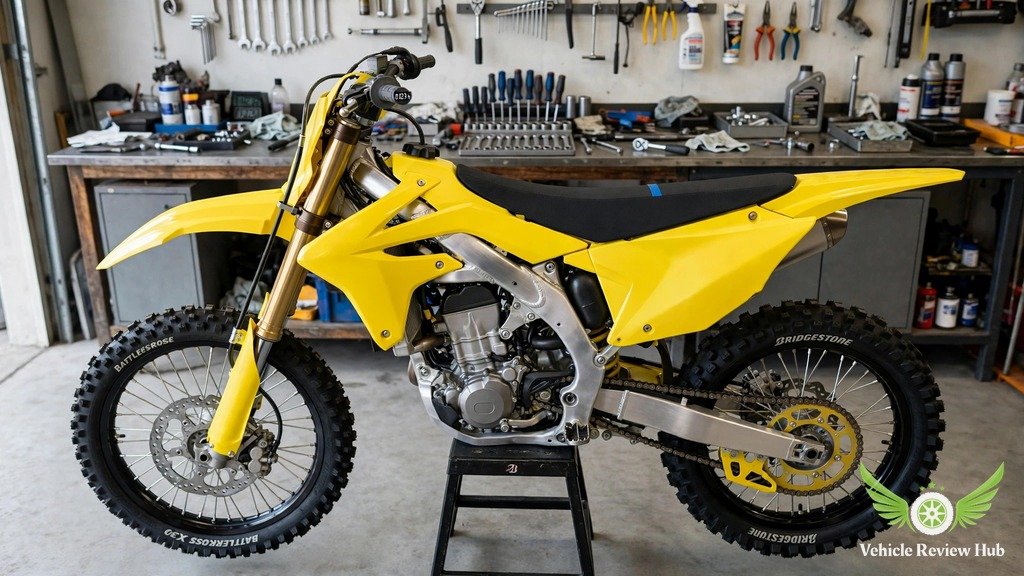
Reliability on a motocross bike is measured in hours, not miles, and the RM-Z450 has no odometer to argue with, only a run-time indicator light, while the owner’s manual schedules every service by hours. That discipline is the first thing to understand about Suzuki RM-Z450 reliability: the bike is honest about what it needs, and it needs it often.
Manual Schedule Mirrors the 250’s Discipline
The RM-Z450’s service chart follows the same structure as its smaller brother, the RM-Z250: three interval columns of every race or every 2 hours, every 3 races or every 6 hours, and every 6 races or every 12 hours. Engine oil is replaced every 6 hours, the oil filter is replaced only at 12 hours, and the piston and ring are replaced at 12 hours. The full chart is in the 2020 owner’s manual, and the Suzuki RM-Z250 reliability guide shows the same discipline on the 250. One trap to avoid is reading the chart as “oil and filter every six hours”. It is not. The filter is replaced only at 12 hours, and a shop that swaps the filter with every oil change is billing you for a part the manual does not ask for yet. Suzuki RM-Z450 reliability starts with reading the chart correctly, and the chart is the authority for everything in this guide.
How Hours, Storage and Previous Care Affect Reliability
Hours are the currency of motocross reliability, and they are also the easiest thing to lie about. The RM-Z450 has no odometer and no trip meter, only a run-time indicator light that flashes 0.2 seconds per hour of running, up to 100 hours, and even that needs an optional battery wire and a 12-volt battery to work. A cheap new bike with a skipped 12-hour piston service is a more expensive bike than a dearer one with a stamped logbook, and the Suzuki RM-Z450 review covers the full price and spec case. That is the practical meaning of Suzuki RM-Z450 reliability for a buyer.
Suzuki RM-Z450 Common Problems and Wear Items
Magazine testing over nearly two decades documents three real stories: the air forks of 2015 to 2017, the engine-case cracking of 2008, and the BFRC rear shock that every tester hated from 2018 to 2026. None of them is a pattern of engines blowing up, and no magazine-documented pattern of stalling, valve-train failure or clutch slip exists for the 2018-and-later bike. Each story belongs to a specific set of model years, and confusing them is how buyers get scared off a good bike, which is why this Suzuki RM-Z450 reliability guide takes each story in turn.
Air-Fork Years 2015 to 2017: the TAC Story
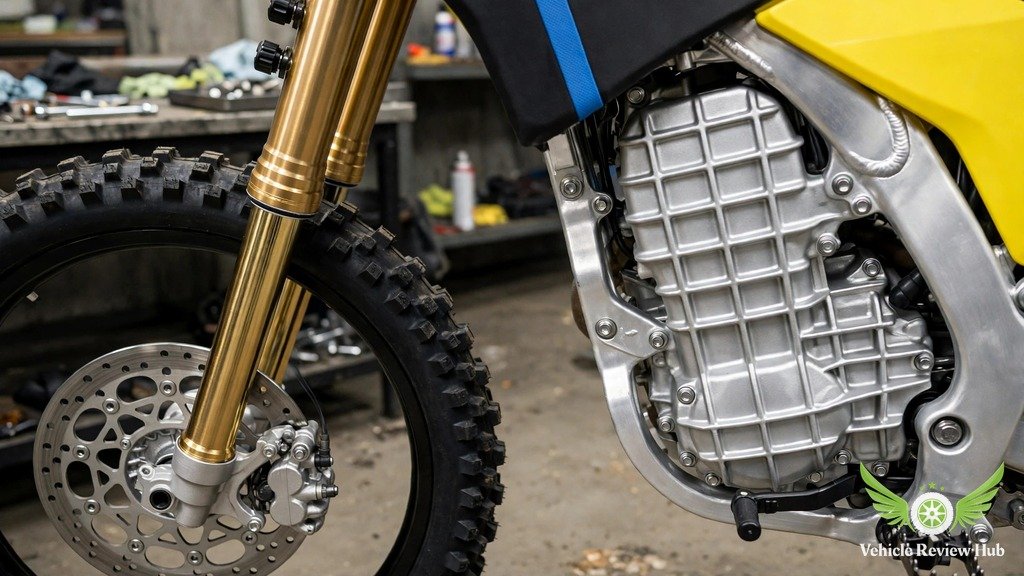
The air-fork years are the one period where Suzuki’s suspension made the bike harder to own, not easier. The 2015 bike ran the Showa SFF-AIR fork, with 49mm tubes, a 39mm piston, a 14mm rod and three air valves. The 2016 and 2017 bikes ran the Showa SFF-TAC fork, a triple-air-chamber design where upsetting the balance chamber could pull the forks 30mm down into the stroke. Motocross Action called the TAC fork one of the most complicated forks ever put on a production bike, with a quoted 420,000 tuning combinations. The full story is in the MXA suspension feature on the SFF-TAC air fork. For a buyer, a 2015 to 2017 bike needs a rider who enjoys suspension tuning or a budget for a fork swap, while a 2018 or later bike runs a conventional 49mm Showa coil-spring fork. It remains the one genuine wear-and-setup trap in Suzuki RM-Z450 reliability history, and it belongs to three model years only.
2008 Case Cracking, Fixed for 2009
The 2008 bike is the oldest story in this guide and the one most often repeated wrong. The first-year RM-Z450 suffered a cast-part glitch in the right-side engine case, and the bikes were delayed for months while Suzuki fixed it. Motocross Action’s 2009 race test records that the 2008 bike was subject to a recall once it did arrive, and that the 2009 fix was a reinforced right-side case. Very few 2008 bikes were ever sold. The honest framing matters: MXA documents the recall, but no campaign number for it was located in the public record, and the NHTSA database shows no recall naming the bike for any year from 2008 to 2027. A buyer looking at a 2009 or later bike can forget the case story entirely. A buyer looking at a 2008 bike should check the right-side case for the reinforced ribs, and walk away if the seller cannot show the work was done. That single check is the whole of the 2008 lesson.
Suzuki RM-Z450 Maintenance Schedule and Servicing
The maintenance schedule is the heart of Suzuki RM-Z450 reliability, because on a motocross bike the schedule is the reliability. The owner’s manual chart runs in three columns, every race or every 2 hours, every 3 races or every 6 hours, and every 6 races or every 12 hours, and every item on the bike has a home in one of those columns. The table below is the chart’s headline items, and the text beneath it fills in the fluids, the capacities and the items that catch owners out.
Oil Every Six Hours on the Manual Chart
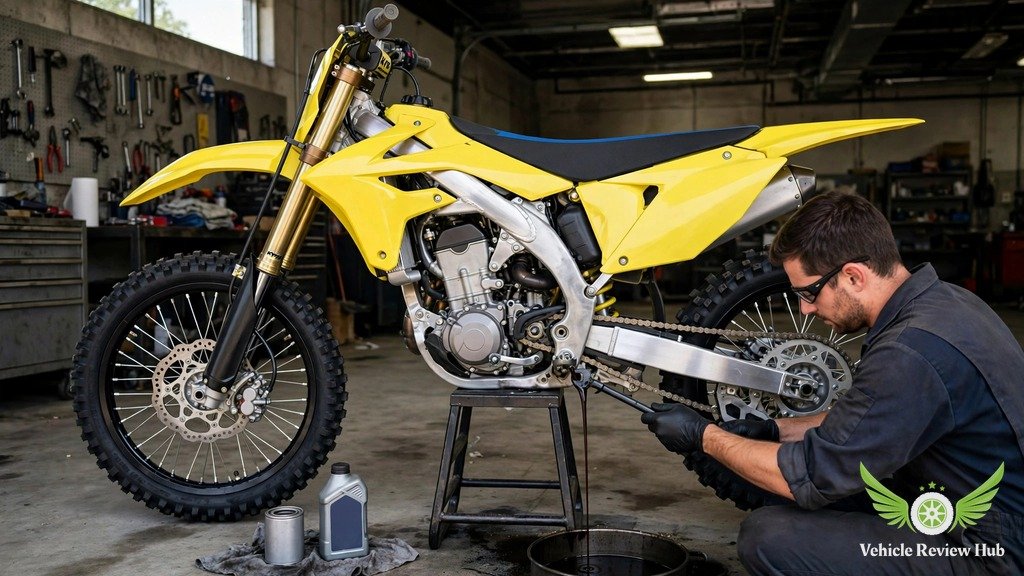
Engine oil is replaced every 6 hours. The oil strainers are inspected and cleaned at the same 6-hour mark, and the front fork oil is replaced every 6 hours too. The oil is SAE 10W-40, API SG through SN, JASO MA, and the capacity is 1,050 ml for an oil change or 1,100 ml with a filter. The filter is the trap: it is replaced only at 12 hours, not with every oil change, and the 12-hour column is where the expensive work lives. The Suzuki USA 2027 RM-Z450 page carries the current spec table, and the Suzuki RM-Z450 performance guide covers the engine behind it.
Piston and Ring Replacement at 12 Hours
The 12-hour column is the one that separates motocross ownership from road-bike ownership: the piston and ring are replaced at 12 hours, and the valve clearances are inspected at the same mark. That is why the run-time indicator light matters, and why a used bike with an unknown hour count is a risk: a piston that is past its 12-hour life does not announce itself politely, it loses compression and then it stops. The spark plug is the NGK DIMR8C10, inspected at 2 hours, and the manual gives no millimetre values for valve clearances on the 2019-and-later bike, so this guide prints no clearance figure.
| Service item | Interval | Action |
|---|---|---|
| Engine oil | Every 6 hours | Replace (SAE 10W-40, 1,050 ml) |
| Oil filter | Every 12 hours ONLY | Replace (not with every oil change) |
| Oil strainers | Every 6 hours | Inspect and clean |
| Air cleaner | Every race / every 2 hours | Clean |
| Spark plug (NGK DIMR8C10) | Every 2 hours | Inspect |
| Valve clearance | Every 12 hours | Inspect (no mm values published) |
| Piston | Every 12 hours | Replace |
| Piston ring | Every 12 hours | Replace |
| Cylinder head / cylinder | Every 12 hours | Inspect |
| Silencer | Inspect every 2 hours; replace at 12 hours | Replace after a race in sand |
| Front fork oil | Every 6 hours | Replace |
| Drive chain | Inspect and lubricate every 2 hours | Replace at 6 hours |
| Drive chain buffer / guide | Every 6 hours | Replace |
| Fuel hose | Inspect every 2 hours | Replace every 4 years |
| Radiator hose and coolant | Every year | Replace |
| Brake hose and fluid | Every year | Replace |
| Kick starter lever | Every 2 hours | Inspect and lubricate |
| Bolts and nuts | Tighten at 2 hours | Retighten every 1 hour |
Notes for this Suzuki RM-Z450 reliability table: intervals are from the 2020 owner’s manual chart; the oil filter is replaced only at 12 hours.
Suzuki RM-Z450 Tires, Brakes and Suspension Maintenance
Tyres, brakes and suspension are the wear items that decide how the bike feels, and on the RM-Z450 they are also the items where the model year matters most. What wears, what to inspect, and which year the part belongs to matters, because a 2027 fork and a 2018 fork are different jobs. That is the wear side of Suzuki RM-Z450 reliability.
Air Filter Cleaned After Every Race
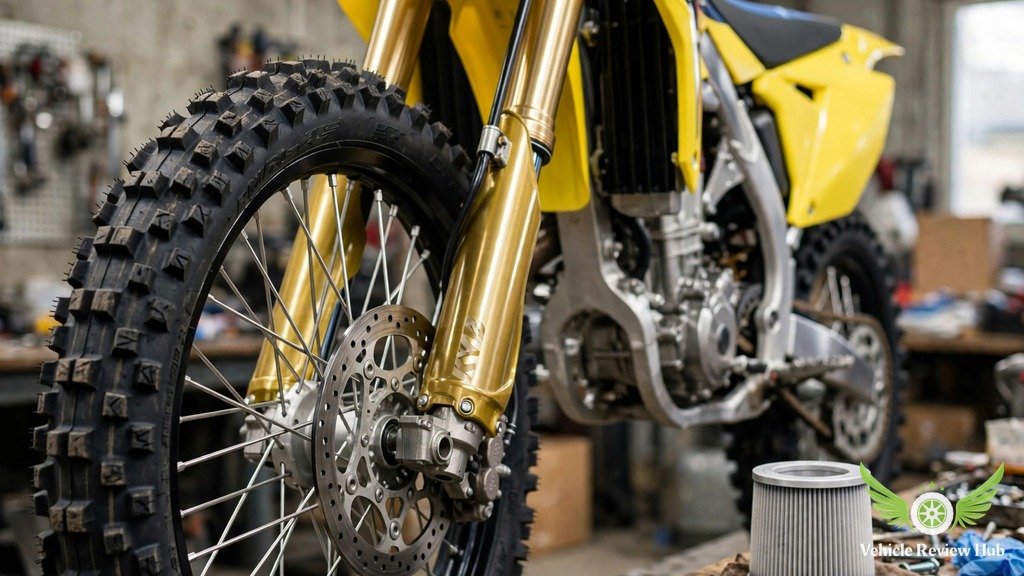
The air filter is cleaned after every race or every 2 hours, and it is the single most important maintenance job on the bike. A motocross track is a dust storm, and the filter is the only thing between that dust and the bore. It is the cheapest insurance in Suzuki RM-Z450 reliability. The manual’s every-race interval is not conservative; it is the minimum. A rider who cleans the filter after every race will never score a bore from dust, and a rider who stretches it to every third race will eventually pay for a top end. The bike is cheap to maintain and expensive to neglect.
Valve Clearance Inspection at 12 Hours
Valve clearances are inspected every 12 hours, in the same column as the piston, the ring, the cylinder head and the silencer. The manual gives no millimetre values for the 2019-and-later bike, so this guide prints no clearance figure rather than a borrowed one, and the 12-hour inspection applies to the 2027 bike exactly as it did to the old one. Suzuki has not published the 2027 KYB fork diameter, so no figure is printed here for it.
Suzuki RM-Z450 Maintenance and Ownership Costs
Ownership costs on the RM-Z450 are honest in one way and frustrating in another. The honest part is the purchase price: $9,699 plus $650 destination is $10,349 delivered, the cheapest 450 in the USA, and dealers commonly discount further. No verified service or parts price was found, so this guide quotes no service prices at all. That is the cost side of Suzuki RM-Z450 reliability.

Fuel, Routine Servicing, Tires and Replacement Parts
Fuel is premium unleaded at a minimum of 90 pump octane, with no more than 10 percent ethanol, and the 6.3-litre tank is sized for motos and practice sessions rather than miles. Tyres are Bridgestone Battlecross X30 knobbies, and the brakes are Nissin with a round 270mm front disc and a 240mm rear disc. Used prices are thin: the only verified figure is a single-source 1000PS average of $4,210 for a 2019 bike, with a suspiciously low average mileage of 1,000 km, and a 2021 range of $3,700 to $6,300 from the same source, so treat both as rough guides. The 1000PS model page carries those figures. A buyer should price a used 450 on its hour count and service log, not on its year alone, because hours are what Suzuki RM-Z450 reliability is measured in.
No Official Recall Names This Bike
No official recall names this bike. The NHTSA recalls database returns a Count of zero for every model year checked from 2008 to 2027, and the NHTSA recalls API for the 2027 RM-Z450 returns the same zero-count body. Two honest caveats belong with that zero. First, NHTSA covers road vehicles, and competition off-road bikes are thinly covered, so a zero count is a verified NHTSA zero, not proof that no defect ever existed. Second, the 2008 case-cracking recall documented by Motocross Action has no located campaign number. The Suzuki RM-Z450 comparison puts the bike against rivals with recall histories, and the contrast is real. That is the full recall picture for Suzuki RM-Z450 reliability, and it is a strong one.
| Cost item | What is verified | Note |
|---|---|---|
| 2027 delivered price | $10,349 ($9,699 + $650) | Cheapest 450 in the USA |
| Fuel | Premium unleaded, min 90 octane | Max 10% ethanol; 6.3 L tank |
| Engine oil | SAE 10W-40, 1,050 ml per change | 1,100 ml with filter; every 6 hours |
| Oil filter | Replaced only at 12 hours | Not with every oil change |
| Spark plug | NGK DIMR8C10, inspected every 2 hours | No verified parts price found |
| Chain | RK 520DMXZK, 114 links | Replaced at 6 hours |
| Tyres | Bridgestone Battlecross X30 | 80/100-21 front, 110/90-19 rear |
| Used 2019 average | $4,210 (single-source 1000PS) | Avg mileage 1,000 km, suspiciously low |
| Used 2021 range | $3,700 to $6,300 (single-source 1000PS) | Thin data, rough guide only |
| Dealer service labour | No verified price found | Honestly unquoted, not estimated |
| 12-hour piston job | No verified price found | Honestly unquoted, not estimated |
Notes for this Suzuki RM-Z450 reliability table: service prices are honestly unquoted because no verified dealer labour or parts price was found. The used figures are single-source 1000PS data.
| Model years | Suspension | Known reliability story |
|---|---|---|
| 2008 | Coil-spring fork | Right-side engine-case cracking; recall per MXA, no campaign number located; very few sold, ~8 months late |
| 2009 to 2014 | Coil-spring fork | Reinforced case standard; no documented failure pattern |
| 2015 | Showa SFF-AIR air fork | Air fork with three air valves; hard to tune |
| 2016 to 2017 | Showa SFF-TAC air fork | Triple-air-chamber fork; 420,000 tuning combinations; most complicated fork on a production bike |
| 2018 to 2026 | 49mm Showa fork + BFRC shock | BFRC shock most-hated component; adjusted in turns, not clicks |
| 2027 | KYB fork + KYB shock | First mechanical update since 2018; no documented pattern yet |
Notes for this Suzuki RM-Z450 reliability table: the air-fork and BFRC years are setup problems, not engine-failure patterns.
How to Keep a Suzuki RM-Z450 Reliable
Keeping an RM-Z450 reliable is a routine, not a project: the manual chart does the thinking, the owner does the hours, and the bike does the rest. Clean the air filter after every race, change the oil every six hours, replace the piston and ring every twelve, and keep a logbook. That is the whole method of Suzuki RM-Z450 reliability: the bike rewards discipline and punishes neglect.
Preventive Maintenance, Records and Regular Inspections
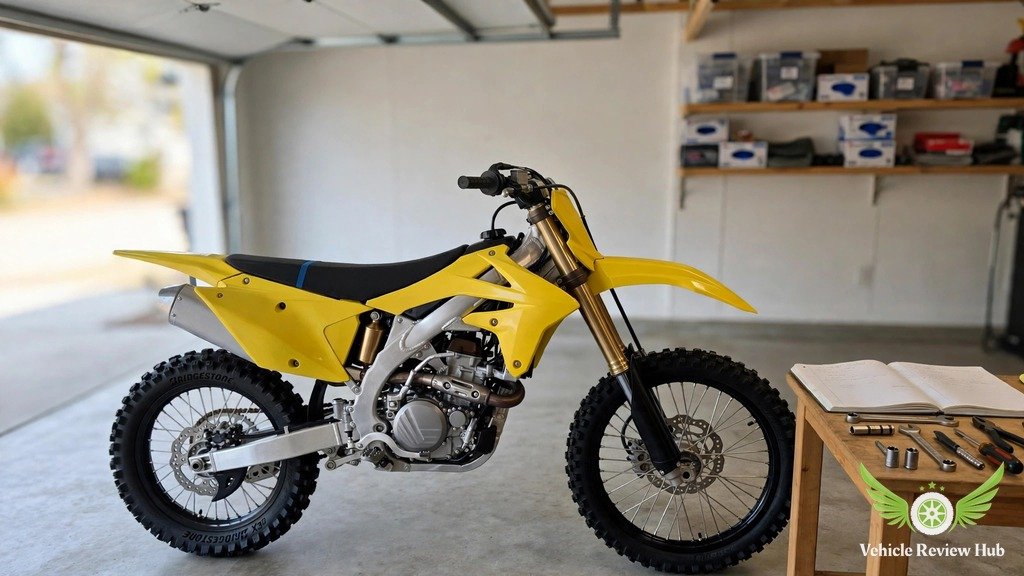
Preventive maintenance on the RM-Z450 is the manual chart, followed on time, with records, and that routine is the whole of Suzuki RM-Z450 reliability in practice. A logbook turns that into resale value. Motocross Action ran its own test bikes for years with no serious issues reported, and the MXA living-with-the-2024-RM-Z450 article shows that ownership in practice. The video below is that living-with story on film.
The video below is Motocross Action living with its 2024 RM-Z450 over a season. It is a living-with video, not a service-manual walkthrough, and the 2024 bike is the same 2018 to 2026 platform, so the maintenance habits it shows still apply to the pre-2027 bikes. There is no dedicated RM-Z450 service video.
The 2008 Story Has No Campaign Number
The 2008 story closes this guide. Motocross Action’s 2009 race test records that the 2008 bike was subject to a recall once it arrived, after the right-side engine case cracked and delayed the bikes for months. The MXA 2009 race test is the primary source for the story. This guide states the gap plainly: the recall is documented, the number is not found, and the fix has been in every bike built since 2009. That is the honest end of the oldest story in Suzuki RM-Z450 reliability, and the bike’s record since then is clean.
Suzuki RM-Z450 Reliability: Frequently Asked Questions
Direct answers to the questions US buyers ask about Suzuki RM-Z450 reliability.
Is the Suzuki RM-Z450 reliable?
Yes, with the discipline the manual asks for. Suzuki RM-Z450 reliability rests on a simple 449cc single with no electric start, no battery and no dashboard, and the magazine record shows no pattern of engine failure on the 2018-and-later bike. The bike needs oil every 6 hours and a piston and ring every 12 hours, and it punishes owners who skip that chart, which is the deal at the heart of Suzuki RM-Z450 reliability.
How often does the RM-Z450 need an oil change?
Every 6 hours, per the owner’s manual chart, which is the first number in Suzuki RM-Z450 reliability. The oil strainers are inspected and cleaned at the same 6-hour mark. The oil filter is replaced only at 12 hours, not with every oil change.
How often does the RM-Z450 need a new piston?
Every 12 hours, per the manual chart. The piston and the piston ring are both replaced at 12 hours, and the valve clearances are inspected at the same mark. Twelve hours arrives in a few weekends of riding, so the run-time indicator light is the gauge that matters for Suzuki RM-Z450 reliability.
Does the RM-Z450 have any recalls?
No official recall names the bike. The NHTSA database returns a Count of zero for every model year from 2008 to 2027, and Suzuki RM-Z450 reliability is helped by that clean official record. The one exception is the 2008 case-cracking recall documented by Motocross Action, for which no campaign number was located.
What was the 2008 engine-case problem?
A cast-part glitch in the right-side engine case delayed the 2008 bikes for months, and Motocross Action records that the bike was subject to a recall once it arrived. The 2009 fix was a reinforced right-side case with additional ribs and thicker walls, and the reinforced case has been standard ever since, which is why the 2008 story is closed in Suzuki RM-Z450 reliability. No campaign number for the 2008 recall was found, and it is the oldest item in Suzuki RM-Z450 reliability.
Are the 2015 to 2017 air forks a problem?
They are a setup problem, not a failure pattern, and that distinction matters for Suzuki RM-Z450 reliability. The 2015 bike ran the Showa SFF-AIR fork and the 2016 and 2017 bikes ran the Showa SFF-TAC triple-air-chamber fork, which Motocross Action called one of the most complicated forks ever put on a production bike. A 2018 or later bike runs a conventional coil-spring fork instead, and the 2027 bike runs KYB front and rear, which is why the air-fork years matter so little to Suzuki RM-Z450 reliability today.
What is the BFRC shock problem?
The BFRC rear shock on the 2018 to 2026 bike was the most-hated component in the class, and its compression and rebound screws are adjusted in turns rather than clicks, with no adjuster on the clevis, which makes it hard to dial in by feel. It is a setup and feel problem, not a failure pattern, which is the recurring theme of Suzuki RM-Z450 reliability. The 2027 KYB linkage shock ends the BFRC era entirely, and with it the biggest setup complaint in Suzuki RM-Z450 reliability.
Does the RM-Z450 have electric start?
No. The bike is kick-start only on every model year, with a primary kickstarter and automatic decompressor and no battery. It is the only 450 in the class without electric start, and Racer X confirmed electric start is not coming for 2027. The kick starter lever is inspected and lubricated every 2 hours, because on a kick-start-only bike the lever is part of Suzuki RM-Z450 reliability.
What spark plug does the RM-Z450 use?
The NGK DIMR8C10, inspected every 2 hours per the manual chart. Suzuki RM-Z450 reliability does not depend on the plug alone, but a worn plug on a kick-start-only bike means a bike that will not start when it is hot, so the 2-hour inspection is worth doing.
How much does it cost to maintain an RM-Z450?
No verified service price exists for the 12-hour piston job, the valve check, the fork service or the parts, so this Suzuki RM-Z450 reliability guide quotes no service prices. What is verified is the purchase price of $10,349 delivered, the fuel and oil specifications, and the used figures of $4,210 for a 2019 bike and $3,700 to $6,300 for a 2021, both single-source and labelled as rough guides.
Is a used RM-Z450 a good buy?
Yes, if the hour count and the service log check out. Buy on the logbook, not the year. A 2009 or later bike has the reinforced engine case, a 2018 or later bike avoids the air forks, and a 2027 bike avoids the BFRC shock. Avoid any used bike with an unknown hour count, because hours are the currency of Suzuki RM-Z450 reliability.
Should I buy the 2027 RM-Z450 for reliability?
Yes, if you accept the hour-based schedule. The 2027 bike keeps the same proven 449cc engine and replaces the Showa fork and BFRC shock with KYB suspension front and rear. Suzuki RM-Z450 reliability on the 2027 bike is the same deal as always: follow the chart, keep records, and the bike will run for years.