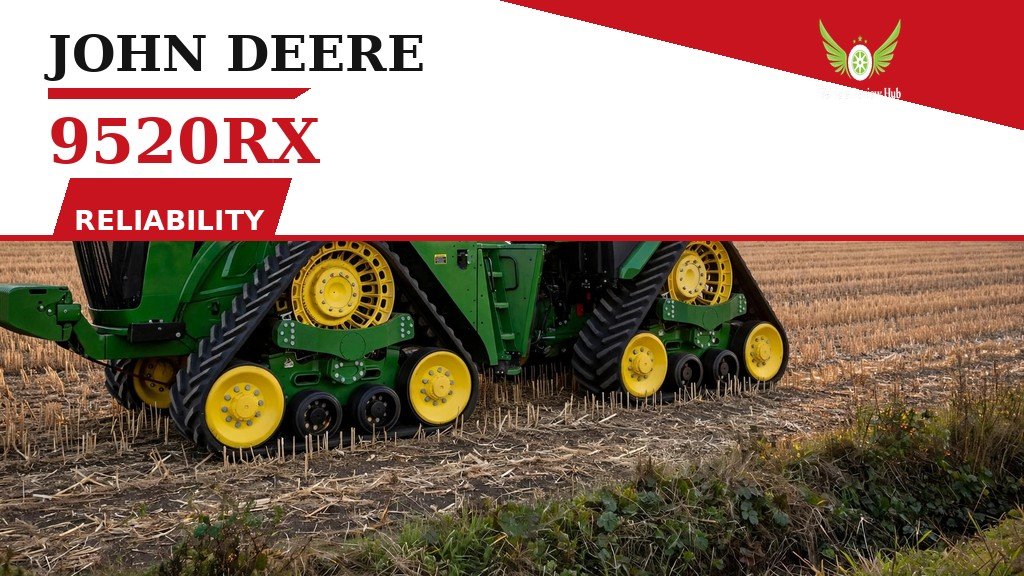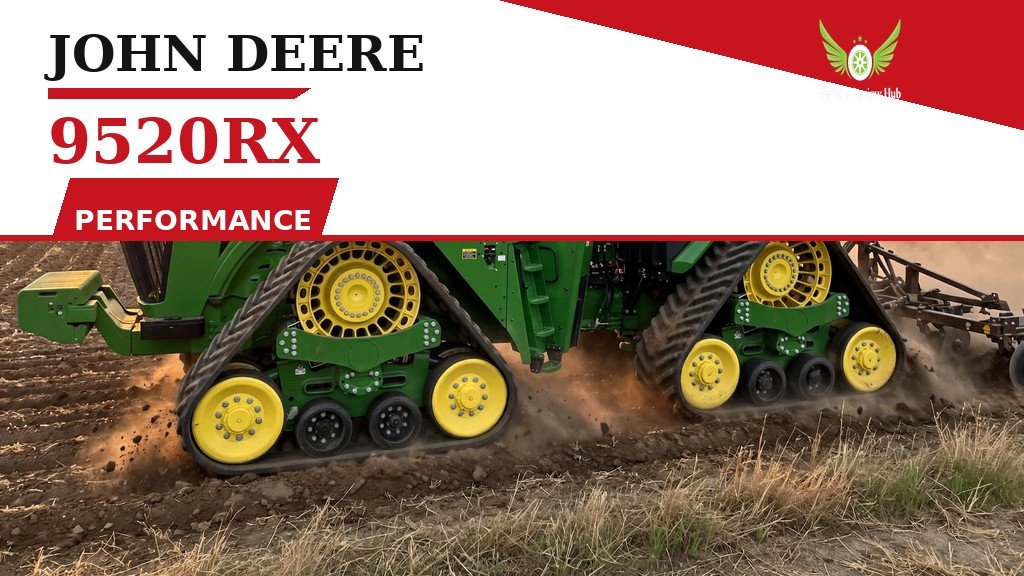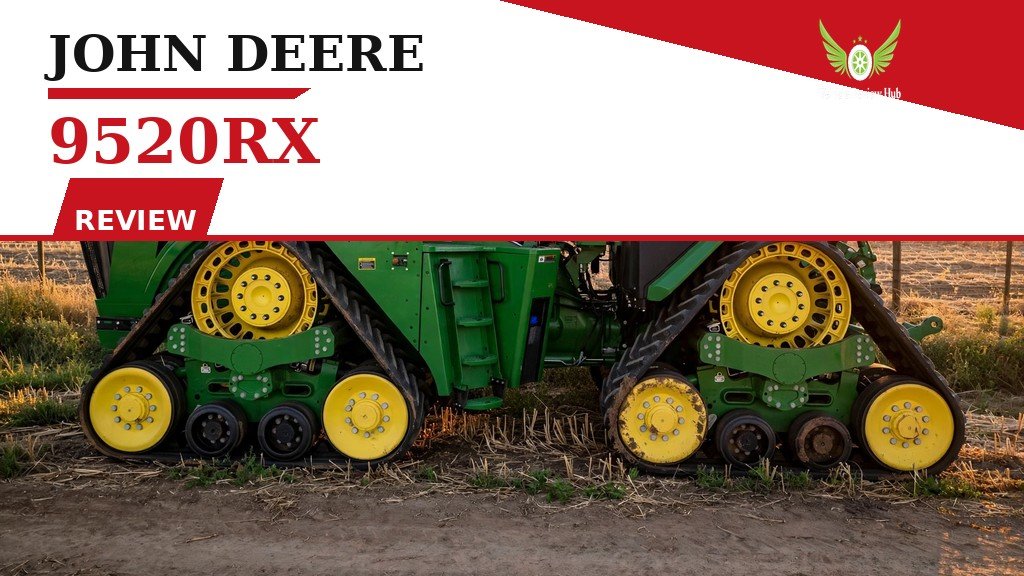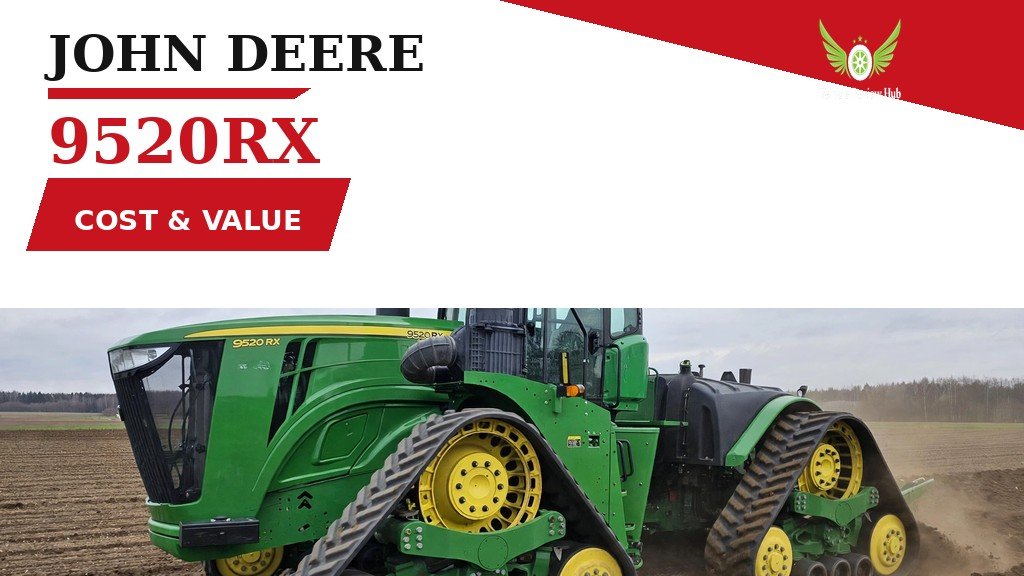
The John Deere 9520RX is the four-track workhorse that put Deere on the tracked-tractor map. Built from 2015 through 2019, this 520-hp machine pairs the John Deere PowerTech PSS 13.5-liter engine with four Camso rubber belt tracks, an e18 PowerShift and up to 115 gpm of hydraulic flow. New ones are long gone from dealer lots, but the used market is full of them: late-model machines with 3,000–4,500 hours currently change hands between about $280,000 and $450,000 in the USA, depending on year, hours, track condition and options.
This John Deere 9520RX ownership cost guide puts real numbers on what five years of used-track-tractor ownership actually looks like. Expect roughly $500,000–$540,000 in total operating cost over five years at 600 hours a year — diesel dominates, but track belts, DEF, maintenance and the steep early depreciation curve of a discontinued flagship all move the needle. Understanding John Deere 9520RX ownership cost before you buy is what separates a smart used purchase from an expensive lesson.
One more thing that shapes John Deere 9520RX ownership cost: this is a discontinued model from the first four-track generation (2015–2019). That means no factory warranty, no new-machine financing programs and no configurator to hide behind — but it also means deep parts support, a decade of owner knowledge on forums, and a purchase price that has already absorbed the worst depreciation. Every figure below comes from current dealer listings, Deere spec sheets or labeled owner reports — nothing is guessed.
John Deere 9520RX Total Cost of Ownership
John Deere 9520RX ownership cost breaks into three buckets: what it burns (diesel and DEF), what wears out (track belts, filters, undercarriage parts) and what time takes (depreciation). A typical used purchase in 2026 runs around $295,000 for a 2018 machine with roughly 3,800 hours — a real, verifiable market figure from current dealer listings. The five-year math below builds from that entry point at 600 hours per year, which is a realistic workload for a used high-horsepower tractor.
Fuel, Routine Maintenance and Track Operating Expenses
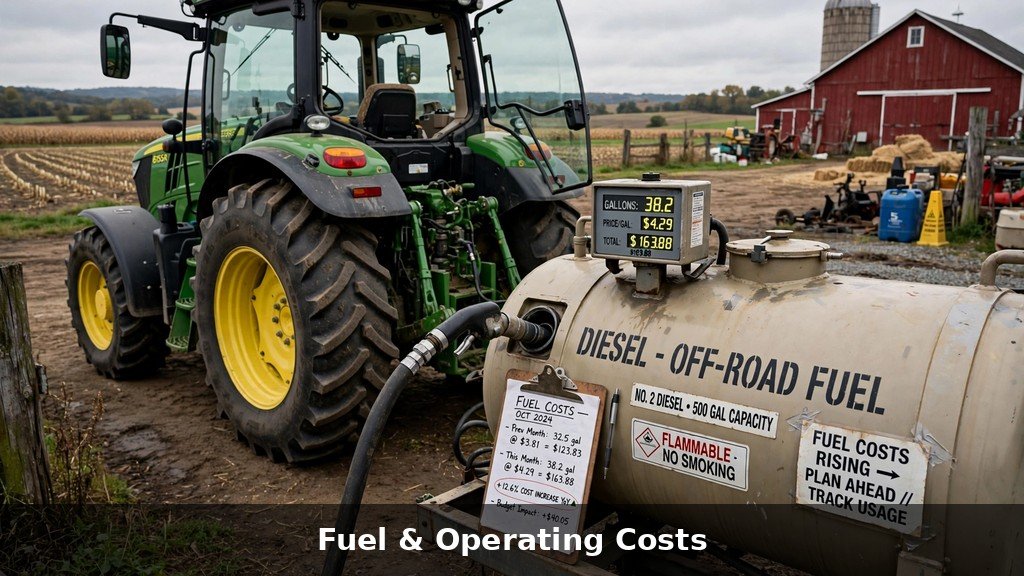
Diesel is the single biggest line item in John Deere 9520RX ownership cost. The 13.5-liter PSS engine is a thirsty workhorse in heavy draft: owner-reported figures from the first-generation 9RX family cluster around 12–18 gph in field work and 18–28 gph in sustained heavy draft, with transport and light PTO work dropping into the low teens. At $6.179 per gallon — the U.S. average retail diesel price for the week of October 12, 2026, per the EIA’s weekly diesel update — a 600-hour year at an average 17 gph costs about $63,000. That is the number that makes or breaks the budget, so size your workload honestly before you sign.
The 9520RX runs US Final Tier 4 aftertreatment of the DOC-plus-DPF-plus-SCR variety, with a 31.7-gallon DEF tank — this is not the DEF-free JD18 of the new 9RX generation. DEF runs about 2.5 percent of diesel consumption, adding roughly $800 a year at $3 per gallon. Routine maintenance follows the 500-hour engine oil interval (the PSS 13.5L uses electronic unit injectors and dual series turbos, so a quality oil and genuine filters matter): budget about $2,000–$2,500 a year for parts and dealer labor combined at 600 hours per year, labeled here as an estimate. The 400-gallon fuel tank gives long field days — roughly 24 hours of runtime at 17 gph — so fuel logistics are rarely the constraint; the constraint is the fuel bill itself, which is the heart of John Deere 9520RX ownership cost. The biggest wear item is the track system. Camso Duradrive 3500/6500 belts on these machines run 3,000–5,000+ hours of owner-reported life, and a full four-corner belt refresh at dealer rates runs roughly $40,000–$50,000 installed — about $10,000–$15,000 per belt. At 600 hours a year, expect to face one belt set inside a five-year window. Our 9520RX maintenance and common problems guide walks through service intervals, DPF regeneration care and undercarriage inspection in detail.
Repairs, Unexpected Costs and Five-Year Budget
An eight-to-ten-year-old flagship costs more to keep healthy than a new one, and John Deere 9520RX ownership cost should carry a real repair reserve. Budget about $30,000 over five years (estimate) for the surprises: hydraulic hoses and SCV couplers, mid-roller and idler wear in the undercarriage, electrical gremlins in the CommandView III cab, DEF/SCR sensor faults and the occasional e18 shift-calibration visit. None of these are deal-breakers — the 13.5L PSS is a proven, well-supported engine — but they are the reality of a used 520-hp track tractor, and a realistic repair reserve is part of every sound John Deere 9520RX ownership cost plan.
Here is an illustrative five-year John Deere 9520RX ownership cost budget for a 2018 machine bought at $295,000 with ~3,800 hours, running 600 hours per year. Fuel math is shown line by line; insurance, repairs and residuals are labeled estimates. This is the core of any honest John Deere 9520RX ownership cost analysis.
| Expense (5 years) | 9520RX at 600 hrs/yr (est.) |
|---|---|
| Diesel (17 gph avg × 600 hrs × $6.179/gal) | $315,129 |
| DEF (~2.5% of diesel @ $3.00/gal, est.) | $4,000 |
| Routine maintenance (est.) | $12,000 |
| One full track-belt set installed (est.) | $45,000 |
| Repair reserve (est.) | $30,000 |
| Insurance (est.) | $20,000 |
| Depreciation ($295,000 → ~$200,000 residual, est.) | $95,000 |
| Total five-year cost (est.) | $521,129 |
Fuel alone is about 60 percent of John Deere 9520RX ownership cost in this scenario — which is why matching the tractor to real work matters more than the purchase price. Compared with the new-generation four-track, our 9RX Series ownership cost guide shows how the DEF-free JD18 and a ~$1.2M price tag change the same five-year math.
John Deere 9520RX Insurance and Financial Considerations
A $300,000 used tractor still needs full financial protection. Insurance, storage and theft protection are a modest but real part of John Deere 9520RX ownership cost — and lenders will require coverage if the machine is financed, which most used big-tractor purchases are.
Equipment Insurance and Liability Coverage
Insure a used 9520RX on a stated-value farm equipment policy at its purchase price. Expect roughly $3,500–$5,000 a year (estimate) for a $295,000 machine, varying with your state, deductible and claims history. Keep liability coverage in place for road transport and custom work — a 44,000-lb track tractor does not forgive a fender-bender. If you finance, the lender sets minimums; factor that into John Deere 9520RX ownership cost before you negotiate, not after. Deere Financial and ag banks both write used-tractor loans, and rates on used iron typically run a point or two above new-equipment programs. On a $295,000 purchase with 20 percent down over five years, interest alone can add $25,000–$35,000 (estimate) to lifetime John Deere 9520RX ownership cost — get the loan quote before the machine quote.
Storage, Theft and Damage Protection
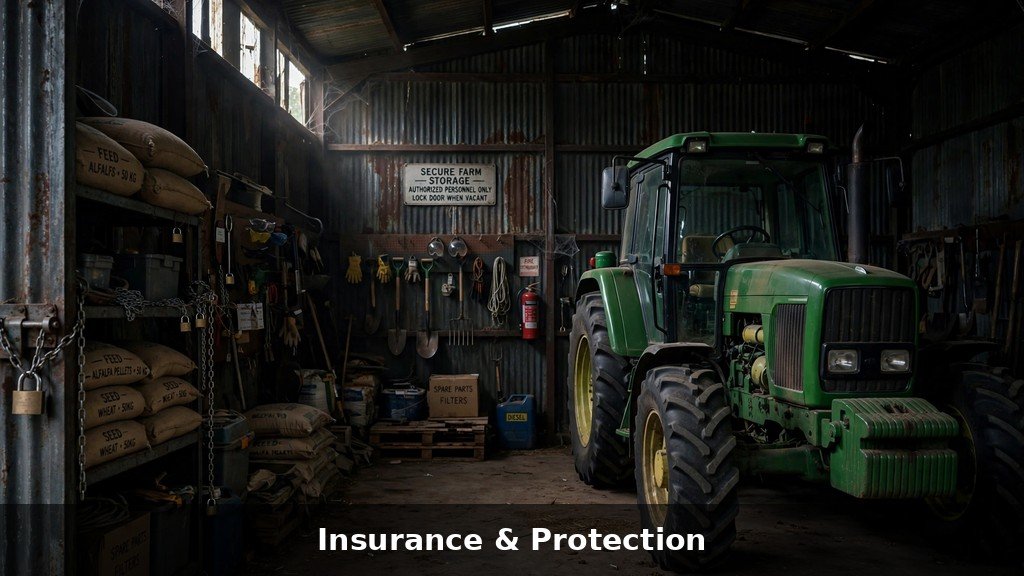
Shed storage protects the single most expensive wear item: the tracks. UV and weather age rubber belts even when the tractor sits, so indoor storage genuinely extends belt life — and belt life is money on a 9520RX. Theft of whole tractors is rarer than parts theft: GPS receivers, displays and DEF system components are the usual targets. Pull the receiver, lock the cab, and consider a telematics subscription for recovery. Hail and storm damage to cabs and glass is the other regional risk; check that your policy covers it. None of this is expensive individually, but together it runs a few thousand dollars a year (estimate) — cheap against the cost of one premature belt set.
John Deere 9520RX Depreciation and Resale Value
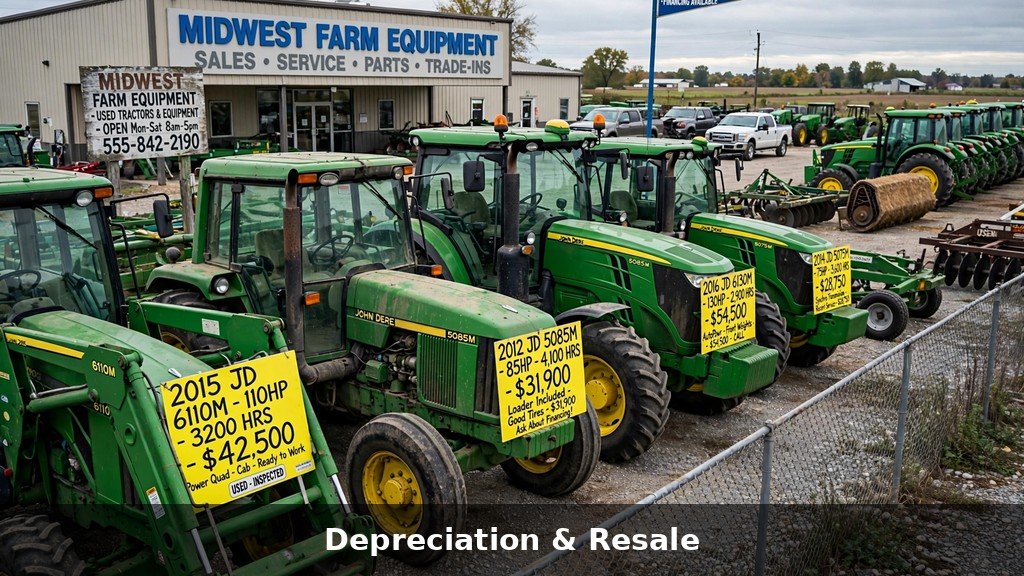
Here is the good news in John Deere 9520RX ownership cost: the steepest depreciation already happened. First-generation 9RX machines lost the most value in their first four to six years; a 2016–2019 machine in 2026 is on the flatter part of the curve. Late-model 9520RX tractors with 3,000–4,500 hours currently list around $280,000–$450,000 in the USA — Papé Machinery recently advertised a 2018 with 3,477 hours at $279,999 and another 2018 with 4,171 hours at $313,999 — and five more years should leave roughly $200,000 of residual on a well-kept machine (estimate). That flattening curve is exactly why used-machine John Deere 9520RX ownership cost beats new-machine math for most operations.
How Model Year, Hours, Track Condition and Equipment Affect Price
Three things set a used 9520RX’s price: hours, track condition and build spec. Hours dominate — every 1,000 hours knocks roughly $20,000–$30,000 off (estimate) at this age. Track condition is the swing factor buyers miss: a machine with 70-percent belts is worth $15,000–$25,000 more than one with worn belts (estimate), because the buyer is one season away from a $45,000 refresh. Build spec matters too: the 115-gpm big-pump hydraulic option, six-plus rear SCVs, StarFire receiver and AutoTrac, the Premium CommandView III cab package and 36-inch tracks over 30s all support stronger resale. Compare any used 9520RX against the current four-track market with our 8RX Series ownership cost guide for context on what newer tracked power costs to own.
Private Sale, Dealer Trade-In and Resale Preparation
When it is time to sell, a dealer trade-in is the fast route and a private sale the profitable one — the spread on big used track tractors runs 8–15 percent (estimate). Prepare the machine like a buyer is watching, because one will be: fresh 500-hour service with receipts, belts measured and photographed, undercarriage cleaned, all fault codes cleared with documentation of what was fixed, and the CommandView display showing a clean service history. A used 9520RX with complete dealer service records sells faster and holds value better than a mystery machine at any hour count. Photograph the hour meter, the belt lug depth and the undercarriage from multiple angles — buyers shopping a $300,000 machine expect that level of transparency, and it protects your John Deere 9520RX ownership cost position at resale. That documentation discipline is also the single best defense against repair-cost surprises during your own ownership — it is part of John Deere 9520RX ownership cost management, not just resale theater.
Buying a Used John Deere 9520RX
Buying a used 9520RX is buying into the cheapest way to own 520 hp on four tracks. The machine is proven, parts support is deep, and the purchase price is a fraction of a new 9RX 830. But it is also a 10,000-hour-design machine being bought mid-life — the inspection matters more than the negotiation.
Inspection Checklist, Service History and Repair Records
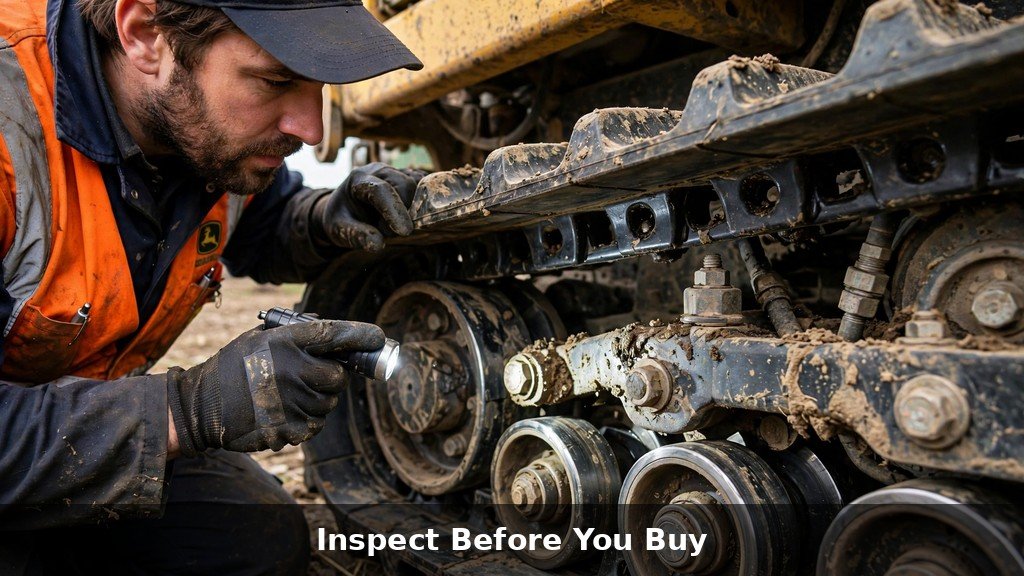
Start with the tracks: measure belt lug height on all four corners, check for cuts, chunking and exposed cable, inspect mid-rollers and idlers for wear and play, and look at alignment — uneven wear across the belt width signals alignment trouble. Then the powertrain: the 13.5L PSS should start cleanly, build boost smoothly and show no active DPF or SCR fault codes (this engine uses DOC-plus-DPF-plus-SCR with DEF, so ask about regen history and DEF system repairs). Watch for interrupted-regen derates and NOx sensor faults, the two most common owner-reported aftertreatment complaints on this generation — both are fixable, but both are negotiating leverage. Check e18 shift quality through the gears, hydraulic response at all SCVs, and the articulated steering for hinge-pin play. Verify the 1,000-rpm PTO, all lighting, the cab HVAC and the guidance hardware. Pull the service history: 500-hour oil changes, 1,500-hour transmission/hydraulic service and any undercarriage work should be documented. A clean inspection directly lowers your five-year John Deere 9520RX ownership cost, because every fault you find now is a repair you price into the deal instead of discovering later. The video below — a 2018 9520RX walkaround from bigtractorpower — shows what a clean late-model machine looks like and what to look for:
Price Negotiation and Comparison with Newer 9RX Models
Negotiate from the inspection, not the asking price. Worn belts, missing service records, fault codes or tired undercarriage parts are each worth thousands off — a belt set alone is $40,000–$50,000 of leverage (estimate). Current market: late 2018 machines with 3,400–4,200 hours list at $280,000–$314,000, while lower-hour or 2019 machines reach into the $400,000s — recent sold listings show where the market actually clears. Against a new 9RX 830 at roughly $1.2 million, a $295,000 used 9520RX buys about 63 percent of the horsepower for about a quarter of the money — but plan the five-year John Deere 9520RX ownership cost budget above against the new machine’s warranty and DEF-free running. For most operations in the 3,000–5,000-acre range, the used 9520RX wins the math. Our 9R Series ownership cost guide offers a wheeled-articulated alternative at a similar used price point.
Frequently Asked Questions About John Deere 9520RX Ownership Cost
Quick answers to the questions used buyers ask most about John Deere 9520RX ownership cost.
What does a used John Deere 9520RX cost in 2026?
Late-model machines (2017–2019) with 3,000–4,500 hours currently list around $280,000–$450,000 in the USA. Verified 2026 listings include a 2018 with 3,477 hours at $279,999 and a 2018 with 4,171 hours at $313,999 (Papé Machinery). Hours and track condition drive the spread more than model year.
How much fuel does a 9520RX burn per hour?
Owner-reported figures for the first-generation 9RX family run about 12–18 gph in field work and 18–28 gph in sustained heavy draft, with light work in the low teens. At the EIA’s $6.179/gal diesel average for the week of October 12, 2026, plan on roughly $60,000–$65,000 a year in diesel at 600 hours with a 17-gph average. Fuel is the largest single component of John Deere 9520RX ownership cost.
Does the 9520RX need DEF?
Yes. The 9520RX’s PowerTech PSS 13.5L runs US Final Tier 4 aftertreatment with DOC, DPF and SCR — including a 31.7-gallon DEF tank. This differs from the new 9RX 710/770/830, whose JD18 engine meets emissions with cooled EGR only and no DEF. Budget DEF at roughly 2.5 percent of diesel consumption, about $800 a year at 600 hours (estimate).
How long do 9520RX track belts last?
Owner-reported belt life on the Camso Duradrive 3500/6500 belts runs 3,000–5,000+ hours, depending on roading, soil conditions and maintenance. Avoid roading — road miles wear belts far faster than field work — keep correct tension and inspect alignment regularly. A full four-belt replacement at dealer rates runs roughly $40,000–$50,000 installed (estimate), which is why belt condition is the first thing a careful John Deere 9520RX ownership cost analysis checks.
Is there a warranty on a used 9520RX?
The original factory warranty expired years ago on every 9520RX. Check for transferable Deere PowerGard coverage or dealer-certified used programs, and ask specifically what the powertrain coverage includes — it is paid extended protection, not the original 24-month/2,000-hour terms. A pre-purchase inspection at a Deere dealer is worth the fee.
9520RX or a new 9RX 830 — which costs less to own?
The used 9520RX, by a wide margin. Five years of John Deere 9520RX ownership cost on a $295,000 used machine runs roughly $521,000 (estimate) at 600 hours a year — against a ~$1.2M purchase price for the new 9RX 830 before a single gallon of fuel. The new machine counters with a full warranty, DEF-free running and current technology. For most mid-size operations, the 9520RX’s math wins; for maximum acres with minimum downtime risk, the new machine earns its premium. Either way, run your own John Deere 9520RX ownership cost numbers with your hours, your diesel price and your track condition before deciding.