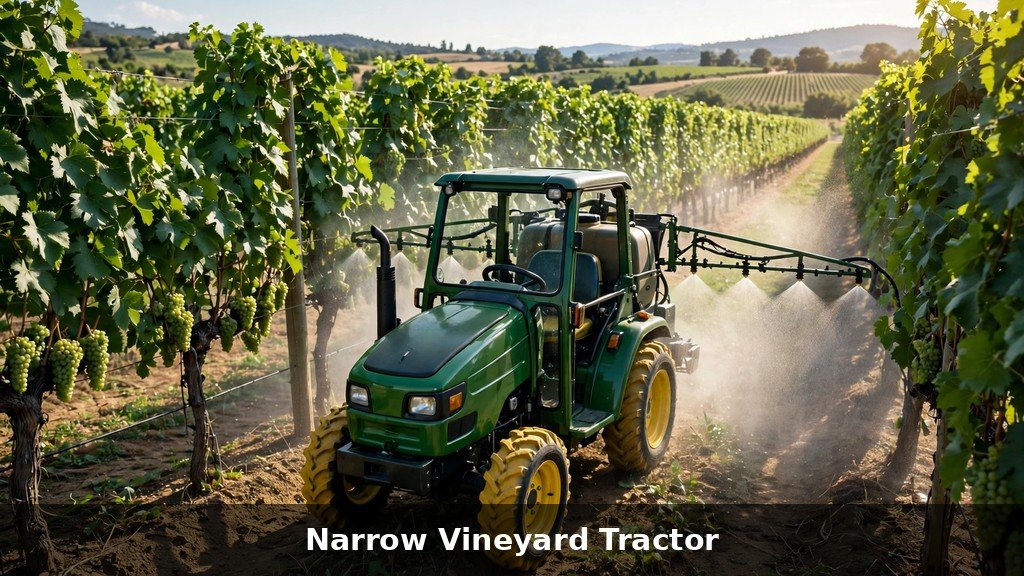
If your vineyard rows are too tight for a standard utility tractor, the John Deere 5GV Series is built for that problem. This John Deere 5GV Series review covers the two models in the lineup, the 5075GV and the 5090GV, their specifications, used prices, and comparison with the wider 5GN and 5GF tractors. The short version, and the headline of this John Deere 5GV Series review, is simple: the 5GV is a genuine vineyard tractor, not a utility tractor with narrow tires bolted on. With a minimum working width of 42.8 inches, a 75 or 90 horsepower Final Tier 4 diesel, and an 11.9-foot turning radius, it fits rows where a normal tractor would crush vines on both sides. The trade-off: this is a specialist, and if your rows are wide or you need a loader tractor, a wider machine serves you better.
The 5GV Series comes from John Deere’s 5G Final Tier 4 specialty lineup, introduced in December 2015 for grape and orchard growers. Both models covered in this John Deere 5GV Series review are four-wheel drive only, with a cab or open station, and share the same 3.4-liter engine, chassis, and hydraulic system. The choice between them comes down to horsepower and price: 75 engine horsepower for the 5075GV, 90 for the 5090GV.
John Deere 5GV Series Review, Models and Used Prices
For this John Deere 5GV Series review, the lineup is deliberately small: two models, one chassis, one job, built for vineyards first.
5075GV and 5090GV Features and Intended Uses
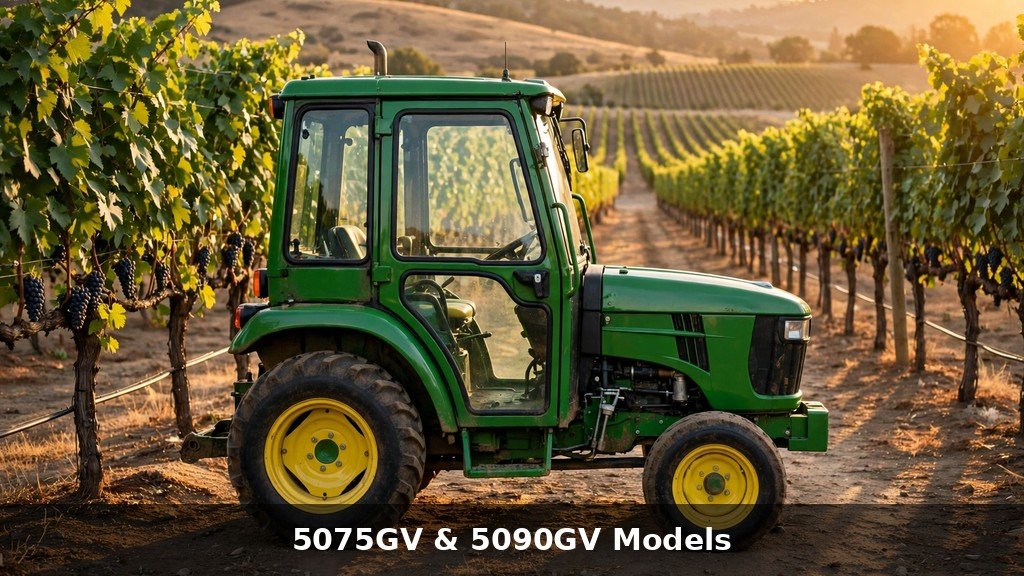
The 5075GV is the entry point, with 75 engine horsepower and 61 PTO horsepower, suited to smaller vineyards, lighter sprayers and mowers, and growers who spend most hours spraying, mowing, trimming, and hauling fruit within the rows. The 5090GV moves up to 90 engine horsepower and 78 PTO horsepower, which matters with a heavier air-blast sprayer, a larger mower, or on slopes. Both models use the same FPT 3.4-liter four-cylinder diesel, so the step up is a tune and calibration difference, not a different engine family, and dealer specification sheets for the 5075GV confirm the shared platform.
Intended use is where this John Deere 5GV Series review has to be blunt: these tractors are happiest between vine rows. The cab is 42.6 inches wide, minimum working width is 42.8 inches from rear tire to rear tire, and weight is 5,577 pounds open-station or 6,051 pounds with a cab. That narrow footprint and 11.9-foot turning radius let a 5GV turn at the headland and come straight back down the next row. The two-door cab helps when you stop constantly to check vines, with 22.1 inches between the consoles.
Standard equipment in this John Deere 5GV Series review covers the vineyard essentials: a 540/540E rear PTO, a Category 1 hitch convertible to Category 1N, and an open-center hydraulic system. On a used machine, look for the PowrReverser, the three-pump system, extra rear SCVs, and mid-mounted couplers; a 5GV so equipped is noticeably more capable than a base machine.
John Deere’s official 5G Series overview shows the narrow specialty tractors working in tight rows and explains the 5GN’s wider stance and tight turning circle, giving a useful sense of how the 5G family is built for narrow-row work.
Used Prices by Model Year, Hours and Equipment
Used 5GV pricing is thinner than for mainstream utility tractors, because fewer were sold and most stay put. The listings found for this John Deere 5GV Series review in October 2026: a 2019 5090GV with 923 hours listed in Canada at $57,600 Canadian, a 2023 5075GN with 29 hours listed in Oregon at $58,999, a higher-hour 2022 5090GN with 2,133 hours listed in the United States at $40,000, and a 2017 5090GN with 1,871 hours in Canada at CAD $44,900. Aggregator listings put a typical 5090GV around $69,423 and a 5075GV around $39,500, though those figures mix new and used stock.
From those data points, the estimated used price bands in this John Deere 5GV Series review look like this:
| Model | Older / higher-hour examples | Newer / low-hour examples |
|---|---|---|
| 5075GV | $30,000 – $45,000 | $50,000 – $65,000 |
| 5090GV | $40,000 – $55,000 | $55,000 – $70,000 |
| What moves the price most | Cab vs open station, PowrReverser vs SyncReverser, three-pump hydraulics, SCV count, tire condition, verified service history | |
Hours matter differently on a vineyard tractor: 2,000 hours of spraying and mowing is light loading compared with tillage work, while a machine from steep slopes with a heavy sprayer deserves a closer look at the clutch, brakes, and front axle. Cab machines command a premium, especially with working air conditioning and intact glass. Against a wider 5075E, remember it will not fit the same rows, so the price gap this John Deere 5GV Series review highlights buys row access, not just horsepower. The companion 5GV ownership cost guide covers fuel, maintenance, insurance, and resale in detail.
John Deere 5GV Series Engine, Horsepower and Specifications
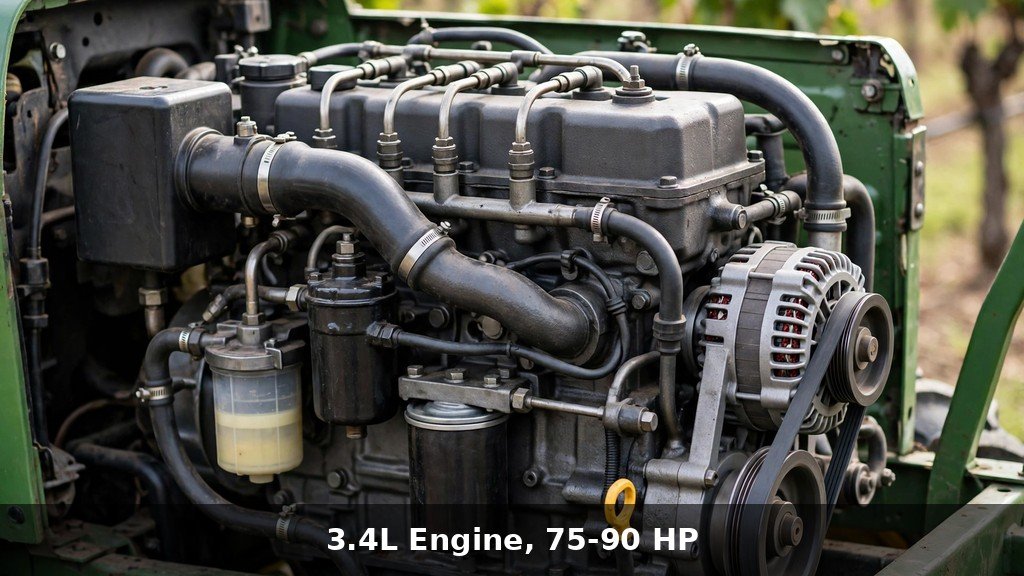
Both 5GV models share one engine, which is good news for parts and service. The engine at the heart of this John Deere 5GV Series review is the FPT Industrial F34, a 3.4-liter four-cylinder turbocharged diesel with common-rail injection and Final Tier 4 DOC/SCR aftertreatment, using diesel exhaust fluid from a 2.7-gallon DEF tank.
Engine Displacement, Rated HP, Torque and PTO Power
The numbers that matter in this John Deere 5GV Series review are straightforward. The 5075GV is rated at 75 horsepower (55.9 kW) at 2,300 rpm with 61 PTO horsepower, while the 5090GV is rated at 90 horsepower (67.1 kW) at 2,300 rpm with 78 PTO horsepower. Peak torque is 309 Nm (228 lb-ft) on the 5075GV and 366 Nm (270 lb-ft) on the 5090GV, with torque rise of 36 and 31 percent respectively. One caution: Deere’s base-machine sheet lists 78 PTO horsepower for the 5090GV, while some dealer sheets list 76 or 79 depending on the rating standard, so treat 78 as the working figure. TriGreen Equipment’s 5090GV page shows the same spread: 76 horsepower in its header, 79 horsepower SAE in its spec table.
Two engine features are worth understanding in this John Deere 5GV Series review before you buy. First, standard Economy PTO cuts engine rpm by about 15 percent in light PTO work, saving fuel on long spraying days. Second, the 90 horsepower model can be ordered with Intelligent Power Management, adding roughly 5.5 percent power for demanding PTO and transport work. For the full service schedule, see the companion 5GV maintenance guide.
| Specification | 5075GV | 5090GV |
|---|---|---|
| Engine | FPT F34, 4-cylinder turbo diesel | FPT F34, 4-cylinder turbo diesel |
| Displacement | 3.4 L (207.5 cu in.) | 3.4 L (207.5 cu in.) |
| Rated engine power | 75 hp (55.9 kW) at 2,300 rpm | 90 hp (67.1 kW) at 2,300 rpm |
| PTO power | 61 hp | 78 hp (some dealer sheets list 76–79 hp) |
| Peak torque | 309 Nm (228 lb-ft) | 366 Nm (270 lb-ft) |
| Torque rise | 36% | 31% |
| Emissions / aftertreatment | Final Tier 4, DOC/SCR | Final Tier 4, DOC/SCR |
| Engine oil change interval | 500 hours in earlier manuals; current 5G service table lists 750 hours — follow your own manual | |
Dimensions, Fuel Capacity, Hydraulic Flow and Working Width
The dimensions tell the story in this John Deere 5GV Series review better than the horsepower figures do. Minimum working width is 42.8 inches from rear tire to rear tire, cab 42.6 inches wide, wheelbase 82.5 inches, overall length 170 inches. Typical fitment is a 6.50R16 front and 260/70R16 rear.
Fuel capacity in this John Deere 5GV Series review is roughly 19 gallons (73 liters) on the 5090GV, with a 2.7-gallon DEF tank; some sheets list 19.9 gallons, so plan on 19. That suits vineyard work near the farm. Hydraulic flow is 25.5 gpm standard, rising to 33.4 gpm with the optional three-pump system (7.9 steering/transmission, 17.6 SCVs/hitch, 7.9 rockshaft). A single rear SCV delivers 11 gpm, enough for most vineyard sprayer and mower motors.
John Deere 5GV Series Transmission and Implement Compatibility
A vineyard tractor lives or dies by its transmission, because spraying and mowing demand exact ground speeds, constant row-end changes, and long hours at low speed. The choice this John Deere 5GV Series review flags as the most important option decision is between the 5GV’s two transmissions, both available on either model.
SyncReverser and PowrReverser Transmission Options
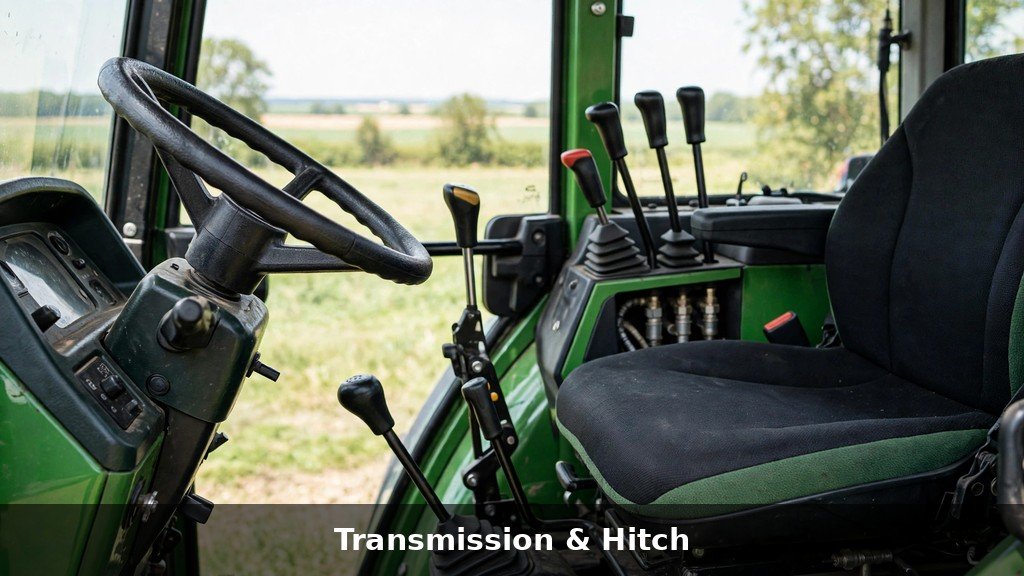
The standard transmission is a 12-forward, 12-reverse SyncReverser, a mechanical shuttle for growers who set a speed. The optional 24-forward, 12-reverse PowrReverser adds an electrohydraulic Hi-Lo splitter, a wet multi-disc clutch, and a creeper range, spanning 0.5 to 40 km/h (0.3 to 24.9 mph). Push-button Hi-Lo shifting lets the operator nudge speed without touching the clutch, and the left-hand reverser lever makes row-end changes quick. An engagement override valve requires the clutch pedal to be pressed once after each start, and a neutral-start switch requires the reverser in neutral before starting.
Which one should you buy? For most vineyard spraying and mowing, this John Deere 5GV Series review leans toward the PowrReverser, because the creeper range and Hi-Lo splitter let you match ground speed to the sprayer or mower precisely. The SyncReverser is simpler and cheaper, and adequate for hauling and light chores. One note for used buyers in this John Deere 5GV Series review: one dealer page describes the PowrReverser as standard, while spec tables across the dealer network list the SyncReverser as standard with the PowrReverser as an option. Assume SyncReverser is standard and verify it on any machine before paying a premium. Fuel use differences are covered in the companion 5GV performance and fuel guide.
PTO, Three-Point Hitch, Mid-Mount Implements and Hydraulic Connections
The rear PTO is a standard 540/540E setup with electrohydraulic engagement, giving 540 rpm at 1,938 engine rpm and 540E at 1,648 engine rpm. The 540E economy mode, used most for spraying, holds PTO speed at lower engine rpm and cuts fuel use and noise. The three-point hitch is Category 1, convertible to Category 1N, with a maximum lift of 5,710 pounds at the ball ends (5,620 pounds behind the lift points), top-link draft sensing, and fixed, adjustable, or quick-coupler ball ends.
Hydraulic connections are where a well-optioned 5GV earns its keep. Two rear SCVs are standard, with up to four available, all mechanically controlled, and the three-pump system keeps steering oil separate from implement oil. Mid-mounted couplers are a factory option for front mowers and undervine tools; confirm they are fitted if you plan to run a front-mounted implement. The implement world in this John Deere 5GV Series review is smaller than that of the big track tractors in Deere’s lineup, such as the 9RX 590, but it is exactly matched to vineyard implements, which is the point.
John Deere 5GV vs. 5GN and 5GF Tractors
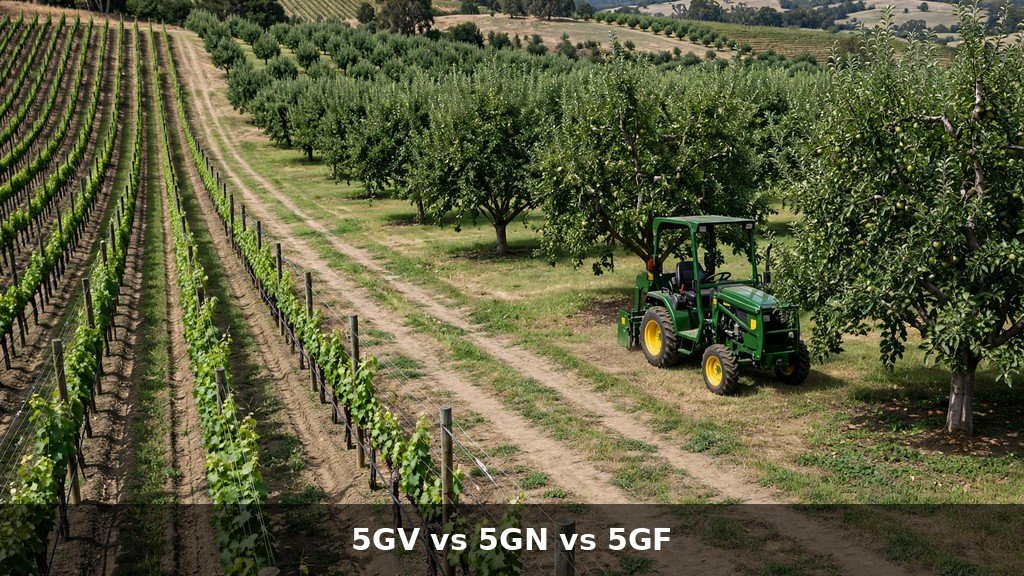
The 5G family has three width personalities, and this John Deere 5GV Series review sorts them by letter: the 5GV is the vineyard machine, the 5GN is the narrow orchard machine, and the 5GF is the wide-orchard machine in Deere’s global lineup. Specialty naming varies by market and model year, so confirm which designation your dealer uses. In the United States, buyers will more often see the 5GL low-profile orchard model in place of the 5GF. The right choice starts with a tape measure, not a horsepower chart.
Differences in Width, Turning and Crop Applications
The width differences in this John Deere 5GV Series review are stark. The 5GV works down to a 42.8-inch minimum working width with a 42.6-inch cab, built for tightly planted vineyards. The 5GN steps out to a 49.5-inch working width with a 50.2-inch cab for narrow orchards and wider vineyards, and adds a 100 horsepower 5100GN. The 5GF, in the global lineup, is the wide-orchard tractor for row spacing of 2,500 to 6,000 mm, while the US-market 5GL low-profile model stands about 53.5 inches tall and 60 inches wide. Both turn in 11.9 feet, so the 5GV’s advantage is its width, not its turning circle.
The 5GN uses a standard Category 2 hitch, can be fitted with an extra lift cylinder raising maximum lift to 6,834 pounds at the ball ends against the 5GV’s 5,710 pounds, and offers the 7.5-gallon auxiliary tank the 5GV does not. The 5GL is open-station only, suiting low-branch work but ruling it out for growers who want a cab. All three share the same engine family and transmissions (oil interval: 500 hours in earlier manuals, 750 hours in the current 5G service table — follow your own manual), so the decision is about fit. Deere’s original 5G Series launch announcement framed the lineup the same way.
| Model | Best crop fit | Working width / cab width | Engine options | Standout difference |
|---|---|---|---|---|
| 5GV | Tightly planted vineyards | 42.8 in. min / 42.6 in. cab | 75, 90 hp | Narrowest in the family |
| 5GN | Narrow orchards, wider vineyards | 49.5 in. / 50.2 in. cab | 75, 90, 100 hp | Cat 2 hitch, optional extra lift to 6,834 lb |
| 5GF | Wide orchards (global lineup) | Row spacing 2,500–6,000 mm | 75, 90 hp (global range wider) | Widest stance in the family |
| US note: 5GL | Low orchards, pergola crops | About 60 in. wide, 53.5 in. tall | 75 hp | Open station only, no cab option |
Which Specialty Tractor Fits Your Vineyard or Orchard?
Start by measuring your rows. If the gap between vine trunks is under 45 inches, the 5GV is the answer, and wider machines are simply not an option regardless of price. If your rows run 48 to 60 inches, the 5GN is the better buy: a roomier cab, a Category 2 hitch, and the 100 horsepower 5100GN if you need it. For wide orchard rows, look at the 5GF globally or the 5GL in the United States, and if your canopy hangs low, the 5GL’s low profile matters more than horsepower. Growers whose rows fit a standard utility tractor should also compare a 5M or a 5090M, which bring loader capability and versatility the specialty tractors cannot match.
One more practical point from this John Deere 5GV Series review: buy the narrowest tractor that fits your rows, not the widest you can afford. A 5GV in rows it fits will outwork a wider tractor brushing vines on every pass, and vine damage costs more per season than any horsepower advantage repays. Conversely, a 5GV bought for rows it barely fits, with the wrong tires, will disappoint, so confirm width with the tires fitted, not the brochure figure.
John Deere 5GV Series Review FAQs
The questions vineyard and orchard buyers ask most often, answered from the specifications and listings covered in this John Deere 5GV Series review.
What is the John Deere 5GV Series?
The 5GV Series is John Deere’s vineyard specialty line within the 5G Final Tier 4 family: the 5075GV and the 5090GV, built for narrow vineyard rows.
What is the difference between the 5075GV and the 5090GV?
Power: the 5075GV has 75 engine horsepower and 61 PTO horsepower, while the 5090GV has 90 and 78. Both share the same engine, chassis, and transmissions.
How wide is the John Deere 5GV Series?
Minimum working width is 42.8 inches from rear tire to rear tire, and the cab is 42.6 inches wide. Actual width depends on tires fitted, so measure the specific machine.
What engine does the 5GV Series use?
Both models in this John Deere 5GV Series review use an FPT Industrial F34 four-cylinder turbocharged diesel, 3.4 liters, with common-rail injection and Final Tier 4 DOC/SCR aftertreatment.
How much torque does the 5GV produce?
Peak torque is 309 Nm (228 lb-ft) on the 5075GV and 366 Nm (270 lb-ft) on the 5090GV, with torque rise of 36 and 31 percent respectively.
What transmissions are available on the 5GV?
A 12-forward, 12-reverse SyncReverser is standard; a 24-forward, 12-reverse PowrReverser with Hi-Lo and a creeper range is optional. The two transmissions in this John Deere 5GV Series review span 0.5 to 40 km/h with the PowrReverser.
What is the fuel capacity of the 5GV Series?
The 5090GV carries roughly 19 gallons (73 liters) of diesel, plus a 2.7-gallon DEF tank. Some sheets list 19.9 gallons, so plan on about 19.
What is the hydraulic flow on the 5GV?
Standard flow is 25.5 gpm, rising to 33.4 gpm with the optional three-pump system. Two rear SCVs are standard, with up to four available.
Does the 5GV have a cab option?
Yes, both models offer a cab or an open operator station. Cab machines weigh 6,051 pounds against 5,577 pounds for the open station.
What is the turning radius of the 5GV?
The turning radius without brakes is 11.9 feet (3,627 mm), making headland turns in narrow vineyards practical without repeated shunting.
How much does a used John Deere 5GV cost?
Based on the listings gathered for this John Deere 5GV Series review, older or higher-hour 5075GV examples run roughly $30,000 to $45,000 and 5090GV examples roughly $40,000 to $55,000, while newer or low-hour machines run roughly $50,000 to $70,000.
Is the 5GV better than the 5GN?
Neither is better in absolute terms. This John Deere 5GV Series review judges by row width: the 5GV fits tighter rows, while the 5GN offers a roomier cab, a Category 2 hitch, and 100 horsepower.
What is the difference between the 5GV and the 5GF?
The 5GF is the wide-orchard sibling in Deere’s global lineup, for row spacing of 2,500 to 6,000 mm, while the 5GV is the narrow vineyard tractor. Naming varies by market and model year, and in the United States the low-profile orchard role is more often filled by the 5GL.
What implements work with a 5GV?
Vineyard sprayers, mowers, trimmers, undervine tools, trailers, and fruit-handling equipment all suit the 5GV, using the 540/540E PTO, the Category 1 hitch, and up to four rear SCVs. Mid-mounted couplers are optional for front implements.
Is the 5GV a good first vineyard tractor?
For rows under 45 inches, this John Deere 5GV Series review says yes: it is one of the few tractors in the 75 to 90 horsepower class that fits. For wider rows, a wider utility tractor is usually the better value.
The verdict from this John Deere 5GV Series review is simple. If your rows demand it, the 5GV is nearly the only option in its class. If they do not, spend the same money on a wider machine with a loader. Measure your rows, check the transmission and hydraulics on the specific machine, verify the service history, and buy the narrowest tractor that fits your work.