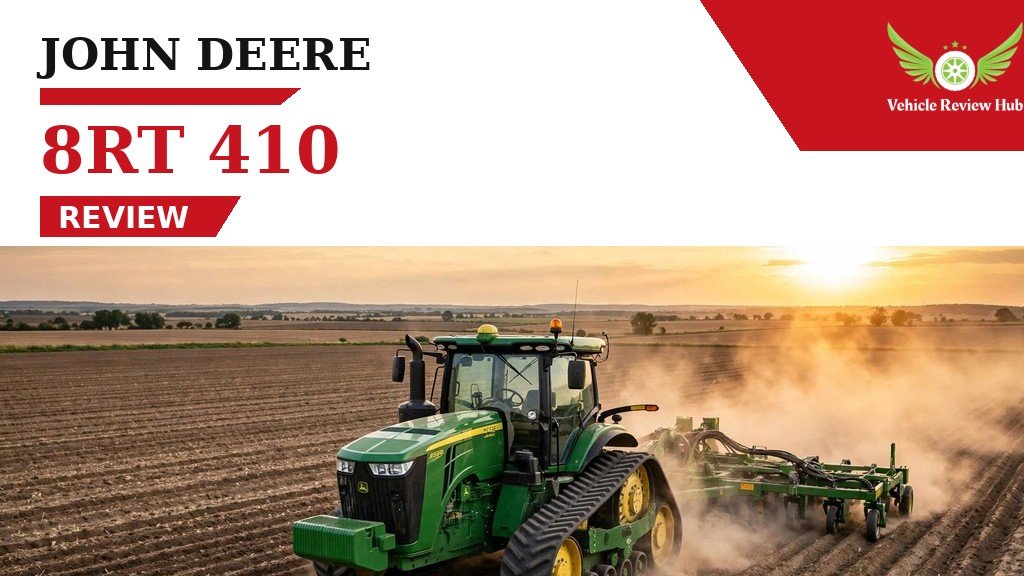
The short answer in this John Deere 8RT 410 review is that the 8RT 410 is the two-track flagship of John Deere’s 8 Family row-crop range: a 410-horsepower tracked tractor built for large farms that need maximum drawbar pull and low ground pressure without stepping up to a heavier articulated machine. This John Deere 8RT 410 review covers the full specification, the two transmission choices, track options, and what used examples actually sell for in the United States.
One framing note for this John Deere 8RT 410 review: the 8RT 410 is a current model, so most used examples are young and low-hour. Where a figure comes from Deere dealer specification pages, this John Deere 8RT 410 review says so, and where used-market evidence is thin, the price bands below are labeled planning estimates.
John Deere 8RT 410 Review, Features and Used Price
The 8RT 410 tops John Deere’s two-track lineup, above the 8RT 310, 340, and 370, and shares its cab, engine, and transmissions with the wheeled 8R 410 and the four-track 8RX 410. This section of the John Deere 8RT 410 review looks at the model’s history, the two-track design, and the used market.
Model History, Two-Track Design and Main Features
John Deere’s two-track 8RT line predates the 410-horsepower rating: before model year 2020, the largest two-track 8RT offered 370 engine horsepower. For 2020, Deere added a 410-horsepower option across the 8R family, making the 8RT 410 the largest two-track row-crop tractor in the range. That history matters to buyers reading this John Deere 8RT 410 review, because a “two-track 410” is a 2020-or-newer machine by definition.
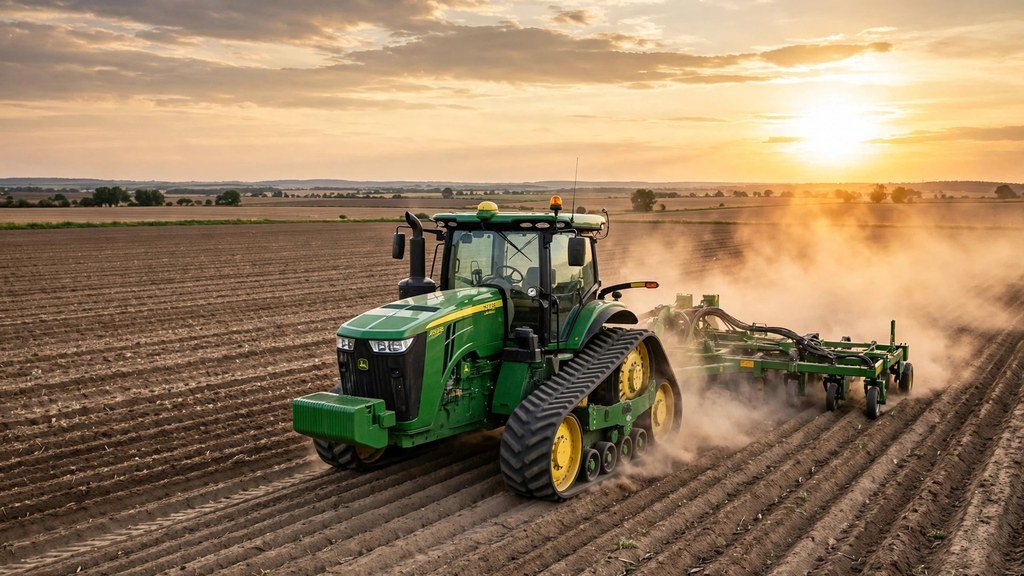
The two-track design is the whole point of this John Deere 8RT 410 review. Instead of wheels, the tractor rides on two wide rubber track belts driven by a friction-drive system, with Deere’s AirCushion suspension. Two tracks give a very long ground-contact patch, which is why Deere’s product staff have long argued that a two-track machine is hard to out-pull: more engine power reaches the ground as drawbar pull, with low slip. The trade-off, noted honestly in this John Deere 8RT 410 review, is steering behavior — turning pivots the whole chassis, and sharp headland turns can berm soil in loose conditions, something the four-track 8RX was designed to reduce.
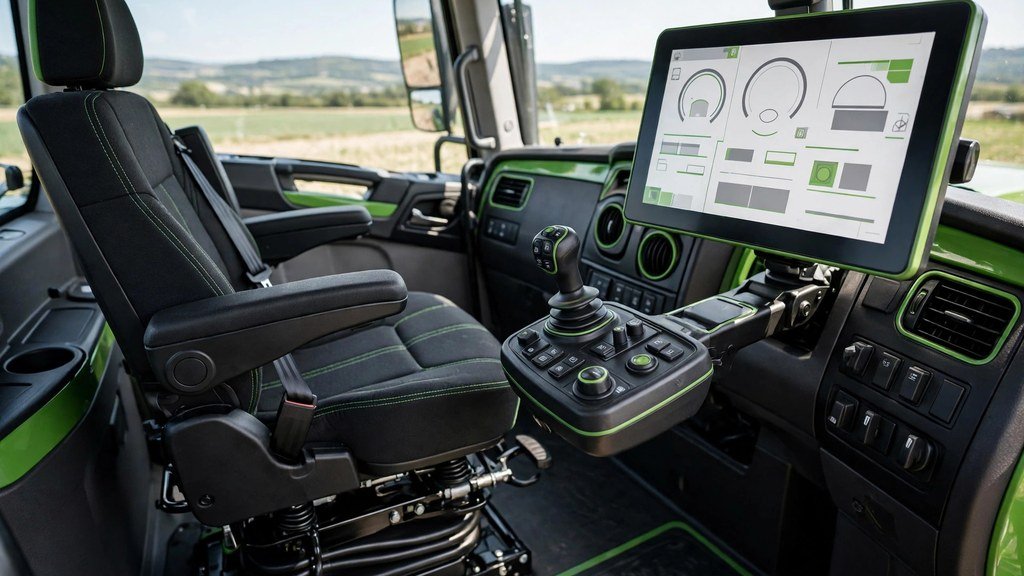
Comfort is a genuine selling point in this John Deere 8RT 410 review. The 8RT uses a four-post cab suspension on top of the chassis AirCushion system, and the cab offers 114 cubic feet of interior volume with an air-suspension seat that swivels 25 degrees left and 40 degrees right. Integrated AutoTrac guidance and JDLink telematics hardware are standard on the tractor in this John Deere 8RT 410 review, so it arrives ready for precision work. Display hardware varies by model year — Generation 4 CommandCenter on earlier examples, G5 Plus on newer listings — so check the screen on any specific tractor.
The video below is John Deere’s official walkaround of the updated 8 Family, covering the wheeled 8R, the two-track 8RT, and the four-track 8RX together — a family overview rather than an 8RT 410-only film:
Used Prices by Hours, Track Condition and Equipment
Used 8RT 410 prices in this John Deere 8RT 410 review are anchored to a small number of real listings, because the model is young and few used examples change hands each year. The strongest 8RT-specific anchor is a 2024 8RT 410 with 237 hours, EVT, 24-inch tracks, and guidance equipment, listed at $509,900 by a central Illinois dealer. That single listing sets the top of the used market described in this John Deere 8RT 410 review: a nearly new, fully equipped 8RT 410 still commands over half a million dollars.
For context in this John Deere 8RT 410 review, wheeled siblings run in the same territory: a 2025 8R 410 with 251 hours listed at $502,000, and another with 665 hours at $485,900 — a cross-check that the 8RT anchor is not an outlier. Track condition moves the price more on the 8RT 410 in this John Deere 8RT 410 review than tires do on a wheeled tractor, because replacement track belts are a major expense.
Given the thin listing evidence, the bands below are planning estimates in this John Deere 8RT 410 review, not verified market averages. Expect nearly new, low-hour (under 500 hours) examples roughly from $450,000 to $510,000 and above when fully equipped with EVT, guidance, and wide tracks, and mid-hour examples (roughly 1,000 to 3,000 hours) roughly from $300,000 to $450,000 depending on track life, transmission, and guidance package. Older or high-hour 8RT 410 tractors are still rare, so any example below $300,000 deserves a hard look at track wear and service history. New-tractor pricing is quoted by dealers on application, so this John Deere 8RT 410 review does not state a single new MSRP.
| Used 8RT 410 example | Hours | Price evidence |
|---|---|---|
| 2024 8RT 410, EVT, 24-in. tracks (dealer listing) | 237 | $509,900 listed |
| Planning band, low-hour 8RT 410 | Under 500 | Roughly $450,000–$510,000+ |
| Planning band, mid-hour 8RT 410 | 1,000–3,000 | Roughly $300,000–$450,000 |
John Deere 8RT 410 Engine, Horsepower and Specifications
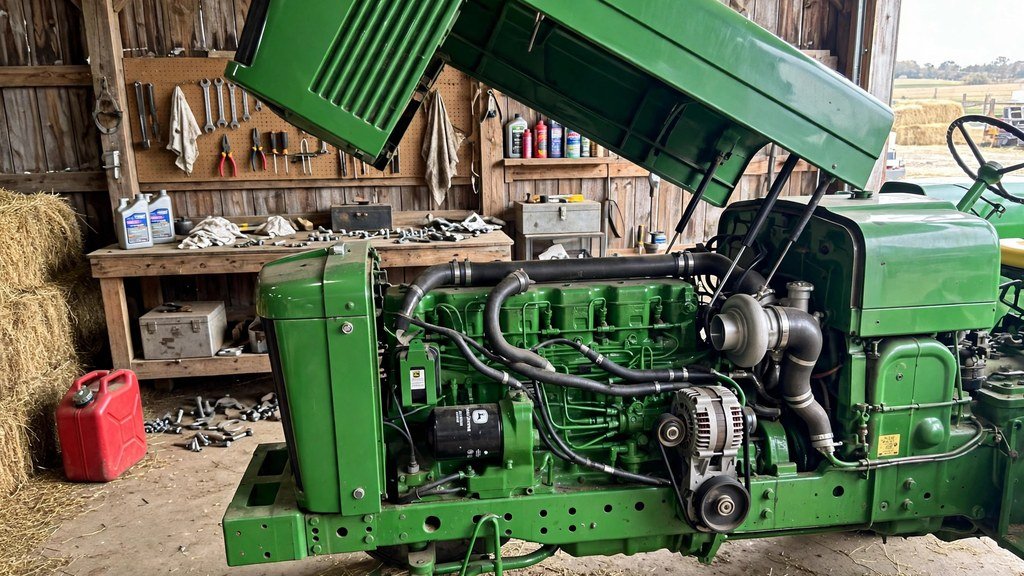
The engine is the heart of any John Deere 8RT 410 review: 410 rated horsepower from a 9.0-liter six-cylinder diesel, rising to 443 horsepower maximum, with 310 horsepower at the PTO, a 40 percent PTO torque rise, and a torque peak at just 1,600 rpm.
9.0L PowerTech Diesel, Rated Power and Maximum HP
The 8RT 410 uses the John Deere PowerTech PSS 9.0L engine: an inline six-cylinder, four-valve diesel of 9.0 liters (549 cubic inches) with wet-sleeve liners, dual turbochargers — a variable-geometry turbo in series with a fixed-geometry turbo — air-to-air aftercooling, and cooled exhaust-gas recirculation. Emissions compliance is Final Tier 4 through DOC/DPF/SCR aftertreatment, and the engine is B20 biodiesel compatible. Rated power is 410 horsepower (302 kW) at 2,100 rpm under ECE-R120, maximum power 443 horsepower (326 kW) with an 8 percent power boost, rated PTO power 310 horsepower SAE, and peak torque 1,365 lb-ft (1,851 Nm) at 1,600 rpm with a 40 percent PTO torque rise.
One honesty note in this John Deere 8RT 410 review: no Nebraska or OECD test report specific to the 8RT 410 was retrievable during research, so this article quotes no independently tested PTO, drawbar, or fuel figures for this exact model. Every power figure above in this John Deere 8RT 410 review is the manufacturer’s rated figure from dealer specification pages, not a laboratory test result. Treat any seller-quoted “tested” figure for an 8RT 410 with caution unless a report number is produced. The fuel use under different loads is covered in more depth in the performance figures.
Fuel Capacity, Hydraulic Flow, Hitch Lift and Tractor Weight
Fuel capacity is generous: the 8RT 410 carries 202 US gallons of diesel, with an 8.3-gallon DEF tank for the SCR system. Other capacities on the dealer specification sheet: 6.8 gallons of crankcase oil, a 52-gallon transmission-hydraulic system, and an 11.2-gallon cooling system (12.4 with EVT).
Hydraulics are a strong point in this John Deere 8RT 410 review. The closed-center, pressure- and flow-compensated system with load sensing uses a standard 85-cc pump rated at 60 gallons per minute, with a dual-pump option. At a single rear SCV, flow is 35 gallons per minute through half-inch couplers and 42 through the three-quarter-inch coupler. Rear hitch capacity is Category 4N/3, rated at 20,000 pounds of standard lift at 24 inches behind the hitch point (15,000-pound optional configuration); dealer tables also list a maximum lift capacity of 26,729 pounds behind the lift points. Base machine weight in this John Deere 8RT 410 review, with the e23 transmission and 25-inch tracks, is 34,400 pounds, with a maximum ballast level of 39,000 pounds and a maximum permissible weight of 40,100 pounds.
| Specification (dealer spec) | John Deere 8RT 410 |
|---|---|
| Engine | PowerTech PSS 9.0L, inline 6, 549 cu in., dual turbo, FT4 DOC/DPF/SCR |
| Rated engine power | 410 hp (302 kW) at 2,100 rpm; max 443 hp (326 kW) |
| Rated PTO power | 310 hp SAE; peak torque 1,365 lb-ft at 1,600 rpm |
| Fuel / DEF | 202 gal diesel; 8.3 gal DEF |
| Hydraulic pump | 85-cc pump, 60 gpm standard; dual-pump option |
| Hitch lift | Cat 4N/3, 20,000 lb std at 24 in. (15,000 lb opt); max 26,729 lb |
| Base weight | 34,400 lb (e23, 25-in. tracks); max ballast 39,000 lb |
John Deere 8RT 410 Transmission and Implement Compatibility
Transmission choice changes how the 8RT 410 feels most: the e23 PowerShift as standard and the eAutoPowr EVT as the stepless option. This section of the John Deere 8RT 410 review compares them and covers the PTO, hitch, SCVs, and track widths.
e23 PowerShift vs. eAutoPowr EVT
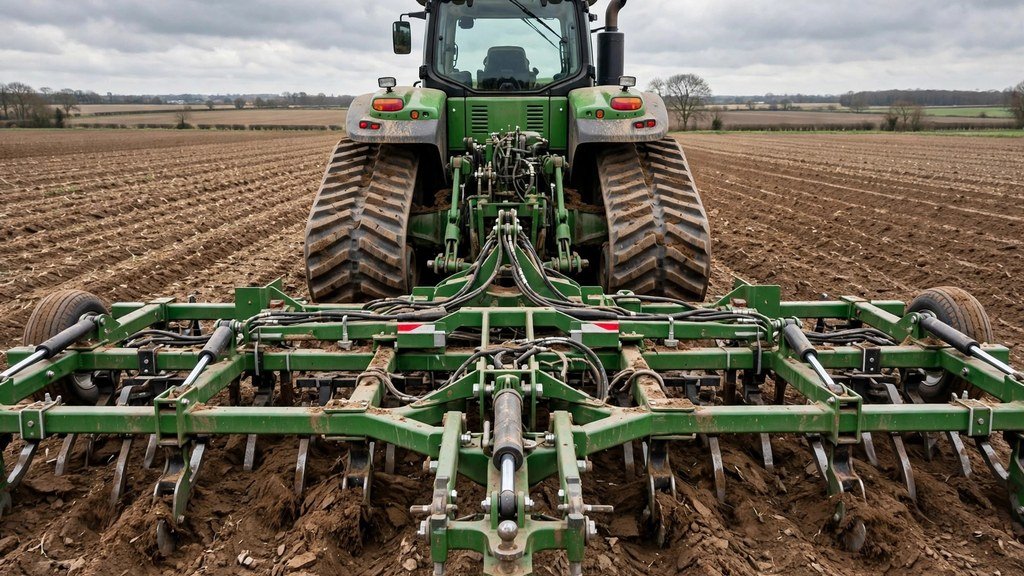
The standard transmission in this John Deere 8RT 410 review is the e23 PowerShift with Efficiency Manager, rated 40K — a 24.9 mph top road speed. The e23 name reflects its 23 forward speeds, and Deere’s product staff have emphasized that every gear uses the same ratio split, so there is no jump between gear packs and shifts stay seamless. Efficiency Manager matches gear and engine speed to the load, keeping the engine near its efficient range during draft work and dropping rpm for transport. For operators who like a conventional powershift feel and a lower purchase price, the e23 is the natural pick in this John Deere 8RT 410 review.
The optional eAutoPowr EVT in this John Deere 8RT 410 review replaces stepped gears with stepless, electrically driven speed control from 0.03 to 26 mph. That matters most where exact speed holds yield — planting, spraying, and variable-rate application. The EVT also pairs with Deere’s CommandPRO lever on equipped models, putting speed, direction, and implement control in one hand control. The trade-off in this John Deere 8RT 410 review is simple: the EVT costs more and adds electrical complexity, while the e23 is simpler, cheaper, and proven for straight draft work. Either transmission suits the 410-horsepower engine in this John Deere 8RT 410 review; the choice should follow the work mix, not the badge. What to inspect on either gearbox before paying is listed in the pre-purchase checklist.
| Transmission | Speed range | Best for |
|---|---|---|
| e23 PowerShift (standard) | 23 speeds, 40K / 24.9 mph | Draft work, transport, lower purchase price |
| eAutoPowr EVT (optional) | Stepless, 0.03–26 mph | Planting, spraying, precise speed control |
Rear PTO, Category 4 Hitch, SCVs and Track Options
The rear PTO in this John Deere 8RT 410 review is independent with electrohydraulic engagement: standard 1,000 rpm on a 1.75-inch 20-spline shaft, with an optional 1,000E economy speed, both shiftable from the cab on equipped models. Engine speeds at rated PTO output are 1,995 rpm for 1,000 rpm PTO and 1,590 rpm for 1,000E. The Category 4 drawbar on the tractor in this John Deere 8RT 410 review carries a 4,950-pound standard vertical load, rising to 11,000 pounds with the heavy-duty support option.
Hydraulic connections in this John Deere 8RT 410 review are generous for the class: four rear SCVs with half-inch ISO couplers are standard, with five and six SCV options available, plus one three-quarter-inch coupler for high-flow implements, all with electronic control. Track options are where an 8RT buyer makes the most consequential choice in this John Deere 8RT 410 review: standard tracks are 25 inches wide, with 16.5-, 18-, 24-, and 30-inch widths available, on Camso AG 4500 friction-drive belts with three mid-rollers per side and tread spacing adjustable from 72 to 120 inches. Narrow tracks suit row-crop work; wide tracks suit soft ground and maximum flotation. A used tractor’s track width is fixed at purchase, so it should match the buyer’s row spacing and soil.
John Deere 8RT 410 vs. 8R 410 and 8RX 410
The 8RT 410 does not stand alone in this John Deere 8RT 410 review: it shares its engine, cab, and transmissions with two siblings that differ only in how they meet the ground — the wheeled 8R 410 and the four-track 8RX 410.
Two-Track vs. Wheeled and Four-Track Design
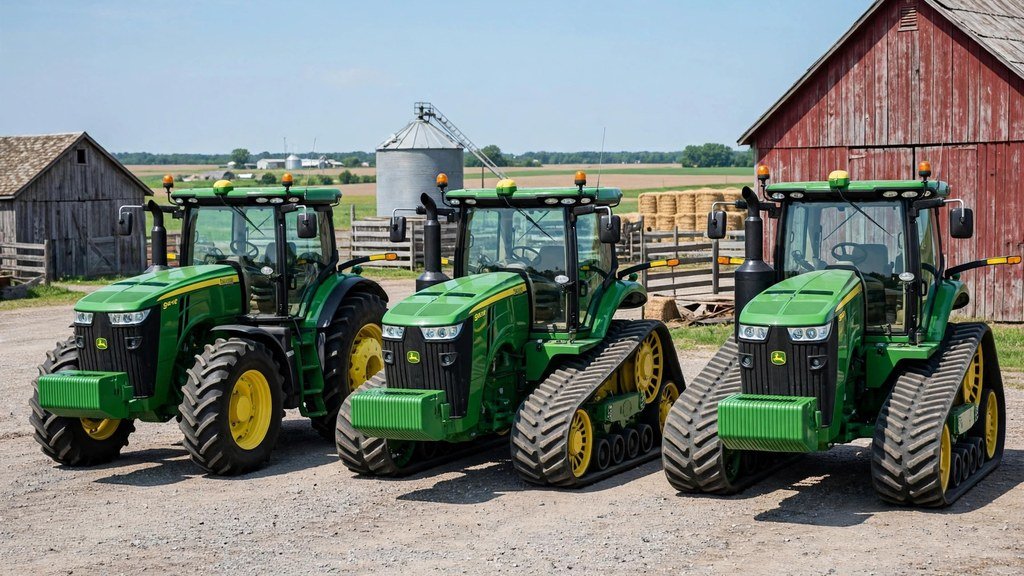
All three 410 models in this John Deere 8RT 410 review use the same 9.0-liter PowerTech engine at 410 rated horsepower, the same e23 or eAutoPowr transmissions, and the same cab and guidance package — the difference is entirely in the running gear. The wheeled 8R 410 is the most familiar to operate and the cheapest to buy and maintain, but even with duals its ground pressure and slip are higher than either tracked model. The two-track 8RT 410 delivers the strongest straight-line pull of the three for its weight, because two long tracks put a huge contact patch down. The four-track 8RX 410, introduced with the 2020 lineup as the industry’s first rigid-frame four-track tractor, splits the difference: four independent tracks give a larger footprint and lower ground pressure than the 8RT, and because only the front modules steer, it handles headland turns much like a wheeled tractor, with far less berming.
Weight tells part of the same story in this John Deere 8RT 410 review. The 8RT 410’s base weight of 34,400 pounds, noted in this John Deere 8RT 410 review, sits between the lighter wheeled 8R and the heavier four-track 8RX. The four-track machine’s launch coverage describes the 8RX as a ground-up design rather than an 8R with tracks bolted on; the same applies in reverse to the 8RT, a dedicated two-track chassis, not a wheeled tractor with a track kit.
Which Tractor Configuration Fits Your Farm?
Choose the wheeled 8R 410 for mixed work and the lowest cost — the verdict of this John Deere 8RT 410 review for mixed farms. Choose the 8RT 410 for long, straight draft work — primary tillage, heavy planting, and wide implements where maximum drawbar pull matters. Choose the 8RX 410 if you need tracked flotation but turn constantly or work soft ground. Condition matters more than the badge in this John Deere 8RT 410 review: a clean, documented 8RT 410 with good belts beats a tired 8RX every time. The running costs and resale picture are broken down in the ownership figures.
John Deere 8RT 410 Review: Frequently Asked Questions
These are the questions buyers actually ask about the 8RT 410, answered from the specifications, model history, and used-market evidence in this John Deere 8RT 410 review.
How much horsepower does a John Deere 8RT 410 have?
A John Deere 8RT 410 review starts with 410 rated engine horsepower at 2,100 rpm, 443 horsepower maximum, and 310 PTO horsepower SAE from the 9.0-liter PowerTech diesel.
What engine does the John Deere 8RT 410 have?
The PowerTech PSS 9.0L: an inline six-cylinder diesel of 9.0 liters (549 cubic inches) with dual turbochargers, wet-sleeve liners, and Final Tier 4 DOC/DPF/SCR aftertreatment.
When was the John Deere 8RT 410 introduced?
The 410-horsepower rating joined the two-track 8RT line for model year 2020, the key date in this John Deere 8RT 410 review; before that, the largest 8RT offered 370 horsepower. Any genuine 8RT 410 is therefore a 2020-or-newer tractor.
What transmissions are available on the 8RT 410?
Two in this John Deere 8RT 410 review: the standard e23 PowerShift with 23 speeds and a 24.9 mph top speed, and the optional eAutoPowr EVT with stepless speed control from 0.03 to 26 mph.
How much can an 8RT 410 lift on the three-point hitch?
The Category 4N/3 hitch in this John Deere 8RT 410 review is rated at 20,000 pounds of standard lift at 24 inches behind the hitch point, with a 15,000-pound optional configuration, and dealer tables list a maximum lift capacity of 26,729 pounds behind the lift points.
How big is the fuel tank on a John Deere 8RT 410?
The diesel tank holds 202 US gallons and the DEF tank holds 8.3 gallons, per the dealer specification sheet quoted in this John Deere 8RT 410 review.
What track widths are available on the 8RT 410?
Standard tracks in this John Deere 8RT 410 review are 25 inches wide, with 16.5-, 18-, 24-, and 30-inch widths available, on Camso belts with 72-to-120-inch tread spacing.
How much does a used John Deere 8RT 410 cost?
As planning bands in this John Deere 8RT 410 review, nearly new low-hour examples run roughly $450,000 to $510,000 and above, and mid-hour examples roughly $300,000 to $450,000. A 2024 example with 237 hours was listed at $509,900.
Is there a Nebraska test for the 8RT 410?
No Nebraska or OECD test report specific to the 8RT 410 was retrievable for this John Deere 8RT 410 review, so no independently tested figures are quoted for this exact model.
Should I buy an 8RT 410, an 8R 410, or an 8RX 410?
Buy the wheeled 8R 410 for mixed work and the lowest cost, the two-track 8RT 410 for maximum straight-line pull, and the four-track 8RX 410 for tracked flotation with wheeled-tractor handling on headlands.
What warranty does a John Deere 8RT 410 carry?
Deere’s standard agricultural base warranty, noted in this John Deere 8RT 410 review, is 24 months or 2,000 hours, with extended PowerGard coverage available through the dealer. Confirm remaining coverage on any used tractor.
Is the John Deere 8RT 410 still in production?
Yes, per this John Deere 8RT 410 review. The 8RT 410 remains in Deere’s current 8 Family lineup, with the updated 8 Series generation announced in June 2026 continuing the 310-to-410-horsepower two-track range.
The bottom line of this John Deere 8RT 410 review: the 8RT 410 is the strongest-pulling tractor in the 8 Family, with a proven 9.0-liter engine, a choice between a simple powershift and a stepless EVT, and a two-track chassis that turns engine power into drawbar pull better than wheels can. Buy it for long, straight, heavy work — and buy on track condition and service records, not on the badge alone.