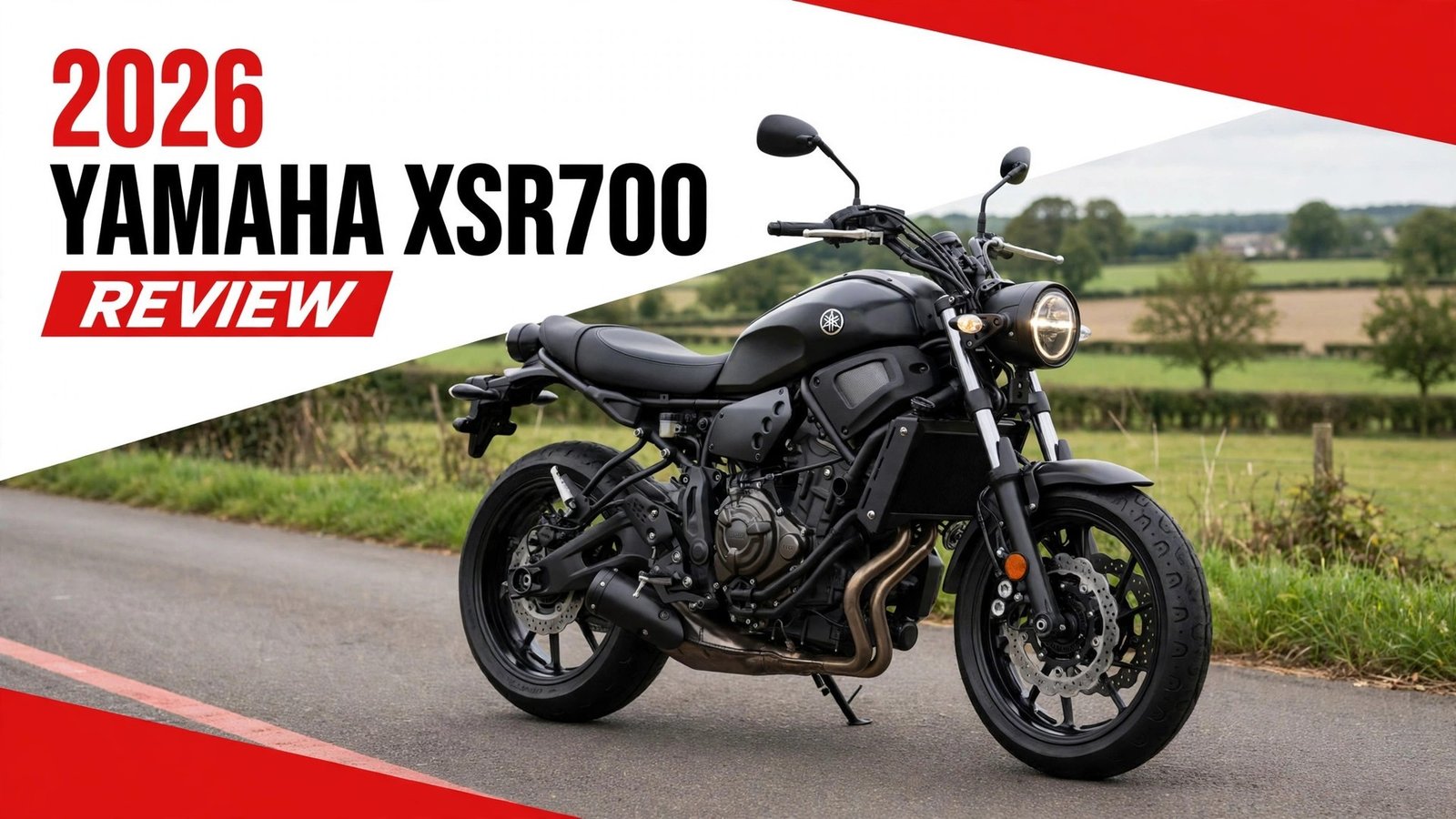
The Yamaha XSR700 is Yamaha’s retro middleweight done right, and this Yamaha XSR700 review answers the questions buyers ask first: what it costs, what its 689cc twin delivers, and whether the heritage look beats the sharper MT-07. This Yamaha XSR700 review covers the 2018 US launch, the 2022 update that brought LED lighting and bigger brakes, and the 2026 price and colours, The short version: at $8,599 for 2026, this Yamaha XSR700 review finds a stylish, honest motorcycle that trades modern electronics for character and simplicity — and for the right rider, that trade is the whole point.
Yamaha XSR700 Overview and Model-Year Updates
The XSR700 has always been the thinking rider’s alternative in Yamaha’s middleweight lineup, and this Yamaha XSR700 review traces how it grew from a European retro into a regular US model. This Yamaha XSR700 review follows three stages: the 2016 European launch, the 2018 American arrival, and the 2022 update.
What Is the Yamaha XSR700 and Who Is It Designed For?
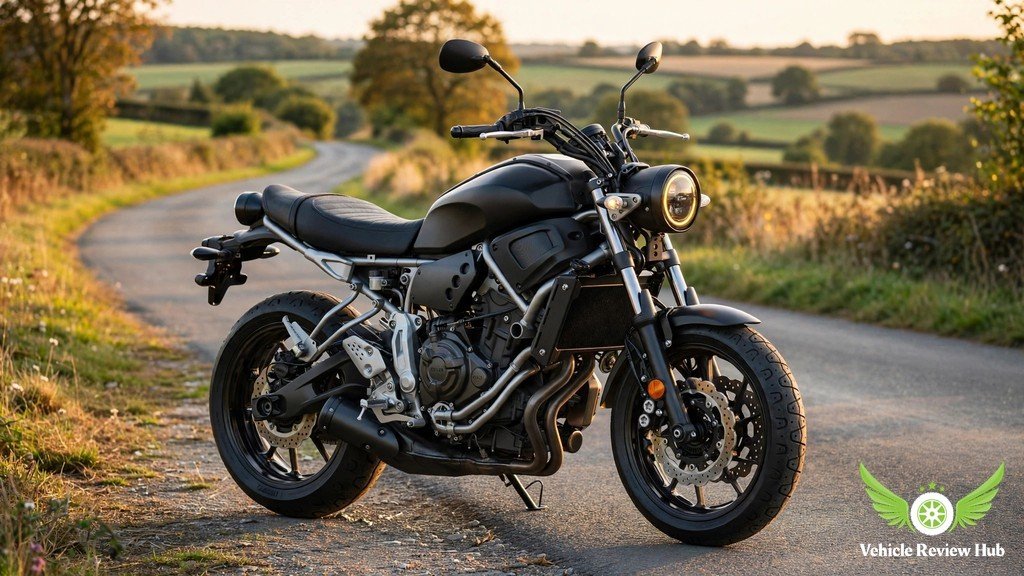
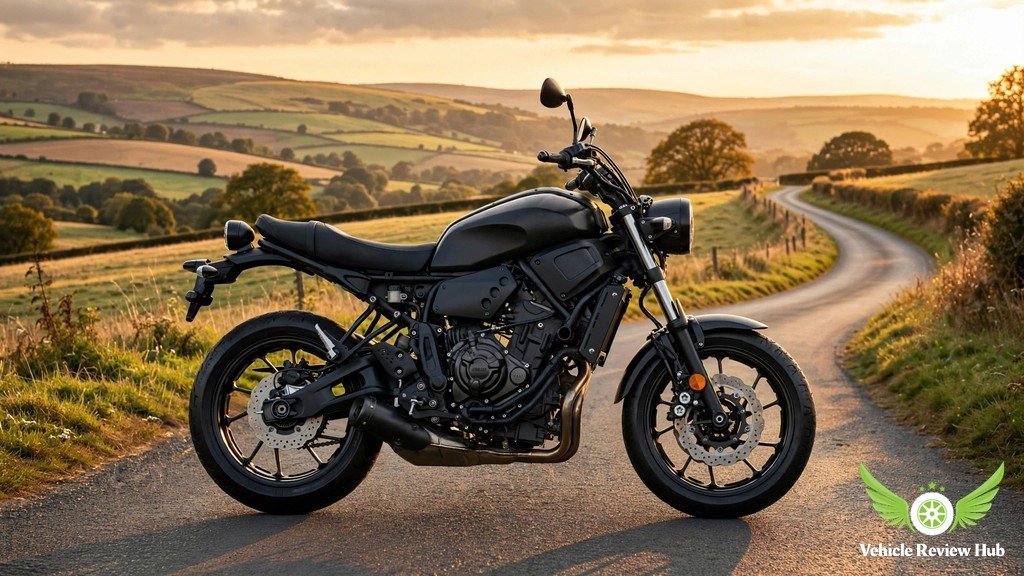
The XSR700 is Yamaha’s Sport Heritage middleweight: a naked motorcycle that takes the MT-07’s proven 689cc CP2 twin and chassis and dresses them in retro-inspired bodywork — round headlight, stepped seat, exposed aluminium details. It is designed for riders who want modern performance without modern-looking bodywork, and this Yamaha XSR700 review rates that positioning as the bike’s whole point. It suits experienced riders, returning riders and customisers. It is also one of the friendliest bikes in its class for newer riders moving up from a small motorcycle, though this Yamaha XSR700 review is plain that 74 horsepower in a 410 lb chassis still deserves respect. The standard MT-07 review covers the sharper, more aggressive sibling for riders who prefer that character.
Europe 2016, US Launch as a 2018 Model and the 2022 Update Explained
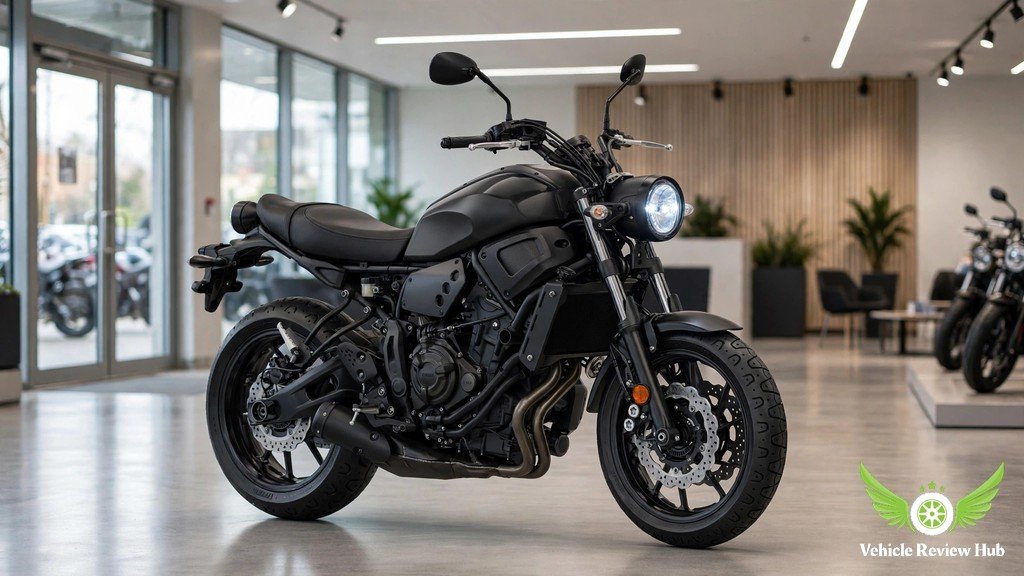
The XSR700 arrived in Europe in 2016 as a tribute to Yamaha’s 1970s XS series, but American buyers waited two years: the bike reached the USA as a 2018 model at $8,499 ($900 more than the MT-07 of the time). The original US bike wore Pirelli Phantom SportComp tyres, a round LCD, a round headlight and 282mm front discs. Then came the 2022 update, the only significant change in the bike’s US life: a heritage-style round LED headlight with stays integrated into the fork shrouds, a repositioned reverse LCD, new switchgear with display scrolling from the left handlebar, larger 298mm front discs, new radiator side covers, and Michelin Road 5 tyres replacing the Pirellis. The 2022 bike reached dealers in December 2021 at $8,799, and since then the bike has carried on essentially unchanged apart from colours and price (see the price section below).
Yamaha XSR700 Engine and Specifications
The engine is the reason the XSR700 works as more than a styling exercise, and this Yamaha XSR700 review puts its numbers in context first. This Yamaha XSR700 review also settles the specification figures buyers argue about.
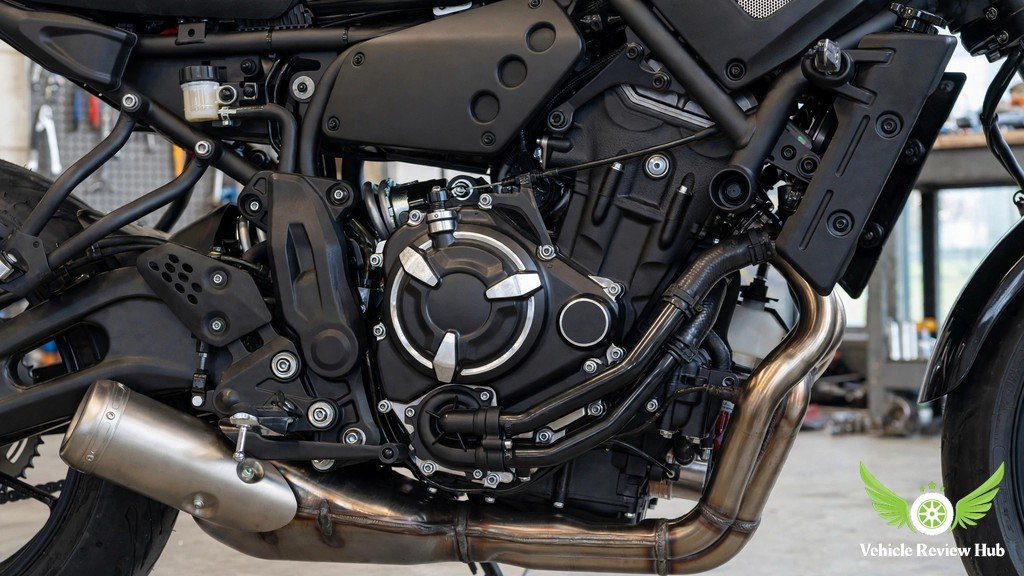
689cc CP2 Engine, Torque and Six-Speed Transmission Without Assist and Slipper
The XSR700 uses Yamaha’s 689cc CP2 engine: liquid-cooled DOHC inline twin, 80.0 x 68.6mm bore and stroke, 11.5:1 compression, and a 270-degree crossplane crankshaft that gives the twin its distinctive uneven, V-twin-like pulse. Yamaha’s European figures claim 73.4 hp at 8,750 rpm and 49.5 lb-ft at 6,500 rpm, and this Yamaha XSR700 review notes plainly that Yamaha publishes no US horsepower figure, so American buyers should treat the European claim as the factory number, not a US certification. Independent testing backs up the claim: Motorcycle.com’s 2018 first-ride review records Cycle World’s dyno test of a stock 2018 US bike at 67.91 hp at 8,790 rpm and 47.47 lb-ft at 6,490 rpm. Drive goes through a six-speed gearbox and chain to a multiplate wet clutch, and this Yamaha XSR700 review states one thing explicitly: the XSR700 has no assist-and-slipper clutch on any year. The MT-07 gained one in 2025, but that change never transferred to the XSR700, so downshifts on the retro bike need the rider’s attention. The performance figures explain what that engine delivers on the road.
Weight 410 lb, Seat Height 32.9 Inches, Fork and Braking Specifications
At a claimed 410 lb wet, the XSR700 is light for its class, and this Yamaha XSR700 review finds that weight explains how approachable the bike feels despite its output. Seat height is 32.9 inches (10mm taller than the MT-07’s, though narrow at the front so getting feet down is easy), wheelbase 55.3 inches, tank 3.7 gallons, official estimate 58 mpg. Suspension is a conventional 41mm telescopic fork, non-adjustable, with 5.1 inches of travel, and a single rear shock adjustable for preload only, also 5.1 inches. This Yamaha XSR700 review stresses the word conventional: the MT-07’s 2025 inverted fork never appeared on the XSR700. Braking is a pair of front discs with four-piston calipers and a 245mm rear disc with a single-piston caliper, all with conventional ABS. Front discs grew from 282mm on 2018–2021 bikes to 298mm from 2022, and this Yamaha XSR700 review advises used buyers to check the year before assuming either size. Tyres are 120/70ZR17 front and 180/55ZR17 rear — Pirelli Phantom SportComp before 2022, Michelin Road 5 from 2022 — at 33 psi front and 36 psi rear cold. Total Motorcycle’s 2026 specifications list the same 410 lb weight, 32.9-inch seat and 3.7-gallon tank.
| Specification | Yamaha XSR700 (2022-on unless noted) |
|---|---|
| Engine | 689cc liquid-cooled CP2 inline twin, 6-speed, chain |
| Power / torque | 73.4 hp @ 8,750 rpm / 49.5 lb-ft @ 6,500 rpm (EU claim); 67.91 hp @ 8,790 rpm dyno (2018 US bike) |
| Weight / seat / wheelbase | 410 lb wet (claimed) / 32.9 in / 55.3 in |
| Fuel tank / economy | 3.7 gal / 58 mpg official estimate |
| Suspension | 41mm conventional telescopic fork, non-adjustable, 5.1 in; single shock, preload only, 5.1 in |
| Brakes / tyres | Dual front discs 298mm (282mm 2018–2021), 4-piston calipers, conventional ABS; Road 5 120/70ZR17 + 180/55ZR17 |
Yamaha XSR700 Price and Market Availability
Price is where the XSR700 makes its case most quietly, and this Yamaha XSR700 review gives the full year-by-year ladder, not a single sticker figure. This Yamaha XSR700 review treats the ladder as the honest way to judge the bike.
Yamaha XSR700 Price by Year in the USA: 2018 to 2026
The XSR700 launched in the USA for 2018 at $8,499 and held that price for four straight years — stability this Yamaha XSR700 review notes made early bikes easy to value. The 2022 update brought the only real increase of the bike’s early life, to $8,799, and prices edged up again to $8,899 for 2023 and 2024. Then Yamaha cut the price: 2025 and 2026 both list at $8,599, exactly matching the MT-07. As with all Yamaha pricing, MSRP excludes destination charges — $675 on the 2026 bike — tax, title and dealer fees, and this Yamaha XSR700 review advises buyers to confirm the out-the-door figure before comparing deals.
| Model year | US MSRP | What changed |
|---|---|---|
| 2018 | $8,499 | US launch |
| 2019 | $8,499 | Carried over |
| 2020 | $8,499 | Radical White / Rapid Red colour |
| 2021 | $8,499 | Carried over |
| 2022 | $8,799 | LED headlight, 298mm discs, Road 5 tyres, LCD repositioned |
| 2023 | $8,899 | Carried over |
| 2024 | $8,899 | Carried over |
| 2025 | $8,599 | Price cut; Raven only |
| 2026 | $8,599 | Carried over; $675 destination |
Raven Colour Only for 2025-2026 and Official US Dealer Availability
The 2026 XSR700 is available in the USA in Raven only at $8,599 through Yamaha dealers with a one-year limited factory warranty. Used buyers should note the colour story: 2020 Radical White and Rapid Red with gold rims, 2022 Raven with gold tank striping and gold 10-spoke wheels.
Yamaha XSR700 Design, Features and Technology
Design is where the XSR700 earns its keep, and this Yamaha XSR700 review separates the styling from the electronics: the styling is deliberate and detailed, while the electronics are deliberately minimal. This Yamaha XSR700 review also warns used buyers about the single most common misdescription: a pre-2022 bike advertised with 2022 equipment.
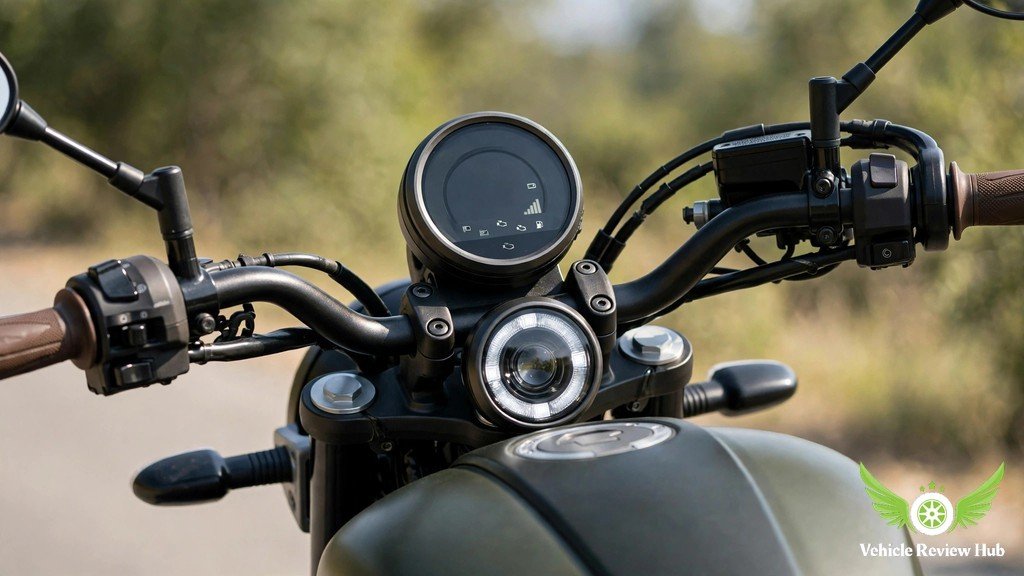
Retro Styling, LED Lighting From 2022 and Round LCD Display
The styling follows Yamaha’s Faster Sons idea and nods to the 1970s XS series: teardrop tank, exposed aluminium details, a stepped seat with the XSR logo embossed at the rear, a round brake light, and a short stubby exhaust. The 2022 redesign sharpened that look with a round LED headlight whose stays connect into the fork shrouds for a compact, snub-nose front end, and this Yamaha XSR700 review finds the result ages better than most retro attempts. The display is where buyers must check the year: every XSR700 year uses a round LCD display — never a TFT — and the 2022 update repositioned it into a reverse layout that is easier to read in daylight, with scrolling from the left handlebar switch. Any XSR700 advertised with a TFT display has been modified or misdescribed, and this Yamaha XSR700 review advises treating that claim as a red flag rather than a bonus.
Cable Throttle, ABS Only and Why There Is No Traction Control in the USA
The XSR700 keeps things simple by design, and this Yamaha XSR700 review lists what that means in full: a cable throttle with no ride-by-wire, conventional two-channel ABS that cannot be switched off, and no traction control, ride modes, IMU, cornering ABS, quickshifter, cruise control, Y-Connect or Smart Key on any US year. The reason is mechanical: traction control and ride modes need a ride-by-wire throttle and an IMU, and the XSR700 never received either — the MT-07 gained both in 2025, but those changes never transferred to the retro bike. For many riders that simplicity is a feature — nothing to configure, nothing to update, less to go wrong — and this Yamaha XSR700 review counts the honest analogue feel as part of the bike’s appeal. The trade is real, though — a ham-fisted throttle hand gets no electronic safety net — and this Yamaha XSR700 review says so plainly.
Yamaha XSR700 Riding Experience and Comfort
On the road, the XSR700 feels like a middleweight that learned manners, and this Yamaha XSR700 review draws on published road tests and owner accounts rather than an invented personal test. This Yamaha XSR700 review finds the riding experience settles the retro-versus-modern argument in the bike’s favour.
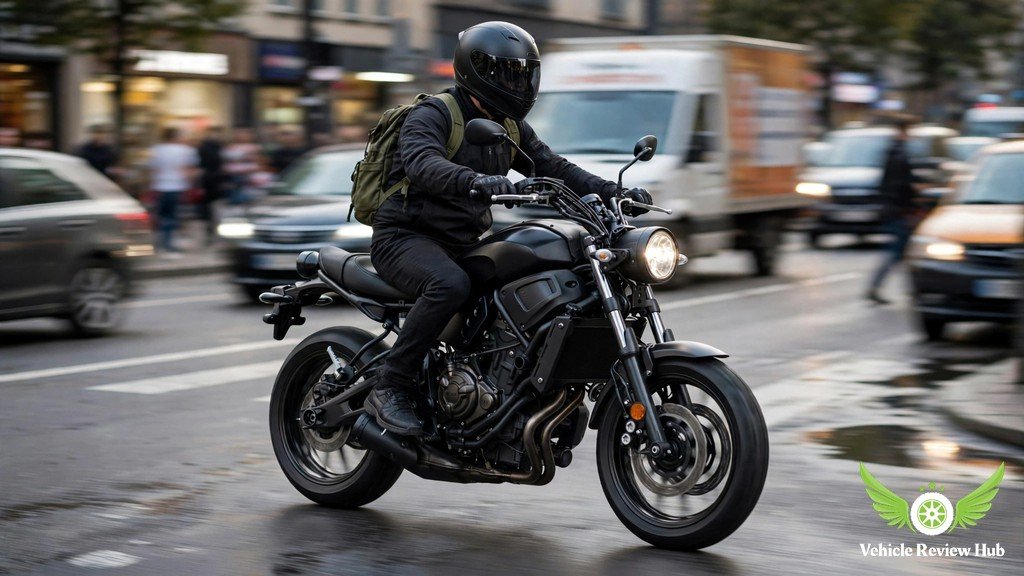
Riding Position, Handling and Low-Speed Maneuverability
The riding position is upright and roomy: bars about three inches wider than the MT-07’s, sitting taller and closer to the rider, a 32.9-inch seat and comfort-set footpegs — and this Yamaha XSR700 review notes the extra room is the first thing MT-07 riders notice. At 410 lb with a low centre of gravity, the bike changes direction easily, and reviewers praise its low-speed manners — filtering, tight turns and parking build a new owner’s confidence, helped by the light clutch and smooth low-rev twin manners. Handling is sharper than the retro looks promise: compared with the old FZ-07, fork springs are about six percent stiffer and the shock spring about eleven percent stiffer, giving a more planted feel mid-corner without ruining the ride, and the Road 5 tyres on 2022-on bikes grip predictably. Braking matches: the four-piston calipers and larger 2022-on discs give strong stopping with conventional ABS backup, and this Yamaha XSR700 review rates the brakes a clear strength. Watch an owner’s 2026 review — specs, town riding, twisty roads, highway running and final thoughts:
City Riding, Highway Comfort and Everyday Practicality
In the city, the XSR700 is in its element: clean low-rev twin pull and an upright, commanding position. Fuel economy is a genuine strength for a 74 hp bike, and this Yamaha XSR700 review separates the figures: Yamaha’s official estimate is 58 mpg with the 3.7-gallon tank, roughly 215 miles of range, while Rider’s 2018 first-ride test recorded 51.7 mpg over about 400 hard-ridden miles, roughly 191 miles from a tank. On faster roads, the bike cruises comfortably at highway speeds, but this Yamaha XSR700 review is plain about the limit: there is no fairing and no windscreen, so sustained high-speed riding brings wind fatigue, and the flat, wide seat — comfortable all day according to Rider — still leaves taller riders wanting a screen for long trips. As everyday transport it is practical within limits: easy to park and cheap to fuel, but luggage options are limited and the retro tail was never designed for touring.
Yamaha XSR700 Review: Pros, Cons and Verdict
Weighing everything above, this Yamaha XSR700 review finds a bike that justifies its price on quality and character, not technology. This Yamaha XSR700 review sets out what it does better than its rivals, and where it asks too much.
Main Advantages and Limitations of the Yamaha XSR700
The advantages start with the engine: the CP2 twin’s broad, linear torque makes the bike fast without being frantic, and this Yamaha XSR700 review counts that flexibility as its best feature. Second is the chassis and ergonomics package — light weight, roomy riding position, planted handling and strong brakes. Third is the styling and finish: brushed aluminium details, the embossed seat and careful detailing give a premium feel. Reliability reporting is encouraging but thin: MCN rates the bike 5 out of 5 overall with owners’ and reliability ratings of 4.8 out of 5, but from only 9 owner reviews, so this Yamaha XSR700 review treats long-term dependability as encouraging but not proven; the reliability and maintenance write-up covers the evidence honestly. Limitations are equally clear: minimal wind protection, basic suspension with no adjustment up front and preload only at the rear, and electronics a generation behind — no traction control, no modes, no TFT. The buying guide covers used prices and inspection checks.
Who Should Consider the Yamaha XSR700 Over the MT-07?
This Yamaha XSR700 review recommends the XSR700 to riders who value character, comfort and simplicity over outright technology: the rider who wants CP2 performance in a package that draws compliments at every stop and looks at home outside a café and a canyon alike. The MT-07 remains the better pick for riders who want the sharpest handling, the most aggressive ergonomics and the latest equipment — at the same $8,599 for 2026 it adds a 5-inch TFT, ride modes, switchable traction control, an inverted fork and an assist-and-slipper clutch — and this Yamaha XSR700 review says so plainly rather than pretending the two bikes are interchangeable. Riders wanting more power altogether should look at the MT-09 review instead. The smart buy in this Yamaha XSR700 review is a 2022-on bike: the LED headlight, bigger brakes, Road 5 tyres and repositioned display justify the premium over earlier bikes, while a 2018–2021 bike is the value pick. Overall, this Yamaha XSR700 review rates the XSR700 as the most complete retro middleweight — fast enough, refined and honest about what it is.
Yamaha XSR700 Review FAQs
The questions buyers ask most often, answered from the verified figures above, so this Yamaha XSR700 review stays consistent throughout.
How much does a Yamaha XSR700 cost in the USA?
In this Yamaha XSR700 review, the 2026 bike costs $8,599 in Raven, plus a $675 destination charge. The ladder runs $8,499 (2018–2021), $8,799 (2022), $8,899 (2023–2024), and $8,599 (2025–2026).
What engine does the Yamaha XSR700 have?
The bike in this Yamaha XSR700 review uses a 689cc liquid-cooled CP2 inline twin, European-claimed at 73.4 hp and 49.5 lb-ft. Yamaha publishes no US horsepower figure; Cycle World’s dyno test of a stock 2018 US bike measured 67.91 hp.
How much does the Yamaha XSR700 weigh?
The bike weighs a claimed 410 lb wet, with a 32.9-inch seat, 55.3-inch wheelbase and 3.7-gallon tank.
Does the Yamaha XSR700 have a TFT display?
No. Every XSR700 year uses a round LCD display, never a TFT. The 2022 update repositioned the LCD and switched it to a reverse layout; any XSR700 advertised with a TFT has been modified or misdescribed.
Does the Yamaha XSR700 have traction control or ride modes?
No. This Yamaha XSR700 review confirms the US bike has a cable throttle, conventional ABS only, and no traction control, ride modes, IMU, cornering ABS, quickshifter, cruise control or Y-Connect on any year.
Does the Yamaha XSR700 have an assist-and-slipper clutch?
No. The XSR700 uses a conventional multiplate wet clutch with no slipper function on any year, unlike the MT-07, which gained an assist-and-slipper clutch in 2025.
What changed on the 2022 Yamaha XSR700?
The 2022 update brought a round LED headlight, a repositioned reverse LCD display, new switchgear, larger 298mm front discs (up from 282mm), new radiator side covers and Michelin Road 5 tyres, at $8,799.
How often does the Yamaha XSR700 need servicing?
Yamaha schedules routine service every 4,000 miles or 6 months in the USA, with a first service at 600 miles and valve-clearance checks at 26,600 miles in US manuals; the XSR700 service schedule lists the same pattern.
Is the Yamaha XSR700 reliable?
Early evidence is encouraging but thin: MCN rates the bike 5 out of 5 overall with owners’ and reliability ratings of 4.8 out of 5, but from only 9 owner reviews, so this Yamaha XSR700 review treats it as a positive sign, not proof. The reliability write-up covers the evidence, common wear items and recall checks in full.
Does the Yamaha XSR700 have any recalls I should check?
One verified recall touches the XSR700: 18V483 covers certain 2018 MT-07 and XSR700 models for chain-guard bolts, 3,493 units, Yamaha number 990120. Run the VIN through Yamaha’s recall check before buying; clutch-drag reports carry no verified US campaign number.
What are the Yamaha XSR700’s main rivals?
The key rivals are the MT-07 at the same $8,599, plus retro rivals such as the Kawasaki Z650RS and Suzuki SV650. This Yamaha XSR700 review finds the Yamaha’s case rests on its twin engine, roomy ergonomics and price rather than pure heritage appeal.
Who should buy a Yamaha XSR700?
Experienced riders who want modern performance with retro styling, returning riders, and customisers. Riders wanting the latest electronics should compare the MT-07; riders wanting more power should look at the MT-09.