Yamaha NMAX 125 reliability is one of the strongest reasons this little maxi-scooter keeps topping UK sales charts. Owners and reviewers agree the 125cc Blue Core single is a tough, low-drama engine, and a decade on sale in Britain shows very few serious failures. That does not mean an NMAX 125 is maintenance-free: it still needs regular oil changes, CVT belt care and brake checks. This guide covers what goes wrong, the UK service schedule, running costs, and how to judge a used example — the full picture of Yamaha NMAX 125 reliability.
Yamaha NMAX 125 Reliability Overview
The headline verdict on Yamaha NMAX 125 reliability is reassuring. Across a decade in the UK and Europe, the NMAX 125 has earned a reputation as a hard-working commuter. The 2025 update was styling and specification, not mechanical. Still, the evidence base has limits, and how a scooter was used matters as much as the badge on the front for Yamaha NMAX 125 reliability.
MCN Owners 4 Out of 5 and Reliability 4.2 From Only 5 Reviews
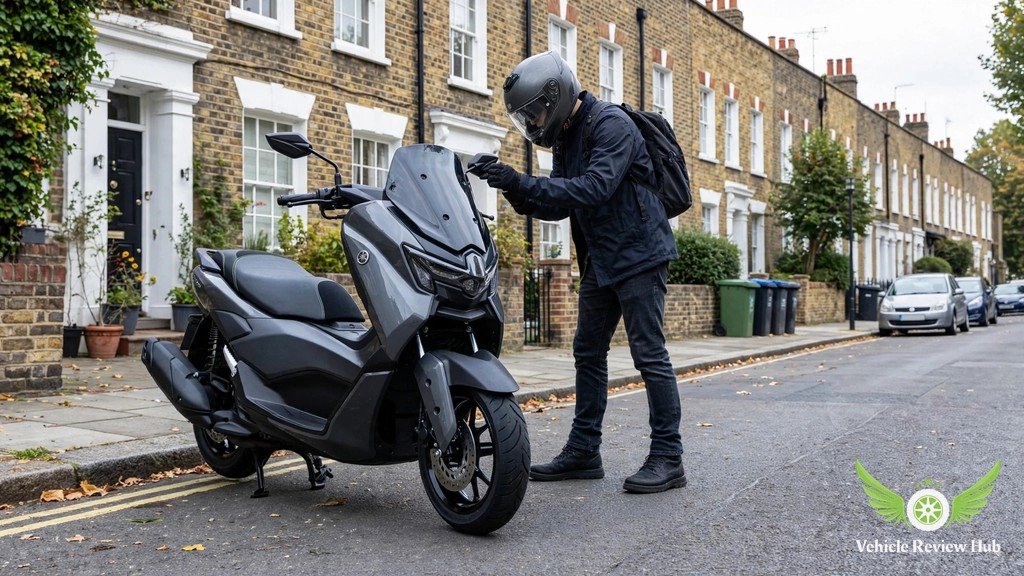
MCN’s owner reviews for the 2015–2021 NMAX 125 rate reliability at 4.2 out of 5 and the bike overall at 4 out of 5, with the engine scoring a full 5 out of 5. But the essential caveat for Yamaha NMAX 125 reliability is the sample: those owner scores rest on only 5 reviews. Five owners cannot represent tens of thousands of scooters. The expert picture for Yamaha NMAX 125 reliability is steadier: MCN’s 2021-onwards review rates reliability and build quality at 4 out of 5, and Autotrader’s experts also award 4 out of 5, describing a largely unblemished record over the last decade. Yamaha NMAX 125 reliability is genuinely good — but the five-review warning should travel with every citation of that 4.2 figure.
How Mileage, Maintenance History and Previous Use Affect Reliability
Mileage alone rarely hurts Yamaha NMAX 125 reliability; missed servicing and hard previous use do. A 20,000-mile scooter with a stamped book, fresh belt and clean oil beats a 6,000-mile scooter that sat outside for two winters. Delivery work is the sharpest example: MCN notes battle-scarred NMAX and PCX fleets in Deliveroo service — proof the platform takes a hard life. Check the service history first, then the finish, CVT area and fork seals. The NMAX 125 review covers specification and pricing, and the NMAX 125 performance figures explain why this is a city tool, not a motorway machine. In short, Yamaha NMAX 125 reliability is a partnership: Yamaha built a durable scooter, and the service book shows whether the previous owner kept up their half of the bargain.
| Source | Score | Notes |
|---|---|---|
| MCN owners (2015–2021) | 4.2 out of 5 | Only 5 owners — small sample |
| MCN owners (2015–2021) | 4 out of 5 overall | Engine 5/5, value 3.4/5, equipment 3.6/5 |
| MCN experts (2021-on) | 4 out of 5 | Reliability and build quality |
| Autotrader experts (2025) | 4 out of 5 | “Largely unblemished” over a decade |
Yamaha NMAX 125 Common Problems and Wear Items
Honest Yamaha NMAX 125 reliability reporting means separating verified campaigns from owner grumbles. The verified record is thin: one European and Australian reflector campaign, and no confirmed pattern of major engine or gearbox failure. The owner-reported list for Yamaha NMAX 125 reliability is longer but softer — CVT wear, brake feel, battery drain and finish issues that mostly trace back to maintenance gaps or hard use.
Rear Reflector EU Recall and Finish Inspection Points Explained
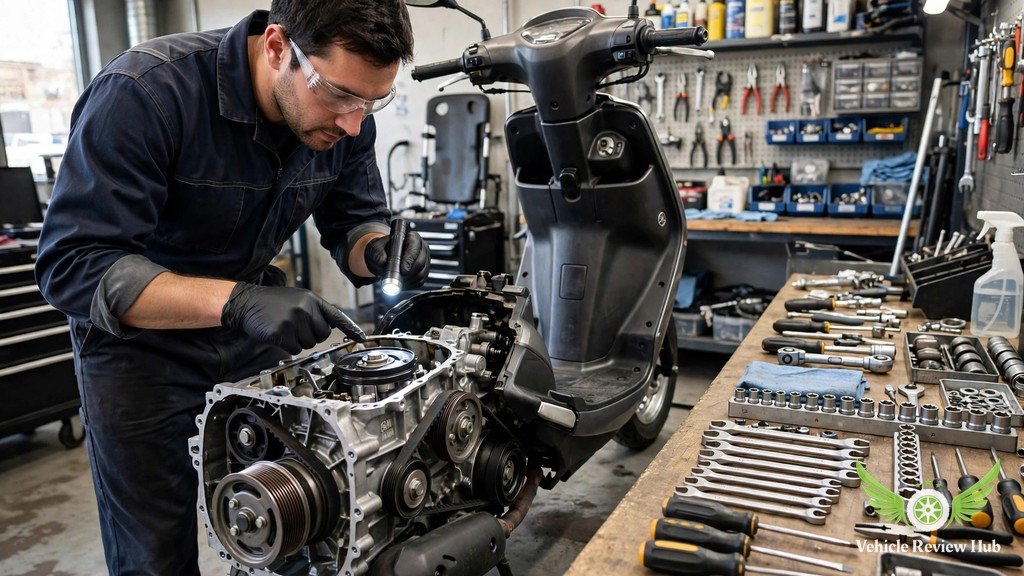
The one formal campaign every buyer should know about concerns the rear reflector, and its geography matters for Yamaha NMAX 125 reliability. In week 52 of 2020, the EU Safety Gate system listed the NMAX 125 alongside the X-MAX 125/300/400, YZF-R3, MT-03, XSR700, Tracer 700 and Tenere 700, made between 2013 and 2020, because the rear retro-reflector did not properly reflect light. Australia ran a parallel notice covering 168 NMAX 125 scooters from 2015, with free replacement under the ADR 47 standard, per webBikeWorld’s recall coverage. Critically, there is no US NHTSA recall for the NMAX 125 — never sold in the United States — and American recall 20V611 covers certain YZF-R3, MT-03 and XMAX models only. Never let a seller present this as a US recall; check status by VIN with a dealer in the market of registration. Finish is the other inspection point: always-outside bikes corrode on fasteners and exhaust hardware. Yamaha NMAX 125 reliability does not hinge on cosmetics, but rusty bolts suggest outdoor life and skipped winter care.
CVT Belt, Rollers, Clutch, Battery and Electrical Checks
The CVT transmission is where Yamaha NMAX 125 reliability is won or lost in practice. Owners report belt wear and CVT noise — whining, vibration or jerky take-off — as the most common drivetrain complaint; worn rollers or a tired clutch do the same. These are wear items, not defects, and that distinction matters for Yamaha NMAX 125 reliability: the belt has a fixed interval (below), and a belt changed on time with fresh rollers keeps the transmission quiet. Ask when the belt was last replaced; a seller who cannot answer has probably not done it. Battery drain in storage is the next most-reported niggle, especially over winter, because the Smart Key system and dash draw a small current. Other owner reports include soft front brake feel (usually pads or fluid), a firm ride, fluctuating fuel economy, and occasional Y-Connect app dropouts — weakly sourced, so test it on your own phone. None of this is a verified major failure pattern — good news for Yamaha NMAX 125 reliability, where the problems are the predictable, affordable ones.
Yamaha NMAX 125 Maintenance Schedule and Servicing
The UK service schedule is the backbone of Yamaha NMAX 125 reliability: a short first service, regular oil changes, and a small number of fixed replacement intervals. All figures below are the UK schedule in miles. Skipping services to save money is a false economy for Yamaha NMAX 125 reliability — the belt and valve items below punish neglect.
First Service at 600 Miles, Then Every 3,500 Miles in the UK Schedule
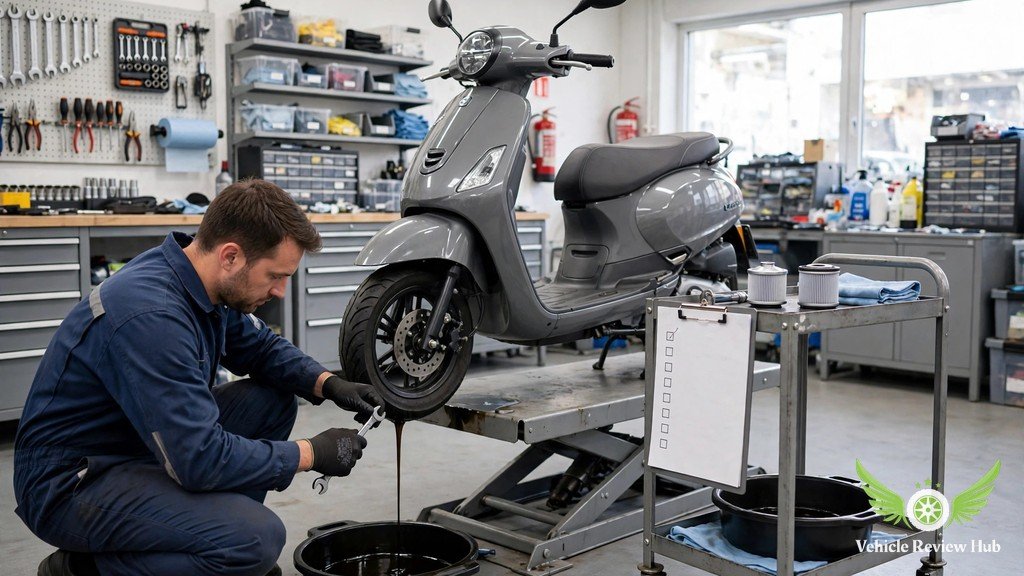
Autotrader’s 2025 review quotes a first ‘break-in’ service at 500 miles (oil and filter), then routine services every 3,500 miles or annually. Yamaha’s own manual chart sets the first visit at 1,000 km (600 miles), then 6,000 km, 12,000 km, 18,000 km and 24,000 km, repeating from 6,000 km past 30,000 km — and this guide follows the manual’s figures. The full chart is in the 2022 NMAX 125 owner’s manual. Every chart visit calls for a diagnostic check, battery and brake checks, and fastener, cable and lubrication inspections. Oil quantity is small — 0.90 litres on the 2020 manual, drain bolts at 20 N·m — so use the specified grade. The 2025 manual adds a battery check every 3 months (recharge below 12.4 volts) and a fuel-filter check every 12,000 km. Keep every invoice: Yamaha NMAX 125 reliability on the used market is proved by paperwork, and a stamped book beats sales patter.
V-Belt Replacement at 15,500 Miles and Valve Checks Every Service
Two items deserve special attention for Yamaha NMAX 125 reliability, because buyers most often get them wrong. First, the V-belt: the 2025 manual requires replacement every 25,000 km (15,500 miles) even without visible wear, checked at 7,000 km and then every 4,000 km. A belt that looks fine at 16,000 miles is still overdue, and a snapped belt strands you. Second, valve clearance: the manual marks check and adjustment at every chart visit, so valve checks happen at every service. On a single-cylinder scooter it is a quick service job. Other fixed intervals: air-filter element every 18,000 km (10,500 miles), brake fluid and master-cylinder and caliper internals every 2 years, brake hoses every 4 years, and coolant every 3 years on 2021-onwards manuals (earlier: every 12,000 km).
The video below shows a full NMAX 125cc belt change, step by step.
| Service item | Interval (UK schedule) |
|---|---|
| First service (oil and filter) | 600 miles (1,000 km) |
| Routine service | Every 3,500 miles or annually, whichever first |
| V-belt replacement | Every 25,000 km (15,500 miles), even without wear |
| Valve clearance check and adjust | Every chart visit (every service) |
| Air-filter element replacement | Every 18,000 km (10,500 miles) |
| Brake fluid and master/caliper internals | Every 2 years |
| Brake hoses | Every 4 years |
| Coolant change | Every 3 years (2021-on manuals) |
Yamaha NMAX 125 Tires, Brakes and Suspension Maintenance
Tires, brakes and suspension are the safety-critical half of Yamaha NMAX 125 reliability, and where a used bike hides its history. The NMAX 125 runs 13-inch wheels — 110/70-13 front, 130/70-13 rear — with 230 mm discs front and rear, ABS, and a 100 mm-travel telescopic fork. None of it is exotic, which is good news for Yamaha NMAX 125 reliability: tires, pads and fork seals are affordable and any competent shop can fit them.
Tire Condition, Pressure, Tread Wear and Replacement
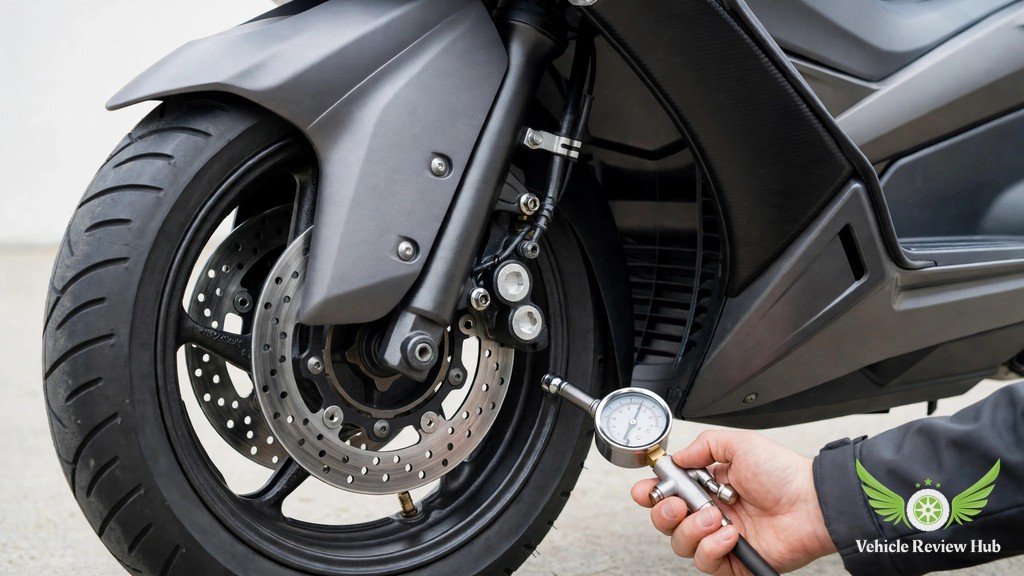
Check tires cold, before riding — a basic Yamaha NMAX 125 reliability habit. The 2022 manual gives single-rider cold pressures of 150 kPa (22 psi) front and 250 kPa (36 psi) rear — the big gap surprises new owners, so do not guess or equalise them. Inspect tread depth across the full width, squared-off centres, cracking from age and UV, and cuts or embedded objects. Small wheels wear faster than motorcycle tires: budget for a rear roughly every riding season, and a front roughly every second rear. Age matters as much as tread: a five-year-old tire has hardened and grips less in the wet. The detailed chart sits in the 2021 NMAX 125 owner’s manual. Correct pressures also protect Yamaha NMAX 125 reliability: under-inflated tires overheat and wear unevenly, while over-inflation shrinks the contact patch.
Brake Pads, Brake Discs, Forks and Rear Suspension Checks
Brake pads are checked at every service visit and replaced when worn — never defer this cheap job, because scored discs cost far more than pads. Check both 230 mm discs for scoring, warping and minimum thickness; soft lever feel usually means pads, fluid or air in the system rather than a failing ABS unit — reassuring for Yamaha NMAX 125 reliability. Brake fluid is hygroscopic, hence the two-year change interval; dark fluid in the reservoir means it is overdue. Forks deserve a wipe-and-look at every wash: oil mist on a leg means a weeping seal, which contaminates the brake pads below it. Rear suspension needs a year-by-year note: the 2022 manual’s FAQ describes a two-position preload ring (1 standard, 2 hard), while Bennetts’ 2025 specification lists none — check your own year. Owners widely describe the ride as firm, so harshness alone is often character, not fault; check for knocking, leaking or seized adjustment. Together, these checks keep Yamaha NMAX 125 reliability a safety story as well as a mechanical one.
Yamaha NMAX 125 Maintenance and Ownership Costs
Yamaha NMAX 125 reliability pays off in the running-cost column. Fuel is cheap, servicing is simple, and parts are shared across a huge European parc. Figures below are UK prices and costs; there is no US MSRP because the NMAX 125 is not sold in the United States. The 2025 UK list price is £3,600 standard and £3,900 for the Tech MAX — budget commuter, budget-sized bills.
Fuel, Routine Servicing Around £170 a Year, Tires and Parts
Fuel economy is the quiet superpower behind Yamaha NMAX 125 reliability. The official figure is 2.2 litres per 100 km, about 128 mpg imperial or 106.9 mpg US — always state which gallon, because the two differ by 20 percent. With a 7.1-litre tank, that means roughly 190–200 miles between fill-ups, and real-world economy stays close to the claim with a fresh filter and correct pressures. Routine servicing averages around £170 a year (MCN owner data, small sample of 5 owners) — covering the annual service with oil, filter and checks. Tires are the next regular bill: a fitted pair of quality 13-inch tires typically lands in the £120–£180 range. Bennetts’ 2025 technical review confirms the 132 kg wet weight and 7.1-litre tank behind these costs. None of this threatens Yamaha NMAX 125 reliability as a value proposition: a year’s servicing costs less than a month of train fares.
Repair Expenses, Parts Availability and Long-Term Ownership Costs
For Yamaha NMAX 125 reliability, bigger bills are rare, and when they arrive they are usually the scheduled ones: a belt and roller service, a battery, a set of tires, or a fork seal. A decade in production across Europe means parts are widely available, and most jobs need no special tools beyond a torque wrench and a variator holding tool. The two-year, unlimited-mileage warranty from first registration covers early defects, but it is a UK and European warranty that does not transfer into US support. Long-term, the expensive scenario is accumulated neglect: a bike that missed three services may need belt, rollers, battery, tires, fluid and fork seals in one visit. For buyers weighing the whole purchase, the NMAX 125 buying guide sets out prices, trims and what to pay. The long-term verdict on Yamaha NMAX 125 reliability is therefore a financial one too: serviced on time, it is among the cheapest powered two-wheelers to keep.
How to Keep a Yamaha NMAX 125 Reliable
Yamaha NMAX 125 reliability is mostly a matter of rhythm: short, regular attention beats heroic annual overhauls. The schedule above is the skeleton; the habits below make it work. None of it needs mechanical genius — just a calendar, a pressure gauge and a dealer you trust.
Preventive Maintenance, Proper Lubrication and Regular Inspections
Build five habits and Yamaha NMAX 125 reliability largely takes care of itself. First, for Yamaha NMAX 125 reliability, check oil level, tire pressures and lights weekly — two minutes that catch most problems early. Second, keep the battery on a tender if the bike stands for more than a couple of weeks. Third, wash regularly, including underneath and around fasteners — road salt is the enemy of finish and electrics. Fourth, lubricate moving parts and cables as the manual directs, and keep the CVT case air filter clean. Small disciplines, repeated, are the whole secret of Yamaha NMAX 125 reliability.
Checks Before Buying in Europe and Why US Buyers Cannot Service One Locally
If you are buying in Europe, run this Yamaha NMAX 125 reliability checklist before money changes hands: full service history with the 600-mile first service present; belt proof at or before 15,500 miles; reflector status by VIN; correct pressures and in-date tires; firm brakes; no fork oil; healthy battery; working Smart Key and start-stop; and a test ride listening for CVT whine. A bike that passes is a sound buy. For US buyers, the position is different: the NMAX 125 is not sold in the United States, so there is no US dealer network, parts pipeline or warranty support. Importing one is a specialist project involving federal compliance; general import information here is not legal advice. Servicing would mean sourcing European parts privately, which undermines the affordable ownership behind Yamaha NMAX 125 reliability in the UK. American buyers should look at models actually sold in the USA, such as the Zuma 125 review. Yamaha NMAX 125 reliability is excellent where Yamaha sells and supports the bike — and that support is what an import cannot bring.
Yamaha NMAX 125 Reliability: Frequently Asked Questions
These are the questions buyers and owners ask most about Yamaha NMAX 125 reliability. Each answer is direct, with the small-sample and UK-only caveats stated where they apply.
Is Yamaha NMAX 125 reliability good?
Yes. Owners rate Yamaha NMAX 125 reliability at 4.2 out of 5 and experts at 4 out of 5, with no verified pattern of major failure across a decade on sale. The owner score rests on only 5 reviews, so read it as encouraging rather than conclusive.
What is the most common Yamaha NMAX 125 reliability problem?
CVT belt and roller wear, reported by owners as whining, vibration or jerky take-off. Scheduled wear item, not a defect: replace the belt every 15,500 miles.
How often does a Yamaha NMAX 125 need servicing?
Under the UK schedule for Yamaha NMAX 125 reliability, the first service is at 600 miles (1,000 km), then every 3,500 miles (6,000 km) or annually, whichever comes first. The manual chart uses 1,000 km, then 6,000 km, 12,000 km, 18,000 km and 24,000 km.
When should the V-belt be replaced?
Every 25,000 km (15,500 miles) for Yamaha NMAX 125 reliability, even if it shows no visible wear, with checks at the initial 7,000 km and then every 4,000 km. A belt that looks fine past the interval is still overdue.
Was there a Yamaha NMAX 125 recall?
Yes, in Europe and Australia, for the rear reflector: the EU Safety Gate listing in week 52 of 2020 covered NMAX 125 models made between 2013 and 2020, and Australia’s notice covered 168 from 2015. No US NHTSA recall exists — the bike was never sold in the USA.
How much does Yamaha NMAX 125 servicing cost?
MCN owner data puts routine servicing at around £170 a year, from a small sample of 5 owners — treat it as an indication for Yamaha NMAX 125 reliability. Add tires roughly every season, a battery every 2–3 years, and the belt job every 15,500 miles.
Can I buy and service a Yamaha NMAX 125 in the USA?
No, not through normal channels. The NMAX 125 is not sold in the United States, so there is no US dealer network, parts pipeline or warranty support — the hard limit on Yamaha NMAX 125 reliability for US buyers. US buyers should consider models actually sold in the USA, such as the Zuma 125.