Short answer: Honda CRF300LS performance is modest, honest, and exactly right for the bike’s job. The low-seat LS pairs a 286cc liquid-cooled single with a six-speed gearbox, and Honda CRF300LS performance is built around usable low-end torque and outstanding fuel economy rather than outright speed. It cruises at 70 mph, returns over 65 mpg in real testing, and handles city traffic and light trails — but it has no meaningful passing reserve, and no LS-specific top-speed test exists. This Honda CRF300LS performance guide separates verified test figures from shared platform data, so you know precisely what the LS can and cannot do.
Honda CRF300LS Engine Performance and Power Delivery
Honda CRF300LS performance starts with the engine, and the engine is shared across the whole 300 platform. That sharing means the most-quoted power figures need careful labelling.
Shared-Engine Data Only: Dirt Rider Dyno 22.7 HP on the Standard L
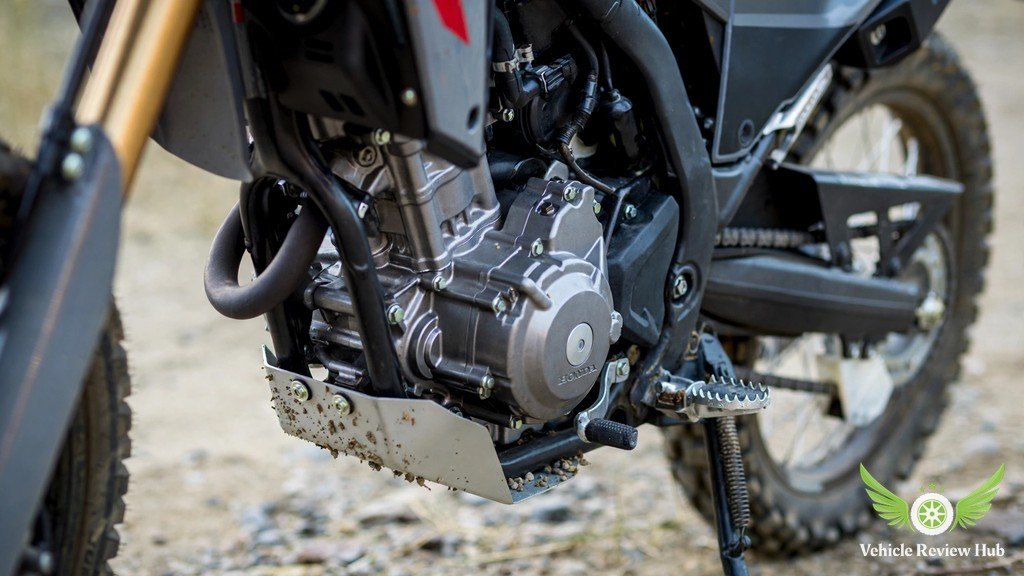
The only widely published dyno figure for this engine family comes from Dirt Rider’s test of the standard CRF300L, and Honda CRF300LS performance reporting must label it as shared-engine data, not an LS measurement. Dirt Rider’s dyno test of the 2022 standard L recorded 22.7 horsepower at the rear wheel, with 16.7 lb-ft of torque, and Expedition Portal’s LS test repeats the same 22.7 hp figure at 8,400 rpm with 16.7 lb-ft at 6,400 rpm, again describing the shared platform engine. The LS uses the same 286cc liquid-cooled DOHC single, the same 76.0mm x 63.0mm bore and stroke, the same 10.7:1 compression ratio, and the same 38mm PGM-FI throttle body as the standard L, so the shared figure is a reasonable guide to Honda CRF300LS performance — but it is not an LS dyno run, and this guide does not pretend otherwise. What matters more than the peak number is delivery: testers describe a quick-revving, linear engine with a flat torque curve and strong low-end pull, plus a gear-driven counterbalancer that keeps vibration in check. The first five gears are closely spaced for trail and city work, sixth is a tall overdrive, and an assist and slipper clutch lightens lever effort by nearly 20 percent. For Honda CRF300LS performance, the honest summary is modest peak power with friendly delivery — an engine that feels stronger than its numbers suggest at the speeds most riders actually use.
Why the 27 HP Figure Is a Non-US Factory Claim, Not Honda USA
You will see 27 horsepower quoted for the CRF300L family almost everywhere, and Honda CRF300LS performance articles often repeat it without qualification. That figure is a non-US factory claim — the crankshaft number published for European and other markets — not a figure Honda USA publishes for the American LS. Honda’s own United States specification page for the 2025 CRF300LS lists displacement, bore and stroke, compression, and gearing, but publishes no horsepower figure at all. Rider magazine’s LS spec box likewise lists 27 hp at 8,500 rpm and 19.6 lb-ft at 6,500 rpm as a factory claim, while Expedition Portal cites a slightly different Honda claim of 26.7 horsepower. If a seller quotes 27 hp as a measured LS figure, that is a misreading — it is a factory claim from another market, and Honda CRF300LS performance should be judged on the measured 22.7 hp shared figure and tested riding behaviour, not the brochure number.
Honda CRF300LS Top Speed and Acceleration
Honda CRF300LS performance at the top end is the weakest part of the package, and this guide says so plainly. The LS will hold highway speed, but it does not have speed in reserve, and anyone promising a precise LS top speed is guessing.
Highway Cruising at 70 MPH and 7,000 RPM in Top Gear per Rider
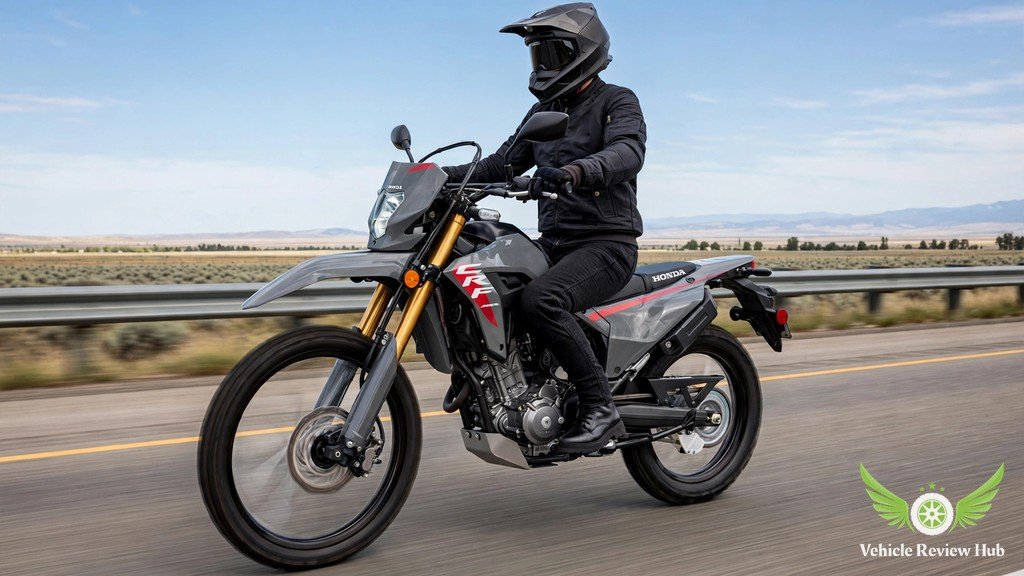
Rider magazine’s 2025 LS test found the bike cruises busily but comfortably at 70 mph, and Honda CRF300LS performance at that speed is defined by the rev counter as much as the speedometer. Expedition Portal’s LS test puts the same point precisely: the counterbalanced single stays smooth until the revs close in on 7,000 rpm, around 70 mph in sixth gear, and buzz begins to intrude beyond that point. But Honda CRF300LS performance at 70 mph is a cruise, not a launch pad: the engine is already in its upper midrange, the small single has little left to give, and wind becomes a factor on a light, upright bike. For a rider whose daily route is a 55 mph back road, this is a non-issue; for a 75 mph interstate commuter, it is the central compromise of Honda CRF300LS performance.
Why No LS-Specific Instrumented Top Speed Test Exists
No LS-specific instrumented top-speed test exists, and Honda CRF300LS performance coverage that quotes one is inventing it. No major American magazine has published a GPS-verified LS top speed, a timed 0-60 mph run, or a quarter-mile figure for the low-seat model, and Honda publishes no top-speed claim for the LS. Platform figures float around the internet — roughly 80 mph is often mentioned for the standard L — but those are estimates and general platform discussion, not LS measurements, and this guide does not adopt them as LS facts. What can be said honestly about Honda CRF300LS performance at the top end is that the LS shares the standard L’s engine, gearing, and aerodynamics closely enough that its top speed will be in the same neighbourhood, while its shorter suspension and lower seat do not change the power equation. Expect a bike that reaches highway speed comfortably, holds it, and runs out of enthusiasm not long after.
Honda CRF300LS Mileage and Fuel Economy
If top speed is the LS’s weakness, fuel economy is its superpower, and Honda CRF300LS performance in this area is backed by genuine LS-specific testing. Two independent testers measured the actual LS. The catch is the tank: at 2.1 gallons, even superb economy only buys a modest range.
Rider Tested 65.7 MPG Average and 71.4 MPG Best on the LS
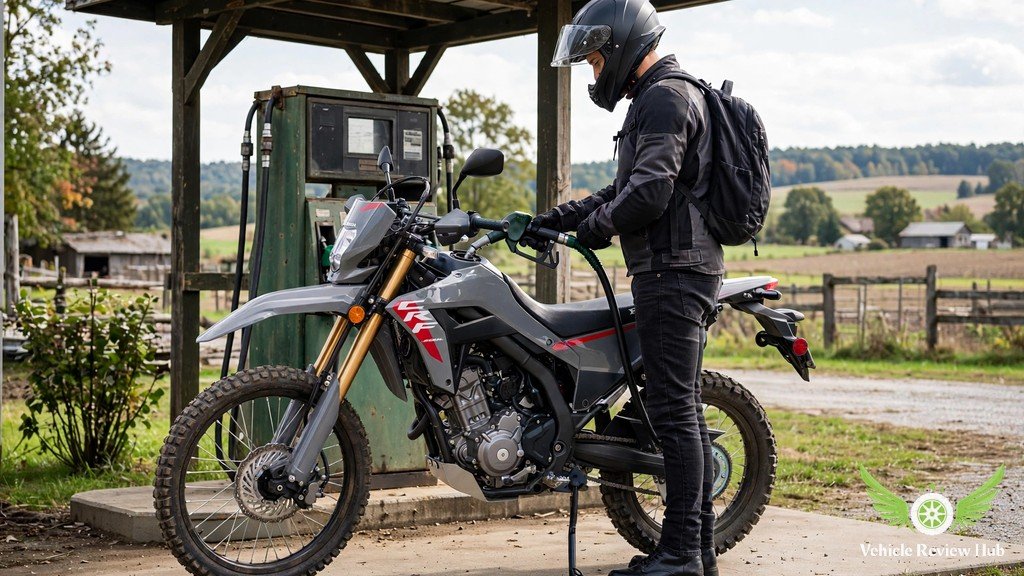
Rider magazine’s 2025 LS test is the strongest fuel-economy evidence for Honda CRF300LS performance, because it is LS-specific and measured, not estimated. Rider averaged 65.7 mpg across its test and recorded a best of 71.4 mpg, for a range of about 130 miles on the LS’s small tank. Rider’s test bike carried the same 2.06-gallon usable figure its spec box lists — Honda rounds the tank to 2.1 gallons including a 0.5-gallon reserve — so the arithmetic is tight: 65.7 mpg times roughly 2 gallons is about 130 miles before the fuel light demands attention. Fuel stops come often but cost almost nothing.
Expedition Portal Saw Over 70 MPG Often and the 2.1-Gallon Tank
Expedition Portal’s 2024 LS test corroborates Rider from a different angle, and Honda CRF300LS performance looks even better in its hands. Expedition Portal’s road and trail test reports frequently seeing over 70 mpg from a tankful of regular fuel, with a best run of 77.7 mpg on a brisk 50-mile ride from sea level to 4,200 feet and back over rolling ridge-top hills. Expect mid-60s mpg in mixed use and over 70 mpg when ridden gently. The 2.1-gallon tank, including its 0.5-gallon reserve, shapes touring: at Rider’s 65.7 mpg average, the reserve alone is worth roughly 30 miles, but total range of about 130 to 150 miles means route planning on remote roads is mandatory.
| Honda CRF300LS performance figure | Value | Source and status |
|---|---|---|
| Engine | 286cc liquid-cooled DOHC single, 76.0 x 63.0mm, 10.7:1 | Honda USA spec page |
| Measured rear-wheel power | 22.7 hp at 8,400 rpm, 16.7 lb-ft at 6,400 rpm | Dirt Rider, standard L — shared data, labelled |
| Factory power claim | 27 hp at 8,500 rpm, 19.6 lb-ft at 6,500 rpm | Non-US factory claim, not Honda USA |
| Highway cruise | 70 mph at about 7,000 rpm in sixth gear | Rider and Expedition Portal LS tests |
| Fuel economy (LS-specific) | 65.7 mpg average, 71.4 mpg best (Rider); over 70 mpg often, 77.7 mpg best (Expedition Portal) | LS-specific tests |
| Tank and range | 2.1 gallons (0.5 reserve); about 130–150 miles | Honda spec; Rider and Expedition Portal range |
| Instrumented LS top speed | None published | No LS-specific test exists — not invented here |
Honda CRF300LS Real-World Riding Performance
Test numbers only go so far, and Honda CRF300LS performance in daily use is where the bike earns its keep. Around town it is quick, light, and confidence-inspiring; on the highway it is adequate with clear limits;.
City Riding, Traffic Performance and Everyday Acceleration
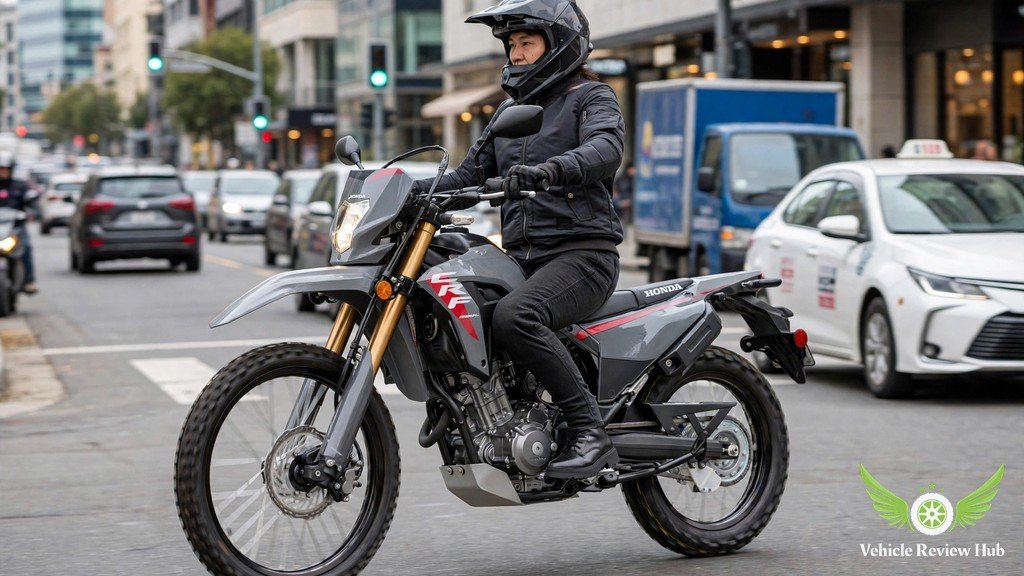
In the city, Honda CRF300LS performance is at its best. The 311-pound curb weight, narrow chassis, and 32.7-inch seat make the LS easy to paddle through traffic, filter to the front of a queue, and park anywhere, and the engine’s low-end torque means second and third gear cover almost all urban riding without constant shifting. Everyday acceleration feels brisk because the bike is light and the first gears are short. Honda CRF300LS performance in traffic is not about horsepower; it is about a bike that weighs barely more than its rider, responds instantly at low speed, and never feels like a handful.
Highway Riding, No Passing Reserve and 2,700-Mile Tour Findings
On the highway, Honda CRF300LS performance changes character, and buyers should understand the change before they buy. At 70 mph the engine sits near 7,000 rpm in sixth, buzz begins to creep in, and accelerating past a truck requires planning: drop a gear, wait for the revs to build, and accept that the pass will take longer than on any larger bike. There is no passing reserve in the sense a 500cc or 650cc rider would recognise — the LS can pass, but it cannot surge. Expedition Portal’s LS test covered road and trail use with repeated fuel stops under 150 miles, a rear tire due for replacement at 2,500 miles, and a headlight singled out as the bike’s weakest part. A 2,700-mile tour is possible: comfortable at back-road speeds, economical throughout, with fuel stops every 130 miles or so. Honda CRF300LS performance on tour is therefore a question of temperament: riders who enjoy the journey at 60 to 65 mph will love it, while riders who want to cover 500 interstate miles a day will not. The video below is a ride-along review of the standard CRF300L — the same platform engine and chassis family — showing how this performance feels on real roads and trails.
Honda CRF300LS Handling, Braking and Stability
Honda CRF300LS performance is not only about the engine; the chassis decides how much of that modest power a rider can actually use. The LS chassis is the standard L chassis with about an inch less suspension travel at each end.
Fork Travel 9.3 Inches and Rear 9.0 Inches: Where Bottoming Shows
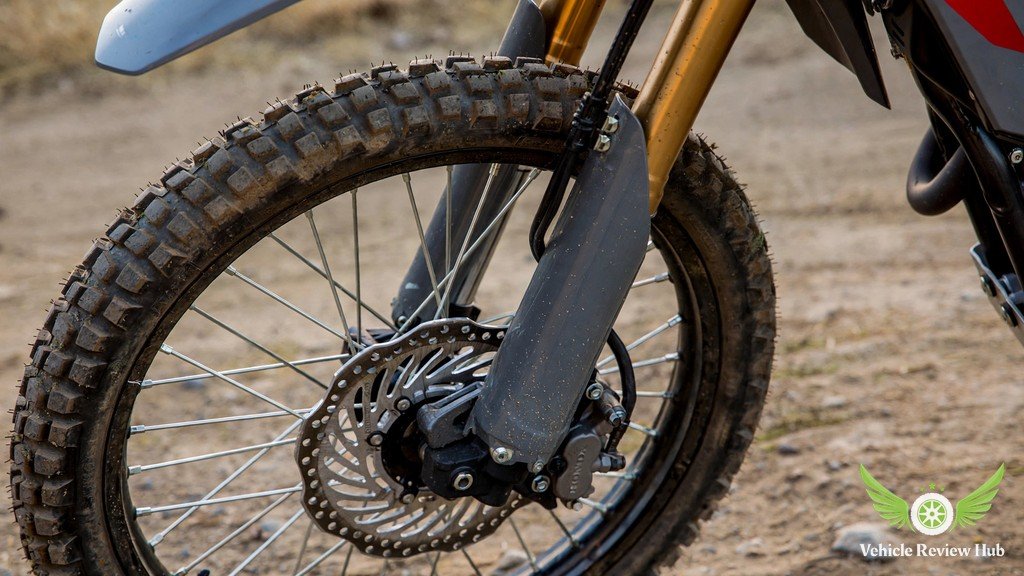
The LS runs 9.3 inches of fork travel and 9.0 inches at the rear, against 10.2 inches at both ends on the standard L, and Honda CRF300LS performance off-road is shaped by that reduction. Ground clearance drops with it, from 11.2 inches on the L to 9.6 inches on the LS, which is still generous by street standards but noticeably less on rocky trails. Where bottoming shows is predictable: square-edged rocks, deep ruts, and hard landings will use the full travel sooner on the LS than on the L, and heavier riders will notice it first. Rider’s 2025 test found firmer damping and more bottoming resistance than the 2023 bike, but the LS remains soft and comfort-oriented. Honda CRF300LS performance in handling terms is a deliberate compromise — better on the road and at stops, slightly less capable in the rough.
All Three Testers Recommend a Skid Plate First for Trail Use
Every serious LS test reaches the same first-modification verdict, and Honda CRF300LS performance off-road effectively starts with a skid plate. Rider’s test notes that, with clearance reduced to 9.6 inches, the test team added Honda’s accessory skid plate first thing, along with light-duty hand guards. Expedition Portal is blunter: with less clearance than the L, bottoming is a consideration, and a skid pan is the first accessory it would buy for the motorcycle. Braking, by contrast, needs no apology. The LS runs a single 256mm front disc with a twin-piston caliper and a single 220mm rear disc, both with ABS, and testers describe stopping power as strong and feel as good for a bike of this weight and price. For Honda CRF300LS performance, the handling verdict is simple: fit the skid plate, set the preload, and the chassis will do everything the engine asks of it. The service side of that chassis is covered in the reliability and maintenance guide.
Honda CRF300LS Performance Compared With Other Small Dual-Sports
Honda CRF300LS performance only makes sense in context, because the small dual-sport class is full of bikes that trade seat height, weight, power, and price against each other. The LS’s rivals are its own taller sibling and Kawasaki’s long-running KLX300.
Honda CRF300LS vs Standard CRF300L and Kawasaki KLX300
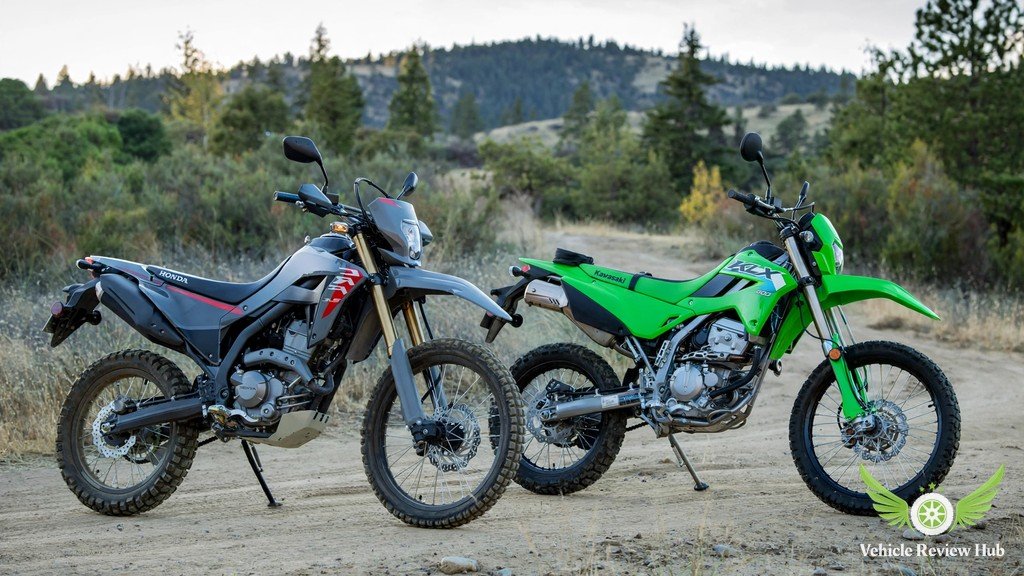
Against the standard CRF300L, Honda CRF300LS performance is identical in the engine and nearly identical everywhere else — the differences are the seat, the travel, and the clearance. The standard L costs the same $5,749 plus $600 destination, with 10.2 inches of travel and a 34.7-inch seat many riders cannot flat-foot. RevZilla’s first ride of the standard L family found the same engine eager and acceptable as a street bike, cruising to 65 mph at 6,500 rpm with minimal vibration, and sipping fuel at 65 to 70 mpg. Against the Kawasaki KLX300, the comparison sharpens: the KLX300 runs a 292cc liquid-cooled single, a six-speed gearbox, a 35.2-inch seat, 10.8 inches of clearance, and about 302 pounds curb weight, at a comparable $5,449 to $5,649 price. The Kawasaki is lighter and roomier off-road, but its seat is two and a half inches taller than the LS’s, which excludes exactly the riders the LS is built for. Prices and ownership costs are covered in the companion buying guide.
| Small dual-sport comparison | Honda CRF300LS | Honda CRF300L | Kawasaki KLX300 |
|---|---|---|---|
| Engine | 286cc single | 286cc single | 292cc single |
| Seat height | 32.7 in | 34.7 in | 35.2 in |
| Curb weight | 311 lb | 309–311 lb | 302 lb |
| Ground clearance | 9.6 in | 11.2 in | 10.8 in |
| Tank | 2.1 gal | 2.1 gal | 2.0 gal |
| Best for | Shorter riders, commuting | Trail ability, taller riders | Light weight, trail range |
Is the Honda CRF300LS Suitable for Shorter Riders and Commuting?
Yes, and this is the question Honda CRF300LS performance answers most convincingly. The 32.7-inch seat, 311-pound weight, and narrow chassis make the LS the most approachable full-size dual-sport Honda sells, and testers with 29-inch inseams report flat-foot confidence that taller dual-sports simply cannot offer. For commuting, Honda CRF300LS performance is close to ideal for urban and suburban routes: superb economy, easy parking, and enough highway ability for short freeway sections. The compromises are real but manageable. If both tests pass, Honda CRF300LS performance is not a compromise at all — it is the right tool for the job, and the full CRF300LS review explains why the package works as a whole.
Honda CRF300LS Performance FAQs
Direct answers to the questions riders ask most about Honda CRF300LS performance, drawn from Honda’s specifications and the LS-specific tests behind this guide.
How fast is the Honda CRF300LS?
It cruises comfortably at 70 mph at about 7,000 rpm in sixth gear. No LS-specific instrumented top-speed test exists, so Honda CRF300LS performance has no verified top-speed figure — only the honest statement that it holds highway speed with little in reserve.
How much horsepower does the Honda CRF300LS have?
The measured figure is 22.7 rear-wheel horsepower from Dirt Rider’s standard-L dyno test — shared-engine data, not an LS run. The 27 hp figure is a non-US factory crankshaft claim, not a Honda USA figure, and Honda CRF300LS performance should be judged on the measured number.
What MPG does the Honda CRF300LS get?
Rider magazine measured 65.7 mpg average and 71.4 mpg best on the actual LS, while Expedition Portal frequently saw over 70 mpg with a 77.7 mpg best run. Expect mid-60s mpg in mixed use for Honda CRF300LS performance.
How far can the Honda CRF300LS go on a tank?
About 130 to 150 miles. The tank holds 2.1 gallons including a 0.5-gallon reserve, so at Rider’s 65.7 mpg average the range is roughly 130 miles, and Honda CRF300LS performance touring means planning fuel stops accordingly.
Is the Honda CRF300LS good on the highway?
Adequate, not strong. Honda CRF300LS performance holds 70 mph comfortably, but there is no meaningful passing reserve, vibration increases past 7,000 rpm, and crosswinds affect a 311-pound bike more than a heavier one.
Can the Honda CRF300LS handle off-road trails?
Yes, for light to moderate trails. Honda CRF300LS performance off-road is limited by 9.3-inch front and 9.0-inch rear travel and 9.6-inch clearance, so fit a skid plate first — every major tester recommends one.
How does the Honda CRF300LS compare with the Kawasaki KLX300?
Power is similar, the KLX300 is lighter with more clearance, and the LS wins decisively on seat height: 32.7 inches against the KLX300’s 35.2 inches. For shorter riders, Honda CRF300LS performance is the accessible choice.
What RPM does the Honda CRF300LS run at 70 mph?
About 7,000 rpm in sixth gear, per both Rider and Expedition Portal LS tests. Buzz begins to intrude beyond that point, which is why Honda CRF300LS performance feels best at 60 to 70 mph rather than above it.
What is the Honda CRF300LS 0-60 time?
No verified figure exists. No LS-specific instrumented acceleration test has been published, so Honda CRF300LS performance coverage that quotes a 0-60 time is guessing, and this guide does not repeat one.
Should I buy the Honda CRF300LS for long-distance touring?
Only if your touring is back-road touring. Honda CRF300LS performance suits 60 to 65 mph routes with fuel stops every 130 miles; riders wanting fast interstate touring should choose a larger dual-sport or adventure bike.