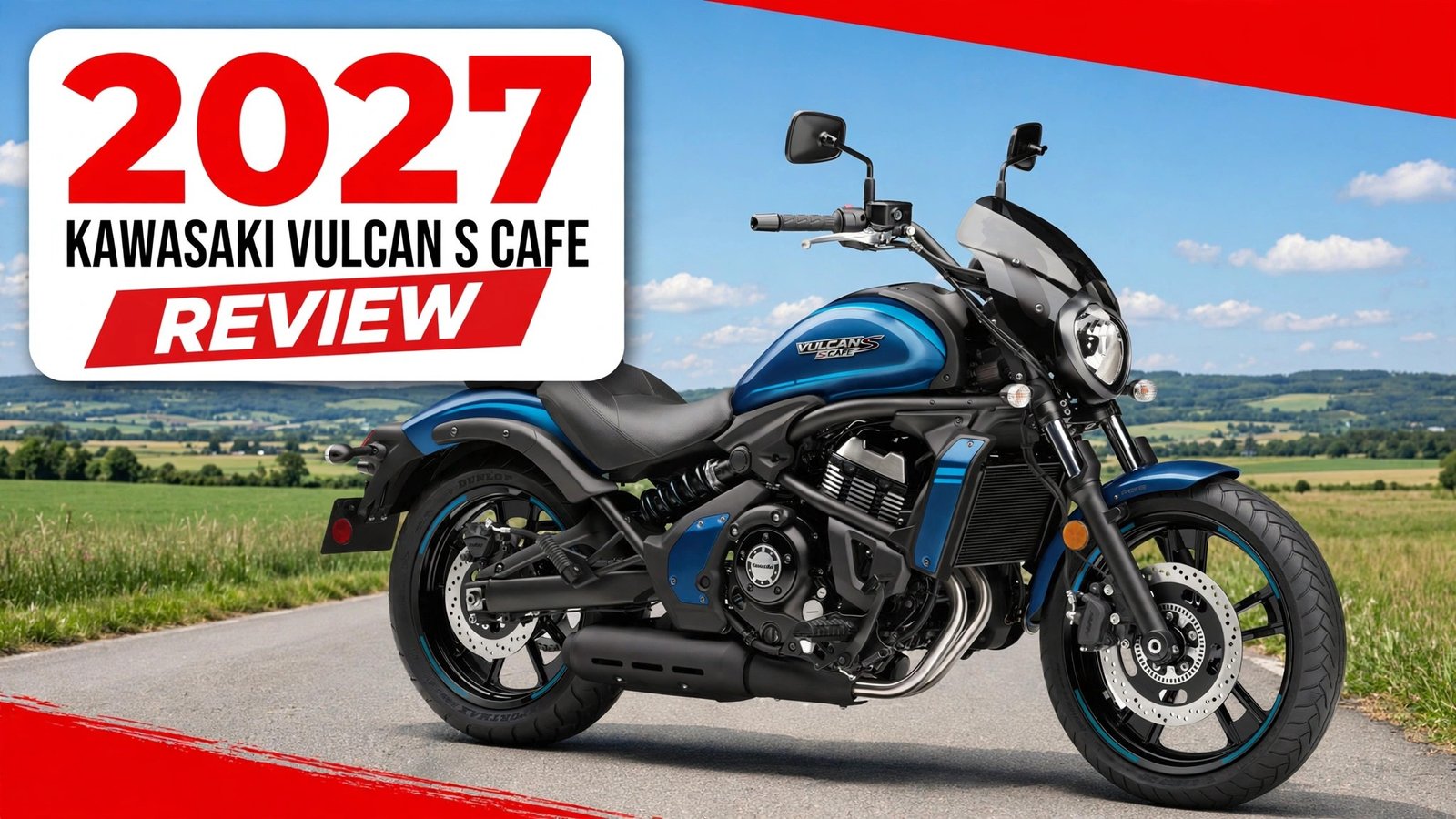
The short answer is that the Vulcan S Cafe is the same 649cc Vulcan S with a fly screen, clubman bars, a solo seat and multi-tone paint — and nothing else. This Kawasaki Vulcan S Cafe review puts the 2027 Cafe at $8,899 before destination, $9,584 on the road, which is $800 more than the standard Vulcan S ABS it is built from. That premium buys looks and riding position, not speed: the Cafe makes the same 60 hp, sits at the same 27.8-inch seat height and runs the same 7,500-mile service intervals as the standard bike. The rest of this Kawasaki Vulcan S Cafe review works through what the premium actually buys, and whether the top trim is worth the money.
Kawasaki Vulcan S Cafe Overview and Model-Year Updates
The Cafe arrived for 2016, revealed at AIMExpo in October 2015, as the top trim of the Vulcan S line. Rider Magazine called the line-up “the base-model S (available with or without ABS), the mid-range S ABS SE and the top-of-the-line S ABS Café”. This Kawasaki Vulcan S Cafe review treats the Cafe as what it is: a trim, not a separate model. ABS is standard on every Cafe ever sold, and from 2027 the whole Vulcan S line is ABS-only, so, as this Kawasaki Vulcan S Cafe review notes, the Cafe’s equipment is now the only thing that separates it from the standard bike.
Cosmetics Only, in Every Year
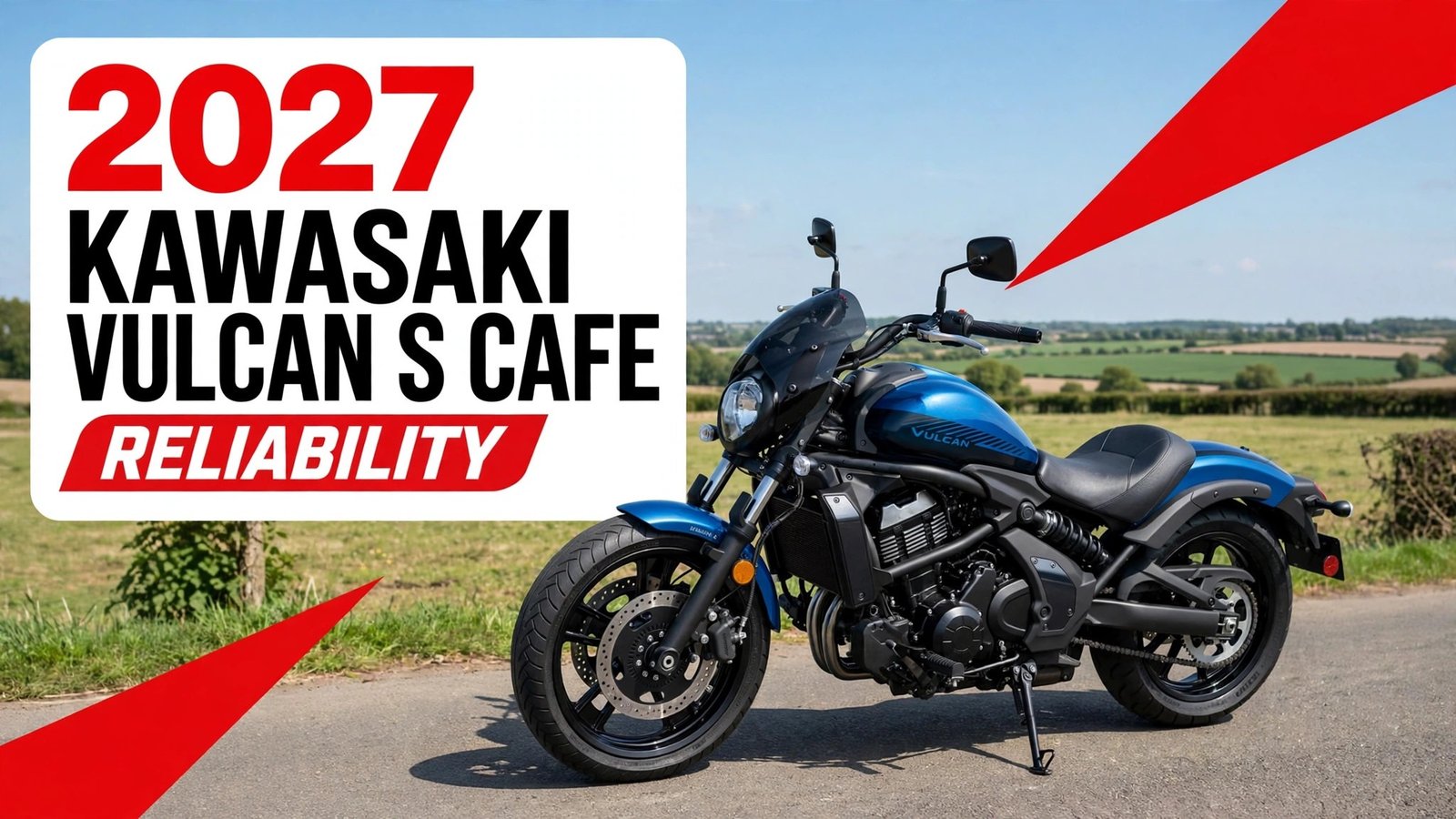
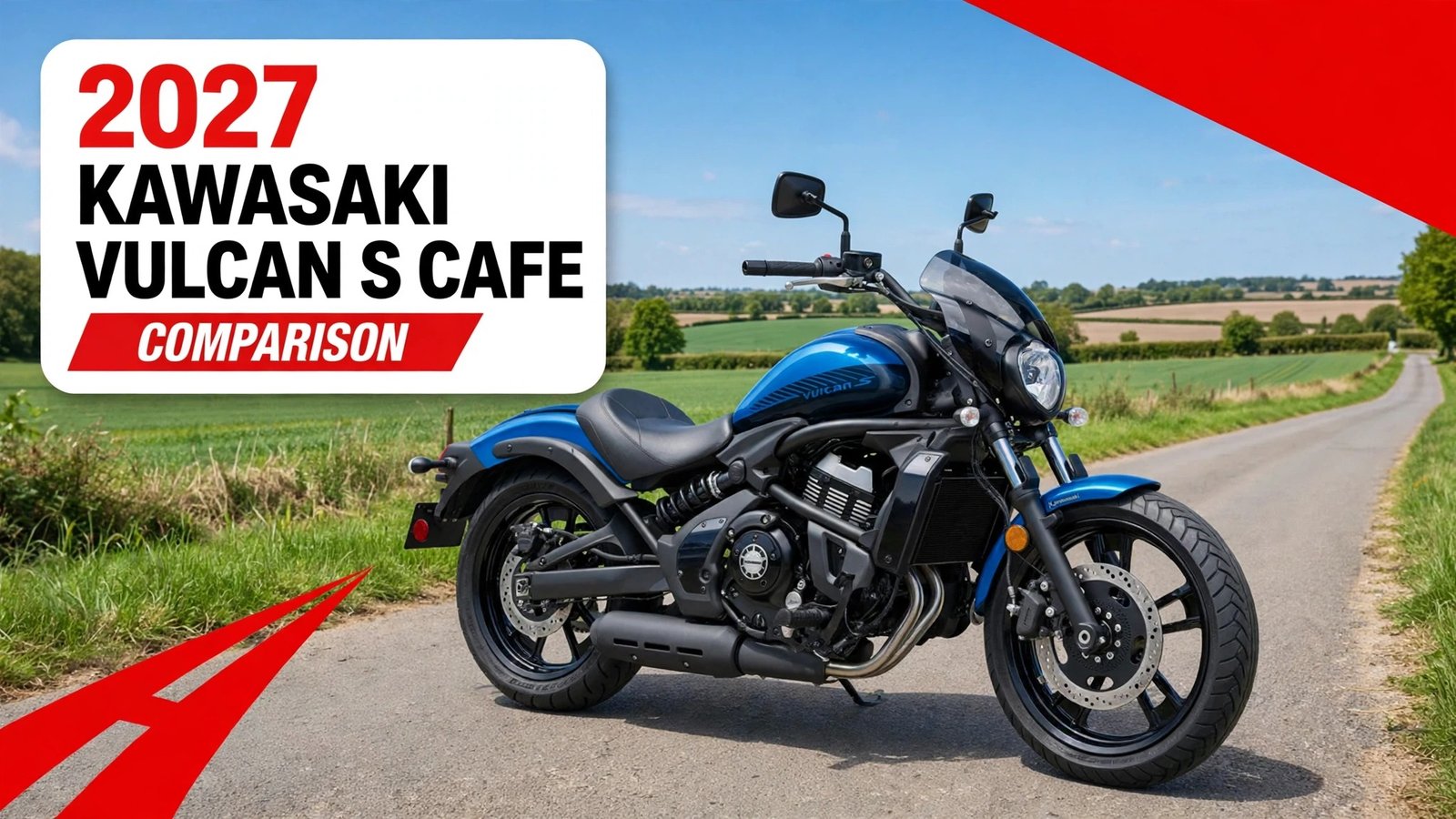
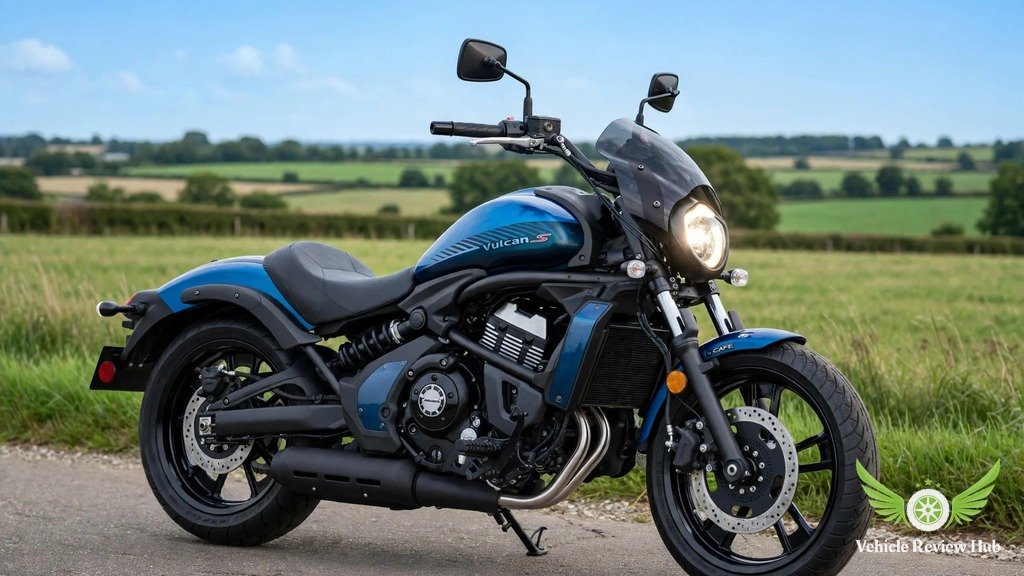
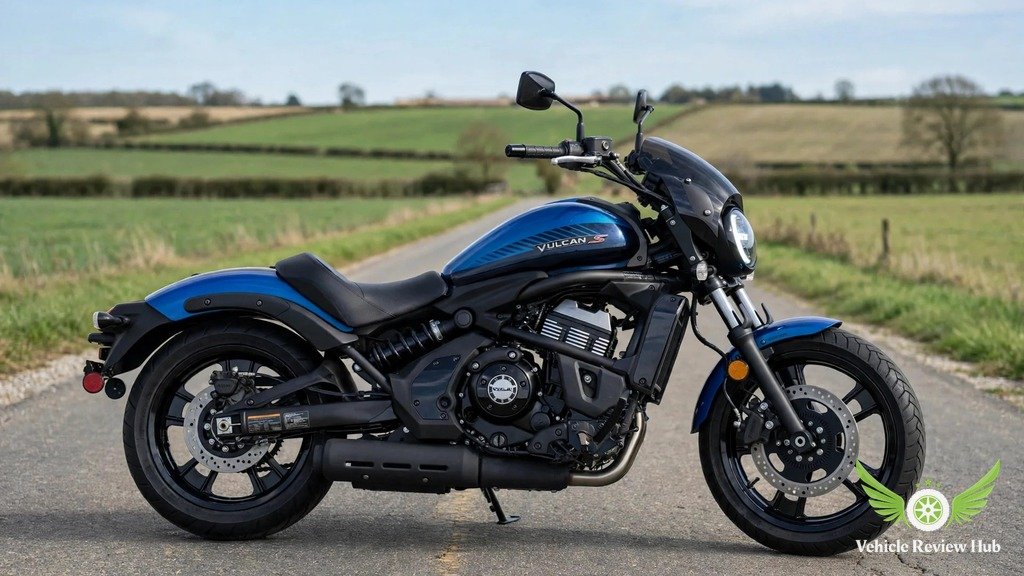
The Cafe’s equipment list has never included a mechanical part. The October 2015 launch reports were blunt: “no mechanical changes”, and the same twin, chassis, brakes and Ergo-Fit have carried over unchanged in every year since. What the Cafe adds is a stubby dark-tinted fork-mount fly screen, clubman handlebars, a solo seat with no passenger footpegs, signature tank badging, sport striping and model-specific multi-tone paint. Rider Magazine’s 2017 road test summed it up as “its solo seat, lack of passenger footpegs, flyscreen and racy look”. The 2015 spec box and the 2027 Kawasaki USA sheet agree on every figure — 60 hp, 46.5 lb-ft, a 27.8-inch seat, a 3.7-gallon tank and a 62.0-inch wheelbase. Only colours, trims and ABS availability changed.
2022 Price Dip Is Real, Not an Error
The Cafe’s price history has one odd year, and it is real. In 2022 the Cafe’s MSRP was $8,049 — $150 below the $8,199 asked in 2021, the only year-over-year price cut in the trim’s history. The delivered price fell too, from $8,609 to $8,484. The dip happened because the standard ABS price jumped that year, from $7,599 to $7,849, while the Cafe barely moved — so the premium collapsed from $600 to $200 in 2022 and stayed there in 2023. The premium returned to $600 in 2024 and stayed there through 2026, before rising to $800 for 2027. The 2022 figure is documented in the dealer brochure and the Motorcycle.com comparison for that year — the dip is part of the trim’s story, not a typo in it.
Kawasaki Vulcan S Cafe Engine and Specifications
The Cafe’s engine is the Ninja 650’s 649cc liquid-cooled parallel twin, retuned for low and mid-range torque with revised cams, intake, ECU and exhaust, and a flywheel 28 percent heavier than the Ninja’s. The result is 60 hp at 7,500 rpm and 46.5 lb-ft at 6,600 rpm, with a 9,900 rpm rev limit and a clutch Cycle News called “nearly impossible to stall while launching”. This Kawasaki Vulcan S Cafe review prints the US figures: 60 hp, never “61 hp”, the European 61 PS figure mislabelled. The same 649cc in the Versys 650 makes 66.0 hp at 8,500 rpm — the Vulcan tune trades peak power for torque where a cruiser uses it.
| Specification | 2027 Vulcan S Cafe ABS |
|---|---|
| Engine | 649cc liquid-cooled DOHC parallel twin, 4 valves/cylinder |
| Bore x stroke | 83.0 x 60.0 mm, 10.8:1 compression |
| Power | 60 hp @ 7,500 rpm (ISO 4106) |
| Torque | 46.5 lb-ft @ 6,600 rpm (63.0 Nm) |
| Transmission | 6-speed, Positive Neutral Finder, sealed chain final drive |
| Frame | High-tensile steel diamond frame; 41 mm fork, 5.1 in travel |
| Rear suspension | Lay-down offset shock, preload-adjustable, 3.2 in travel |
| Rake / trail | 31 degrees / 4.7 in |
| Wheels / tyres | Cast five-spoke, 18-in front / 17-in rear; 120/70-18 front, 160/60-17 rear |
| Brakes | Front single 300 mm disc, 2-piston Nissin caliper + ABS; rear single 250 mm disc, single-piston Nissin caliper + ABS |
| Length / width / height | 90.9 in / 34.6 in / 44.5 in |
| Seat height | 27.8 in |
| Wheelbase | 62.0 in |
| Fuel capacity | 3.7 gal |
| Curb weight | 502.7 lb (dry 471.9 lb) |
| Warranty | 12-month limited |
Notes for this Kawasaki Vulcan S Cafe review specification table: every figure is Kawasaki USA’s 2027 Cafe ABS spec sheet, identical to the 2015 figures except for the Cafe equipment. The torque figure is 46.5 lb-ft on the live USA page; dealer brochures print 46.3 lb-ft, the same engine with a rounding split. Rider’s Cafe spec box prints 3.1 inches of rear travel against Kawasaki’s 3.2 inches.
Plus 4.4 Pounds, Plus 1.2 Inches Tall
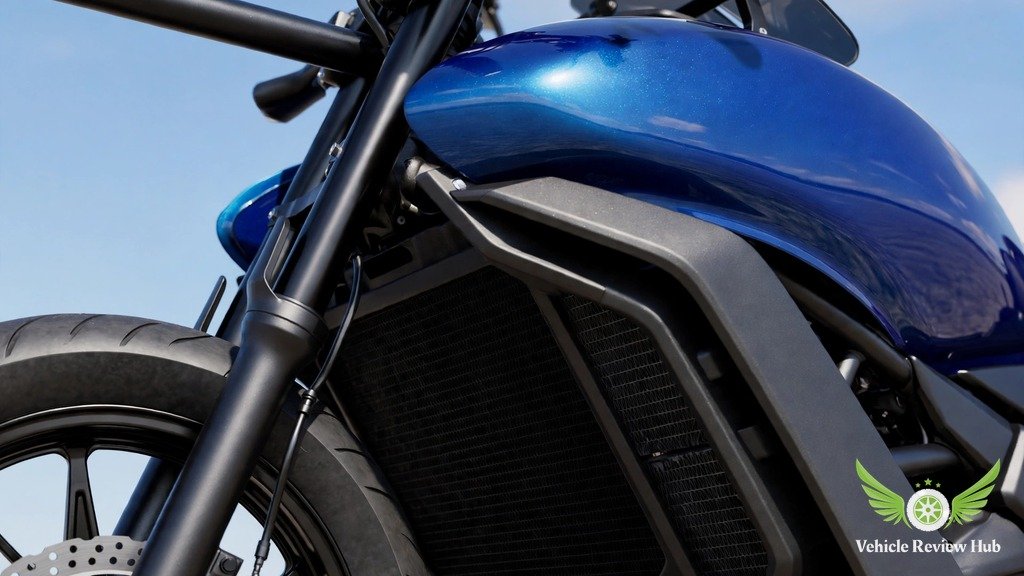
The Cafe’s only measurable differences from the standard ABS are weight and height, and both are small. The Cafe’s curb weight is 502.7 lb against the standard ABS at 498.3 lb — a 4.4-lb difference — and its height is 44.5 inches against 43.3 inches, a 1.2-inch difference. The delta is the fly screen, the clubman bars and the solo-seat hardware — nothing mechanical. This Kawasaki Vulcan S Cafe review stresses the point because it is the whole trim in two numbers: the Cafe is the standard bike plus equipment, and the equipment weighs 4.4 lb and stands 1.2 inches taller.
Seat Height Identical at 27.8 Inches
The Cafe’s seat is the same 27.8-inch perch as the standard Vulcan S, and that matters more than the weight or height figures. Kawasaki’s Ergo-Fit system is standard on both bikes: three seats, two handlebar positions and three footpeg positions combine into 18 configurations, with the fitting free at purchase at a participating dealer. The low seat is what makes the Vulcan line work for shorter riders, and the Cafe gives none of it up. What changes is who sits behind: nobody — the Cafe has no passenger seat and no passenger footpegs. A buyer who rides two-up should not buy the Cafe, and this Kawasaki Vulcan S Cafe review makes that clear because it is the first question a shorter rider asks.
Kawasaki Vulcan S Cafe Price and Market Availability
The Cafe has been sold in the United States in every year from 2016, and its price history is fully documented — twelve model years, one dip, and a premium that has swung between $200 and $800. This Kawasaki Vulcan S Cafe review prices the whole run, because the 2027 figure only makes sense against the twelve years behind it. The Cafe is still on sale new in 2027, and used examples trade too, so the table below covers both.
| Year | Cafe MSRP | Destination | Delivered | ABS MSRP | Cafe premium |
|---|---|---|---|---|---|
| 2016 | $7,999 | $345 | $8,344 | $7,399 | $600 |
| 2017 | $8,099 | $360 | $8,459 | $7,499 | $600 |
| 2018 | $8,099 | $370 | $8,469 | $7,499 | $600 |
| 2019 | $8,099 | $370 | $8,469 | $7,499 | $600 |
| 2020 | $8,099 | $410 | $8,509 | $7,499 | $600 |
| 2021 | $8,199 | $410 | $8,609 | $7,599 | $600 |
| 2022 | $8,049 | $435 | $8,484 | $7,849 | $200 |
| 2023 | $8,099 | $435 | $8,534 | $7,899 | $200 |
| 2024 | $8,499 | $450 | $8,949 | $7,899 | $600 |
| 2025 | $8,499 | $665 | $9,164 | $7,899 | $600 |
| 2026 | $8,749 | $685 | $9,434 | $8,149 | $600 |
| 2027 | $8,899 | $685 | $9,584 | $8,099 | $800 |
Notes for this Kawasaki Vulcan S Cafe review price table: MSRP and destination are Kawasaki’s per-year figures, verified against dealer brochures and launch reporting; delivered is MSRP plus destination. The 2022 dip is real, and the 2027 premium of $800 is the highest in the trim’s history.
Kawasaki Vulcan S Cafe Price in the USA: $8,899
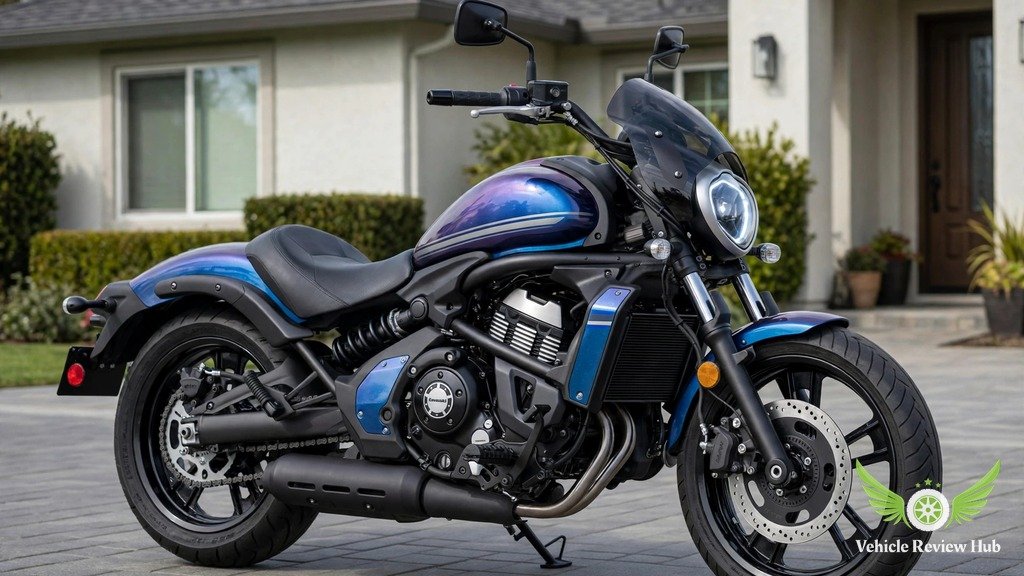
The 2027 Cafe lists at $8,899, plus a $685 destination charge, for $9,584 delivered. That is $150 above the 2026 Cafe and $800 above the 2027 standard ABS — the widest premium the trim has ever carried. The 2027 colour is Candy Plasma Blue with Metallic Ocean Blue (EN650EVFNN). For context, the Cafe cost $7,999 at launch in 2016, so twelve years of price rises have added $900 to the sticker while the bike itself stayed mechanically identical. A used Cafe is the cheaper way in: aggregator reports put used Vulcan S models at $4,500–$7,500, with 2016–2020 examples at $5,000–$7,200, and a used Cafe commands a small premium over a standard S of the same year for the screen, bars, seat and paint — though no priced premium for that used uplift was verified, so this Kawasaki Vulcan S Cafe review prints none. One warning: some listings quote Indian-market prices, which are wrong for the United States — the 2021 US figures are $7,199 for the standard S and $8,199 for the Cafe.
Premium: $600 at Launch, $600 to $800 Now
The Cafe premium has moved in three bands. It was $600 at launch in 2016 and stayed $600 through 2021, then collapsed to $200 in 2022 and 2023 when the ABS price jumped and the Cafe barely moved, then returned to $600 from 2024 through 2026, and now stands at $800 for 2027. The premium is the price of the equipment: the deflector, the clubman bars, the solo seat and the multi-tone paint, fitted at the factory. Whether $800 is worth it depends on what the buyer values — the screen and bars change the look and the riding position, and nothing else. This Kawasaki Vulcan S Cafe review judges the premium on that basis alone, because there is no performance gain to weigh against it: the Cafe and the standard ABS make the same power, weigh within 4.4 lb of each other and run the same service schedule.
Kawasaki Vulcan S Cafe Design, Features and Technology
The Cafe’s design is a styling exercise, and Kawasaki never pretended otherwise. Cycle World put it plainly in April 2016: “the addition of a stubby forkmount fly screen is the sole premise for its Café name”. The screen, the clubman bars, the solo seat and the paint are the design — there is no other design story to tell, and this Kawasaki Vulcan S Cafe review tells it straight. The dash is an analog tachometer with a small LCD for speed, fuel, clock, trips, range and economy, plus an eco indicator. There is no gear indicator, TFT, traction control or riding modes — the only rider aids are ABS and the Economical Riding Indicator.
Deflector Costs $418 as an Accessory
The deflector is the one Cafe part a standard-S owner can buy, and the price needs care. No parts source found in three search rounds quotes $418 for the Cafe deflector, so this Kawasaki Vulcan S Cafe review does not print $418 as a verified price. What is verified, from the RevZilla OEM parts diagrams for the 2018–2020 bikes, is the parts breakdown: the deflector screen itself, part 59254-0005, is $179.76; the mounting kit without KQR, part 99994-0826, is $221.16; and each fork bracket, part 11057-0220, is $42.23. Screen plus kit is $400.92, and screen plus kit plus one bracket is $443.15 — $418 sits between those sums and matches no single part. The complete deflector therefore runs into the low-$400s in parts, before labour. The accessory point itself is verified: the deflector is sold as a factory accessory for the standard Vulcan S, and launch coverage said it “can be mounted on the standard Vulcan”. A standard-S owner who wants the Cafe look can buy it — but should budget on the verified parts prices, not the unverified $418 figure.
Two-Tone or Three-Tone: Kawasaki Conflicts
Kawasaki disagrees with itself about the Cafe’s paint, and this Kawasaki Vulcan S Cafe review presents both sides rather than picking one. The “two-tone” side is Kawasaki USA’s own 2027 Cafe page, whose features list says “2-TONE, PAINT”, and the 2025 dealer brochure, which says the Cafe “includes 2-tone paint”. The “three-tone” side is Kawasaki’s own October 2026 press release, which says the 2027 Cafe “adds three-tone paint, signature tank badging, sport striping and a dark-tinted windshield deflector”, plus the 2016 launch reports, which all described a “three-tone custom paint scheme”, and Motorcyclist’s 2018 guide, which called it “a unique tricolor Pearl Sport Gray paint scheme”. TotalMotorcycle’s 2019 guide lists “three-tone paint, signature tank badging and sport striping”, and a 2024 dealer article describes the same three-tone scheme. The 2027 colour is named as two colours — Candy Plasma Blue and Metallic Ocean Blue — while the press release calls the scheme three-tone, so the third tone is plausibly the striping or accent. The 2022 brochure named three colours outright: Ebony, Pearl Robotic White and Candy Steel Furnace Orange.
Kawasaki Vulcan S Cafe Riding Experience and Comfort
The Cafe rides like the standard Vulcan S, because it is the standard Vulcan S. The 27.8-inch seat, light steering and forgiving clutch make it easy at town speeds, and the 649cc twin pulls cleanly from low revs. This Kawasaki Vulcan S Cafe review keeps the riding verdict honest: the screen and bars change the feel and the look, but not the engine, chassis or suspension. The rear shock is the known weak point — Cycle News found it “fairly stiff out of the crate” and Rider’s Cafe test called it “harsh and jarring on uneven pavement” — while steering is light and ground clearance generous.
The film below is one rider’s first-ride review of a 2026 Cafe, not an instrumented test — the bike on screen is the Cafe trim, with its stubby fly screen and clubman bars. The measured figures in this Kawasaki Vulcan S Cafe review come from the instrumented tests in the tables, not from the film.
Kawasaki Claims No Wind Function
On the current Kawasaki USA page, the deflector gets no wind claim at all — the 2027 page’s only mention of wind is the bare feature-list entry “Dark-tinted, wind deflector”. That is the heading’s basis, and this Kawasaki Vulcan S Cafe review reports it accurately. But the older Kawasaki copy did claim a wind function: TotalMotorcycle’s copy of the 2019 feature list says the “dark-tinted windshield deflector helps wind management for a more comfortable ride”, and the 2015 launch coverage said the windshield “helps reduce wind blast deflecting the flow of air away from the rider”. The testers split the difference. Rider Magazine’s Cafe road test said “the Café’s flyscreen diverts enough windblast to make highway speeds tolerable”, and added that longer rides “would be easier with more protection from the elements” — the screen helps, it does not transform the bike. No UK-owner verdict on the Cafe screen was located in three searches, so this Kawasaki Vulcan S Cafe review does not invent one: Rider’s verdict stands as the published word on the screen, and the current Kawasaki page claims nothing for it.
SE Is Paint Only, No Deflector
The SE is the trim buyers confuse with the Cafe, and the difference is simple: the SE is paint. Motorcyclist’s 2018 buyer’s guide says the SE “features unique Pearl Lava Orange special-edition paintwork” while the Cafe “adds a stylized tinted windshield, a unique tricolor Pearl Sport Gray paint scheme, Lime Green accents and special gas-tank badges”. The 2015 launch coverage said the same: the Cafe gets “a new tinted wind deflector and a three tone custom paint scheme”, while the SE “will feature a special two-tone paint finish”. The SE never had a deflector, clubman bars or a solo seat, and it existed only from 2016 to 2018 — it did not make it through to 2019. Its 2016 price was $7,599 in the launch reports, $400 above the standard ABS and $400 below the Cafe. A used SE is therefore a standard Vulcan S with special paint, not a Cafe without a screen, and this Kawasaki Vulcan S Cafe review makes the distinction because used listings blur it.
Kawasaki Vulcan S Cafe Review: Pros, Cons and Verdict
The verdict of this Kawasaki Vulcan S Cafe review is that the Cafe is the best-looking Vulcan S and the hardest to justify on value alone. It is the same strong bike as the standard ABS, with the best styling in the line and a screen that helps at highway speed, for $800 more than the bike it is built from. The premium buys the look, and the look is the point.
Main Advantages and Limitations of the Kawasaki Vulcan S Cafe
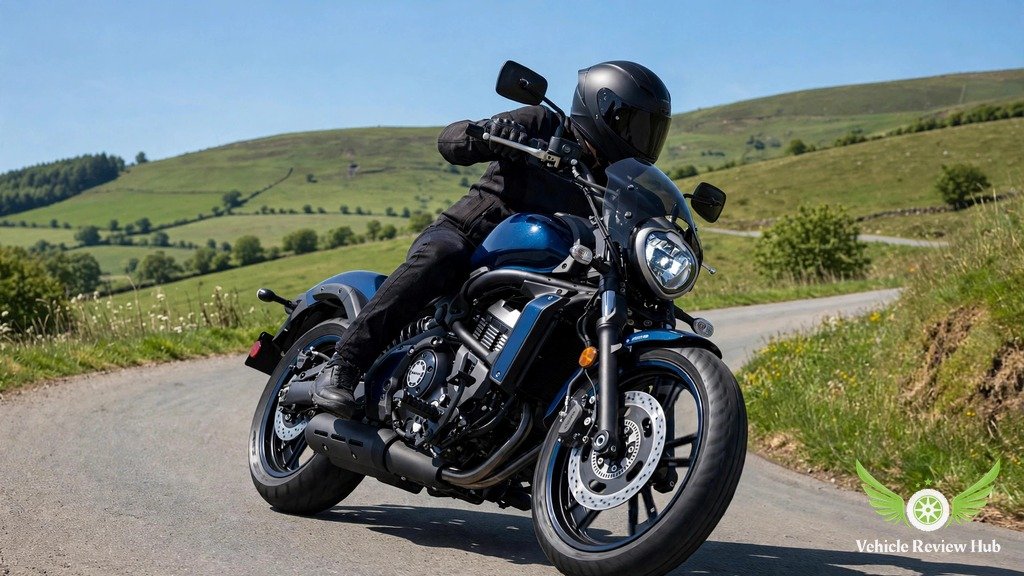
The advantages are the 60 hp twin with its low-end torque, the 27.8-inch seat with 18 Ergo-Fit configurations, the light steering, the standard ABS, and the Cafe’s styling — fly screen, clubman bars and multi-tone paint. The limitations are the $800 premium for cosmetics, the solo seat with no passenger provision, the harsh rear suspension, and the screen’s modest wind protection, which Rider called enough for highway speeds and no more. This Kawasaki Vulcan S Cafe review weighs those honestly: the bike’s strengths are the standard S’s strengths, and its weaknesses are the standard S’s weaknesses plus the price of the trim.
12 Month Limited Warranty
The Cafe carries Kawasaki’s 12-month limited warranty, the same as every Vulcan S. The Ergo-Fit fitting is free at purchase at a participating dealer, though the parts for a later change cost extra. The service schedule is the standard S schedule: oil and filter every 7,500 miles, valve inspection every 15,000 miles, brake fluid every two years, and chain lubrication every 400 miles. This Kawasaki Vulcan S Cafe review notes the warranty plainly because the premium does not buy extra cover — $800 buys the screen, the bars, the seat and the paint, and nothing else.
Kawasaki Vulcan S Cafe Review: Frequently Asked Questions
These are the questions buyers ask most about the Cafe trim, answered with the verified figures from this Kawasaki Vulcan S Cafe review.
Is the Kawasaki Vulcan S Cafe just a standard Vulcan S with a screen?
Almost. In this Kawasaki Vulcan S Cafe review, the Cafe is the same 649cc bike plus a fly screen, clubman bars, a solo seat with no passenger pegs, tank badging, sport striping and multi-tone paint — 4.4 lb and 1.2 inches from that equipment.
How much does the 2027 Kawasaki Vulcan S Cafe cost?
In this Kawasaki Vulcan S Cafe review, the 2027 Cafe is $8,899 plus a $685 destination charge, $9,584 delivered — $150 above 2026 and $800 above the 2027 standard ABS.
What is the price premium of the Cafe over the Vulcan S ABS?
In this Kawasaki Vulcan S Cafe review, the premium is $800 for 2027 — $600 at launch in 2016, $200 in 2022–2023, $600 from 2024 to 2026, and $800 now, the highest ever.
Does the Cafe have ABS?
Yes. In this Kawasaki Vulcan S Cafe review, ABS is standard on every Cafe ever sold, and from 2027 the whole Vulcan S line is ABS-only.
How much horsepower does the Vulcan S Cafe make?
In this Kawasaki Vulcan S Cafe review, the Cafe makes 60 hp at 7,500 rpm and 46.5 lb-ft at 6,600 rpm — the same as the standard S, since the trim adds no mechanical parts.
Is the Cafe’s seat height the same as the standard Vulcan S?
Yes. In this Kawasaki Vulcan S Cafe review, both bikes list a 27.8-inch seat, and the Ergo-Fit system with 18 configurations is standard on both — only the passenger provision differs.
Does the fly screen actually block wind?
Partly. In this Kawasaki Vulcan S Cafe review, Rider Magazine said the flyscreen “diverts enough windblast to make highway speeds tolerable”, while the current Kawasaki page makes no wind claim for it.
Can a passenger ride on the Vulcan S Cafe?
No. In this Kawasaki Vulcan S Cafe review, the Cafe has a solo seat and no passenger footpegs — a rider who carries a passenger should buy the standard S.
What is the difference between the Cafe and the SE?
In this Kawasaki Vulcan S Cafe review, the SE is paint only — special two-tone paintwork with no deflector, clubman bars or solo seat — while the Cafe adds the screen, bars, seat and paint.
Is the Vulcan S Cafe a good beginner bike?
For many, yes. In this Kawasaki Vulcan S Cafe review, the low seat, light steering, forgiving clutch and standard ABS help new riders, but the 502.7-lb curb weight and revvy twin argue for some experience.
What colours does the 2027 Cafe come in?
In this Kawasaki Vulcan S Cafe review, the 2027 Cafe comes in Candy Plasma Blue with Metallic Ocean Blue — while Kawasaki’s press release calls the scheme three-tone and its USA page calls it two-tone.
How long is the Vulcan S Cafe warranty?
In this Kawasaki Vulcan S Cafe review, the Cafe carries a 12-month limited warranty, the same as every Vulcan S — the premium buys styling, not extra cover.