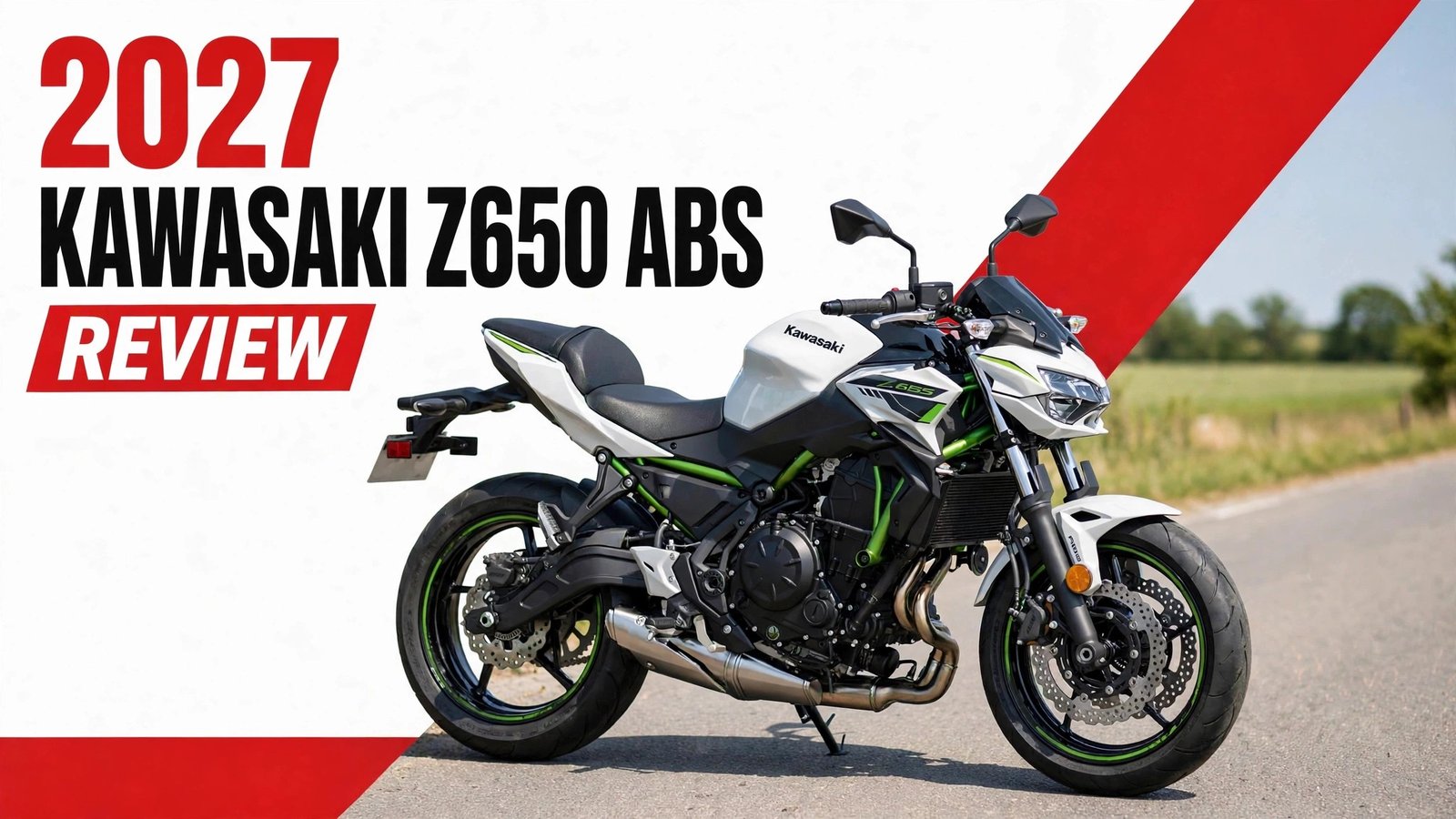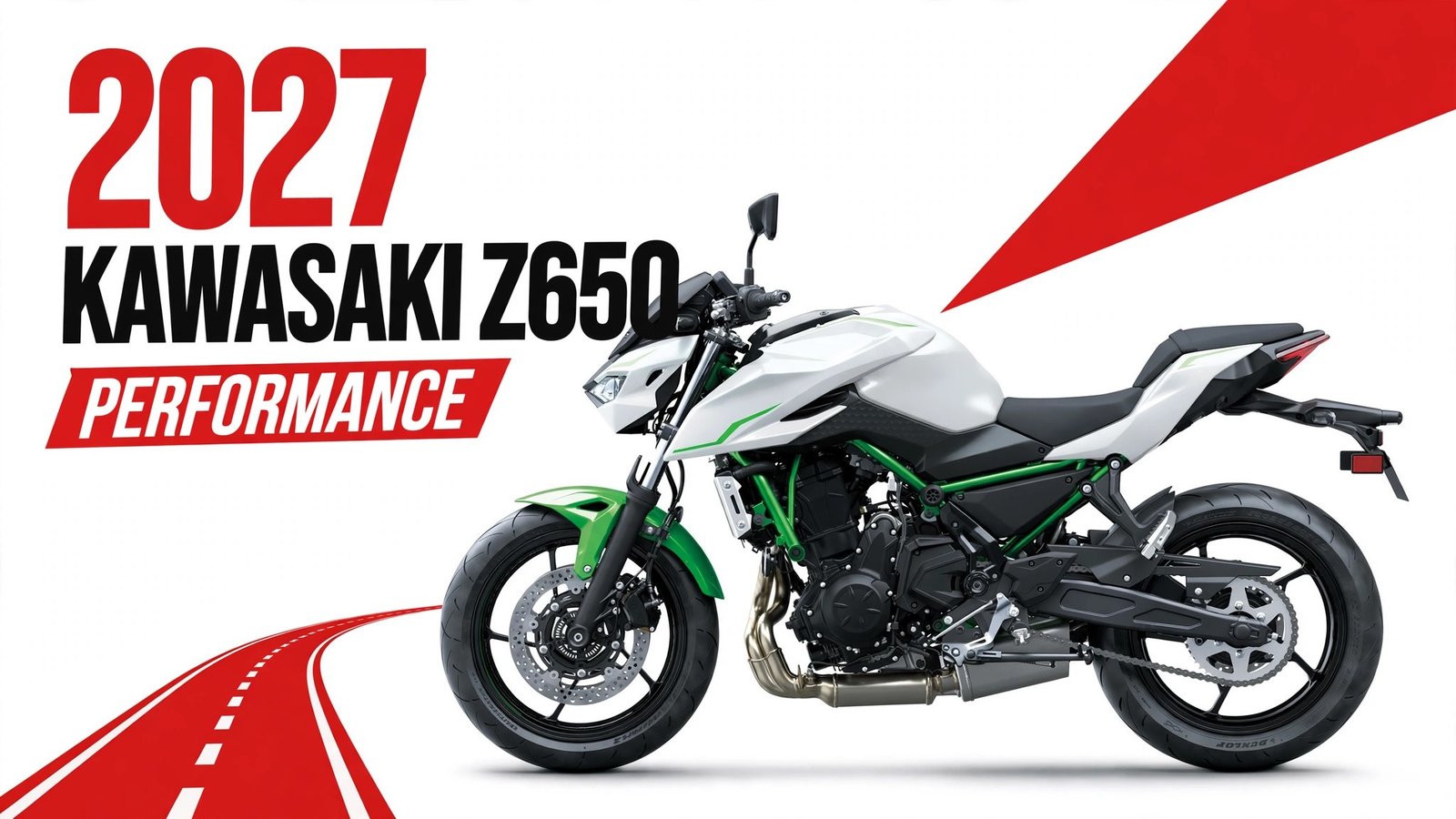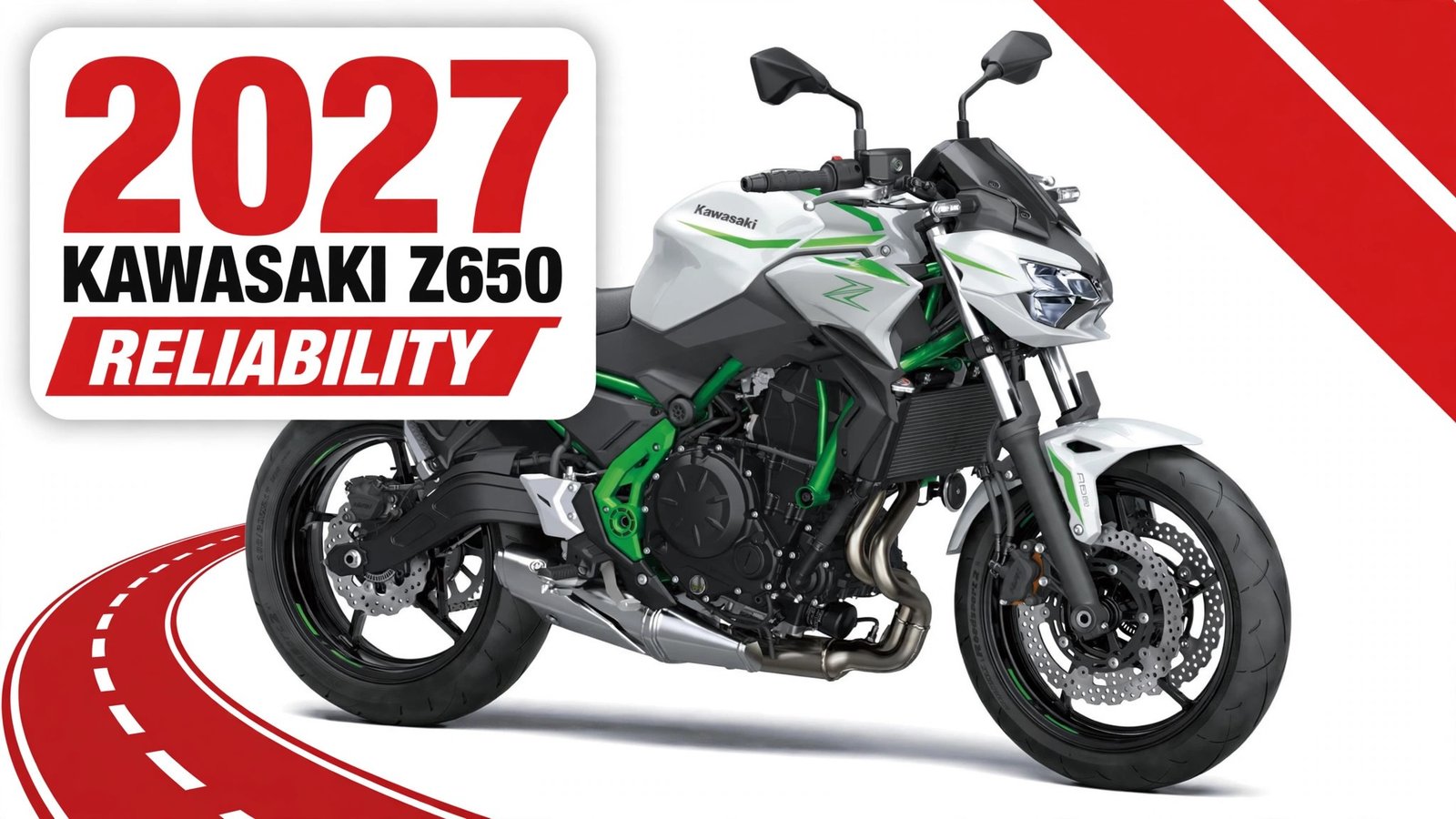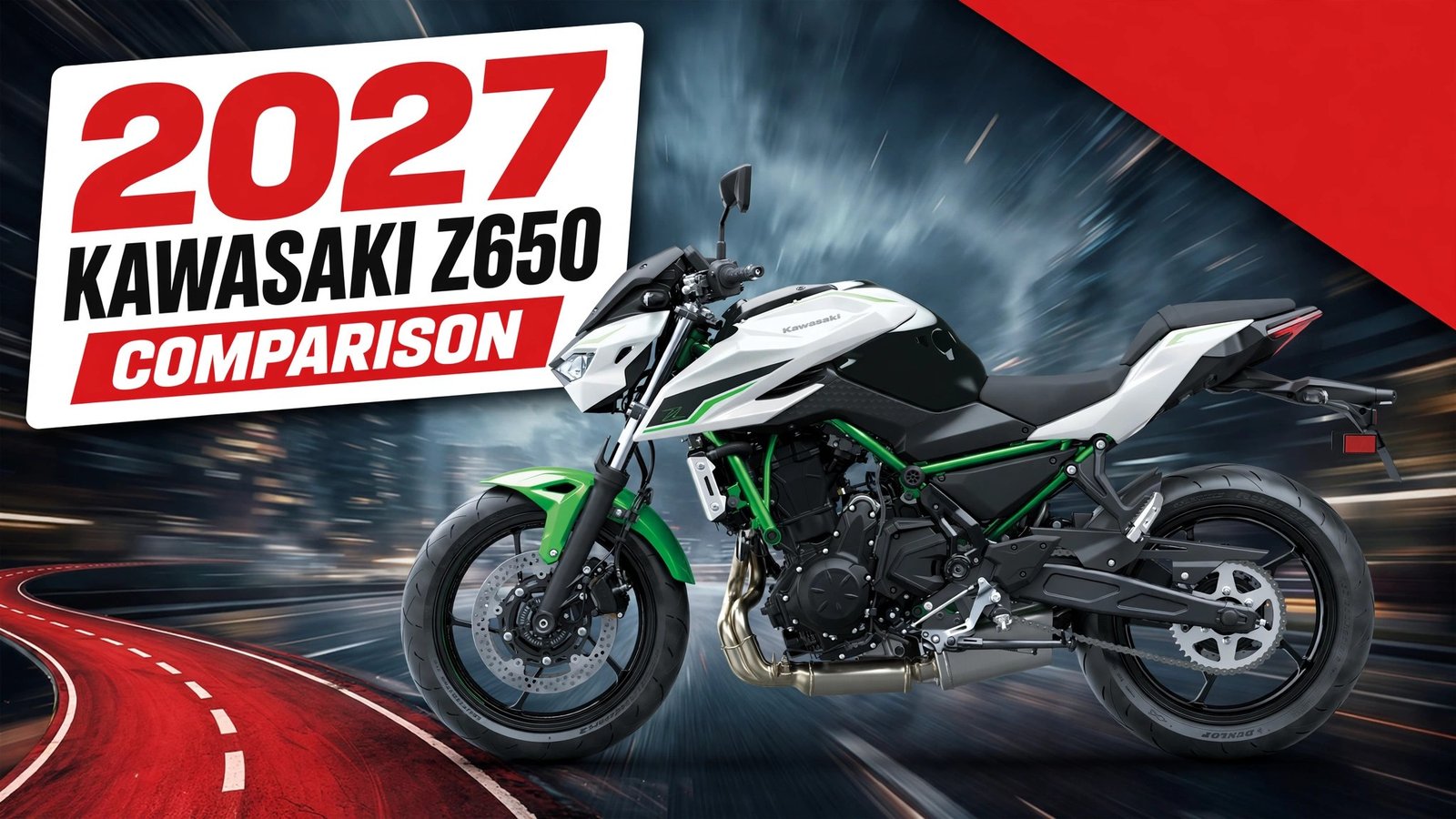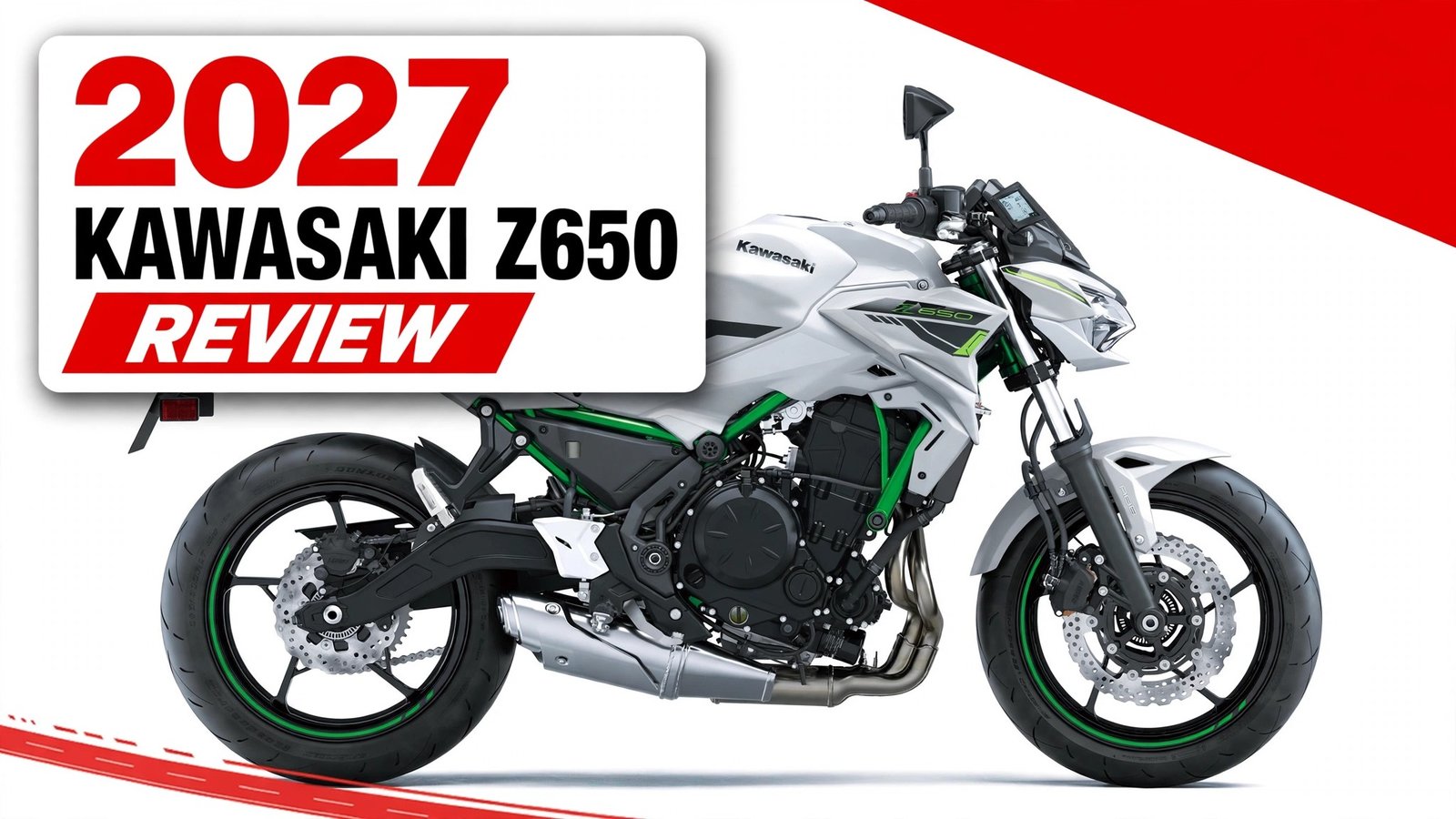
The 2027 Kawasaki Z650 S ABS costs $7,899 plus $685 destination, which makes it $8,584 delivered — the cheapest delivered middleweight naked in its class. It is the same 649cc twin that has sold in the US since 2017, now with a taller seat, wider bars and standard ABS. This Kawasaki Z650 review works through the price ladder, the spec sheet, the two verified dyno runs, the riding experience and the verdict. This Kawasaki Z650 review puts the delivered price first because that is where the bike wins.
Kawasaki sells only one Z650 in the United States for 2027: the Z650 S ABS. There is no non-ABS trim and no base Z650 on the American price list, and that change is US-only — in the United Kingdom and Europe the S sits alongside the base bike. The engine is unchanged at a claimed 67.0 hp and the fork is still a conventional 41 mm telescopic unit, not an inverted one; what changed for 2026 is the riding position and the trim structure.
Kawasaki Z650 Overview and Model-Year Updates
This Kawasaki Z650 review starts with the model-year history, because the 2027 bike only makes sense against the eleven years before it. The Z650 has run in the United States continuously from 2017 to 2027 with no gaps, and every update in that run is visible on the current bike: the 2020 TFT dash, the 2023 traction control, and the 2026 S transformation.
Became the Z650 S for 2026
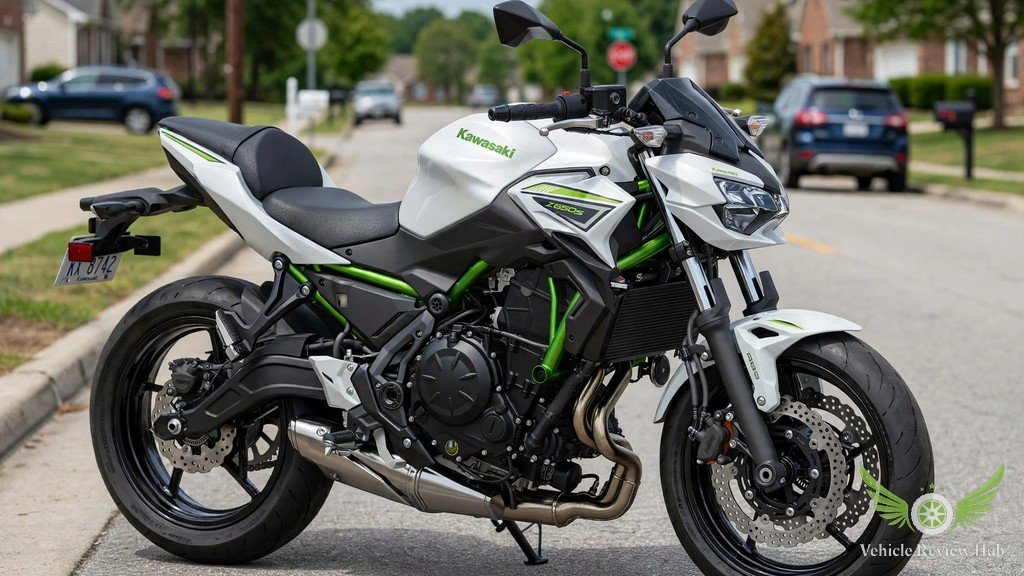
For 2026 the American Z650 became the Z650 S ABS, model code ER650WTFNL, and the change is more than a badge. The front seat is taller and more cushioned, the handlebar moves 40 mm further forward, 10 mm higher and 30 mm wider, and the bike is ABS-only. Kawasaki’s 2026 sheet notes the seat is “20mm higher than previous”, while the published seat heights go from 31.1 inches to 31.7 inches — a rise of 0.6 inches, or about 15 mm — and this Kawasaki Z650 review prints both figures instead of reconciling them.
The S is the only Z650 the United States gets for 2026 and 2027. Kawasaki publishes no 2026 or 2027 base Z650 spec sheet in the US at all: the 2026-z650-abs, 2026-z650, 2027-z650-abs and 2027-z650 addresses all serve the maker’s not-found page. In the United Kingdom the S sits alongside the base bike at £7,199 against the base bike’s £7,099, so a buyer should never be told the base Z650 was dropped everywhere — it was dropped in the United States only, and this Kawasaki Z650 review keeps that distinction throughout.
ABS-Only From 2026
Non-ABS Z650s were sold in the United States through 2025 — the spec sheets list non-ABS weights through that year — and from 2026 the American bike is ABS-only. The 2017 price gap shows what ABS used to cost: $6,999 for the base bike against $7,399 for the ABS version, a $400 premium. That premium is now gone because there is no non-ABS bike left to compare against, and a used-bike buyer should know that any 2017 to 2025 Z650 may or may not carry ABS, while every 2026 and 2027 bike has it as standard. This Kawasaki Z650 review treats 2026 as the ABS-only dividing line.
Kawasaki Z650 Engine and Specifications
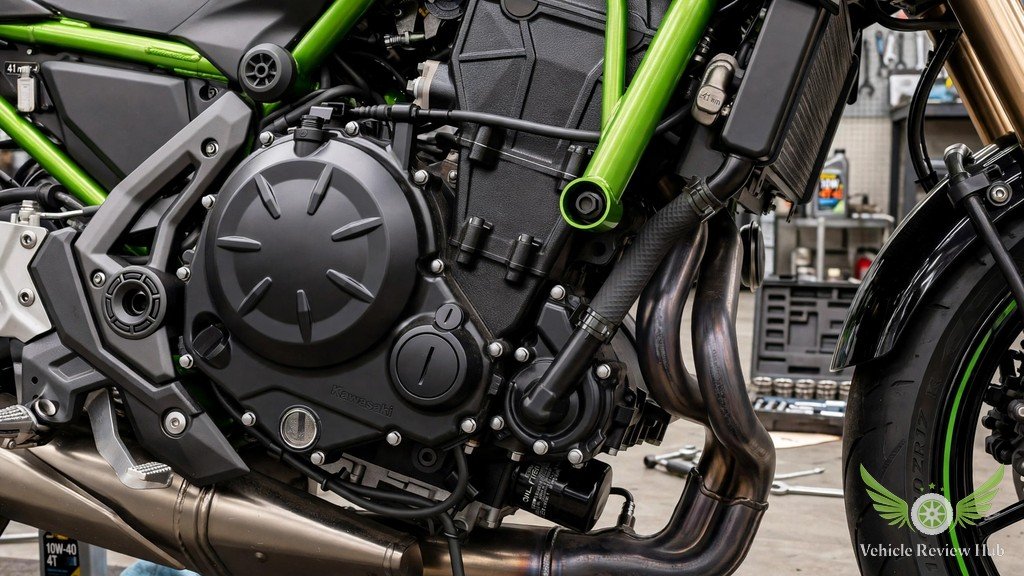
This Kawasaki Z650 review puts the engine first because it is the one part of the bike that has barely changed in eleven years — and that is a strength, not a complaint. The 649cc parallel twin is the naked twin of the Ninja 650’s engine, a liquid-cooled DOHC eight-valve twin with a 6-speed gearbox and an assist and slipper clutch, and Kawasaki claims 67.0 hp at 8,000 rpm on every spec sheet from 2019 to 2027. The measured figures are lower, as they always are on a rear-wheel dyno, and the gap between claimed and measured is the honest story here.
No Inverted Fork Here
The Z650 has never had an inverted fork, and the 2027 S does not change that. The front end is a 41 mm telescopic fork — chrome uppers at the top, black lowers at the bottom — with a horizontal back-link rear shock that adjusts for preload only. A buyer who expects the inverted fork of the MT-07 or GSX-8S will not find it here. The conventional fork is part of why the Z650 costs less than its rivals, and this Kawasaki Z650 review counts it as a price decision, not a defect.
The steel trellis frame is the same family as the Ninja 650’s, and at the 2017 launch Rider Magazine put the ABS bike at 410 lb wet — 55 lb lighter than the 2016 Ninja 650.
The dyno record is short and clean. Motorcycle.com’s 2017 shootout dyno measured 60.95 hp at 8,000 rpm and 43.71 lb-ft at 6,700 rpm at the rear wheel, on the same dyno and the same day that the SV650 made 71.6 hp and the FZ-07 made 68.2 hp. Motorcycle.com’s 2021 six-way dyno measured 61.4 hp at 8,100 rpm — the lowest of the six bikes that year. A “59.9 hp” dyno figure is sometimes quoted online for this bike, but no source for it could be verified, so this Kawasaki Z650 review does not print it as a dyno result — the two Motorcycle.com runs above are the only verified dyno figures in the record.
Torque Prints Two Ways
The torque figure depends on the model year. The 2019 to 2025 spec sheets print 48.5 lb-ft at 6,500 rpm, while the 2026 and 2027 sheets print 47.2 lb-ft at 6,700 rpm. The claimed power did not change — 67.0 hp at 8,000 rpm on both sets of sheets — so the torque change is a small retune of the peak, not a different engine. This Kawasaki Z650 review year-labels every torque figure for exactly that reason. MCN lists 68 bhp for the 2017 to 2019 bike, but the American sheets print 67.0 hp, and this Kawasaki Z650 review uses the American sheet figure because this is a US-market bike.
| Item | 2027 Kawasaki Z650 S ABS |
|---|---|
| Engine | 649cc parallel twin, DOHC, liquid-cooled, 8 valves |
| Claimed power | 67.0 hp @ 8,000 rpm (ISO 4106) |
| Claimed torque | 47.2 lb-ft @ 6,700 rpm (48.5 lb-ft @ 6,500 on 2019–2025 sheets) |
| Bore × stroke / compression | 83.0 × 60.0 mm / 10.8:1 |
| Transmission | 6-speed, assist & slipper clutch |
| Frame | Steel trellis |
| Front suspension | 41 mm telescopic fork (not inverted) |
| Rear suspension | Horizontal back-link, preload-adjustable |
| Front brakes | Dual 300 mm petal discs, 2-piston calipers + ABS |
| Rear brake | Single 220 mm petal disc, single-piston caliper + ABS |
| Tyres | 120/70-17 front / 160/60-17 rear, Dunlop Sportmax D214 |
| Rake / trail / wheelbase | 24.0° / 3.9 in / 55.5 in |
| Seat height | 31.7 in (31.1 in on 2020–2025 bikes; 30.9 in in 2019) |
| Curb weight | 416.7 lb (49-state) / 419.0 lb (50-state) |
| Fuel capacity | 4.0 gal |
| Warranty | 12-month limited |
Note: This Kawasaki Z650 review spec table is taken from the 2027 Z650 S ABS spec sheet, read in full. This Kawasaki Z650 review uses it as the anchor for every figure in the section. The torque figure is year-labelled because it prints two ways across the model years, and the dyno figures quoted in the text are Motorcycle.com rear-wheel runs, not Kawasaki’s claimed crank figures.
Kawasaki Z650 Price and Market Availability
This Kawasaki Z650 review prices the bike the way a buyer actually pays for it: MSRP plus destination, equals delivered. The destination charge is verified per model year from Kawasaki’s own spec sheets and dealer listings, never carried across years, and where a year has no verified destination this review says so instead of inventing one. The headline is simple — the 2027 bike is $7,899 plus $685, which is $8,584 delivered.
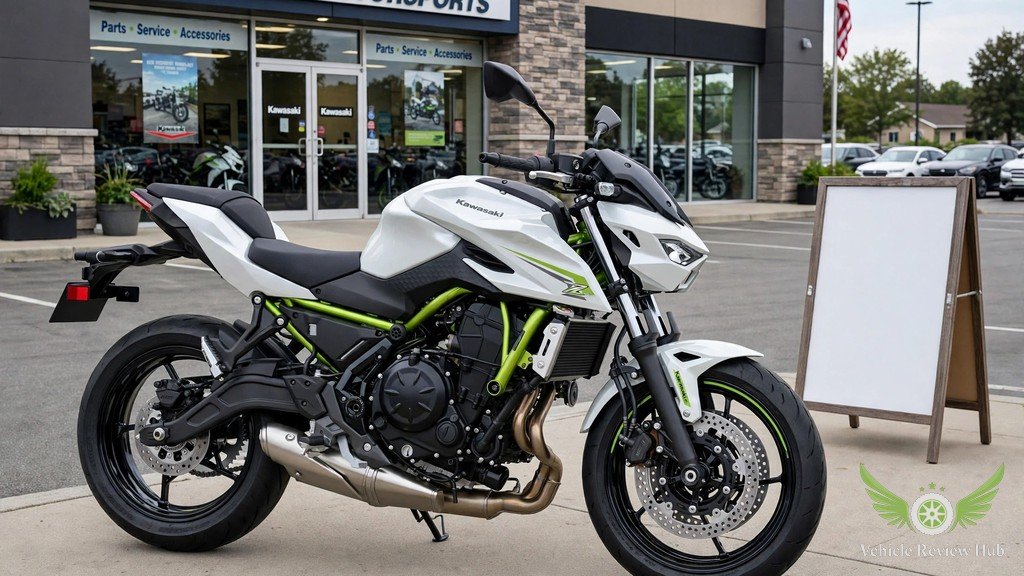
Kawasaki Z650 Price in the USA: $7,899 (2027)
The 2027 Z650 S ABS lists at $7,899 on Kawasaki USA’s own spec sheet, with a $685 destination charge verified from dealer listings, for a delivered price of $8,584. The 2026 S ABS listed at $7,699 with the same $685 destination, or $8,384 delivered — which means the 2027 bike costs $200 more than the 2026 bike, and the 2025 ABS bike at $7,749 plus $685, or $8,434 delivered, actually cost more than the 2026 bike. A buyer who assumes each new year costs more than the last will get this ladder wrong, and this Kawasaki Z650 review prints the inversion plainly because it is real.
The older years are harder to price honestly. The 2018 to 2023 spec sheets regenerate with “BASE MSRP TBA” in the price field, so those years have no verified MSRP from Kawasaki at all. The 2024 bike is priced only from dealer brochures: three DX1 dealer brochures agree on $7,249 without ABS and $7,749 with ABS, and one buyer’s guide printed higher 2024 figures that conflict with those three brochures — this review does not use them. The 2024 destination charge is unverified, so no 2024 delivered price is computed anywhere in this Kawasaki Z650 review.
| Year | Trim | MSRP | Destination | Delivered |
|---|---|---|---|---|
| 2017 | Z650 | $6,999 | Unverified | — |
| 2017 | Z650 ABS | $7,399 | Unverified | — |
| 2018–2023 | Z650 / Z650 ABS | Unverified — sheets print “BASE MSRP TBA” | — | — |
| 2024 | Z650 | $7,249 (dealer brochures) | Unverified | — |
| 2024 | Z650 ABS | $7,749 (dealer brochures) | Unverified | — |
| 2025 | Z650 ABS | $7,749 | $685 | $8,434 |
| 2026 | Z650 S ABS | $7,699 | $685 | $8,384 |
| 2027 | Z650 S ABS | $7,899 | $685 | $8,584 |
Note: This Kawasaki Z650 review price ladder is built from Kawasaki USA spec sheets for 2025, 2026 and 2027, the Motorcycle.com 2017 shootout spec table for the launch prices, and three DX1 dealer brochures for 2024. The 2024 destination is unverified, so no 2024 delivered price is printed, and the 2018–2023 MSRP gap is printed openly rather than filled with a guess — the approach this Kawasaki Z650 review takes with every unverified figure.
Cheapest Delivered in Class
The 2027 Z650 S at $8,584 delivered undercuts every rival in its middleweight class. The 2026 Suzuki SV650 ABS is $8,149 plus $600 destination, or $8,749 delivered — $165 more than the Z650 S — and Suzuki adds a $250 freight surcharge on models shipped on or after September 17, 2025, which widens the gap to $415 for a total of $8,999. A full side-by-side of the four bikes is in the Kawasaki Z650 comparison blog, and this Kawasaki Z650 review uses the delivered prices here only to show why the Z650’s value case starts with the price tag.
Used prices tell a different story from the new-bike ladder. Live Cycle Trader listings checked in November 2026 show 2023 Z650s from $3,990 to $6,997 and 2024 Z650s from $6,249 to $6,997, with a 2024 ABS at $6,249 and a 2023 ABS at $6,997. The doc’s “$5,195” starting figure for 2023 bikes is a snapshot, not the floor — the live range starts $1,205 lower — so this Kawasaki Z650 review prints the live range with its November 2026 check date.
| Bike (2026–2027) | MSRP | Destination | Delivered | Gap vs Z650 S |
|---|---|---|---|---|
| Kawasaki Z650 S ABS (2027) | $7,899 | $685 | $8,584 | — |
| Suzuki SV650 ABS (2026) | $8,149 | $600 | $8,749 | +$165 (+$415 with $250 surcharge) |
| Yamaha MT-07 (2026) | $8,599 | $675 | $9,274 | +$690 |
| Suzuki GSX-8S (2026) | $9,249 | $700 | $9,949 | +$1,365 |
Note: This Kawasaki Z650 review delivered-price table uses the 2027 Z650 S ABS spec sheet and the Motorcycle.com database plus dealer listings for the rivals, all checked in November 2026. The SV650’s $250 freight surcharge is Suzuki’s own footnote for models shipped on or after September 17, 2025, and it is named separately rather than folded into the delivered figure. Rival prices in this Kawasaki Z650 review are the November 2026 figures, not later discounts.
Kawasaki Z650 Design, Features and Technology
This Kawasaki Z650 review treats the design story as two updates that arrived years apart and now define the bike. The TFT dash came in 2020 and the traction control in 2023. Neither update changed the engine or the frame, and that is the point this Kawasaki Z650 review keeps returning to: the technology grew around a settled mechanical package instead of replacing it.
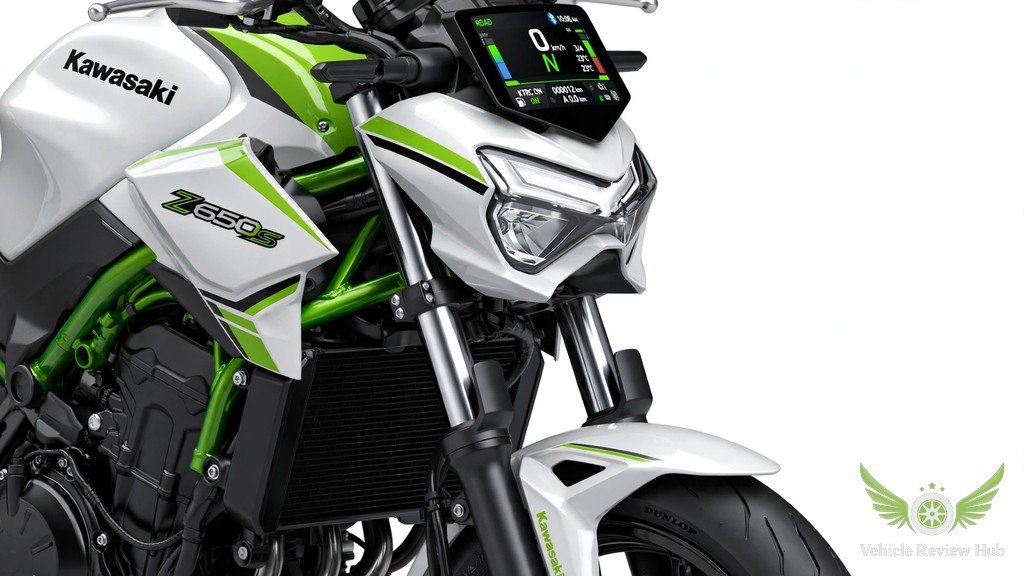
TFT Arrived for 2020
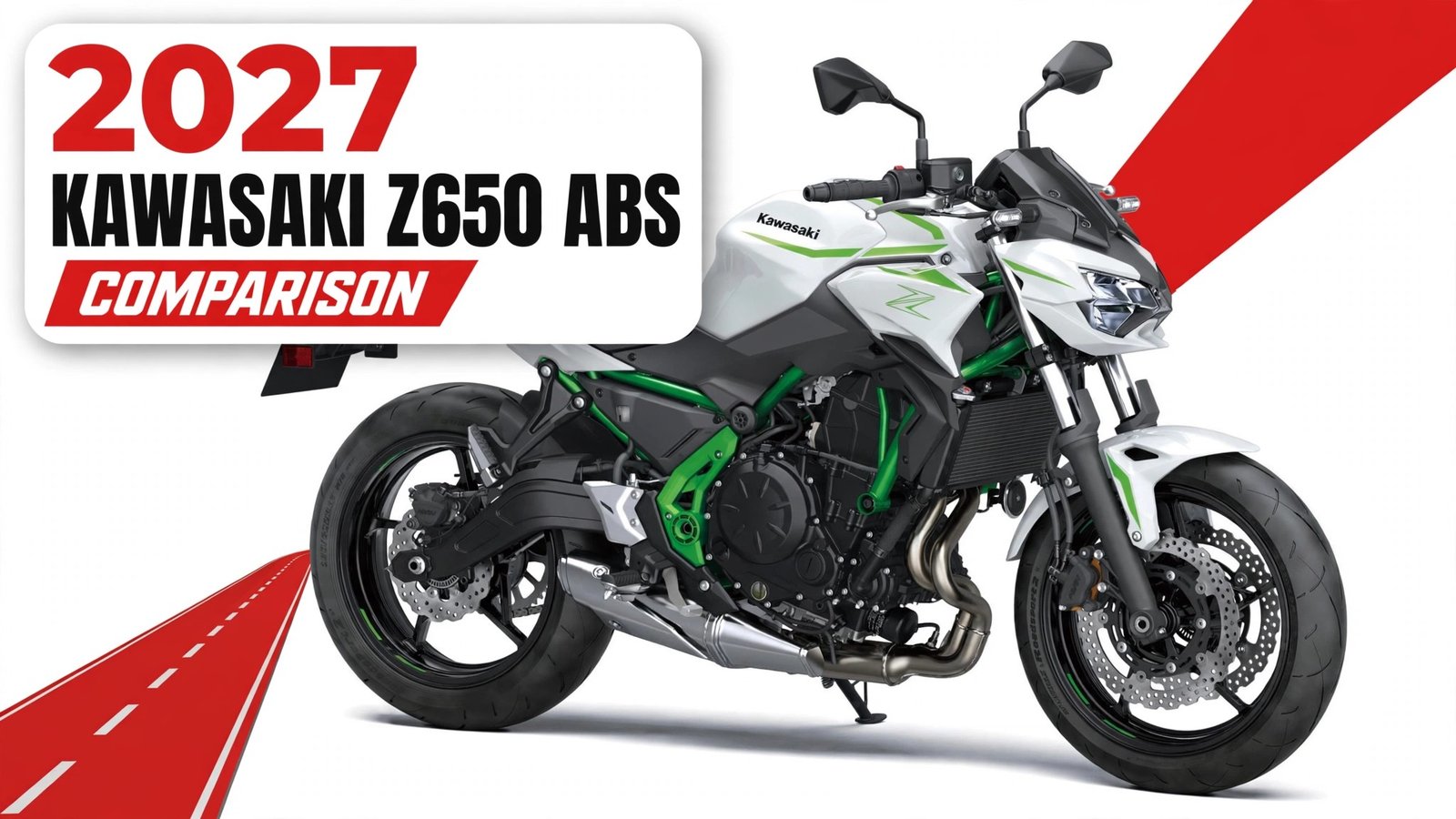
The 2020 update brought a 4.3-inch all-digital TFT dash with RIDEOLOGY THE APP connectivity, replacing the older LCD instrument cluster, and it arrived with revised styling and ergonomics. The TFT is the dash every Z650 has carried since, including the 2027 S. The Sugomi styling stayed recognisably the same through the update, and the 2027 S in Pearl Blizzard White with Candy Lime Green accents is the colour scheme this Kawasaki Z650 review uses for the featured image.
KTRC Arrived for 2023
KTRC traction control arrived for 2023 with two modes on that year’s spec sheet, and the 2025 sheet lists three modes. The 2026 and 2027 sheets do not print a mode count, so this Kawasaki Z650 review does not claim one for the S. KTRC is the bike’s only rider aid beyond ABS. The Z650 sits between the SV650’s simplicity and the MT-07 and GSX-8S electronics.
Kawasaki Z650 Riding Experience and Comfort
This Kawasaki Z650 review puts the riding experience where it belongs: after the price and the spec sheet, because the bike’s case is made on the road, not on paper. The Z650 is an upright naked with a 649cc twin, a 416.7 lb curb weight and a 31.7-inch seat, and that combination makes it light, narrow and easy to place in traffic.
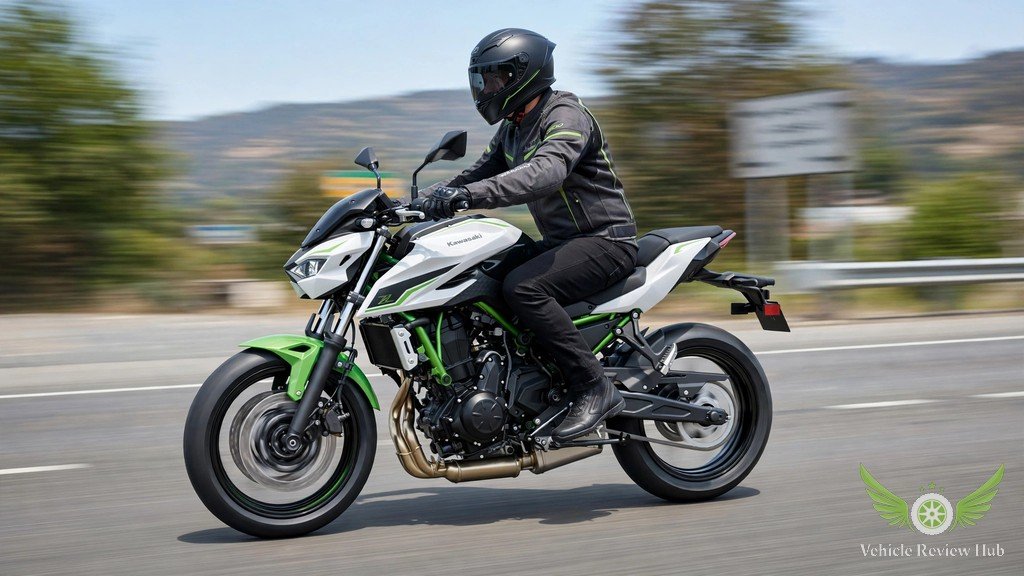
In the video below, Sonny Brooks takes a 2025 Z650 out for a real-world test ride — note that the bike on screen is a 2025 model with the 31.1-inch seat and the pre-S ergonomics, not the 2026 S — and this Kawasaki Z650 review pairs it with the riding section because his verdict matches what the written tests say: upright ergonomics, surprising comfort, sharp throttle response and freeway-friendly power, with the caveat that it is not quite a beginner bike.
Seat Rose to 31.7
Seat height by year: 30.9 inches in 2019, 31.1 inches on the 2020, 2021, 2023 and 2025 bikes, 31.5 inches in 2022, and 31.7 inches on the 2026 and 2027 S. A rider coming from a 2020 to 2025 bike will sit taller and reach further forward on the S, and a shorter rider who fitted the old 31.1-inch seat should sit on the S before buying — the extra 0.6 inches is small on paper and real at a traffic light. This Kawasaki Z650 review recommends sitting on the S before buying.
Motorcycle.com’s 2017 shootout gave the Z650 the win in the Handling and Suspension categories, and its testers called the brake feel the most confidence-inspiring of the group. The vibration is the known trade-off: testers report a buzz between 4,000 and 5,000 rpm and again around 7,000 to 8,000 rpm, and Motorcycle.com’s tester put it plainly — more high-rpm vibration than the other bikes in the shootout, “but it never becomes annoying.” The full riding and performance picture, including the observed fuel economy and the top-speed evidence, is in the Kawasaki Z650 performance blog.
12 Month Warranty
Every Z650 carries a 12-month limited warranty. Twelve months is short next to the 24-month cover on some rivals, and a buyer should factor it into the ownership cost rather than discovering it at the first service. This Kawasaki Z650 review counts the short warranty as the bike’s clearest ownership weakness. There is no warranty extension, no stop-sale and no do-not-ride campaign documented for the Z650, and the reliability record is covered in full in the Kawasaki Z650 reliability blog, including the zero-recall NHTSA record and the 7,500-mile oil rhythm from the bike’s own manuals.
Kawasaki Z650 Review: Pros, Cons and Verdict
This Kawasaki Z650 review ends where a buyer ends: with the verdict. The 2027 Z650 S ABS is the cheapest delivered middleweight naked in its class at $8,584, it carries a proven 649cc twin with a claimed 67.0 hp, it has a TFT dash and traction control, and it has zero recalls on its own NHTSA record. Those four facts are the case this Kawasaki Z650 review makes for the bike, and the case against it is just as short: it makes the least power on the dyno in its class, its fork is conventional while two rivals have inverted forks, and its warranty is only twelve months.
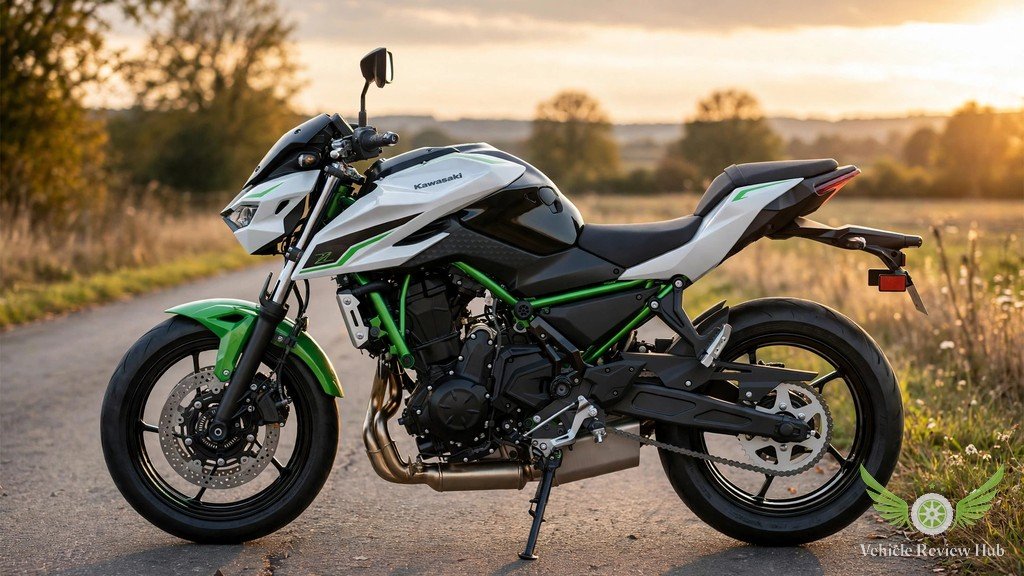
Main Advantages and Limitations of the Kawasaki Z650
The advantages start with price and weight. At $8,584 delivered the Z650 S undercuts the SV650 ABS by $165, the MT-07 by $690 and the GSX-8S by $1,365, and at 416.7 lb curb it is lighter than the SV650 at about 437 lb and the GSX-8S at 445 lb. That is the advantage list this Kawasaki Z650 review weighs against the limitations below. The engine is proven over eleven model years with no gaps in the US run, and the maintenance rhythm is simple: oil and filter every 7,500 miles, valves at 15,000 miles, and no documented failure pattern to fear.
The limitations are real and should be weighed, not hidden. On Motorcycle.com’s 2021 six-way dyno the Z650 made 61.4 hp at 8,100 rpm — the lowest of the six bikes, against the SV650’s 70.7 hp and the MT-07’s 70.0 hp on the same dyno. The 41 mm fork is conventional while the MT-07 and GSX-8S carry inverted forks. The warranty is twelve months and the quickshifter is an accessory rather than standard. A buyer who wants the most power, the best fork or the longest warranty should look at the rivals in the Kawasaki Z650 comparison blog before deciding.
The verdict is straightforward. Buy the Z650 S if the lowest delivered price in the class matters, if a light and friendly middleweight with a proven engine matters, and if a TFT dash and traction control are enough. Do not buy it for the most power, the best fork or the lowest seat — the GSX-8S wins on power and electronics, and the SV650 wins on seat height. For most riders shopping in 2027, the Z650 S is the sensible middleweight: the cheapest way into the class, with the manners to match, and this Kawasaki Z650 review recommends it on those terms.
Low-Seat Claim Aged Out
The low-seat claim aged out in 2026, and it still appears in older listings. The 2019 Z650 sat at 30.9 inches and the 2020 to 2025 bikes at 31.1 inches, but the 2026 S at 31.7 inches is not the lowest in its class: the SV650 is 30.9 inches, the MT-07 ties the S at 31.7 inches, and the GSX-8S is tallest at 31.9 inches. What the Z650 kept is the price lead — $8,584 delivered against $8,749 for the SV650, $9,274 for the MT-07 and $9,949 for the GSX-8S — and that is the claim this Kawasaki Z650 review stands behind.
The related middleweight to know is the bike this one is twinned with: the Kawasaki Ninja 650 review covers the faired version of the same 649cc twin, with the same engine and the same maintenance rhythm, for buyers who want a fairing and a different riding position.
Kawasaki Z650 Review: Frequently Asked Questions
These are the questions buyers ask most in this Kawasaki Z650 review — and the answers stay honest about what is verified, what changed for 2026, and what the rivals actually cost.
What is the 2027 Kawasaki Z650 price in the USA?
$7,899 MSRP + $685 destination = $8,584 delivered. The 2027 bike is the Z650 S ABS, the only US trim.
What changed for the 2026 Z650 S?
A taller, more cushioned front seat (31.7 in), bars 40 mm further forward, 10 mm higher and 30 mm wider, and the S badge. In the US the base Z650 is gone from 2026 — the S ABS is the only trim; in the UK and Europe the S sits alongside the base bike.
How much power does the Kawasaki Z650 make?
Kawasaki claims 67.0 hp at 8,000 rpm. On Motorcycle.com’s dyno it made 60.95 hp in 2017 and 61.4 hp in 2021 — both rear-wheel figures, not crank figures.
Is the Z650 ABS-only?
Yes, from 2026 in the US. Non-ABS Z650s were sold through 2025; the 2026 and 2027 US bikes are S ABS only.
What is the Z650’s seat height?
31.7 inches on the 2026–2027 S, up from 31.1 inches on the 2020–2025 bikes and 30.9 inches in 2019. It is no longer the low-seat bike in its class — the SV650’s 30.9-inch seat is lower.
Is the Z650 a good beginner bike?
It is approachable for a 649cc twin — light, upright and forgiving — but with 67 claimed hp and 416 lb it is a second-bike step up, not a true first bike. See the Performance blog’s beginner section for the full answer.