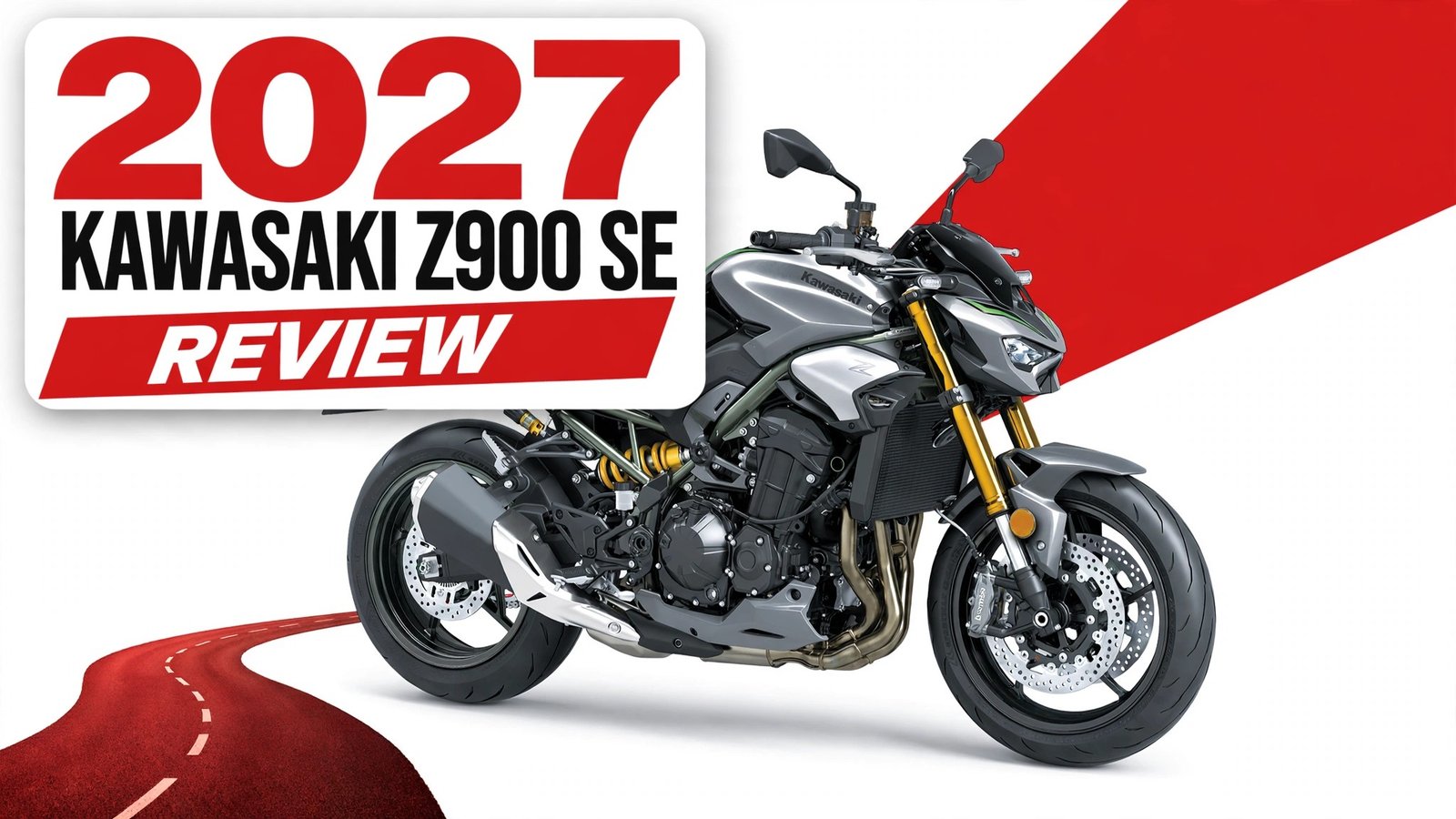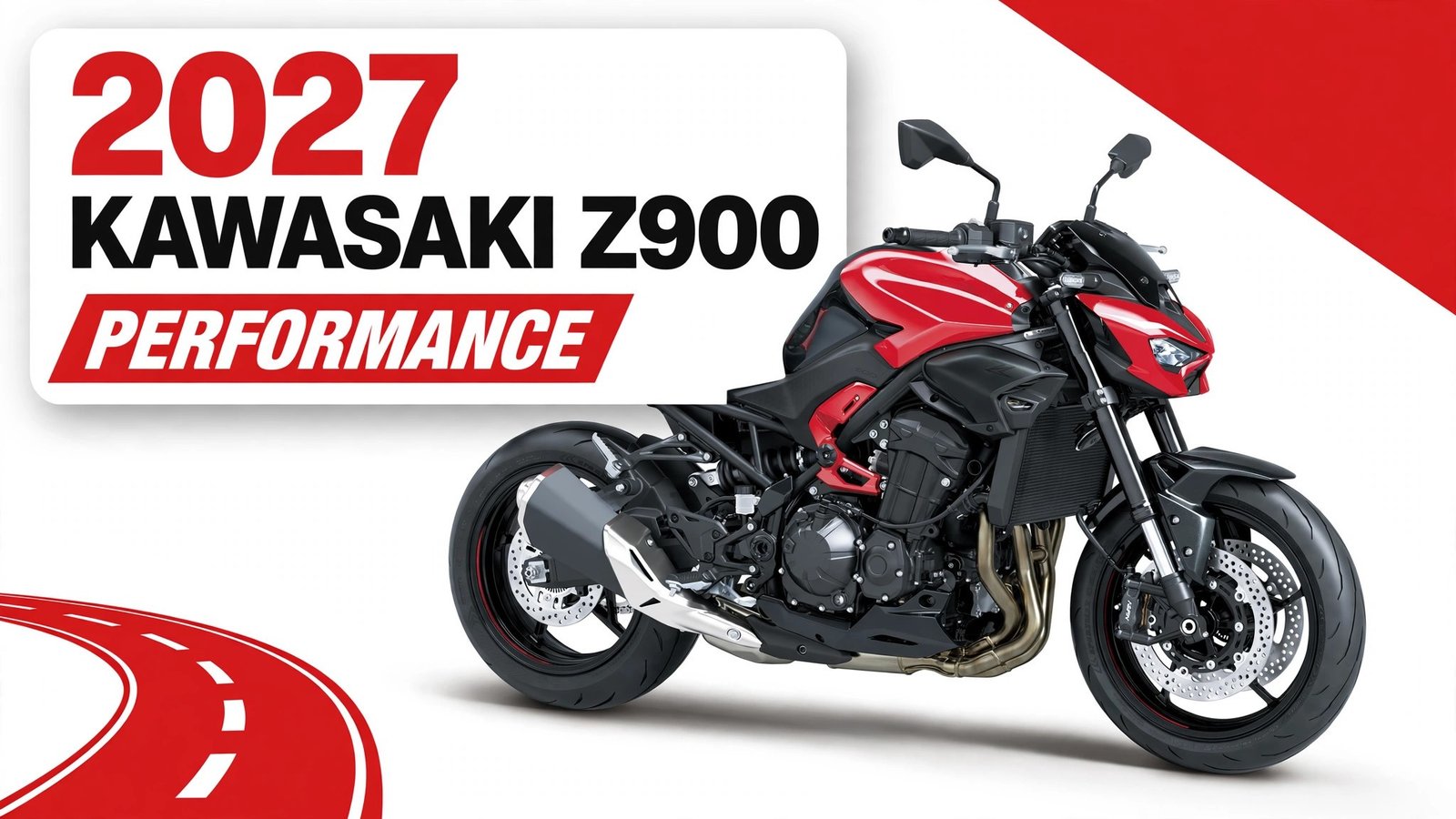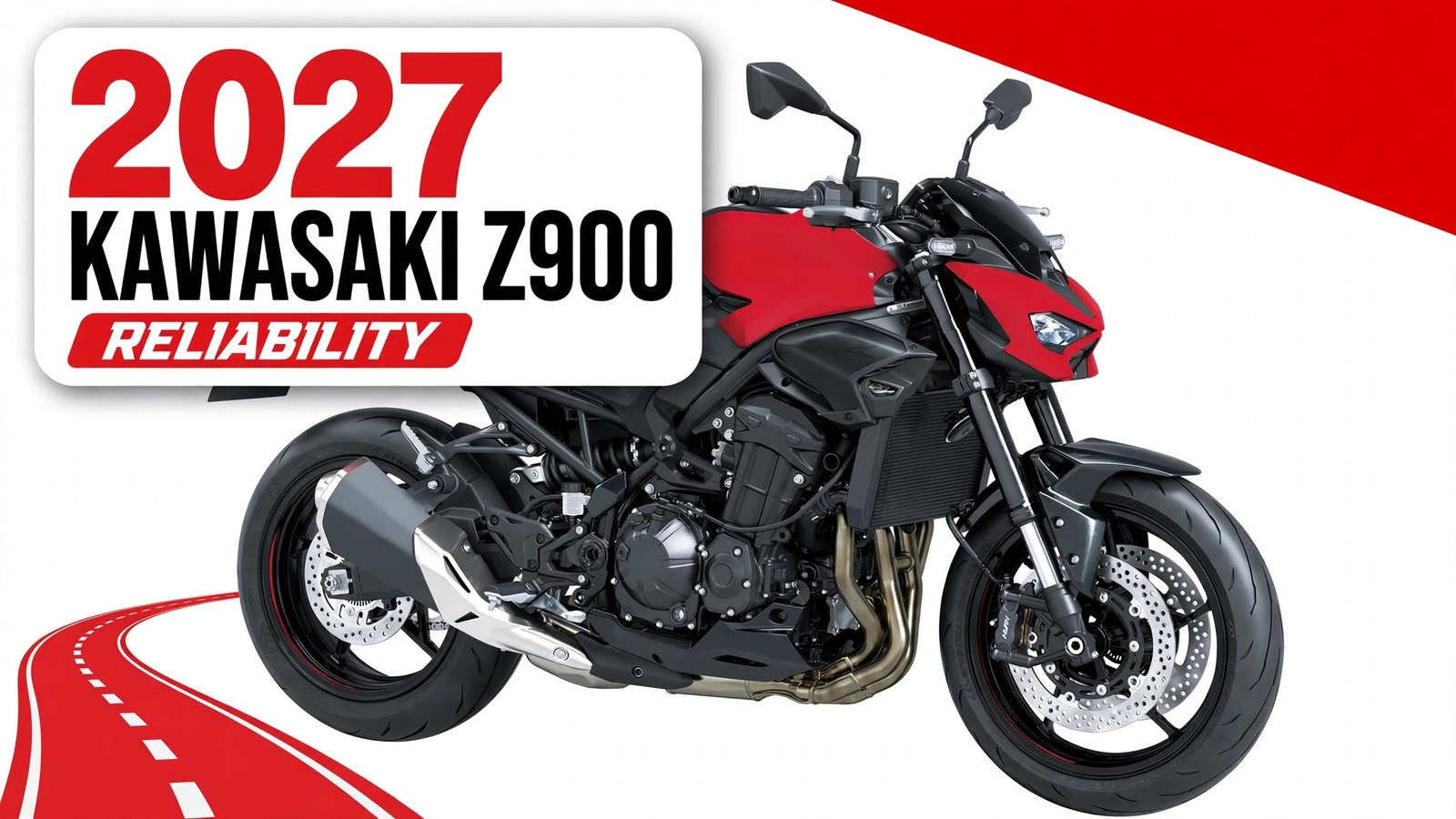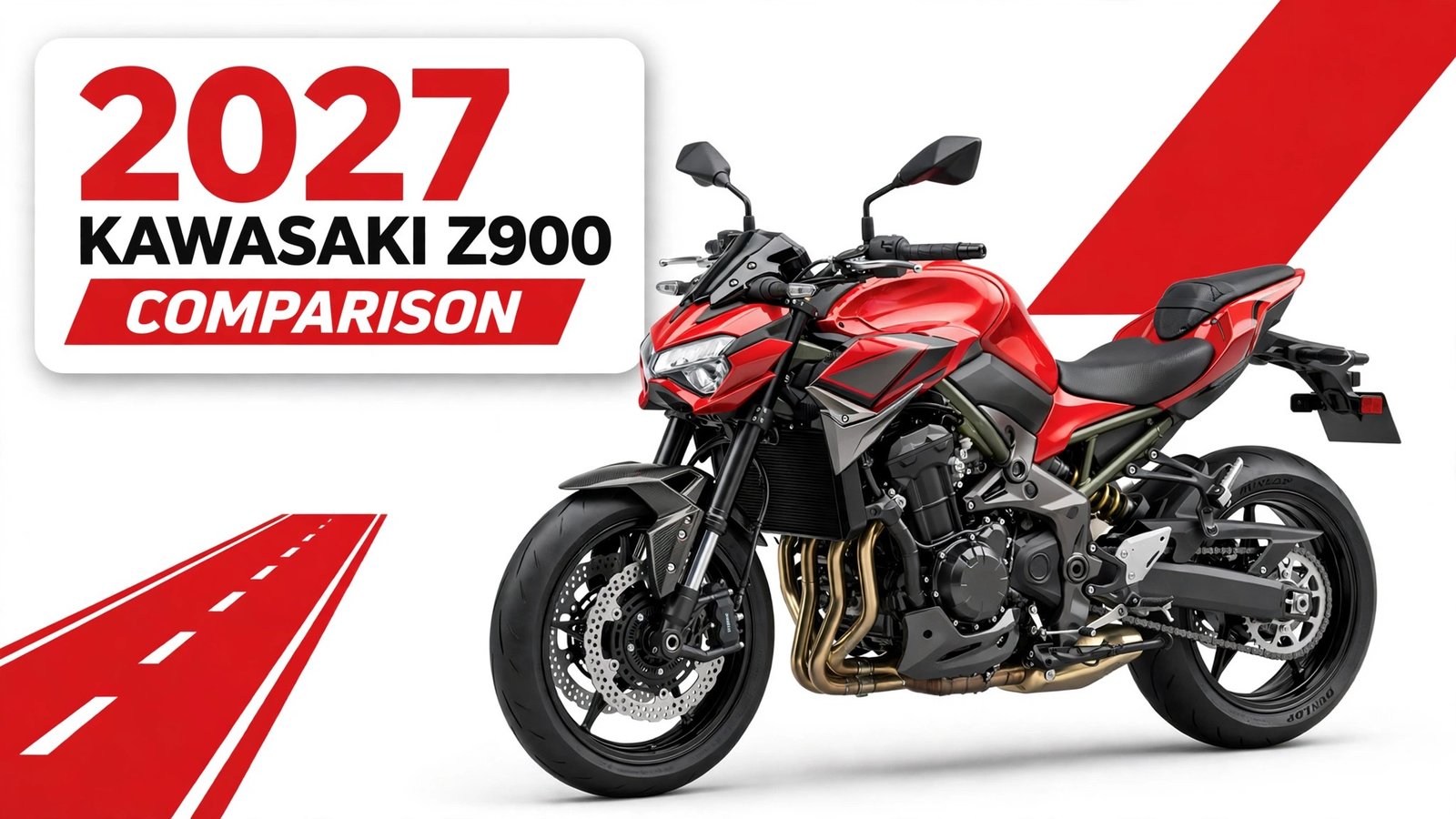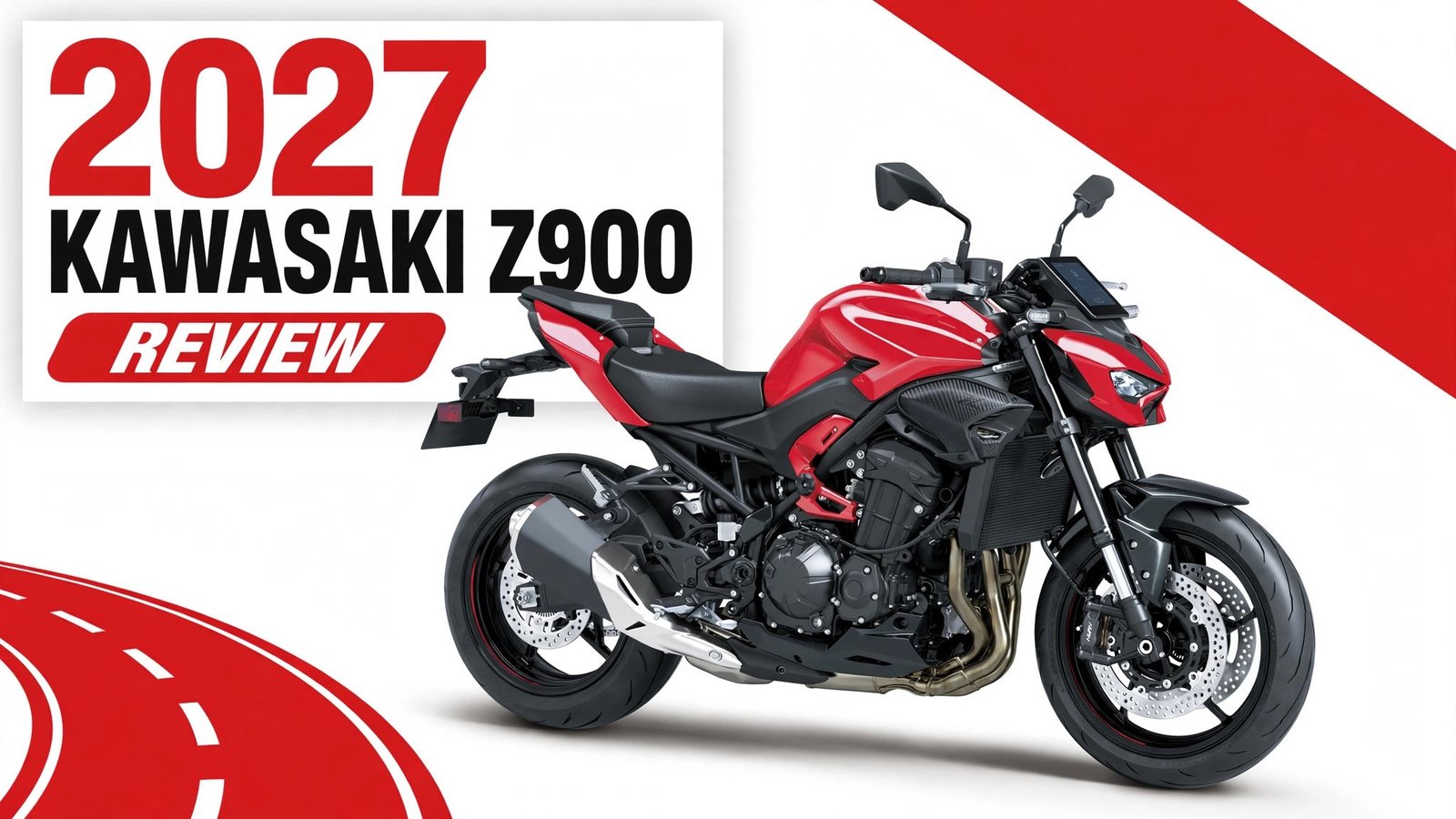
The Kawasaki Z900 has been the working definition of a middleweight naked since 2017: a 948cc inline-four, a steel trellis frame, and a price that undercuts every four-cylinder rival. This Kawasaki Z900 review looks at the 2027 bike and the two earlier versions still on the used market — three clear eras.
The short version: the 2027 Z900 costs $10,199 before destination, claims 123.0 hp, and is still the cheapest four-cylinder naked delivered in the US. This Kawasaki Z900 review works through the three eras, the 2025 electronics overhaul, the SE trim, and what the bike is like to ride — every price and spec year-labelled.
Kawasaki Z900 Overview and Model-Year Updates
The Z900 replaced the Z800 as Kawasaki’s middleweight naked in 2017, and it has stayed in production every year since. This Kawasaki Z900 review starts with the model-year story: the electronics, dash, brakes and power all changed while the 948cc engine stayed the same. Riders who want a fairing usually look at the Ninja 650 instead, but the Z900 is the naked benchmark of the line.
No Electronics in 2017
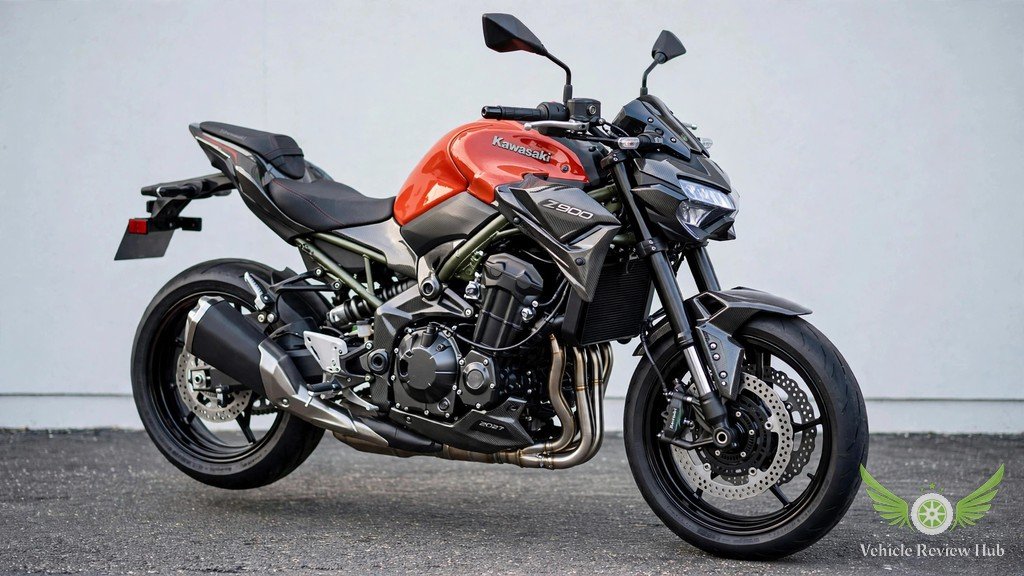
The 2017 Z900 arrived with no rider electronics at all. There was no traction control, no ride modes, no IMU, no quickshifter and no cruise control — Rider’s 2017 comparison with the Yamaha FZ-09 noted the Z900 “lacks its bells and whistles such as throttle-by-wire and traction control”. ABS was a $400 option in 2017: the base bike cost $8,399 and the ABS model $8,799. The dash was a simple LCD, the throttle was a cable, and the brakes were dual 300 mm petal discs. What it did have was the engine — a 948cc inline-four claiming 125 hp at 9,500 rpm and 73.1 lb-ft at 7,700 rpm — in a steel trellis frame. In this Kawasaki Z900 review, the 2017 bike matters because it is the cheapest way into the model on the used market, and the review treats it as the entry point to the range.
Three Eras, One Engine
The Z900’s history splits into three eras, and the engine is the constant: the same 948cc liquid-cooled inline-four, the same bore and stroke, the same compression, the same 4.5-gallon tank. Era 1 (2017–2019) is the bare bike: LCD dash, cable throttle, no electronics. Era 2 (2020–2024) added a 4.3-inch TFT with Bluetooth and the RIDEOLOGY app, KTRC, four ride modes, and LED lighting — while keeping the cable throttle and the 125 hp claim. Era 3 (2025–2027) is the overhaul: a six-axis IMU, cornering management, ride-by-wire, cruise control, a bi-directional quickshifter, a 5-inch TFT, round front discs with radial-mount calipers, and a claimed 123.0 hp. This Kawasaki Z900 review treats the eras separately throughout, because a price or spec without a year is wrong by default on this bike.
| Era | Years | Dash | Electronics | Front brakes | Claimed power |
|---|---|---|---|---|---|
| Era 1 | 2017–2019 | LCD, gear indicator | None — no TC, ride modes, IMU, quickshifter or cruise | Dual 300 mm petal discs, Nissin calipers | 125 hp |
| Era 2 | 2020–2024 | 4.3-in TFT + Bluetooth | KTRC (3 levels + off), 4 ride modes, LED lighting | Dual 300 mm petal discs, Nissin calipers | 125 hp |
| Era 3 | 2025–2027 | 5-in TFT + voice command + navigation | IMU, KCMF, lean-sensitive ABS/TC, ride-by-wire, cruise, KQS | Dual 300 mm round discs, radial-mount calipers | 123.0 hp |
Note: The 948cc engine, the 73.1 lb-ft torque peak, the 4.5-gallon tank and the trellis frame are the same in all three eras. This Kawasaki Z900 review year-labels every price and spec because the eras differ in electronics, dash, brakes and power.
Kawasaki Z900 Engine and Specifications
The engine never changed displacement, but the 2025 update retuned it. This Kawasaki Z900 review covers the engine and the full 2027 specification, with earlier years’ figures alongside where they differ. Independent dyno tests of the 2020 bike measured 113 to 115.5 hp at the rear wheel; the performance guide covers those runs.
IMU Arrived for 2025
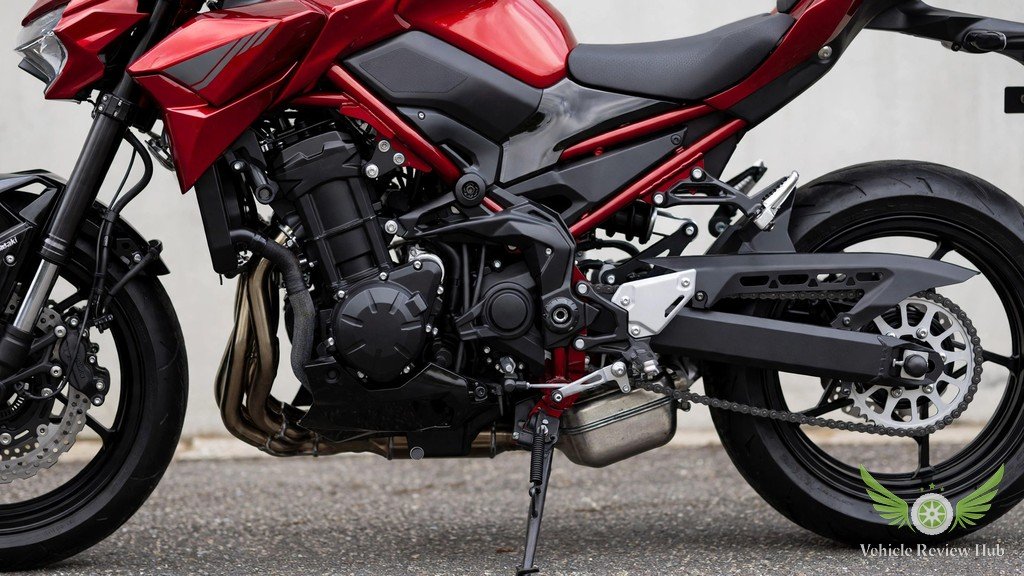
The 2025 Z900 is the first in the line with a six-axis IMU. The inertial measurement unit feeds Kawasaki’s cornering management function (KCMF), which makes the traction control and the ABS lean-sensitive. The same update brought ride-by-wire, cruise control, Power Modes, and a bi-directional quickshifter that works from 1,500 rpm. The engine kept its 948cc displacement but gained a new cam profile aimed at mid-range torque and fuel economy — Kawasaki claims up to 16% better — plus revised ECU settings. The forks were pulled through the yokes by 3 mm and a frame plate was added for rigidity, and the bike wears Dunlop Sportmax Q5A tyres. Claimed peak power actually fell slightly with the retune, from 125 hp to 123.0 hp at 9,500 rpm, while torque stayed at 73.1 lb-ft at 7,700 rpm. In this Kawasaki Z900 review, that trade matters: the 2025 bike was built for mid-range and rideability, not for a bigger headline number — the heart of the review’s take on the 2025 bike. Note the figures that do not belong here: 124 PS and 122 bhp are the European claim for the same engine, and 71.8 lb-ft is the European torque figure.
Seat Now 31.9 Inches
The seat got taller with each era: 31.3 inches on the 2017–2019 bikes, 31.5 inches on the 2020–2024 bikes, and 31.9 inches on the 2025–2027 bikes. At 31.9 inches the current bike still had the lowest seat in Cycle News’ 2025 shootout group — but it is not the low perch the first-era bike was, so a shorter rider should know which year they are sitting on. Ignore the 830 mm figure on some UK dealer pages: that is the bike’s overall width, copied into the seat-height field by mistake. The US figure is 31.9 inches (810 mm). This Kawasaki Z900 review uses the US seat heights throughout, year-labelled.
| Item | 2027 Z900 ABS (base) |
|---|---|
| Engine | 948cc liquid-cooled DOHC 16-valve inline-four (73.4 × 56.0 mm; 11.8:1) |
| Claimed power | 123.0 hp @ 9,500 rpm (ISO 4106) — 125 hp @ 9,500 rpm, 2017–2024 |
| Claimed torque | 73.1 lb-ft @ 7,700 rpm — every year 2017–2027 |
| Transmission | 6-speed; assist & slipper clutch; KQS quickshifter from 2025 |
| Frame | Trellis, high-tensile steel |
| Front suspension | 41 mm inverted fork, preload + rebound; 4.7-in travel |
| Rear suspension | Horizontal back-link shock, preload + rebound; 5.5-in travel |
| Front brakes | Dual 300 mm round discs, radial-mount calipers, ABS |
| Rear brake | Single 250 mm disc, ABS |
| Front tyre | 120/70 ZR17 (Dunlop Sportmax Q5A, 2025+) |
| Rear tyre | 180/55 ZR17 (Dunlop Sportmax Q5A, 2025+) |
| Seat height | 31.9 in (31.3 in 2017–2019; 31.5 in 2020–2024) |
| Curb weight | 467.5 lb (49-state) / 469.7 lb (50-state) |
| Fuel capacity | 4.5 gal (all years) |
| Wheelbase | 57.1 in (57.3 in 2020–2024) |
| Rake / trail | 24.7° / 4.3 in (2025+; 24.5° rake 2017–2024) |
| Instrumentation | 5-in TFT, RIDEOLOGY, voice command, navigation, USB-C |
| Rider aids (2025+) | IMU, KCMF, KTRC, lean-sensitive ABS/TC, Power Modes, KQS, cruise control |
| Warranty | 12-month limited |
Note: The figures above are the 2027 base Z900 ABS from Kawasaki’s 2027 Z900 page; this Kawasaki Z900 review names the earlier years’ figures where they differ.
Kawasaki Z900 Price and Market Availability
The Z900’s price is the reason it exists in this class. This Kawasaki Z900 review lays out the full US price ladder: the price rose steadily while the destination charge jumped sharply in 2025.
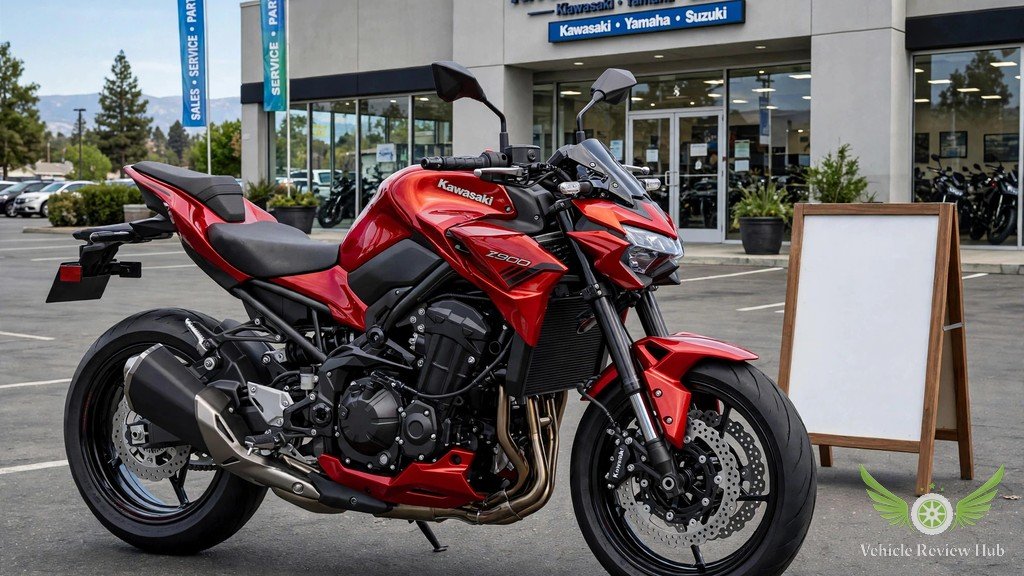
Kawasaki Z900 Price in the USA: $10,199 (2027)
The 2027 Z900 costs $10,199 in the standard colours — Ebony with Metallic Carbon Gray — and $10,399 in Candy Persimmon Red, a $200 colour premium. Add the $840 destination charge and the delivered prices are $11,039 and $11,239. That delivered price is the cheapest four-cylinder naked in the class for 2027: the Suzuki GSX-S1000 lands at $11,548 delivered, so the Z900 undercuts it by $509. The 2017 bike cost $8,399 without ABS and $8,799 with it, plus a $360 destination charge — $8,759 and $9,159 delivered. Prices rose in small steps: $8,999 for 2020–2021, $9,199 for 2022, $9,399 for 2023 and $9,799 for 2024, the last pre-IMU year. The 2025 bike jumped to $9,999, and its destination charge jumped with it, from $475 to $815 — so the delivered price moved from $10,274 to $10,814. The 2026 bike held the $9,999 MSRP ($10,839 delivered), and the 2027 bike’s $200 MSRP rise brings it to $10,199. In this Kawasaki Z900 review, the delivered price is the number that counts. This Kawasaki Z900 review compares the Z900 with its rivals in the comparison guide. ABS was optional from 2017 to 2020 and standard from 2021; the non-ABS price is verified only for 2017, so the ladder prints ABS prices for 2018–2020.
| Year | MSRP | Destination | Delivered | Notes |
|---|---|---|---|---|
| 2017 | $8,799 (ABS) / $8,399 (non-ABS) | $360 | $9,159 / $8,759 | Non-ABS $8,399 (Rider 2017) |
| 2018 | $8,799 | $370 | $9,169 | ABS price; non-ABS unverified |
| 2019 | $8,799 | $370 | $9,169 | ABS price; non-ABS unverified |
| 2020 | $8,999 | $410 | $9,409 | ABS price; non-ABS unverified |
| 2021 | $8,999 | $410 | $9,409 | ABS-only from 2021 |
| 2022 | $9,199 | $430 | $9,629 | ABS-only |
| 2023 | $9,399 | $460 | $9,859 | ABS-only |
| 2024 | $9,799 | $475 | $10,274 | Last pre-IMU year |
| 2025 | $9,999 | $815 | $10,814 | First IMU year; destination jumped $475 to $815 |
| 2026 | $9,999 | $840 | ABS-only | |
| 2027 | $10,199 / $10,399 | $840 | $11,039 / $11,239 | $10,399 Candy Persimmon Red |
Note: All prices are US MSRP plus destination, from Kawasaki USA and the Motorcycle.com database. This Kawasaki Z900 review prints delivered prices; the 2018–2020 non-ABS prices were not verified and are not printed.
SE Premium: $2,000
The SE is the same 948cc bike with better suspension and brakes, and its premium grew with the years. For 2026 and 2027 the premium is $2,000: the SE costs $12,199 plus the same $840 destination charge, $13,039 delivered against the base bike’s $11,039. But the $2,000 figure is the 2026–2027 figure only. The ladder ran $1,500 in 2022–2024 (SE $10,699 in 2022, $10,899 in 2023, $11,299 in 2024), then $1,850 in 2025 (SE $11,849, delivered $12,664), then $2,000 in 2026 ($11,999, delivered $12,839) and 2027. The SE costs about 18% more than the base bike for 2027 — whether that is worth it depends on how much a buyer values the Brembo calipers and the Öhlins shock. This Kawasaki Z900 review prices the SE on the delivered basis throughout.
| Year | SE MSRP | Destination | Delivered | Premium over base |
|---|---|---|---|---|
| 2022 | $10,699 | Not verified | — | $1,500 |
| 2023 | $10,899 | $460 | $11,359 | $1,500 |
| 2024 | $11,299 | $475 | $11,774 | $1,500 |
| 2025 | $11,849 | $815 | $12,664 | $1,850 |
| 2026 | $11,999 | $840 | $12,839 | $2,000 |
| 2027 | $12,199 | $840 | $13,039 | $2,000 |
Note: The SE is ABS-only in every year. This Kawasaki Z900 review does not print a 2022 SE delivered price — the 2022 destination charge was not verified; the $2,000 premium is the 2026–2027 figure only.
Kawasaki Z900 Design, Features and Technology
The Z900’s look barely changed across the eras, but the dash and the SE hardware did. This Kawasaki Z900 review covers the design and technology a buyer touches.
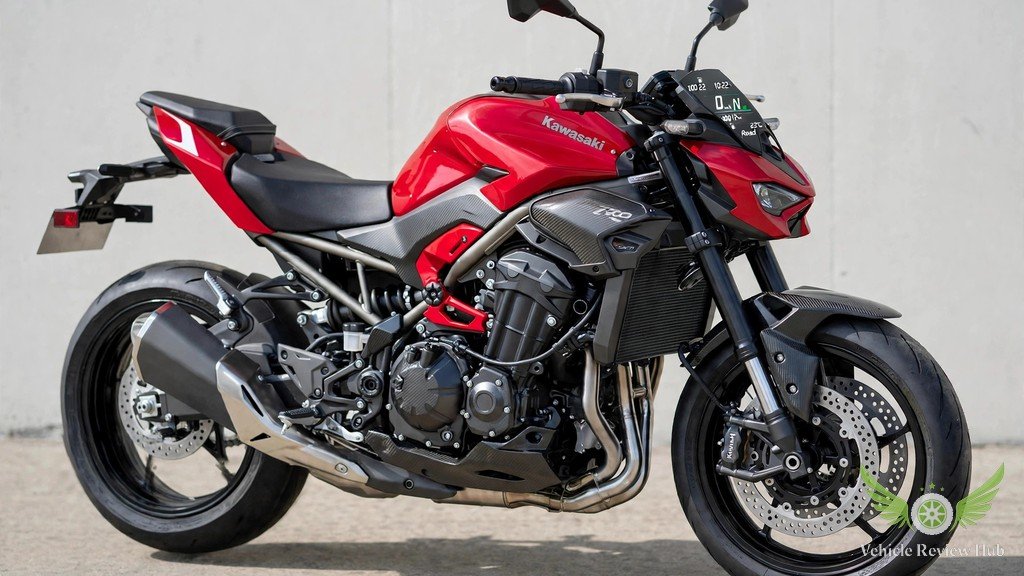
TFT Came for 2020
The 2020 update replaced the 2017 bike’s LCD dash with a 4.3-inch TFT with Bluetooth and the RIDEOLOGY app, alongside four ride modes and LED lighting. Rider’s 2020 road test lists the TFT, the ride modes and the traction control as the headline changes. The 2025 bike went further: a 5-inch TFT with voice command and navigation, plus a USB-C outlet. The 2025 dash is larger and brighter, though Cycle News’ 2025 testers found the new menus harder to navigate than the 2024 unit’s. The headlight is a single angular LED unit, not a round lamp. That lamp is one more detail this Kawasaki Z900 review uses to date a used bike. A buyer comparing a 2019 bike with a 2020 bike will see the difference first in the dash — this Kawasaki Z900 review flags it as the quickest way to tell the eras apart.
SE: Brembo and Öhlins
The SE is the base Z900 plus the hardware a track-day rider would buy anyway. Up front are Brembo M4.32 radial-mount monobloc four-piston calipers on dual 300 mm discs, with steel-braided brake lines and a Nissin radial-pump master cylinder. At the back is an Öhlins S46 shock with a remote preload adjuster, paired with a fully adjustable 41 mm inverted KYB fork with gold outer tubes. The SE also gets a two-tone seat on the 2025+ bikes and the same TFT, quickshifter and cruise control as the base bike. Everything else is the base bike’s. That sameness is why this Kawasaki Z900 review prices the SE on its hardware alone. The SE weighs about 2.2 lb more — the 2025 SE curbs at 469.7 lb against 467.5 lb — and Cycle News measured it at 471 lb wet, the heaviest bike in its 2025 shootout. Rider’s 2022 SE first look covered the original SE package. This Kawasaki Z900 review treats the SE as a suspension-and-brakes package, not a different motorcycle.
Kawasaki Z900 Riding Experience and Comfort
On the road the Z900 is a big, smooth four-cylinder naked: strong in the mid-range, stable at speed, and easier to live with than its power suggests. This Kawasaki Z900 review looks at what the bike is like to ride, the ownership basics, and one check every used buyer must do before paying.
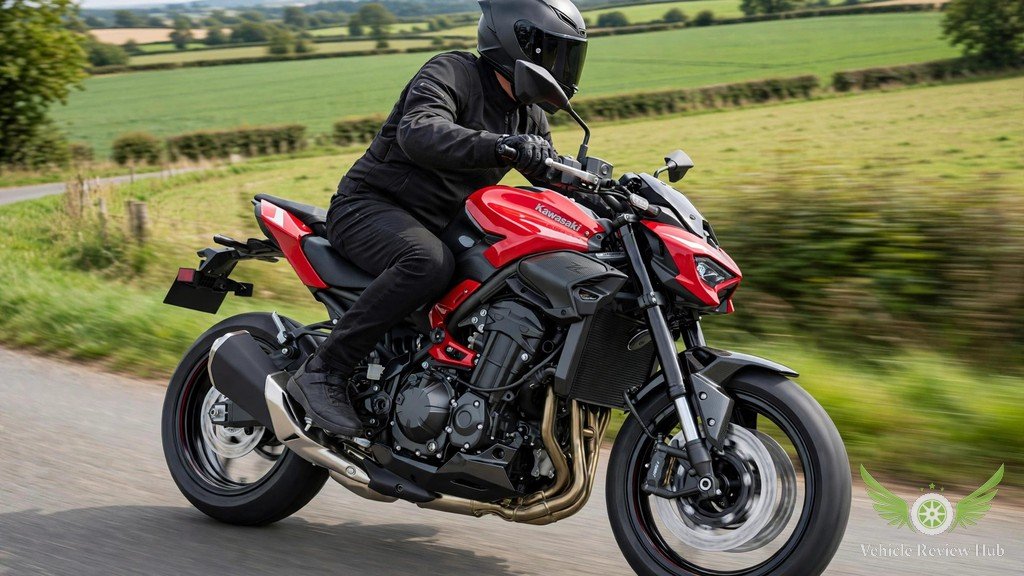
UK owner review — 1,000 miles on a 2025 Z900 after its first service, asking whether the bike suits an older rider. The video’s description quotes UK-spec figures (124 PS, an 830 mm seat and a 17-litre tank) — those are not US figures: the US bike claims 123.0 hp, has a 31.9-inch seat and a 4.5-gallon tank.
Thailand and Japan VINs
US Z900s were built in two countries, and only the VIN tells which one a given bike came from. A VIN starting with ML5 means Thailand — Kawasaki Motors Thailand at Pluak Daeng, Rayong — and that covers the 2023 Z900 and the 2024 Z900 SE decoded here. A VIN starting with JKA means Japan — Akashi, Hyogo — and that covers the 2022 Z900 decoded here. Both plants built bikes for the US market, so a buyer cannot assume the origin from the model year. The check takes ten seconds and it settles the question: ML5 is Thailand, JKA is Japan. In this Kawasaki Z900 review, the VIN check is the one piece of used-bike homework that costs nothing.
12 Month Warranty
The Z900 carries a 12-month limited warranty in every year. That is Kawasaki’s standard limited warranty, and no extended factory warranty is included as standard. Kawasaki’s extended coverage, the Kawasaki Protection Plus plan, is a paid add-on, not part of the purchase price. For a used buyer the warranty matters less than the service record: a 2017–2019 bike is long out of warranty and a 2025 bike may still have months left, and the reliability picture is in the companion reliability guide. In this Kawasaki Z900 review, the warranty is a one-line fact, not a selling point — twelve months, limited, on every year.
Kawasaki Z900 Review: Pros, Cons and Verdict
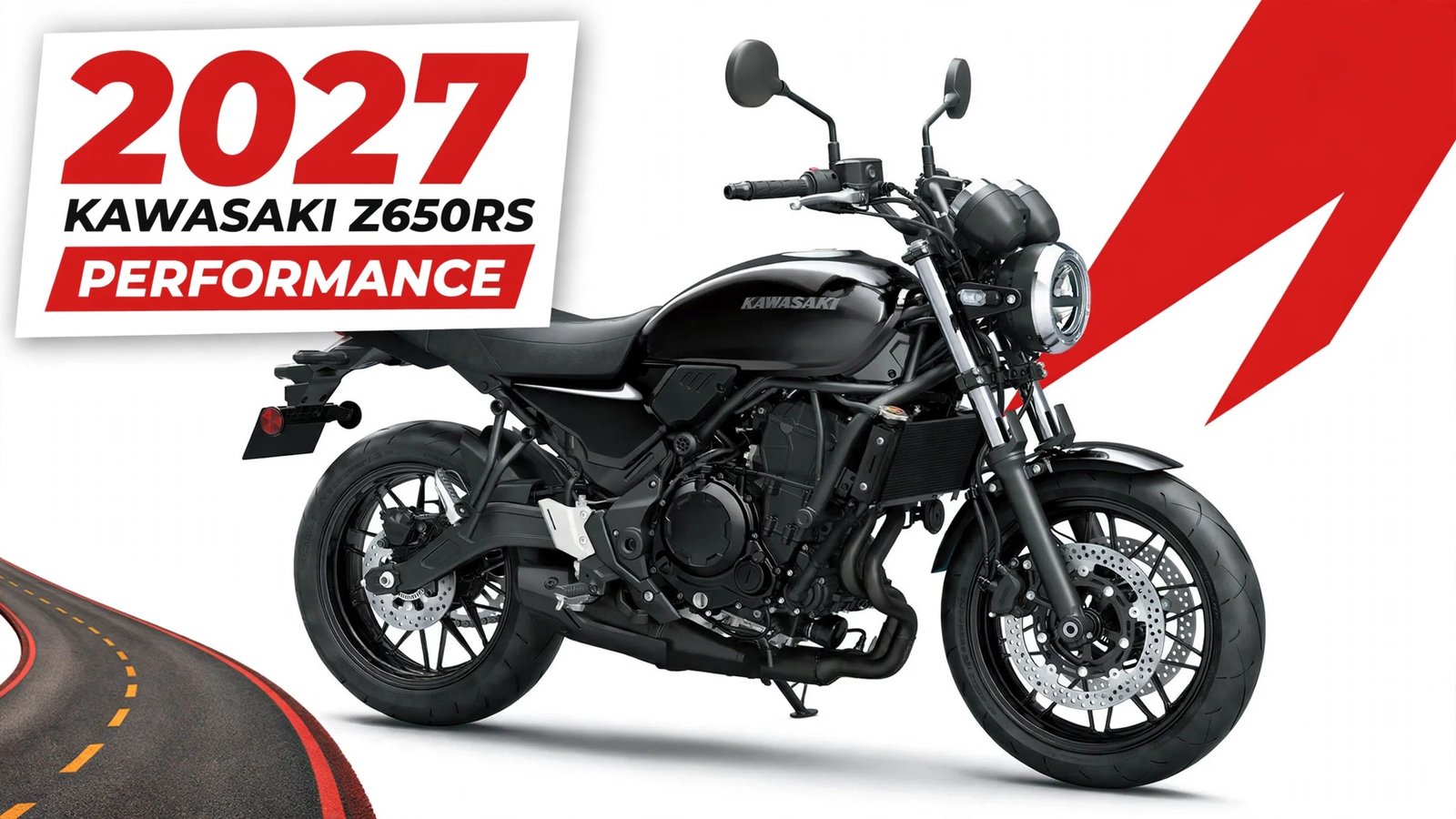
The Z900’s case is simple: the most engine and the most bike for the least money. This Kawasaki Z900 review ends with the balance sheet — what the bike does better than its rivals, where it falls short, and who should buy which year. Buyers who want the retro look instead should read the Z650RS review; the Z650 review covers the smaller twin-cylinder sibling.
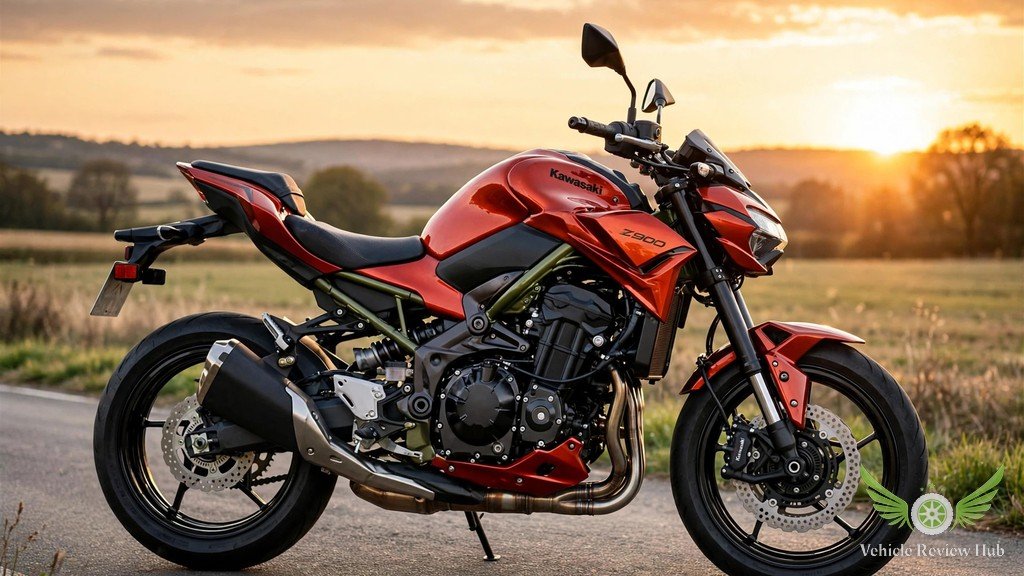
Main Advantages and Limitations of the Kawasaki Z900
The advantages start with the engine and the price. A 948cc inline-four claiming 123.0 hp for 2025–2027 (125 hp before that), a 4.5-gallon tank, a 31.9-inch seat, and a delivered price of $11,039 for 2027 — $509 less delivered than the Suzuki GSX-S1000. The 2025 electronics overhaul closed the technology gap: a six-axis IMU, lean-sensitive ABS and traction control, ride-by-wire, cruise control and a quickshifter are all standard now. That is the balance this Kawasaki Z900 review keeps coming back to: more motorcycle for less money. The limitations are the ones the 2025 shootouts found: Cycle News’ 2025 test put the SE last of four, blaming cramped ergonomics and soft base suspension settings, and the base bike’s suspension adjusts only preload and rebound. The quickshifter is notchy at low revs, the 5-inch TFT’s menus are harder to navigate than the 2024 unit’s, and the 12-month warranty is short by class standards. The 2017–2019 bikes carry three recalls, all of which a used buyer must check by VIN. None of that changes the verdict: for the money, no four-cylinder naked gives a buyer more motorcycle. Motorcycle.com’s 2020 first ride reached the same conclusion on the earlier bike, and Bennetts’ 2025 SE review calls the current bike “really really good — not a great one”.
| Pros | Cons |
|---|---|
| Cheapest four-cylinder naked delivered for 2027 ($11,039) | 12-month limited warranty is short for the class |
| 948cc inline-four, 123.0 hp claimed (2025–2027) | Base suspension adjusts preload and rebound only |
| IMU, lean-sensitive ABS/TC, ride-by-wire, cruise and quickshifter standard from 2025 | Quickshifter is notchy at low revs (RevZilla) |
| 31.9-in seat — lowest in the 2025 shootout group | Cramped ergonomics for taller riders (Cycle News) |
| 4.5-gal tank; 41.6–42.5 mpg observed in tests | 5-in TFT menus harder to navigate than the 2024 unit |
| No recalls on any 2020-or-newer bike | 2017–2019 bikes carry three recalls to verify by VIN |
Note: The pros and cons above are drawn from the verified figures and tests in this Kawasaki Z900 review — the 2027 delivered price, the 2025 Cycle News shootout, RevZilla’s 2025 first ride, and the NHTSA record.
Quickshifter Notchy Down Low
The quickshifter exists only on the 2025+ bikes, and two respected tests disagree about it — which is why this Kawasaki Z900 review reports both. RevZilla’s 2025 SE first ride found upshifts “best performed in the midrange”, with “grabbing a gear in the lower rev range often yields notchy shifts”, and noted missed gears near the 11,000-rpm redline on track plus a slightly snatchy throttle pick-up and roll-off. Cycle News’ 2025 shootout, riding the same quickshifter on the street, called it “the slickest of the bunch” in its four-bike test. Both can be true: slick at street pace in the mid-range, notchy at low revs and at the redline. A buyer test-riding a 2025 Z900 should try the quickshifter at low revs in traffic, not only at speed: the behaviour is a characteristic, not a fault, and no failure pattern for the quickshifter exists in the record. The 2025 quickshifter works from 1,500 rpm in both directions, standard on both trims. MCN’s 2025 review covers the same 2025 changes from the UK side, including the 34–40 mpg it saw when ridden hard.
Kawasaki Z900 Review: Frequently Asked Questions
The questions buyers ask most about the Z900, answered from the verified figures in this Kawasaki Z900 review.
How much does the 2027 Kawasaki Z900 cost?
$10,199 for the standard colours (Ebony/Metallic Carbon Gray) and $10,399 for Candy Persimmon Red, plus an $840 destination charge — $11,039 or $11,239 delivered before tax and dealer fees. The SE is $12,199 plus $840, or $13,039 delivered — and this Kawasaki Z900 review prices both trims delivered throughout.
What engine does the Kawasaki Z900 have?
A 948cc liquid-cooled DOHC 16-valve inline-four — the engine at the centre of this Kawasaki Z900 review. The US claim is 123.0 hp at 9,500 rpm and 73.1 lb-ft at 7,700 rpm for 2025–2027; the 2017–2024 bikes claim 125 hp at the same revs, with the same 73.1 lb-ft of torque every year.
Does the Z900 have traction control and an IMU?
Only from 2025. The 2017 bike had no electronics at all — no traction control, no ride modes, no IMU, no quickshifter, no cruise. The 2020–2024 bikes added KTRC and four ride modes but no IMU. The 2025 bike added a six-axis IMU, cornering management, ride-by-wire, cruise control and a bi-directional quickshifter, as this Kawasaki Z900 review details above.
What is the Z900’s seat height?
31.9 inches on the 2025–2027 bikes, 31.5 inches on the 2020–2024 bikes, and 31.3 inches on the 2017–2019 bikes — the seat-height ladder this Kawasaki Z900 review uses throughout. Ignore the 830 mm figure on some UK dealer pages: that is the bike’s width, not its seat height.
What is the difference between the Z900 and the Z900 SE?
The SE adds Brembo M4.32 radial front calipers with braided lines, an Öhlins S46 rear shock, a fully adjustable gold KYB fork and a two-tone seat. In this Kawasaki Z900 review the premium is year-labelled: $2,000 for 2026–2027, $1,850 in 2025, and $1,500 in 2022–2024.
Is the Z900 a good beginner bike?
No. With 123 hp claimed, about 114 hp at the rear wheel and a 467.5 lb curb weight, it is a large, powerful naked, not a first bike. Kawasaki’s beginner naked is the Z500, with 51 hp — and this Kawasaki Z900 review points first-time buyers there, not here.