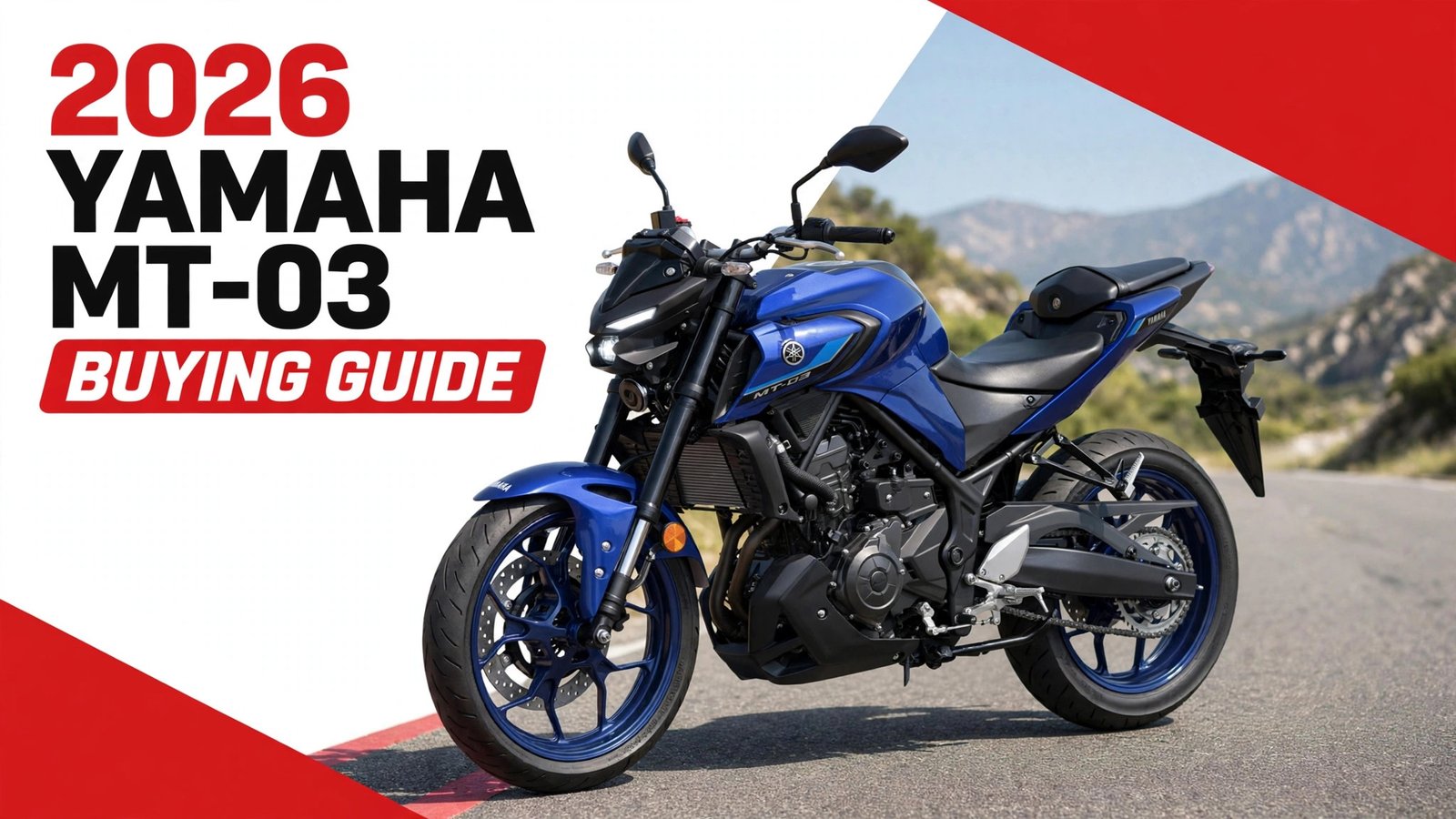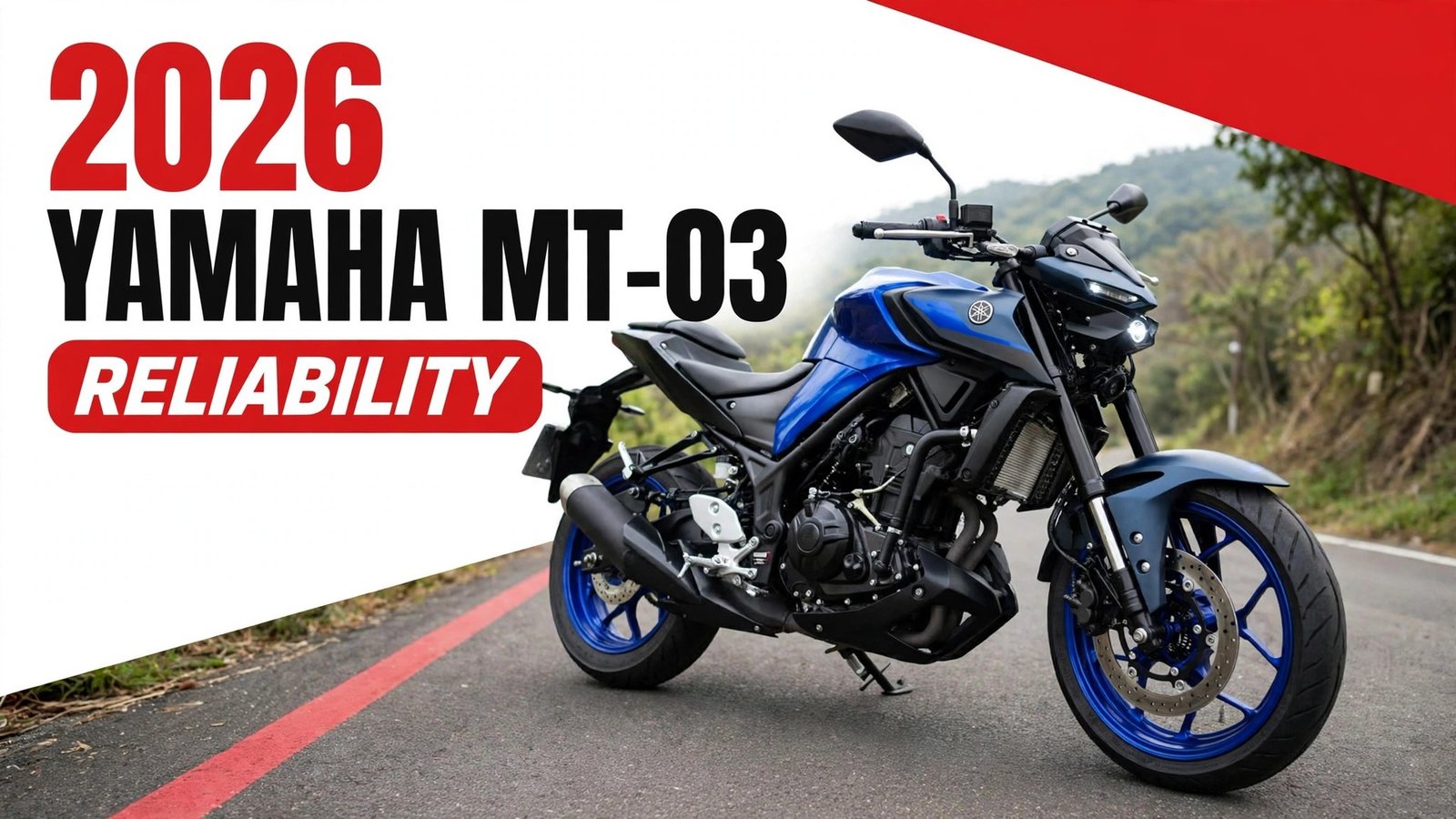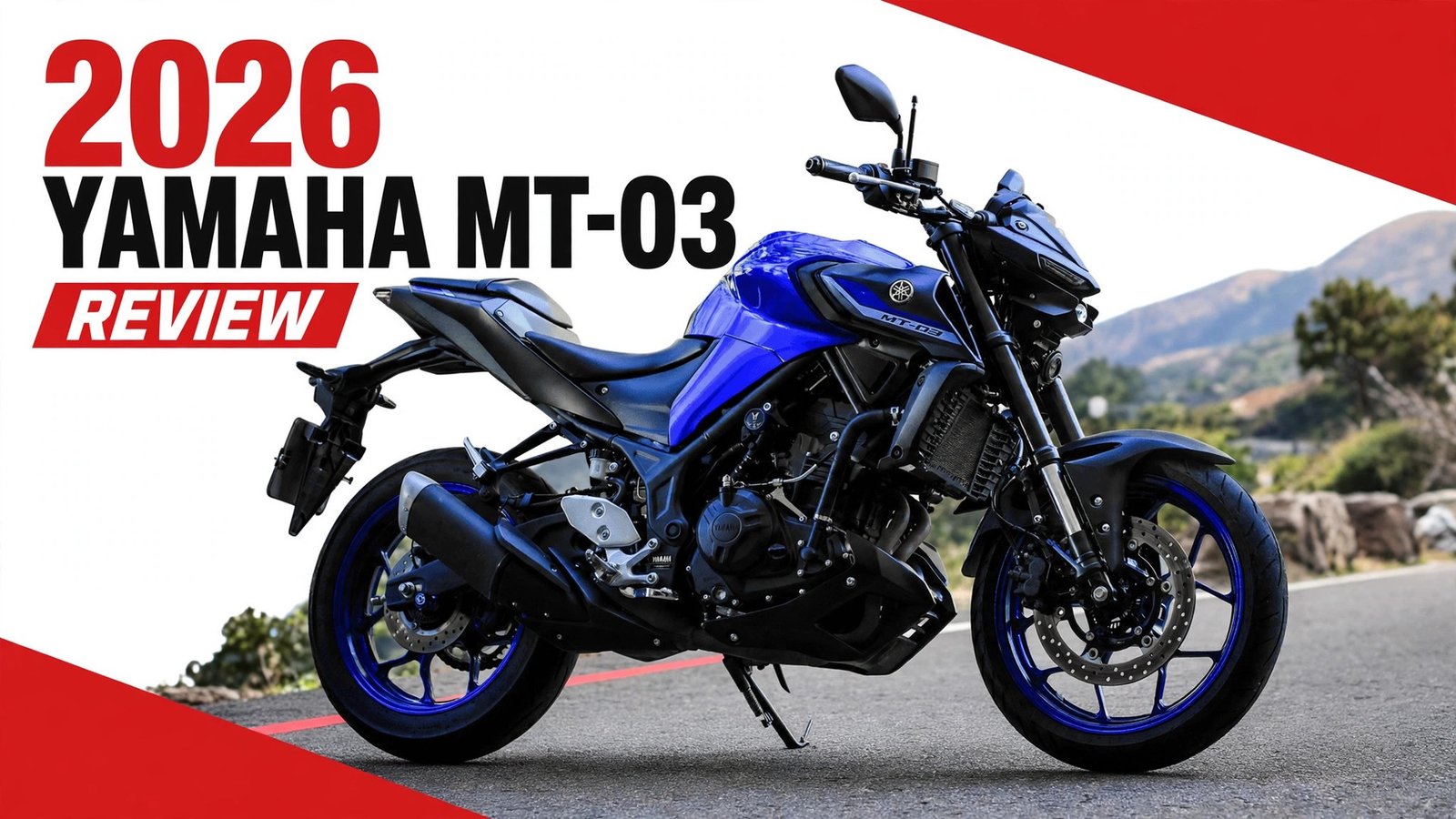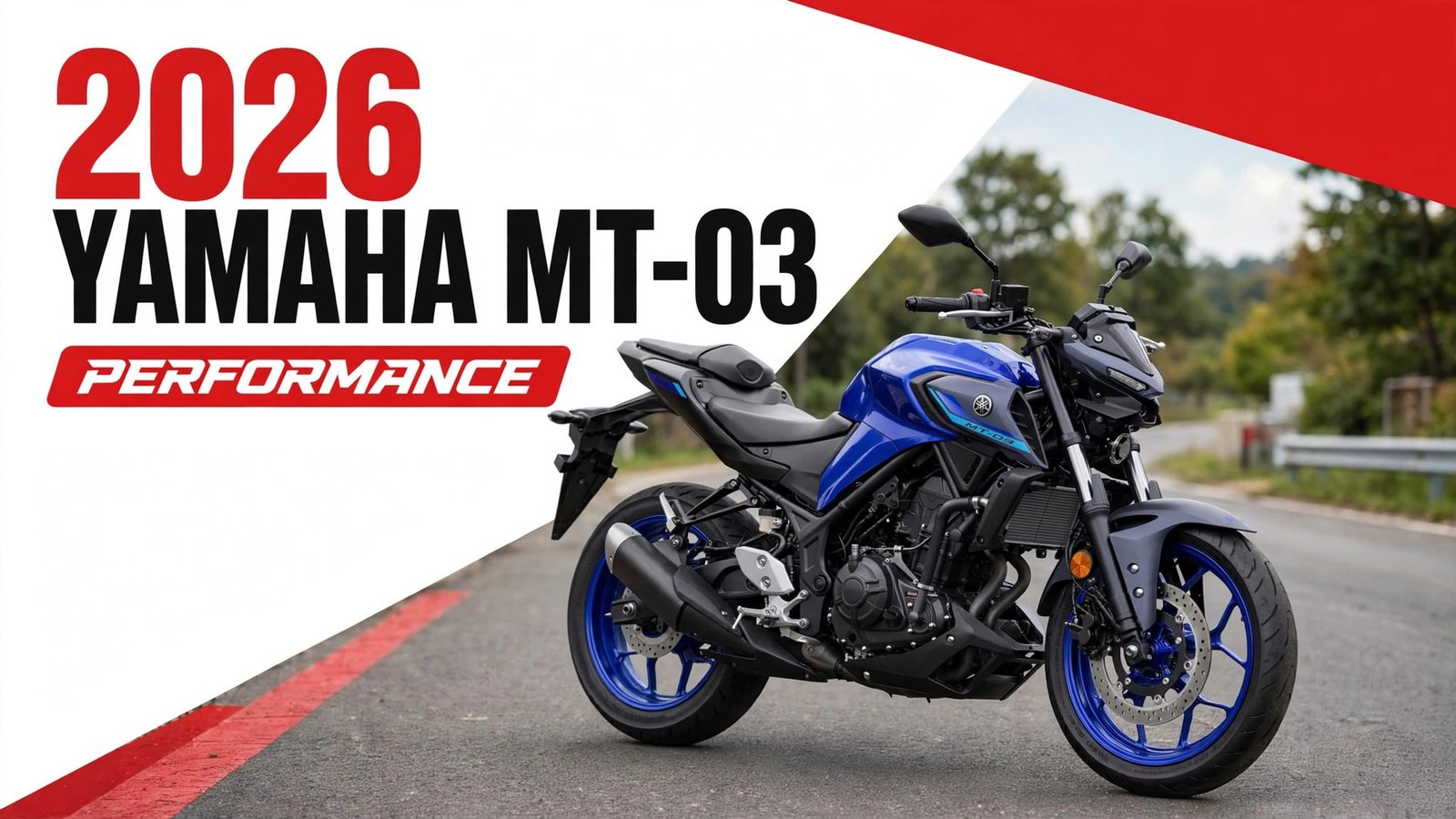
Yamaha MT-03 performance starts with an honest number: on Cycle World’s dyno, a 2020 MT-03 made 37.07 rear-wheel horsepower — not a big number, and not supposed to be. Yamaha MT-03 performance is about a light, rev-happy 321cc twin in a 373-pound naked chassis, and the numbers that matter most are measured independently: the dyno figure, the 108 mph MotoStatz top speed, and fuel economy stretching a 3.7-gallon tank past 200 miles.
The short version of Yamaha MT-03 performance: a 321cc parallel twin that loves revs, 0–60 mph in 5.11 seconds and a quarter mile of 14.05 seconds from independent non-US testing, a top speed best quoted as 108 mph with an exhaust caveat, and an official 62 mpg estimate for 2025–2026 against 56 mpg earlier. Below: the dyno evidence, the top-speed question, real fuel economy, everyday riding, handling and brakes, and the beginner rivals.
Yamaha MT-03 Engine Performance and Power Delivery
The engine is the whole point of Yamaha MT-03 performance: a 321cc liquid-cooled DOHC parallel twin, shared in concept with the faired YZF-R3 but tuned and packaged for naked-bike street riding, with an upright riding position and a wide handlebar instead of clip-ons — the ergonomic side of Yamaha MT-03 performance.

Cycle World Dyno 37.07 RWHP at 10,590 RPM Explained
For judging Yamaha MT-03 performance, rear-wheel horsepower matters most, because it measures what actually reaches the road. Cycle World’s dyno test of the 2020 MT-03 strapped the new model to its in-house Dynojet 250i dynamometer ahead of its full test and recorded 37.07 horsepower at 10,590 rpm and 20.22 pound-feet of torque at 9,010 rpm. Those are the test bike’s measured figures, not a factory claim, and this article keeps them labeled that way.
Against the factory figure, the gap is normal driveline loss. Yamaha’s widely reported factory output is 41.4 horsepower at 10,750 rpm and 21.8 pound-feet at 9,000 rpm, measured at the crankshaft — roughly 4 horsepower above the rear-wheel figure. Yamaha MT-03 performance should always be quoted with that distinction: crankshaft claims on one side, rear-wheel tests on the other. Bore and stroke are 68.0 by 44.1 mm, compression is 11.2:1, and fueling is by dual 32mm Mikuni throttle bodies.
| Figure | Value | Source |
|---|---|---|
| Rear-wheel power | 37.07 hp at 10,590 rpm | Cycle World dyno, 2020 bike |
| Rear-wheel torque | 20.22 lb-ft at 9,010 rpm | Cycle World dyno, 2020 bike |
| Factory claim | 41.4 hp at 10,750 rpm; 21.8 lb-ft at 9,000 rpm | Widely reported factory figure |
| Weight | 373 lb claimed; 375 lb Cycle World measured | Yamaha / Cycle World scales |
Six-Speed Transmission, Gear Shifting and Parallel-Twin Power Delivery
Yamaha MT-03 performance depends as much on the gearbox as on the engine. The six-speed constant-mesh transmission is central to Yamaha MT-03 performance, driving the rear wheel by chain, with ratios close enough to keep the twin in its useful range. Below about 6,000 rpm it is calm and commuter-friendly; above that it wakes up, pulling cleanly to its peak. That split personality is why Yamaha MT-03 performance feels faster than 37 rear-wheel horsepower sounds on paper.
The clutch deserves an honest note in any account of Yamaha MT-03 performance. Cycle World’s 2020 testers flagged a relatively stiff clutch pull on the early bike, even while praising its feel and easy launches. Yamaha answered for 2025 with an assist-and-slipper clutch, lightening lever effort and helping prevent rear-wheel hop on hard downshifts. So the clutch story splits by generation: heavier on 2020–2024 bikes, lighter on 2025-on bikes.
Yamaha MT-03 Top Speed and Acceleration
Top speed and acceleration come with two caveats: the test bike wore an aftermarket exhaust, and the test was not conducted in the United States.

Top Speed 108 MPH Measured by MotoStatz With Exhaust Caveat
Yamaha publishes no top speed for the MT-03, so the best measured figure for Yamaha MT-03 performance comes from MotoStatz’s MT-03 acceleration and top-speed test, which recorded a top speed of 108 mph. That figure comes with the tester’s own caveat: the test bike had an aftermarket exhaust fitted and may not have been running at its best, which could have slightly reduced the top speed. MotoStatz adds that a better tuck or a smaller rider might add a few mph, and it would re-test a stock example if one became available.
That caveat is why Yamaha MT-03 performance must never be summarized as a stock 112 mph top speed: figures around 110–112 mph in some roundups trace back to MotoStatz’s own speculation about tuck and rider size, not to a measured stock result. For Yamaha MT-03 performance, the measured figure stays 108 mph on a modified bike. The video below is a short dyno clip that runs a stock Yamaha MT-03 against the Honda CB300F and BMW G310GS for a top-speed comparison — the MT-03 leads the test, but it is a multi-bike dyno comparison, not an MT-03-only road test.
0-60 in 5.11 Seconds and Quarter Mile in 14.05 Seconds: Non-US Test Explained
The acceleration figures for Yamaha MT-03 performance come from the same MotoStatz test, and the same honesty rules apply. The MT-03 recorded 0–60 mph in 5.11 seconds, 0–100 km/h in 5.41 seconds, and a quarter mile of 14.05 seconds at 92 mph, and 0–100 mph in 18.82 seconds. Those are competitive times, and for Yamaha MT-03 performance they are the headline acceleration figures, set back-to-back against the faired YZF-R3 on the same day: the MT-03 actually pipped the R3 in the quarter mile, and only after that point did the faired bike pull away on aerodynamics.
Two warnings belong with those figures. First, this was a non-US test, so Yamaha MT-03 performance here never presents 5.11 seconds or 14.05 seconds as American instrumented results; no verified US instrumented test for the MT-03 was found. Second, the same aftermarket-exhaust caveat applies, since the whole test used the same bike. One figure must never be borrowed: the R3’s own 5.17 seconds and 112.1 mph belong to the faired bike, not to the MT-03.
Yamaha MT-03 Mileage and Fuel Economy
With a 3.7-gallon tank, every mpg counts toward real range, and the MT-03’s official figures changed with the 2025 model year, so the bike’s year decides which estimate applies.

Official Yamaha 62 MPG Estimate for 2025-2026 and 56 MPG for Earlier Years
Yamaha’s official estimate for the 2025 and 2026 MT-03 is 62 mpg, and Yamaha’s own listings mark that figure as estimated. Earlier US listings quote 56 mpg: the 2020 bike’s specification tables list 56 mpg claimed, and Motorcycle.com’s 2020 MT-03 first ride repeats that 56 mpg claim. The rule for Yamaha MT-03 performance is clean: 62 mpg for 2025–2026, 56 mpg earlier, with the 2025 update bringing the higher estimate alongside its assist-and-slipper clutch, Y-Connect, USB-A socket, and new LCD.
On the 3.7-gallon tank, those estimates give theoretical ranges of 229 miles at 62 mpg and 207 miles at 56 mpg. Nobody runs a tank dry, so neither is a planning number, but Yamaha MT-03 performance on fuel is a genuine strength. The Ultimate Motorcycling 2025 MT-03 first look confirms the 2025 specification, including the 62 mpg estimate and the $4,999 price.
Real-World MPG, UK Imperial Figures and Estimated Fuel Range
Real-world riding moves Yamaha MT-03 performance below the official estimate, but not by much. Ultimate Motorcycling’s 2026 review notes that at the claimed 62 mpg the bike should deliver more than 200 miles between fill-ups, while warning that time in the 8,000–9,000 rpm zone brings the filling station closer. Ridden gently it sips fuel; ridden hard it drinks.
UK figures need converting before they mean anything to an American buyer judging Yamaha MT-03 performance. A UK press bike averaged around 76 mpg imperial over 1,200 miles, and MCN’s road-test reporting puts the bike in the mid-70s mpg imperial, good for more than 200 miles from its 14-litre tank. An imperial gallon is about 1.2 US gallons, so 76 mpg imperial converts to roughly 63 mpg US, and mid-70s imperial to roughly 62 mpg US — in line with Yamaha’s 2025–2026 estimate, not above it. Any source quoting 74 or 76 mpg without saying “imperial” flatters the bike by about 20 percent.
| Scenario | Fuel economy | Range on 3.7 gallons |
|---|---|---|
| Official Yamaha estimate (2025–2026) | 62 mpg (estimated) | About 229 miles (theoretical) |
| Official Yamaha estimate (earlier years) | 56 mpg (claimed) | About 207 miles (theoretical) |
| UK press bike, converted | About 63 mpg US (76 mpg imperial) | About 230 miles (theoretical) |
| Sensible planning number | 55 to 62 mpg US | Fuel stop every 180 to 200 miles |
Yamaha MT-03 Real-World Riding Performance
Spec sheets tell half the story; in daily use it is about how the bike behaves in traffic and on the freeway.

City Riding, Traffic Performance and Everyday Acceleration
Around town, Yamaha MT-03 performance is genuinely easy to live with: the 373-pound weight and 30.7-inch seat make it manageable at stoplights, the upright handlebar gives good visibility over traffic, and the twin’s low-end manners mean a gap in traffic is handled with a roll of the wrist.
Everyday acceleration is where Yamaha MT-03 performance earns its reputation: the twin pulls cleanly from low revs, so Yamaha MT-03 performance feels quick without being frantic. Drawbacks are modest: some vibration around 5,000 rpm, frequent fuel stops on a long commute, and no range readout on the 2025-on LCD dash. None of that changes the verdict: this is one of the easiest fast-feeling bikes to ride slowly.
Highway Riding, Overtaking Ability and Long-Distance Limitations
On the highway, Yamaha MT-03 performance shows both its strength and its limit: the bike holds freeway speeds without the strained feel common to weaker entry-level machines, and the tall upper gears calm the engine in a cruise. Overtaking needs commitment: little punch low in the rev range means a quick pass requires a downshift and revs.
MotoStatz states the MT-03’s limits plainly: the lack of bodywork starts to hurt from around 80 mph onwards, and more so above 90 mph, which is why the 0–100 mph time of 18.82 seconds is nearly two seconds slower than the R3’s. Wind blast, a firm seat, and no cruise control make long-distance work possible but tiring. Back roads, city streets, and short highway hops are its home ground.
Yamaha MT-03 Handling, Braking and Stability
If the engine is the reason people buy in, the chassis is the reason they keep it: a light diamond steel frame, a 37mm inverted fork, and tires sized for agility.
37mm KYB Inverted Fork, Chassis, Dunlop Tires and Cornering Performance
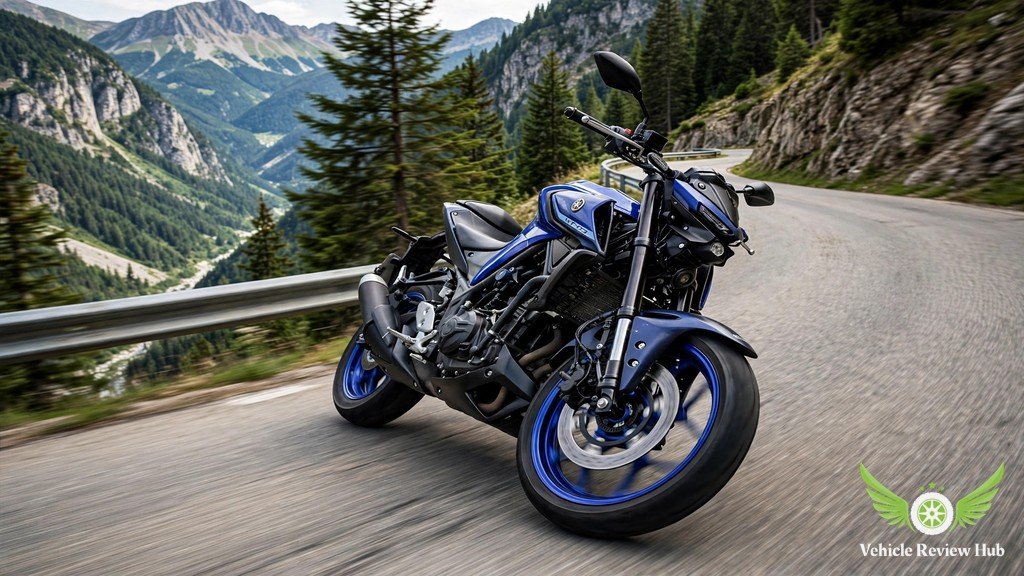
Yamaha MT-03 performance hardware starts with a 37mm KYB inverted fork with 5.1 inches of travel, non-adjustable, paired with a single rear shock adjustable for spring preload, 4.9 inches of travel. The diamond-type tubular steel frame, 54.3-inch wheelbase, 25-degree rake, and 3.7-inch trail give quick steering without nervousness; Cycle World noted that it tips into corners quickly and easily. That agility is the chassis payoff for weighing just 373 pounds.
The tires complete the cornering picture for Yamaha MT-03 performance: Dunlop Sportmax GPR-300 tires, 110/70-17 front and 140/70-17 rear, narrow enough to flick quickly and grippy enough for back-road riding. The long swingarm adds stability, and the package feels composed at lean and changes direction with little effort. The MT-03 review covers the full model-year history behind these numbers.
Single 298mm Front Disc, 2-Piston Caliper and ABS Only Features
Braking confuses many buyers, so the facts for Yamaha MT-03 performance deserve stating clearly: a single 298mm front disc with a 2-piston caliper and a single 220mm rear disc with a 1-piston caliper, both with standard ABS. There is no second front disc, no radial caliper, no lean-sensitive ABS, and no IMU — conventional dual-channel ABS is the whole electronic braking story. Cycle News’ 2020 MT-03 specifications confirm the single 298mm disc, 2-piston front caliper, and ABS layout.
One conflict is worth flagging: some spec roundups of the 2025 bike list a four-piston front caliper, but Yamaha’s detailed specification tables and Cycle News both list the 2-piston caliper, and this article follows the detailed tables. Either way, for Yamaha MT-03 performance, braking is adequate for the bike’s weight and speed; Cycle World found the brakes the weakest part of its 2020 test, and pad condition matters more than any caliper debate. For servicing costs, see the MT-03 reliability and maintenance guide.
| Chassis / brake item | MT-03 specification |
|---|---|
| Front fork | 37mm KYB inverted, non-adjustable, 5.1-in travel |
| Rear shock | Single shock, 7-step preload adjustable, 4.9-in travel |
| Front brake | Single 298mm disc, 2-piston caliper, ABS |
| Rear brake | Single 220mm disc, 1-piston caliper, ABS |
| Tires | Dunlop Sportmax GPR-300, 110/70-17 front and 140/70-17 rear, narrow enough to flick quickly and grippy enough for back-road riding |
| Weight / seat / wheelbase | 373 lb claimed / 30.7 in / 54.3 in |
Yamaha MT-03 Performance Compared With Other Beginner Naked Bikes
No bike exists in a vacuum, and Yamaha MT-03 performance only makes sense in context. The two most relevant rivals are the Kawasaki Z500 and the Honda CB300R, with dealer sources labeled where factory figures were unconfirmed.

Yamaha MT-03 vs Kawasaki Z500 and Honda CB300R
Against the Kawasaki Z500, Yamaha MT-03 performance is outgunned on paper: the Z500’s 451cc parallel twin is larger than the MT-03’s 321cc twin, and its dealer-listed price of $5,599 for the ABS model sits $600 above the MT-03’s $4,999. The Z500 is faster and roomier, but costs more. Against the Honda CB300R, the balance flips: the Honda’s 286cc single is smaller than the MT-03’s twin, its 2026 MSRP of $4,499 undercuts the MT-03 by $500, and the Yamaha answers with a smoother, more powerful twin — though not with a lower price. On value, Yamaha MT-03 performance wins this comparison; on outright pace, the Z500 wins it.
The MT-07 performance page covers Yamaha’s 689cc upgrade at $8,599, while the YZF-R3 performance page covers the faired sibling that shares the MT-03’s engine family but trades naked comfort for aerodynamics. For prices and alternatives, see the MT-03 buying guide.
Is the Yamaha MT-03 Suitable for Beginners and Daily Commuting?
The short answer for Yamaha MT-03 performance is yes to both, with one qualification. For beginners, Yamaha MT-03 performance is genuinely manageable: predictable delivery, light weight, a 30.7-inch seat, and no rider aids beyond conventional ABS. A rider stepping up from a 125 should respect the jump in pace, especially above 8,000 rpm, but the bike rarely punishes mistakes.
For daily commuting, Yamaha MT-03 performance makes the MT-03 one of the easiest bikes to live with: light, narrow, comfortable for an hour or two, economical at a realistic 55 to 62 mpg US, and equipped from 2025 onward with Y-Connect and a USB-A port. Its weaknesses are the small tank, the lack of wind protection, and no cruise control. The full MT-03 review covers comfort and model-year differences.
Yamaha MT-03 Performance FAQs
Direct answers about Yamaha MT-03 performance: power, top speed, fuel economy, brakes, and rivals.
How much horsepower does the Yamaha MT-03 make?
For Yamaha MT-03 performance, the widely reported factory figure is 41.4 horsepower at 10,750 rpm, while Cycle World’s dyno test of a 2020 bike recorded 37.07 rear-wheel horsepower at 10,590 rpm and 20.22 pound-feet of torque at 9,010 rpm.
What is the top speed of the Yamaha MT-03?
The best measured figure for Yamaha MT-03 performance is 108 mph from MotoStatz testing, but the test bike wore an aftermarket exhaust and may not have been running at its best, so it is not a verified stock result.
What is the MT-03’s 0-60 time?
MotoStatz recorded 0–60 mph in 5.11 seconds and a quarter mile of 14.05 seconds at 92 mph for Yamaha MT-03 performance, but this was a non-US test on the same aftermarket-exhaust bike, so neither figure is a US instrumented result.
Is the MotoStatz 108 mph figure a stock top speed?
No. The test bike had an aftermarket exhaust fitted, and MotoStatz said the bike may not have been running at its best, promising a re-test on a stock example. Figures around 110–112 mph in roundups come from the tester’s speculation about tuck and rider size, not a measured stock run.
What is the real-world MPG of the Yamaha MT-03?
For Yamaha MT-03 performance, Yamaha estimates 62 mpg for 2025–2026 models and earlier listings quote 56 mpg. Converted UK figures land in the same band: about 63 mpg US from a 76 mpg imperial press-bike average. Plan on 55 to 62 mpg US in real riding, with a fuel stop every 180 to 200 miles.
Does the MT-03 have an inverted fork?
Yes. Yamaha MT-03 performance hardware includes a 37mm KYB inverted fork with 5.1 inches of travel, non-adjustable, paired with a preload-adjustable single rear shock.
Does the MT-03 have a TFT display or traction control?
No. For Yamaha MT-03 performance, the answer is no: the MT-03 uses an LCD display on every US model year, including 2025-on, and has no traction control, no riding modes, no ride-by-wire, and no IMU. Its only electronic rider aid is conventional ABS.
What brakes does the MT-03 have?
For Yamaha MT-03 performance, the answer is simple: a single 298mm front disc with a 2-piston caliper and a single 220mm rear disc with a 1-piston caliper, both with ABS. It has no dual front discs or radial calipers.
How does the MT-03 compare with the Z500 and CB300R?
For Yamaha MT-03 performance, the Z500’s 451cc twin is faster and roomier but costs $600 more at a dealer-listed $5,599, while the CB300R’s 286cc single is smaller and undercuts the MT-03 at $4,499 for 2026. On twin-cylinder smoothness and outright pace, the MT-03 wins this comparison; on sticker price, the CB300R wins it.
Is the MT-03 good for highway riding?
Yes for short highway hops, with limits. Yamaha MT-03 performance holds freeway speeds comfortably, but overtaking needs a downshift, wind blast grows above 80 mph, and the lack of bodywork costs top-end pace.