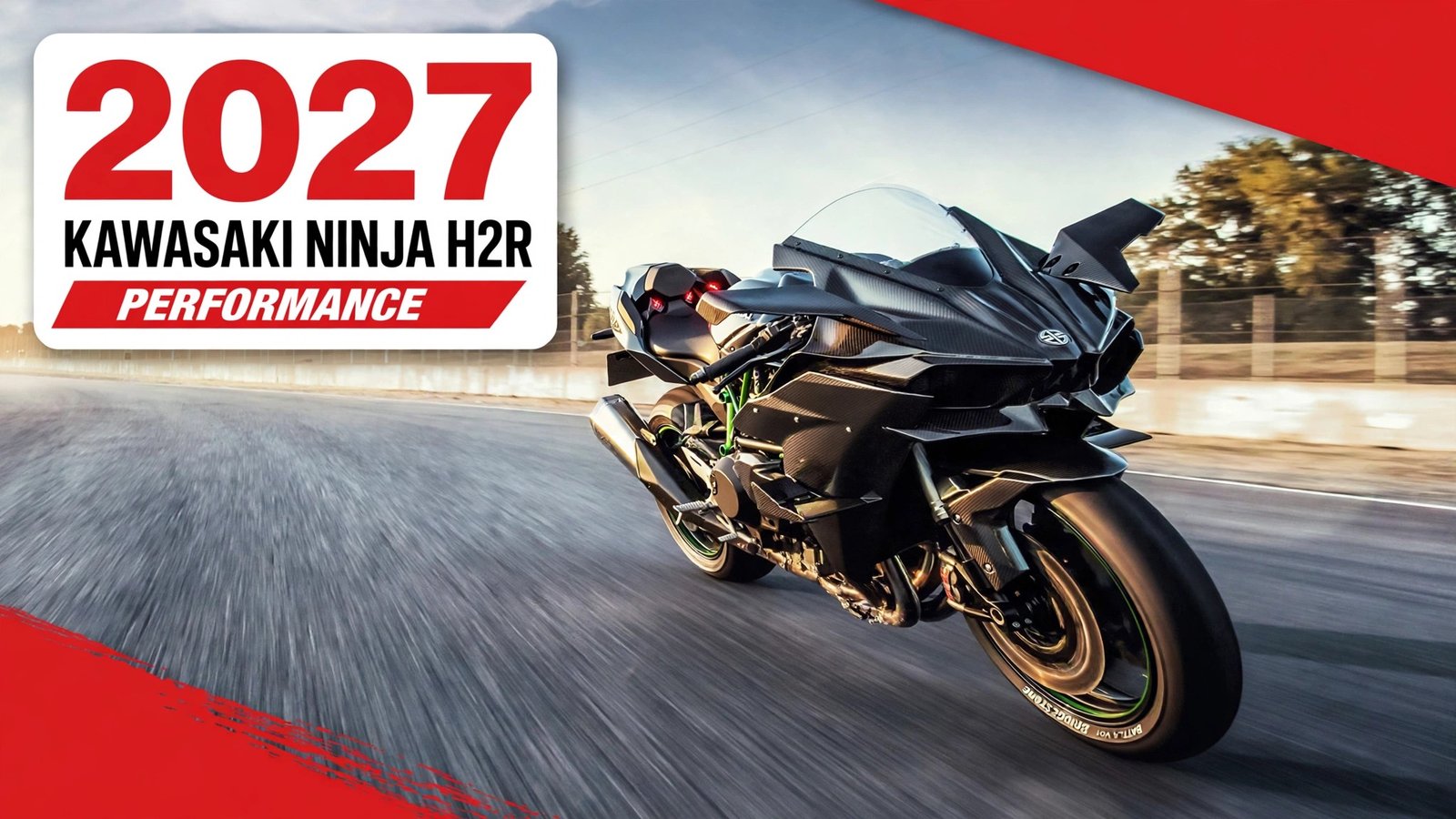
The Kawasaki Ninja H2R makes 322 hp, and almost none of that number has ever been measured in the United States. This Kawasaki Ninja H2R performance guide starts with that gap, because it is the whole story: the fastest production motorcycle Kawasaki has ever sold has no US instrumented quarter-mile or top-speed test of a stock bike, no published dyno test with numbers, and no fuel-economy figure at all. What does exist is a handful of honest, attributed numbers — 198 mph in the half-mile, 191 mph on GPS at Losail, 231 hp raw on the dyno — and a 400 km/h bridge run that was a staged stunt, not a test.
That framing matters because the H2R’s performance numbers get quoted everywhere, usually without the bike, the tester or the conditions attached. This Kawasaki Ninja H2R performance guide puts every figure back with its source: the claimed power with its ISO 4106 label, the dyno numbers with the bike that made them, the speed figures with the event that timed them, and the 400 km/h run with the closed bridge it happened on. The bike below is the 2027 model, and everything it does happens on a racetrack — it cannot be registered, it ships on slicks, and it is sold with no warranty at all.
Kawasaki Ninja H2R Engine Performance and Power Delivery
The H2R’s engine is a 998cc supercharged inline-four, and this Kawasaki Ninja H2R performance guide starts with the claimed figures, because they are the only power numbers Kawasaki will stand behind. The current bike — 2025 through 2027 — is claimed at 322 hp at 14,000 rpm (ISO 4106), with 121.5 lb-ft at 12,500 rpm. Those two numbers are the whole official story this Kawasaki Ninja H2R performance guide works from.
No US Instrument Test
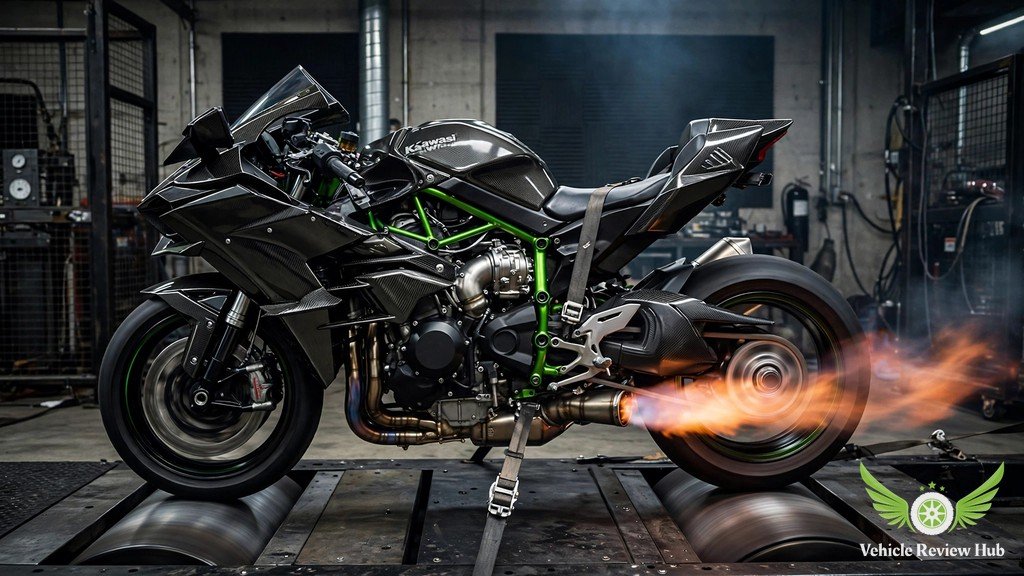
There is no US instrumented quarter-mile, dyno or top-speed test of a stock H2R, and this Kawasaki Ninja H2R performance guide says so plainly because the absence is the fact that matters most. No American magazine has put a showroom-stock H2R on a dyno and published the numbers, run it down a drag strip, or measured its top speed with GPS on US soil. The closest things are a half-mile event in Oregon and a dyno video shoot at Kawasaki USA that produced flames and no numbers.
Cycle World ran a pilot-production H2R on Kawasaki USA’s own dyno for a video shoot in June 2015, and the magazine’s own account is that Kawasaki “wasn’t ready to disclose that all-important number to us at the time”. The run produced a video of a fire-breathing engine and no published figure. The honest position of this Kawasaki Ninja H2R performance guide: the dyno exists on film, the number does not exist in print, and any article quoting a Cycle World H2R dyno figure is inventing one.
400 km/h Was a Stunt
The 400 km/h figure is the one every H2R performance discussion starts with, and it was a staged stunt, not a test. On June 30, 2016, at 5:00 in the morning, Kenan Sofuoğlu rode an H2R across the Osman Gazi Bridge in Turkey — a bridge not yet open to traffic, closed for the event — and indicated 400 km/h in 26 seconds. The run celebrated the bridge opening, with four months of training and specially made tyres behind it. This Kawasaki Ninja H2R performance guide prints it as what it was: theatre with a motorcycle in it, not a measurement.
Kawasaki had told Sofuoğlu the H2R maxes out at 380 km/h, and his previous trial run had reached 390 km/h — so 400 km/h was a target chased on a closed road, not a speed measured by any independent party. No timing body, no GPS log and no third-party observer has verified the number. That is why this Kawasaki Ninja H2R performance guide never prints 400 km/h or 249 mph as the H2R’s top speed.
| Figure | Number | Source and status |
|---|---|---|
| Claimed power, 2025–2027 | 322 hp @ 14,000 rpm | Kawasaki USA spec sheet, ISO 4106 |
| Claimed torque, all years | 121.5 lb-ft @ 12,500 rpm | Kawasaki USA spec sheets, 165 Nm |
| Claimed power, 2015–2024 | 310 hp @ 14,000 rpm, 326 hp with ram air | Kawasaki’s period wording — same engine, printed differently |
| Motorcycle.com dyno, raw | 231 hp | Motorcycle.com, Dynojet, 2015 Airstrip Attack test bike |
| Motorcycle.com dyno, corrected | About 259 hp (+12%) | Motorcycle.com’s own estimate, not a measured figure |
| Cycle World dyno, Kawasaki USA | No numbers published | Pilot-production bike, video shoot, June 2015 |
Note: The 322 hp figure is the old 326 PS figure expressed in horsepower (326 PS × 0.98632 = 321.5 hp, rounded to 322), so there was no power change in 2025 — only a change in how Kawasaki prints it. This Kawasaki Ninja H2R performance guide never prints 322 hp as SAE, and never prints 310 hp for the current bike.
Kawasaki Ninja H2R Top Speed and Acceleration
The honest answer to “how fast is the H2R?” is that nobody has measured it properly, and this Kawasaki Ninja H2R performance guide would rather say that than repeat a stunt number as a top speed. The fastest measured US figure is 198 mph in a standing half-mile; the fastest GPS figure anywhere is 191 mph at Losail. The 400 km/h bridge figure was never verified by anyone independent, and the 216.4 mph Mojave figure came from a bike with modified bodywork. Every speed in this Kawasaki Ninja H2R performance guide carries its event and method, because without those the number means nothing.
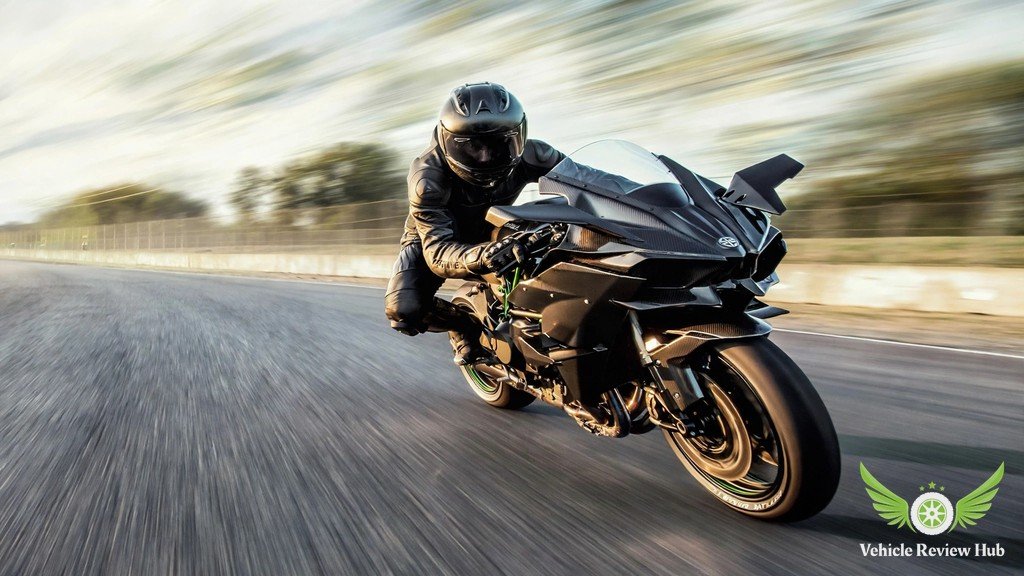
Bridge Run Never Verified
The bridge run is the most famous H2R speed claim and the least verified. Sofuoğlu’s indicated 400 km/h — 249 mph — came from the bike’s own instruments on a closed bridge at dawn, with no independent timing, no GPS log published and no third party standing by to confirm it. Kawasaki organised the event and supplied the bike. This Kawasaki Ninja H2R performance guide treats that as a claim, not a measurement — and the distinction matters.
The video below is the footage of that morning, and it is honest about what it is. The June 30, 2016 Osman Gazi Bridge run, as re-uploaded by Motociclismo magazine — a staged stunt on a closed bridge, not a test — with Sofuoğlu indicating 400 km/h in 26 seconds.
Watch the clip for what it shows — a rider flat out on an empty bridge in the early morning — and notice what it does not show: no timing gantry, no speed trap, no independent verification of any kind. This Kawasaki Ninja H2R performance guide keeps the footage here because it is the most-watched H2R clip in existence, but the text next to it says plainly that it proves a stunt happened, not a speed.
Mojave Bike Wore Mod Bodywork
The Mojave Mile run is the other big H2R speed number, with the same problem in a different shape. Kawasaki’s factory Team 38 took the H2R to the Mojave Mile after Bonneville Speed Week 2015 was cancelled, and rider Shigeru Yamashita ran a best of 216.4 mph on the Saturday. The number is real and timed — but the bike was not stock. This Kawasaki Ninja H2R performance guide prints 216.4 mph with its modifications attached, because without them the figure misleads.
The Mojave bike wore a flattened front fairing, its winglets removed, an oversized front fender, a redesigned chain cover and a new rear sprocket, and it ran on Dunlop Sportmax GP-A Pro tyres instead of the stock V01 slicks. There were no mechanical alterations and the engine still made its claimed 326 PS with ram air, but the bodywork that shapes a bike’s top speed had been changed for the standing mile. A stock H2R, wings on and V01 slicks fitted, has never been timed at Mojave, and this Kawasaki Ninja H2R performance guide does not present 216.4 mph as a stock figure.
| Run | Figure | Status |
|---|---|---|
| Oregon Airstrip Attack, standing half-mile — Rickey Gadson | 198 mph | Measured, stock H2R, 2015 — fastest US figure |
| Oregon Airstrip Attack, standing half-mile — Kevin Duke | 195 mph | Measured, stock H2R, 2015 — fastest bike at the event |
| Oregon Airstrip Attack, flashed ECU — Kevin Duke | 196 mph | Brock’s flashed ECU — NOT a stock run |
| Losail, VBOX GPS — Cycle World | 191 mph | Measured, 2015 first ride, ~1,500 rpm to spare |
| Mojave Mile, standing mile — Team 38 | 216.4 mph | Timed, but modified bodywork — NOT a stock figure |
| Osman Gazi Bridge — Sofuoğlu | 400 km/h indicated | Staged stunt, closed bridge — NEVER verified |
Note: Neither Oregon rider broke 200 mph in the standing half-mile, and no stock H2R has ever been timed through a quarter-mile or a full standing mile. This Kawasaki Ninja H2R performance guide prints only the figures above, each with its event and conditions — no listicle top speed.
Kawasaki Ninja H2R Mileage and Fuel Economy
There is no MPG figure for the H2R — not a good one, not a bad one, not an estimate. This Kawasaki Ninja H2R performance guide does not print one, because none exists: no EPA rating, no Kawasaki-published figure, and no magazine has ever published a measured consumption number for the bike on track or anywhere else. The section below explains why, instead of filling the gap with another bike’s figure.
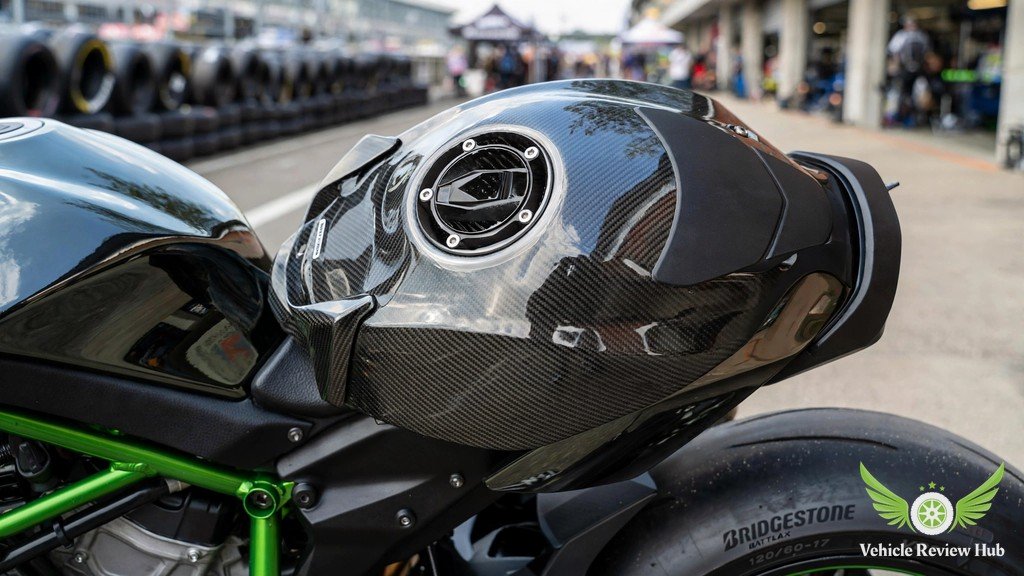
No Official MPG Exists
The H2R has no EPA fuel-economy rating because it is not a road vehicle, and the EPA does not test closed-course machines. Kawasaki publishes no MPG figure either — the spec sheet lists a 4.5-gallon tank and nothing about consumption. This Kawasaki Ninja H2R performance guide treats that silence as the answer: a track-only motorcycle with no road test cycle has no official economy figure to quote, and inventing one would be worse than printing none. Any MPG number attached to this bike in a listicle or database is copied from the street H2 or made up.
No Measured Track Figure Either
No publication has published a measured fuel-consumption figure for the H2R on track either. Track riding does not produce a repeatable MPG number — consumption changes with the circuit, the session length, the rider’s pace and how much time the engine spends above 8,000 rpm, which is exactly the time the service clock counts. A single “track MPG” figure would be meaningless the moment the bike moved to a different circuit. This Kawasaki Ninja H2R performance guide prints no range figure either: with a 4.5-gallon tank and no consumption figure to divide by, a range would be pure invention.
Kawasaki Ninja H2R Real-World Riding Experience
There is no US riding experience of the H2R to describe, and this Kawasaki Ninja H2R performance guide does not invent one. The only first ride that matters happened at Losail in Qatar in June 2015, with Don Canet of Cycle World as the only North American motojournalist invited, and everything in this section comes from that test and the Oregon half-mile event. The riding story, in this Kawasaki Ninja H2R performance guide, is a Losail story.
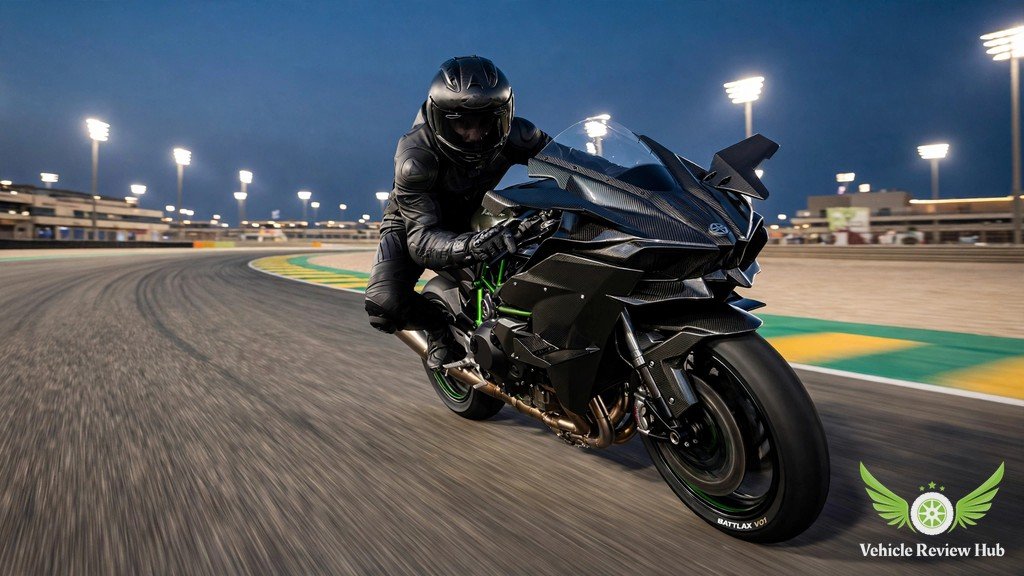
Tested at Losail, Not in US
Losail International Circuit in Qatar is where the H2 and H2R were launched together. Canet’s June 2015 test is the only instrumented first ride of the H2R in existence, and it produced the bike’s only GPS speed figure: 191 mph on the VBOX, with the dash indicating 203 mph and about 1,500 rpm still to spare. This Kawasaki Ninja H2R performance guide prints the VBOX figure as measured and the dash figure as indicated, because the gap between them is the difference between a measurement and a speedometer reading.
What Canet found at Losail was a bike that worked the circuit with what he called remarkable competence, with feedback notably better than the street H2. The H2R is geared taller than the H2, with two fewer teeth at the rear, which Canet said was necessary to run a gear lower through certain corners. Visordown’s lap-time note from the same launch puts the H2R a whole 11 seconds faster than the street H2, with average lap times well over two minutes on the H2 — a comparison between two bikes on the same day, not a timed lap record, and this Kawasaki Ninja H2R performance guide prints it with that attribution.
Gadson Numbers Are Hybrids
Rickey Gadson’s name turns up next to the biggest H2R numbers in print, and every one of them belongs to a different bike. The 8.213-second quarter-mile at 166.48 mph was the one-off H2R-based “Ninja H2 Hybrid” drag bike — an Adam’s Performance build with a “Strong Arm” swingarm stretching the wheelbase from 56.5 to 67.5 inches, run at Rockingham Dragway. It is a drag bike built around H2R parts, not a stock H2R, and this Kawasaki Ninja H2R performance guide never prints its quarter-mile as a stock figure.
The other Gadson numbers are further from the H2R still. His 229.1 mph Texas Mile run, with an 8.05-second quarter at 184 mph and 323 rear-wheel horsepower, was the modified street H2 known as the RG62 build — a street bike with a supercharger pushed far beyond stock, not an H2R at all. Gadson also rode a second stock H2R at the Oregon Airstrip Attack in 2015 and ran 198 mph in the standing half-mile, and that number — timed, stock, attributed — is the one this Kawasaki Ninja H2R performance guide prints. Check which bike made the number before quoting it.
Kawasaki Ninja H2R Handling, Braking and Stability
Handling on the H2R is a track subject, and this Kawasaki Ninja H2R performance guide treats it that way. The bike has never been ridden on a public road by a tester, so there are no road handling figures, no road braking distances and no stability notes from street riding. What exists is one first ride at Losail: a bike that Canet said would “run circles around the ZX-14R and Suzuki ‘Busa” on the circuit, with brakes and a steering damper praised as highly as the engine.
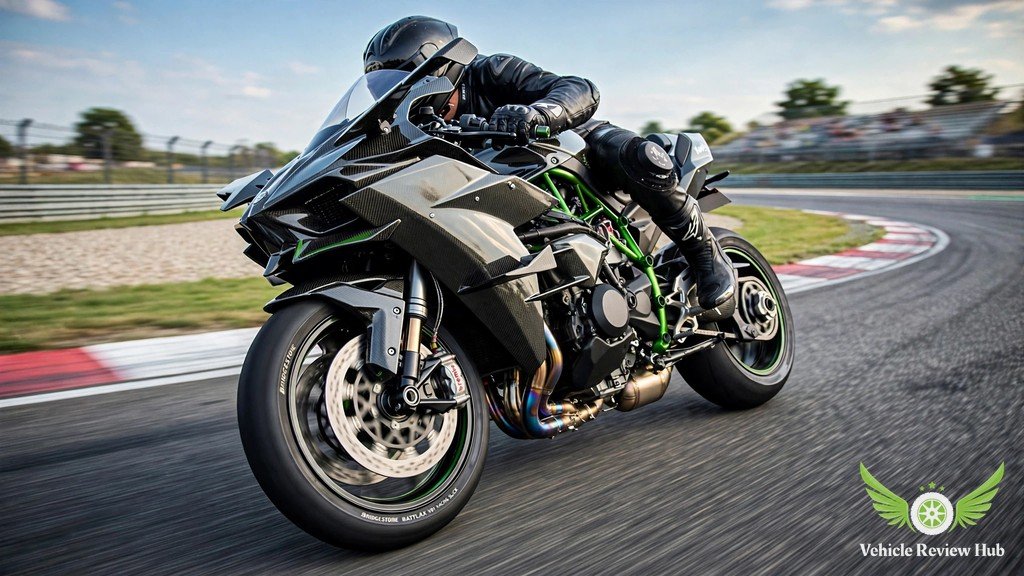
Handling, Braking and Stability on Real Roads
There are no real-road handling figures for this bike — the heading would otherwise promise something that does not exist. The H2R has never been ridden on a public road by any tester — it cannot be registered, it ships on slicks, and its only test ground is a racetrack. Everything below is track handling, from the one first ride that exists, and this Kawasaki Ninja H2R performance guide keeps it labelled that way.
At Losail, Cycle World found the H2R working the 3.375-mile, 16-turn circuit with remarkable competence, with feedback notably better than the street H2. The Brembo monobloc calipers and 330 mm rotors earned what Canet called incredible strides in acceleration and braking, and the Öhlins steering damper quelled bar wag. The traction control’s flickering yellow indicator, he wrote, “may as well be labeled: HSA (HighSide Avoidance)” — the electronics working hardest exactly where the power is hardest to use.
Warmers and Stands Mandated
Tyre warmers and stands are not recommendations for the H2R — they are Kawasaki’s own instructions, printed in the bike’s 2015 acknowledgement. Always use tyre warmers before riding, because a cold V01 slick has no grip to give, and always store the bike on front and rear stands with both tyres off the ground, because a slick left loaded deforms. This Kawasaki Ninja H2R performance guide prints those rules as instructions, not advice.
Warm tyres are a performance rule too. Canet’s Losail account of the rear V01 breaking loose and hooking up on exits is a warm-tyre story, and a cold-tyre version ends differently — which is why this Kawasaki Ninja H2R performance guide treats warmers as a rule, not a tip. The stands rule matters the same way: a bike stored on its tyres between sessions is a bike with flat-spotted slicks at the next session.
Kawasaki Ninja H2R Performance Compared With Other Sport Bikes
The H2R has no direct rival, so this Kawasaki Ninja H2R performance guide compares it the way the bike demands: on claimed power, measured speed and weight, against the bikes closest to it in the line. The H2 SX’s 207 hp claim is the touring version of the same idea, the ZX-10R’s 190 hp the superbike version, and the ZX-6R’s 127 hp the middleweight version. Measured speed in this line is always GPS or timed, as with the ZX-4RR’s 124 mph RevZilla figure — and the H2R’s measured figures sit at the top of that honest list.
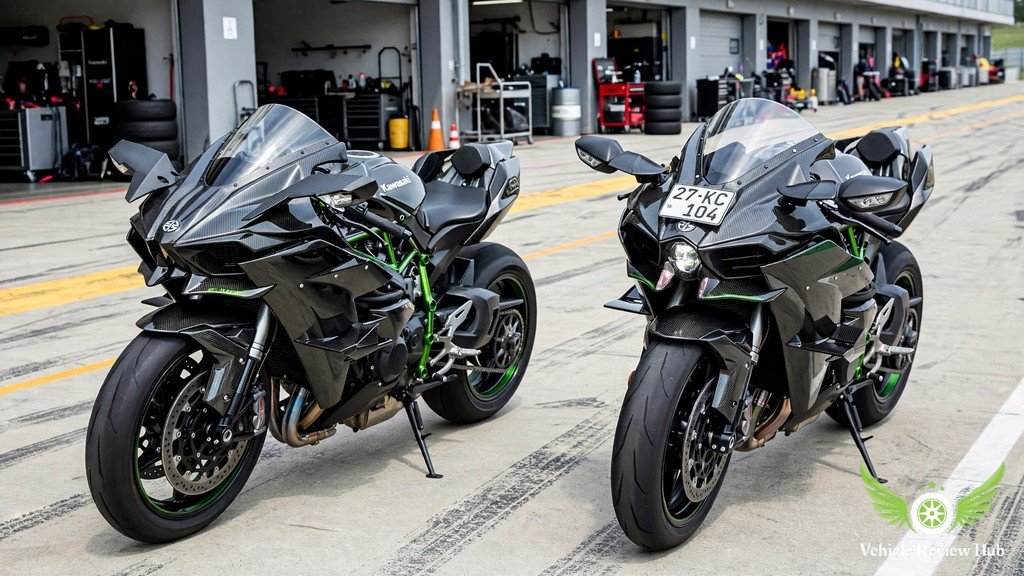
Kawasaki Ninja H2R vs Kawasaki Ninja H2 Carbon ABS
The H2 Carbon is the H2R’s street-legal sibling. The Ninja H2 Carbon is claimed at 206 hp at 11,000 rpm with 99.5 lb-ft at 8,500 rpm, weighs 524.8 lb at the curb, and costs $39,400 — and you can ride it home on the road. The H2R makes 116 hp more, weighs 48.5 lb less, and costs $24,900 more, and you cannot ride it anywhere but a racetrack. This Kawasaki Ninja H2R performance guide puts the trade plainly: the Carbon buys usability, the H2R buys power.
On power delivery the two are different machines despite the shared engine. The Carbon’s 206 hp arrives in a road bike with road gearing, road tyres and a warranty behind it; the H2R’s 322 hp arrives on slicks, with warmers mandated, a 15-hour service clock and no warranty at all. The weight gap — 476.3 lb against 524.8 lb — is the Carbon’s road equipment made visible: lights, mirrors, indicators and the rest. The H2R is 48.5 lb lighter because it carries none of it, and this Kawasaki Ninja H2R performance guide counts that as the clearest number in the comparison.
| Item | Ninja H2R (2027) | Ninja H2 Carbon ABS (2027) |
|---|---|---|
| Claimed power | 322 hp @ 14,000 rpm (ISO 4106) | 206 hp @ 11,000 rpm |
| Claimed torque | 121.5 lb-ft @ 12,500 rpm | 99.5 lb-ft @ 8,500 rpm |
| Curb weight | 476.3 lb | 524.8 lb |
| Base price | $64,300 | $39,400 |
| Street-legal | No — track-only | Yes |
Note: All figures are from Kawasaki USA’s own 2027 spec sheets for the two bikes, and the H2R’s price from Kawasaki USA’s 2027 H2R product page. The H2R makes 116 hp more than the Carbon (322 vs 206) and weighs 48.5 lb less at the curb (476.3 vs 524.8 lb), for $24,900 more ($64,300 vs $39,400). This Kawasaki Ninja H2R performance guide compares the two on power, weight and legality only — no lap-time comparison exists.
Is the Kawasaki Ninja H2R Suitable for Beginner Riders?
No. The answer is the shortest in this Kawasaki Ninja H2R performance guide, because it needs no hedging: 322 hp claimed, 476.3 lb, no warranty, not street-legal, $64,300, slicks only, 120 dB/A at factory shipment, and a 15-hour service clock. A beginner has no business on a machine that cannot be ridden on the road and needs tyre warmers and stands before it turns a wheel. The honest first-bike recommendation is the Ninja 500 or the Ninja 650 — real road bikes, with warranties, that teach a rider everything the H2R would punish them for not knowing.
Kawasaki Ninja H2R Performance: Frequently Asked Questions
The questions riders ask about the H2R’s performance, answered with the verified figures from this Kawasaki Ninja H2R performance guide.
How much power does the H2R make?
Kawasaki USA claims 322 hp at 14,000 rpm (ISO 4106) and 121.5 lb-ft at 12,500 rpm for the current bike. The 2015–2024 bikes were claimed at 310 hp (326 hp with ram air) — the same output printed differently, not a power change.
What did the H2R make on the dyno?
No published US dyno test of a stock H2R exists. Motorcycle.com’s 2015 test bike read 231 hp raw on a Dynojet (about 259 hp corrected), with other H2Rs registering in the 240 range. Cycle World ran a pilot-production H2R on Kawasaki USA’s dyno but published no numbers.
How fast is the H2R?
The 400 km/h bridge run was a staged stunt, not a test: Kenan Sofuoğlu indicated 400 km/h (249 mph) in 26 seconds on a closed bridge on June 30, 2016, and no independent party verified the figure. The fastest measured US figure is 198 mph in the standing half-mile (Motorcycle.com, Oregon Airstrip Attack, 2015); Cycle World’s VBOX at Losail read 191 mph.
What is the H2R’s quarter-mile time?
No stock-H2R quarter-mile figure exists. The often-quoted 8.213 seconds at 166.48 mph is a one-off H2R-based drag bike with a stretched swingarm, not a stock H2R.
What MPG does the H2R get?
There is no official MPG, no EPA rating and no measured figure at all — the bike is track-only, so no road test cycle applies. Owners measure fuel per track session, not miles per gallon.
Is the Kawasaki Ninja H2R suitable for beginner riders?
No. 322 hp claimed, 476.3 lb, no warranty, not street-legal, $64,300, slicks and a 15-hour service clock. The Ninja 500 or Ninja 650 is the honest first-bike recommendation.