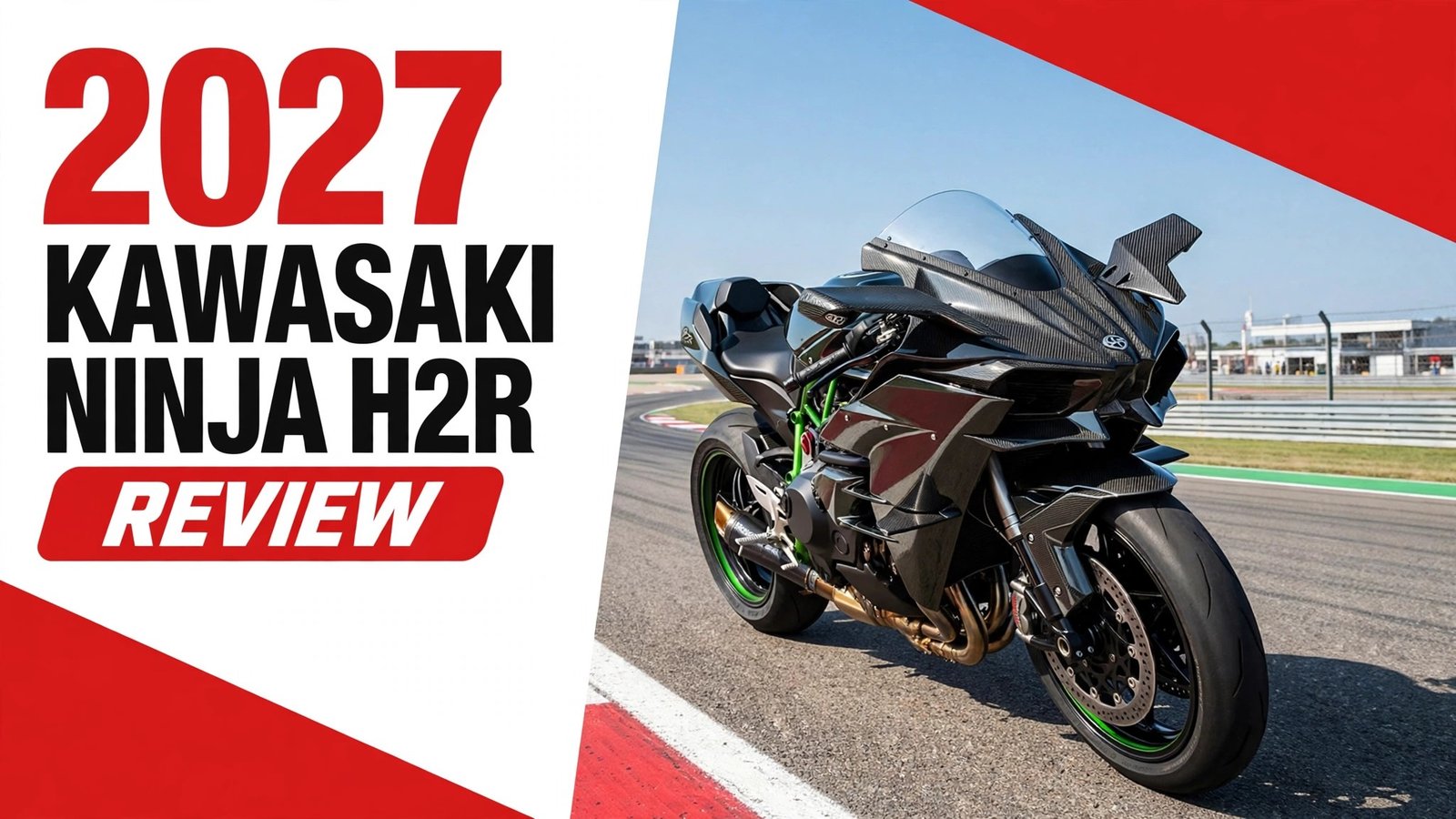
The Kawasaki Ninja H2R is the most powerful production motorcycle Kawasaki has ever sold, and it is also the one you cannot ride home. This Kawasaki Ninja H2R review starts with the fact that decides everything else: the H2R is a closed-course, track-only motorcycle that cannot be registered in the United States, ships on racing slicks, and is sold with no warranty at all. The 2027 bike costs $64,300 plus an $840 destination charge, $65,140 delivered, and the order window for it closed on November 13, 2026. What that money buys is a 998cc supercharged inline-four claimed at 322 hp, a carbon-fibre body with winglets, and a machine built for one purpose only: the racetrack.
That framing matters because every number in this Kawasaki Ninja H2R review only makes sense on a circuit. There is no road test, no commuting verdict and no fuel-economy figure, because Kawasaki never built the H2R for the road. The bike below is the 2027 model in Mirror Coated Spark Black, the thirteenth year of a run that began in 2015, and owning one means owning a trailer, tyre warmers and stands before it ever turns a wheel.
Kawasaki Ninja H2R Overview and Model-Year Updates
The H2R has never been redesigned. Across thirteen model years, Kawasaki has kept one trim, one colour per year and the same 998cc supercharged engine, changing the claimed power figure on paper in 2025 while the engine itself stayed the same. This Kawasaki Ninja H2R review covers the whole run, from the $50,000 launch bike of 2015 to the $64,300 bike of 2027.
Not Street-Legal, Ever
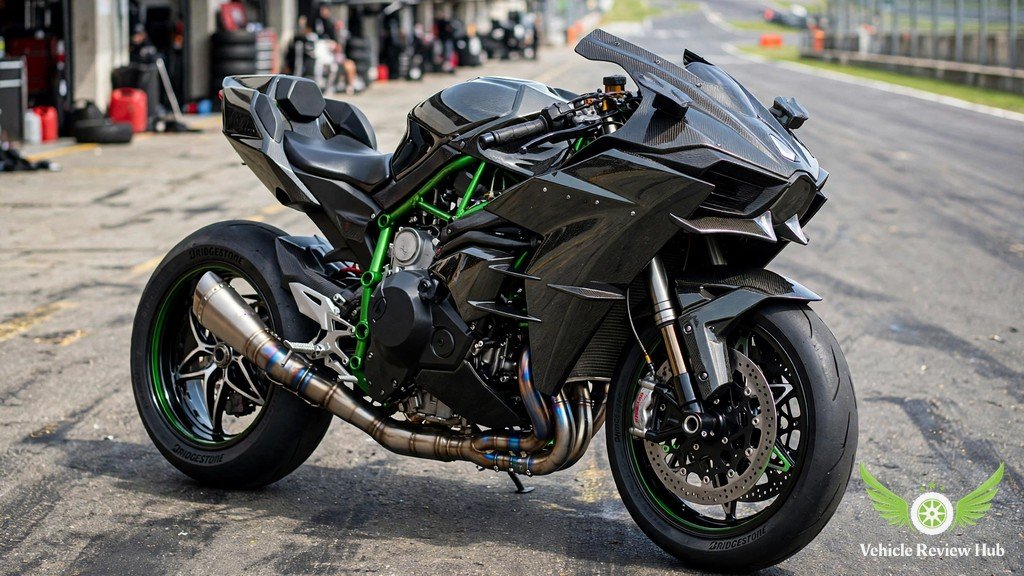
Kawasaki’s own 2015 acknowledgement, republished by Cycle World, calls the H2R a closed-course, riding-use-only vehicle that is “not manufactured for public roads, streets or highways.” The bike has no headlight, no indicators and no mirrors, and it cannot be registered in the US. It ships on Bridgestone Battlax V01 racing slicks, illegal on public roads and useless without tyre warmers. Anyone who buys one is buying a track-day machine, and the purchase only works if the buyer already has a way to get it to a circuit.
The street-legal sibling is the Ninja H2 Carbon, which shares the supercharged 998cc family but carries a headlight, mirrors, indicators, a warranty and a number plate. The H2R gives all of that up for power and weight: 322 hp claimed against the Carbon’s 206 hp, and 476.3 lb curb against the Carbon’s 524.8 lb.
Order Window Sold Out
The 2027 H2R was sold through a short annual order window, November 3–13, 2026, and that window is now closed — Kawasaki’s own product page states “ORDER PERIOD IS NOW CLOSED,” and the 2027 allocation sold out in days. The 2026 bike was sold by special order through October 31, and the 2015 launch orders closed in December 2014, with deposits due to dealers by December 19, 2014.
That changes how a buyer should read this Kawasaki Ninja H2R review. The 2027 bike is no longer orderable new, so a buyer today is looking at the used market or waiting for the next window, if Kawasaki opens one, and every used bike still carries the same conditions: no warranty, slicks only, and a service clock that counts hours above 8,000 rpm.
Kawasaki Ninja H2R Engine and Specifications
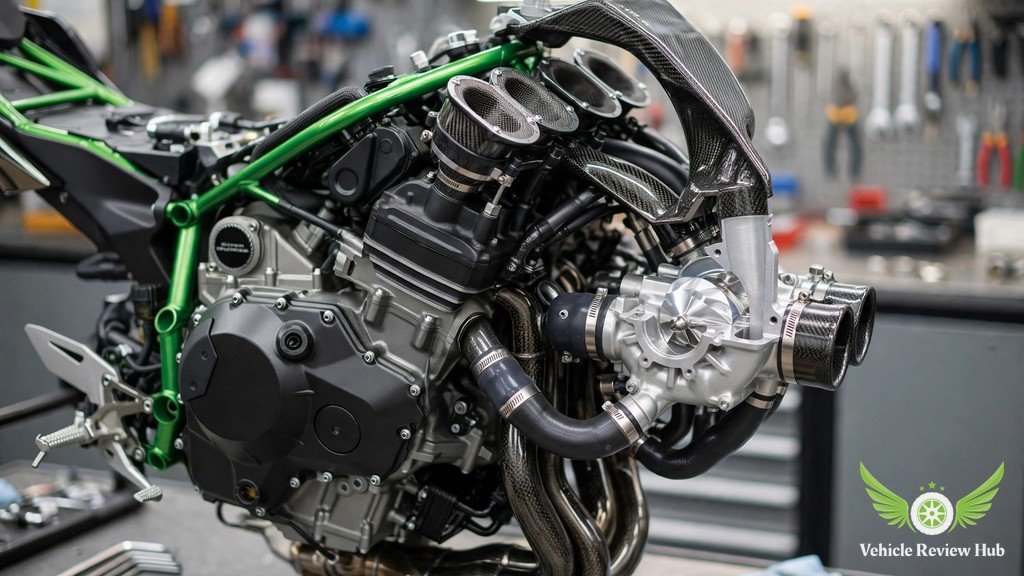
The engine is the whole point of the H2R, and this Kawasaki Ninja H2R review treats it that way. A 998cc supercharged inline-four sits in a steel trellis frame, and everything else on the bike exists to keep that engine usable at full throttle. The full 2027 specification is in the table below, taken from Kawasaki USA’s own spec sheet.
322 HP Claim, Two Wordings
Kawasaki USA claims 322 hp at 14,000 rpm for the current bike, measured to ISO 4106. From 2015 to 2024, Kawasaki claimed 310 hp at 14,000 rpm, or 326 hp with ram air. The 322 hp figure is the old 326 figure expressed in horsepower instead of PS: 326 PS multiplied by 0.98632 is 321.5 hp, rounded to 322. The two wordings are 321.5 hp on dealer pages and 322 hp on Kawasaki’s spec sheet. It is the same engine and the same output, printed two ways — not a power increase, and this Kawasaki Ninja H2R review does not present it as one.
Torque is simpler and has never changed: 165 Nm, which is 121.5 lb-ft at 12,500 rpm on the 2025–2027 sheets. One older review prints 115 lb-ft, but no Kawasaki sheet supports it, so it is not printed here. The 2024 sheet prints the same weights and torque but omits the power line entirely.
Ships on V01 Slicks
The H2R ships on Bridgestone Battlax V01 racing slicks: a V01F Soft front in 120/60-17 and a V01R Medium rear in 190/65-17. Kawasaki’s own acknowledgement says: do not replace the tyres with any other brand or model than standard, always use tyre warmers before riding, and always store the bike on front and rear stands with both tyres off the ground. Kawasaki does not approve the V02F and V02R for H2R use. The slicks are part of why the bike cannot be ridden on the road, and part of why this Kawasaki Ninja H2R review measures running costs in heat cycles and track sessions rather than miles.
| Spec | 2027 Kawasaki Ninja H2R |
|---|---|
| Engine | 998cc, liquid-cooled, 4-stroke, in-line four, DOHC, 16-valve, supercharged |
| Bore × stroke | 76.0 × 55.0 mm |
| Compression ratio | 8.3:1 |
| Maximum horsepower | 322 hp @ 14,000 rpm (ISO 4106) |
| Maximum torque | 121.5 lb-ft @ 12,500 rpm |
| Fuel system | DFI with 50 mm throttle bodies (4), dual injection |
| Transmission | 6-speed, return, dog-ring |
| Final drive | Sealed chain |
| Front suspension | 43 mm inverted KYB AOS-II fork, 4.7 in travel |
| Rear suspension | Uni-Trak, Öhlins TTX36 gas-charged shock, 5.3 in travel |
| Frame | Trellis, high-tensile steel, with swingarm mounting plate |
| Rake / trail | 25.1° / 4.3 in |
| Front brakes | Dual 330 mm discs, Brembo Stylema monobloc calipers, KIBS |
| Rear brakes | Single 250 mm disc, opposed 2-piston calipers, KIBS |
| Front tyre | 120/60-17 Bridgestone Racing Battlax V01F Slick, Soft |
| Rear tyre | 190/65-17 Bridgestone Racing Battlax V01R Slick, Medium |
| Seat height | 32.7 in |
| Wheelbase | 57.1 in |
| Curb weight | 476.3 lb |
| Dry weight | 432.2 lb |
| Fuel capacity | 4.5 gal |
| Colour | Mirror Coated Spark Black |
| Warranty | N/A (none) |
| BASE MSRP ABS | $64,300 |
Note: All figures are from Kawasaki USA’s own 2027 Ninja H2R spec sheet. The horsepower figure is measured to ISO 4106, which Kawasaki notes measures horsepower differently than the SAE standards, so this Kawasaki Ninja H2R review never prints 322 hp as an SAE figure.
Kawasaki Ninja H2R Price and Market Availability
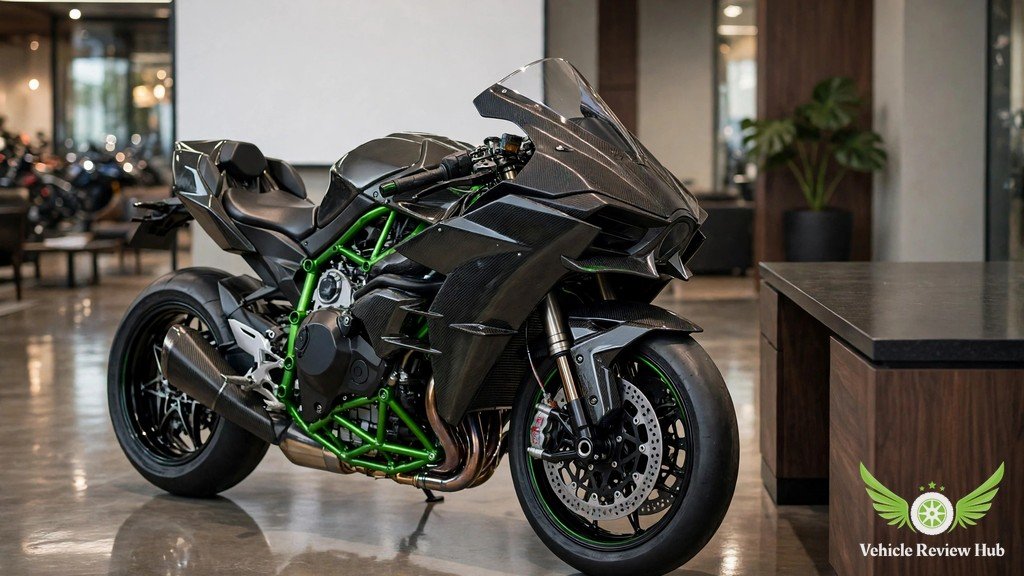
The price of the H2R has climbed by $14,300 since launch. The table below is the verified US price ladder for the whole run, and this Kawasaki Ninja H2R review prints only the figures that could be checked against a named source.
Kawasaki Ninja H2R Price in the USA: $64,300 (2027)
The 2027 H2R costs $64,300 before destination, and $65,140 delivered with the $840 destination charge. That is the only delivered price this Kawasaki Ninja H2R review prints for a current-year bike, because it is the only one Kawasaki USA publishes in full: the base price and the destination charge both appear on the live 2027 product page. The 2023 bike can also be priced delivered, at $57,960, from a $57,500 MSRP and a $460 destination charge recorded in Motorcycle.com’s spec database. For 2024, 2025 and 2026, the destination charges were not verified, so no delivered figure is printed for those years at all.
The 2019 MSRP is not printed anywhere in this review because no exact figure could be verified: the best source says the 2019 models started at “$55,000 or a little higher,” which is a range, not a price. One widely read article prints $59,100 as the 2026 price, but $59,100 is the 2025 price; the 2026 spec sheet prints $62,100, and the spec sheet governs. The 2016 price of $53,000 comes from Motorcycle.com’s review rather than a Kawasaki sheet, because the 2016 spec-sheet page no longer serves a real document, so it is printed with that attribution.
| Model year | MSRP (US) | Destination | Delivered |
|---|---|---|---|
| 2015 | $50,000 | Unverified | — |
| 2016 | $53,000 | Unverified | — |
| 2017 | $55,000 | Unverified | — |
| 2018 | $55,000 | Unverified | — |
| 2019 | ~$55,000+ (exact figure unverified) | Unverified | — |
| 2020 | $55,000 | Unverified | — |
| 2021 | $55,500 | Unverified | — |
| 2022 | $56,500 | Unverified | — |
| 2023 | $57,500 | $460 | $57,960 |
| 2024 | $58,100 | Unverified | — |
| 2025 | $59,100 | Unverified | — |
| 2026 | $62,100 | Unverified | — |
| 2027 | $64,300 | $840 | $65,140 |
Note: MSRPs for 2024–2027 are from Kawasaki USA’s own spec sheets; the 2027 delivered figure is from the live Kawasaki USA product page. The 2016 figure is from Motorcycle.com, the 2023 destination is from Motorcycle.com’s spec database, and the 2019 figure is not verified as an exact price. This Kawasaki Ninja H2R review prints no delivered price for 2024, 2025 or 2026 because those destination charges were not verified.
Sold As-Is, No Warranty
The H2R is sold “As is” with no warranties at all, express or implied. That wording comes from Kawasaki’s own 2015 acknowledgement, and the 2021 and 2027 spec sheets print “Warranty N/A” in the warranty line. There is no limited warranty, no extended warranty and no roadside cover. If the engine fails, the supercharger fails or the electronics fail, the cost sits with the owner. This is the single most important buying fact in this Kawasaki Ninja H2R review, because it changes the meaning of the $65,140 delivered price.
That absence of warranty also explains the parts rule, unique in this line of reviews: H2R-specific parts cannot be bought without proof of H2R ownership, such as product registration or VIN confirmation. Kawasaki gates the parts because the bike is a limited, closed-course machine, so a second owner should confirm parts access with a dealer before paying. The supercharged H2 SX sport-tourer carries a normal warranty and normal parts access, which is one more reason the two bikes, close as they are in name, are not close as purchases.
Kawasaki Ninja H2R Design, Features and Technology
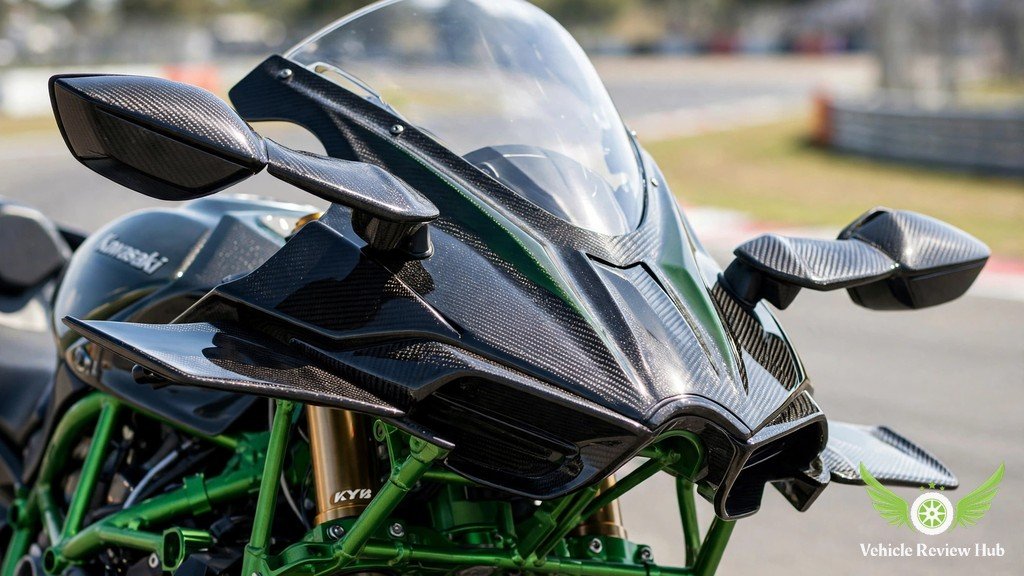
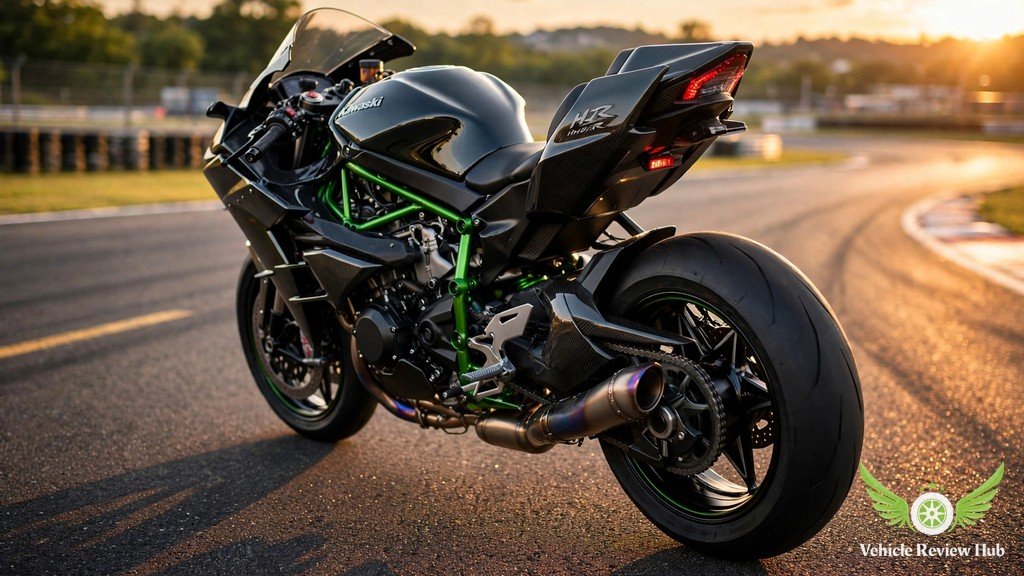
The H2R looks like nothing else on a dealer floor. Carbon-fibre bodywork, winglets where mirrors would sit, a green trellis frame and a single-sided swingarm give the bike away at a glance. This Kawasaki Ninja H2R review covers the design as engineering, not as styling, because every visible part of the bike exists to manage 322 hp on a racetrack.
Carbon Body With Winglets
The bodywork is carbon fibre, and the winglets on the upper cowl are vortex generators that create downforce in place of the mirrors the bike does not have. The bodywork was designed with input from Kawasaki Heavy Industries’ aerospace division, the same group behind the supercharger, which Kawasaki says spins its impeller at up to about 130,000 rpm. The trellis frame is high-tensile steel, green on the H2R — Cycle World calls it a “green, tubular steel trellis frame.” The single-sided swingarm is stock, and the exhaust is an uncorked titanium system that is responsible for the 120 dB/A figure covered later in this Kawasaki Ninja H2R review.
The engine differs from the street H2 in the places that matter at full throttle: different cam profiles, a different head gasket, a lower compression ratio of 8.3:1 against the street bike’s 8.5:1, two additional clutch plates, a model-specific exhaust and its own ECU mapping. The colour is Mirror Coated Spark Black for 2027 and Mirror Coated Matte Spark Black for every year from 2015 to 2026. There has never been a KRT edition of this bike, so a lime-green race livery on an H2R is a fantasy, not a factory option. The ZX-6R KRT Edition shows what a KRT paint package looks like on a Kawasaki.
No Cruise or Road Aids
The heading means the H2R has no cruise control and no road-legal equipment, not that the bike has no electronics. The 2027 spec sheet lists a full rider-aid suite: electronic throttle valves, Kawasaki Cornering Management Function, traction control, launch control, an IMU, intelligent anti-lock brakes, engine brake control, a bi-directional quickshifter and an Öhlins electronic steering damper. The instruments are an analogue tachometer and an LCD multifunction meter. There is no TFT display and no RIDEOLOGY app connection.
What is missing is everything a road bike needs: no cruise control, no headlight, no indicators and no mirrors. The ABS is defeatable on the H2R, on the rear wheel or on both wheels, where the street H2’s ABS is not. That is a track decision, not a road decision, and it is one more reason this Kawasaki Ninja H2R review keeps saying the same thing in different words: the bike is a closed-course machine with a full electronics suite, and the electronics serve the track, not the street.
Kawasaki Ninja H2R Riding Experience and Comfort
There is no road-riding impression of the H2R to print, and this Kawasaki Ninja H2R review does not invent one. The only first ride that matters is Cycle World’s June 2015 test at Losail International Circuit in Qatar, where Don Canet was the only North American motojournalist invited, and everything here comes from that test, because no US first ride of a stock H2R exists.
476.3 lb Curb Weight
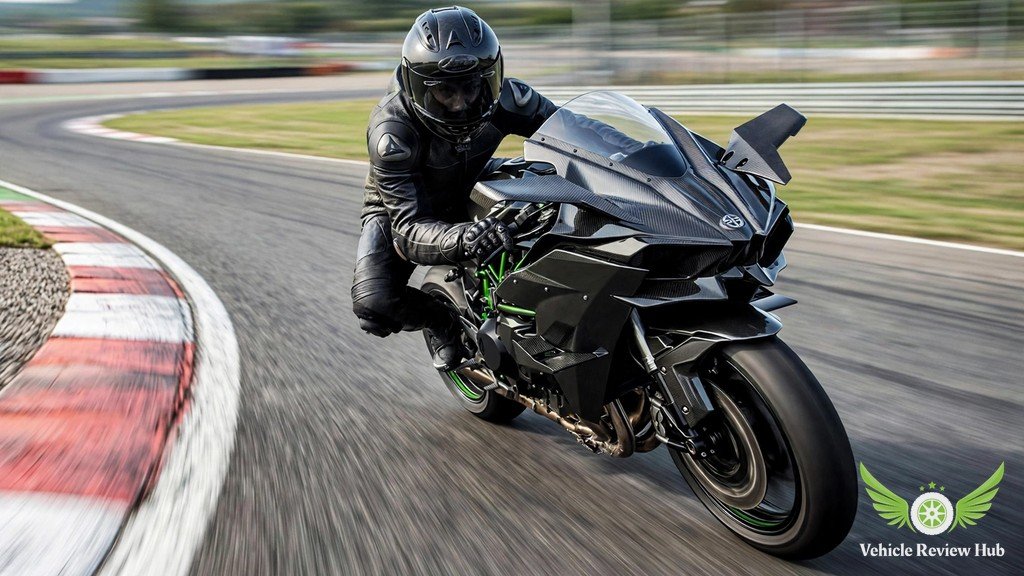
The H2R weighs 476.3 lb with a full 4.5-gallon tank and 432.2 lb dry. Cycle World calls it “the 476-pound H2R,” and the figure matters because the street H2 Carbon is 524.8 lb curb — 48.5 lb heavier than its track sibling. The riding position is a full race tuck, with a 32.7 in seat, a narrow front saddle and hip-support pads adjustable by 15 mm. There is no pillion provision, no luggage and no wind protection discussion for road use. Comfort, on the H2R, is a question of track ergonomics: the firm clutch pull, the tucked position and the windblast at speed.
The weight also explains why the bike feels the way it does at Losail. Canet describes power delivery as linear in the bottom third, with things heating up beyond 5,000 rpm, and power wheelies beginning while still banked over in second-gear corners. The rear Bridgestone V01 slick breaks loose and hooks up again on corner exits, and Canet calls the feeling “the closest most of us can come to experiencing the sensation of a WSBK corner exit.” The traction control’s flickering yellow indicator, he writes, “may as well be labeled: HSA (HighSide Avoidance).” The ZX-10R is the superbike in this line with a racing pedigree of its own, and even it does not produce corner exits like these.
120 dB/A From the Factory
Kawasaki’s own 2015 acknowledgement states the exhaust sound is 120 dB/A at factory shipment, measured using ACU guidelines — the factory-shipment figure, not a measured roadside figure and not a trackside measurement, and this Kawasaki Ninja H2R review prints it with that attribution. Visordown’s first ride calls the H2R “by far the loudest thing I have ever heard on two wheels. Louder than a MotoGP bike.” Cycle World describes “an ear-splitting shriek with every quick blip of throttle followed with a compressor chirp sound when the throttle is snapped shut again.” A buyer who plans to ride the H2R at a track day should check the circuit’s noise limit first, because 120 dB/A is louder than most tracks allow without a silencer.
60 seconds of onboard footage from James Hillier’s 2015 Isle of Man TT-course lap on the H2R — 206 mph on the Sulby straight, no narration, just the supercharger and the road.
Canet keeps returning to the abrupt engine response coming off a closed throttle at Losail, which he puts down to throttle-cable free play and drivetrain lash rather than to the supercharger itself. Once past that, the bike works the 3.375-mile, 16-turn circuit with what he calls remarkable competence, with feedback notably better than the street H2 and less fore-aft chassis pitch. The H2R is geared taller than the H2, with two fewer teeth at the rear — necessary, Canet says, to run a gear lower through certain corners. The Brembo calipers and 330 mm rotors get the same praise as the engine, and the Öhlins electronic steering damper quelled the bar wag. Visordown’s lap-time note puts the H2R a whole 11 seconds faster than the street H2 around the same Qatari circuit, with average lap times well over two minutes on the H2 — a comparison between two bikes on the same day, not a timed lap record, and this Kawasaki Ninja H2R review prints it with that attribution.
Kawasaki Ninja H2R Review: Pros, Cons and Verdict
The verdict of this Kawasaki Ninja H2R review is the same as its opening line: the H2R is the most powerful production motorcycle Kawasaki has ever sold, and the least usable one. The pros and cons below are the whole bike in one table.
Main Advantages and Limitations of the Kawasaki Ninja H2R
| Advantages | Limitations |
|---|---|
| 322 hp claimed (ISO 4106) — the most powerful production Kawasaki ever | Not street-legal; cannot be registered in the US |
| 476.3 lb curb — 48.5 lb lighter than the street H2 Carbon | No warranty at all — sold “As is” |
| Carbon body with winglets, green trellis frame, single-sided swingarm | Ships on V01 slicks only; tyre warmers and stands mandated |
| Full electronics suite: KTRC, KCMF, KQS up/down, KIBS, KLCM, KEBC, IMU | No headlight, indicators, mirrors or cruise control |
| Brembo Stylema calipers, 330 mm discs, Öhlins TTX36 shock | Service every 15 hours over 8,000 rpm; parts need proof of ownership |
| Unchanged since 2015 — a proven, single-trim machine | $65,140 delivered, and the 2027 order window is closed |
Note: The advantages and limitations above are the verified facts of this Kawasaki Ninja H2R review, not a buyer’s opinion. The power, weight and price figures are from Kawasaki USA’s 2027 spec sheet and product page, and the warranty and tyre rules are from Kawasaki’s own 2015 acknowledgement.
Brake Light Is Fitted, Nothing Else
A rear brake light IS fitted on the H2R, according to Kawasaki’s own 2017 materials, quoted by TotalMotorcycle: “The Ninja H2R has no headlight or indicator but does have a rear brake light.” That is the whole of the bike’s road equipment. There is no headlight, no indicator and no mirror, and the small brake light under the tail does not make the bike road-legal, registrable or rideable on a public road. One South African source says the bike has no tail light at all, but the Kawasaki 2017 materials govern, and this Kawasaki Ninja H2R review prints the Kawasaki version.
Buy the H2R if you want the fastest production motorcycle Kawasaki sells, you have a trailer and a track, and you accept a machine with no warranty, slicks only and a 15-hour service clock. Do not buy it if you want to ride on the road, because you cannot. The street H2 Carbon is the bike for that buyer, at $39,400 with a warranty, a headlight and a number plate, and the H2 SX comparison shows what the supercharged family looks like when it is built for the road instead of the track. The Ninja 650 is the honest first bike for a rider new to this class, and the Ninja 500 is the other one. The H2R is not a first bike, a second bike or a commuter — it is a 322 hp track machine that happens to be for sale, and this Kawasaki Ninja H2R review calls it exactly that.
Kawasaki Ninja H2R Review: Frequently Asked Questions
The questions buyers ask about the H2R, answered with the verified figures from this Kawasaki Ninja H2R review.
What is the Kawasaki Ninja H2R?
Kawasaki’s supercharged, track-only hypersport: a 998cc supercharged inline-four with a claimed 322 hp (ISO 4106) in a carbon-bodied, wingleted chassis. It is a closed-course-only motorcycle — not manufactured for public roads, and it cannot be registered in the US.
How much does a 2027 Kawasaki Ninja H2R cost?
$64,300 plus $840 destination — $65,140 delivered before dealer fees and tax. The 2026 bike was $62,100 and the 2025 bike was $59,100 (destination charges for those years are unverified, so no delivered figure is printed for them).
Can I ride the Ninja H2R on the road?
No. It has no headlight, no indicators and no mirrors, it ships on racing slicks, and Kawasaki states it is not manufactured for public roads, streets or highways. It cannot be registered in the US.
Does the Ninja H2R have a warranty?
No. It is sold “As is” with no warranties at all, express or implied. The spec sheet prints “Warranty N/A”.
What tyres does the H2R ship on?
Bridgestone Battlax V01 racing slicks only: V01F Soft front (120/60-17) and V01R Medium rear (190/65-17). Kawasaki does not approve any other tyre, including the V02F/V02R, and tyre warmers must always be used before riding.
How much does the H2R weigh?
476.3 lb curb with a full 4.5-gallon tank; 432.2 lb dry (2025–2027 spec sheets). The street H2 Carbon is 524.8 lb curb — 48.5 lb heavier.