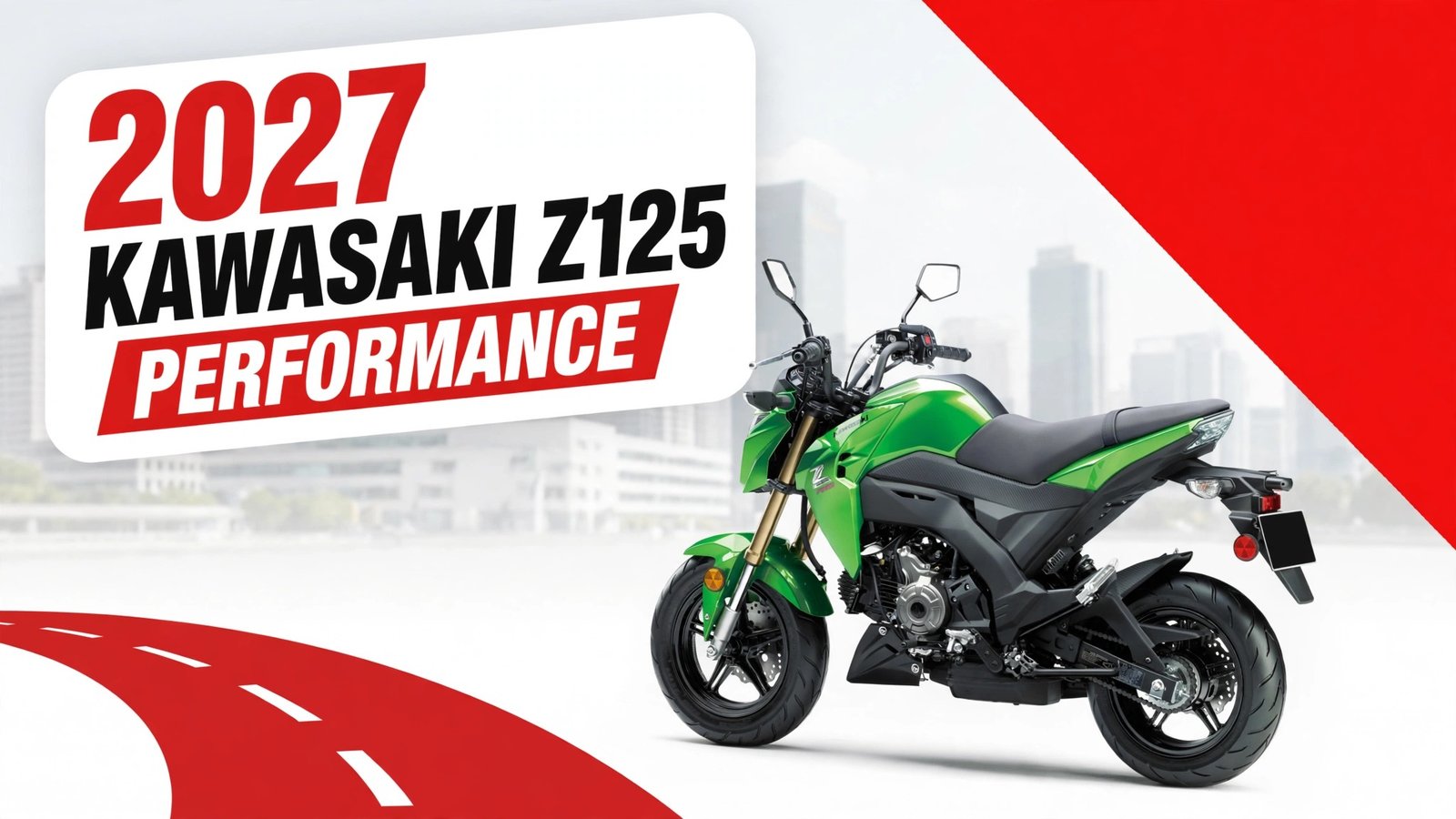
The Kawasaki Z125 PRO makes 8.3 horsepower at the rear wheel, tops out at about 60 mph on flat ground, and sips fuel at a rate Kawasaki itself cannot agree on — somewhere between 100 and 135 mpg depending on which launch figure you believe. This Kawasaki Z125 performance guide starts with the numbers that matter: the claimed 10.0 hp at the crank, the measured 8.3 hp at the wheel, the four-speed gearbox, and the 224.8 lb the little single must move. For a buyer weighing Kawasaki Z125 performance against the Honda Grom, the short version is this: the Z125 is the sharper bike, the Grom is the faster one.
Kawasaki Z125 Engine Performance and Power Delivery
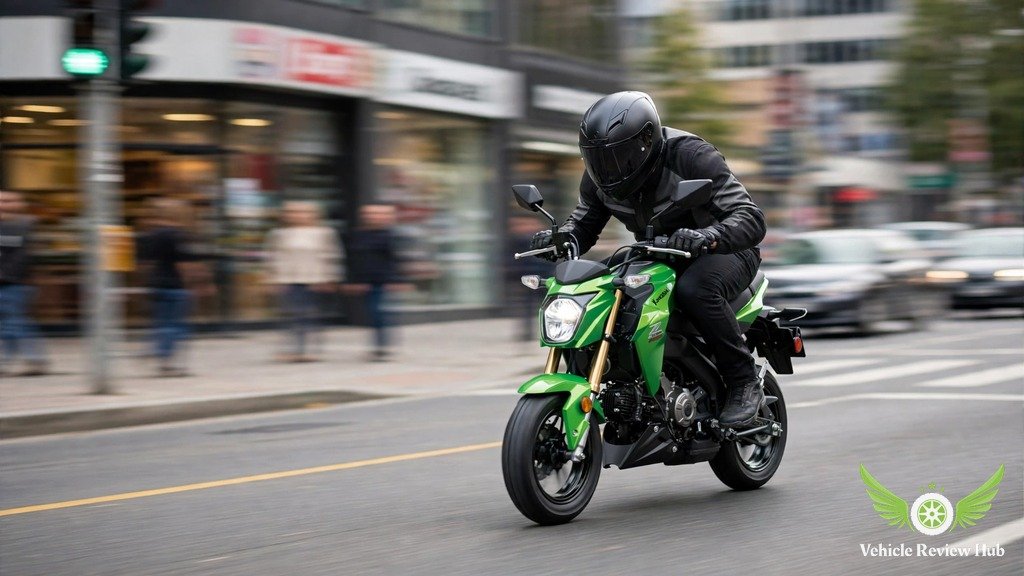
The engine is a 125cc air-cooled single, and Kawasaki Z125 performance starts with the gap between what the spec sheet claims and what the dyno measures. The sheet now prints 10.0 hp at 8,000 rpm; the rear wheel sees 8.3 hp. That gap is normal for a small single, and it is the first thing to understand.
Dyno: 8.3 hp at the Wheel
The headline Kawasaki Z125 performance figure is not the claimed 10.0 hp. It is the measured 8.3 hp at 7,800 rpm that Motorcycle.com’s dyno test recorded on a MotoGP Werks dyno, with 6.5 lb-ft of torque at 6,100 rpm. The same dyno gave the Honda Grom 8.7 hp at 6,700 rpm and 7.8 lb-ft at 5,200 rpm, and the article’s verdict was plain: the Honda wins on both counts in stock form. The claimed figure is 10.0 hp at the crank to the ISO 4106 standard, printed on the 2026 and 2027 spec sheets; the measured figure is 8.3 hp at the wheel. The two Kawasaki Z125 performance numbers describe different things, and mixing them up is the most common mistake in writing about this bike. GoRollick, SlashGear and TopSpeed all repeat 8.3 hp as if it were the bike’s power figure, and TopSpeed’s 2023 article even prints it as the claimed power — a dyno figure, not Kawasaki’s claim.
There is a second Kawasaki Z125 performance data point from the same publisher, and it must be kept separate from the first: Motorcycle.com’s Ankle Biters shootout ran its own dyno and recorded the Z125 PRO at 8.0 hp at 7,700 rpm and 6.4 lb-ft at 5,900 rpm, with the Grom at 8.3 hp at 6,400 rpm and 7.6 lb-ft at 5,300 rpm. That is a different bike on a different day, not a second reading of the same run, so the two results are never blended into one figure. The doc’s 8.3 hp is the dyno-article figure, and the 8.0 hp is the shootout figure. What both runs agree on is the gap: the Grom makes a little more power and torque, and the Z125 makes its peak higher in the rev range. The engine is oversquare — 56.0 mm bore against a 50.6 mm stroke, where the Grom is undersquare — so it spins about 500 rpm faster at the top. Motorcycle.com’s first ride said the oversquare single feels like it has more bottom-end grunt than the Honda, but the dyno says otherwise — the feeling is the short gearing, not the engine.
| Bike | Dyno run | Power | Torque |
|---|---|---|---|
| Kawasaki Z125 PRO | MotoGP Werks dyno article | 8.3 hp @ 7,800 rpm | 6.5 lb-ft @ 6,100 rpm |
| Honda Grom | MotoGP Werks dyno article | 8.7 hp @ 6,700 rpm | 7.8 lb-ft @ 5,200 rpm |
| Kawasaki Z125 PRO | Ankle Biters shootout dyno | 8.0 hp @ 7,700 rpm | 6.4 lb-ft @ 5,900 rpm |
| Honda Grom | Ankle Biters shootout dyno | 8.3 hp @ 6,400 rpm | 7.6 lb-ft @ 5,300 rpm |
Note: The figures in this Kawasaki Z125 performance table come from Motorcycle.com’s two separate dyno runs; the claimed figure is 10.0 hp at 8,000 rpm to the ISO 4106 standard, printed on the 2026 and 2027 spec sheets — not a dyno result.
Four Gears, Manual Clutch
Four gears shape Kawasaki Z125 performance more than any other single choice. The gearbox is a 4-speed return shift with a manual cable clutch, and it is widely praised: RevZilla called it a very impressive four-speed gearbox with easy shifts, and Motorcyclist described a slick-shifting four-speed transmission that is easy to master. The clutch is light, the shifts are clean, and the gear indicator tells a new rider exactly which gear is engaged. The weakness is the missing fifth gear. The Grom has five, and at 60 mph the Z125’s engine is spinning hard with nowhere left to go — the rev limiter becomes the shift light. For Kawasaki Z125 performance, the four-speed is both the charm and the ceiling: eager and involved at city speeds, and the reason the bike runs out of legs on the highway. The gearing is shorter than the Grom’s in every gear, which is why the Z125 feels zippier off the line despite making less power. The power curve is flat from top to bottom, according to Rider Magazine, with a 9,500 rpm redline and no sudden hit anywhere.
Kawasaki Z125 Top Speed and Acceleration
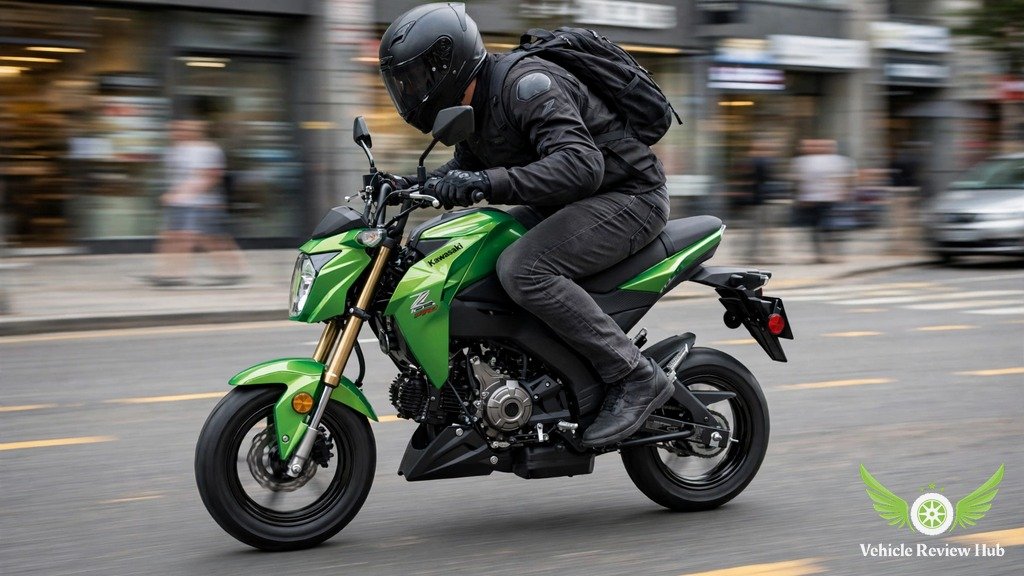
Top speed is where Kawasaki Z125 performance meets its limit: the bike is quick to 45 mph and slow beyond it, and the gap between observed speeds and claimed ones is the whole story of this section.
60 mph Observed
The observed figure is the one that counts in Kawasaki Z125 performance: about 60 mph on flat ground, and two independent road tests agree on it. GoRollick’s Duke of DC road-tested the 2018 bike at 60 mph, and RevZilla’s first ride at the San Francisco press launch said a rider would be lucky to hit an indicated 60 mph, spending most of the time using the rev limiter as a shift indicator. That is the honest spread for Kawasaki Z125 performance: 60 mph observed, 63 to 64 mph claimed, mid-60s on a good day, 67 mph downhill. GoRollick’s own research found a claimed top speed of 63 mph, TopSpeed’s 2023 article prints 64 mph, and SlashGear puts it at about 65 mph. Men’s Journal got into the mid-60s on a highway test, and AutoTrader.ca measured 102 km/h (63 mph) for the Z125 against 112 km/h (70 mph) for the Grom. The 67 mph figure from Motorcycle.com’s Ankle Biters Part 2 is a downhill number, and it is never a flat-road top speed. MCN’s indicated 72 mph is an indicated figure, not a US observed one, and Rider Magazine’s 45 mph is an around-town figure, not a measured top speed. There is no published source for 61 mph, so this guide does not print it.
| Figure | Speed | Source and status |
|---|---|---|
| Observed, flat ground | About 60 mph | GoRollick road test + RevZilla first ride |
| Claimed | 63 mph | GoRollick’s research |
| Claimed | 64 mph | TopSpeed 2023 |
| Claimed | About 65 mph | SlashGear |
| Highway test | Mid-60s mph | Men’s Journal |
| Downhill | 67 mph | Ankle Biters Part 2 — not a flat-road figure |
| Indicated | 72 mph | MCN — indicated only, not a US observed figure |
Note: This Kawasaki Z125 performance table labels every top-speed figure by source and status. Only the 60 mph figure is an observed flat-ground top speed.
GoRollick’s road-tested top-speed run is the video companion to this section. The Duke of DC takes the 2018 Z125 PRO out and holds it flat to see what it will actually do — the run behind the 60 mph figure above, not a claimed number from a spec sheet.
Watch how hard the little single is working at the top of fourth gear. That is Kawasaki Z125 performance at its ceiling, with the rev limiter doing the talking and no fifth gear to reach for.
No US 0-60 Test Exists
The absence matters for Kawasaki Z125 performance because it is the one number buyers ask for that nobody has ever measured. No published 0–60 mph test of Kawasaki Z125 performance exists — no magazine, no YouTube road test, no database lists one — and this guide states that plainly rather than inventing a time. AI-generated pages print 8 to 10 seconds for the bike’s 0–60, but that figure has no source behind it, and the same pages claim under-seat storage the bike does not have and print the dyno 8.3 hp as the engine’s output. None of it is usable. What can be said instead comes from Rider Magazine: the 125cc single propels the Z125 from zero to 45 mph faster than you can sip a latte. That is a launch-ride impression, not a timed test, and it fits everything else known about the bike — quick to 45 mph, slow beyond it.
Kawasaki Z125 Mileage and Fuel Economy
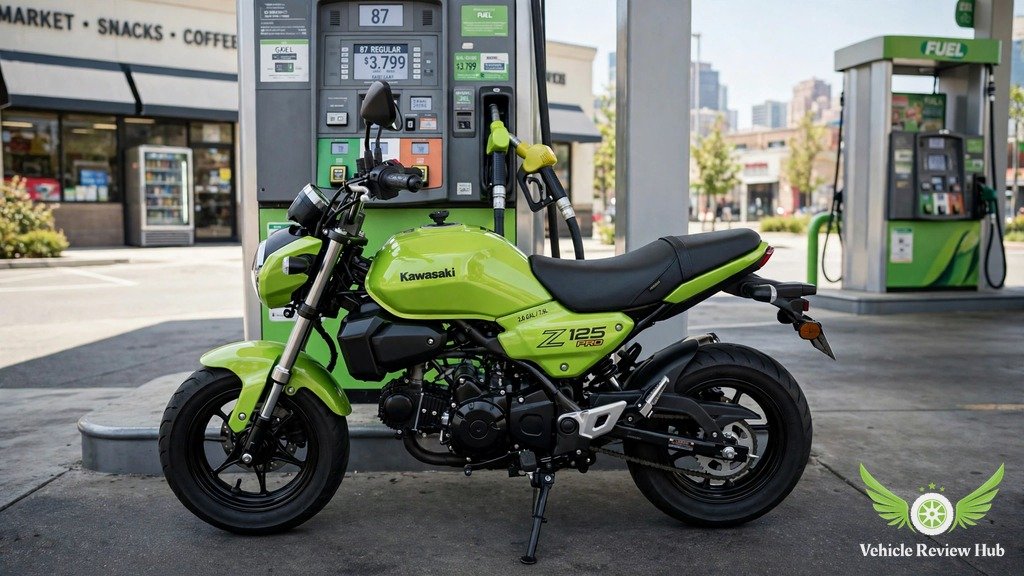
Fuel economy is where Kawasaki Z125 performance gets strange: the official number depends entirely on which Kawasaki figure you quote — and Kawasaki quoted three different ones at the same launch.
Claims Conflict: 100 vs 135
Three Kawasaki numbers, three different answers — that is the Kawasaki Z125 performance economy story in one line. MotorcycleDaily’s 2016 first ride reported Kawasaki claiming a rated fuel economy north of 100 mpg. Rider Magazine’s 2017 first ride quoted a claimed 135-point-whatever miles per gallon, and its by-the-numbers box printed 135 mpg outright. And at the March 2016 unveil, Ultimate Motorcycling reported Kawasaki representatives saying initial tests were pushing into the 80 mpg range. All three are Kawasaki-sourced, quoted by three different first rides, and none is a measurement. This guide presents all three and settles on none. Other published figures only widen the spread: GoRollick quotes 84 miles per gallon without attribution, TopSpeed’s database figure is 135.5 mpg, and Men’s Journal puts it somewhere in the 80s. TopSpeed’s newer article takes the sensible line: while Kawasaki doesn’t make any claim, 100 mpg is certainly achievable. No single figure in this Kawasaki Z125 performance section should be printed as settled, and no drained-tank US test exists to settle it.
The 134.4 mpg figure deserves its own warning: MotorcycleDB cites an EPA estimate of 134.4 mpg, but that is a database figure, not a verified EPA rating, and no fueleconomy.gov listing for the Z125 PRO turned up in this guide’s checks. This guide does not print 134.4 mpg as an EPA figure. What the tank allows is simple arithmetic, labelled as arithmetic and not a test: 2.0 gallons at 100 mpg is 200 miles, at 135 mpg is 270 miles, and at 84 mpg is 168 miles. The New Straits Times test said the Malaysian bike’s 7.4-litre tank gives more than 300 km per full tank, which is 186 miles or more. Whichever claim you believe, a fill-up costs a few dollars and a tank lasts a working week of commuting.
| Figure | MPG | Who said it | What it is |
|---|---|---|---|
| Rated fuel economy | North of 100 | MotorcycleDaily, 2016 first ride | Kawasaki’s rating at launch |
| Claimed economy | 135 | Rider Magazine, 2017 first ride | Kawasaki’s claim at launch |
| Initial tests | About 80 | Ultimate Motorcycling unveil | Kawasaki reps, initial testing |
| Unattributed | 84 | GoRollick | Likely the author’s own number |
| Database figure | 135.5 | TopSpeed | Database figure, not a test |
Note: Every figure in this Kawasaki Z125 performance table is an attributed claim, never a measurement. No drained-tank US test exists, and the 134.4 mpg figure is a database estimate, not a verified EPA rating.
No Cycle World Verdict Exists
Cycle World has no Kawasaki Z125 performance verdict to cite, because the magazine never published a Z125 PRO road test or a measured fuel-economy verdict. Its coverage of the bike is a buyer’s-guide spec listing only, and a spec listing is not a test. Any article citing Cycle World for a Z125 PRO economy or performance figure is citing something that does not exist. Cycle World is citable for the Grom, though: it reported that on level ground, with an average-sized rider on board, the Grom will hit around 60 mph — the same observed figure as the Z125, which is the point. Both minis top out at about 60 mph; neither magazine has ever said otherwise.
Kawasaki Z125 Real-World Riding Experience
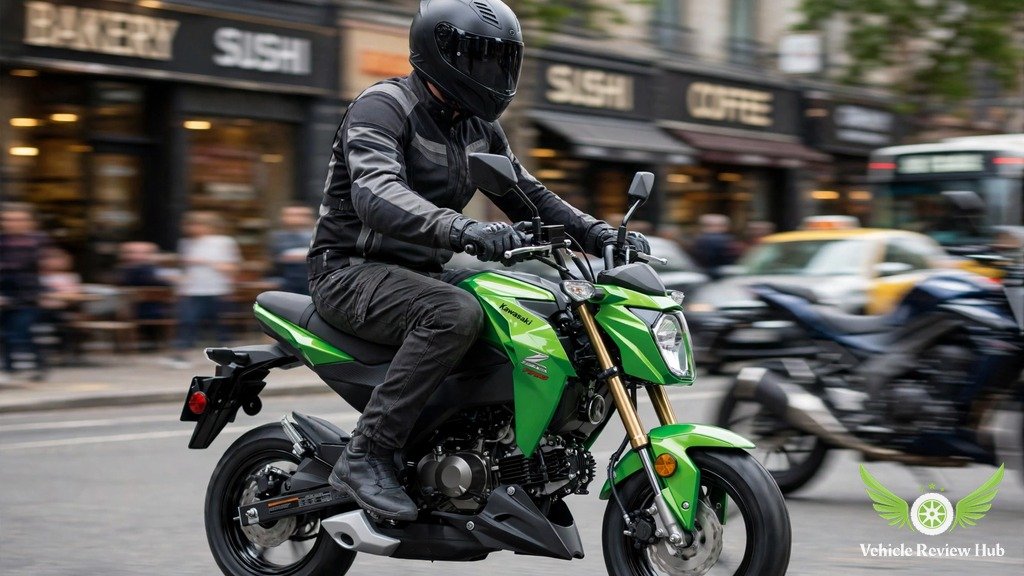
Numbers aside, Kawasaki Z125 performance is really about how the bike feels on a city street. The dyno says 8.3 hp and the top speed says 60 mph, but neither explains why owners keep coming back to a bike that loses on paper.
The Riding Experience Buyers Actually Talk About
What buyers actually talk about when they talk about Kawasaki Z125 performance is the fun-per-dollar, and the agility that comes with it. GoRollick put it simply: only moments into your first ride, it all just clicks. Motorcyclist’s Troy Siahaan called the Z125 Pro literally a smaller version of a motorcycle, while the Grom is just more fun and feels like a killing toy. It is a real motorcycle shrunk down, with a clutch, a gearbox and a riding position that asks the rider to work. The one flaw that keeps coming up in Kawasaki Z125 performance discussions is the snatchy throttle. Motorcycle.com’s Ankle Biters shootout listed snatchy throttle as a Z125 sigh — on-off jerkiness at low speed, not quite as pronounced as the Kymco’s but present. It is the bike’s best-known rideability flaw, felt most in slow traffic. The other honest limit is hills: RevZilla’s San Francisco launch ride had the tester furiously downshifting on the bigger hills, and Men’s Journal found the bike did well with a passenger until it got into some hills. The 125cc single has 7.1 lb-ft to work with, and gravity notices.
Sportier Chassis Than Grom
The chassis is where Kawasaki Z125 performance beats the Grom. Motorcycle.com’s Ankle Biters Part 1 gave the Z125 the highs of fit and finish on par with Honda, most agile bike here, and excellent brakes, and its verdict was that the Grom is the most well-rounded and best performing bike here, with the Kawasaki coming in a close second — 85.7 percent for the Grom and 84.5 percent for the Z125. Part 2 put it more bluntly: the Grom may make more power, but the Z is more agile. The New Straits Times test agreed, finding the tiny Kawasaki taut and planted, encouraging the rider to push faster than the other two bikes. The Kawasaki Z125 performance story is consistent across every test: the Z125 is the sharper, more agile handler, and the Grom is the more refined, better-rounded bike. For a buyer who rides for the corners rather than the spec sheet, that is the more important verdict.
Kawasaki Z125 Handling, Braking and Stability
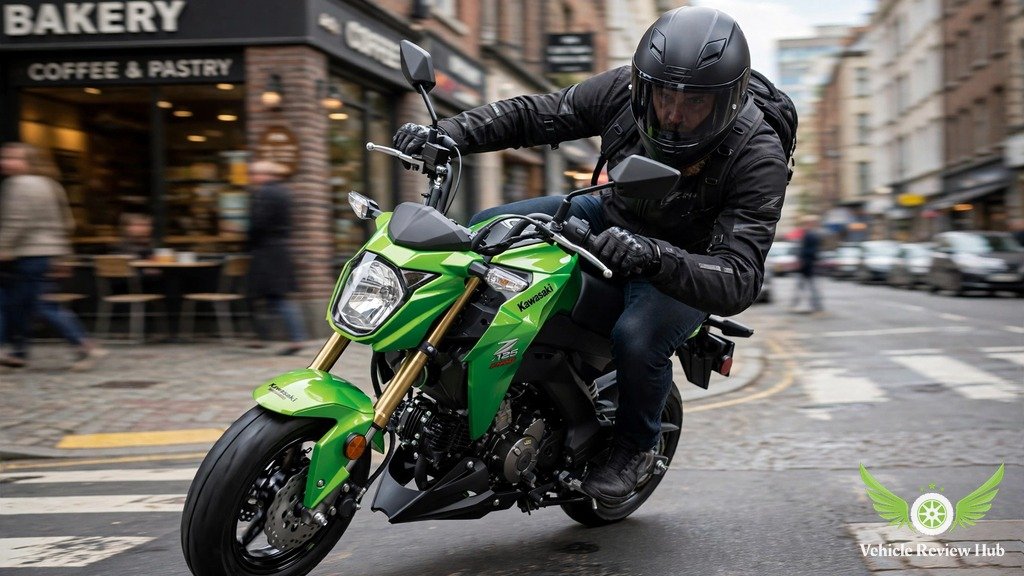
Handling and braking are where Kawasaki Z125 performance earns its keep. The engine is the weakest part of the bike and the chassis is the strongest, and the shootout proved it with a painted box on the ground.
Best Brakes in Shootout
The brakes are the strongest part of Kawasaki Z125 performance, and the claim is measured, not asserted. Motorcycle.com’s Ankle Biters braking exercise asked each bike to stop inside a defined box, and the Kawasaki rose above the rest with excellent stopping power but without abruptness that can overwhelm new riders. The Honda and the Razkull kept the Kawasaki honest, and the Kymco lagged behind. Excellent brakes also appears in the Z125’s list of highs. The hardware is simple: a single 200 mm petal disc up front and a single 184 mm petal disc at the rear, with no ABS anywhere in the system. That is the trade-off at the heart of Kawasaki Z125 performance — the best brakes in the class, and no ABS to back them up. The Grom offers ABS on its top trim and the Monkey has front-wheel ABS as standard, while the Z125 PRO has never had ABS. A buyer who wants ABS must buy something else; a buyer who wants the strongest stop in the mini class will find it here.
Handling, Braking and Stability on Real Roads
On real roads, Kawasaki Z125 performance is predictable rather than twitchy. The 26.0-degree rake and 2.7 inches of trail, the 46.3-inch wheelbase and the 224.8 lb curb weight add up to a bike that is nimble without being nervous — Rider Magazine found it handles predictably and exhibits no twitchiness in either shopping-cart-slow corners or fast sweepers. The 12-inch wheels make it flickable; the Kymco’s 17-inch wheels were more stable, but the Z125 was the most agile of the 12-inch bikes. The suspension does its part: the 30 mm fork and the preload-adjustable rear shock absorbed San Francisco’s streets without ever calling uncle, according to RevZilla, with a 205 lb rider on the second preload notch. Around four inches of travel at each end gives a smoother and better-controlled ride than some motorcycles seven times the Z125 PRO’s price, in Rider’s words.
Kawasaki Z125 Performance Compared With Other Sport Bikes
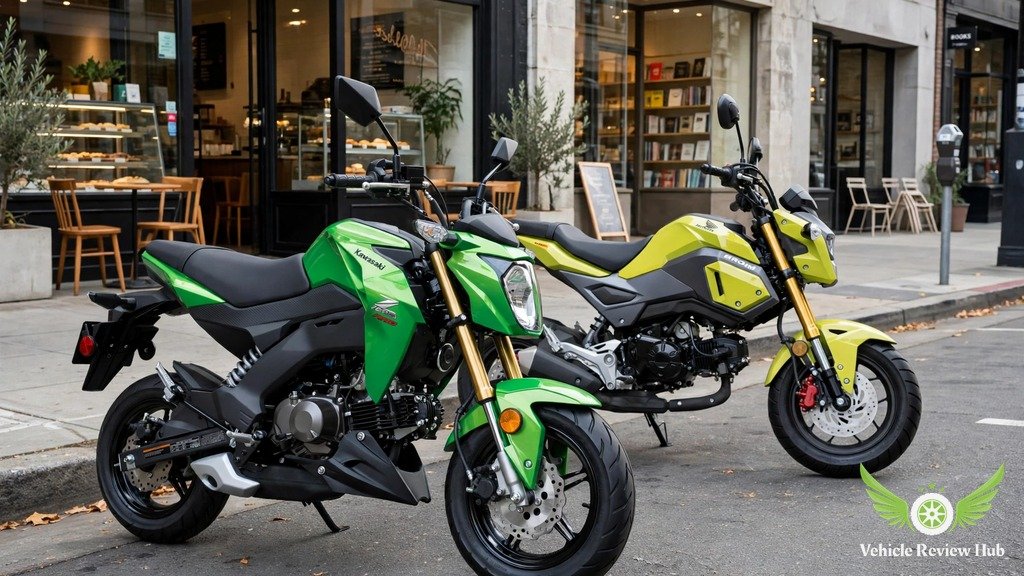
This section puts Kawasaki Z125 performance next to the Honda Grom, the bike every mini is measured against. The two share a class, a price bracket and a top speed — and almost nothing else.
| Figure | Kawasaki Z125 PRO | Honda Grom |
|---|---|---|
| Claimed power | 10.0 hp @ 8,000 rpm | 9.7 hp @ 7,000 rpm |
| Dyno power | 8.3 hp @ 7,800 rpm | 8.7 hp @ 6,700 rpm |
| Torque | 7.1 lb-ft @ 6,000 rpm | 7.7 lb-ft @ 5,500 rpm |
| Gears | 4-speed, manual clutch | 5-speed, manual clutch |
| Seat height | 31.7 in | 30.0 in |
| Fuel tank | 2.0 gal | 1.59 gal |
| Curb weight | 224.8 lb | 227 lb |
| Top speed | About 60 mph observed | About 60 mph observed |
| Front brake | 200 mm disc, no ABS | 220 mm disc, ABS on ABS trim |
Note: This Kawasaki Z125 performance table uses claimed figures from the spec sheets and measured figures from the same Motorcycle.com dyno — the Grom’s claimed figures are 9.7 hp at 7,000 rpm and 7.7 lb-ft at 5,500 rpm.
Kawasaki Z125 vs Honda Grom
Head to head, the Grom wins the Kawasaki Z125 performance comparison on power: 8.7 hp on the dyno against 8.3, 7.8 lb-ft against 6.5, and a fifth gear the Kawasaki does not have. The Grom is also the more refined, better-rounded bike, and the shootout gave it the overall win, 85.7 percent against the Z125’s 84.5. The Z125 wins it on agility, brakes and range — which is why Kawasaki Z125 performance is a story of character, not outright speed. It is the sharper handler, it stops better, it goes further per tank. A buyer who wants the faster mini buys the Grom; a buyer who wants the more playful mini buys the Z125, and accepts that the Grom will pull away on a straight road.
Is the Kawasaki Z125 Suitable for Beginner Riders?
For a new rider, Kawasaki Z125 performance is approachable in the ways that matter and honest about the ways that do not. It is light at 224.8 lb, the 31.7-inch seat is low enough for most riders, the four-speed gearbox shifts cleanly, and the gear indicator tells a beginner which gear is engaged. The handling is predictable, the brakes are strong, and the bike forgives mistakes. The two warnings are the ones this guide has already given: there is no ABS, and the snatchy low-speed throttle takes getting used to. A beginner who learns on the Z125 learns real clutch and gearbox skills, and the Ninja 125 is the faired alternative for a rider who wants the same engine with wind protection. The Ninja 500 and Ninja 650 are the natural next steps for a rider who outgrows the mini class.
Kawasaki Z125 Performance: Frequently Asked Questions
The answers below are short, direct, and based on the figures in this Kawasaki Z125 performance guide.
How much horsepower does a Kawasaki Z125 make on a dyno?
8.3 hp at 7,800 rpm and 6.5 lb-ft at 6,100 rpm on Motorcycle.com’s MotoGP Werks dyno. The Grom made 8.7 hp on the same dyno.
What is the top speed of a Kawasaki Z125?
About 60 mph observed on flat ground — GoRollick road-tested 60 mph and RevZilla’s first ride says you’ll be lucky to hit an indicated 60 mph. Claimed figures run 63 to 64 mph.
Does the Kawasaki Z125 have a 0–60 mph time?
No published 0–60 test exists for the Z125 PRO. Any 0–60 figure you see online for this bike is invented.
What MPG does a Kawasaki Z125 get?
Kawasaki’s own launch figures conflict: MotorcycleDaily quotes a rating north of 100 mpg, while Rider Magazine quotes a claimed 135 mpg. Neither is a measured or EPA figure, so neither should be printed as settled.
Is the Kawasaki Z125 faster than the Honda Grom?
No. The Grom makes slightly more power on the dyno and has a fifth gear. The Z125 feels zippier off the line because of its shorter gearing, and it is the more agile bike — but it is not the faster one.
Is the Kawasaki Z125 good for beginners?
Yes. It is light at 224.8 lb, has a 31.7-inch seat, a slick 4-speed gearbox with a gear indicator, and predictable handling — but it has no ABS, and its snatchy low-speed throttle takes getting used to.