The Kawasaki Vulcan 900 Custom is a reliable motorcycle for a simple reason: almost nothing about it has changed in twenty years. The same 903cc V-twin (51 hp @ 5,500 rpm, 58.3 lb-ft @ 3,500 rpm), five-speed gearbox, belt drive and steel frame have been sold since 2007, and the 2027 bike is still listed new at $10,099. This Kawasaki Vulcan 900 Custom reliability guide starts with the honest summary: the engine itself is consistently described as bulletproof, owners routinely cover 100,000 miles, and documented cases run past 150,000 miles. There is no ABS, no traction control and no modern electronics to fail, which is part of why this Kawasaki Vulcan 900 Custom reliability record looks the way it does.
Kawasaki Vulcan 900 Custom Reliability Overview
A twenty-year production run with one mechanical update — the 2009 exhaust revision — is the best reliability evidence this bike has. This section of the Kawasaki Vulcan 900 Custom reliability guide sets out what that long run proves.
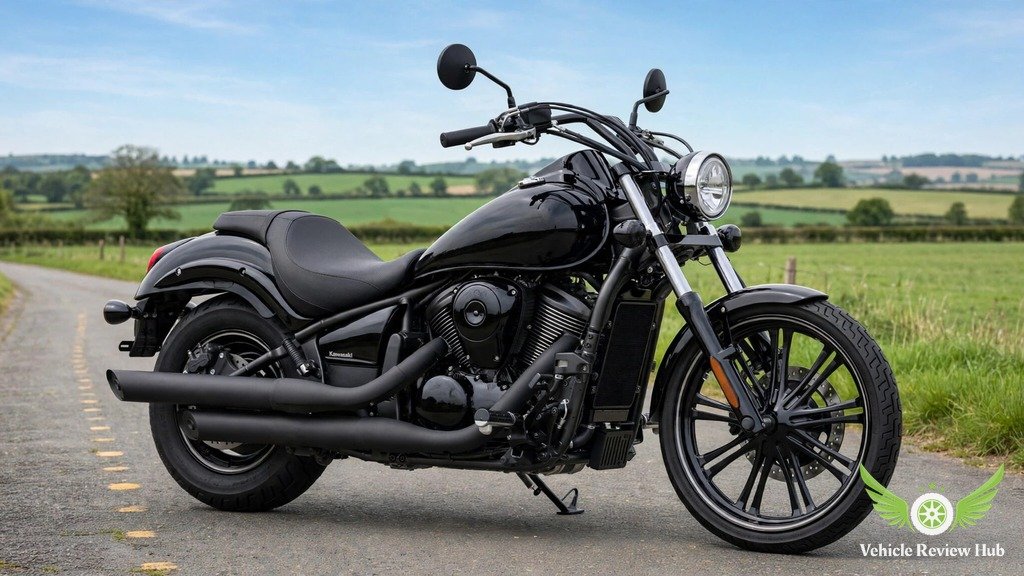
Valve Check at 15,000 Miles
The first big service milestone on the Custom is the valve-clearance inspection at 15,000 miles (24,000 km), then again at 30,000 miles, according to the owner’s manual. For a buyer, the 15,000-mile valve check is a routine inspection, not a repair: no source in this guide’s research reports valve trouble as a pattern on the Vulcan 900.
How Mileage, Storage and Previous Care Affect Reliability
What matters more is previous care. A bike with the 7,500-mile services and the 15,000-mile valve check on record is a different purchase from one with no records, even at the same odometer reading. The stator is the one item where mileage does matter — owner reports put failures anywhere from 28,000 miles upward — so a used bike’s charging history is worth asking about, and this Kawasaki Vulcan 900 Custom reliability guide explains the test below.
Kawasaki Vulcan 900 Custom Common Problems and Wear Items
The Vulcan 900’s problem list is short: one owner-documented electrical item, one known niggle in the front suspension, and a belt that wears out eventually — and nothing else that shows up as a pattern in the sources this Kawasaki Vulcan 900 Custom reliability guide checked. The engine, gearbox and frame have no recurring failure in twenty years of owner reports.
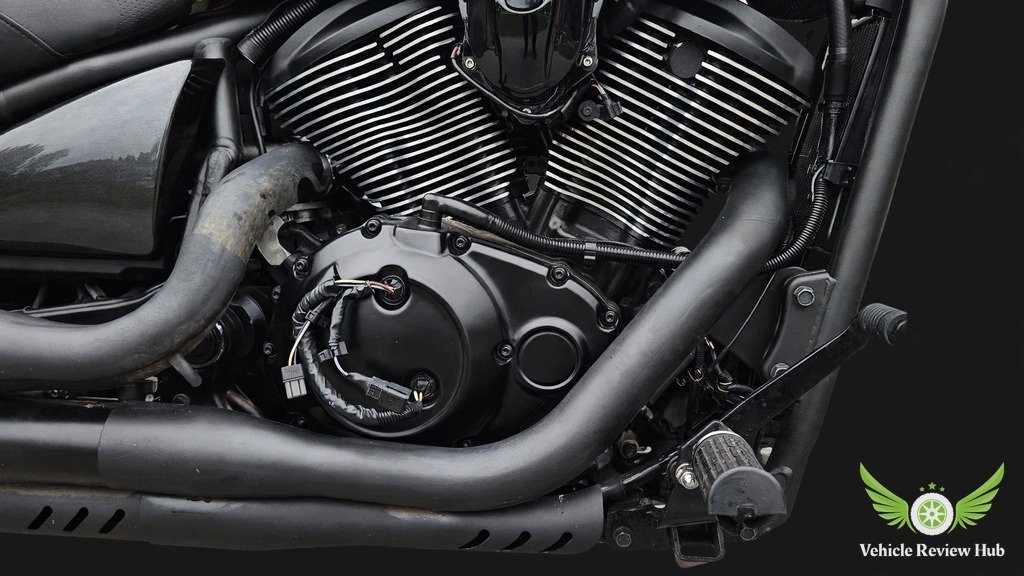
Stator Failure Is the Owner-Documented Item
If the Custom has one weak point, it is the stator. Owner reports agree on this across every source this Kawasaki Vulcan 900 Custom reliability guide checked. JustAnswer put it plainly: “It is likely that the stator has failed, as this is the most common issue with that unit.” The cararac ownership guide calls the stator “the culprit 80% of the time” for the Vulcan 900’s electrical problems. Owner reports put failures at 28,000 miles (JustAnswer), 35,000 miles on a 2017 Custom (ProductReview), 60,000 miles (Motorcycle.com) and 45,000 miles (Cycle Insider). First, the stator is an owner-documented wear item, not a recall and not a factory defect — the two recalls that name this bike are fuel-system items, both from 2008, and this Kawasaki Vulcan 900 Custom reliability guide covers them below. Second, the failure is cheap to diagnose: test the AC output per leg, and a healthy stator reads more than 70 volts AC per leg at 4,000 rpm. A leg reading low or zero means the stator has failed. HotCars lists stator and rectifier failures alongside leaking fork seals as the known niggles on an otherwise durable bike.
Regulator Check Goes With the Stator
A new stator dies quickly if the regulator is the real culprit, so the two are always checked together. The regulator/rectifier sits at the front of the frame, in front of the oil filter, and a faulty one overheats and kills new stators. The check is a diode-mode test on the regulator, and the rule this Kawasaki Vulcan 900 Custom reliability guide prints is the one from the owner reports: replace the two together only if the regulator tests defective, not automatically. The same caution applies to buying used: a Custom with a fresh stator and an untested regulator is not a fixed bike. Ask whether the regulator was tested. Leaking front fork oil seals are the other niggle HotCars names — oil on a fork leg means seals, not a major repair, but a bargaining point.
Kawasaki Vulcan 900 Custom Maintenance Schedule and Servicing
The Custom’s service schedule is one of the shortest in the cruiser class, unchanged in twenty years. This section of the Kawasaki Vulcan 900 Custom reliability guide works through the schedule as the owner’s manual prints it, with the part numbers and torque figures a home mechanic needs.
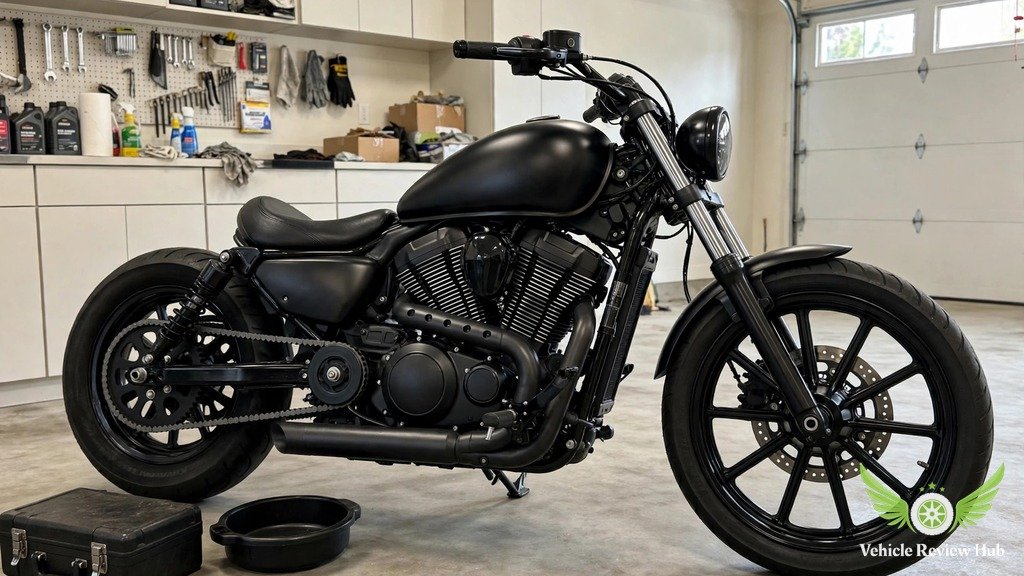
Oil, Plugs and Filter Every 7,500 Miles
The oil is SAE 10W-40, 3.2 litres with the filter changed; the drain bolt tightens to 20 Nm and the filter — part number 16097-1058 — to 18 Nm. Spark plugs are replaced at the same interval: NGK CPR7EA-9, gapped at 0.8 to 0.9 mm, tightened to 18 Nm. The Vulcan 900 has one service step other bikes do not: the oil change includes removing, inspecting and cleaning the oil screen, held by four bolts. It is not a separate scheduled interval, but it is part of every oil change on this engine, and skipping it leaves debris in the screen. The film below is a full oil-change how-to on a 2012 Vulcan 900, spoken in English, covering the screen as well as the filter — any trim counts, since the Custom shares the same engine. The screen-cleaning section starts at 11:29. No trim is named in the film, so this Kawasaki Vulcan 900 Custom reliability guide does not claim the bike on screen is a Custom.
Shims Swap by Sliding the Rocker
The heading describes a real procedure, confirmed for this engine. The VN900 service manual — the 2006 first-edition manual for the Vulcan 900 family, which covers the same 903cc engine the Custom uses — gives the adjustment in one sentence: to change the clearance, slide the rocker arm sideways and change the shim. The manual’s clearances are inlet 0.10 to 0.15 mm and exhaust 0.20 to 0.25 mm, measured with the engine cold, and it warns never to put shim stock under a shim or grind one — either can cause extensive engine damage at high rpm. This matters because the heading was flagged as unverified in the brief, and this Kawasaki Vulcan 900 Custom reliability guide checked it against the service manual at writing: the sliding-rocker method is the factory procedure for the VN900, not an imported Ducati or NC30 method.
| Service item | Interval | Detail |
|---|---|---|
| First service | 600 miles | Dealer service |
| Engine oil + filter | Every 7,500 miles | SAE 10W-40, 3.2 L with filter, drain bolt 20 Nm, filter 16097-1058 at 18 Nm |
| Spark plugs | Replace every 7,500 miles | NGK CPR7EA-9, gap 0.8–0.9 mm, 18 Nm |
| Air filter | Replace every 7,500 miles | Part number 11013-0015 |
| Valve clearances | Inspect at 15,000 miles, then 30,000 miles | Inlet 0.10–0.15 mm, exhaust 0.20–0.25 mm, engine cold, shims swapped by sliding the rocker |
| Drive belt | Inspect every 3,750 miles | Deflection and wear, tension 1.5–4 mm at 10 lb force, rear axle nut 108 Nm |
| Coolant | Change every 3 years | Age-based, regardless of miles |
| Brake fluid | Change every 2 years | DOT 4 |
| Fuel hoses | Replace every 5 years | Age-based, regardless of miles |
| Brake hoses | Replace every 4 years | Age-based, regardless of miles |
Notes for this Kawasaki Vulcan 900 Custom reliability table: intervals are from the owner’s manual chart, cross-checked against the 2018 and 2020 manuals. The oil screen is part of the oil-change procedure, not a separate interval.
Kawasaki Vulcan 900 Custom Tires, Brakes and Suspension Maintenance
This section of the Kawasaki Vulcan 900 Custom reliability guide covers the belt first, because it is the item buyers ask about most, then the checks that matter on tyres, brakes and suspension.
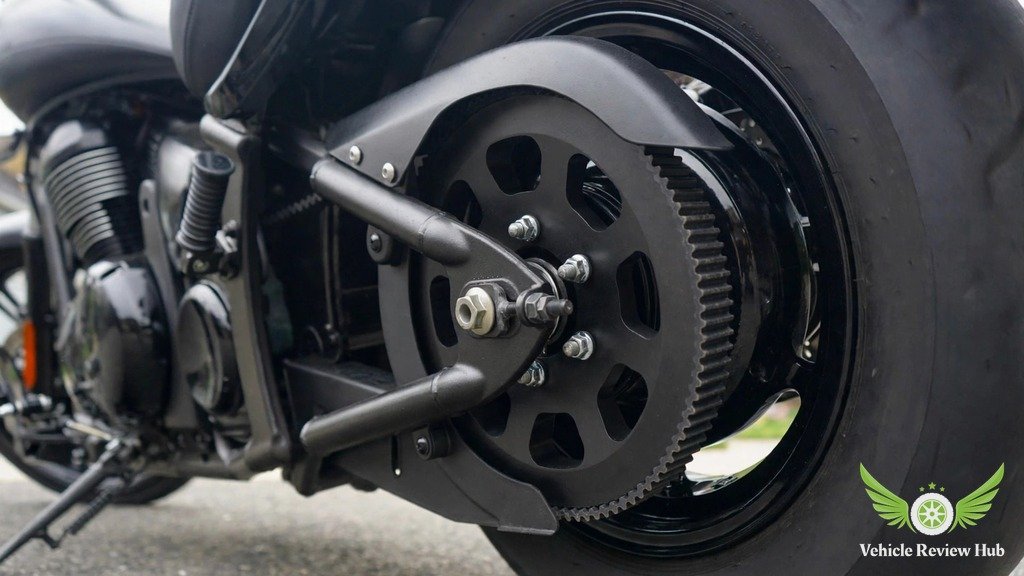
Belt Inspected Every 3,750 Miles
The drive belt is inspected every 3,750 miles (6,000 km) for deflection and wear — that is the whole of the manual’s instruction, with no fixed replacement interval. In practice the belt lasts a long time: the only breakage in this Kawasaki Vulcan 900 Custom reliability guide’s research is a single owner report, a Motorcycle.com owner of a 2006 Classic LT whose belt broke at 55,000 miles. Inspect for cracks, fraying and glazing at every check, and look at the rear pulley at the same time. The genuine belt is part number 59011-0062, a 153-tooth belt, confirmed on Kawasaki’s own parts diagram. Belt condition is one of the first things to check on a used Custom, alongside the stator test — a cracked belt is a bargaining point, not a reason to walk away.
Tire, Brake and Suspension Checks That Matter
Check tyres for age as well as tread — many used Customs wear tyres older than their tread suggests. Brakes are a single 300 mm front disc and a single 270 mm rear disc, both two-piston, with no ABS in any year — Kawasaki’s own feature list calls the bike “Non-ABS”. One older review spec box prints 272 mm for the rear disc; this Kawasaki Vulcan 900 Custom reliability guide follows Kawasaki USA’s 270 mm. The check that matters most is the fork seals: HotCars names leaking fork oil seals as one of the two known niggles, and oil on a fork leg is easy to spot. No instrumented braking test exists for the Custom — the Kawasaki Vulcan 900 Custom performance guide covers what the single front disc means on the road.
Kawasaki Vulcan 900 Custom Maintenance and Ownership Costs
Owning a Custom is cheap where it matters and expensive in exactly one place. The routine service is a short list of common parts on long intervals, fuel use is modest, and there is no dealer-only electronics work to pay for. The one bill that can surprise an owner is the belt, and this section of the Kawasaki Vulcan 900 Custom reliability guide is honest about what is and is not verified on that price.
Fuel, Routine Servicing, Tires and Replacement Parts
The only tested mileage figure in the Vulcan 900 record is 41.3 mpg, measured on the sibling Classic LT in Motorcycle.com’s 2016 comparison test — a heavier bike with a windscreen and saddlebags, so the Custom should do no worse. Against the 5.3-gallon tank, the arithmetic is about 219 miles at 41.3 mpg and about 239 miles at the 45 mpg estimate — both are arithmetic, not tests, and this Kawasaki Vulcan 900 Custom reliability guide prints neither as a verified range. Tyres are 80/90-21 front and 180/70-15 rear; prices vary by brand and region, and this guide prints no tyre price it has not verified.
| Item | When it comes up | What to plan for |
|---|---|---|
| Fuel | Every ride | 41.3 mpg tested on the sibling LT, 45 mpg Kawasaki estimate, owner reports 50–52 mpg highway |
| Oil + filter | Every 7,500 miles | SAE 10W-40, 3.2 L, filter 16097-1058, home-mechanic job with the oil screen cleaned at the same time |
| Valve check | 15,000 miles, then 30,000 miles | Inspection, usually a dealer job, shims swapped by sliding the rocker |
| Drive belt | Inspect every 3,750 miles, no fixed interval | Inspect-only item, genuine part 59011-0062, one owner break reported at 55,000 miles |
| Stator + regulator | Owner reports from 28,000 miles upward | The one known weak point, test first at more than 70 V AC per leg at 4,000 rpm |
| Fork seals | Age and mileage wear item | Known niggle, oil on a fork leg is the tell, a routine repair |
Notes for this Kawasaki Vulcan 900 Custom reliability table: no dollar figure here is a verified price — servicing parts are common and cheap.
OEM Belt Costs $485, No Fixed Interval
The heading names $485, and this Kawasaki Vulcan 900 Custom reliability guide is plain about it: no source was found to verify $485 as the OEM list price for the drive belt, after three search rounds. What is verified is the part itself — a genuine Kawasaki drive belt, part number 59011-0062, a 153-tooth belt, confirmed on Kawasaki’s own parts diagram — and one marketplace price: a genuine belt listed on eBay at $438.98, which is a marketplace listing, not an OEM list price. The second half of the heading is verified: there is no fixed replacement interval for the belt in the manual, only the 3,750-mile inspection. A buyer budgeting for a belt should therefore price the genuine part from a dealer at the time of purchase, and budget the labour alongside it, rather than relying on a figure this guide could not verify. The 2027 Custom itself costs $10,099 plus an $840 destination charge, $10,939 delivered, against $7,349 at launch in 2007 — and the belt is the one replacement part whose price deserves a fresh quote rather than a printed number.
How to Keep a Kawasaki Vulcan 900 Custom Reliable
This section of the Kawasaki Vulcan 900 Custom reliability guide puts the routine and the record-keeping together, then the recalls themselves.

Preventive Maintenance, Records and Regular Inspections
The routine fits on a card: oil and filter every 7,500 miles with the oil screen cleaned, plugs and air filter at the same interval, valve clearances at 15,000 miles, belt checked every 3,750 miles, coolant every three years, brake fluid every two, fuel hoses every five and brake hoses every four. The full comparison with the Custom’s rivals is in the Kawasaki Vulcan 900 Custom comparison, and the price story is in the Kawasaki Vulcan 900 Custom review. One more code owners sometimes ask about: MC24-01 is not a recall, and its contents were not verified, so this Kawasaki Vulcan 900 Custom reliability guide does not describe them.
Two Recalls Name the Custom, Both 2008
The first, campaign 08V-114 from March 2008, covers a fuel-hose connector on 31,789 units — 2006 to 2008 VN900B and VN900D models plus certain 2008 VN900C bikes, and VN900C is the Custom. The second, campaign 08V-473 from September 2008, covers a filler-neck and cap-gasket leak on 604 units — model-year 2008 VN900C8F and VN900D8F plus model-year 2009 VN900B9F and B9FL — under Kawasaki bulletin MC 08-13, with spare fuel tanks also affecting 2006 to 2009 models. A possible third campaign, 10V-507 from October 2010, covers 2009 to 2010 Vulcan motorcycles for an ECU stall, but it does not name the Custom, so this Kawasaki Vulcan 900 Custom reliability guide notes it only as a possible third and tells the reader to check by VIN — it is not presented as a Custom recall. The NHTSA recalls database returns zero recalls for this model, and that zero is false — the two campaigns above are real, and any buyer should check by VIN on NHTSA’s recall search rather than trusting a zero result. The same database returns zero for the 2010 Vulcan 1700 Vaquero even though campaign 15V-550 exists.
| Campaign | Date | Defect | Units and models named |
|---|---|---|---|
| 08V-114 | March 2008 | Fuel-hose connector | 31,789 units, 2006–2008 VN900B + VN900D + certain 2008 VN900C (Custom) |
| 08V-473 | September 2008 | Fuel-tank filler-neck and cap-gasket leak | 604 units, MY 2008 VN900C8F + VN900D8F and MY 2009 VN900B9F/B9FL, bulletin MC 08-13 |
| 10V-507 (possible, VIN-check) | October 2010 | ECU stall | 2009–2010 Vulcan motorcycles, does NOT name the Custom, check by VIN |
Notes for this Kawasaki Vulcan 900 Custom reliability table: the two 2008 campaigns name the Custom; 10V-507 does not and is listed only as a possible third for a VIN check. The NHTSA database’s zero for this model is false — cite the campaign numbers, never the zero.
Kawasaki Vulcan 900 Custom Reliability FAQs
The questions below cover what buyers ask most about the Custom’s reliability — answered from the same verified figures as this Kawasaki Vulcan 900 Custom reliability guide.
Is the Kawasaki Vulcan 900 Custom reliable?
Yes. This Kawasaki Vulcan 900 Custom reliability guide calls the engine bulletproof on the evidence: the same 903cc V-twin has run unchanged since the 2009 update, owners routinely cover 100,000 miles, and documented cases run past 150,000 miles. The weak points are narrow — stator, two 2008 fuel recalls and fork seals — all known, checkable and fixable.
What is the most common problem with the Vulcan 900 Custom?
The stator. This Kawasaki Vulcan 900 Custom reliability guide records it as the owner-documented item across every source checked: failures reported from 28,000 miles upward, with the regulator checked alongside it, since a faulty regulator kills new stators. It is a wear item, not a recall.
How do you test a Vulcan 900 stator?
Test the AC output per leg. This Kawasaki Vulcan 900 Custom reliability guide prints the owner-documented figure: more than 70 volts AC per leg at 4,000 rpm is healthy, and a leg reading low or zero means the stator has failed. Test the regulator with diode mode too.
How often does the Vulcan 900 Custom need an oil change?
Every 7,500 miles or annually, with the filter changed at the same time. This Kawasaki Vulcan 900 Custom reliability guide also notes the Vulcan 900-specific step: the oil screen is removed, inspected and cleaned at every oil change. Oil is SAE 10W-40, 3.2 litres with the filter.
When should the valves be checked on a Vulcan 900 Custom?
At 15,000 miles, then again at 30,000 miles. This Kawasaki Vulcan 900 Custom reliability guide prints the manual’s clearances — inlet 0.10 to 0.15 mm, exhaust 0.20 to 0.25 mm, measured cold — and the factory method, which swaps shims by sliding the rocker sideways.
How often should the drive belt be inspected?
Every 3,750 miles for deflection and wear. This Kawasaki Vulcan 900 Custom reliability guide stresses that the manual gives no fixed replacement interval for the belt — an inspect-only item, with a target tension of 1.5 to 4 mm at 10 lb of force.
Does the Vulcan 900 Custom have any recalls?
Yes, two, both from 2008. This Kawasaki Vulcan 900 Custom reliability guide names them: 08V-114 (March 2008, fuel-hose connector, 31,789 units) and 08V-473 (September 2008, filler-neck and cap-gasket leak, 604 units). A possible third, 10V-507, needs a VIN check, and the NHTSA database’s zero for this model is false.
How long does a Vulcan 900 Custom last?
Owners routinely cover 100,000 miles with simple oil changes, and this Kawasaki Vulcan 900 Custom reliability guide notes documented cases past 150,000 miles. The engine has no recurring failure in twenty years; the items that end a bike’s life are neglect and the stator, not wear.
Is the Vulcan 900 Custom expensive to maintain?
No. This Kawasaki Vulcan 900 Custom reliability guide puts the routine at an oil and filter change, plugs and an air filter every 7,500 miles, all common parts, plus a valve check at 15,000 miles. The one bill that can surprise an owner is the belt, and no verified OEM price for it was located.
What oil does the Vulcan 900 Custom take?
SAE 10W-40, 3.2 litres with the filter changed. This Kawasaki Vulcan 900 Custom reliability guide prints the filter part number as well — 16097-1058 at 18 Nm, drain bolt at 20 Nm — and the oil screen cleaned at the same service.
What is the oil screen on a Vulcan 900?
A mesh screen in the oil system, held by four bolts, removed, inspected and cleaned at every oil change. This Kawasaki Vulcan 900 Custom reliability guide notes it is a Vulcan 900-specific step, not a separate scheduled interval, and the how-to film above shows the screen cleaning at 11:29.
Is the Vulcan 900 Custom a good used buy?
Yes, with two checks. This Kawasaki Vulcan 900 Custom reliability guide says to test the charging system — more than 70 volts AC per leg at 4,000 rpm — and to run a VIN check for the two 2008 recalls, 08V-114 and 08V-473. A bike with service records at the 7,500-mile intervals and the 15,000-mile valve check beats a low-mileage bike with no history.