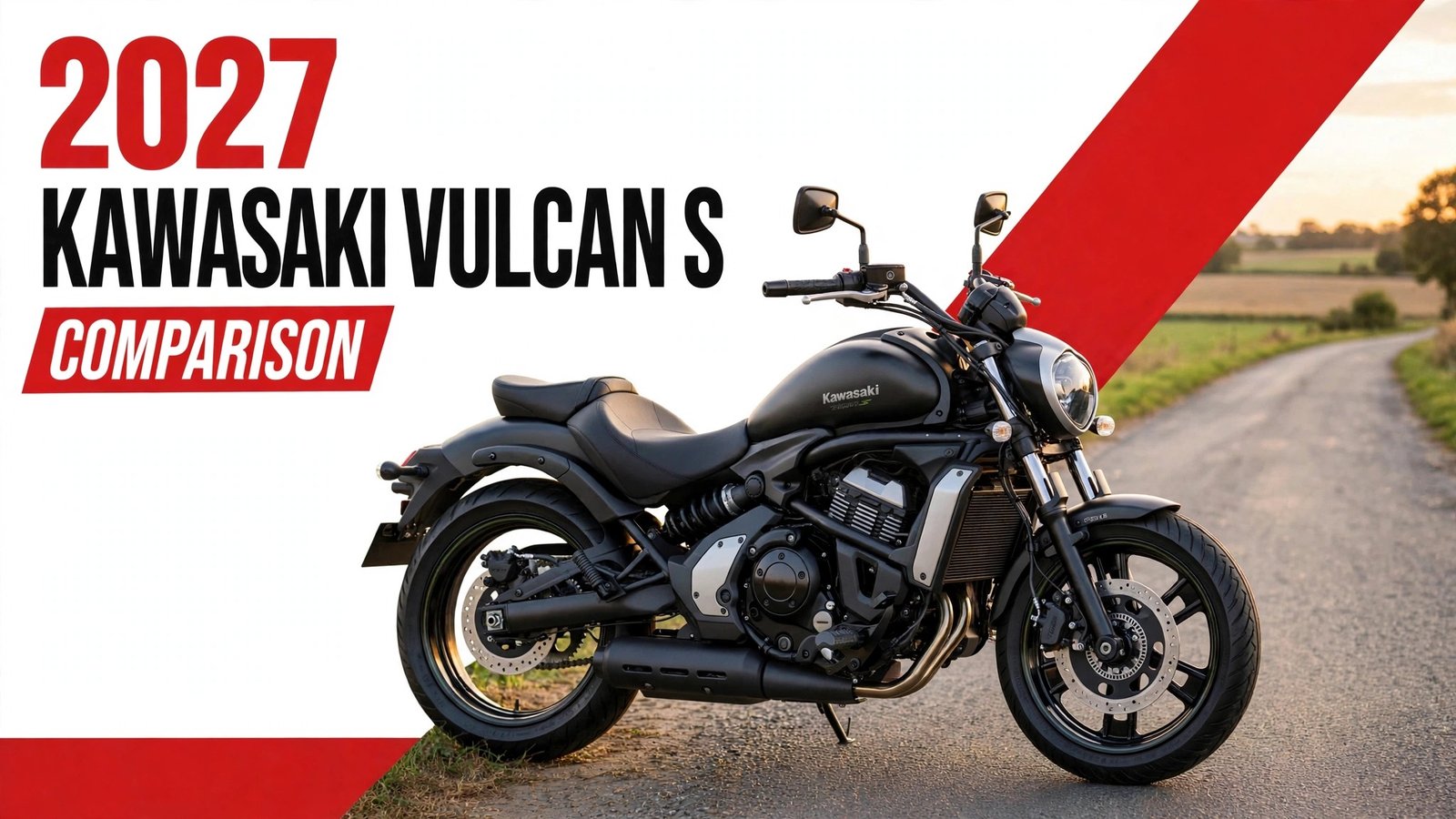
The short answer: the Kawasaki Vulcan S is quicker than its cruiser looks suggest, and the instrumented figures prove it. This Kawasaki Vulcan S performance guide starts with the two numbers that matter most — Cycle World’s dyno run of 53.5 horsepower at the rear wheel and its quarter mile of 13.40 seconds at 93.57 mph — and works outward to economy and handling.
This Kawasaki Vulcan S performance guide covers the dyno and quarter-mile figures, the top-speed conflict, the fuel economy from three testers and the Cycle World trio test against the Harley Forty-Eight and the Yamaha Bolt C-Spec. Every figure comes from a named test, and where no test exists, this Kawasaki Vulcan S performance guide says so plainly.
Kawasaki Vulcan S Engine Performance and Power Delivery
The engine is a retuned Ninja 650 twin, and the retune is the whole story of this Kawasaki Vulcan S performance review. Kawasaki took the 649cc liquid-cooled parallel twin from the Ninja 650 and the Versys 650, fitted revised cams, a modified intake, a retuned ECU, a different exhaust, plus a flywheel 28 percent heavier than the Ninja’s. The result is 60 hp at 7,500 rpm and 46.5 lb-ft at 6,600 rpm, per Kawasaki’s spec sheet, with an ISO 4106 footnote. That is six horsepower below the Versys 650’s 66.0 hp — a deliberate trade of peak power for low and mid-range pull.
Dyno: 53.5 Horsepower on the Cafe
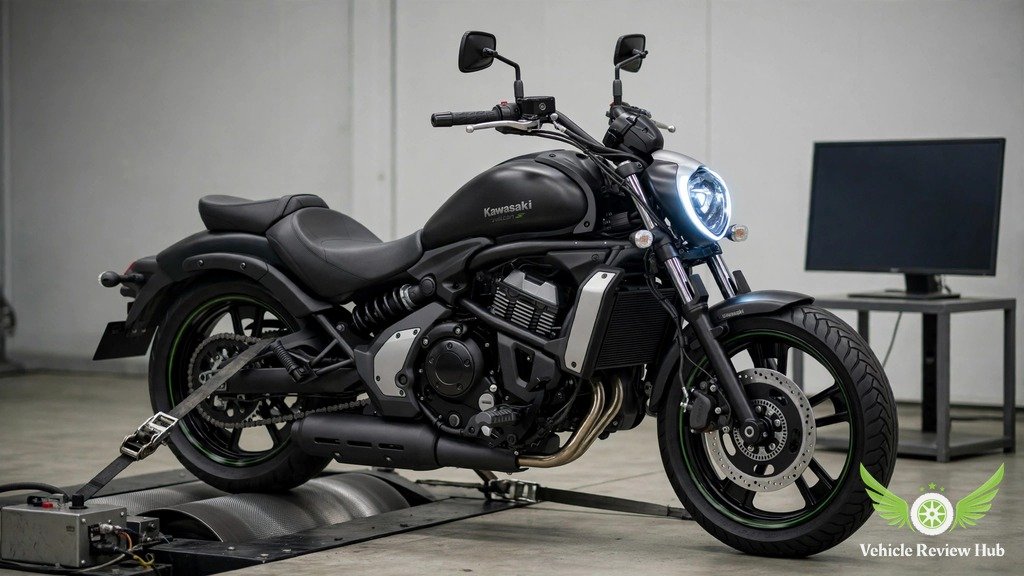
The only published dyno run of the Vulcan S comes from Cycle World, which tested the 2016 Cafe on a Dynojet and recorded 53.5 hp at 7,150 rpm and 42.7 lb-ft at 5,650 rpm at the rear wheel. Those are rear-wheel figures, so they sit below Kawasaki’s claimed 60 hp and 46.5 lb-ft — the gap is drivetrain loss, and it is normal. Peak torque at 5,650 rpm and peak power at 7,150 rpm sit well below the 9,900 rpm rev limit — the engine does its best work in the midrange. The Cafe is mechanically identical to the standard bike, so this Kawasaki Vulcan S performance dyno result applies to every Vulcan S from 2015 to 2027.
| Instrumented figure | Result | Source |
|---|---|---|
| Claimed power | 60 hp @ 7,500 rpm | Kawasaki USA (ISO 4106) |
| Claimed torque | 46.5 lb-ft @ 6,600 rpm (63.0 Nm) | Kawasaki USA (ISO 4106) |
| Dyno power (rear wheel) | 53.5 hp @ 7,150 rpm | Cycle World, 2016 Cafe, Dynojet |
| Dyno torque (rear wheel) | 42.7 lb-ft @ 5,650 rpm | Cycle World, 2016 Cafe, Dynojet |
| Quarter mile | 13.40 sec @ 93.57 mph | Cycle World, April 2016 |
| 0–60 mph | 4.3 sec | Cycle World, April 2016 |
| Rev limit | 9,900 rpm | Cycle News, 2015 first ride |
Notes for this Kawasaki Vulcan S performance instrumented-figures table: the dyno and quarter-mile figures are Cycle World’s, measured on the 2016 Cafe, which is mechanically identical to the standard Vulcan S. Claimed figures are Kawasaki USA’s. Dyno figures are rear-wheel measurements, so they read lower than the claimed crankshaft figures.
Sportiest Engine in the Class, Tester-Verified
Calling the Vulcan S engine the sportiest in its class is a tester verdict, not a measurement — but several testers reached it independently. Cycle World wrote that the Ninja 650-derived twin “injects the Vulcan S with sporting spirit and a horsepower endowment to make it capable of running with bigger steeds in the middleweight-cruiser category”, and that “tip the throttle and this sporty 650cc cruiser comes on like an espresso double shot”. Bike-urious, riding a Vulcan S on a group ride, reported having “no trouble keeping up with Abhi on a BMW R nineT Urban GS, and Nathan, riding a Suzuki V-Strom 1000”. Midrange and light steering let the bike run with bigger, more powerful machines. This Kawasaki Vulcan S performance verdict rests on those tester quotes, not on a horsepower ranking.
Kawasaki Vulcan S Top Speed and Acceleration
Acceleration is where the Vulcan S has hard, instrumented evidence — and top speed is where it has none. The quarter mile and the 0–60 time were measured by Cycle World with timing gear, while every top-speed number comes from an aggregator, a forum post or an AI page. The film below is one rider’s top-speed run, not an instrumented test.
Quarter 13.40 at 93.6, Cycle World
Cycle World’s April 2016 trio test measured the Vulcan S Cafe at 13.40 seconds at 93.57 mph in the quarter mile, with a 0–60 mph time of 4.3 seconds. For context, the Forty-Eight ran 13.23 seconds at 98.18 mph with the same 4.3-second 0–60, and the Bolt C-Spec 13.87 at 91.17 mph with a 4.8-second 0–60. The Vulcan S was quicker than the Bolt and nearly level with the Forty-Eight, despite giving away 550cc. One aggregator lists 13.2 seconds with a 4.2-second 0–60, but it publishes no trap speed and names no test source, so this Kawasaki Vulcan S performance guide treats it as an unsourced number.
| Acceleration figure | Vulcan S Cafe | Harley Forty-Eight | Yamaha Bolt C-Spec |
|---|---|---|---|
| Quarter mile | 13.40 sec @ 93.57 mph | 13.23 sec @ 98.18 mph | 13.87 sec @ 91.17 mph |
| 0–60 mph | 4.3 sec | 4.3 sec | 4.8 sec |
| Top gear 40–60 mph | 4.5 sec | Not published | Not published |
| Top gear 60–80 mph | 5.0 sec | Not published | Not published |
| Braking 60–0 mph | 130 ft | Not published | 152 ft |
| Price as tested | $7,999 | $11,549 | $8,690 |
Notes for this Kawasaki Vulcan S performance quarter-mile table: all figures are Cycle World’s, from the April 2016 trio test. The Vulcan S Cafe is mechanically identical to the standard Vulcan S. The zeroto60times figure of 13.2 seconds is an unsourced aggregator number with no trap speed and is not shown here as a test result.
Top Speed Figures Conflict by Source
No magazine has published an instrumented or GPS top speed for the Vulcan S, and Kawasaki publishes none — so every top-speed number you will see is a claim, not a test. The claims spread widely: around 120 mph from GoRollick (2019) and motorcyclehorizon; 118 mph from sbkmotor and BikeDekho; and 108–110 mph from rider reports. None of these is an instrumented test, and this Kawasaki Vulcan S performance guide does not pick one as the answer. The honest statement is that the top speed is unverified and the claims span roughly 108 to 120 mph. What is verified is the trap speed: 93.57 mph at the end of the quarter mile.

Kawasaki Vulcan S Mileage and Fuel Economy
Fuel economy is the one area where the Vulcan S has more test data than almost any rival, because three different testers measured it — and they mostly agree. This Kawasaki Vulcan S performance section uses Rider Magazine’s 2015 road test as the anchor — low, average and high figures from the same bike — cross-checked against Cycle World’s Cafe figure and the UK testers.
Testers Measured 38.8 to 56.1 MPG
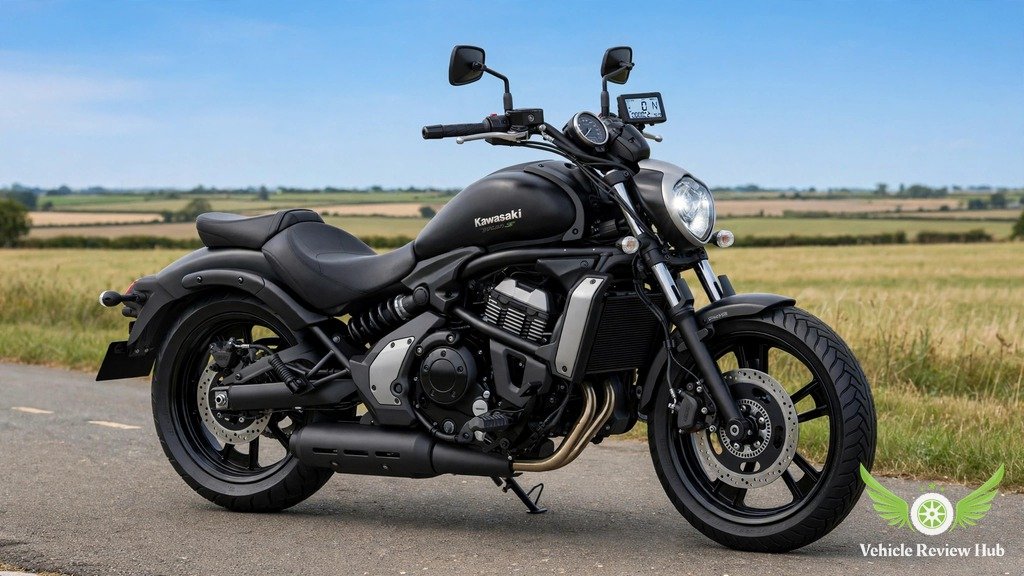
Rider Magazine’s 2015 road test measured 38.8 mpg at its worst, 48.3 mpg on average and 56.1 mpg at its best — a spread that reflects how the bike is ridden. Hard riding drops the figure toward 38.8; steady cruising lifts it toward 56.1. Cycle World measured 47 mpg on the Cafe, almost exactly Rider’s average. MoreBikes in the UK recorded 56 mpg, and Bennetts reported figures in the high 50s. The EPA estimate is 4.56 litres per 100 km, or 51.6 US mpg. Kawasaki publishes no fuel-economy figure, so this Kawasaki Vulcan S performance picture is built from those named tests.
| Fuel economy figure | MPG | Source |
|---|---|---|
| Worst measured | 38.8 mpg | Rider Magazine, 2015 road test |
| Average measured | 48.3 mpg | Rider Magazine, 2015 road test |
| Best measured | 56.1 mpg | Rider Magazine, 2015 road test |
| Cycle World Cafe test | 47 mpg | Cycle World, April 2016 |
| MoreBikes UK test | 56 mpg | MoreBikes, 2015 review |
| EPA estimate (2024 cert) | 51.6 mpg (US) | EPA via MotorcycleDB |
Notes for this Kawasaki Vulcan S performance fuel-economy table: Rider Magazine’s low, average and high figures come from the same 2015 road test on the same bike. The EPA figure is an estimate from the 2024 certification, converted from 4.56 L/100 km.
Range Stops Near 179 Miles
Rider Magazine’s estimated range of 179 miles is the figure most often quoted for the Vulcan S, and it is worth showing the arithmetic: 3.7 gallons times 48.3 mpg equals 178.7 miles, which rounds to 179. That is an estimate, not a tank-to-empty test. The practical range is shorter, because the low-fuel light comes on with 0.8 gallon left — closer to 150 miles at average economy. The 3.7-gallon tank is the smallest in its class, and it is the bike’s real touring limit — the range lesson of this Kawasaki Vulcan S performance guide.
Kawasaki Vulcan S Real-World Riding Experience
Instrumented figures tell you what the bike can do; the trio test tells you what it feels like to ride — the riding half of this Kawasaki Vulcan S performance guide. Cycle World’s April 2016 comparison put the Vulcan S Cafe against the Harley Forty-Eight and the Yamaha Bolt C-Spec on the same roads, on the same day — and the Kawasaki won the back-road riding.

Value Choice Against the Bolt, Said CW
The Vulcan S Cafe cost $7,999 in the trio test, $691 less than the Bolt C-Spec at $8,690 and $3,550 less than the Forty-Eight at $11,549 — and it beat the Bolt where it matters. It was quicker in the quarter mile (13.40 vs 13.87), quicker to 60 mph (4.3 vs 4.8) and shorter-stopping (130 vs 152 feet). The value framing in this Kawasaki Vulcan S performance section is a fair summary of that test outcome — cheaper, quicker, better brakes — not a verbatim Cycle World quote, and it is presented as such.
| Trio test figure | Vulcan S Cafe | Harley Forty-Eight | Yamaha Bolt C-Spec |
|---|---|---|---|
| Price as tested | $7,999 | $11,549 | $8,690 |
| Engine | 649cc parallel twin | 1,202cc V-twin | 942cc V-twin |
| Dyno power | 53.5 hp @ 7,150 rpm | 61.6 hp @ 5,550 rpm | 50.8 hp @ 5,350 rpm |
| Dyno torque | 42.7 lb-ft @ 5,650 rpm | 67.8 lb-ft @ 3,450 rpm | 58.0 lb-ft @ 2,900 rpm |
| Quarter mile | 13.40 sec @ 93.57 mph | 13.23 sec @ 98.18 mph | 13.87 sec @ 91.17 mph |
| 0–60 mph | 4.3 sec | 4.3 sec | 4.8 sec |
| Fuel economy | 47 mpg | 41 mpg | 48 mpg |
| Tank / range | 3.7 gal / ~174 mi | 2.1 gal / ~75 mi | 3.2 gal / ~154 mi |
| Braking 60–0 mph | 130 ft | Not published | 152 ft |
Notes for this Kawasaki Vulcan S performance trio-test table: all figures are Cycle World’s, from the April 2016 “Café Cruise” comparison, measured on the same day. The “value choice” framing in the heading above is a fair summary of the test outcome, not a verbatim Cycle World quote.
Back-Road Play Won the Trio Test
The trio test’s riding verdict is where the Vulcan S earned its keep. Cycle World’s testers praised “the lightest steering feel of our trio”, “excellent stability, compliant suspension, superb ABS brakes, and more cornering clearance”, and gave “a nod to the Kawi Café” for back-road play. The light steering comes from the 31-degree rake and the 498.3-pound curb weight — heavy for a 649, light next to a 1,202cc Harley. The Bolt’s footrests and exhaust dragged early; the Vulcan S kept going.
Kawasaki Vulcan S Handling, Braking and Stability
Handling is the Vulcan S’s quiet advantage in this Kawasaki Vulcan S performance review, and it comes from the chassis, not the engine. The long 62.0-inch wheelbase gives stability at speed, the 31-degree rake gives light steering, and the low 27.8-inch seat keeps the centre of gravity down.

Handling, Braking and Stability on the Road
Cycle News, at the 2015 launch, called the steering “light and neutral” and the bike “nimble and agile through the twisties”, with “a decent amount of footpeg-to-tarmac clearance” for the class. The one handling weakness every tester named is the rear shock: with a 175-pound tester aboard, Cycle News found it “fairly stiff out of the crate” and reported being “blown out of the seat when hitting medium-sized bumps at speed”. FlamingBikes calls it a design characteristic — short travel and an angled shock transfer harsh bumps.
One Front Disc, 3.2 Inches of Rear Travel
The braking hardware is simple: a single 300 mm front disc with a two-piston Nissin caliper, a single 250 mm rear disc, and ABS on both. Cycle News called the front Nissin brake “superb — super strong yet not grabby”, and the ABS “works well” and “not overly sensitive”. The measured result is the 130-foot stop from 60 mph — 22 feet shorter than the Bolt C-Spec’s 152 feet. The two numbers to remember from this Kawasaki Vulcan S performance section are 130 feet and 3.2 inches — the first is a strength, the second is the compromise.
Kawasaki Vulcan S Performance Compared With Other Cruisers
The Vulcan S does not compete against other 650cc parallel twins. It competes against V-twin cruisers that make their power lower, weigh more and cost more — and against the Honda Rebel 500, the closest rival in price and purpose. This Kawasaki Vulcan S performance comparison starts with the Rebel, because it is the bike most buyers cross-shop.
Kawasaki Vulcan S vs Honda Rebel 500
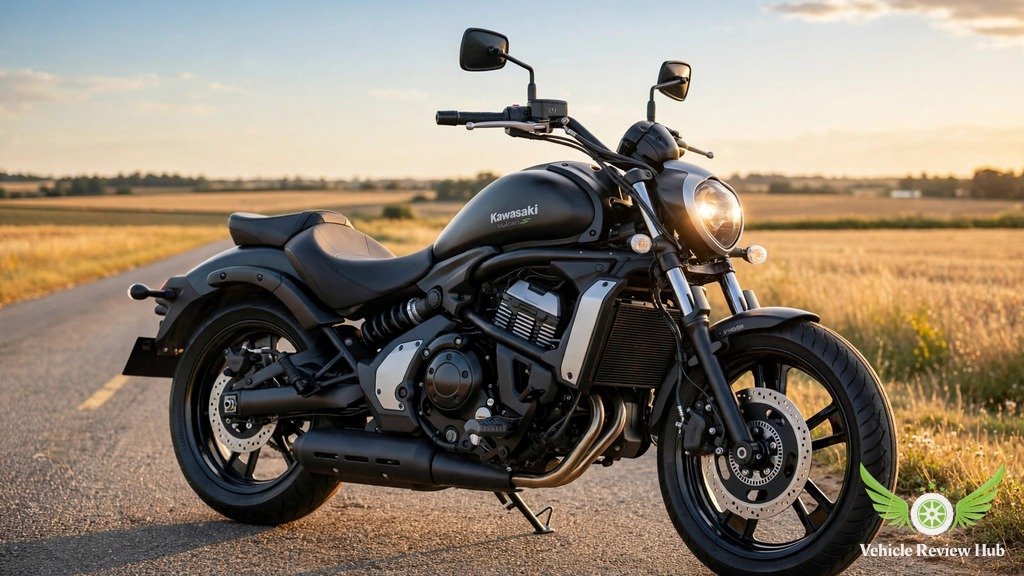
The Rebel 500 is the Vulcan S’s natural rival: a 471cc parallel twin, a 27.2-inch seat, and a 2026 delivered price of $7,399 — $1,385 less than the Vulcan S ABS. The Honda makes 46 hp and 32.9 lb-ft against the Kawasaki’s 60 hp and 46.5 lb-ft, so the Vulcan S is the faster bike: 13.40 seconds in the quarter mile against the Rebel’s mid-14s, and 4.3 seconds to 60 mph against the Rebel’s 5.2. The Rebel answers with weight — 414 pounds against the Vulcan S’s 498.3 — and a lower seat and simpler feel that suits newer riders. The choice is straightforward: the Rebel 500 is the cheaper, lighter, easier first cruiser; the Vulcan S is the faster, more adjustable one, with Ergo-Fit the Honda cannot match. The full comparison is in our Kawasaki Vulcan S comparison — and the same 649cc engine in an adventure-touring chassis is covered in our Versys 650 performance guide.
| Performance figure | Kawasaki Vulcan S ABS | Honda Rebel 500 |
|---|---|---|
| Engine | 649cc parallel twin | 471cc parallel twin |
| Claimed power | 60 hp @ 7,500 rpm | 46 hp @ 8,500 rpm |
| Claimed torque | 46.5 lb-ft @ 6,600 rpm | 32.9 lb-ft @ 6,000 rpm |
| Quarter mile | 13.40 sec @ 93.57 mph | Mid-14 sec (instrumented) |
| 0–60 mph | 4.3 sec | 5.2 sec |
| Seat height | 27.8 in | 27.2 in |
| Curb weight | 498.3 lb | 414 lb |
| Fuel capacity | 3.7 gal | 2.9 gal |
| 2026 delivered price | $8,834 | $7,399 |
Notes for this Kawasaki Vulcan S performance comparison table: the Vulcan S quarter mile and 0–60 figures are Cycle World’s instrumented results; the Rebel 500 figures are instrumented results as reported in the motorcycle press. Prices are 2026 delivered prices (MSRP plus destination). The Rebel 500’s 2026 ABS is standard on all trims.
Is the Kawasaki Vulcan S Suitable for Beginner Riders?
Mostly yes, for a shorter beginner — with two honest catches. For the bike: the 27.8-inch seat lets almost any adult flat-foot it, the clutch is light, the engine is “nearly impossible to stall while launching” in Cycle News’s words, and ABS is standard. Against the bike: it weighs 498.3 pounds, the twin is revvy with a 9,900 rpm limit, there is no traction control, and the forward controls ask more of a new rider than the Rebel 500’s lighter package. No single authority calls the Vulcan S a beginner bike outright, and one outlet, bestbeginnermotorcycles.com, calls it “too powerful for really ‘green’ beginners” — that is one outlet’s take, not a consensus. The balanced verdict from this Kawasaki Vulcan S performance review is that it suits a shorter beginner with training.
Kawasaki Vulcan S Performance: Frequently Asked Questions
Short answers to the questions this Kawasaki Vulcan S performance guide raises most.
How much horsepower does the Vulcan S make?
Kawasaki publishes 60 hp at 7,500 rpm and 46.5 lb-ft at 6,600 rpm, with an ISO 4106 footnote. Cycle World’s dyno run of the 2016 Cafe measured 53.5 hp at 7,150 rpm and 42.7 lb-ft at 5,650 rpm at the rear wheel — the key dyno figure in this Kawasaki Vulcan S performance guide. The 61 figure in European listings is 61 PS, the metric unit — not horsepower.
What is the Vulcan S quarter-mile time?
Cycle World measured 13.40 seconds at 93.57 mph in the April 2016 trio test, with a 0–60 mph time of 4.3 seconds. That is the only instrumented quarter-mile figure for the bike in this Kawasaki Vulcan S performance guide — an aggregator lists 13.2 seconds with no trap speed and no named test source.
What is the top speed of the Kawasaki Vulcan S?
There is no instrumented top speed for the Vulcan S — no magazine has published a GPS or timed top-speed run, and Kawasaki publishes none. Claims span roughly 108 to 120 mph, and this Kawasaki Vulcan S performance guide presents them as a conflict, not as a verified figure.
How many miles per gallon does the Vulcan S get?
Rider Magazine measured 38.8 mpg at its worst, 48.3 mpg on average and 56.1 mpg at its best in its 2015 road test — the anchor figures for this Kawasaki Vulcan S performance fuel-economy section. Cycle World measured 47 mpg on the Cafe, and the EPA estimate is 51.6 US mpg.
How far can a Vulcan S go on a tank?
About 179 miles at Rider Magazine’s average economy — 3.7 gallons times 48.3 mpg is 178.7 miles. This Kawasaki Vulcan S performance range figure is an estimate, not a tank-to-empty test. The low-fuel light comes on with 0.8 gallon left, so the practical range is closer to 150 miles.
Is the Vulcan S faster than the Honda Rebel 500?
Yes. The Vulcan S runs the quarter mile in 13.40 seconds at 93.57 mph against the Rebel 500’s mid-14s, and reaches 60 mph in 4.3 seconds against the Rebel’s 5.2 — the clearest win in this Kawasaki Vulcan S performance comparison. The Rebel answers with 84 fewer pounds and a lower price.
Is the Vulcan S faster than the Yamaha Bolt?
In Cycle World’s April 2016 trio test, yes: the Vulcan S Cafe ran 13.40 seconds against the Bolt C-Spec’s 13.87, reached 60 mph in 4.3 seconds against the Bolt’s 4.8, and stopped from 60 mph in 130 feet against the Bolt’s 152 — a clean sweep in this Kawasaki Vulcan S performance comparison.
What is the Vulcan S 0–60 time?
4.3 seconds, measured by Cycle World in April 2016 — the same time as the Harley Forty-Eight in the same test, and half a second quicker than the Yamaha Bolt C-Spec. An aggregator lists 4.2 seconds with no named test source, so this Kawasaki Vulcan S performance guide prints the Cycle World figure.
Does the Vulcan S have good brakes?
Yes. The single 300 mm front disc with a two-piston Nissin caliper stopped the bike from 60 mph in 130 feet in Cycle World’s test, 22 feet shorter than the Bolt C-Spec — the strongest braking result in this Kawasaki Vulcan S performance guide. Cycle News called the front brake “superb — super strong yet not grabby”.
How does the Vulcan S handle?
Light and neutral, according to every tester. Cycle News called the steering “light and neutral” and the bike “nimble and agile through the twisties”. Cycle World praised “the lightest steering feel of our trio” and “more cornering clearance” — the handling verdict of this Kawasaki Vulcan S performance review.
Is the Vulcan S good for highway riding?
Yes, with one limit. The engine turns about 4,500 rpm at an indicated 60 mph and holds 70–80 mph comfortably — the highway verdict of this Kawasaki Vulcan S performance guide. The limit is the 3.7-gallon tank: the practical range before the low-fuel light is around 150 miles.
Is the Vulcan S a good beginner bike?
Mostly yes, for a shorter beginner who has done a training course. The 27.8-inch seat, light steering, forgiving clutch, near-impossible-to-stall engine and standard ABS all help. The catches are the 498.3-pound curb weight, the revvy twin, no traction control and a stiff rear shock. The balanced verdict in this Kawasaki Vulcan S performance review is that it suits a beginner who will not outgrow it in a season.