The short answer to this Suzuki Burgman 200 reliability guide is that the 200 is a simple, lightly stressed scooter with a clean official record — zero NHTSA complaints in any year from 2014 to 2022 — but it is also a used-only bike now, and its real ownership story is three small recalls, one fuel-pump warranty extension, and age catching up with tyres, belts and rubber hoses. This guide separates factory-acknowledged problems from owner chatter, keeps every service figure labelled, and tells you what to check before buying.
Suzuki Burgman 200 Reliability Overview
This Suzuki Burgman 200 reliability guide starts with the record, because the record is unusually clean for a nine-year-old model. The Burgman 200 was sold in the USA from 2014 to 2022 as a 199cc liquid-cooled single with an automatic CVT, standard ABS on both wheels, and a 12-month warranty when new, per Suzuki’s 2018 one-sheet.

Low Complaint Counts in the Record
The strongest fact in this Suzuki Burgman 200 reliability guide is also the simplest: NHTSA’s complaints database returns zero complaints for the Burgman 200 in every model year from 2014 to 2022, checked under both “Burgman 200” and “UH200”. It does not prove no owner ever had a problem: the best-known defect, the fuel-pump leak, surfaced through Suzuki’s own warranty extension rather than through NHTSA complaints.
How Mileage, Storage and Previous Care Affect Reliability
Every Burgman 200 today is four to twelve years old, so this Suzuki Burgman 200 reliability guide weighs age and care more than model-year differences — there were no mechanical changes across the nine years, only colours. A low-mileage 2022 that lived in a garage is a different purchase from a high-mileage 2014 that sat outside. The full review covers what the bike is like to ride; this guide covers what breaks, what wears, and what to check.
Suzuki Burgman 200 Common Problems and Wear Items
The common problems on this Suzuki Burgman 200 reliability guide come in two groups. The first group is factory-acknowledged: defects Suzuki recognised through recalls, a warranty extension, or a technical bulletin. The second group is wear items: parts that wear with age and miles on any scooter.
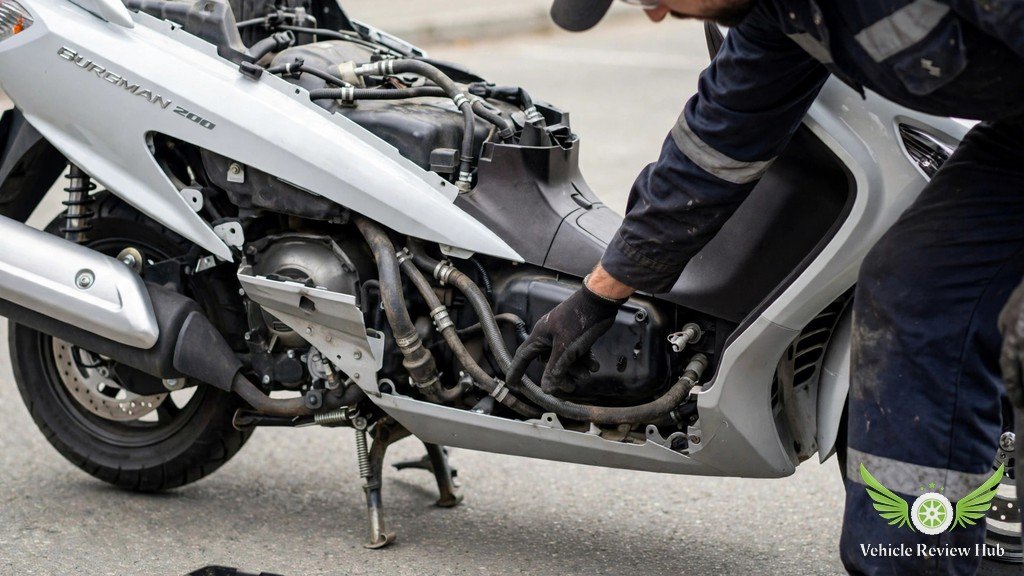
The video below is an Indonesian review and walkaround of the Burgman 200 from the Kasarunk channel — there is no English narration, and no English-language Burgman 200 review video exists instead. It shows the bike up close and ridden — useful viewing before this Suzuki Burgman 200 reliability guide’s buying checklist.
Fuel Pump Cracking Earned a Warranty Extension
The best-known problem on this Suzuki Burgman 200 reliability guide is the fuel pump, and it is also the best-handled one. Suzuki bulletin GV/AN/UH No. 059, issued in January 2025 and revised twice that spring, covers every Burgman 200 from 2014 to 2022 under campaign 2M99: a ten-year fuel-pump warranty extension, unlimited mileage from the original date of purchase. Salt water can accumulate on the pump, the discharge-port resin deteriorates from contact with compounds in it, and bending stress from the outlet hose opens micro-cracks that grow into a leak. The fix is a new fuel pump assembly, part number 15100-03H21, plus a protective cover and a new hose, with a dealer labour allowance of 3.9 hours. First, this is a warranty extension, not a recall — it is not in the NHTSA safety-recall record, and it is a different part and issue from the fuel-hose recall below. A 2014 bike bought in 2014 is covered until 2024, so the earliest bikes are already out, while a 2022 bike bought in 2022 is covered until 2032.
CVT Belt Is the Main Consumable Story
The CVT belt is the main wear item on this Suzuki Burgman 200 reliability guide, and the first thing to get right is the part number. The correct belt is 27601-14F20-000, confirmed by the Bando OE application chart, 22.5 by 881 mm. A different number, 27601-05H10, circulates online as a Burgman 200 belt, but it is the Burgman 400 belt — do not order it. Worn-belt symptoms are the usual CVT ones — poor acceleration, slipping, and whining — and the performance guide covers how the CVT behaves when it is healthy. Ask when it was last changed.
Suzuki Burgman 200 Maintenance Schedule and Servicing
This Suzuki Burgman 200 reliability guide has to be honest about the schedule first: the actual UH200 owner’s manual and service manual PDF could not be obtained for this research. Everything in this section is therefore labelled: verified figures from Suzuki bulletins, secondary figures from UH200-specific guides, and unverified intervals printed as such. No chart rows are invented.
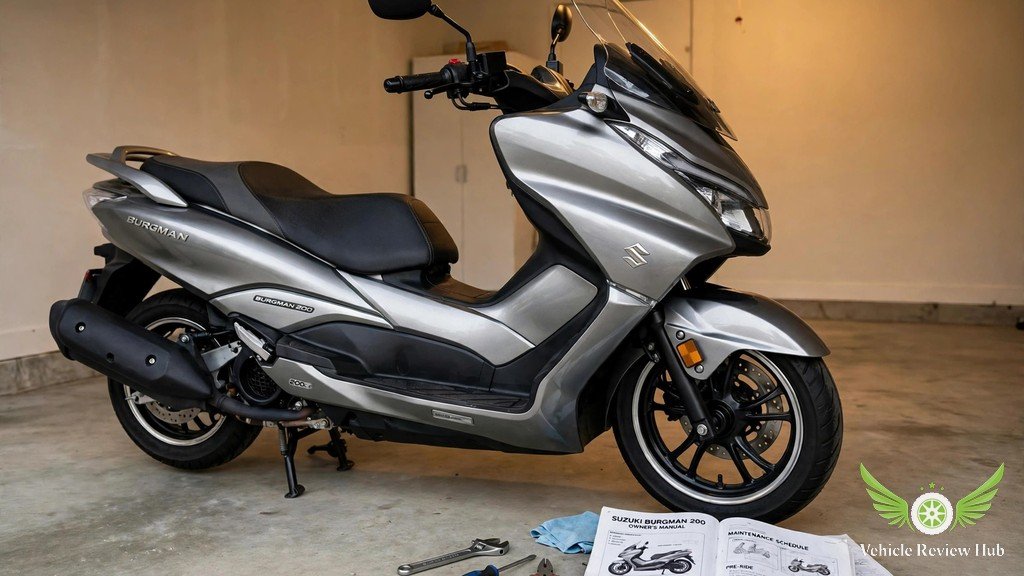
Get the Schedule From the Bike’s Own Manual
The trap to avoid is borrowing another Burgman’s manual. A ManualsLib “Suzuki Burgman Series” manual circulates online, but it is the Burgman 650 — none of its figures belong on the 200. What is verified for the 200 itself is in the table below. The oil-change interval itself is the gap this guide will not fill with a guess: two secondary claims conflict, one saying every 3,000 miles or six months and the other every 6,000 km, and neither was verified against the manual.
| Service item | Figure | Status |
|---|---|---|
| Engine oil | SAE 10W-40, 1.2 L oil only / 1.3 L with filter | Secondary guide figure |
| Oil-change interval | Conflicting claims: 3,000 mi / 6 mo vs 6,000 km | Unverified — neither confirmed |
| Oil filter | OEM 16510-05240, spin-on | Secondary; interval unverified |
| Air filter | Inspect every 3,500 mi; OEM 13780-03H00, do not oil | Secondary guide figure |
| Spark plug | NGK CPR7EA-9, gap 0.8–0.9 mm, torque 11 Nm | Secondary; interval unverified |
| CVT belt | OEM 27601-14F20-000; inspect every 12,000 km | Part verified; interval owner practice |
| Coolant capacity | 1.4 US qt (1,350 ml) excluding reservoir | Verified, Suzuki bulletin |
| Final-drive oil | 140 ml refill / 150 ml total | Secondary; interval unverified |
| Valve clearance | Interval and specs not found | Unverified — see the manual |
| Brake fluid | Type and interval not found | Unverified — see the manual |
Notes for this Suzuki Burgman 200 reliability table: the full factory chart was not obtained, so every row is labelled verified, secondary, or unverified. The oil-change interval has two conflicting secondary claims and neither was confirmed against the manual. The correct CVT belt is 27601-14F20-000 — the 27601-05H10 in circulation is the Burgman 400 belt. Service manual part number 99500-31523-03E is confirmed from Suzuki’s own bulletin.
Belt Practice Around 12,400 Miles, Owner-Sourced
The belt figure that needs the most care in this Suzuki Burgman 200 reliability guide is the 12,400-mile point, because it looks like a manual interval and it is not one. The figure is 20,000 km converted to miles, and 20,000 km is the belt-replacement interval in the Burgman Street 125 manual — a different bike. Treat it as owner-sourced practice, never the factory interval. A Thailand dealer quoted replacement at 24,000 km, about 14,900 miles, and a UH200 guide recommends inspecting the belt every 12,000 km, about 7,500 miles, replacing it if cracked or worn. Inspect the belt at the 12,000 km point for cracking, glazing and edge wear, and budget for a replacement somewhere in the 12,400 to 14,900-mile window if no record shows one was done.
Suzuki Burgman 200 Tires, Brakes and Suspension Maintenance
Tyres, brakes and suspension on this Suzuki Burgman 200 reliability guide are a story of age more than wear.

Tires Age Out Before They Wear Out
Tyres are the clearest age item on this Suzuki Burgman 200 reliability guide. The sizes are 110/90-13 front and 130/70-12 rear, tubeless, on 13-inch front and 12-inch rear aluminium wheels. Pressures, as reported from the owner’s manual, are 29 psi front and 33 psi rear solo, with the rear rising to 41 psi two-up while the front stays at 29 psi — check them cold. The point of the heading is that a Burgman 200 tyre with plenty of tread can still be done. Read the date code on both tyres and budget for a pair if either is old, cracked, or of unknown age.
Discs Both Ends, Fluid on Time
Braking on this Suzuki Burgman 200 reliability guide is straightforward and well specified: a single 240 mm disc at the front with a two-piston caliper and a single 240 mm disc at the rear with a single-piston caliper, with Nissin ABS standard on both wheels from launch. Motorcycle.com found the system works well, “allowing completely ham-fisted brake grabs without drama”. Two things need care. Ignore summaries that say the US bike has a rear drum brake or a combined braking system — the US 2014–2022 bike has discs at both ends with ABS. Whether the brakes are linked is unresolved: Ultimate Motorcycling’s first ride says they are linked, Motorcycle.com’s first-ride article says they are not, and Motorcycle.com’s own spec database says linked brakes are standard. This guide prints neither claim as settled fact. The brake-fluid change interval is unverified — this guide prints no interval rather than borrowing one from the Burgman Street or the Burgman 650. Suspension is equally simple: a telescopic 33 mm front fork with 3.6 inches of travel, and a swingarm rear with a coil-spring, oil-damped shock and 3.3 inches of travel. The shock count is a genuine conflict — Suzuki’s own spec tables say single shock, while the 2014 launch coverage says twin preload-adjustable shocks — so this guide follows the spec-table wording. RevZilla‘s head-to-head tester preferred how much better the Burgman “ate up road bumps” than the Yamaha SMAX.
Suzuki Burgman 200 Maintenance and Ownership Costs
Ownership cost on this Suzuki Burgman 200 reliability guide is a story of a cheap bike to buy and to run, with one honest gap: no verified US retail price was found for any Burgman 200 part, so this guide prints no parts prices. What can be costed is fuel, routine servicing, tyres, and the recall record — and the recall record is where the money is saved, because every recall repair is free.
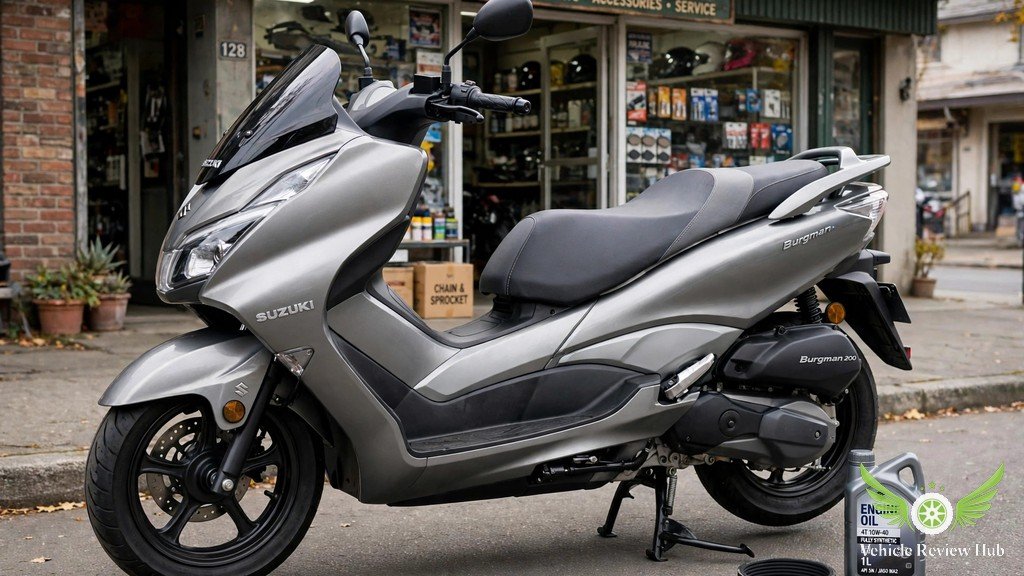
Fuel, Routine Servicing, Tires and Replacement Parts
Fuel is the cheapest part of this Suzuki Burgman 200 reliability guide’s ownership maths. Testers measured 58 to 65 mpg with hard riding, and Suzuki’s own 2014 press claim was 70.8 mpg, giving about 196 miles from the 2.8-gallon tank — the full tester spread runs 58 to 82 US mpg. No verified US retail price was found for the fuel pump, the belt, the filters, the spark plug, tyres or brake pads, and no dealer service menu was found either. The one cost figure that is verified is dealer-side, not a customer price: the fuel-pump warranty-extension claim allows 3.9 hours of labour plus coolant.
| Cost item | Figure | Basis |
|---|---|---|
| MSRP, every year 2014–2022 | $4,999 | Suzuki, every model year |
| Delivered total, 2022 | $5,424 | $4,999 + $425 destination |
| Used 2022 listings | $3,499–$4,999 | CycleTrader crawl, 16 Oct 2026 |
| Fuel economy, tester measured | 58–65 mpg | Motorcycle.com trip computer |
| Fuel economy, Suzuki claim | 70.8 mpg | Suzuki 2014 press material |
| Range on a tank | 162–196 miles | 2.8-gal tank at 58–70.8 mpg |
| Warranty when new | 12 months | Long expired on every example |
| Fuel-pump extension | 10 years, unlimited mileage | Campaign 2M99, from purchase date |
Notes for this Suzuki Burgman 200 reliability table: used prices are CycleTrader listings crawled 16 October 2026, not market values. No verified US retail price was found for any Burgman 200 part — fuel pump, belt, filters, spark plug, tyres or brake pads — so this Suzuki Burgman 200 reliability guide prints no parts prices. The 3.9-hour fuel-pump labour figure is a dealer-side allowance from Suzuki’s bulletin, not a customer price.
Three Recalls, All 2018 to 2020 Bikes
Three NHTSA safety recalls cover the Burgman 200, and the year split is the part this Suzuki Burgman 200 reliability guide must get exactly right. The CVT drive-plate recall, campaign 19V377, covers certain 2018–2019 bikes only, 300 units: the rivets in the movable driven face may fail and let the drive plate break, cutting drive. The fuel-hose recall, campaign 21V558, covers certain 2019–2020 bikes only, 270 units: the hose assembly may leak fuel at its connection to the metal pipe, a fire risk. The speedometer recall, campaign 21V299, covers certain 2019–2020 bikes only, 270 units: resistors in the speedometer may corrode from sulfur gas from the rubber boot over the wire-harness coupler, killing the speedometer and odometer. All three repairs are free at the dealer. A buyer checks recall status by VIN at nhtsa.gov/recalls or through a Suzuki dealer, and the comparison puts the used Burgman 200’s price against new rivals.
| Campaign | Years affected | Units | Issue and remedy |
|---|---|---|---|
| 19V377 (2A89) CVT drive plate | 2018–2019 | 300 | Rivets may fail, drive plate breaks; dealer replaces it free |
| 21V558 (2A97) Fuel hose | 2019–2020 | 270 | Hose may leak fuel; dealer replaces the hose set free |
| 21V299 (2A96) Speedometer | 2019–2020 | 270 | Resistors corrode, speedo and odometer go dark; dealer replaces it free |
| 2014 emissions recall, muffler | 2014 | Certain 2014 bikes | Resonance can fracture the muffler; dealer replaces it free |
| 2M99 fuel-pump extension | 2014–2022 | All years | 10 years, unlimited mileage; NOT a recall; dealer checks by VIN |
Notes for this Suzuki Burgman 200 reliability table: three distinct NHTSA safety recalls, verified live under both “Burgman 200” and “UH200” — the two 2021 recalls are filed under “UH200” only. Only the CVT recall touches a 2018 bike, only the two 2021 recalls touch a 2020 bike, and a 2019 bike can have all three. The fuel-pump extension 2M99 is a warranty extension, not a safety recall, and a different part and issue from the 21V558 fuel-hose recall.
How to Keep a Suzuki Burgman 200 Reliable
Keeping a Burgman 200 reliable is mostly doing the ordinary things on time and checking the few known items before they become problems. This Suzuki Burgman 200 reliability guide ends with the checklist a buyer and an owner can both use.
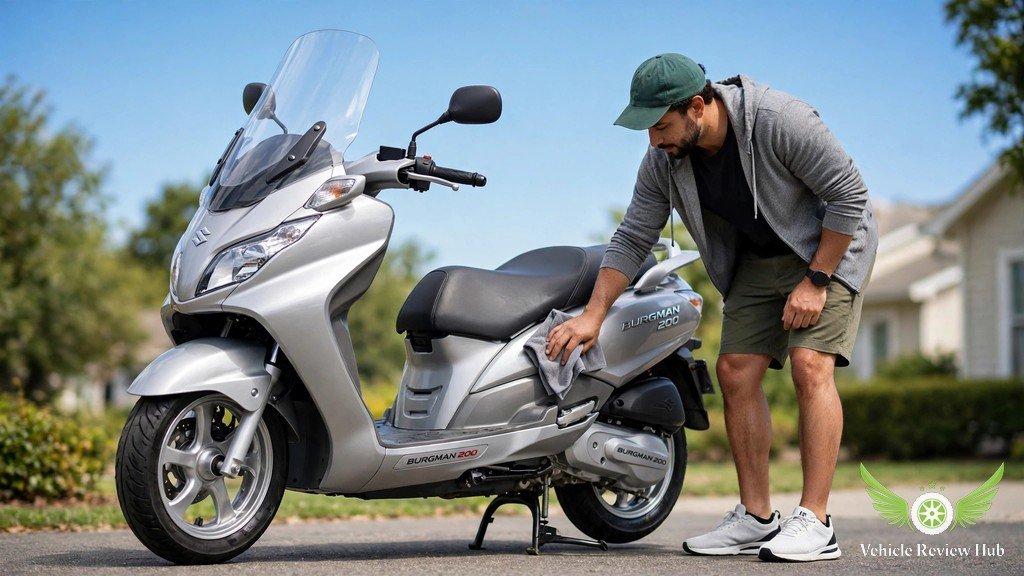
Preventive Maintenance, Records and Regular Inspections
The preventive routine for this Suzuki Burgman 200 reliability guide is short. Change the engine oil and filter, inspect the air filter, check the spark plug, keep the final-drive oil fresh, and watch the coolant and brake fluid — and get the intervals from the bike’s own manual (service manual 99500-31523-03E), because this guide does not invent them. Inspect the CVT belt every 12,000 km and replace it if it is cracked or worn, with owner practice putting replacement somewhere around 12,400 to 14,900 miles. Check the tyres by date code as well as tread, and check the pressures cold: 29 psi front, 33 psi rear solo, 41 psi rear two-up. At key-on, watch both needles sweep and settle exactly on zero — a needle resting off zero is the documented 2014 fault covered by Suzuki bulletin GV/AN/UH No. 54, fixed by cycling the ignition off and on until it returns to zero. Keep records of everything — they prove the recalls were done and lift the resale value. Inspect the bike regularly rather than waiting for a symptom — the pump, belt, tyres and hoses all give warning first.
Confirm the Pump Extension by VIN
The last check on this Suzuki Burgman 200 reliability guide is the one buyers most often get wrong, so it gets its own section. There is no public VIN lookup for the fuel-pump warranty extension — none exists. The owner takes the bike and its VIN to an authorised Suzuki dealer, who uses the Vehicle Master Inquiry function in Suzuki CONNECT to find the original date of sale and verify the ten-year, unlimited-mileage coverage from that date. Ask the seller for the original purchase date before agreeing a price: a 2022 bike bought in 2022 is covered until 2032, a 2019 bike until 2029, and a 2014 bike is already out of the extension. If the pump leaks inside its ten years, the repair is covered — new pump, cover and hose, with 3.9 hours of dealer labour allowed. If it is outside, the pump is the buyer’s cost, and no verified US retail price for the part was found to quote. That is the whole of this Suzuki Burgman 200 reliability guide’s verdict: a simple scooter with a clean record, three small recalls, one generous extension, and age as its real enemy — buy clean, check the VIN, keep the records.
Suzuki Burgman 200 Reliability: Frequently Asked Questions
Direct answers to the Suzuki Burgman 200 reliability questions buyers ask most.
Is the Suzuki Burgman 200 reliable?
Yes, by the official record. NHTSA shows zero complaints for the Burgman 200 in every year from 2014 to 2022, and the three safety recalls are small and free to fix. This Suzuki Burgman 200 reliability guide calls it simple and lightly stressed — but every example is now four to twelve years old, so age and care matter more than model year.
How many recalls does the Suzuki Burgman 200 have?
Three: the CVT drive plate on 2018–2019 bikes (19V377, 300 units), the fuel hose on 2019–2020 bikes (21V558, 270 units), and the speedometer on 2019–2020 bikes (21V299, 270 units). Also note the 2014 muffler emissions recall and the fuel-pump warranty extension, which is not a recall.
What is the fuel pump problem on the Suzuki Burgman 200?
The fuel-pump discharge-port resin can crack from salt water and hose stress, causing a fuel leak. Suzuki covers it under campaign 2M99: ten years, unlimited mileage from the original purchase date, for all 2014–2022 bikes. This Suzuki Burgman 200 reliability guide stresses that a dealer confirms the extension through Suzuki CONNECT — there is no public VIN lookup for it.
How long does the CVT belt last on a Suzuki Burgman 200?
No factory interval was verified. Owner and dealer practice puts inspection every 12,000 km, about 7,500 miles, with replacement around 12,400 to 14,900 miles if no record shows one was done. This Suzuki Burgman 200 reliability guide treats the 12,400-mile point as owner-sourced practice, never as the manual interval. The correct belt is 27601-14F20-000.
What is the maintenance schedule for the Suzuki Burgman 200?
Get it from the bike’s own manual — service manual part number 99500-31523-03E. This Suzuki Burgman 200 reliability guide could not obtain the manual PDF, so it prints no invented chart rows: verified figures are the 1.4-quart coolant capacity, the belt part number, and the labelled service items above.
How often should I change the oil on a Suzuki Burgman 200?
This Suzuki Burgman 200 reliability guide cannot give a verified interval: two secondary claims conflict (3,000 miles / 6 months vs 6,000 km), and neither was confirmed against the manual. The grade is SAE 10W-40, API SF to SL, JASO MA or MB, with a capacity of 1.2 litres for oil only and 1.3 litres with the filter.
What tyres and tyre pressures does the Suzuki Burgman 200 use?
Front 110/90-13 and rear 130/70-12, tubeless. Pressures are 29 psi front and 33 psi rear solo, 41 psi rear two-up, front stays 29 psi, checked cold. This Suzuki Burgman 200 reliability guide adds that tyres age out before they wear out — read the date code on any used bike.
How much does a used Suzuki Burgman 200 cost to run?
Fuel is cheap: 58 to 65 mpg measured, 70.8 mpg claimed, 162 to 196 miles per tank. Routine servicing is a scooter’s usual list, but this Suzuki Burgman 200 reliability guide found no verified US retail price for any part, so it prints no parts prices. Budget for a belt, a pair of tyres, and a full fluid change on any example with no service records.
How do I check recall status by VIN?
Enter the full VIN at nhtsa.gov/recalls, or ask a Suzuki dealer to check through Suzuki CONNECT. This Suzuki Burgman 200 reliability guide notes the two 2021 recalls are filed under “UH200” only, so a “Burgman 200”-only search misses them.
Is the fuel pump extension still valid on a 2014 Burgman 200?
Probably not: it runs ten years from the purchase date, so a 2014 bike bought in 2014 was covered until 2024. This Suzuki Burgman 200 reliability guide says to check the purchase date with a dealer, not just the model year — a 2022 bike bought in 2022 is covered until 2032.
What are the common problems with the Suzuki Burgman 200?
The factory-acknowledged problems are fuel-pump discharge-port cracking, CVT drive-plate rivet failure (2018–2019), fuel-hose leak (2019–2020), speedometer resistor corrosion (2019–2020), and muffler fracture (2014). This Suzuki Burgman 200 reliability guide also notes the speedometer needle fault on 2014 bikes, covered by Suzuki bulletin GV/AN/UH No. 54.
What should I check before buying a used Suzuki Burgman 200?
Check the fuel pump for leaks, the CVT belt and its change record, the tyre date codes, the speedometer needle at key-on, and the recall status by VIN. This Suzuki Burgman 200 reliability guide also says to confirm the pump extension with a dealer using the original purchase date. Buy clean, because a neglected example costs its savings back in catch-up work.