This Suzuki DR-Z70 reliability guide starts with the short answer: the DR-Z70 is a simple, tough little bike, and the evidence for that is unusually strong. The only professional test it ever received — Dirt Rider’s 2008 launch test — reported that “nothing broke or fell off”, and the factory service manual asks for little more than oil changes, valve checks and a clean chain. The catch is age: every DR-Z70 is now 8 to 18 years old, so reliability today depends less on the design and more on how the bike was stored and cared for. This Suzuki DR-Z70 reliability guide covers what breaks, what the manual actually asks for, what it costs to keep one running, and why no recall has ever named the bike.
Suzuki DR-Z70 Reliability Overview
The DR-Z70’s reliability story is a short one, because the bike itself is simple. A 67cc air-cooled single with a Mikuni VM13 carburetor, a 3-speed automatic clutch, drum brakes and no instruments has very little to go wrong. The two sources that matter — Dirt Rider’s 2008 test and the 2008 factory service manual (PN 99500-40030-03E) — agree on the same picture: a machine built to be used hard by a child and kept running with basic tools. This Suzuki DR-Z70 reliability overview sets out that picture before the details, so a parent shopping a used one knows what “reliable” actually means for a bike this old.

Built to Last, Nothing Broke on Test
Dirt Rider’s testers rode the DR-Z70 hard in 2008 and came away with the cleanest durability report a youth bike can get: “nothing broke or fell off; we just had to keep an eye on the spokes”. That is the whole reliability case in one line: the DR-Z70 was built to last, and the only professional test ever run on it found nothing to complain about. No later magazine tested the bike, so this Suzuki DR-Z70 reliability verdict rests on that single test plus the factory manual — and both point the same way.
How Storage and Previous Care Affect Reliability
A used DR-Z70’s reliability depends far more on its past than on its design. The bike was sold in the USA in two runs — 2008–2009, then 2015–2018 after a four-year absence caused by a federal lead law — and most examples for sale today have sat parked for years. A bike that was parked with fuel in the carburetor, a flat battery and old tyres will need work before it is reliable again. The difference is not a model defect; it is storage. This Suzuki DR-Z70 reliability guide treats a used bike’s history as the first thing to check, because a clean service record and a drained carburetor tell a buyer more than the model year does.
Suzuki DR-Z70 Common Problems and Wear Items
The DR-Z70 has no known design weakness, and that is a claim the evidence supports: one professional test with a clean durability report, a factory manual with a short service list, and no recall naming the bike. Carburetor gumming after years parked is the classic one. The fork grease, the lean cold running and the neutral-start interlock are the quirks a new owner meets first. This Suzuki DR-Z70 reliability section covers each one honestly, so a parent can tell a real problem from a characteristic of the bike.
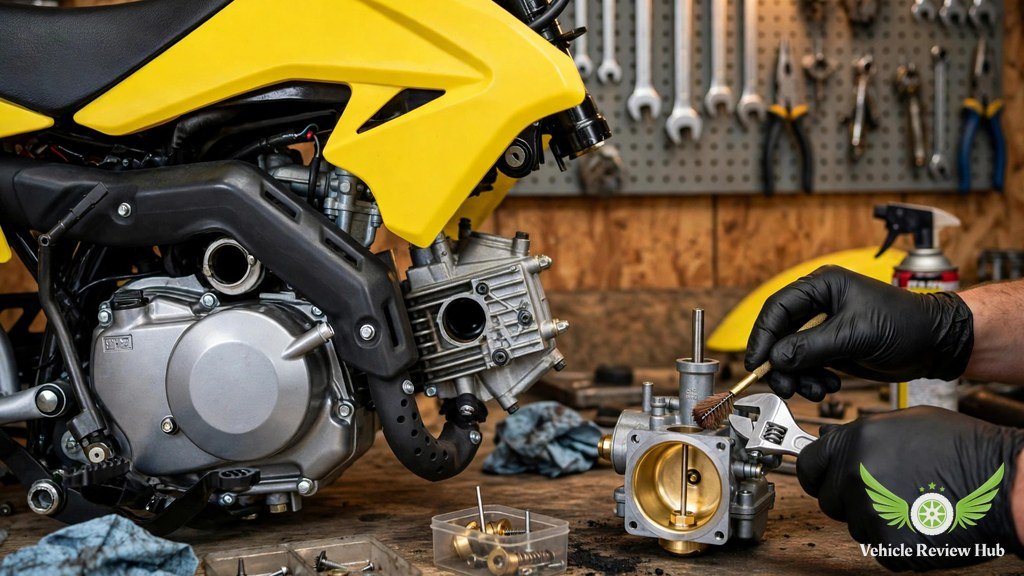
Carb Gumming After Years Parked
Carburetor gumming is the most common problem on a used DR-Z70, and it is a storage problem, not a design fault. The bike’s Mikuni VM13 carburetor has small jets, and fuel left sitting in it for months or years turns to varnish that blocks them. The result is a bike that will not start, or starts and stalls, or runs rough — and the fix is a carburetor clean or rebuild, not a new part. A buyer should always ask whether the carburetor was drained before storage. If it was not, budget for a clean. This Suzuki DR-Z70 reliability point is the one that matters most on a used buy, because a gummed carburetor is the difference between a bike that runs and a bike that does not.
Fork Grease Instead of Oil, by Design
The DR-Z70’s inverted front fork uses grease as a damping medium by design, and that surprises almost every owner who opens it. Dirt Rider’s testers found the fork “pumped out a lot of the grease used inside the fork as a damping medium” during their test, and that is normal for this fork — it is not a leak and not a fault. A parent or mechanic who opens the fork expecting oil will find grease instead, and the correct response is to leave it alone, not to “fix” it. This Suzuki DR-Z70 reliability note is here because the grease is the most misunderstood feature of the bike, and misunderstanding it costs money.
| Problem or wear item | Cause | What to do |
|---|---|---|
| Carburetor gumming | Fuel left in the carburetor during years parked | Clean or rebuild the Mikuni VM13 carburetor |
| Fork grease seepage | Grease damping by design, not a leak | Leave it alone — do not “fix” it |
| Lean running and stalling when cold | Lean factory tuning | Warm the engine up before riding |
| Won’t start | Usually the neutral-start interlock, or a flat battery | Shift to neutral first; charge or replace the battery |
| Loose spokes | Normal wear on a child’s dirt bike | Check and tighten spokes regularly |
| Ageing tyres and seals | Every example is 8 to 18 years old | Inspect tyres, fork seals and carb rubber before buying |
Notes for this Suzuki DR-Z70 reliability table: the problems are drawn from Dirt Rider’s 2008 launch test and the pattern of used DR-Z70s for sale today. None of them is a design defect — the carburetor, the spokes and the ageing rubber are storage and age items, and the fork grease, the lean cold running and the neutral-start interlock are characteristics of the bike, not faults.
Suzuki DR-Z70 Maintenance Schedule and Servicing
The DR-Z70’s maintenance schedule is short and months-based, and that is good news for a parent. The 2008 factory service manual (PN 99500-40030-03E) asks for oil changes at 1, 6 and 12 months, a valve clearance inspection at every interval, and a spark plug inspection at 6 months with replacement at 12 months. This Suzuki DR-Z70 reliability section follows the manual’s own schedule, because it is the only authoritative service source that exists for the bike.

The video below is a home oil change and valve check on a DR-Z70, not a dealer service video. This Suzuki DR-Z70 reliability guide includes it because the valve check is the part that matches the manual’s schedule section — valve clearance is inspected at every interval, and the video shows exactly that job being done.
Oil Replaced at 1, 6 and 12 Months
Engine oil is replaced at 1, 6 and 12 months under the factory manual’s schedule — a months-based pattern, not a mileage-based one, because a youth bike’s use is measured in riding sessions rather than miles. No oil capacity figure is given here: it was not found in any source searched.
Valve Clearance Inspected at Every Interval
Valve clearance is inspected at every interval — 1, 6 and 12 months — and that is the most important job in the DR-Z70’s schedule. The clearances are tight: intake 0.04–0.07 mm and exhaust 0.05–0.10 mm, measured cold. This Suzuki DR-Z70 reliability point matters because a used bike that has never had its valves checked is a bike with an unknown running condition, and the check itself is cheap insurance against a much bigger problem.
| Service item | 1 month | 6 months | 12 months |
|---|---|---|---|
| Engine oil | Replace | Replace | Replace |
| Valve clearance (cold) | Inspect | Inspect | Inspect |
| Spark plug | — | Inspect | Replace |
| Drive chain and air filter | Service each ride | Service each ride | Service each ride |
Notes for this Suzuki DR-Z70 reliability table: the schedule is from the 2008 factory service manual (PN 99500-40030-03E). No oil capacity figure is printed here, because it was not verified for the DR-Z70.
Suzuki DR-Z70 Tires, Brakes and Suspension Maintenance
The running gear on a DR-Z70 is as simple as the engine, and the maintenance is mostly inspection rather than replacement. The chain and air filter are serviced each ride, the tyres are 2.50-10 tube type at both ends, the brakes are drums front and rear, and the suspension is an inverted fork with a swingarm rear end. This Suzuki DR-Z70 reliability section covers the wear limits the manual actually gives, because a used bike is judged by its wear items more than by anything else.
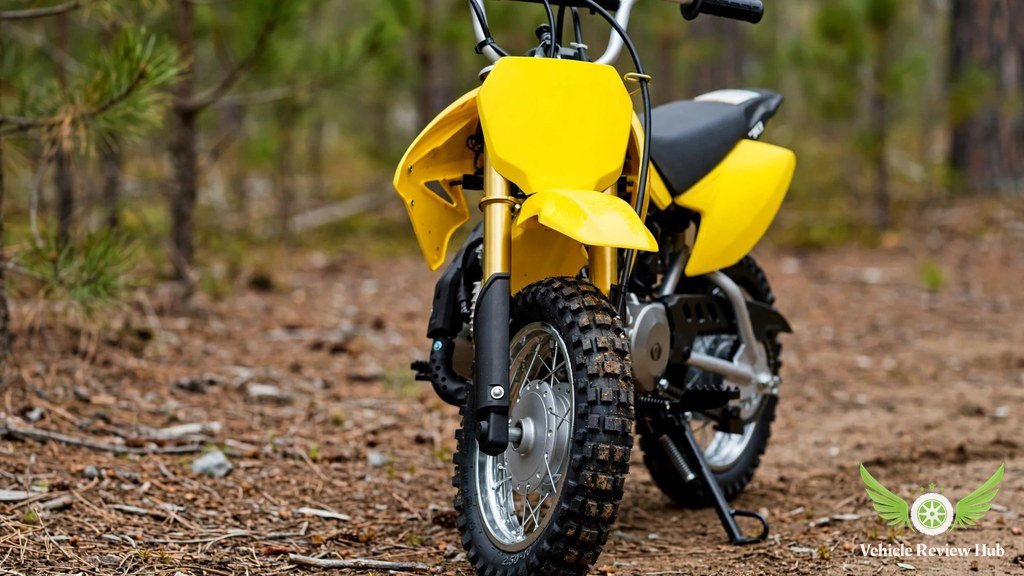
Chain and Filter Serviced Each Ride
The drive chain and the air filter are serviced each ride, and that is the most frequent job on the whole schedule. The chain is a DID 428DS with 78 links, and the slack should be 25–35 mm, with the rear axle nut tightened to 54 N·m when it is adjusted. The “filter” in this heading is the air filter.
Plug Inspected at Six, Replaced at Twelve
The spark plug is inspected at 6 months and replaced at 12 months, and it is a useful window into the engine’s health. The plug is an NGK CR7HSA or a DENSO U22FSR-U, with a gap of 0.6–0.7 mm. On a used DR-Z70, pulling the plug is one of the fastest checks a buyer can do — it takes minutes and it shows whether the engine has been running clean. This Suzuki DR-Z70 reliability check pairs naturally with the valve inspection, because both are done at the same intervals and both tell the same story about how the engine has been treated.
| Wear item | Specification |
|---|---|
| Drive chain slack | 25–35 mm (1.0–1.4 in) |
| Rear axle nut torque | 54 N·m (5.4 kgf·m, 39.0 lb·ft) |
| Tyre pressures (cold) | Front 14 psi (100 kPa); rear 18 psi (125 kPa) |
| Brake lining wear limit | 4.0 mm (0.16 in), front and rear |
| Spark plug gap | 0.6–0.7 mm (0.024–0.028 in) |
| Valve clearance (cold) | Intake 0.04–0.07 mm; exhaust 0.05–0.10 mm |
Notes for this Suzuki DR-Z70 reliability table: all wear limits are from the 2008 factory service manual (PN 99500-40030-03E). The brake lining limit of 4.0 mm applies to both the front and rear drum brakes.
Suzuki DR-Z70 Maintenance and Ownership Costs
Keeping a DR-Z70 running is cheap, and that is part of its appeal as a first bike. The service items are small and simple — oil, a spark plug, chain lube, an air filter clean — and the parts are shared with the DR-Z50, which is still in production. A carburetor clean, new tyres, a battery and fresh rubber can add up, but none of them is a surprise if the buyer inspects the bike first. This Suzuki DR-Z70 reliability section puts the numbers that are verified next to the costs that vary, so a parent can budget honestly.
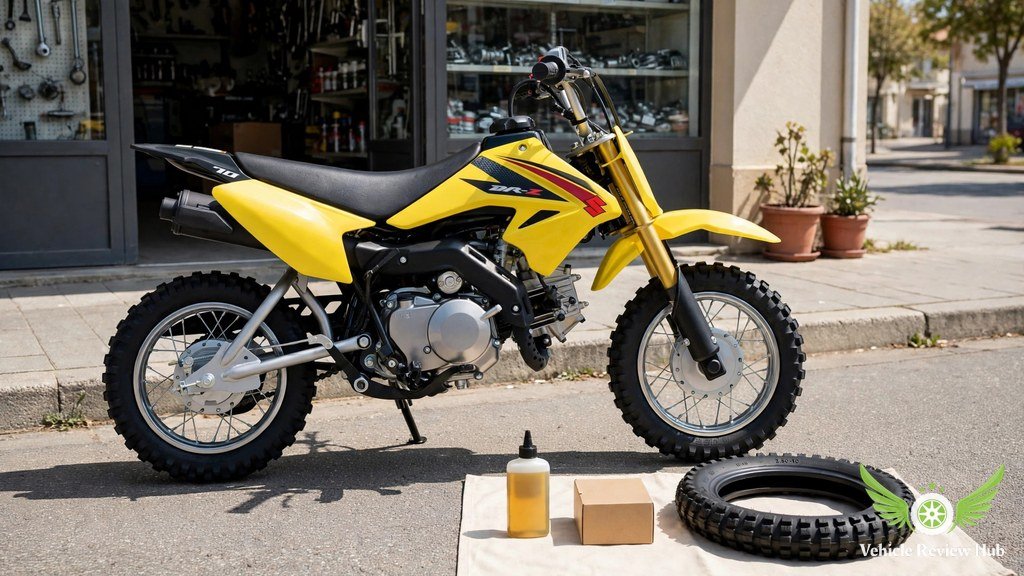
Fuel, Routine Servicing, Tires and Replacement Parts
The tank holds 0.8 US gallons, and Suzuki publishes no MPG figure while no independent test ever measured fuel use, so no fuel-cost figure is printed here. Tyres are the first real expense on a used buy, because the 2.50-10 tube tyres on an 8- to 18-year-old bike are usually aged out even if the tread looks fine. Replacement parts are not a problem: the DR-Z70 shares its bodywork, seat, tank, 10-inch wheels and drum brakes with the DR-Z50, which Suzuki still sells, and the 67cc engine parts are covered by the same dealer network as the DR-Z50. This Suzuki DR-Z70 reliability picture is a cheap bike to own, provided the buyer budgets for the age items rather than pretending they do not exist.
No Recall Names the DR-Z70 Itself
No recall has ever named the Suzuki DR-Z70, and the scope of that claim is worth stating exactly. The NHTSA recalls database returns no recalls for the DR-Z70 for model years 2008 and 2018, a web search found no CPSC recall for the bike, and Suzuki’s own recalls page has no DR-Z70 entry. The one nearby recall that sometimes gets confused with it is a different brand entirely: the 2011 Pep Boys recall of about 4,300 Baja DR50 and DR70 bikes for a fuel-tank fire hazard was Baja Motorsports, not Suzuki, and it has nothing to do with this bike. This Suzuki DR-Z70 reliability record is clean as far as the public sources show, and that is a genuine comfort on a used buy.
| Ownership cost item | What is verified |
|---|---|
| Price when new (final year) | $1,849 MSRP + $152 destination = $2,001 delivered, 2018 |
| Used listings today | Roughly $1,102–$1,799 (listings, date-tagged, not values) |
| Successor when new (2026) | DR-Z50 $2,599 + $300 = $2,899 delivered |
| Fuel | 0.8-gal tank; no MPG figure published or tested |
| Routine servicing | Oil, plug, chain and air filter — home-mechanic jobs |
| Age items to budget for | Tyres, fork seals, carb rubber, battery, carburetor clean |
| Recalls | None — NHTSA Count:0 for MY2008 and MY2018 |
Notes for this Suzuki DR-Z70 reliability table: prices are year-tagged. The 2018 delivered total of $2,001 is the price when new, not a current price. Used listings are from CycleTrader and other listings — a 2015 example at $1,102 in Roswell, Georgia, two 2015 examples at $1,550 and $1,799 in Plano, Texas, and a 2017 example at $1,199 in Macon, Georgia in September 2024.
How to Keep a Suzuki DR-Z70 Reliable
Keeping a DR-Z70 reliable is mostly a matter of doing the small jobs on time and storing the bike properly. The manual’s schedule is short, the parts are simple, and the bike forgives a lot — but it does not forgive years parked with fuel in the carburetor and a dead battery. This Suzuki DR-Z70 reliability section is the practical summary: the habits that keep the bike running, and the age items that need watching on every example now that the youngest DR-Z70 is eight years old.

Preventive Maintenance, Records and Regular Inspections
Preventive maintenance on a DR-Z70 means three habits: follow the manual’s months-based schedule, keep a record of what was done, and inspect the bike before each riding season. The schedule itself is light — oil at 1, 6 and 12 months, valve clearance inspected at every interval, plug inspected at 6 and replaced at 12, chain and air filter serviced each ride. The pre-season inspection is the third habit: check the chain slack, the tyre pressures, the brake lining, the spokes, the plug and the battery before the child rides. This Suzuki DR-Z70 reliability routine takes an afternoon a year and a few minutes before each ride, and it is the difference between a bike that always starts and a bike that always needs something.
Ageing Tires and Seals on Old Examples
Every DR-Z70 is now 8 to 18 years old, and age is the one thing no service schedule can fix. Tyres harden and crack with age even when the tread looks deep, and the 2.50-10 tube tyres on a used example should be inspected for sidewall cracking and replaced if they are original. Fork seals dry out, carburetor rubber perishes, and the battery that powers the electric start loses its ability to hold a charge — the kick starter is the backup, and it works, but a dead battery still needs replacing. This Suzuki DR-Z70 reliability warning is simple: budget for the age items when buying, inspect them before the first ride, and the bike itself will reward the care with years of trouble-free use.
Suzuki DR-Z70 Reliability: Frequently Asked Questions
Direct answers to the questions parents ask most about Suzuki DR-Z70 reliability.
Is the Suzuki DR-Z70 reliable?
Yes. The only professional test ever run on the bike reported that “nothing broke or fell off”. This Suzuki DR-Z70 reliability verdict comes with one condition: a used bike’s reliability depends on how it was stored and cared for, because every example is now 8 to 18 years old.
What is the most common problem with the Suzuki DR-Z70?
Carburetor gumming after years parked. This Suzuki DR-Z70 reliability problem is a storage issue, not a design fault, and the fix is a carburetor clean or rebuild.
How often should I change the oil on a Suzuki DR-Z70?
At 1, 6 and 12 months, under the factory service manual (PN 99500-40030-03E). This Suzuki DR-Z70 reliability schedule also asks for a valve clearance inspection at every interval.
What size tyres does the Suzuki DR-Z70 use?
The DR-Z70 uses 2.50-10 33J tube-type tyres front and rear, at 14 psi front and 18 psi rear when cold. This Suzuki DR-Z70 reliability check is worth doing before every ride, because the tyres on an 8- to 18-year-old bike are often aged out even when the tread looks fine.
What is the valve clearance on a Suzuki DR-Z70?
Intake 0.04–0.07 mm and exhaust 0.05–0.10 mm, measured cold, from the 2008 factory service manual (PN 99500-40030-03E). The clearance is inspected at 1, 6 and 12 months. This Suzuki DR-Z70 reliability job is the most important one in the schedule, because a valve that has closed up makes the bike hard to start.
Why does my Suzuki DR-Z70 stall when cold?
The engine runs very lean from cold. Dirt Rider found it “very lean and will stall pretty easily until the motor has some temperature”. It is a tuning choice, not a carb fault — let the bike warm up for a minute or two before riding. This Suzuki DR-Z70 reliability quirk is easy to live with once it is known.
Why won’t my Suzuki DR-Z70 start?
Check neutral first. The bike has to be in neutral to start, and that interlock is the usual cause of a “won’t start” complaint. Then check the battery, because a flat battery after winter storage is the next most common cause — and remember the kick starter is there as a backup. This Suzuki DR-Z70 reliability check takes a minute and solves most no-start complaints.
Is the fork supposed to have grease instead of oil?
Yes. The inverted front fork uses grease as a damping medium by design. Dirt Rider’s testers found it “pumped out a lot of the grease used inside the fork as a damping medium”, and that is normal for this fork — not a leak and not a fault. This Suzuki DR-Z70 reliability point is the most misunderstood feature of the bike, so do not pay anyone to “fix” it.
Does the Suzuki DR-Z70 have any recalls?
No recall names the DR-Z70. The NHTSA recalls database returns no recalls for model years 2008 and 2018, a web search found no CPSC recall, and Suzuki’s recalls page has no DR-Z70 entry. This Suzuki DR-Z70 reliability record is clean as far as the public sources show — and the 2011 Baja DR50 and DR70 recall was a different brand, Baja Motorsports, not Suzuki.
How much does it cost to maintain a Suzuki DR-Z70?
Very little for routine servicing: oil changes, a spark plug once a year, chain lube and air filter cleans are all home-mechanic jobs, and the parts are shared with the DR-Z50. This Suzuki DR-Z70 reliability cost picture changes on a used buy, where the catch-up work — a carburetor clean, new tyres, a battery and fresh rubber — is the real expense, so budget for the age items.
What should I check before buying a used Suzuki DR-Z70?
Check the carburetor, the tyres and the spokes first, as the DR-Z70 review explains. Then check the chain slack, the tyre pressures, the brake lining, the spark plug and the battery, and ask for service records. This Suzuki DR-Z70 reliability check takes an afternoon and tells a buyer more than the model year does.
How long will a Suzuki DR-Z70 last?
There is no published lifespan figure, and no owner survey measured one — so this Suzuki DR-Z70 reliability guide prints none.