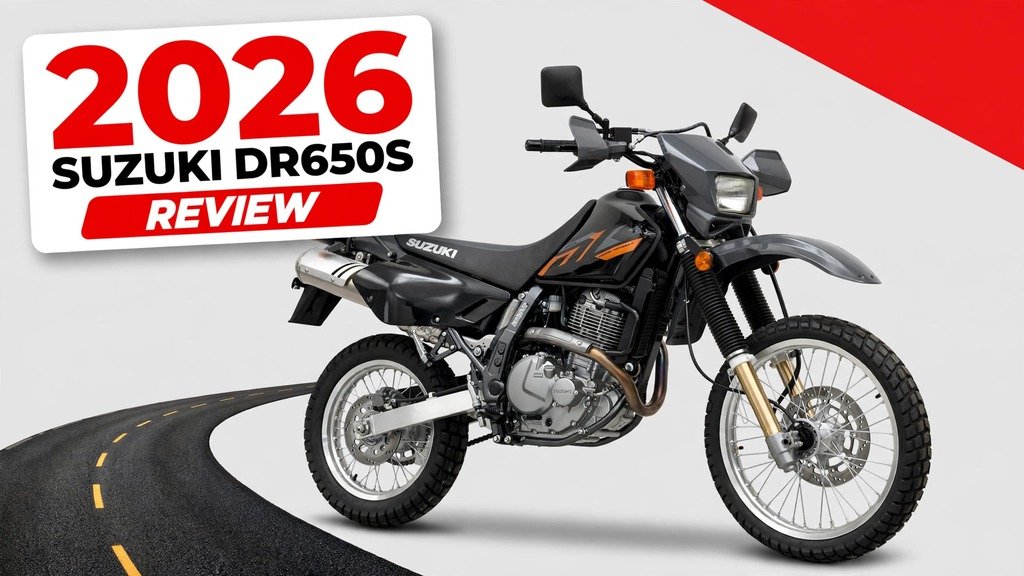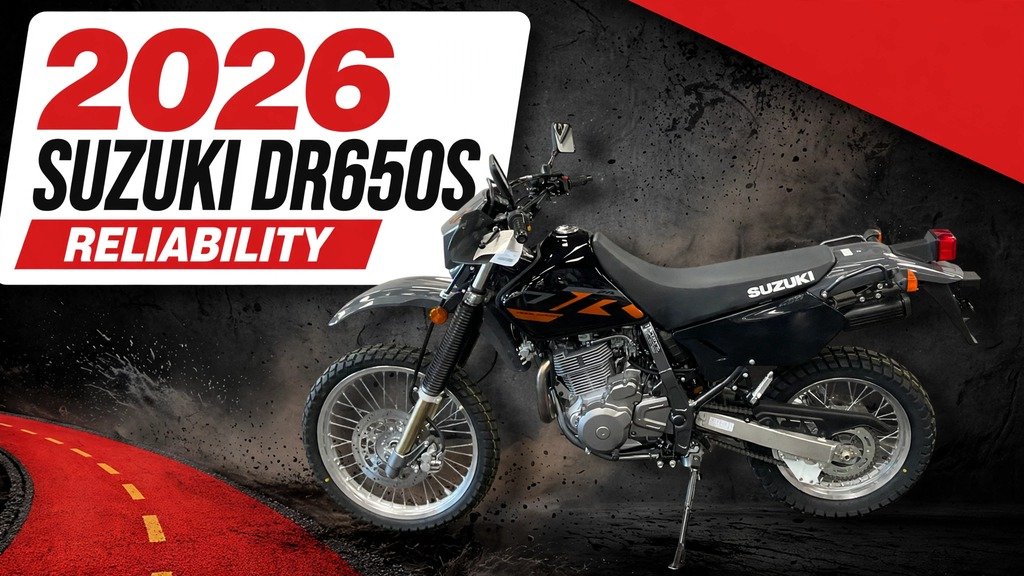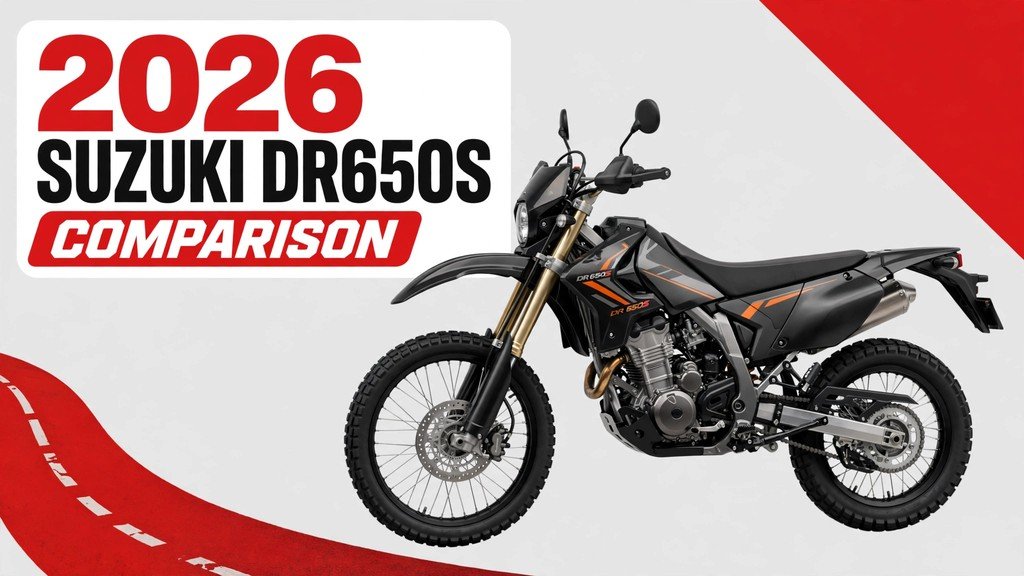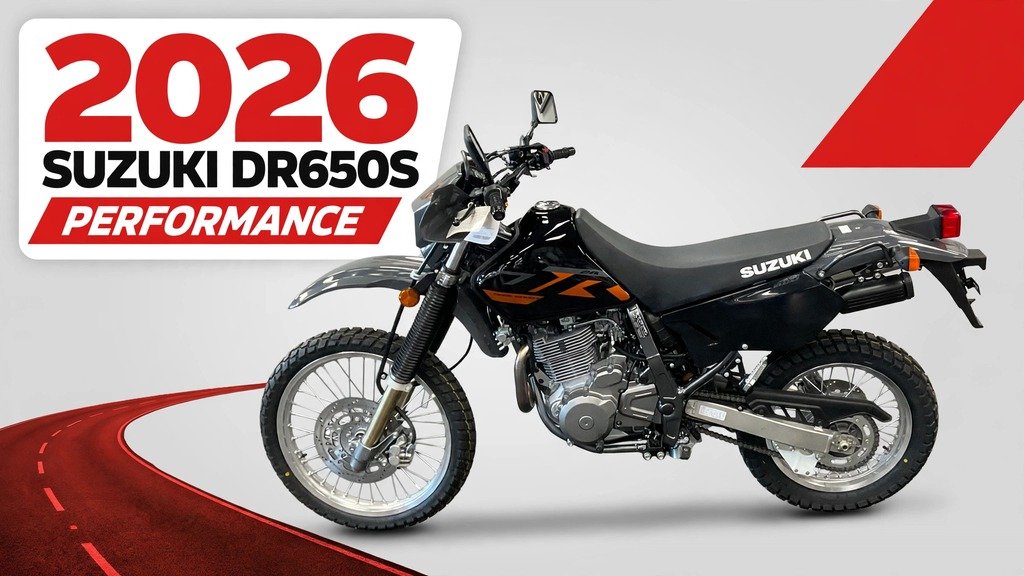
The short answer first: the 2026 Suzuki DR650S makes 35.1 horsepower at the rear wheel, measured by Dirt Rider on a dynamometer — the only measured power figure. It has no official top speed and no official MPG figure, because Suzuki publishes neither and no magazine has instrumented either. Owners report 45 to 55 mpg, and the database top-speed band runs 96 to 100 mph, but both are unattributed numbers, not test results. This Suzuki DR650S performance guide separates the one measured figure from everything else, so you know exactly what is tested and what is not.
Suzuki DR650S Engine Performance and Power Delivery
The DR650S engine is a 644cc air/oil-cooled single with a Mikuni BST40 carburettor, and its performance character is torque first, horsepower second. It makes its modest power low in the rev range and holds it in a flat, friendly curve. This Suzuki DR650S performance guide starts with the dyno, because it is the only place a number carries a test name behind it.

Dirt Rider Dyno: 35.1 HP and 32.2 lb-ft, 2022
Dirt Rider put a 2022 DR650S on its in-house Dynojet 250i rear-wheel dynamometer and documented 35.1 hp at 6,200 rpm and 32.2 lb-ft of torque at 4,500 rpm — the only measured power figure for the DR650S from a named outlet, and the figure this guide uses everywhere power is discussed. The Dirt Rider 2022 dyno test is the source; the same article confirms the test bike cost $6,849 at the time, the 2022 price.
Suzuki itself publishes no horsepower and no torque figure for the DR650S. Its 2026 specification table jumps from compression ratio to fuel system with no output figures at all. Everything else in circulation is a claimed or estimated database number, and the claims do not agree: webbikeworld prints around 43 hp and 47 lb-ft; moto-data prints 43.5 hp at 6,400 rpm and 54 Nm at 4,600 rpm; MotorcycleDB prints 42 hp and 54 Nm, labelled as an editorial estimate; motoryk prints 46 hp at 6,400 rpm and 54 Nm at 5,200 rpm. Note the torque split: 47 lb-ft and 54 Nm (39.8 lb-ft) are different claims, not a unit conversion, and the claimed figures disagree on rpm points, so they cannot be merged. The measured pair — 35.1 hp and 32.2 lb-ft — is the only one attached to a test, a machine and a date.
The dyno curve matters more than the peak: the DR650S makes its torque at 4,500 rpm, well below its 6,200 rpm power peak, which is why the bike feels strong from low revs and never needs to be wound out.
The video below is Cross Training Adventure’s free carb mods for the DR650 — the jetting work owners do to fix the lean stock tune. This is a modifications video, not a dyno run and not a top-speed test; no dedicated dyno or top-speed video exists for the DR650S.
| Bike | Rear-wheel dyno | Source |
|---|---|---|
| Suzuki DR650S | 35.1 hp @ 6,200 rpm / 32.2 lb-ft @ 4,500 rpm | Dirt Rider 2022, measured |
| Honda XR650L | 34.1 hp @ 6,100 rpm / 31.4 lb-ft @ 5,300 rpm | Dirt Rider 2023, measured |
| Kawasaki KLR650 | 34.6 hp / 33.5 lb-ft | Derived from Dirt Rider comparison line |
| KTM 690 Enduro R | 79 hp claimed | KTM claim; no US dyno cited |
Measured Wet Weight 369 Pounds, Seat 35.0 Inches
Dirt Rider weighed the same 2022 test bike on its own scales and measured 369 pounds wet, with the seat height measured at 35.0 inches. Suzuki claims 366 lb curb weight and a 34.8-inch seat, so the measured figures run 3 lb heavier and 0.2 inches taller than the brochure. This Suzuki DR650S performance guide prints both pairs side by side — claimed and measured — because the measured pair is what a rider actually sits on.
Two other wet weights circulate, and neither is a measurement: motorcyclespecifications.com prints 162 kg (357 lb) for 1999–2019 bikes — its own database figure — and a junk aggregator prints 158 kg (348 lb), which contradicts Suzuki’s own 166 kg. The figures that count are Suzuki’s 366 lb claimed and Dirt Rider’s 369 lb measured.
At 366 lb claimed the DR650S sits between the 456 lb KLR650 and the 346 lb XR650L, and the weight sits low enough that the bike feels lighter than the number at walking pace.
Suzuki DR650S Top Speed and Acceleration
Here is where honesty matters most: there is no tested top speed and no published 0–60 time for the DR650S. No magazine has GPS-tested the current bike’s top speed, and no named outlet has ever published an acceleration time. What exists is a band of database figures, and this section presents them as exactly that.

Top-Speed Figures Are Unattributed Database Numbers
The database band runs 96 to 100 mph: moto-data prints 160.6 km/h (99.8 mph) for 2017–18 bikes, motorcyclespecifications prints the same figure for 1997–98 bikes, and motoryk prints 155 km/h (96.3 mph). None carries a test name, a rider, a date or a GPS reading.
The only named-outlet colour in this Suzuki DR650S performance guide comes from riding impressions, not tests: Ultimate Motorcycling’s buyer’s guide says the DR650S can “cruise at 80 mph all day long and hit 100 mph when necessary”, and SlashGear writes of “an even 100 miles per hour”. Owner reports cluster around 90 to 100 mph. None of these is an instrumented result. The Ultimate Motorcycling buyer’s guide is the source for the 80 mph cruising line.
Two figures must never appear as top speeds for this bike: the “120 mph” claim from an AI-generated aggregator page, and the 101 mph recorded by the 1990 Motosprint group test for the 1990–1995 generation bike — a 640cc machine with different bore, stroke and compression. That 101 mph belongs to the old generation, not to the bike on sale today.
No Named Outlet Has Published a 0-60 Time
No named outlet has published a 0–60 mph time for the DR650S. That sentence is the whole finding, and it matters because aggregator pages do print acceleration times — and they are junk. One well-known aggregator prints “5.83 seconds” for the Honda XR650L, a figure with no test behind it; the same class of site prints invented times for the DR650S. This guide prints none of them.
The only timed figure in circulation is a database entry: motorcyclespecifications’ 1997–98 entry lists a standing quarter-mile of 14.1 seconds at 88.5 mph, with no test name attached — a database number, never a period test and never the 2026 bike’s tested time. The comparable gen-1 figure, the 1990 Motosprint group test at 13.9 seconds at 89.0 mph, belongs to the old 640cc generation.
What acceleration feels like is better described without a stopwatch: the torque peak at 4,500 rpm means the bike pulls hard from low revs, first gear is low enough for trail work, and fifth is tall enough for the highway.
Suzuki DR650S Mileage and Fuel Economy
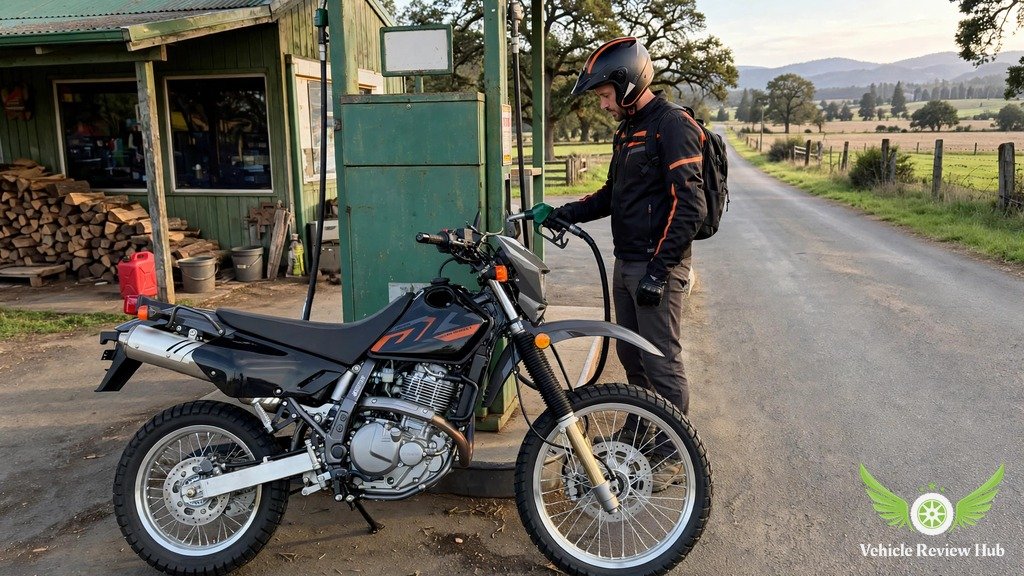
Fuel economy is the second gap in the DR650S’s official record, after top speed: Suzuki publishes no MPG figure, no EPA rating exists, and no magazine has run a test-loop measurement. What exists is an owner-reported band, printed here with the label attached every time — owner-reported, never tested.
No Official MPG Figure Exists
Suzuki’s own 2026 specification table lists no fuel-economy figure anywhere on the page. There is no EPA rating for the DR650S, and no magazine test-loop MPG was found in research for this guide. The Suzuki 2026 DR650S page is the source for the specification gap — the page lists the tank, the carburettor and the weight, and nothing about consumption.
Consumption depends heavily on how the bike is ridden — a gentle highway cruise and a hard trail day can be 10 mpg apart — so no single official number could honestly cover both.
Owners Report 45 to 55 MPG, Labelled as Such
The typical owner-reported band is 45 to 55 mpg in US gallons, with an observed spread of 44 to 58 mpg: one round-the-world owner averaged 50 mpg, and a long-term owner averaged 59 mpg over 15 years of mostly gentle highway-heavy riding. The moto-data database average is 47.3 US mpg. The Motocross Hideout DR650 review covers the same owner experience from the riding side.
Range follows from the band, only as a derived estimate: on the standard 3.4-gallon tank, 45 mpg gives about 153 miles, 50 mpg about 170 miles, and 55 mpg about 187 miles — all before reserve, all derived, none tested. The California model’s 3.2-gallon tank runs roughly 10 miles shorter.
| Owner-reported MPG (US gal) | Derived range, 3.4-gal tank |
|---|---|
| 45 mpg | About 153 miles |
| 50 mpg | About 170 miles |
| 55 mpg | About 187 miles |
The small tank is the DR650S’s biggest touring weakness: a 4.9-gallon aftermarket tank at the same 50 mpg gives about 245 miles, nearly 75 miles more than stock. The Suzuki DR650S reliability guide covers the service side of the same ownership picture.
Suzuki DR650S Real-World Riding Experience
Numbers only go so far with this bike. The DR650S is best understood on the road and the trail, where its soft suspension, tall gearing and torque-led engine add up to something the dyno sheet does not capture — what the numbers feel like, not just what they are.

Torque-Led Manners On Road and Trail
On the road, the DR650S is a relaxed cruiser: the torque peak at 4,500 rpm means the bike pulls cleanly from low revs in any gear, and the five-speed gearbox gives it a tall top gear for the highway. Ultimate Motorcycling’s buyer’s guide puts it well: “rev it up, and you can cruise at 80 mph all day long and hit 100 mph when necessary.” The balancer shaft keeps vibration acceptable at highway speed.
On the trail, the same torque-led character works differently: first gear is low enough for slow technical work, the engine’s low-end pull means the rider rarely needs the clutch, and the soft suspension soaks up rocks and ruts. The 10.4 inches of ground clearance keeps the engine cases out of trouble, and the 21-inch front wheel rolls over obstacles that would stop a smaller wheel.
Five Gears, a Carb and a Soft Seat on the Highway
The five-speed gearbox is the DR650S’s most old-fashioned performance feature, and it works because the engine’s torque band is so wide: first gear handles trail work, fifth handles the highway, and the three gears between them cover everything else without constant shifting. There is no sixth gear and no quickshifter, and the bike does not miss them.
The carburettor shapes the highway experience in two ways: cold starts need the manual choke routine, and altitude makes the bike run richer than a fuel-injected bike would, because the fixed jetting cannot adjust for thin air. A rider crossing a mountain pass will feel the bike soften as the air thins. The Suzuki DR650S review covers the same carburettor character from the ownership side.
The soft seat is the universal complaint, and it limits how long the bike’s highway comfort lasts: owners report the stock seat wearing on them after an hour or so, and the aftermarket seat is one of the most common first modifications, alongside the tank and the carburettor jetting.
Suzuki DR650S Handling, Braking and Stability
Handling on the DR650S is defined by two numbers — 366 lb claimed and 10.4 inches of ground clearance — and one absence: no ABS. The bike is heavy for a dual-sport and light for a street bike, tall enough to see over traffic and narrow enough to manage at walking pace.

290mm Front and 240mm Rear Discs, No ABS
The brakes are a single floating 290 mm front disc with a two-piston caliper and a single 240 mm rear disc with a two-piston caliper, both Nissin. They stop the bike competently and nothing more — adequate for the bike’s weight and speed.
There is no ABS on any year of the DR650S, and there never has been. On the trail that is a genuine advantage — locked wheels are a tool off-road — but on wet pavement the rider is the anti-lock system, and a panicked grab of the front brake will lock the wheel. The KLR650 offers ABS as an option and the KTM 690 Enduro R carries switchable ABS, so the DR650S asks its rider to learn braking properly instead.
Tire, Brake and Suspension Checks That Matter
The tyres are tube-type Bridgestone Trail Wings — 90/90-21 front and 120/90-17 rear — and the pressures matter more than the brand. Suzuki’s manual specifies 22 psi front and 25 psi rear solo, rising to 25 psi front and 29 psi rear two-up. The maintenanceschedule.com service chart, transcribed from the owner’s manual, sets out the full schedule behind these checks.
The suspension is a 43 mm KYB conventional fork with gold anodized lower legs and 260 mm of travel, matched to a link-type rear shock with a piggyback reservoir and the same 260 mm of travel — soft by design, set up for comfort and trail compliance. The fork seals are the wear item to watch, since a leaking seal coats the front brake disc in oil. Brake fluid is replaced every two years, the chain is cleaned and lubricated every 600 miles with 30–45 mm of slack, and the air filter is cleaned or replaced every 3,000 km between services.
Suzuki DR650S Performance Compared With Other Big Singles
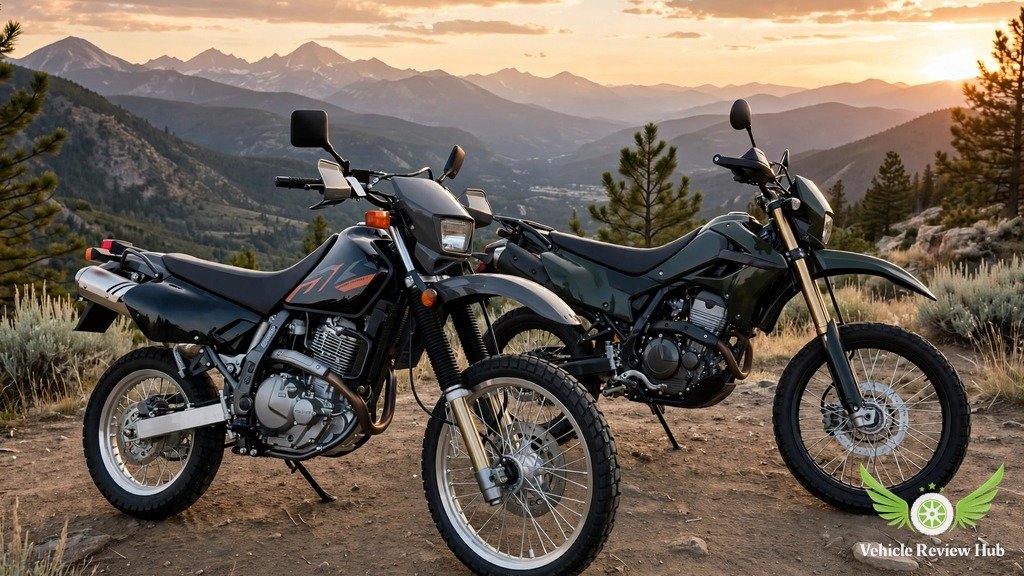
The DR650S does not win its class on paper: against its Japanese rivals the dyno numbers are nearly identical — 35.1, 34.6 and 34.1 horsepower — and the differences that matter are weight, tank size, seat height and equipment. The DR-Z400SM performance guide applies the same yardstick to the supermoto sibling.
| Bike | Published total | Rear-wheel dyno | Tank | Seat | Curb weight |
|---|---|---|---|---|---|
| Suzuki DR650S | $7,899 | 35.1 hp / 32.2 lb-ft | 3.4 gal | 34.8 in | 366 lb |
| Kawasaki KLR650 | $7,684 | 34.6 hp / 33.5 lb-ft (derived) | 6.1 gal | 34.3 in | 456 lb |
| Honda XR650L | $7,599 | 34.1 hp / 31.4 lb-ft | 2.8 gal | 37.0 in | 346 lb |
Suzuki DR650S vs Kawasaki KLR650
The KLR650 is the DR650S’s closest rival on price and its biggest contrast on character: it costs $6,999 plus $685 destination — $7,684 in total, $215 less than the DR650S — and for that money it gives a 652cc liquid-cooled fuel-injected single, a 6.1-gallon tank, a digital dash with a fuel gauge, and optional ABS. Its derived dyno figure of 34.6 hp and 33.5 lb-ft sits within half a horsepower of the DR650S.
What separates them is weight and simplicity: the KLR weighs 456 lb — 90 lb more than the DR650S — and that weight shows everywhere the road ends. The DR650S is the simpler bike to own and the easier bike to ride off-road, while the KLR is the better tourer, with nearly double the fuel range. The Suzuki DR650S comparison puts the two bikes side by side on price, weight and equipment in full.
The Honda XR650L is the DR650S’s closest mechanical twin: both are 644cc air-cooled singles with the same 100.0 × 82.0 mm bore and stroke, and Dirt Rider measured them 1.0 hp and 0.8 lb-ft apart — 35.1 and 32.2 for the Suzuki, 34.1 and 31.4 for the Honda. The Dirt Rider 2023 XR650L dyno test is the source for the Honda’s figures.
Is the Suzuki DR650S Suitable for Beginner Riders?
Yes, with caveats — and the caveats are about size, not power. The engine is forgiving, the clutch is light, the torque arrives early, and the bike is easy to handle at low speed. The five-speed gearbox is easy to learn, and the bike’s narrow shape makes the tall seat easier to manage than the number suggests.
The caveats are the 34.8-inch seat (35.0 inches measured) and the 366 lb weight, which are a lot for a shorter or lighter new rider — though Suzuki’s factory lowering kit drops the seat to 33.2 inches. The other caveat is the absence of ABS: a beginner locking the front wheel on wet pavement has no electronic safety net. A beginner who fits the bike, with or without the lowering kit, will find it friendly; one who cannot reach the ground comfortably should look at the smaller dual-sports first — the DR-Z400S performance guide covers the lighter liquid-cooled sibling, and the DR-Z125L performance guide covers the smallest bike in the family.
Suzuki DR650S Performance: Frequently Asked Questions
Direct answers to the questions riders ask about the DR650S engine, top speed, fuel economy and handling.
How much horsepower does the DR650S make?
The only measured figure is Dirt Rider’s 2022 dyno test: 35.1 hp at 6,200 rpm at the rear wheel. Suzuki publishes no horsepower figure. Claimed database figures run from about 42 to 46 hp, but none is a measurement — and this Suzuki DR650S performance guide uses the measured figure everywhere.
What is the top speed of the DR650S?
There is no tested top speed for the DR650S. The database band runs 96 to 100 mph, with 99.8 mph the most widely repeated figure — but no named outlet has GPS-tested the current bike, so this Suzuki DR650S performance guide presents the band as database figures, not as a tested result.
What is the 0-60 time of the DR650S?
No named outlet has published a 0–60 mph time for the DR650S, so this Suzuki DR650S performance guide prints none. The only timed figure in circulation is a database entry: a standing quarter-mile of 14.1 seconds at 88.5 mph for a 1997–98 bike, with no test name attached.
What MPG does the DR650S get?
There is no official MPG figure for the DR650S — Suzuki publishes none and no EPA rating exists. Owners report 45 to 55 mpg in US gallons, with an observed spread of 44 to 58 mpg, labelled as owner-reported.
How far can the DR650S go on a tank?
On the standard 3.4-gallon tank, the owner-reported 45 to 55 mpg band gives a derived range of about 153 to 187 miles before reserve — derived estimates, never tested. The California model’s 3.2-gallon tank runs roughly 10 miles shorter.
How much does the DR650S weigh?
Suzuki claims 366 lb curb weight, and Dirt Rider measured 369 lb wet on its own scales. The 3 lb gap is the difference between a brochure claim and a scale reading, and this Suzuki DR650S performance guide prints both.
How tall is the DR650S seat?
Suzuki claims 34.8 inches, and Dirt Rider measured 35.0 inches — the figure this Suzuki DR650S performance guide uses. The factory lowering kit drops the seat by 1.6 inches to 33.2 inches, and the kit includes a shorter side stand.
Is the DR650S fast?
Not by modern standards. With 35.1 measured horsepower moving 369 measured pounds, the DR650S is a relaxed, torque-led bike that cruises at 80 mph all day and reaches 100 mph when necessary.
Does the DR650S have ABS?
No. The DR650S has never had ABS on any year. The brakes are a 290 mm front disc and a 240 mm rear disc, both with two-piston calipers, and the rider is the anti-lock system.
Is the DR650S good for beginners?
Yes, with caveats. The engine is forgiving and the clutch is light, but the 34.8-inch seat and 366 lb weight are a lot for a shorter or lighter new rider. The factory lowering kit to 33.2 inches changes the answer for many beginners, and the absence of ABS means the rider must learn braking properly from the start.
Which is quicker, the DR650S or the KLR650?
On the dyno they are effectively identical: the DR650S measured 35.1 hp and 32.2 lb-ft, and the KLR650’s derived figure is 34.6 hp and 33.5 lb-ft. In the real world the DR650S feels quicker because it is 90 lb lighter — the same power moving much less weight, which is the heart of this Suzuki DR650S performance guide’s comparison.
Does the DR650S need carb mods for more power?
It does not need them, but owners commonly do them: the stock BST40 carburettor runs lean from the factory, and free jetting mods — shown in the video in this Suzuki DR650S performance guide — wake the bike up without an expensive pumper carburettor. The measured power figure stays Dirt Rider’s 35.1 hp until someone dynos a modified bike.